Commercial Heat Pumps for the Global Market: Buying Guide
Quick Answer

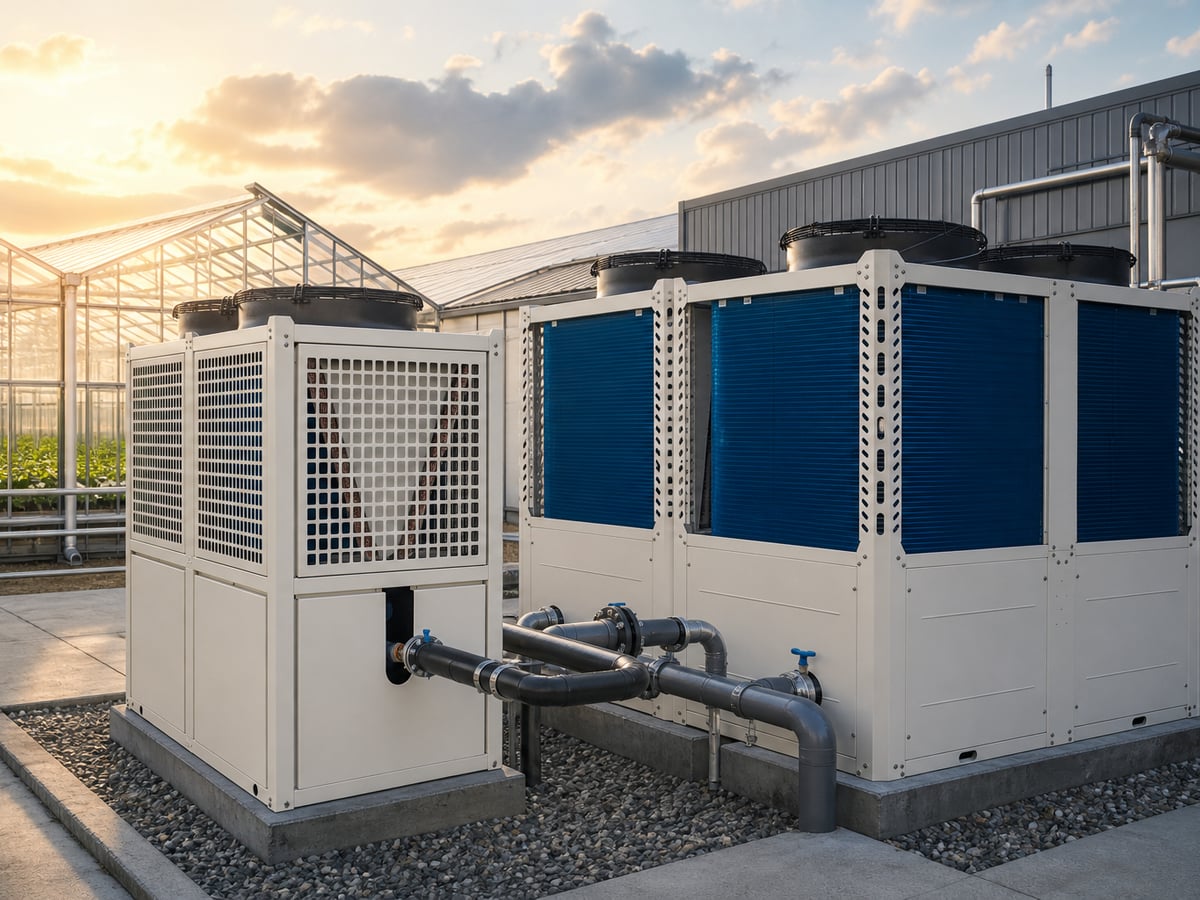
A commercial heat pump is an electrically driven HVAC system designed to supply heating, cooling, domestic hot water, process water, or dehumidification for large buildings and commercial operations. Instead of generating heat through combustion, it transfers heat from outdoor air, water, ground sources, or recovered process heat. This enables significantly lower energy consumption than many conventional electric-resistance or fossil-fuel heating systems.
For the Global Market, commercial air source heat pumps are commonly selected because they are modular, scalable, comparatively fast to install, and suitable for locations ranging from mild coastal climates to cold inland regions. A correctly engineered system can support hotels, hospitals, agricultural facilities, commercial greenhouses, mushroom farms, food-processing plants, warehouses, schools, offices, swimming pools, and multi-unit residential buildings.
The most important purchasing factors are not only nominal heating capacity. Buyers should assess local winter design temperature, required supply-water temperature, part-load efficiency, heating load profile, hydraulic configuration, electrical infrastructure, defrost behavior, refrigerant compliance, noise limits, maintenance access, and after-sales support. For agricultural and controlled-environment projects, humidity, fresh-air load, crop requirements, and operating continuity also need to be considered.
In practical terms, a commercial heat pump should be selected as a complete system rather than as a standalone machine. The unit, buffer tank, circulation pumps, water treatment, controls, pipe sizing, terminal equipment, backup heating strategy, and commissioning plan must work together. Learn more about available air source heat pump solutions for commercial and agricultural climate-control applications.
What Is a Commercial Heat Pump and Where Is It Used?
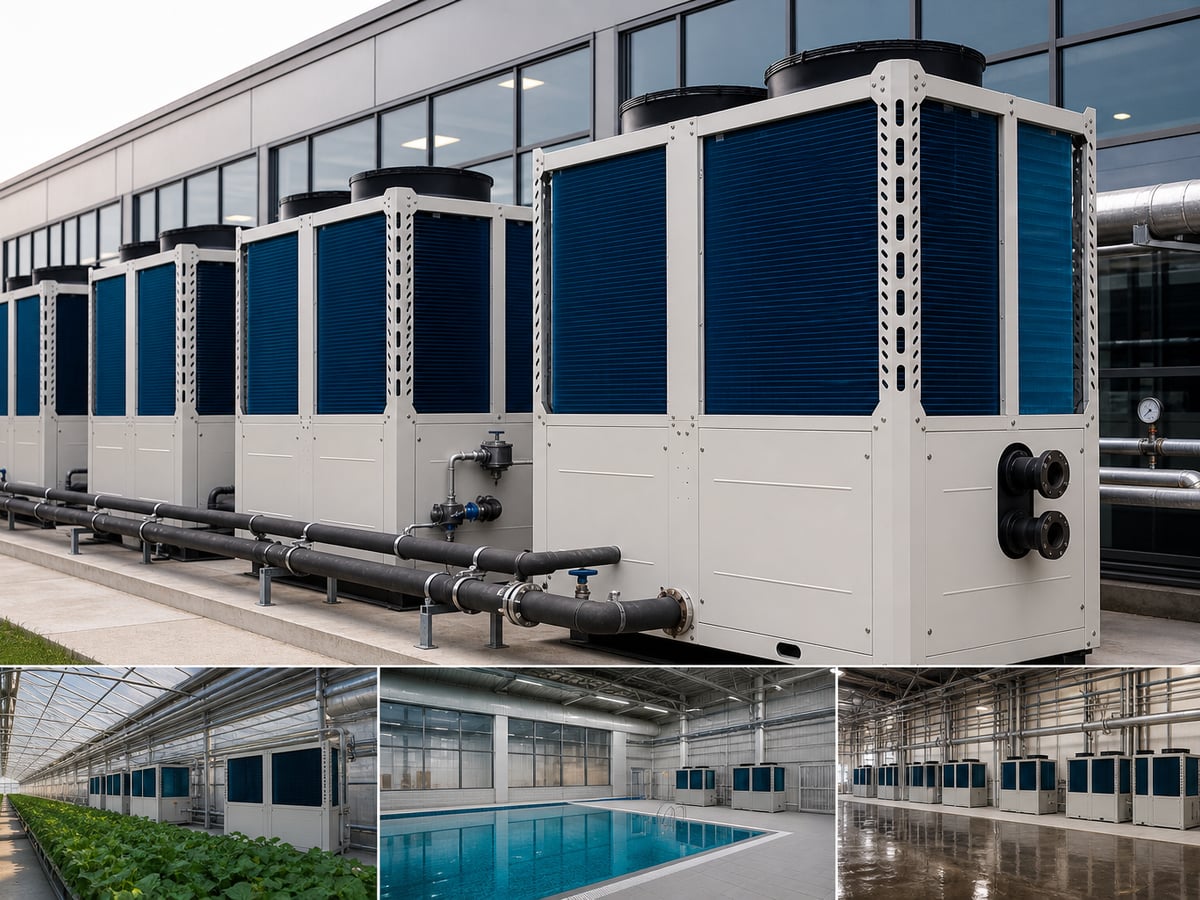
A commercial heat pump uses a refrigeration cycle to move thermal energy from one location to another. During heating operation, the evaporator absorbs low-grade heat from the air or another source. The compressor raises refrigerant pressure and temperature, and the condenser transfers useful heat into a water circuit or air distribution system. In cooling mode, the cycle reverses or operates through a dedicated cooling circuit to remove heat from the building or process.
Commercial models are generally larger, more durable, and more controllable than domestic heat pumps. They may include multiple compressors, inverter-driven fans, plate heat exchangers, electronic expansion valves, integrated circulation pumps, remote monitoring, cascade controls, and advanced fault protection. They are intended to operate for long hours under variable demand and often support multiple temperature zones.
Demand is growing across the Global Market as energy regulations tighten and businesses seek lower carbon operating models. In Europe, electrification targets and carbon-reduction policies are accelerating heat-pump adoption. In North America, commercial retrofits often replace aging boilers and packaged rooftop equipment. In the Middle East, heat pumps can provide efficient cooling and hot water. Across Southeast Asia, Africa, Latin America, and Oceania, they are used for hotels, farms, processing facilities, and distributed commercial developments.
Common applications include:
- Space heating and cooling for offices, schools, shopping centers, hospitals, and hotels.
- Domestic hot water for accommodation, kitchens, laundries, gyms, and healthcare facilities.
- Hydronic fan coils, underfloor heating, radiators, air handling units, and chilled-water systems.
- Commercial agriculture, including mushroom cultivation rooms, hydroponic farms, greenhouses, hatcheries, and livestock buildings.
- Industrial and food-processing applications requiring moderate-temperature hot water or process cooling.
- Swimming-pool heating, spa facilities, sports centers, and recreation venues.
Project location affects equipment selection. A hotel near Rotterdam or Hamburg may prioritize high seasonal efficiency and low noise. A facility in Toronto, Warsaw, or Ulaanbaatar may require low-ambient heating performance and reliable defrosting. A greenhouse near Dubai, São Paulo, Nairobi, or Sydney may prioritize cooling, dehumidification, and stable water temperatures. Ports and trade hubs such as Singapore, Los Angeles, Jebel Ali, Rotterdam, and Durban also benefit from equipment packages that are easy to ship, commission, and service internationally.
Available Unit Types and Commercial Applications
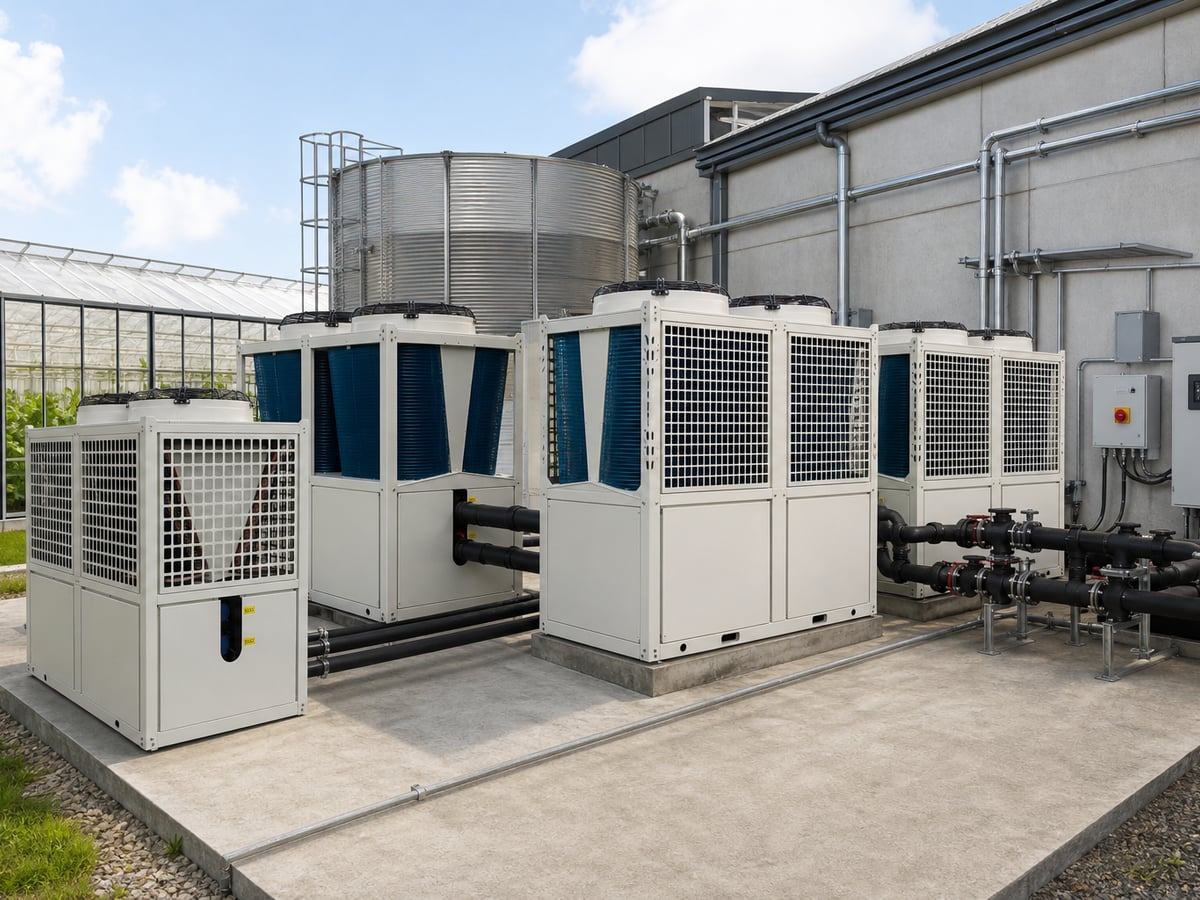
Commercial heat pumps are available in several configurations. The right type depends on the available heat source, building load, water temperatures, installation space, climate, and budget. Air-to-water systems are among the most widely used because no boreholes, cooling towers, or groundwater permits are normally required. Water-source and ground-source systems can offer highly stable efficiency where water or geothermal resources are available, while hybrid systems provide resilience for difficult climates or high-temperature requirements.
| Commercial Heat Pump Type | Primary Heat Source | Typical Use | Main Advantage | Key Consideration |
|---|---|---|---|---|
| Air-to-water monobloc | Outdoor air | Heating, cooling, hot water | Compact hydronic installation | Water circuit frost protection is essential |
| Air-to-water split system | Outdoor air | Commercial buildings and farms | Indoor hydraulic module can improve freeze resilience | Requires qualified refrigerant pipe installation |
| Modular air source heat pump | Outdoor air | Hotels, schools, factories | Capacity can be expanded in stages | Requires coordinated cascade controls |
| Water-source heat pump | Loop water, groundwater, recovered heat | Large commercial properties | Stable source temperature and high efficiency | Water quality and permits must be assessed |
| Ground-source heat pump | Ground loops or boreholes | Long-term low-carbon developments | High seasonal efficiency | Higher civil-work investment |
| High-temperature heat pump | Air, water, or process heat | Retrofit radiators and process water | Can serve higher supply temperatures | Efficiency falls as leaving-water temperature rises |
| Heat recovery chiller | Simultaneous cooling load | Hotels, food plants, data centers | Produces cooling and useful hot water together | Best when heating and cooling overlap |
The table shows why a capacity number alone is not enough for comparison. For example, a 100 kW air-to-water machine and a 100 kW water-source machine can have very different seasonal energy use, installation cost, operating limits, and maintenance needs. A modular air source design is particularly practical for phased projects because additional units can be added as occupancy, crop area, production volume, or hot-water demand increases.
For commercial cultivation, air source units are often combined with air handlers, fan coils, ducted dehumidification equipment, hot-water coils, chilled-water coils, and intelligent climate controllers. Mushroom production facilities may use heat pumps to stabilize room temperature while dedicated fresh-air and humidity systems manage CO2, moisture, and crop-specific environmental targets. Hydroponic containers may use the same hydronic source for air conditioning, nutrient-water temperature management, and humidity control.
Heating and Cooling Capacity, COP, SCOP, and Ambient Ratings
Heating capacity is the useful heat delivered by the unit under stated test conditions, usually expressed in kW. Cooling capacity is the useful amount of heat removed from the conditioned space or water loop. Manufacturers must state conditions clearly because capacity changes substantially with outdoor air temperature, entering-water temperature, leaving-water temperature, flow rate, and defrost operation.
COP, or coefficient of performance, is the ratio of heating output to electrical input at one defined operating point. A COP of 4.0 means the machine delivers approximately 4 kW of heat for each 1 kW of electrical energy consumed under those conditions. SCOP, or seasonal coefficient of performance, estimates performance across a representative heating season with part-load operation and changing ambient temperatures. For cooling, EER and SEER-type indicators may be used depending on the applicable standard and market.
| Performance Indicator | What It Measures | Why It Matters | Buyer Checkpoint |
|---|---|---|---|
| Heating capacity | Heat output in kW | Determines whether design load can be covered | Compare at the actual winter design condition |
| Cooling capacity | Cooling output in kW | Supports summer comfort and process cooling | Review at required chilled-water temperature |
| COP | Point heating efficiency | Useful for like-for-like operating comparisons | Confirm ambient and water test conditions |
| SCOP | Seasonal heating efficiency | Better indication of annual energy use | Check climate zone and declaration standard |
| EER | Point cooling efficiency | Shows cooling electrical demand | Verify full-load and part-load values |
| Operating ambient range | Allowed outdoor temperature range | Indicates climate suitability | Check heating capacity at low ambient temperatures |
| Maximum leaving-water temperature | Highest supply-water temperature | Important for radiators and hot-water applications | Evaluate capacity and COP at that temperature |
As outdoor temperature drops, an air source heat pump has less available heat to absorb and must work against a higher temperature lift. Capacity and COP therefore tend to decrease. Defrost cycles also affect net delivered heat in cold, humid weather. Buyers should request a performance map rather than relying on a single headline rating. The map should show output and input power at several ambient conditions, such as 7°C, 2°C, -7°C, and lower if relevant.
For example, a project in Milan may be designed around moderate winter conditions, while a warehouse in Chicago or a cultivation facility in northern China may require a larger unit, a cascade arrangement, thermal storage, or auxiliary backup. In warmer climates, cooling load and hot-water demand may occur simultaneously. A heat recovery solution can then use rejected cooling heat to produce domestic hot water efficiently.
By 2026, the market is expected to place more emphasis on transparent seasonal performance data, low-global-warming-potential refrigerants, smart-grid readiness, demand-response capability, and carbon reporting. Procurement teams should consider lifecycle electricity use and local tariff structures rather than focusing solely on first cost.
Supply-Water Temperature, Flow Rate, and Hydraulic Design
Hydraulic design determines whether a commercial heat-pump system operates quietly, efficiently, and reliably. Supply-water temperature is one of the most important variables. Lower water temperatures generally improve COP because the compressor does not need to create as large a temperature difference. Underfloor heating may operate at 30–40°C, fan coils commonly use moderate water temperatures, and conventional radiator systems may require 45–60°C or more depending on their size and the local climate.
Designers should avoid overspecifying leaving-water temperature. If existing radiators can be enlarged, additional fan coils can be installed, or building insulation can be improved, a lower-temperature heat pump design may reduce operating costs significantly. In agricultural applications, water temperature should be matched to coil design, room conditions, crop requirements, and latent-load management rather than selected according to a generic HVAC rule.
| Hydraulic Item | Recommended Design Purpose | Risk If Incorrectly Selected | Practical Commercial Solution |
|---|---|---|---|
| Supply-water temperature | Match terminal and process demand | Low efficiency or insufficient heating | Use weather compensation and temperature zoning |
| Water flow rate | Carry design heating or cooling load | Flow alarms, poor exchange, high pumping power | Calculate from capacity and design delta-T |
| Buffer tank | Add thermal mass and stabilize cycling | Short cycling and unstable defrost operation | Size according to unit control logic and load variation |
| Primary pump | Maintain evaporator or condenser water flow | Freeze protection trips or exchanger faults | Use variable-speed pump with verified duty point |
| Expansion vessel | Absorb water-volume expansion | Pressure relief discharge and pressure instability | Size for total volume and temperature range |
| Air separator and venting | Remove trapped air from the loop | Noise, corrosion, poor circulation | Install at high points and low-velocity zones |
| Water filter or strainer | Protect pumps and heat exchangers | Blockage and reduced heat transfer | Provide serviceable strainers and monitoring points |
A common simplified relationship is that water flow depends on heating capacity and the selected temperature difference between supply and return water. A smaller temperature difference requires higher flow, larger pipes, and more pump power. A larger temperature difference reduces flow but can affect terminal capacity and control stability. The appropriate design must be confirmed by the system engineer.
Commercial hydraulic systems should normally include isolation valves, pressure gauges, temperature sensors, drain points, air vents, water filters, flexible connections where appropriate, and access for maintenance. Glycol may be required in exposed outdoor pipework or monobloc systems subject to freezing conditions, but excessive glycol concentration reduces heat-transfer performance and increases pumping energy. Water quality should be controlled to prevent scaling, corrosion, and exchanger fouling.
Compressor, Refrigerant, Heat Exchangers, Fans, and Pumps
Commercial heat-pump reliability depends on component selection and system integration. The compressor is the core component, while refrigerant, heat exchangers, fans, pumps, electronic valves, sensors, and controls determine real operating performance. Buyers should request a clear component list, technical data sheet, wiring diagram, hydraulic diagram, and documentation covering protection logic.
Scroll compressors are widely used in light and medium commercial systems because of their dependable operation and compact design. Larger systems may use multiple scroll compressors, rotary compressors, screw compressors, or other configurations depending on capacity and operating temperature. Multiple-compressor arrangements provide redundancy and allow staged capacity control.
| Component | Primary Function | Commercial Buying Consideration | Maintenance Focus |
|---|---|---|---|
| Compressor | Raises refrigerant pressure and temperature | Check capacity modulation and low-ambient capability | Monitor current, vibration, oil condition, alarms |
| Refrigerant | Transfers heat through the refrigeration cycle | Review local regulations and environmental profile | Leak checks and certified handling procedures |
| Plate heat exchanger | Transfers heat between refrigerant and water | Confirm material and flow requirements | Protect from scale, freezing, and debris |
| Fin-and-tube coil | Exchanges heat with outdoor air | Consider corrosion resistance in coastal areas | Clean fins and inspect for damage |
| EC or inverter fan | Moves air through outdoor coil | Assess noise, static pressure, and speed control | Inspect motor, blade balance, and guards |
| Circulation pump | Moves water through the hydraulic loop | Confirm available head at design flow | Check strainers, seals, pressure, and control response |
| Electronic expansion valve | Controls refrigerant flow and superheat | Supports variable-load efficiency | Verify sensor integrity and fault codes |
Refrigerant choice is increasingly important. Regulations differ by region, and many buyers are evaluating lower-GWP alternatives as part of sustainability plans. The safest selection is one that complies with the destination country’s current requirements, can be serviced locally by qualified technicians, and is supported by suitable safety design. Equipment rooms, ventilation, leak detection, electrical classification, and service procedures may need adjustment depending on refrigerant type and charge size.
For coastal locations such as Busan, Rotterdam, Santos, Casablanca, or Auckland, outdoor coils should be evaluated for corrosion protection. Salt-laden air can shorten coil life if units are poorly positioned or inadequately protected. Installation away from direct sea spray, with sufficient airflow and periodic coil cleaning, is often as important as the coating specification.
Technological capability is especially relevant when selecting equipment for demanding environments. Advanced commercial units use coordinated compressor-speed control, fan-speed control, electronic expansion valves, multiple temperature sensors, and hydraulic feedback to maintain stable operation. This level of control is valuable in mushroom rooms and hydroponic facilities, where rapid temperature swings can affect crop quality, energy use, and production consistency.
Inverter Control, EVI, Defrosting, and Safety Protection
Inverter-driven control enables the compressor and fan motors to adjust capacity according to actual demand. Rather than repeatedly switching on and off at full output, an inverter heat pump can reduce speed during low-load periods and increase speed when demand rises. Benefits often include improved part-load efficiency, quieter operation, more stable leaving-water temperature, and less mechanical stress from frequent starts.
Enhanced vapor injection, commonly called EVI, is used in some low-ambient heat pumps to improve heating capacity and operational stability in cold conditions. EVI can support higher compression ratios by injecting intermediate-pressure refrigerant vapor into the compression process. It is not a substitute for correct sizing, but it can be valuable for cold-region projects that require dependable heating output.
| Control or Protection Feature | Operational Benefit | Why It Matters for Commercial Projects |
|---|---|---|
| Inverter compressor control | Matches output to changing load | Reduces cycling and improves part-load performance |
| Weather compensation | Adjusts water temperature by outdoor conditions | Lowers energy consumption during mild weather |
| Cascade sequencing | Coordinates multiple modular units | Provides scalable capacity and partial redundancy |
| EVI technology | Supports low-ambient heating performance | Useful in cold climates and high-temperature applications |
| Automatic defrost | Removes frost from outdoor coil | Maintains airflow and heating efficiency |
| High and low pressure protection | Protects refrigeration circuit | Helps prevent compressor damage and unsafe conditions |
| Water-flow protection | Detects insufficient hydraulic circulation | Protects plate heat exchanger from freezing or overheating |
| Phase-loss and overload protection | Protects electrical components | Important for three-phase commercial installations |
Defrosting deserves special attention in humid, near-freezing weather. Frost forms on the outdoor evaporator when the coil temperature falls below freezing and moisture condenses from the air. A heat pump must periodically reverse or otherwise manage the cycle to remove frost. During defrost, useful heating output may temporarily reduce, so the hydraulic system should include adequate water volume and control logic to prevent discomfort or process instability.
For a commercial buyer, the best question is not “Does the heat pump have defrost?” but “How does the defrost strategy perform under our local weather, load profile, and hydraulic design?” Units installed in London, Seattle, Bergen, or other cool humid areas may experience different defrost conditions than units installed in dry continental climates.
Modern remote controls can provide operating data, alarm history, water temperatures, compressor status, energy consumption, and service reminders. For multi-site operators, centralized monitoring can improve maintenance response and help identify abnormal energy use before it develops into a major failure.
Installation, Commissioning, Maintenance, and Warranty
Commercial heat-pump performance depends heavily on installation quality. The equipment should be located on a stable base with sufficient clearance for airflow, coil service, condensate drainage, and fan discharge. Avoid narrow enclosed corners, areas exposed to snow accumulation, locations beside bedroom windows, and positions where warm discharge air can recirculate into the coil.
Electrical supply must match the unit’s voltage, phase, frequency, breaker size, cable specification, grounding requirements, and local code. Hydronic pipework should be insulated, pressure-tested, cleaned, and supported correctly. For split systems, refrigerant piping, pressure testing, evacuation, charging, and leak testing must be completed by qualified refrigeration personnel.
Commissioning should include verification of water flow, pressure, pump direction, sensor readings, valve positions, electrical phase sequence, refrigerant circuit operating values, compressor current, fan operation, defrost function, leaving-water temperature, safety alarms, and control setpoints. The installer should also confirm that backup heat, buffer tank logic, cascade sequencing, and remote communication operate as intended.
Routine maintenance normally includes coil cleaning, filter and strainer cleaning, water-pressure checks, electrical terminal inspection, pump verification, refrigerant leak inspection, drainage inspection, safety-control testing, and review of operating logs. Maintenance intervals depend on location and application. Dusty industrial environments, agricultural sites, coastal areas, and high-runtime facilities generally need more frequent checks.
Service capability should be part of the purchasing decision. International projects benefit from clear manuals, commissioning support, spare-parts identification, electrical and hydraulic drawings, remote technical assistance, and practical training for local contractors. Before ordering, buyers should review the supplier’s warranty scope, exclusions, response process, spare-parts availability, and local responsibility for labor and transport. Detailed support information is available through the warranty and after-sales service page.
A buyer should also verify local supplier readiness. In major markets, seek HVAC contractors familiar with hydronic systems, three-phase power, commercial controls, and applicable refrigerant regulations. For international shipments through Shanghai, Ningbo, Qingdao, Singapore, Rotterdam, or Jebel Ali, confirm packaging, container loading, customs documents, voltage requirements, and the availability of installation tools at the destination.
Our Company
Shandong Lanhu Air Conditioning Equipment Co., Ltd. supports commercial agricultural and industrial climate-control projects from Dezhou, Shandong, China. The company supplies air source heat pumps alongside smart mushroom cultivation containers, mushroom climate controllers, hydroponic plant containers, and integrated environmental-control solutions for customers worldwide.
Its manufacturing capability is based on a modern production facility exceeding 30,000 square meters. Internal processes include product design support, engineering development, sheet-metal fabrication, CNC bending, insulation-panel production, electrical assembly, system integration, equipment testing, and quality inspection. This integrated approach helps maintain control over enclosure quality, electrical configuration, component integration, and finished-system verification.
Lanhu’s technical development experience includes more than 12 years of thermodynamic research and more than 45 registered patents. Each system undergoes functional inspection, electrical verification, performance testing, and operational evaluation before shipment. The company’s management and operational systems include ISO 9001, ISO 14001, ISO 45001, and ISO 12100 certifications.
For project service capability, Lanhu offers factory-direct supply, OEM and ODM customization, engineering assistance, international logistics coordination, spare-parts support, installation guidance, and after-sales communication. This is particularly useful for distributors, agricultural contractors, engineering companies, and commercial farming investors that need a supplier able to adapt equipment configuration to regional electrical standards, climate conditions, room layouts, and control requirements. For customized project discussions, review the OEM and ODM service options or contact the project team.
When evaluating a manufacturer, ask for load calculations, performance conditions, component specifications, hydraulic diagrams, wiring diagrams, quality-control procedures, lead-time information, shipment terms, commissioning guidance, and warranty documentation. A professional supplier should be transparent about operating limits and should help align the selected commercial heat pump with the actual project conditions.
FAQ
What size commercial heat pump do I need?
Correct capacity depends on the building or process heat-loss calculation, domestic hot-water demand, cooling load, design outdoor temperature, ventilation rate, operating schedule, insulation level, and backup strategy. Do not select only from floor area. A qualified engineer should calculate peak load and annual load profile.
Can a commercial air source heat pump operate in cold weather?
Yes. Cold-climate models can operate at low outdoor temperatures, but heating capacity and efficiency decline as ambient temperature falls. Review low-ambient performance tables, EVI availability, defrost behavior, buffer tank design, and whether supplementary heat is needed during extreme weather.
What supply-water temperature is best?
The lowest temperature that reliably meets the load is generally the most efficient choice. Underfloor systems often use lower water temperatures, while existing radiators or high-temperature process applications may require higher temperatures. Use weather compensation and properly sized terminal units whenever possible.
Is a buffer tank always required?
Not always, but it is often beneficial in commercial hydronic systems. A buffer tank can stabilize water temperature, prevent short cycling, provide minimum system volume, support defrosting, and help coordinate multiple heat-pump modules. The required size should follow manufacturer and engineering guidance.
Can one heat pump provide both heating and cooling?
Many commercial heat pumps can provide both, either seasonally or through dedicated configurations. If a site has simultaneous cooling and hot-water demand, a heat recovery chiller may provide additional energy savings by recovering rejected heat.
How often should commercial heat pumps be serviced?
Most systems should receive at least annual professional maintenance, while high-runtime, agricultural, coastal, dusty, or process-critical installations may require more frequent inspections. Regular monitoring of water flow, coil cleanliness, electrical connections, pressure, and alarm records is recommended.
What information should I send when requesting a quotation?
Provide project location, winter and summer temperatures, required heating and cooling capacity, supply-water temperature, flow requirement, building use, electrical supply, installation area, noise limitations, target delivery port, and any need for OEM branding or customized controls. For more common technical questions, visit the commercial HVAC and heat pump FAQ page.
Share this article

About the Author: Shandong Lanhu Air Conditioning Equipment
Lanhu is a professional climate control equipment manufacturer specializing in smart agricultural systems, commercial HVAC solutions, and customized temperature control technologies. With extensive engineering experience, Lanhu provides reliable solutions for plant factories, controlled environment agriculture, and industrial applications.
Need a Custom Climate Control Solution?
From smart agricultural systems to commercial HVAC solutions, Lanhu provides reliable temperature and humidity control solutions tailored to your project needs.
Contact Us