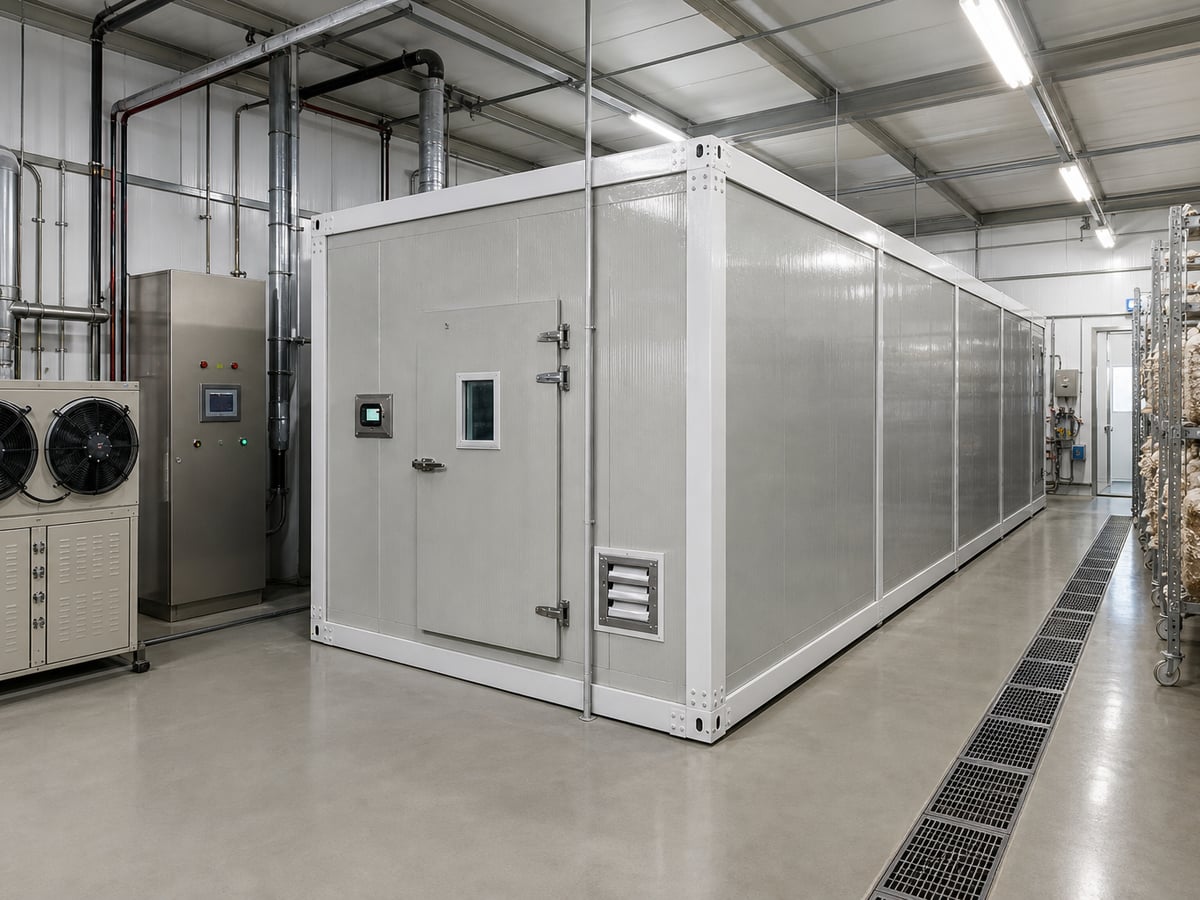
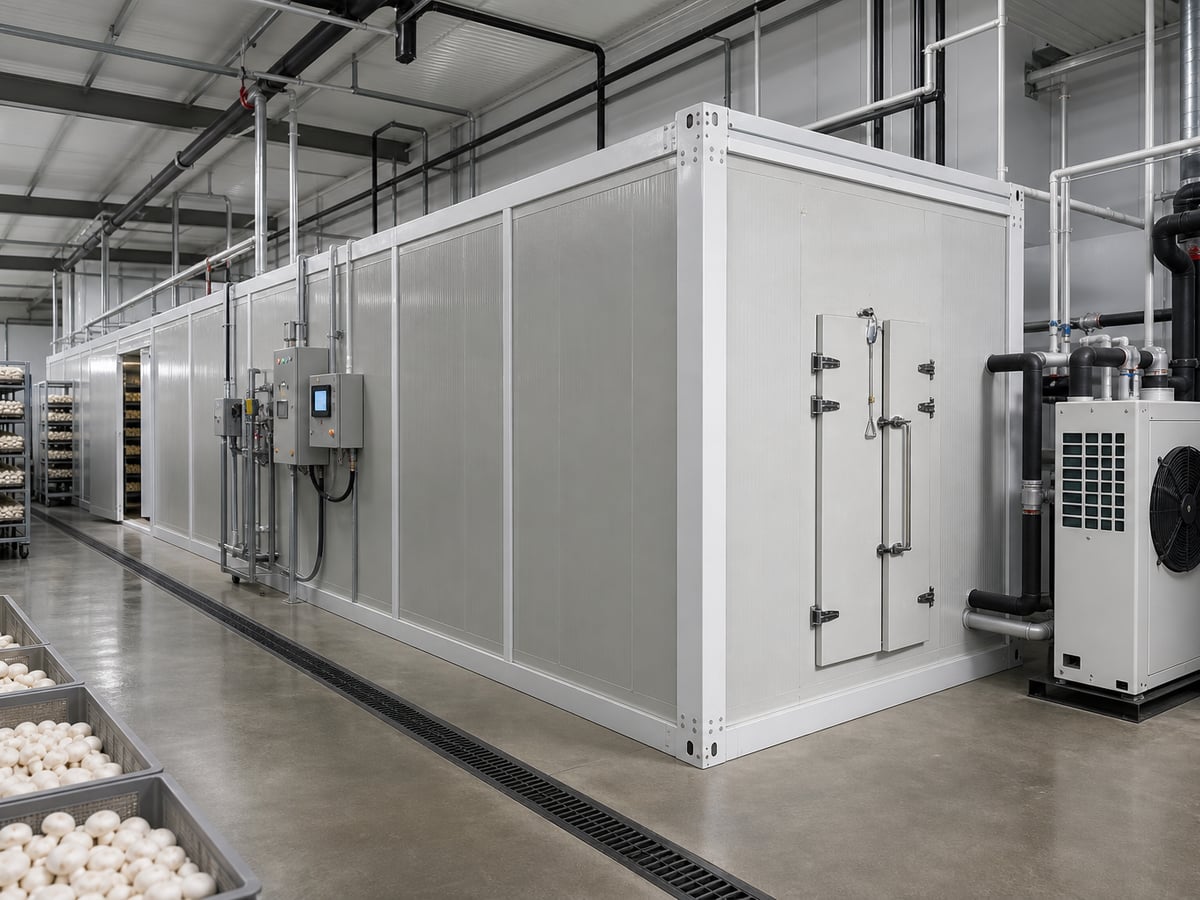
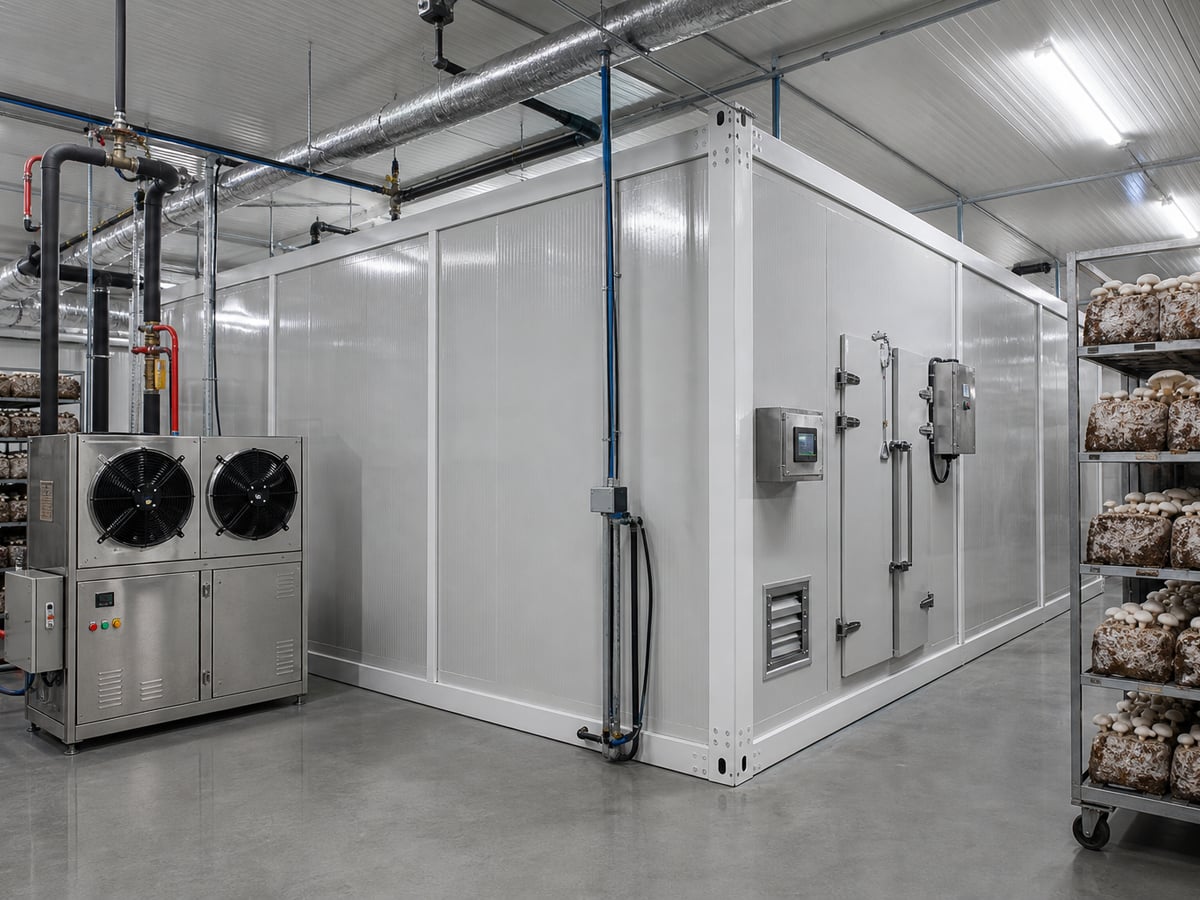
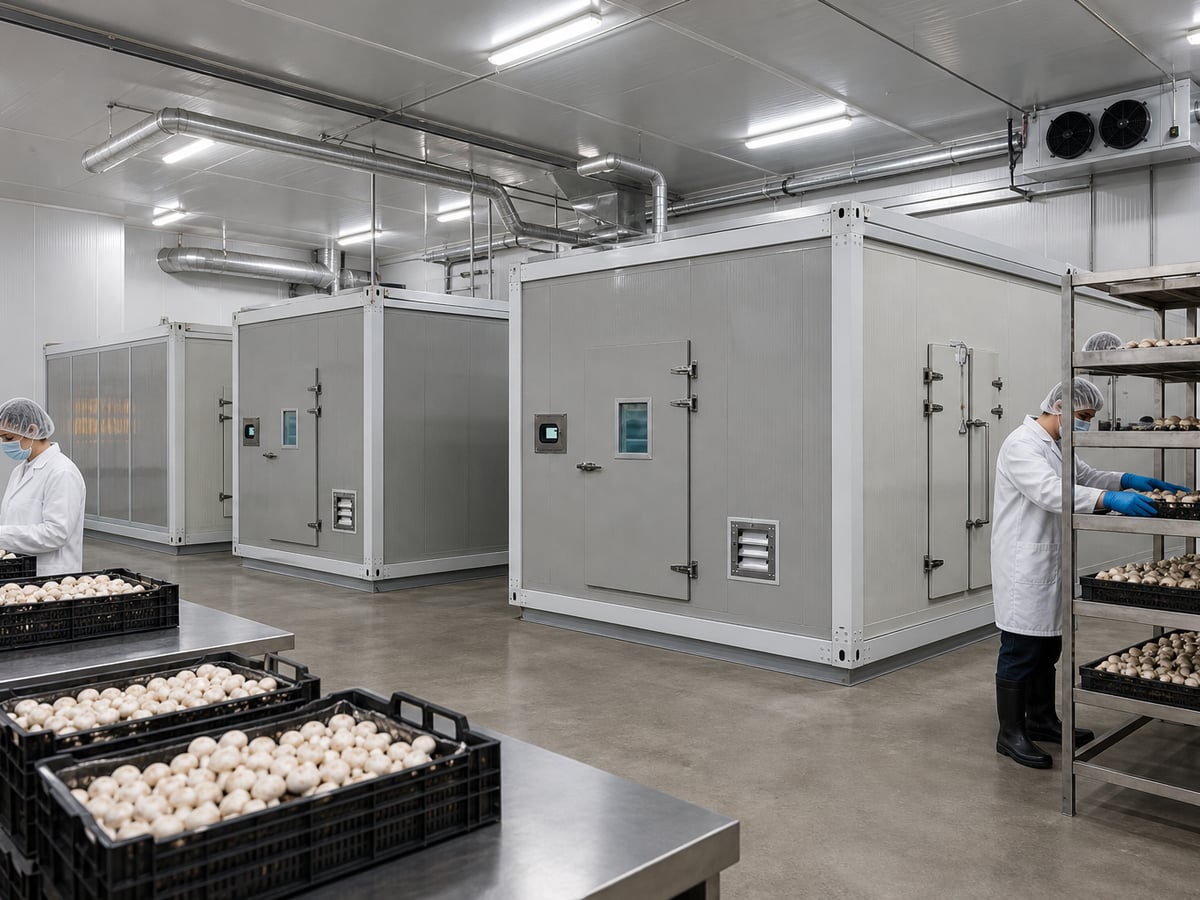
Explore the latest technologies, trends, and solutions in controlled environment agriculture and energy-efficient HVAC systems.
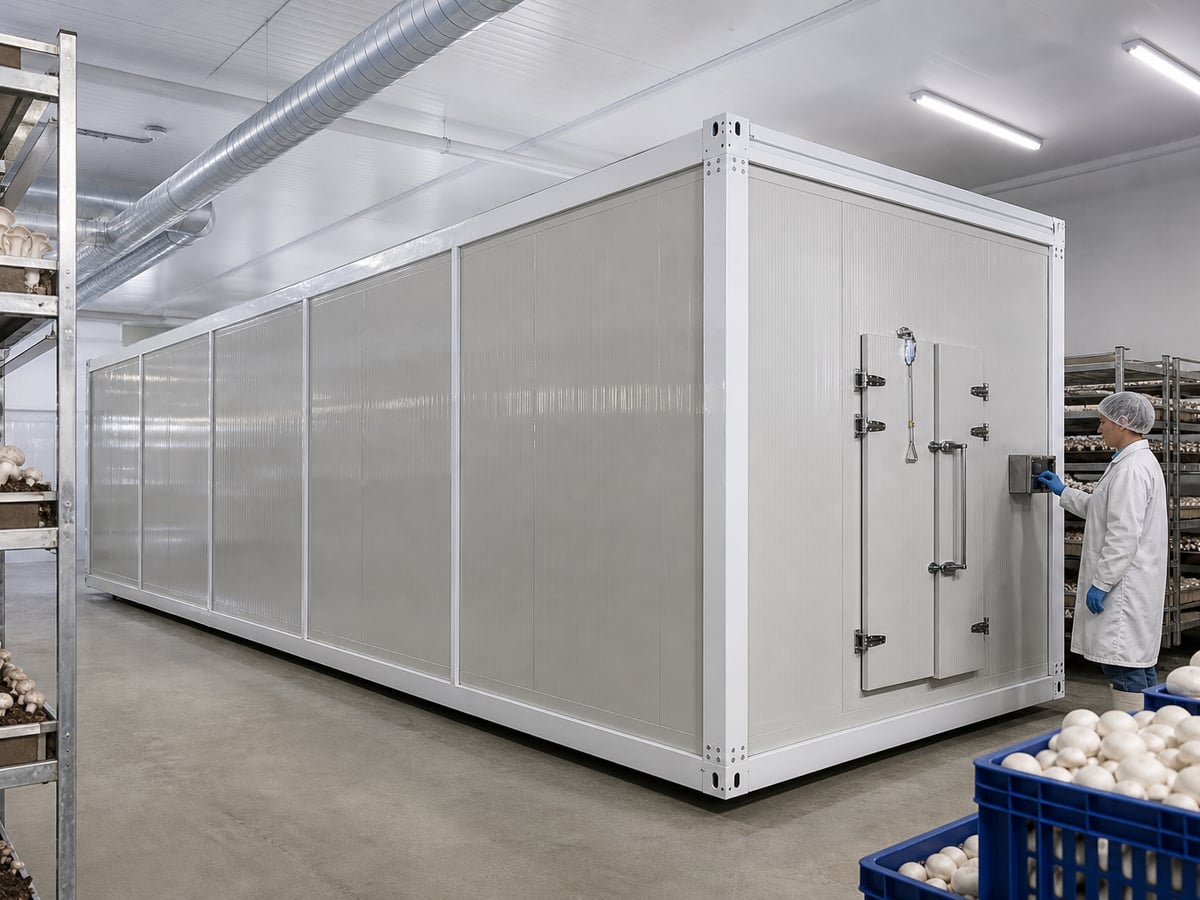
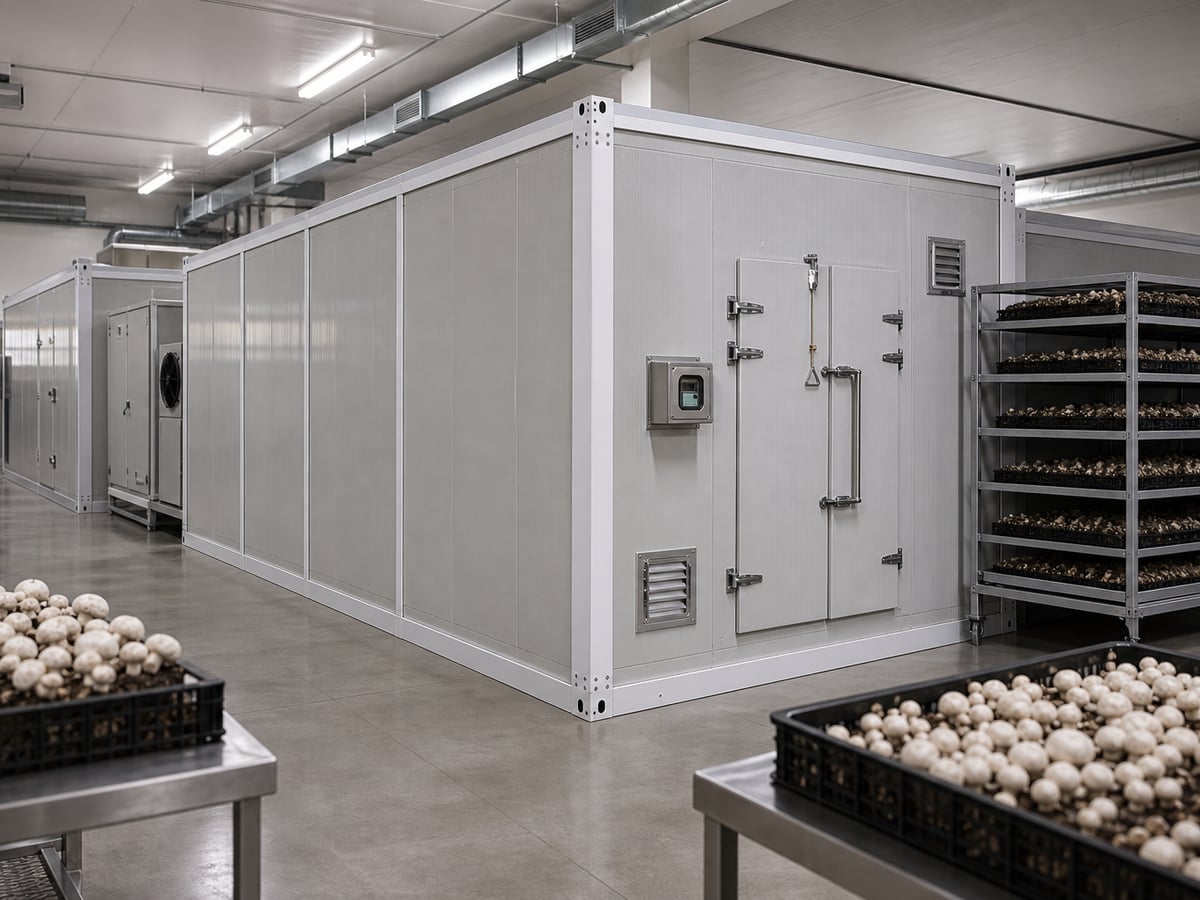
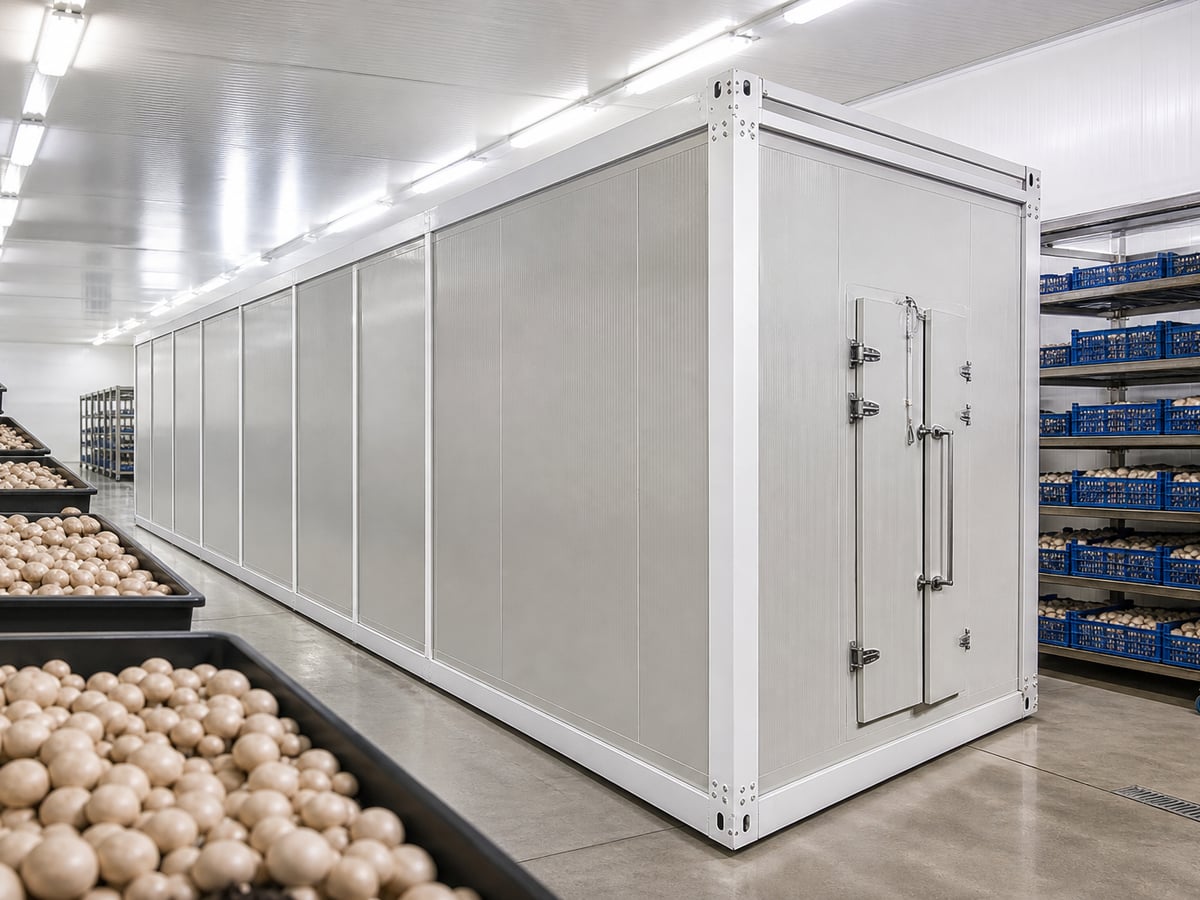
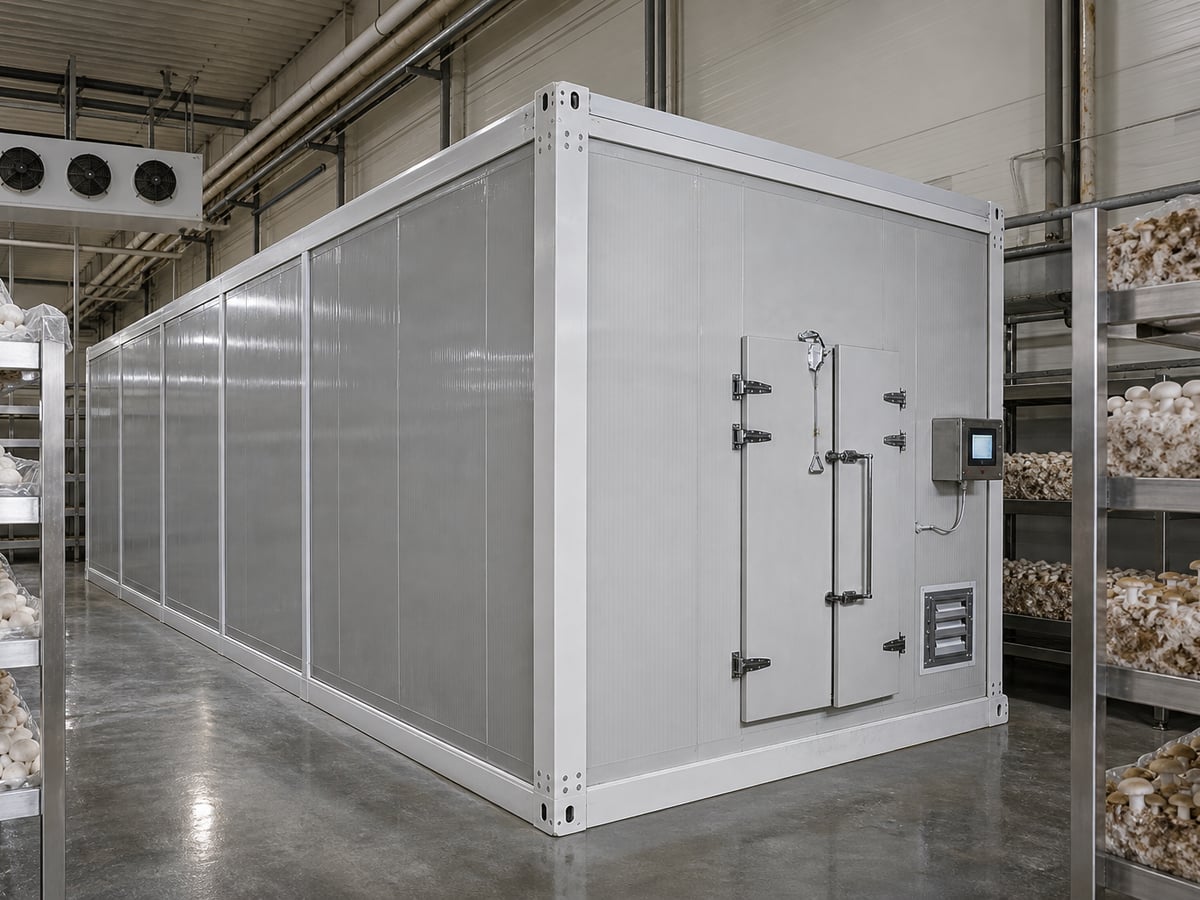
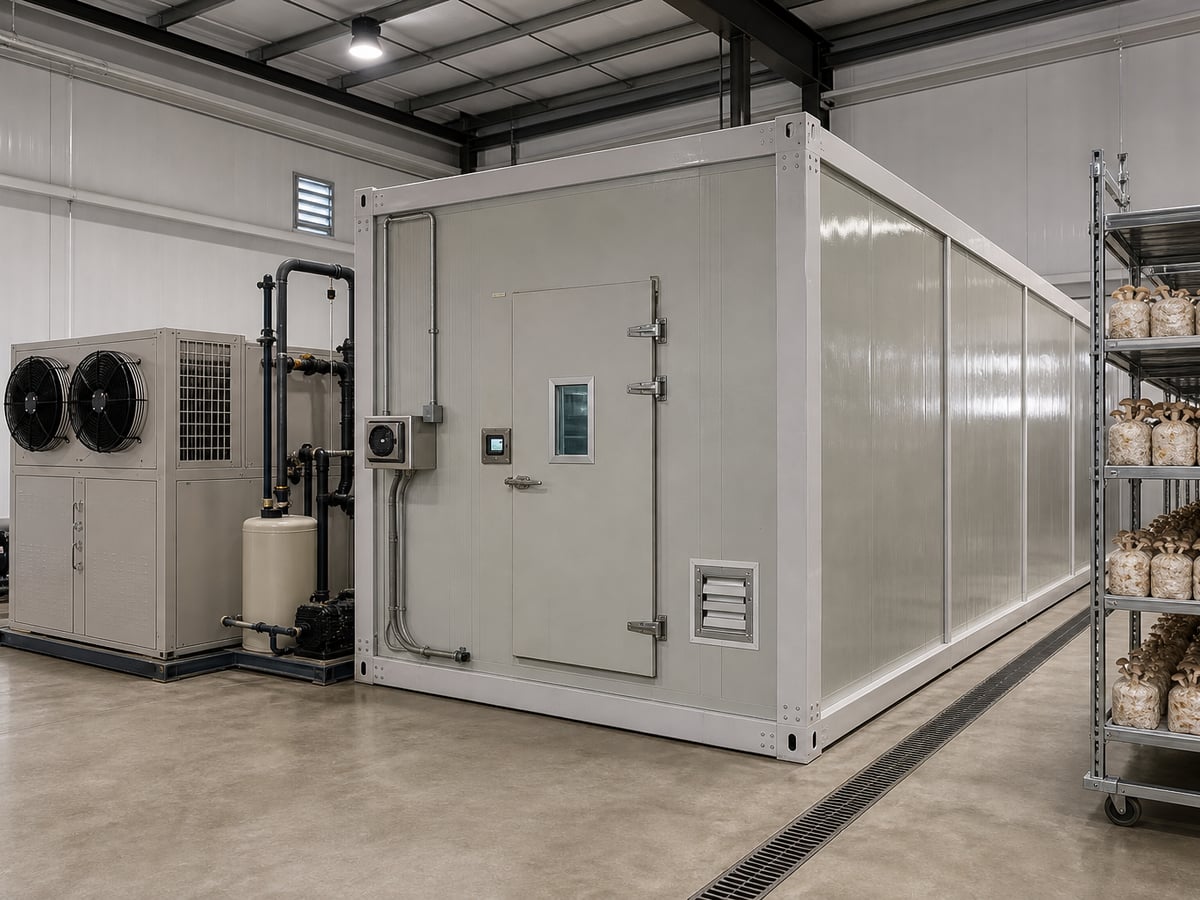
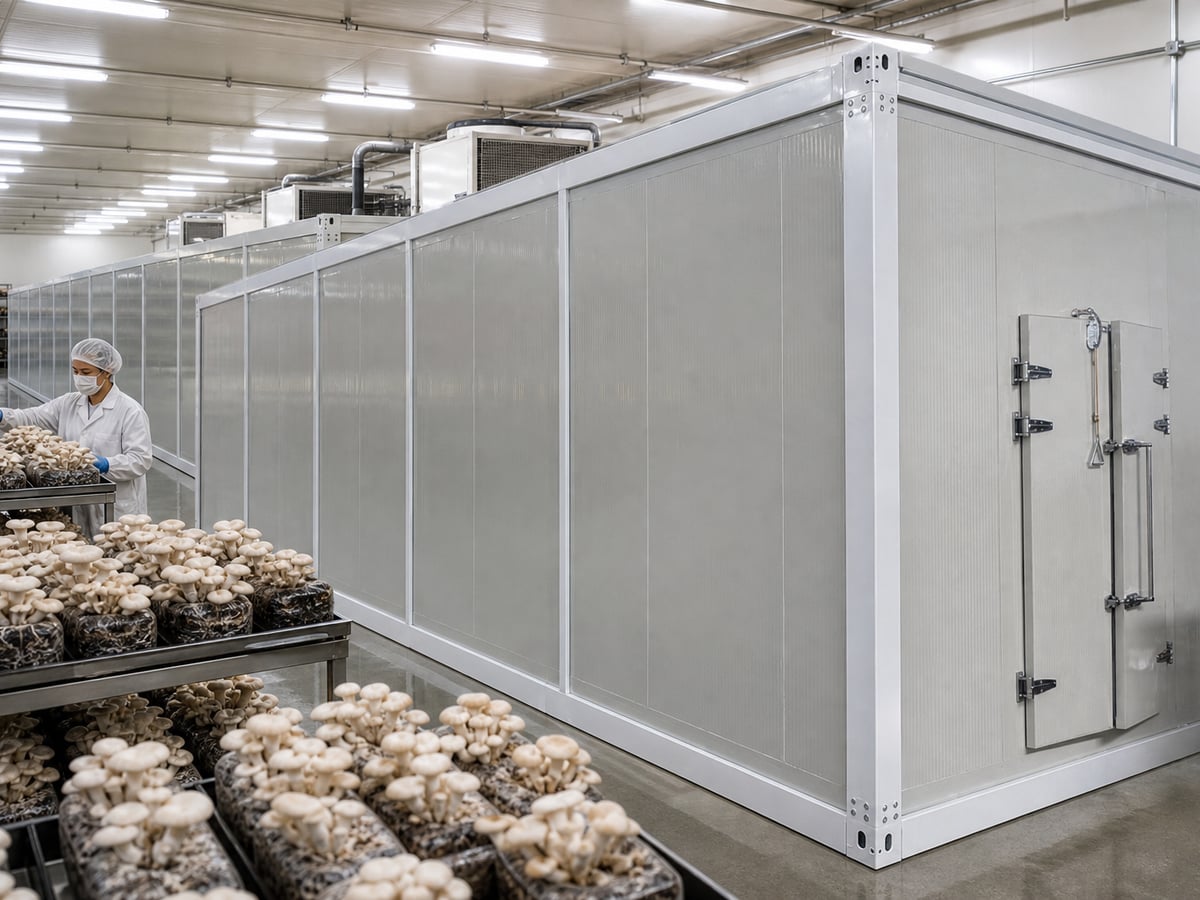
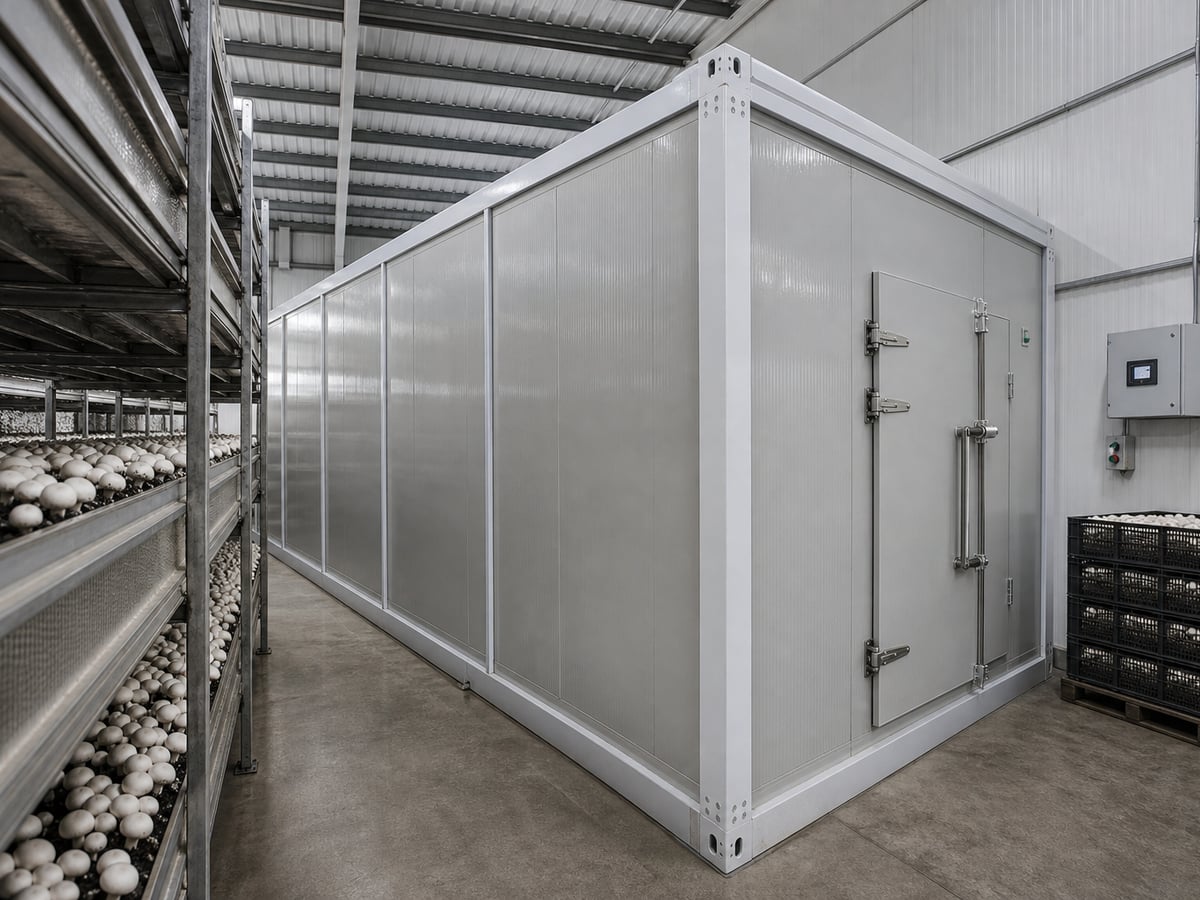
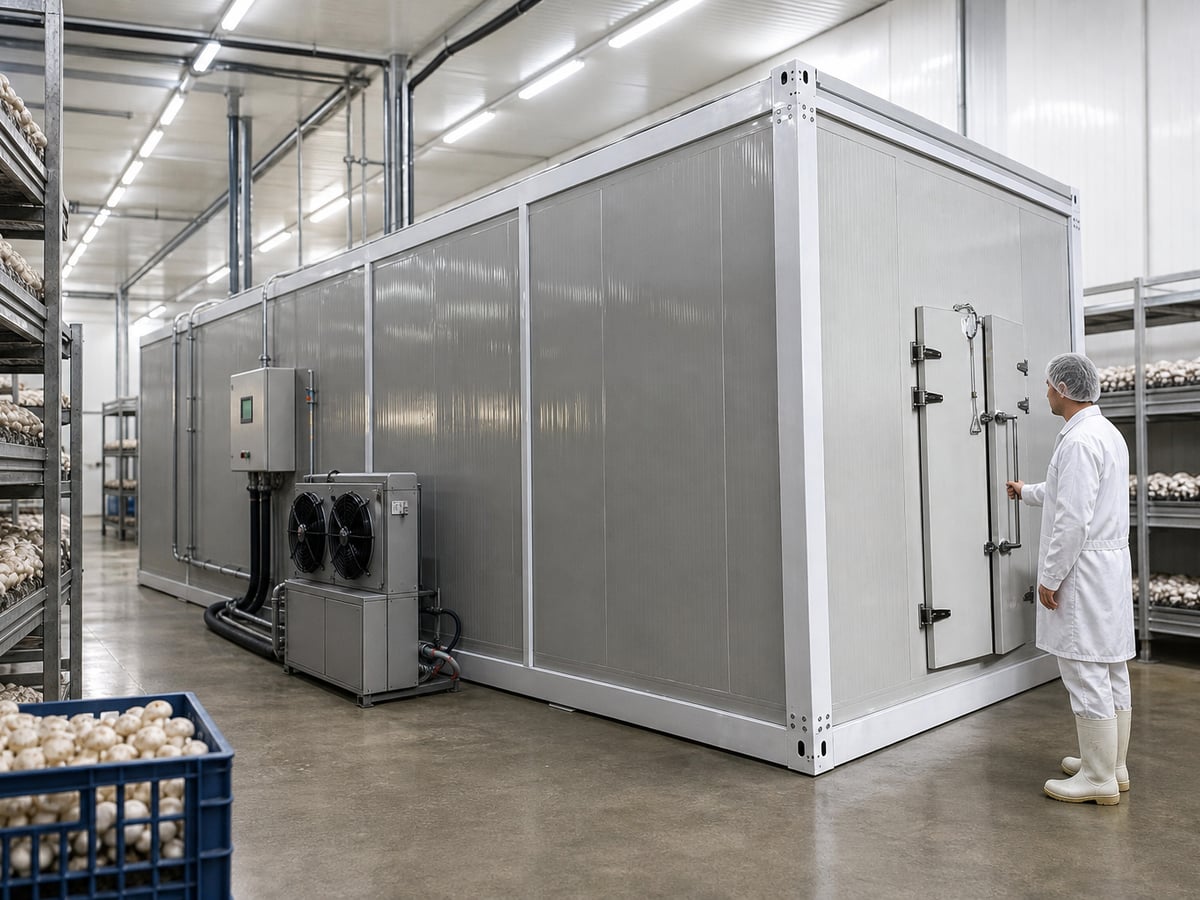
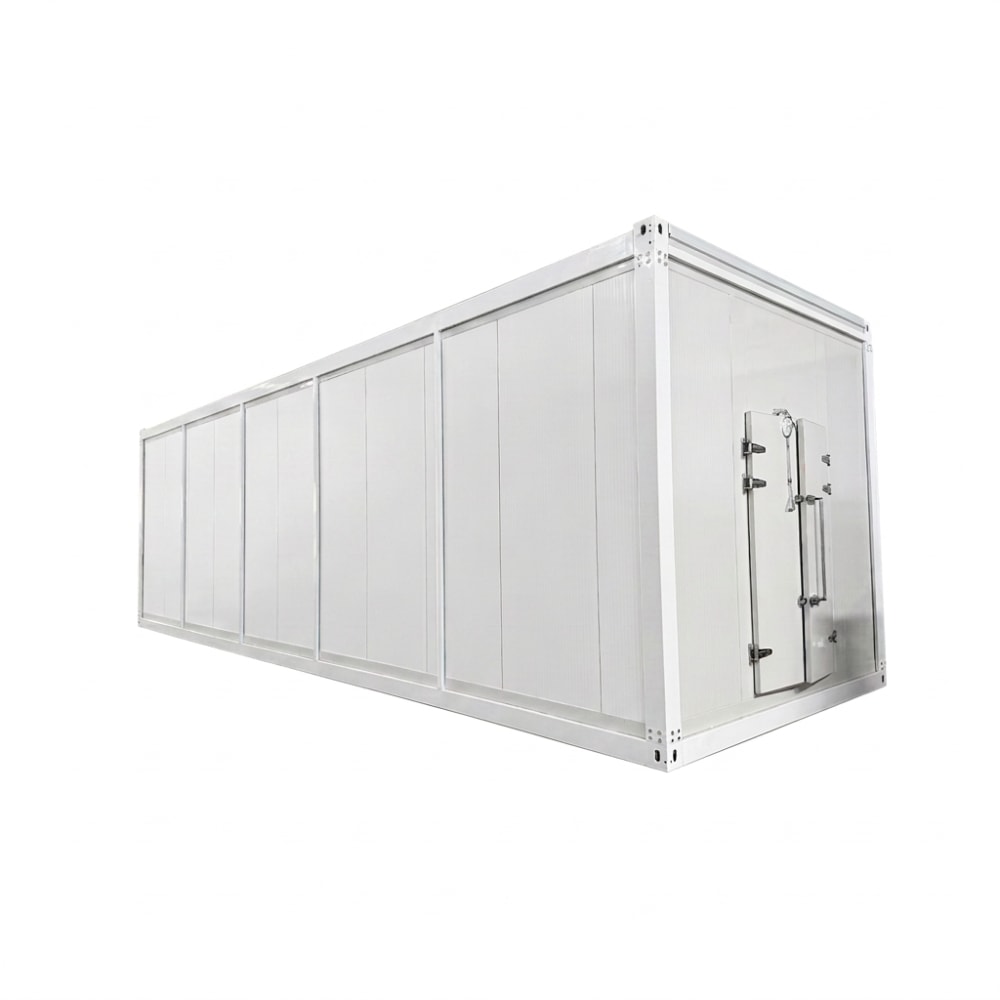
Smart Mushroom Cultivation Container
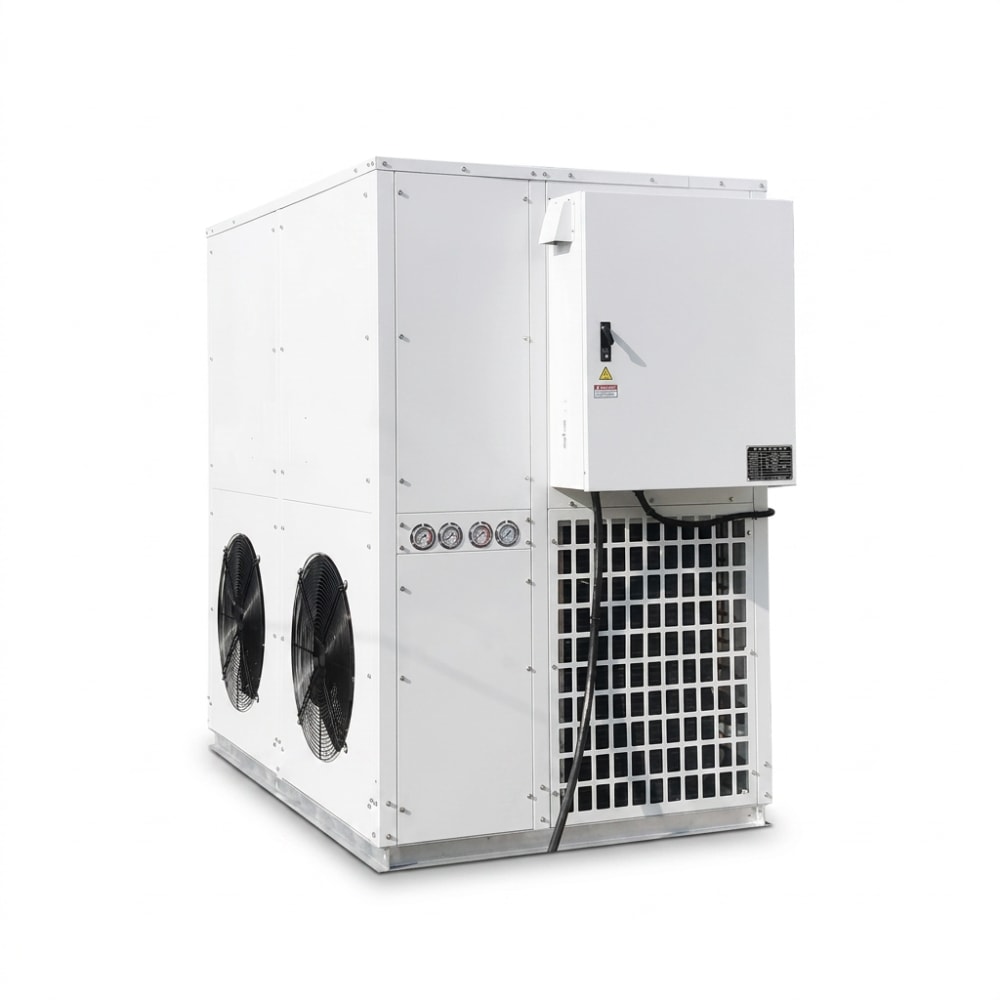
Smart Mushroom Climate Controller
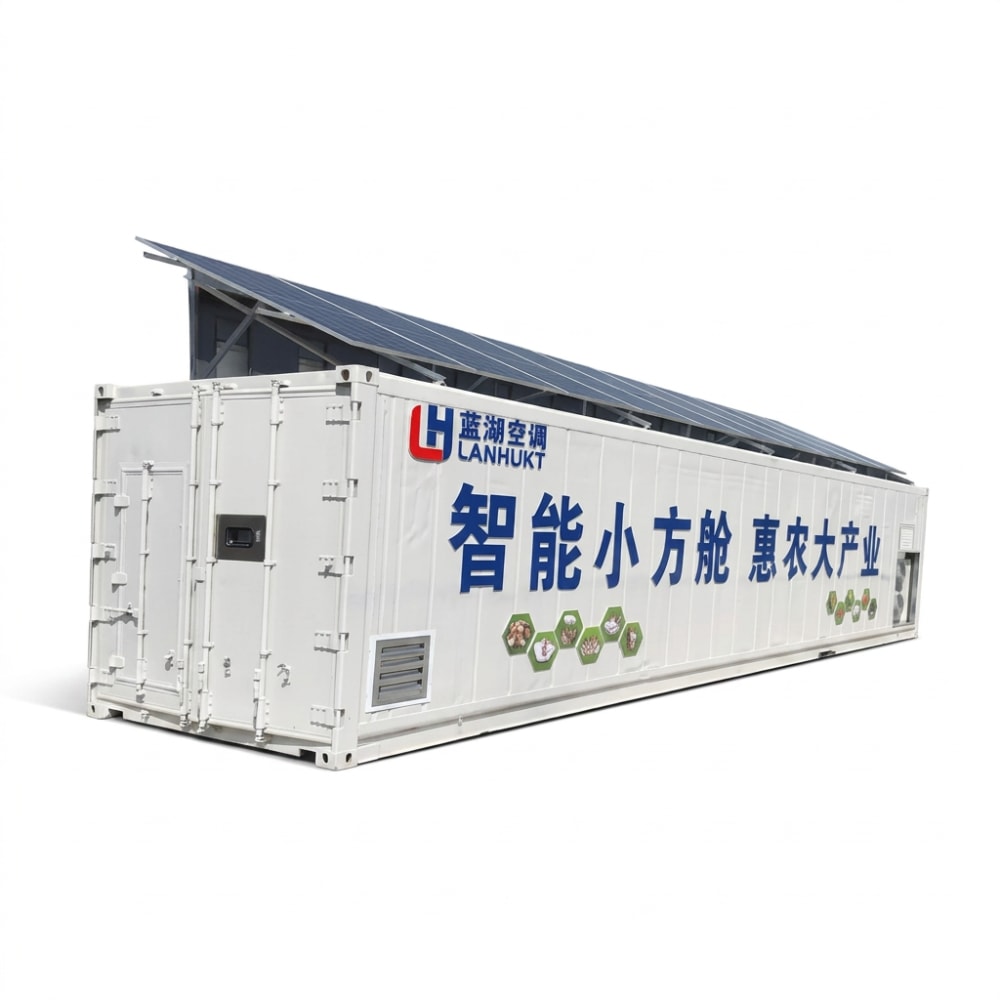
Smart Hydroponic Plant Container
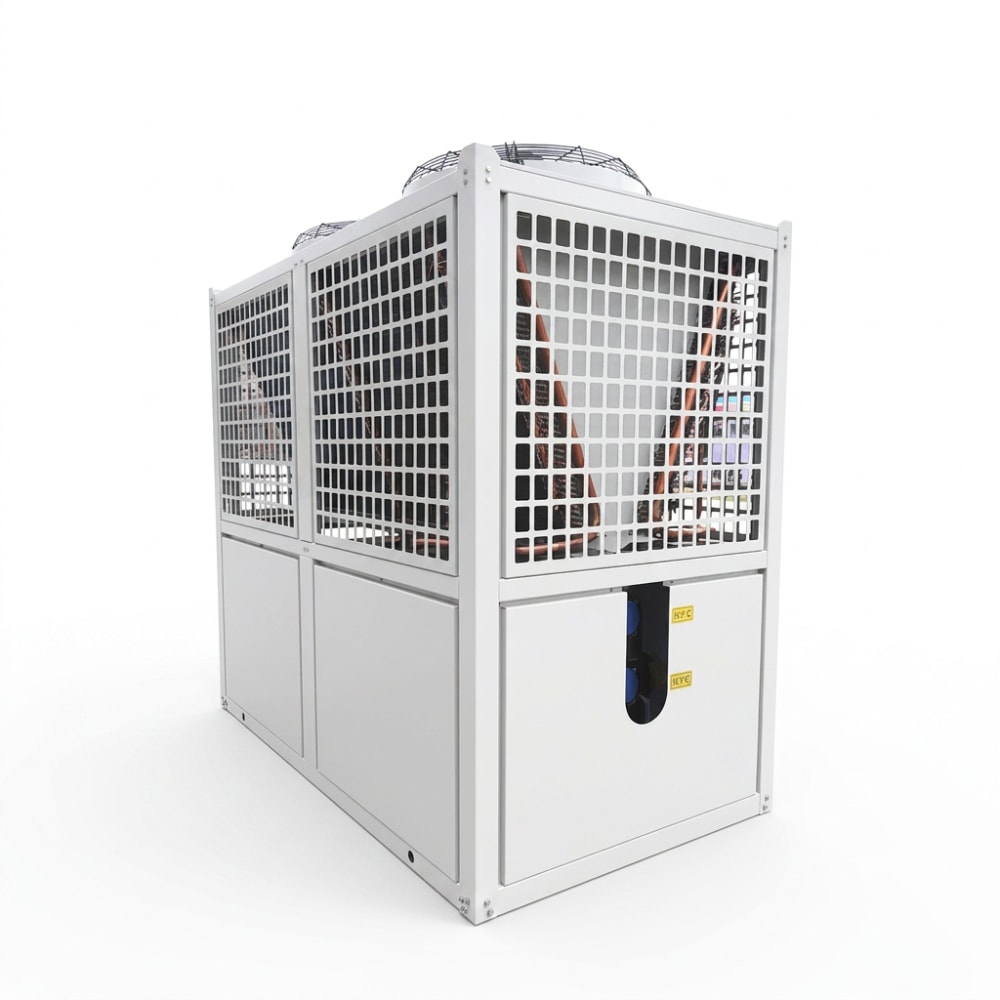
Air Source Heat Pump
Global Market Guide to Mushroom Container Automation
Smart mushroom cultivation containers can automate many repeatable environmental tasks in the Global Market, including temperature control, humidification, dehumidification, fresh-air exchange, CO2 management, fan operation, damper positioning, lighting schedules, data recording, and fault notifications. These controls can keep a container closer to the environmental targets required by each mushroom species and crop stage.However, automation does not replace the grower. A reliable system supports the grower by maintaining stable setpoints, reducing response time, recording operating data, and raising alarms when conditions move outside acceptable limits. Crop observation, disease recognition, substrate assessment, harvesting decisions, sanitation, and recovery after severe failures still require trained people.For commercial farms, contractors, and equipment distributors, the most valuable automation strategy is usually not “fully unattended growing.” It is a practical combination of dependable control loops, clear manual override functions, remote monitoring, preventive maintenance, and operating procedures that local teams can follow. This approach is relevant for container farms shipped through global trade hubs such as Shanghai, Rotterdam, Dubai, Singapore, Los Angeles, and Santos.Mushroom cultivation containers are controlled growing spaces where outdoor weather can change rapidly while the crop needs a relatively stable indoor environment. Automation is especially useful for climate tasks that are measurable, repetitive, and connected to controllable equipment. Sensors collect environmental data, a climate controller compares actual values with target values, and outputs activate equipment such as compressors, heaters, evaporator fans, humidifiers, fresh-air fans, dampers, and lights.The strongest automation candidates are temperature, relative humidity, CO2 concentration, air exchange, lighting time, pressure balance, and equipment status monitoring. A well-designed controller can also log trends that help growers identify why a yield, flush uniformity, or quality result changed from one production cycle to another.Different mushroom species and substrate systems require different control programs. Oyster mushrooms, shiitake, lion’s mane, enoki, button mushrooms, and medicinal mushrooms may use different temperature ranges, CO2 levels, air movement patterns, light requirements, and humidification strategies. Therefore, a container should use configurable recipes rather than one fixed program.Climate TaskTypical Automated EquipmentPrimary Sensor InputWhy Automation HelpsGrower Verification NeededCooling and heatingHeat pump, refrigeration unit, heater, circulation fanAir temperature sensorMaintains crop-stage temperature targets day and nightCheck sensor accuracy and crop responseHumidificationUltrasonic humidifier, high-pressure fogger, solenoid valveRelative humidity sensorReduces drying of primordia and fruiting bodiesInspect for condensation and wet capsDehumidificationCooling coil, heat recovery unit, exhaust fanHumidity and dew-point dataControls excessive moisture and condensation riskConfirm surfaces remain clean and dry enoughCO2 managementFresh-air fan, exhaust fan, modulating damperNDIR CO2 sensorSupports morphology and respiration managementAssess stem length, cap shape, and crop densityLighting scheduleLED grow lights, timer, relay panelProgram clock or crop recipeProvides repeatable photoperiods where requiredVerify light intensity and fixture cleanlinessAlarm monitoringController, SMS gateway, remote dashboardAll critical sensors and equipment status signalsSpeeds up response to out-of-range conditionsFollow recovery procedures and investigate causesThe table shows that automation is most effective where a sensor can provide reliable feedback and the system has a safe method of correction. It also shows why visual crop inspection remains necessary. Sensors can measure air conditions, but they cannot fully judge cap texture, abnormal mycelium growth, bacterial blotch, insect activity, substrate contamination, or harvesting maturity.Across the Global Market, automated mushroom containers are used by commercial mushroom farms, agricultural investors, university research facilities, hospitality suppliers, food-security projects, rural development programs, and controlled-environment agriculture contractors. Demand is growing in regions where climate variability, limited farmland, high labor costs, difficult site conditions, or long transport distances make conventional mushroom houses less practical.Container systems are commonly supplied as fruiting containers, incubation containers, multi-stage modular units, mobile trial units, and integrated farms with several connected containers. A project in a hot coastal city such as Dubai may prioritize heat rejection and insulation performance, while an installation near Rotterdam, Hamburg, Toronto, or Seoul may prioritize winter heating capacity, condensate control, and energy-efficient ventilation. Projects in Nairobi, São Paulo, Jakarta, and Manila may also require designs suited to local voltage, humidity, logistics, and maintenance capabilities.Temperature and humidity are the core climate control loops in a mushroom container. A feedback loop begins with a correctly located sensor. The controller reads the air condition, compares it with the programmed setpoint and deadband, then starts or modulates equipment to move the environment back toward the target. The system repeats this process continuously.For temperature, the controller may activate cooling when the air rises above the upper limit and activate heating when the air falls below the lower limit. To avoid rapid switching that can shorten equipment life, control logic normally uses deadbands, minimum run times, compressor protection delays, and staged capacity control. Larger systems may use variable-speed fans, electronic expansion valves, inverter compressors, or air source heat pumps for more stable operation.Humidity control needs more careful design because water vapor, fresh air, cooling coils, crop respiration, and surface condensation all interact. Adding moisture when relative humidity is low may be simple, but removing moisture without causing excessive cooling can be more complex. An integrated system can coordinate cooling, reheat, ventilation, and humidification instead of allowing each device to operate independently.Crop StageControl PriorityTemperature Control ApproachHumidity Control ApproachImportant ObservationContainer pre-coolingStabilize empty room conditionsRun cooling or heating before substrate loadingConfirm humidifier and drain operationCheck for leaks, condensation, and uneven airflowIncubationUniform substrate temperatureControl air temperature without overcooling blocksMaintain conditions appropriate to the substrate systemWatch for overheating within densely packed materialPinning initiationTrigger consistent fruiting conditionsApply programmed temperature changes graduallyMaintain high humidity without surface waterInspect pin distribution across shelvesEarly fruitingPrevent pin dryingMaintain stable air temperature and circulationUse short, controlled humidification cyclesLook for dry edges or water droplets on capsHarvest developmentProtect quality and morphologyLimit heat buildup from crop respiration and lightsBalance moisture with disease preventionCheck firmness, color, and cap openingPost-harvest resetPrepare for the next flush or sanitationReturn to recipe-specific recovery conditionsDry or humidify according to cleaning proceduresInspect drains, coils, filters, and internal surfacesThe table emphasizes that climate targets should not be treated as permanent values. Each crop stage has a different objective. During pinning, for example, growers may prioritize uniform initiation; during later development, they may focus on fruit body quality, controlled evaporation, and prevention of condensation-related disease.Sensor placement is equally important. A temperature and humidity sensor installed directly in the path of a humidifier nozzle, supply-air outlet, heater discharge, exterior door, or cold wall may not represent the crop zone. Commercial installations often use protected sensors placed at representative shelf height, away from direct water spray and strong supply-air streams. Larger containers may benefit from multiple sensors or zone-based monitoring.For buyers considering a smart mushroom climate controller, important questions include sensor calibration access, control accuracy, historical data storage, remote communication options, alarm configuration, manual override capability, and compatibility with local electrical systems.CO2 concentration is a key variable in mushroom production because mushrooms respire continuously and can rapidly increase CO2 levels in a tightly sealed container. The acceptable concentration depends on the species and the growth stage. High CO2 may be useful or tolerated in some phases, but excessive CO2 during fruiting can lead to undesirable morphology, elongated stems, reduced cap development, lower air freshness, and inconsistent crops.Automation usually relies on an NDIR CO2 sensor connected to a controller. When CO2 rises above the upper setpoint, the controller can open a fresh-air damper, start an exhaust fan, increase variable-speed fan capacity, or use a coordinated intake-and-exhaust sequence. Once the CO2 value returns to the desired range, the controller reduces ventilation to avoid unnecessary energy loss and humidity disturbance.Fresh air should not be treated as an isolated function. Outdoor air can be very hot, cold, dry, humid, dusty, smoky, or contaminated. In regions with high summer heat, such as the Gulf, northern Australia, inland India, or parts of Mexico, frequent ventilation can significantly increase cooling demand. In cold locations such as Northern Europe, Canada, or northern China, uncontrolled fresh-air intake can increase heating demand and create dry air conditions. Proper dampers, filtration, insulation, and control sequencing are therefore important.CO2 ConditionAutomatic ResponseEnergy ConsiderationHumidity ConsiderationManual CheckBelow minimum targetReduce fresh-air rate or close modulating damperAvoid unnecessary fan energy usePrevents excessive drying from outside airConfirm sensor has not drifted lowWithin target bandMaintain minimum ventilation and circulationUse low-speed fan operation where possibleMaintain stable moisture balanceObserve even crop developmentSlightly above targetIncrease fresh-air fan speed or damper openingUse staged ventilation before full capacityPrepare humidification compensation if neededInspect air paths for blockagesHigh CO2 alarm levelRun enhanced exhaust and intake sequenceAccept temporary energy increase for crop protectionMonitor for sudden humidity declineCheck fan operation and crop densitySensor fault signalSwitch to safe backup ventilation strategyUse time-based temporary mode only when necessaryAvoid prolonged over-ventilationCalibrate or replace the CO2 sensorPower recovery eventRestart equipment in programmed sequencePrevent all loads starting simultaneouslyRe-establish air exchange before intensive mistingReview alarm log and crop conditionThis control sequence helps buyers understand why CO2 automation should include more than a simple on/off exhaust fan. Modulating dampers, variable-speed fans, alarm thresholds, sensor calibration plans, and backup rules can improve stability and reduce wasted energy. The design should also prevent unfiltered outside air, insects, and rainwater from entering the cultivation area.Lighting automation is generally simpler than temperature or humidity control, but it is still valuable for production consistency. Some mushrooms require light as a developmental signal, while others need limited or no light during particular phases. Programmable LED lighting allows growers to set photoperiods, light intensity, switching times, and crop-specific recipes.Lighting schedules should account for the mushroom species, room layout, shelf depth, fixture distance, worker access, and heat load. LEDs are commonly preferred because they offer long service life, lower heat output than traditional lamps, and the ability to use timers or controller-based programs. Lights should be sealed or appropriately rated for humid conditions and positioned so they can be cleaned safely.Automation can also provide work-light modes. During harvesting, inspection, loading, cleaning, or maintenance, staff may require brighter lighting than the crop schedule normally provides. A controlled manual override allows workers to activate task lighting without permanently changing the crop recipe.When selecting an automated container, buyers should confirm whether the lighting system is integrated into the climate controller or operates on a separate timer. Integrated systems can record lighting status in the same dashboard as temperature, humidity, CO2, and equipment alarms. This makes troubleshooting easier, particularly for remote farms and multi-container projects.Ask suppliers whether the electrical panel includes separate protection for lights, humidifiers, fans, refrigeration equipment, and sockets. A fault in one circuit should not unnecessarily stop the entire container. For export projects, verify voltage, frequency, plug standards, breaker ratings, local electrical codes, and the availability of replacement LED drivers.Automated systems should be designed around the expectation that failures can occur. Power interruptions, sensor drift, water shortages, drainage blockage, refrigerant faults, fan failures, communication outages, and door-left-open events can all affect crop conditions. A strong fault strategy combines alarms, backup operating rules, manual control access, clear labeling, and trained staff.Alarm notifications may be sent through a local buzzer, indicator light, touchscreen display, SMS message, email, cloud dashboard, or mobile application. Not every alarm should have the same priority. A brief temperature deviation may require observation, while a high-temperature alarm during a heatwave or a refrigeration shutdown could require immediate action.Fault EventSuggested Alarm PriorityAutomatic Protective ActionManual Recovery StepPreventive MeasureMain power failureCriticalSend outage alert and preserve controller settingsStart generator or restore supply safelyInstall backup power plan and surge protectionHigh temperatureCriticalStart cooling sequence and high-temperature alarmCheck compressor, doors, condenser, and ambient conditionsClean condenser and test alarm responseLow humidityHighActivate humidification within safety limitsCheck water source, nozzle, pump, and mist outputClean filters and inspect water qualityHigh CO2HighIncrease ventilation and open damperCheck exhaust fan, intake path, and sensor readingMaintain fans and calibrate sensorsDrain blockageHighLimit humidification if water accumulation is detectedClear drain line and sanitize affected areaSchedule drain cleaning between cyclesSensor communication lossHighUse programmed safe mode and send fault alertInspect wiring, connectors, and sensor moduleKeep spare sensors and protect cables from moistureThe table demonstrates why alarm systems must be paired with recovery procedures. An alert alone does not protect the crop if nobody knows which breaker, valve, fan, drain, or controller setting should be checked first. Each site should maintain a simple operating manual in the local working language, including emergency contacts, equipment diagrams, daily inspection steps, and escalation rules.Manual mode is not a weakness in an automated container. It is a necessary safety feature. Authorized personnel should be able to operate key fans, humidifiers, lights, and climate equipment during troubleshooting. At the same time, manual controls should be protected from accidental activation and should clearly show whether the system is in automatic, off, or manual operation.Automation can control air conditions, but mushrooms are biological crops. Skilled growers remain responsible for interpreting what the crop is showing. They determine whether a climate recipe is working, whether a flush is uniform, whether substrate quality is acceptable, and whether a change in morphology comes from climate, genetics, contamination, watering practice, nutrition, or handling.Human expertise is especially important for receiving substrate or spawn, evaluating bag or block condition, arranging shelves, monitoring mycelial health, identifying contamination, adjusting harvest timing, grading produce, cleaning equipment, and deciding whether a room should be isolated after a disease issue. Workers also manage food safety, traceability, packing, cold-chain transfer, and customer quality requirements.In high-value markets such as Japan, Singapore, Germany, the United Arab Emirates, the United Kingdom, and major North American cities, buyers may expect uniform packaging, reliable supply, clean appearance, and documented production practices. Automation can support these goals through stable climate records, but it cannot replace trained crop management and quality assurance.Automated mushroom containers can support fresh mushroom production near cities, specialty mushroom farms, restaurant supply programs, agricultural demonstration centers, research institutions, food-security projects, remote mining or camp catering, and modular farm developments. They can also help distributors supply packaged cultivation solutions to local entrepreneurs.For urban applications, containers can be placed near distribution zones around London, Dubai, Johannesburg, Sydney, Vancouver, Lima, or Bangkok, reducing the distance between production and customers. For rural applications, modular units can support decentralized production where land is available but climate-controlled buildings are limited. The right configuration depends on crop volume, utility capacity, labor skills, water quality, local climate, and access to substrate.Automation should be tested before substrate, bags, blocks, shelves, or growing materials are loaded into the container. Empty-room commissioning is one of the most effective ways to identify wiring issues, sensor errors, incorrect equipment rotation, airflow imbalance, drain problems, and control logic conflicts without risking a crop.A complete test should include heating, cooling, humidification, dehumidification, fresh-air intake, exhaust operation, damper movement, lighting control, CO2 sensor response, water supply, drainage, alarms, remote access, and manual override. The system should also be tested during simulated faults, such as disconnecting a sensor, opening the door, stopping a fan, or interrupting a water supply.Pre-Loading TestWhat to VerifyAcceptance ResultRisk if IgnoredRecommended RecordTemperature pull-down testCooling capacity and temperature stabilityContainer reaches target within planned timeHeat stress after crop loadingTime-to-setpoint logHeating testHeating response and electrical protectionStable recovery without breaker tripsCold damage in winter operationsHeating run reportHumidity testHumidifier output and sensor feedbackHumidity rises without pooling waterDry pins or excessive condensationHumidity trend graphCO2 response testSensor, fan, and damper coordinationVentilation activates at programmed thresholdMisshapen fruiting bodiesCO2 alarm verification sheetDrainage testCondensate and wash-water dischargeWater flows freely to designated outletStanding water and hygiene problemsDrain inspection checklistAlarm and remote testNotification delivery and user accessAlarm reaches responsible staff promptlyDelayed response to equipment failureContact and escalation test recordThese tests should be documented because they create a baseline for future service. If a container later struggles to maintain temperature or humidity, technicians can compare current performance with the original commissioning results. This is particularly helpful for international installations where equipment may travel from a Chinese manufacturing site through Qingdao or Shanghai ports to customers in Africa, Europe, the Middle East, Oceania, or the Americas.Before crop loading, operators should also check hygiene. Internal wall panels, shelving, floor drains, humidification components, filters, doors, seals, and condensate trays should be cleaned and inspected. A technically advanced controller cannot compensate for poor sanitation or contaminated substrate.Shandong Lanhu Air Conditioning Equipment Co., Ltd. supports commercial controlled-environment agriculture projects with integrated climate-control and modular cultivation equipment. Its solutions are designed for customers seeking factory-direct equipment for mushroom production, hydroponic growing, agricultural engineering, and climate-managed container applications across the Global Market.Lanhu develops smart cultivation solutions based on more than 12 years of thermodynamic research and development experience. Its product range includes smart mushroom cultivation containers, mushroom climate controllers, hydroponic plant containers, and air source heat pumps. The company’s technical focus includes coordinated temperature, humidity, ventilation, CO2, and lighting control, helping customers create configurable climate recipes for different crop stages.For growers planning a modular project, the smart mushroom cultivation container can be specified around crop type, regional climate, available utilities, capacity requirements, and operational preferences. Control functions can be selected to support both daily automation and practical manual recovery when required.Lanhu operates a manufacturing facility of more than 30,000 square meters in Dezhou, Shandong, China. Its integrated production capabilities include product design, engineering development, sheet metal fabrication, CNC bending, insulation panel production, electrical assembly, system integration, equipment testing, and quality inspection. This integrated workflow helps maintain coordination between the insulated container structure, HVAC equipment, electrical cabinet, drainage arrangement, and control system.Before shipment, systems undergo functional inspection, electrical verification, performance testing, and operational evaluation. Lanhu holds ISO 9001, ISO 14001, ISO 45001, and ISO 12100 certifications and has accumulated more than 45 registered patents. Buyers can review cultivation project examples to understand how modular climate-control concepts can be applied in different commercial settings.Lanhu provides factory-direct supply, OEM and ODM customization, engineering assistance, international logistics support, spare-parts support, installation guidance, and after-sales service. These services are important for overseas buyers who need clear commissioning plans, wiring documentation, replacement-part planning, remote troubleshooting, and local contractor coordination.For distributors, engineering companies, and agricultural contractors, OEM and ODM customization services can support private-label projects, project-specific layouts, climate configurations, electrical specifications, and branded equipment requirements. Early communication about local conditions, import requirements, utilities, crop plans, and maintenance teams helps reduce avoidable commissioning delays.By 2026, mushroom container automation is expected to move toward more connected, energy-aware, and traceable systems. Remote dashboards will increasingly combine sensor trends, energy use, alarm history, maintenance reminders, and crop recipes in one interface. Predictive maintenance may use fan runtime, compressor current, coil temperature, and sensor behavior to identify faults before they become critical.Sustainability will also become a stronger purchasing factor. Buyers are increasingly evaluating insulation performance, low-GWP refrigerant options where locally permitted, heat-pump integration, variable-speed equipment, water-saving humidification practices, condensate management, durable materials, and reduced crop losses. In markets with carbon reporting, food-safety controls, energy-efficiency programs, or import requirements, transparent equipment specifications and recorded operating data can support project compliance.Policy trends may encourage local food production, water efficiency, reduced food miles, worker safety, and energy management. Nevertheless, buyers should assess regulations in their specific country, including electrical certification, refrigerant rules, building permits, food-processing requirements, wastewater handling, fire safety, and import documentation. A modular container can simplify deployment, but it still needs to fit local legal and operational conditions.No. It can automate routine environmental control, monitoring, and alarms, but workers are still needed for crop inspection, cleaning, substrate handling, harvesting, packing, maintenance, and fault recovery.Temperature, humidity, CO2-based ventilation, fan and damper control, lighting schedules, data logging, and alarms usually provide the most immediate value because they are repetitive and measurable.Not necessarily. Continuous full-speed ventilation can waste energy and disturb humidity. A CO2-based control strategy with minimum ventilation, staged fan operation, and damper modulation is usually more efficient.Sensor inspection and calibration frequency depends on the equipment, crop risk, and operating environment. As a practical rule, growers should regularly compare readings, inspect sensor condition, review trends, and follow the manufacturer’s calibration recommendations.Test cooling, heating, humidification, drainage, CO2 response, ventilation, lighting, alarms, remote access, and manual override functions. Empty-room testing is safer and less costly than discovering faults after crop loading.Yes. Projects can be adapted for local voltage, frequency, ambient climate, insulation needs, water conditions, logistics, crop types, available service personnel, and relevant regulations. Clear technical specifications should be agreed before manufacturing and shipment.
Global Market Guide to Mushroom Incubation Containers
Mushroom incubation containers should be selected as controlled production environments, not simply insulated storage boxes. For commercial growers in the Global Market, the correct design must manage substrate-generated heat, rack spacing, clean loading, air circulation, batch traceability, and contamination response before fruiting begins.The most important purchasing check is whether the container can maintain stable substrate core temperatures when bags, blocks, bottles, or trays are densely loaded. During colonization, mycelium produces heat. A container that appears adequately cooled when empty can become too warm after full loading, especially in warm trade regions, coastal humid climates, or facilities operating near logistics hubs such as Rotterdam, Dubai, Singapore, Los Angeles, Melbourne, and Durban.For many oyster, shiitake, lion’s mane, and specialty mushroom operations, incubation targets are commonly different from fruiting targets. Incubation often requires a warmer, darker, cleaner, and less ventilated environment than fruiting. Buyers should therefore evaluate whether a multi-purpose cultivation container can reliably switch between stages or whether a separate incubation container provides better operational consistency.A practical buying checklist includes the following: verified insulation performance; sufficient cooling and heating capacity under full substrate load; adjustable circulation fans; shelving designed around bag dimensions; temperature and humidity sensors placed at representative levels; alarms for high core temperature; washable internal surfaces; segregated loading procedures; and remote monitoring capability. A smart mushroom cultivation container can combine these controls in a modular format for farms that need predictable expansion without constructing a permanent building first.Buying CheckWhy It Matters During IncubationPractical Question for SuppliersCooling capacitySubstrate metabolism can raise the internal temperature after loading.What cooling output is available at full rack density and high ambient temperature?Insulation structureWeak insulation causes energy losses and unstable temperatures.What panel thickness, insulation material, and thermal design are used?Rack configurationPoor spacing traps heat and limits air movement around bags or blocks.Can shelf height and aisle width be adjusted for our substrate format?Air circulationUneven airflow creates hot spots and inconsistent colonization.How is air distributed from top to bottom and front to rear?Control systemIncubation requires dependable responses to changing biological loads.Can the controller manage temperature, humidity, timing, alarms, and remote access?Sanitation designIncubation rooms can spread contamination when surfaces are difficult to clean.Are walls, floors, corners, drains, and electrical components washdown-friendly?This table shows why container selection should start with biological performance rather than exterior dimensions alone. The most affordable unit may become expensive if it causes slow colonization, heat stress, high rejection rates, or additional labor for cleaning and batch management.Incubation and fruiting are distinct cultivation stages. Incubation supports mycelial colonization of a prepared substrate. Fruiting encourages pin formation and mushroom development. Although exact setpoints vary by species, strain, substrate formula, and local production protocol, the environmental logic is consistent: incubation generally prioritizes substrate temperature stability and cleanliness, while fruiting generally requires stronger fresh-air exchange, species-specific humidity, lighting schedules, and often lower temperatures.For example, oyster mushroom farms may incubate blocks in a comparatively warm and dark area before moving them to a fruiting room with fresh air, humidity, and light. Shiitake producers may require an incubation and maturation sequence that differs substantially from the fruiting climate. Lion’s mane can also benefit from controlled transitions that prevent excessive condensation, uneven growth, or delayed pinning.A container intended for both stages should have programmable recipes rather than one fixed climate mode. It should also be evaluated for how quickly it can recover after doors open, after a batch is loaded, or after the system changes from incubation conditions to fruiting conditions. For operators managing several species, separate recipes and user access controls are valuable because one incorrect setpoint can affect an entire batch.Operating FactorTypical Incubation PriorityTypical Fruiting PriorityTemperatureStable conditions suited to mycelial growth and substrate core control.Species-specific conditions that support pinning and crop development.Fresh-air exchangeModerate circulation with limited unnecessary outside-air exposure.Higher exchange to manage carbon dioxide and support morphology.LightUsually minimal or absent, depending on species and workflow.Often scheduled or diffused according to crop requirements.HumidityManaged to avoid drying and surface condensation during storage.Closely controlled to support mushroom formation without pooling water.Cleaning riskFocused on preventing contamination during loading and colonization.Focused on hygiene, crop handling, and water management.Door activityIdeally limited after batch loading to preserve stable conditions.More frequent due to inspection, harvest, and crop maintenance.The comparison clarifies why a fruiting room is not automatically a suitable incubation room. A fruiting design with constant high fresh-air exchange may waste energy and introduce unnecessary variability during colonization. Conversely, an incubation-only room may lack the airflow, humidification response, lighting, and drainage needed for productive fruiting.For emerging farms, a programmable modular system can reduce initial capital requirements. For larger facilities, separating stages often improves biosecurity, labor flow, and crop scheduling. The right decision depends on production volume, crop diversity, building layout, labor availability, energy cost, and the financial impact of a contaminated or overheated batch.Substrate heat is one of the most underestimated factors in mushroom incubation container design. Colonizing mycelium is biologically active. As it grows through substrate, metabolic activity generates heat inside each bag, block, bottle, or tray. In a densely loaded container, this heat accumulates faster than many operators expect, particularly in the center of racks and in the middle of large batches.Air temperature alone is not enough for decision-making. A wall-mounted sensor may show an acceptable reading while the substrate core in the middle rack is several degrees warmer. This difference can slow colonization, encourage competitor organisms, alter moisture balance, or stress heat-sensitive strains. Buyers should ask suppliers where sensors are installed, whether probes can be inserted into representative substrate units, and whether high-temperature alarms are configurable.Heat risk rises when substrates are freshly sterilized or pasteurized and loaded before their temperature is fully equalized, when bags are packed tightly, when containers are placed in direct sun, or when refrigeration is sized only for empty-room calculations. Projects in tropical, desert, and subtropical regions require particular attention to ambient design temperatures. Container placement near a hot concrete yard, rooftop, shipping terminal, or sun-exposed warehouse wall can materially affect cooling demand.Heat Source or ConditionPotential ResultRecommended Design ResponseDense substrate loadingHeat accumulates at rack centers and between adjacent bags.Use rack gaps, calculated loading limits, and balanced airflow paths.Warm incoming substrateInitial cooling load overwhelms the climate system.Define loading temperature limits and allow pre-cooling when needed.High external ambient temperatureCompressor runtime increases and recovery becomes slower.Specify equipment for the project climate, shading, and insulation level.Blocked return-air pathAir does not circulate through the lower or central racks.Maintain clear aisles and prevent bags from covering vents.Oversized batchInternal heat exceeds the planned biological load.Stagger loading dates or reduce the number of units per cycle.Single-point sensingHidden hot spots remain undetected until crop quality declines.Use multiple air sensors and periodic substrate core checks.The table demonstrates that equipment capacity and operating discipline must work together. Even a powerful cooling system cannot compensate for blocked ducts, overloaded shelves, or poor batch sequencing. During commissioning, operators should conduct a loaded thermal test using the real substrate format, realistic bag density, normal door-opening behavior, and the expected local ambient conditions.For remote farms or container projects shipped through ports such as Jebel Ali, Hamburg, Santos, Mombasa, or Busan, planning should also include local power supply stability. Voltage variation, generator backup, and refrigeration restart behavior should be reviewed before the equipment arrives on site.Rack density determines how much production can fit inside a container, but maximum density is not always maximum profitability. Overpacking may increase the number of substrate units per cycle while reducing airflow, raising core temperatures, increasing uneven colonization, and making contamination checks difficult. The optimum layout balances capacity with climate uniformity and labor access.Aisles should allow personnel to inspect all shelves without crushing bags or brushing against exposed filters, vents, or surfaces. Rack materials should resist corrosion and support repeated cleaning. Adjustable shelves are useful for growers who change between short blocks, tall bags, bottle systems, and experimental products. Shelf design should also prevent water accumulation and avoid inaccessible corners where debris can build up.Core temperature mapping is an effective commissioning practice. Place probes in representative substrate units at the top, middle, and lower shelf levels; near doors; at the rear; and in the center of the densest rack zone. Compare readings over a full cycle, including the first days after loading when metabolic heat may increase. The goal is not only to obtain one acceptable reading but to identify differences across the container.The chart illustrates a common operating pattern: room air appears stable while substrate cores become warmer, especially in central racks. It is an example only, not a universal setpoint recommendation. Each farm should validate its own species, substrate formula, bag size, inoculation rate, and loading arrangement.Operators should document the maximum safe load per rack and per container. This procedure is especially important when production teams attempt to increase output by reducing spacing. A controlled trial with temperature logging is safer than changing the layout during a commercial batch.Ventilation during mycelial growth should be purposeful rather than excessive. Mycelium needs a stable environment, but the container must still circulate air adequately to avoid stagnant zones, trapped heat, localized condensation, and uneven conditions. The proper balance depends on species, substrate packaging, filter design, room cleanliness, and the amount of biological activity in the batch.Internal air circulation and outside-air exchange are different functions. Internal circulation moves conditioned air through the room and around racks. Outside-air exchange introduces fresh air and removes gases from the room. During incubation, strong fresh-air exchange may not be necessary at the same level as during fruiting, yet circulation must remain sufficient to distribute cooling or heating throughout the container.Air outlets should not blow aggressively onto exposed bag filters or delicate substrate surfaces. High-velocity drafts can cause localized drying and may create inconsistent microclimates. At the same time, insufficient air movement can leave the lower shelves warmer and more humid than the upper shelves. A well-designed system uses fan placement, return-air paths, baffles, and programmable schedules to maintain uniformity.Ventilation IssueVisible or Measurable SignCorrective ActionInsufficient circulationWarm centers, condensation, uneven colonization, stale odors.Check fan operation, rack gaps, return paths, and airflow balance.Excessive direct airflowDry bag surfaces or inconsistent moisture near vents.Redirect outlets, reduce fan speed, or add diffusion control.Blocked ventsOne side of the container performs differently from the other.Reposition stored materials and enforce a no-blocking zone.Uncontrolled door openingRapid temperature and humidity swings after inspections.Use inspection windows, batch schedules, and clear access procedures.Dirty filters or coilsReduced airflow, higher energy use, slower climate recovery.Follow documented preventive maintenance intervals.Incorrect controller settingsFans run continuously or remain off when thermal demand rises.Review control logic and verify sensor calibration.This operating guide helps separate equipment failures from workflow failures. A ventilation problem may be caused by an undersized system, but it may also result from a blocked aisle, neglected filter, improperly positioned rack, or unplanned changes in batch density.For container farms operating in urban industrial zones, external air quality should also be considered. Facilities near busy roads, processing plants, ports, or dust-prone construction areas may need suitable filtration and disciplined door management to reduce contaminant entry.Clean loading begins before substrate reaches the incubation container. The loading path should separate dirty activities, substrate preparation, inoculation, clean transfer, incubation, fruiting, harvesting, and waste handling as much as the site allows. A container can have excellent climate performance but still suffer poor results if workers move contaminated tools, footwear, packaging, or waste through the same route used for fresh inoculated substrate.Each batch should have a clear identity: species, strain, substrate recipe, inoculation date, supplier or spawn lot, operator, container location, rack position, and expected transfer date. Basic labeling enables growers to identify patterns. If contamination increases on a particular rack or within a particular production week, records help distinguish a climate issue from a substrate, spawn, or handling issue.Batch separation can be physical, temporal, or procedural. Physical separation uses separate rooms or containers. Temporal separation loads one batch at a time and avoids mixing ages. Procedural separation uses designated tools, entry practices, cleaning routines, and access rules. The best option depends on scale, but even small farms should avoid placing old suspect batches beside newly inoculated substrate whenever possible.Loading ControlPurposeRecommended PracticeEntry hygieneReduces introduction of contaminants from personnel.Use clean footwear, hand hygiene, protective garments, and clear entry rules.Batch labelsSupports traceability and faster problem investigation.Label each rack zone and substrate group before loading.First-in, first-out flowPrevents forgotten batches and unnecessary mixing of ages.Plan unloading dates before loading begins.Tool segregationLimits transfer of contamination between areas.Assign cleaning tools to specific rooms or containers.Waste isolationPrevents spent or contaminated material from crossing clean routes.Remove waste through a separate route whenever possible.Loading recordsLinks crop outcomes to operational conditions.Record time, substrate temperature, load count, and personnel involved.The table supports a practical rule: sanitation is not one cleaning event. It is a repeatable system that begins with material handling and continues through inspection, unloading, and waste removal. Clean loading is especially valuable for contract growers, farms supplying retail chains, and export-oriented businesses that need consistent production records.Monitoring should combine automated data with trained visual inspection. Climate controllers can record temperature, humidity, equipment status, alarm history, and operating time. However, human inspection remains necessary to identify abnormal colors, sour odors, wet patches, weak mycelial growth, damaged filters, pest activity, or condensation on bags and shelves.Inspection frequency should be based on crop risk and labor capacity. Excessive door opening can disturb the climate, but no inspection can allow problems to spread unnoticed. Many commercial operations use scheduled checks, inspection windows where possible, remote camera systems, and targeted core-temperature measurements. The objective is early action rather than frequent disruption.A smart mushroom climate controller can support disciplined monitoring by centralizing setpoints, historical trends, alarm notifications, and operating schedules. For multi-container farms, remote access can help managers compare performance between batches or sites, including projects located far from the main office.When contamination is found, isolate the affected materials according to the farm’s sanitation procedure. Do not move suspect bags through clean zones without containment. Record the rack location, batch identity, visual condition, and timing. Review whether the issue is isolated, concentrated by location, connected to a substrate supplier, associated with a specific loading team, or correlated with abnormal climate data.A separate incubation space usually pays off when a farm has regular production volume, multiple fruiting rooms, valuable specialty strains, strict delivery schedules, or recurring contamination caused by mixed-stage operations. Separation allows each zone to be optimized for its task. Incubation can remain darker, cleaner, and more stable, while fruiting rooms can focus on fresh-air exchange, crop access, humidity, lighting, and harvesting workflow.The financial case should consider more than the purchase price of another container. Compare reduced crop losses, better scheduling, lower labor disruption, improved quality consistency, easier sanitation, and the ability to load new batches while harvest teams work elsewhere. For farms supplying hotels, supermarkets, meal-kit companies, or wholesale distributors, predictable output can be more valuable than the additional floor area.Separate incubation is particularly useful when the farm operates near regional distribution centers. A producer serving markets from Istanbul, Nairobi, São Paulo, Vancouver, Kuala Lumpur, or Frankfurt may need to maintain steady weekly delivery volumes. A protected incubation workflow can reduce the risk that fruiting-room activity, harvesting traffic, and open-door ventilation disrupt colonizing batches.Modular expansion also offers a practical path. A business may begin with one flexible container, then add a dedicated incubation unit after demand and operating procedures are proven. Growers can review completed project layouts and installation approaches through the mushroom cultivation project cases page before defining their own staged expansion plan.Shandong Lanhu Air Conditioning Equipment Co., Ltd. develops modular climate-control solutions for commercial agriculture, including mushroom cultivation containers, climate controllers, hydroponic growing containers, and air source heat pump systems. The company supports Global Market customers that require factory-built systems for indoor farming, pilot projects, agricultural contracting, distribution, and scalable mushroom production.Technological capabilities are built around more than 12 years of thermodynamic research and development. Lanhu applies climate-control engineering to temperature management, humidity control, ventilation, electrical integration, automation, and operational monitoring. Its product development supports programmable cultivation environments that can be configured around mushroom species, ambient conditions, production scale, and local utility requirements.Manufacturing capabilities include an integrated production facility of more than 30,000 square meters in Dezhou, Shandong, China. Core processes include product design, engineering development, sheet metal fabrication, CNC bending, insulation panel production, electrical assembly, system integration, equipment testing, and quality inspection. Systems undergo functional inspection, electrical verification, performance testing, and operational evaluation before shipment. The company maintains ISO 9001, ISO 14001, ISO 45001, and ISO 12100 certifications and holds multiple patented technologies.Service capabilities cover factory-direct supply, OEM and ODM customization, project engineering assistance, international logistics coordination, spare parts support, installation guidance, and after-sales service. For buyers who need customized layouts, branding, regional electrical specifications, or specialized control logic, Lanhu provides OEM and ODM cultivation equipment services that can be aligned with commercial project requirements.Whether equipment is routed through Qingdao, Shanghai, Ningbo, Antwerp, Long Beach, or another international logistics gateway, project planning should account for container transport, local offloading, electrical connection, site drainage, ventilation clearance, and commissioning access. Early engineering coordination reduces avoidable delays after delivery.Yes, a programmable container can be used for both stages, particularly for smaller farms or pilot projects. However, dedicated incubation and fruiting spaces usually provide better biosecurity, workflow control, and environmental stability as production volume increases.Mycelium produces metabolic heat inside the substrate. The core can become significantly warmer than the surrounding air, especially in dense racks. Core monitoring helps identify hidden overheating before it affects colonization quality.The safe density depends on bag or block dimensions, species, substrate formula, inoculation rate, rack design, airflow pattern, cooling capacity, and local ambient temperature. Farms should validate density through a fully loaded temperature-mapping trial rather than relying on empty-container performance.They require controlled air circulation and appropriate ventilation, but incubation generally does not need the same fresh-air exchange level as fruiting. Excessive outside-air exchange can increase energy consumption and climate instability.Keep the species, strain, substrate recipe, spawn lot, inoculation date, loading date, rack position, room settings, substrate temperature checks, inspection results, contamination observations, and transfer or disposal date. These records improve traceability and decision-making.In 2026, buyers are increasingly prioritizing remote climate monitoring, energy-efficient inverter systems, heat recovery opportunities, predictive maintenance alarms, modular farm expansion, recyclable insulation approaches, water-conscious humidification, and production data traceability. Sustainability expectations are also increasing as agricultural projects seek lower energy use, reduced crop waste, and clearer environmental management practices. Policy trends in many regions are encouraging controlled-environment agriculture, food resilience, efficient refrigeration, worker safety, and documented quality systems. Buyers should select container designs that can be upgraded through software, sensors, and modular equipment rather than becoming obsolete after one production cycle.
Global Market Guide to Mushroom Fruiting Containers 2026
A mushroom fruiting container is a controlled cultivation room designed to take fully colonized substrate blocks from incubation into pinning, mushroom development, harvest, recovery, and the next flush. For growers in the Global Market, the best system is not simply an insulated shipping container with cooling equipment. It is an integrated cultivation environment that controls temperature, fresh air, carbon dioxide, humidity, airflow direction, lighting, drainage, sanitation, and worker access at each stage.For oyster mushrooms, shiitake, lion’s mane, enoki, king oyster mushrooms, and other commercial varieties, fruiting conditions can change rapidly after blocks are opened or cut. A productive container must respond to biological demand rather than operate at one static temperature and humidity setting. It should remove excess CO2 after pinning begins, maintain high humidity without keeping caps or block surfaces constantly wet, and provide airflow that reaches every production tier without drying the mushrooms.The most practical buying approach is to select a container based on daily block volume, target species, harvest labor availability, climate at the installation site, power supply, water quality, and cleaning workflow. A grower operating near Rotterdam, Dubai, Singapore, Durban, Los Angeles, São Paulo, or Melbourne may face very different outdoor temperatures, humidity loads, shipping conditions, and utility costs. A properly engineered mushroom fruiting container reduces those local variables through insulation, refrigeration, dehumidification, ventilation, and smart climate controls.For farms that need an integrated solution, a smart mushroom cultivation container can combine an insulated structure, shelving layout, climate equipment, drainage design, and automated control platform in one modular unit. This approach is especially useful for commercial pilots, distributed farms, restaurants, agricultural projects, and growers expanding without constructing a permanent building.Fruiting RequirementWhat the Container Should DoRisk if Poorly ControlledTemperatureMaintain species-specific setpoints with stable day-to-night operation.Slow pinning, malformed mushrooms, reduced yield.Fresh airReplace stale air while distributing incoming air evenly.Long stems, small caps, weak mushroom structure.CO2 removalUse sensors and staged exhaust to manage concentration.Species-specific morphology defects and inconsistent crops.HumidityMaintain humid air without continuous water deposition.Cracking, drying, bacterial blotch, or aborts.Air movementPrevent stagnant zones without blowing directly onto fruit bodies.Uneven pinning and dry edges on shelves.SanitationProvide washable interiors, drainage, and easy access.Contamination pressure between production cycles.The table shows why fruiting container design is a biological and operational decision. Equipment capacity alone does not guarantee a stable crop. The air must be conditioned, delivered, sensed, and removed in a way that matches the crop density and the physical layout of the growing room.A well-designed fruiting container manages the interaction between the mushroom crop and the room environment. Colonized blocks generate metabolic heat and moisture. As blocks begin to fruit, they also require more oxygen and lower CO2 than during incubation. The container must offset these changing loads while preventing sudden fluctuations caused by door openings, outdoor weather, irrigation cycles, or uneven rack loading.Temperature is often the first specification buyers discuss, but the most important issue is temperature stability at crop level. A sensor installed close to the evaporator may show an acceptable value while blocks on the upper rear shelves experience warmer, drier conditions. Multiple monitoring points, correctly positioned supply ducts, return-air paths, and calibrated controllers help growers understand what the mushrooms actually experience.Humidity must be interpreted alongside air temperature and airflow. Warm air can carry more water vapor than cold air, while airflow increases evaporation from exposed mushroom surfaces. A container that produces high humidity readings but directs air too aggressively at blocks may still cause caps to dry. Conversely, a room with fogging equipment but poor extraction can become wet, stagnant, and vulnerable to bacterial problems.Lanhu’s technological capability is centered on thermodynamic design and integrated environmental control. With more than 12 years of research and development experience in climate systems, the company designs solutions that coordinate cooling, heating, humidification, dehumidification, ventilation, and intelligent sensing. A dedicated mushroom climate controller can help operators manage temperature, humidity, CO2, fan schedules, alarms, and stage-based recipes from one control interface.Control VariablePinning PriorityFruiting PriorityRecommended Design FeatureAir temperatureTrigger species-appropriate pin initiation.Support steady development and cap quality.Variable-capacity cooling and heating control.Relative humidityKeep exposed substrate and primordia from drying.Protect developing mushrooms without condensation.Fine-mist humidification with sensor feedback.CO2 concentrationBegin reducing concentrations as pins develop.Maintain morphology appropriate to the species.CO2 sensor, exhaust fan, and fresh-air damper.Air velocityUse gentle circulation across loaded racks.Prevent stagnant zones and surface wetness.Ducted air distribution and adjustable diffusers.LightingProvide consistent exposure where required by species.Support orientation and harvest visibility.Moisture-resistant LED lighting.DrainageRemove condensate and cleaning water promptly.Keep floors dry and safe for workers.Sloped floor, drain channels, and sealed connections.These variables should not be controlled separately. For example, adding outdoor air lowers CO2 but may introduce hot, cold, humid, or dry air depending on the local climate. The controller should compensate with cooling, heating, or humidification capacity. This is particularly important in coastal regions with high moisture loads, desert regions with dry intake air, and northern climates where winter ventilation can rapidly cool a small container.Fruiting performance begins before blocks enter the container. Colonized substrate should be fully run through, structurally firm, correctly labeled, and inspected for contamination, excess moisture, damaged bags, or incomplete mycelial growth. Loading weak or partially colonized blocks into the fruiting room increases labor, occupies valuable shelf space, and can create avoidable sanitation risks.Before loading, growers should confirm the species, strain, substrate formula, inoculation date, intended fruiting method, and expected harvest schedule. Different products require different handling. Oyster mushroom bags may be cut with X-shaped slits or side openings. Shiitake blocks may require a rest period, bag removal, soaking, chilling, or a controlled shock depending on the strain and production method. Lion’s mane is often fruited through a carefully sized opening to maintain form and reduce unnecessary drying.Blocks should be transferred using clean carts, clean gloves, and a defined movement route. Avoid bringing incubation-room debris, damaged packaging, or unwashed tools into the fruiting area. In larger facilities, the loading process should follow a one-way flow from incubation to fruiting to harvest to waste handling. This reduces the chance of moving contaminants backward into cleaner zones.Loading StepOperator CheckWhy It MattersBlock inspectionConfirm complete colonization and no visible contamination.Prevents weak blocks from occupying productive space.Lot identificationRecord species, strain, date, and rack location.Supports traceability and yield analysis.Bag preparationCut, open, remove, or shock according to the crop recipe.Creates a uniform fruiting trigger.Rack spacingLeave adequate gaps between blocks and shelves.Improves air delivery and harvest access.Climate preconditioningStabilize the room before blocks arrive.Reduces stress caused by sudden environmental change.Loading recordsDocument quantity, time, batch, and expected first harvest.Helps schedule labor and forecast sales.Container loading density should be determined by climate capacity, not only by physical shelf volume. A tightly packed container may hold more bags, but it also increases metabolic heat, moisture release, CO2 generation, and obstruction of airflow. A buyer should ask suppliers for recommended loading densities for the intended species and local design conditions rather than relying on a single nominal block capacity.Pinning and fruiting are connected but distinct biological stages. During pinning, the crop needs conditions that encourage primordia formation and retain small developing pins. During full fruiting, mushrooms need stable conditions that support size, cap development, density, color, texture, and shelf life. A container operated with one fixed recipe through both stages may produce acceptable crops, but stage-specific control usually improves consistency.For many oyster mushroom varieties, the transition toward fruiting involves more fresh air, lower CO2, appropriate light exposure, and carefully maintained humidity. However, exact targets vary by strain, substrate, market preference, and local production experience. King oyster mushrooms are commonly managed differently from blue oyster mushrooms, while shiitake and lion’s mane each have their own temperature and humidity sensitivities. Buyers should request configurable recipes rather than a controller with rigid, generic settings.Crop load changes over time. A newly loaded room may have high block density but limited mushroom surface area. Later, a heavy fruiting flush can dramatically increase evaporation and fresh-air demand. Smart controls should allow separate schedules for pinning, fruiting, recovery, night operation, and emergency ventilation. Historical trend data can help growers identify why one flush performed differently from another.In the Global Market, producers increasingly use digital crop recipes to standardize production across cities and sites. A grower in Hamburg can use the same core production logic as a grower in Nairobi or Vancouver while adjusting equipment capacity and intake-air treatment for local climate conditions. This is valuable for franchise farms, regional distributors, and commercial projects supplying restaurants, supermarkets, and food-service customers.Fresh-air management is one of the defining functions of a mushroom fruiting container. Mycelium and fruit bodies respire continuously, releasing CO2. As CO2 builds up, mushroom form changes. Oyster mushrooms may develop longer stems and smaller caps, while other species can show different quality effects. The objective is not simply to run an exhaust fan continuously; it is to maintain an appropriate CO2 range while preserving temperature and humidity stability.A practical ventilation system includes a CO2 sensor located where it reflects crop-zone conditions, a fresh-air intake path, exhaust capacity, controlled dampers, filtration where needed, and air circulation that distributes fresh air across all racks. Exhaust placement should prevent short-circuiting, where incoming air is immediately removed before it reaches the crop. Likewise, supply air should not create harsh jets directly across fruiting surfaces.Outdoor air quality should be considered during project planning. Farms near busy roads, industrial zones, ports, or dusty agricultural areas may require improved intake filtration. Projects near the Port of Shanghai, Jebel Ali, Antwerp-Bruges, Long Beach, or major logistics corridors should evaluate dust, salt air, fuel emissions, and seasonal weather conditions. The right intake design protects the crop while reducing cleaning requirements inside the container.Ventilation SituationRecommended ResponseOperational ResultCO2 rises after loadingIncrease staged fresh-air exchange and verify sensor accuracy.Supports the transition from incubation conditions.Upper racks fruit poorlyCheck duct balance and return-air circulation.Improves climate uniformity throughout the room.Caps dry after ventilationReduce direct air velocity and coordinate humidification.Maintains quality while retaining gas control.Outdoor air is very hotUse adequate cooling capacity and controlled intake cycles.Prevents heat spikes during ventilation.Outdoor air is very coldUse heat recovery or staged ventilation where appropriate.Reduces heating demand and temperature shocks.External air is dustyUse serviceable intake filtration and scheduled inspection.Protects crop surfaces and internal equipment.CO2 management also affects energy costs. Over-ventilation wastes conditioned air; under-ventilation compromises quality. Automated sensor-based control is usually more efficient than relying only on fixed fan timers, particularly when crop density changes from one flush to the next. Operators should still verify readings with periodic calibration and visual crop assessment.High humidity is essential for many fruiting mushrooms, but persistent water on caps, stems, block openings, walls, and floors is not desirable. Wet surfaces can encourage bacterial blotch, promote uneven development, create slippery floors, and increase sanitation work. The goal is humid air with controlled evaporation, not a permanently wet room.Humidification methods may include ultrasonic systems, high-pressure misting, fogging systems, or other finely atomized approaches. The most suitable method depends on container size, water quality, ambient climate, refrigeration design, airflow pattern, and species. Regardless of the equipment selected, droplets should have time to evaporate into the air rather than settling heavily onto crops.Water treatment and maintenance are equally important. Mineral-rich water can clog nozzles and leave deposits. Poorly maintained reservoirs or pipes can become microbial reservoirs. Buyers should ask about filtration, cleaning access, drain-down procedures, replacement parts, and water-quality recommendations. In hard-water areas, a treatment strategy can protect humidification equipment and maintain reliable output.Humidity sensors must be placed away from direct mist discharge and away from locations where condensation produces false readings. Several sensors across the room may be useful in larger or densely loaded containers. The operator should also observe mushroom surfaces, block edges, floor conditions, and wall condensation because visual inspections complement digital data.A fruiting container should support harvesting as efficiently as it supports climate control. Commercial mushrooms are often harvested over multiple flushes, requiring workers to enter the room repeatedly, inspect blocks, remove mature clusters, trim stems, collect waste, and monitor new pins. A poorly planned rack arrangement can make these daily tasks slow, unsafe, and damaging to the crop.Rack depth, aisle width, shelf height, door position, lighting, and collection-cart access should be considered before production begins. Shelves that are too deep create unreachable blocks and airflow shadows. Narrow aisles can improve nominal capacity but limit worker movement and make it harder to harvest without brushing mushrooms. The optimum layout balances block count with labor productivity, airflow, and cleaning access.Harvest timing strongly influences yield quality and market value. Mushrooms should be harvested at the stage requested by local buyers, whether that means tighter caps for long-distance transport or more developed caps for nearby restaurants and farmers’ markets. In cities such as London, Toronto, Tokyo, Paris, and Sydney, premium fresh mushroom customers often value visual consistency, firmness, cleanliness, and reliable delivery windows.Batch records should include first pin date, first harvest date, flush yield, rejected product, labor hours, and observed climate conditions. These records make it possible to compare strains, substrate suppliers, room recipes, and seasonal operating costs. Over time, the container becomes a measurable production system rather than a simple growing space.Cleaning between batches protects future production and extends equipment life. After the final planned flush, spent blocks should be removed promptly and transferred through a controlled waste route. The container should then be emptied of loose debris, washed according to farm sanitation procedures, rinsed where appropriate, dried, inspected, and prepared for the next loading cycle.Interior wall panels, shelving, floor drains, door seals, humidification lines, fan guards, drain pans, sensors, and air filters all require attention. Organic residues can collect in corners, beneath racks, around drains, and behind equipment panels. A container designed with washable surfaces, sealed joints, corrosion-resistant materials, drainage slope, and accessible service points reduces the time required to complete this work.Lanhu’s manufacturing capability supports this practical requirement through integrated product design, engineering development, sheet metal fabrication, CNC bending, insulation-panel production, electrical assembly, system integration, testing, and quality inspection. The company operates a modern manufacturing facility exceeding 30,000 square meters in Dezhou, Shandong, allowing key components and finished modular systems to be coordinated through a controlled production process.Before shipment, functional inspection, electrical verification, performance testing, and operational evaluation help confirm that equipment is ready for installation. This manufacturing discipline is relevant for overseas buyers who need dependable container systems shipped through trade hubs such as Qingdao, Tianjin, Ningbo, Rotterdam, or Dubai. Durable construction and accessible components are particularly valuable when replacement lead times may be longer for international projects.Cleaning AreaBetween-Batch ActionReason for the ProcedureSpent blocks and bagsRemove promptly using a designated waste path.Reduces pest and contamination pressure.Racks and shelvesBrush, wash, sanitize, rinse if required, and dry.Eliminates organic residue from crop contact surfaces.Floor and drainsClear debris, flush drains, and inspect drainage flow.Prevents standing water and odor buildup.Humidification systemClean reservoirs, lines, filters, and nozzles.Maintains water hygiene and misting performance.Air-handling equipmentInspect filters, coils, fans, and drain pans.Protects airflow capacity and energy efficiency.Sensors and controlsCheck calibration, wiring, alarms, and stored recipes.Ensures the next batch starts with reliable data.The cleaning table should become part of a written standard operating procedure. Farms with multiple containers benefit from a consistent release checklist confirming that the room is clean, dry, mechanically sound, and climate-stable before new blocks are introduced.Shandong Lanhu Air Conditioning Equipment Co., Ltd. supplies agricultural climate-control equipment, industrial HVAC solutions, and modular cultivation systems for customers across the Global Market. Its product range includes smart mushroom cultivation containers, climate controllers, hydroponic plant containers, and air source heat pumps. The company’s experience supports projects ranging from small commercial trials to larger cultivation installations for agricultural contractors, equipment distributors, engineering companies, and commercial farms.Lanhu’s service capability is designed around the practical needs of international buyers. Factory-direct supply can simplify product communication and configuration, while OEM and ODM options allow customers to adapt container dimensions, rack layouts, electrical standards, climate recipes, branding, and auxiliary equipment to project requirements. Learn more about available OEM and ODM cultivation equipment services for specialized commercial applications.Project support can include engineering assistance, international logistics coordination, spare-parts support, installation guidance, and after-sales service. For buyers preparing sites in Africa, Europe, the Middle East, Southeast Asia, Oceania, or the Americas, early planning should address delivery route, foundation requirements, crane access, electrical connection, water supply, drainage, local permits, and operator training.Lanhu holds ISO 9001, ISO 14001, ISO 45001, and ISO 12100 certifications, alongside patent certificates and enterprise credibility credentials. With more than 45 registered patents, the company continues to develop integrated climate solutions that improve operating control and modular farm deployment. Prospective customers can review practical deployment examples through the mushroom cultivation project case studies.For buying decisions, compare suppliers on more than container appearance. Ask for climate design assumptions, insulation specifications, cooling and heating capacity, humidity method, CO2 strategy, control functions, electrical drawings, spare-parts list, warranty terms, remote-support process, cleaning access, and commissioning guidance. Local suppliers may provide fast on-site response, while an experienced manufacturer can offer stronger customization and integrated production capability. The best choice depends on the project’s technical complexity and long-term service plan.Looking toward 2026, mushroom container design is moving toward connected sensors, remote diagnostics, variable-speed equipment, energy monitoring, automated crop recipes, lower-water humidification methods, and better insulation performance. Sustainability expectations are also increasing. Buyers are evaluating refrigerant choices, renewable-energy compatibility, heat recovery, water reuse where safe and permitted, and efficient logistics. Food-security policies, urban agriculture programs, and controlled-environment agriculture incentives may further support modular mushroom projects in many regions.What size mushroom fruiting container should a new commercial farm choose?Start with your expected weekly block volume, crop cycle length, number of flushes, labor capacity, and sales channel. A smaller modular container can be a practical first step because it allows recipe development and market validation before expansion. Do not choose capacity only by the maximum number of bags that can physically fit inside.Can one container fruit several mushroom species?It is possible when species have compatible environmental requirements, but dedicated rooms usually provide better consistency. Oyster mushrooms, shiitake, lion’s mane, and king oyster mushrooms may need different temperature, CO2, humidity, lighting, or fruiting triggers. Separate recipes and careful scheduling are essential when sharing a container.How is CO2 controlled in a mushroom fruiting container?CO2 is managed through sensors, programmable ventilation, exhaust fans, fresh-air intake, and air circulation. The system should increase air exchange when crop respiration raises CO2 while avoiding unnecessary temperature and humidity losses.Why are mushrooms wet even when the humidity setting seems correct?The cause may be oversized droplets, poor humidifier placement, weak air circulation, condensation from cold surfaces, excessive misting time, or inadequate drainage. Relative humidity readings alone do not reveal whether water is depositing on mushroom surfaces.What should buyers ask about after-sales support?Ask about installation guidance, remote troubleshooting, spare-parts availability, electrical documentation, controller training, warranty coverage, recommended maintenance intervals, and response procedures for refrigeration, ventilation, or sensor issues. These points are especially important for international installations.What 2026 trends should mushroom growers consider?Key trends include remote environmental monitoring, predictive maintenance, digital batch records, energy-efficient inverter systems, enhanced insulation, lower-carbon equipment choices, water-management improvements, and modular farms located closer to urban food markets. These developments can help growers improve traceability, reduce waste, and respond more quickly to changing demand.
Global Market Mushroom Container Layout Planning Guide
A mushroom cultivation container should be designed around the crop target before racks, beds, or climate equipment are selected. The most productive layout is not always the one with the most shelves. It is the layout that balances growing area, airflow, worker access, loading space, harvest movement, cleaning access, and reliable climate distribution.For growers in the Global Market, a practical container plan normally starts with four questions: How many kilograms of mushrooms are expected per crop cycle? What bag, block, bottle, tray, or bed system will be used? How many people must harvest inside the container at one time? How will air return to the climate unit after passing through fully loaded racks?In most commercial projects, leave a central aisle for carts and harvesting, reserve clearance from shelves to walls for air circulation and sanitation, and maintain a dedicated loading or discharge zone near the entrance. A container packed too tightly may appear efficient on a drawing, but uneven temperature, high carbon dioxide zones, wet corners, and difficult cleaning can reduce usable yield.A well-designed smart mushroom cultivation container combines insulated structure, climate control, shelving configuration, humidification, fresh-air exchange, lighting where required, and operational access. The layout should be reviewed as a complete production system rather than as a rack-count calculation.Planning FactorRecommended QuestionLayout ImpactCrop speciesOyster, shiitake, button, lion's mane, or another crop?Determines humidity, CO₂ tolerance, shelf format, and harvesting clearance.Production targetWhat weekly harvest volume is required?Sets the number of containers, rack levels, and loading schedule.Growing unitBag, block, tray, bottle, or bulk bed?Determines shelf depth, vertical spacing, and handling method.Labor modelWill workers harvest manually or with carts?Defines aisle width, door arrangement, and turning space.Climate designWhere will supply and return air travel?Prevents stagnant zones behind dense crop loads.Hygiene routineHow will the container be washed and disinfected?Requires drain paths, washable surfaces, and access behind racks.The table above shows why layout decisions should be made together. A narrow aisle can increase nominal capacity, for example, but it can also slow harvesting and prevent carts from moving safely. The resulting labor cost may exceed the value of the additional growing bags.Start with a production calendar rather than a container footprint. A farm supplying supermarkets in Dubai, Singapore, Rotterdam, Toronto, or Sydney may need steady weekly delivery. A farm serving restaurants or local wholesale markets may prefer concentrated harvests. These different sales models require different container layouts and crop-loading patterns.For continuous harvest, divide the available growing space into batches. Load one section or one container each week, then move it through incubation, fruiting, harvest, emptying, and sanitation in a predictable rotation. If all shelves are loaded on the same day, harvest peaks may overwhelm labor and cold storage capacity.Growers should calculate usable crop positions instead of simply counting shelf levels. Usable positions exclude door clearance, humidifier service access, climate equipment space, drain areas, turning zones, and the air gaps required around packed substrate. A supplier drawing that claims maximum capacity without showing these exclusions should be reviewed carefully.Production ObjectiveSuitable Layout DirectionOperational PrioritySmall local farmTwo rack banks with a central aisleSimple access and low capital investment.Weekly retail supplyMultiple containers with staggered loadingStable harvest volumes and predictable delivery.Export-oriented projectStandardized modules with documented capacityRepeatability, traceability, and scalable logistics.High-value specialty mushroomsLower rack density with wider harvest accessProtect fruit body quality and reduce handling damage.Labor-constrained facilityCart-compatible aisles and ergonomic shelf levelsFaster harvesting and reduced worker fatigue.Training or demonstration farmOpen viewing routes and separated work zonesSafety, visitor flow, and easier instruction.This comparison helps buyers match the mushroom container layout to their commercial model. For projects near major trade hubs such as Jebel Ali, Hamburg, Los Angeles, Durban, or Santos, standardized modular units can also simplify shipping, installation planning, spare-parts stocking, and future expansion.Before ordering, request a capacity estimate based on your actual substrate size, crop species, expected flush pattern, and acceptable labor time per kilogram harvested. A meaningful capacity estimate should state whether it means bag count, substrate weight, first-flush yield, total cycle yield, or annual production.Bag dimensions directly affect the practical shelf layout. A 2.5 kg oyster mushroom bag, a larger 5 kg block, and a long substrate log may require completely different shelf depths and vertical gaps. Shelf spacing must allow the crop to develop without touching the shelf above, while also leaving room for inspection, harvesting, and air movement.Do not use empty-bag measurements alone. Measure the fully expanded bag or block after substrate filling, colonization, and fruiting. During peak fruiting, mushroom clusters may extend far beyond the substrate surface. If the vertical gap is too small, fruit bodies deform, caps are damaged during harvest, and moisture accumulates in tight spaces.Shelf construction should resist moisture, cleaning chemicals, and repeated loading. Smooth galvanized, coated steel, stainless steel, food-grade polymer, or properly finished aluminum components may be suitable depending on the project environment. Avoid sharp edges that can puncture cultivation bags or damage workers’ gloves.Growing FormatTypical Layout NeedSpacing ConsiderationSmall substrate bagsHigh-density multi-level shelvesAllow space for clusters and hand harvesting.Large fruiting blocksDeep shelves or single-side placementMaintain adequate rear airflow behind blocks.Long hanging bagsRail or hanging frame systemKeep bags from contacting floor or adjacent rows.TraysLevel support racks with consistent depthProvide access for tray removal and cleaning.Bottle cultivationAutomated or semi-automated rowsMatch spacing to conveyors and handling equipment.Bulk substrate bedsLow-level bed arrangementReserve walking paths on both working sides.The table provides a starting point, not a universal specification. Climate conditions, crop genetics, harvesting style, and local labor practices can change the final dimensions. A trial layout with several fully loaded shelves is often useful before a large production order is confirmed.For container farms in humid coastal areas such as Manila, Mombasa, Jakarta, or Guayaquil, corrosion resistance and easy washdown access deserve additional attention. High ambient humidity can increase condensation risk around poorly insulated joints or hidden rack-to-wall areas.Mushroom growing systems are commonly arranged as bed systems, wall-mounted shelves, free-standing rack banks, or hanging structures. Each method can work well when it matches the crop and operating routine. The wrong choice may create inaccessible corners, uneven air distribution, or excessive labor during loading and harvest.Bed systems are usually suitable for compost-based crops or projects where workers need direct access to broad growing surfaces. They require clear walkways and effective drainage. Wall-mounted shelf arrangements can keep the central aisle open, but they must leave a service gap behind or below the rack where air and cleaning water can move. Free-standing double-sided racks increase density and are common in containerized oyster mushroom production. Hanging systems can maximize vertical space, although they demand secure structural anchoring and careful separation between bags.For a standard freight-container-sized mushroom room, two long rack banks with one central aisle are often easier to manage than many narrow rows. This format helps workers harvest from both sides, allows a cart to travel through the center, and leaves predictable airflow routes along walls and above the rack tops.System TypeBest UseMain AdvantageKey CautionFloor bedCompost or bulk substrate cropsSimple loading of large substrate volumes.Requires strong drainage and broad access paths.Wall shelfSmall bags and blocksPreserves a clear center aisle.Do not block wall airflow or cleaning access.Double-sided rackCommercial bag cultivationHigh density with two working faces.Maintain an air channel through loaded shelves.Single-sided rackPremium crops or narrow containersExcellent visibility and easy picking.Lower capacity per container footprint.Hanging railLong bags or logsUses vertical volume efficiently.Verify load capacity and worker head clearance.Mobile rackSpecialized high-density projectsCan increase space utilization.Needs robust mechanics and controlled hygiene.The comparison above should be considered alongside local building rules, electrical requirements, and worker safety practices. In some markets, clients may require non-slip floors, emergency lighting, fire-resistant panels, specific electrical enclosures, or documented load ratings for shelving systems.Harvesting is one of the most labor-intensive stages of mushroom production. A layout that makes picking awkward can reduce quality even when climate performance is excellent. Workers need room to reach crop surfaces, carry collection crates, inspect developing mushrooms, and remove spent substrate without damaging nearby bags.A central aisle should be sized according to the actual equipment used. A person carrying small crates can work in a narrower passage than a worker pushing a harvest trolley, substrate cart, or pallet jack. Where carts are used, plan for door threshold clearance, turning space at the entry, and enough width to pass a worker safely.Place the first loading and harvest zone near the entrance when possible. This limits travel distance and reduces the chance that dirty spent substrate must pass through a clean fruiting area. If the project uses separate clean and dirty workflows, a dedicated discharge route can improve biosecurity.Ask operators to simulate a harvest day before finalizing the drawing. Mark the route from the door to every shelf level, including where crates are stacked, where mushrooms are weighed, and how spent blocks are removed. This simple exercise often reveals bottlenecks that are not obvious in a two-dimensional plan.Airflow should be evaluated with racks fully loaded, not empty. Empty shelving may appear to have excellent circulation, while dense bags and developing fruit bodies can create resistance that changes the air path completely. The goal is not high air speed everywhere; it is even delivery of properly conditioned air without stagnant zones, direct drying drafts, or uncontrolled condensation.Supply air, return air, humidification, fresh-air intake, and exhaust points must be coordinated with rack placement. If return air is blocked by substrate bags, the climate unit may short-cycle or pull air mostly from the nearest aisle. The far end of the container can then become warmer, wetter, and higher in carbon dioxide.Lanhu integrates climate engineering into container planning rather than treating ventilation as an afterthought. Its technical team can combine rack geometry with sensors, fresh-air control, cooling, heating, humidity management, and circulation logic. A smart mushroom climate controller can help growers monitor key conditions and adjust operating parameters according to crop stage.For consistent performance, include inspection points near supply and return zones. During commissioning, measure temperature, relative humidity, and carbon dioxide at multiple shelf levels and at both ends of the loaded room. Adjust baffles, fan settings, duct orientation, or rack clearance where measurements show persistent variation.Cleaning routes are a production feature, not an optional detail. Between crop batches, workers need to remove spent substrate, wash surfaces, apply approved sanitation procedures, dry the room as needed, and inspect equipment before the next loading cycle. If racks are too close to walls or each other, these tasks become incomplete and contamination pressure can increase.Plan the container so that water, debris, and cleaning tools have a logical route. Floors should direct wash water toward suitable drainage where applicable. Electrical components must be protected from washdown conditions. Rack legs, wall intersections, and floor joints should be accessible enough for inspection. Smooth internal surfaces and sealed panel joints simplify daily hygiene.Separate clean incoming materials from spent substrate whenever the site allows. In larger projects, use one area for receiving colonized bags, another for fruiting, and another for waste handling or composting. This is particularly important where farms supply food-service customers, retailers, or export distribution networks that expect documented hygiene procedures.Future sustainability requirements are also influencing layout decisions. By 2026, more commercial mushroom projects are expected to prioritize water-efficient cleaning, low-energy ventilation, reusable crates, recyclable insulation materials, and data-based maintenance. Buyers should ask how panel materials, drainage design, energy recovery options, and control systems support their environmental objectives.A supplier layout drawing should show more than exterior dimensions and rack count. It should identify the internal clear width, insulated wall thickness, door location, rack footprint, shelf levels, climate equipment position, lighting, drain route, fresh-air and exhaust openings, electrical panel location, and service clearances.When reviewing a drawing, check whether the stated crop capacity is physically possible using your bag dimensions. Count the number of positions per shelf, multiply by shelf levels and rack sections, then subtract areas affected by doors, equipment, and required clearances. Request confirmation of the assumed bag diameter, bag length, substrate weight, and crop orientation.Buyers should also review shipping and installation conditions. A unit moving through Qingdao Port, the Port of Rotterdam, Port Klang, or Long Beach may face different transport restrictions, local electrical standards, foundation conditions, and site-access limits. Confirm container lifting points, power requirements, water supply needs, drainage arrangements, and final placement access before dispatch.Lanhu’s manufacturing process covers product design, engineering development, sheet-metal fabrication, CNC bending, insulation-panel production, electrical assembly, system integration, equipment testing, and quality inspection. This integrated approach helps maintain consistency between the approved layout drawing and the finished container system.Drawing ItemWhat to VerifyWhy It MattersInternal dimensionsNet usable width, length, and height after insulation.Prevents overestimating rack capacity.Rack dimensionsDepth, shelf count, load rating, and access gap.Confirms compatibility with bags or blocks.Door openingClear width, threshold, and opening direction.Ensures carts and substrate can enter safely.Air distributionSupply, return, intake, exhaust, and fan positions.Reduces uneven climate zones.Drainage routeFloor slope, outlet location, and cleaning-water path.Supports sanitation between batches.Electrical layoutVoltage, control panel, lighting, and protected outlets.Supports local compliance and safe maintenance.The table gives buyers a practical drawing-review checklist. Request revised drawings when important features are shown only verbally. A documented layout is especially valuable for OEM, ODM, and engineering projects where local contractors must prepare foundations, utility connections, and site workflow before equipment arrives.Shandong Lanhu Air Conditioning Equipment Co., Ltd. supports mushroom growers, agricultural contractors, distributors, and engineering companies with modular cultivation and climate-control solutions. Based in Dezhou, Shandong, China, the company serves customers across the Global Market with containerized mushroom rooms, climate-control equipment, hydroponic container solutions, and air-source heat-pump systems.Technologically, Lanhu draws on more than 12 years of thermodynamic research and development experience and holds more than 45 registered patents. Its solutions are designed to coordinate temperature, humidity, fresh-air exchange, carbon dioxide management, and operational monitoring for controlled-environment agriculture. This is valuable when a layout must perform reliably across different seasonal conditions, from hot dry regions to humid tropical zones.From a manufacturing perspective, the company operates a modern production facility exceeding 30,000 square meters. Integrated fabrication and assembly support quality control across insulation panels, sheet metal, electrical systems, structural components, and final equipment integration. Functional inspection, electrical verification, performance testing, and operational evaluation are completed before shipment. The company holds ISO 9001, ISO 14001, ISO 45001, and ISO 12100 certifications.In service, Lanhu offers factory-direct supply, customization, engineering assistance, international logistics coordination, installation guidance, spare-parts support, and after-sales service. Customers requiring branded systems, specialized dimensions, alternate power configurations, or project-specific interiors can explore the company’s OEM and ODM customization services. For project examples and application ideas, growers can also review mushroom container case studies.For buyers comparing local suppliers with overseas manufacturers, the key issue is not location alone. Compare drawing accuracy, component traceability, response time, certifications, technical support, spare-parts availability, and the supplier’s ability to adapt the layout to local codes and operating conditions. A reliable global supplier should make the design process transparent before production begins.How many shelves should a mushroom cultivation container have?The right number depends on crop type, bag size, worker reach, airflow requirements, and harvest method. More shelves increase nominal capacity, but excessive density can reduce crop quality and make harvesting difficult.What aisle width is suitable for mushroom harvesting?The aisle should match the way your team works. Manual harvesting with hand crates needs less space than cart-based harvesting. Confirm the actual trolley width, turning radius, and door clearance before finalizing the layout.Can a container layout be customized for different mushroom species?Yes. Oyster mushrooms, shiitake, lion’s mane, button mushrooms, and other crops may require different shelf gaps, humidity strategies, fresh-air volumes, lighting conditions, and access arrangements.Why is airflow behind racks important?Without a return-air path and adequate clearance, loaded bags can create stagnant areas. These zones may develop uneven temperature, elevated carbon dioxide, excess moisture, and inconsistent fruiting.Should I choose hanging bags or shelf racks?Choose based on substrate format, labor availability, container height, structural requirements, and cleaning routines. Shelves often provide easy organization, while hanging systems can use vertical space efficiently for suitable bag formats.What should I ask before buying a mushroom container from an overseas supplier?Ask for a detailed layout drawing, crop capacity assumptions, electrical specifications, climate-control configuration, shipping dimensions, installation requirements, warranty terms, spare-parts plan, and support for your local operating conditions.How can a layout support sustainable mushroom production in 2026?Prioritize efficient insulation, variable-speed ventilation, precise climate sensors, water-conscious cleaning routes, durable reusable racks, energy-efficient cooling and heating, and modular expansion that avoids unnecessary construction waste.
Global Market Guide to Container Mushroom Farm Conversion
Converting a shipping container into a mushroom production room can be practical when the shell is structurally sound, correctly insulated, fully washable, and designed around controlled airflow rather than simply fitted with shelves. For Global Market buyers, the most reliable approach is to start with a dry cargo container or purpose-built modular shell, then integrate insulated panels, a continuous vapor barrier, sloped drainage, corrosion-resistant racks, and a mushroom-specific climate control system.A successful container mushroom farm must manage four connected conditions: temperature, humidity, fresh-air exchange, and hygiene. Oyster mushrooms, shiitake, lion’s mane, enoki, button mushrooms, and specialty fungi each require different climate recipes, but all benefit from a sealed and washable production envelope. A poorly converted container often develops condensation behind wall panels, corrosion around floor edges, uneven air distribution, or standing water beneath racks. These issues can reduce yield, increase contamination risk, and shorten the usable life of the facility.For commercial projects in the Global Market, buyers should compare three options before placing an order: self-conversion, local workshop conversion, and factory-assembled smart cultivation containers. A factory-built unit usually provides better insulation continuity, documented electrical integration, tested drainage, coordinated HVAC placement, and faster commissioning at the farm site. Businesses that need a turnkey starting point can review a smart mushroom cultivation container designed around controlled production workflows.Conversion ElementMinimum Practical RequirementWhy It MattersCommon Failure if IgnoredContainer shellDry, square, low-corrosion structureProvides a stable base for panels and doorsLeaks, rust and difficult sealingInsulationContinuous insulated envelopeReduces heat gain and condensationHigh energy use and wet wall cavitiesVapor barrierSealed warm-side moisture barrierProtects steel and insulation from moisture migrationHidden corrosion and mold growthFloor drainageSloped floor with accessible drain routeSupports wash-down sanitationStanding water and bacterial buildupRackingCorrosion-resistant, load-rated shelvesSupports substrate safely and efficientlyRack deformation or restricted airflowHVAC systemDedicated cooling, heating, humidity and fresh air controlMaintains crop-specific climate stabilityUneven pinning and inconsistent harvestsThe table shows why container farming is an engineering project rather than a simple refurbishment task. The shell, insulation, drainage, racks, and climate system should be designed as one coordinated production environment.The shell selection stage determines how much repair work, insulation detail, and corrosion protection will be required. Most conversion projects begin with either a new one-trip container, a carefully inspected used dry container, a refrigerated container body, or a factory-built insulated modular cabin. Each option has advantages, but the choice should match the crop, local climate, expected operating life, and delivery route.For projects in humid coastal regions, including Rotterdam, Singapore, Busan, Dubai, Mombasa, Santos, and Los Angeles, salt exposure and long-distance freight handling can accelerate exterior corrosion. A one-trip container generally offers cleaner steel, more reliable door seals, and fewer unknown repairs than an older unit. Used containers can reduce initial purchase cost, but they require detailed inspection for roof dents, floor contamination, rust at lower side rails, twisted frames, damaged locking bars, and chemical odors from previous cargoes.Check roof panels for pinholes, impact dents, and evidence of previous patching. Inspect corner posts, lower rails, cross members, and forklift pockets for structural corrosion. Confirm the container sits square and doors close without excessive force. Examine the original floor for absorbed oils, pesticides, cargo residues, or delamination. Measure internal dimensions before designing rack layout, cooling units, ducts, and service corridors. Verify local road, crane, port, and site-access limits before selecting 20-foot, 40-foot, or high-cube formats. Shell TypeBest UseAdvantagesLimitationsNew one-trip dry containerCommercial conversion projectsClean structure, fewer repairs, predictable dimensionsHigher purchase costUsed dry cargo containerBudget pilot farmsLower entry cost and wide availabilityRequires strict inspection and refurbishmentHigh-cube containerMulti-level racks and taller ductingExtra headroom for cultivation layoutMay face transport restrictions in some areasRefrigerated container shellSpecialized retrofit projectsExisting insulation can be usefulRepairs and cleaning can be complexFactory modular insulated cabinTurnkey mushroom productionPurpose-built panels, drainage and service openingsUsually requires a higher initial investmentMultiple connected modulesLarge commercial farmsSeparates incubation, fruiting and packing zonesNeeds more site planning and utilitiesThis comparison helps buyers avoid selecting a shell only by purchase price. A cheaper container with damaged steel or contaminated flooring may cost more after blasting, repair, coating, panel installation, and labor. For growers seeking consistent production across several sites, standardized factory modules make it easier to duplicate climate settings and operating procedures.Shell selection should also reflect product type. Small gourmet mushroom farms may use a 20-foot unit for trials, spawn run support, or low-volume fruiting. A 40-foot high-cube container is more appropriate for commercial fruiting racks, especially where workers need room for harvest carts and sanitation. Larger businesses may deploy separate modules for substrate handling, incubation, fruiting, cold storage, and packing to reduce cross-contamination.Mushroom rooms operate at high relative humidity, often between 80% and 95%, which makes insulation and vapor control essential. Steel containers quickly transfer outdoor heat and cold into the cultivation room. Without a continuous insulated envelope, interior surfaces can fall below the dew point and create condensation. Over time, water can collect behind panels, corrode the shell, saturate insulation, and create hygiene problems that are difficult to see until major repairs are required.Closed-cell polyurethane, polyisocyanurate, and insulated sandwich panels are commonly used in container mushroom farm conversion. The correct thickness depends on the local climate, target temperature, electricity price, and HVAC capacity. A project in tropical Southeast Asia, the Gulf region, or equatorial Africa usually needs stronger protection against heat gain than a project in northern Europe or Canada. However, cold-climate projects still need careful vapor control because warm humid room air can migrate toward colder steel surfaces.Insulation should be continuous over walls, roof, doors, corners, and service penetrations. Thermal bridges around steel ribs, framing screws, window openings, and ducts should be minimized. The vapor barrier must be sealed with compatible tape, sealant, or welded panel joints. Door frames require insulated thresholds and compression gaskets. Electrical conduits, condensate drains, sensor cables, and refrigerant lines should be routed through sealed penetrations instead of improvised holes.Design AreaRecommended PracticeProduction BenefitInspection MethodWall panelsUse washable insulated panels with sealed jointsStable temperature and easier sanitationCheck seams for gaps and water ingressCeiling insulationProvide continuous roof insulationReduces solar heat gain and ceiling condensationInspect after hot-weather operationSteel ribsCover or isolate thermal bridgesLimits cold spots behind finishesUse thermal imaging where availableDoor systemInstall insulated hygienic doors with gasketsReduces air leakage and pest entryPerform light and smoke leakage testsUtility penetrationsSeal around pipes, cables and ductsProtects vapor barrier continuityVisually inspect sealant conditionExterior coatingApply corrosion-resistant coating systemExtends shell life in wet or coastal locationsReview coating thickness and adhesionThe table highlights a key point: insulation is not only an energy-saving layer. It is a moisture-management system. A container that feels cool enough during a short test may still fail after months of humid operation if the vapor barrier is interrupted or the outer steel begins to corrode.In 2026 and beyond, energy efficiency will become more important as electricity tariffs, carbon reporting requirements, and sustainability expectations increase across international food supply chains. Many commercial farms are combining high-performance insulation with variable-speed compressors, heat recovery, solar-assisted electricity, and remote climate monitoring. These measures can reduce operating cost while helping growers document resource efficiency for retailers, investors, and certification programs.The floor must safely support substrate blocks, shelving, workers, harvest carts, wash-down water, and equipment. Original container floors were designed for cargo transport, not repeated high-humidity sanitation cycles. Timber floors may retain moisture, odors, or residues. For food-adjacent mushroom production, the preferred approach is usually a sealed, washable floor with a durable top layer, coved wall junctions, and a drainage route that can be cleaned and inspected.Floor loading should be calculated before racks are installed. A four-tier or five-tier rack filled with hydrated substrate can create concentrated loads at its feet. The design must consider rack weight, block weight, water uptake, worker movement, and any rolling harvest trolley. Heavy rack legs should sit on load-spreading bases where required, especially if the finished floor includes insulation boards, panels, or a raised drainage layer.Drainage should move water away from walking paths and rack bases. A modest floor slope toward a channel drain or point drain makes cleaning easier and prevents puddles. Drain traps, removable grates, smooth pipe runs, and accessible clean-out points help prevent clogging from substrate fragments. Wastewater discharge must follow local regulations, particularly near dense urban areas, industrial parks, or protected water zones.Floor and Drainage ItemPreferred DesignReasonOperational CheckFloor finishSealed resin, welded vinyl or hygienic composite surfaceResists water and supports cleaningCheck for cracks and lifting edgesFloor slopeConsistent fall toward designated drainsPrevents standing waterTest with controlled wash-down waterDrain coverRemovable corrosion-resistant grateAllows routine cleaningInspect weekly for substrate debrisRack footingsLoad-spreading feet or base platesReduces point-load damageInspect for indentation and movementWall-floor junctionCoved, sealed transitionEliminates dirt-trapping cornersVerify sealant remains intactDrain outletAccessible pipe route with trap and clean-outImproves hygiene and maintenanceFlush and inspect regularlyThis table demonstrates why drainage should be designed before interior finishes are installed. Retrofitting drains after racks and wall panels are in place can be disruptive, expensive, and difficult to seal correctly.Production facilities serving restaurants, wholesalers, supermarkets, meal-kit businesses, and food processors benefit from documented cleaning procedures. A hygienic drainage design supports daily sanitation, reduces odor buildup, and makes it easier to maintain a professional standard during buyer audits. In major trade hubs such as Hamburg, Jebel Ali, Shanghai, and Antwerp, suppliers increasingly expect modular agricultural equipment to arrive with clear utility connection points and sanitation-ready interiors.Rack design determines production capacity, air movement, harvest efficiency, and worker safety. The goal is not to install as many shelves as possible. Overcrowded racks create stagnant air zones, shade fruiting bodies, obstruct cleaning, and make it difficult for workers to inspect bags or blocks. The most productive layout balances substrate density with adequate aisle width, headroom, air delivery, and access to every shelf.Rack materials should tolerate high humidity and regular wash-down. Hot-dip galvanized steel, coated steel, aluminum, and suitable food-grade polymer components may be used depending on the budget and crop. Stainless steel is highly durable but can increase project cost. Shelves should allow air movement around bags or blocks and avoid sharp edges that damage packaging.Oyster mushroom fruiting rooms need even fresh-air distribution and enough space for cluster development. Shiitake blocks require access for inspection, soaking, and harvest handling. Lion’s mane production benefits from stable humidity without direct high-speed airflow across fruits. Incubation rooms may use denser layouts but still require heat removal and monitoring access. Training farms and research centers should reserve wider aisles for demonstrations and data collection. Commercial packing operations may require a separate clean area instead of placing packaging tables inside fruiting rooms. Layout FactorPlanning GuidanceImpact on OperationsTypical RiskMain aisleAllow safe worker and cart movementImproves harvest speed and cleaning accessCongestion and damaged cropsSide clearanceKeep space between racks and wallsSupports airflow and inspectionCondensation and inaccessible surfacesTop clearanceLeave room below ducts and ceiling unitsPrevents airflow blockageUneven climate at upper shelvesRack spacingMatch spacing to crop shape and bag sizeImproves fruit quality and light accessDeformed mushrooms and poor airflowService accessKeep valves, sensors and drains reachableSpeeds maintenance and troubleshootingLong downtime for simple repairsHarvest zoneProvide a clean temporary collection areaImproves workflow and product handlingCross-contamination during harvestThe table confirms that aisle space is productive space. It enables faster harvests, safer movement, sanitation, inspection, and maintenance. For a buyer comparing quotations, rack quantity alone is not a useful measure of capacity; usable growing area, climate uniformity, and workflow efficiency are more meaningful indicators.Mushroom production depends on precise air management. The climate system must cool or heat the room, add or remove moisture, control carbon dioxide, circulate air evenly, and introduce filtered fresh air when needed. HVAC openings should be planned before insulation panels and racks are fixed in place. Improvised penetrations can create leaks, thermal bridges, condensation, and difficult-to-clean gaps.Air distribution should be designed according to container length, rack height, crop load, outdoor climate, and target air velocity. A single cooling unit at one end of the container may create a cold zone near the evaporator and warmer conditions at the far end. Ducted supply, perforated air tubes, properly positioned return openings, and variable-speed fans can improve uniformity. Sensors should be placed at more than one position and at different rack levels rather than beside the main air outlet.A mushroom climate controller can integrate temperature, humidity, carbon dioxide, fresh-air exchange, lighting schedules, alarms, and remote monitoring. This is especially valuable for distributed farms where operators manage units in different cities or countries. Remote alarms can notify staff about high temperature, low humidity, door-open events, sensor faults, or power interruptions before crop losses become severe.Modern container systems increasingly use sensor-driven climate recipes rather than manual switching of fans and humidifiers. Lanhu applies more than 12 years of thermodynamic research and development experience to agricultural climate control equipment, with control logic designed for cultivation environments. Integrated systems can coordinate cooling, heating, humidification, ventilation, circulation, and protection functions to improve repeatability from one growing cycle to the next.For Global Market projects, climate design should also consider local electrical supply. Farms in Europe may operate on different voltage and frequency standards than projects in North America, the Middle East, Latin America, Africa, or Southeast Asia. Buyers should confirm power supply, phase configuration, backup power needs, cable routing, control language, and remote-access requirements before manufacturing begins.Mushroom rooms are wet, biologically active environments. Interior finishes must be smooth, non-absorbent, easy to wash, and resistant to repeated exposure to humidity, cleaning chemicals, and organic material. Unsealed plywood, rough paint, exposed mineral wool, untreated timber, and unprotected carbon steel are poor choices for fruiting rooms because they trap moisture and become difficult to sanitize.Washable wall panels with sealed joints are widely used because they create a bright, cleanable interior surface. Light-colored finishes also improve visibility during crop inspection and cleaning. Floor-wall coving, sealed ceiling joints, waterproof lighting, corrosion-resistant fasteners, and protected electrical enclosures support a more complete hygiene system.Exterior protection is equally important. Containers placed in tropical rain, coastal salt air, snowy industrial zones, or desert heat cycles should receive suitable preparation and coating. Rust treatment, primer selection, topcoat durability, and regular inspections are all important. The underside of the container deserves particular attention because it can be exposed to standing water, uneven foundations, and pests.Container mushroom farms are used by commercial mushroom growers, agricultural contractors, food distributors, hospitality groups, universities, vocational schools, community agriculture programs, mining camps, island food-security projects, and controlled-environment agriculture investors. They can operate near urban demand centers where land is expensive, such as London, Tokyo, New York, Dubai, Sydney, Johannesburg, and Mexico City. They are also useful in remote areas where conventional mushroom buildings are difficult to construct.Typical applications include trial production, premium gourmet mushroom cultivation, decentralized farm networks, supermarket supply programs, training centers, substrate-to-harvest demonstration sites, and supplemental production beside existing greenhouses. Units can be configured for incubation, fruiting, or specialized crop research. Growers should avoid mixing incompatible hygiene zones in a single container when production volume grows; separating dirty substrate handling from clean fruiting areas is usually the safer long-term strategy.Self-conversion can work for experienced growers with access to qualified refrigeration technicians, electricians, fabricators, and food-facility contractors. It offers flexibility and may suit experimental projects. However, it requires detailed coordination. The buyer becomes responsible for shell sourcing, design drawings, structural changes, insulation, waterproofing, panel installation, drainage, electrical work, refrigeration, controls, testing, and warranty management.Factory assembly reduces coordination risk by integrating these components before shipment. This can be particularly valuable for export projects where the destination site has limited specialist labor or where the installation schedule is tight. A factory-built unit can be tested before dispatch, then delivered by road, rail, or sea freight through international logistics routes such as Qingdao, Shanghai, Ningbo, Rotterdam, Jebel Ali, or Durban.Purchase ApproachBest ForMain StrengthMain ConsiderationDIY conversionExperienced technical growersMaximum local customizationHigh coordination and quality-control burdenLocal workshop conversionProjects with trusted local contractorsPotentially lower transport costQuality varies by contractor capabilityFactory-assembled containerCommercial buyers and distributorsIntegrated production and pre-shipment testingRequires clear specification before orderOEM-branded unitEquipment distributorsSupports private-label market programsNeeds brand, documentation and support planningMulti-container farm packageExpanding commercial farmsSeparates workflow zones and increases capacityNeeds site utilities and logistics planningHybrid projectRegional engineering companiesFactory core equipment plus local installationResponsibilities must be clearly definedThe comparison shows that the best option depends on technical resources, project scale, local labor quality, and risk tolerance. Buyers should request drawings, equipment lists, electrical diagrams, load information, climate parameters, acceptance testing details, and warranty terms before comparing quotations.Ask suppliers whether the quoted capacity is based on actual usable rack area, crop type, substrate block size, and climate conditions. Confirm whether cooling, heating, humidification, fresh air, racks, lights, floor drainage, electrical panels, and control systems are included. Clarify whether the unit is tested under load, how spare parts are supplied, and what remote support is available after delivery.Case experience across modular agriculture projects shows that early planning prevents expensive changes later. For example, a grower adding more racks after installation may discover that airflow no longer reaches lower shelves. Another project may install a powerful humidifier without providing drainage or sufficient circulation, creating wet floors and uneven crop conditions. Reviewing practical container cultivation project cases can help buyers identify layout, logistics, and climate-control questions before procurement.Future trends include connected farm management, predictive maintenance, lower-GWP refrigerants, solar-linked power systems, water-saving humidification strategies, energy dashboards, and standardized modular farm clusters. Governments and food buyers are also placing greater emphasis on traceability, energy efficiency, worker safety, and reduced food-mileage. A well-designed container farm can support these trends when it includes efficient equipment, documented cleaning procedures, reliable data collection, and scalable production planning.Shandong Lanhu Air Conditioning Equipment Co., Ltd. supports Global Market customers with smart mushroom cultivation containers, climate controllers, hydroponic plant containers, air source heat pumps, and modular agricultural climate solutions. The company serves agricultural contractors, commercial growers, engineering companies, distributors, and controlled-environment agriculture projects that require reliable equipment integration.Lanhu operates a modern manufacturing base of more than 30,000 square meters in Dezhou, Shandong, China. Its integrated production process includes product design, engineering development, sheet metal fabrication, CNC bending, insulation panel production, electrical assembly, system integration, equipment testing, and quality inspection. This in-house coordination helps maintain compatibility between the shell, panels, climate equipment, control system, racks, drainage, and electrical components.With more than 45 registered patents and long-term thermodynamic research experience, Lanhu develops climate-control solutions for demanding agricultural environments. Systems undergo functional inspection, electrical verification, performance testing, and operational evaluation before shipment. The company’s management and product credentials include ISO 9001, ISO 14001, ISO 45001, and ISO 12100 certifications, supporting quality, environmental management, occupational safety, and risk-oriented equipment design.Lanhu provides factory-direct supply, OEM and ODM customization, engineering assistance, international logistics support, spare-parts coordination, installation guidance, and after-sales service. Customers seeking private-label systems or customized layouts can explore the company’s OEM and ODM customization services. For overseas buyers, early communication about destination port, local voltage, delivery access, customs documentation, site foundation, and installation resources helps ensure a smoother project launch.No. A used unit should be dry, structurally square, free from serious corrosion, and free from hazardous cargo contamination. Older containers can be converted, but inspection and refurbishment costs must be included in the budget.Yes. Even mild climates can create daily temperature swings, solar heat gain, and condensation on steel surfaces. Insulation and vapor sealing reduce energy consumption and help maintain stable growing conditions.They can for small pilot projects, but separate zones are usually better for commercial production. Incubation and fruiting have different climate requirements, and separation improves workflow and contamination control.Uniform air distribution is as important as cooling or humidification capacity. The system must maintain suitable temperature, humidity, carbon dioxide concentration, and fresh-air exchange across all rack levels.Routine cleaning should occur throughout production, with more thorough sanitation between crop cycles. Floors, drains, door seals, rack surfaces, humidification equipment, and air openings should be included in the maintenance plan.Yes. Factory-assembled units can be shipped through major international ports, but buyers should confirm dimensions, container loading method, destination regulations, electrical requirements, customs documents, and local installation arrangements before ordering.
Global Market Container Mushroom Farm Planning Guide
For most new growers, the safest way to begin a container mushroom farm is to start with one fully climate-controlled fruiting container, purchase reliable colonized blocks from an established supplier, sell into a defined local market, and record production results for at least three crop cycles before adding more units. This approach limits biological risk, reduces labor complexity, and provides a clear picture of actual demand.A container farm can support commercial production of oyster mushrooms, lion’s mane, shiitake, king oyster mushrooms, enoki, and selected specialty varieties. The right model depends on whether the business is focused on restaurant supply, wholesale distribution, retail packs, farm shops, supermarkets, export-oriented aggregation, or educational and demonstration farming. In the Global Market, modular container systems are increasingly used near cities, food hubs, ports, resorts, controlled-environment agriculture projects, and rural production centers where conventional buildings are costly or slow to develop.The first planning priorities are straightforward: select a container model that fits the crop and climate, decide whether to buy fruiting blocks or produce substrate in-house, keep incubation and fruiting conditions separate when possible, calculate weekly harvest capacity instead of relying on total room volume, and confirm that power, water, drainage, labor, and sales channels can support continuous production.A smart mushroom cultivation container can help new operators standardize temperature, humidity, fresh-air exchange, lighting, and alarms inside a compact production unit. However, automation does not remove the need for crop observation. Mushrooms remain a biological product: harvest timing, contamination control, packaging discipline, and customer communication determine whether the operation becomes profitable.The best first unit is not necessarily the largest one. It is the unit that can be filled consistently, managed by available staff, supplied with dependable inputs, and matched to repeatable customer orders. Build the farm around weekly sales commitments rather than around theoretical maximum yield.Container mushroom farms are available in several configurations. Some are designed primarily for fruiting colonized blocks, while others include incubation shelves, substrate preparation equipment, sterilization systems, or multi-room layouts. A new business should avoid buying more process capability than it can manage. Substrate production and spawn handling require different hygiene standards, equipment, skills, and workflow controls from fruiting operations.For urban and peri-urban markets such as Dubai, Singapore, Rotterdam, London, Los Angeles, Sydney, Johannesburg, São Paulo, and Nairobi, a fruiting-focused model is often the fastest route to market. Colonized blocks can be delivered on a schedule, placed into the container, and harvested for nearby restaurants, retail stores, hotel kitchens, specialty grocers, and distributors. In larger agricultural zones, an integrated substrate-to-fruit model may become attractive after sales volumes are proven.Container Farm ModelTypical UseBest Starting CropCapital RequirementOperating ComplexityRecommended BuyerFruiting-only containerFruit colonized blocksOyster mushroomsLowerLow to mediumNew commercial growersIncubation containerColonize bags or blocksOyster and shiitakeMediumMediumGrowing block suppliersCombined incubation and fruiting unitSmall-batch productionSpecialty mushroomsMediumMedium to highPilot projects with tight spaceMulti-container farmStaggered commercial harvestsMixed speciesHighHighEstablished producersMobile demonstration containerEducation, tourism, brandingOyster mushroomsMediumLow to mediumSchools, resorts, exhibitionsIntegrated substrate and fruiting facilityFull production controlMultiple commercial speciesHighVery highRegional mushroom enterprisesThis comparison shows why a fruiting-only unit is often the preferred first purchase. It isolates the most market-visible stage of production: growing mushrooms that customers can buy. A dedicated fruiting container also makes it easier to test different block suppliers, mushroom varieties, packaging formats, and harvest schedules before investing in sterilizers, mixers, bagging lines, and laboratory equipment.When evaluating a container, inspect insulation quality, floor construction, corrosion resistance, washability, shelving design, air distribution, humidification method, refrigeration capacity, heating performance, lighting placement, drainage slope, electrical protection, and remote monitoring options. The system should be designed for the temperature extremes of the installation location. A unit operating in a hot Gulf climate, a humid tropical zone, a cold northern region, or a coastal port environment needs different engineering allowances.Climate control should be selected according to the crop’s actual requirements, not generic greenhouse specifications. A dedicated mushroom climate controller can coordinate cooling, heating, humidification, ventilation, carbon dioxide management, and alarms. This improves repeatability, particularly when day and night outdoor conditions change sharply.The choice between buying colonized blocks and making substrate is one of the most important decisions in container mushroom farming. Purchased blocks simplify startup. In-house substrate production can reduce unit cost at scale, but it creates a new manufacturing operation with contamination risks and stricter sanitation requirements.Buying blocks is usually the best option when a farm is validating demand, training employees, introducing mushrooms to a new retail area, or operating where agricultural residues are inconsistent. It enables the grower to focus on fruiting climate, harvesting, post-harvest handling, and customer service. The supplier should provide product specifications, inoculation dates, substrate ingredients, expected first-flush timing, storage instructions, block weight, contamination policy, and recommended fruiting parameters.Making substrate can become economically attractive where sawdust, straw, cottonseed hulls, corn cobs, bagasse, coffee waste, or other suitable agricultural by-products are consistently available. Yet a lower raw-material price does not automatically mean a lower finished-block cost. Labor, water treatment, energy, packaging, sterilization, contamination losses, quality testing, and downtime must all be included.Decision FactorBuying Colonized BlocksMaking Substrate In-HousePlanning ImplicationStartup speedFastSlowerBlocks allow earlier sales testingInitial equipmentFruiting infrastructure onlyMixing, bagging, sterilizing, inoculation equipmentIn-house production needs more capitalContamination exposureLower at the farmHigher across production stagesSanitation procedures become essentialRaw-material controlLimitedHighUseful where local residues are reliableLabor demandLowerHigherBudget for trained processing staffScalabilityDependent on supplier capacityDependent on process disciplineExpand only after demand is confirmedQuality consistencyDepends on supplierDepends on internal systemsTrack yield by batch in either modelThe table highlights a practical rule: purchase blocks when the primary unknown is market demand; make substrate when the market is reliable and the primary opportunity is manufacturing efficiency. Many successful operations use a hybrid transition. They begin with external blocks, develop brand recognition and sales routines, then add substrate production once volumes justify the investment.Before signing a supply agreement, test blocks from at least two batches under the same conditions. Compare pinning speed, first-flush yield, second-flush potential, visual quality, contamination rate, shelf life, and customer response. The cheapest block can be the most expensive if it produces inconsistent harvests or weak-looking mushrooms.For processors and agricultural contractors, OEM and project-specific layouts can be valuable when the farm needs to accommodate local block sizes, rack spacing, voltage standards, door orientation, or harvest workflows. Lanhu supports tailored project discussions through its OEM and ODM customization service, helping buyers align equipment configuration with local operating conditions.Incubation and fruiting are distinct biological stages. During incubation, mycelium colonizes the substrate under relatively stable conditions with limited fresh-air demand and no need for intensive light. During fruiting, the crop requires carefully managed fresh-air exchange, humidity, temperature, carbon dioxide levels, and lighting. Combining these stages in one room can work for a very small pilot, but it usually reduces control and raises contamination-management challenges as production expands.Separating incubation from fruiting provides several operational advantages. It protects colonizing blocks from the frequent door opening, humid air, spore load, and handling associated with harvest rooms. It also enables each space to follow the correct climate setpoints. If a fruiting room needs cleaning, the incubation cycle can continue uninterrupted elsewhere.Production StageMain Environmental PriorityTypical Handling ActivityKey RiskRecommended SpaceSubstrate mixingClean water and measured moistureIngredient blendingIncorrect recipe or moisture levelSeparate processing areaBaggingClean packaging workflowFilling and sealing bagsForeign material contaminationDedicated preparation zoneSterilization or pasteurizationTime and temperature controlHeat treatmentInsufficient treatmentUtility-equipped processing zoneInoculationHigh sanitation standardAdding spawnMicrobial contaminationClean inoculation roomIncubationStable temperatureBatch inspectionHidden contamination spreadIncubation room or containerFruitingHumidity, air exchange, temperaturePinning, harvest, cleaningPoor morphology or dryingDedicated fruiting containerPacking and cold holdingHygiene and rapid coolingWeighing and labelingShelf-life reductionClean packing area and cold storageThis workflow table demonstrates why container farming should be planned as a system rather than a single box. A fruiting container may be the central production asset, but it needs receiving space for blocks, a clean route for staff, a place to wash tools, a packing bench, refrigeration, and waste handling. Even compact farms benefit from one-way movement: clean material enters, mushrooms leave, and waste exits without crossing the harvest route.For species such as oyster mushrooms, poor separation may lead to uneven pin sets, stretched stems, smaller caps, or excessive drying. For lion’s mane, unstable humidity and airflow can affect shape and quality. For shiitake, different block maturation and fruiting requirements may complicate mixed-room scheduling. The more species a farm grows, the stronger the argument for dedicated zones or carefully sequenced production.Weekly harvest capacity should be calculated from sellable kilograms, not from the number of shelves or the nominal size of the container. Every crop has a cycle length, expected yield per block, usable rack capacity, loss rate, and harvest pattern. A reliable estimate also accounts for the fact that mushrooms do not all mature on the same day unless batches are deliberately staggered.A practical capacity calculation is:Weekly sellable harvest = active blocks × average sellable yield per block × weekly harvest share − expected losses.For example, if a fruiting container holds 1,000 active oyster blocks, each block produces an average sellable yield of 0.75 kg through its planned flushes, and the crop cycle distributes harvest across six weeks, the average weekly harvest is approximately 125 kg before adjustments for waste and irregularity. If 8% is lost to quality issues, handling damage, or unsold excess, the planned weekly sales target should be closer to 115 kg.Planning VariableExample ValueWhy It MattersHow to VerifyNumber of active blocks1,000 blocksSets maximum productive inventoryCount usable shelf positionsAverage block weight2.5 kgInfluences biological yield potentialCheck supplier batch recordsSellable yield per block0.75 kgDetermines marketable outputMeasure harvested kilogramsCrop cycle length6 weeksControls weekly harvest distributionTrack batch start and finish datesQuality-loss allowance8%Protects sales planning accuracyRecord rejects and shrinkageHarvest-day allocation5 days per weekSupports labor and delivery schedulesMatch orders with picking recordsCold-storage buffer1–2 daysReduces delivery pressureMonitor shelf-life performanceThe table should be used as a live farm-management worksheet. Replace example figures with crop-specific data after every cycle. Do not plan restaurant contracts using supplier yield claims alone. Real output depends on the container environment, local water quality, block age at delivery, staff handling, harvesting discipline, and the actual genetics of the strain.Staggered loading is essential. Instead of placing every block in the container on the same day, load a portion each week. This creates smoother harvesting, steadier cash flow, simpler delivery planning, and less pressure on staff. A farm that harvests 500 kg on one week and 20 kg the next week is harder to sell than a farm that consistently delivers 100 kg every week.This chart is illustrative rather than a yield guarantee. Its purpose is to show why managers should plan for a harvest curve. Tracking this curve by batch helps identify whether a problem comes from block quality, climate settings, delayed picking, airflow imbalance, or a changing seasonal load on the cooling system.Utilities are often the difference between a productive container farm and an unreliable one. Before equipment arrives, confirm electrical supply, voltage and frequency, breaker capacity, grounding, backup plans, water pressure, water quality, drainage location, and site access for installation and maintenance. A container cannot maintain mushroom conditions if power is undersized or if condensate and wash water have nowhere to go.Power demand depends on climate zone, insulation, crop setpoints, container size, cooling load, heating requirement, humidification, ventilation fans, lighting, pumps, refrigeration, and any external cold room. Sites in hot climates may need substantial cooling capacity, while cold regions may require more heating and freeze protection. Ports and coastal cities such as Rotterdam, Mombasa, Jebel Ali, Santos, Busan, and Melbourne also require attention to corrosion resistance and electrical enclosure protection.Utility ItemWhat to ConfirmCommon Failure if IgnoredRecommended Planning ActionElectrical supplyVoltage, phase, frequency, available amperageOverloaded circuits and shutdownsObtain site electrical surveyBackup powerGenerator or battery-supported controlsCrop damage during outagesProtect critical fans and controlsWater sourcePressure, hardness, cleanliness, volumeBlocked humidifiers and poor hygieneInstall filtration where neededDrainageFloor drain route and wastewater destinationStanding water and sanitation issuesCreate a sloped, cleanable discharge pathSite foundationLevel, load-bearing, accessible padDoor misalignment and drainage problemsPrepare concrete or engineered baseInternet connectionSignal stability for remote monitoringMissed alarms and limited support accessUse stable wired or cellular backup optionsCold storageCapacity for packed harvestShort shelf life and unsellable stockSize storage to peak harvest dayThe utility checklist above should be completed before final equipment specification. A site with limited grid capacity may need load management, a generator, additional insulation, or a phased expansion plan. A remote project may require spare sensors, pumps, contactors, humidification parts, and critical electrical components to reduce downtime.Water management is both a food-safety and sustainability issue. Use clean water appropriate for humidification and sanitation. Where practical, monitor consumption, repair leaks promptly, and avoid excessive humidification that causes standing water or condensation on surfaces. Good air distribution and accurate sensors can reduce waste while maintaining mushroom quality.Even a highly automated container mushroom farm needs people every day. The daily routine should include visual crop inspection, climate review, alarm check, humidity verification, water-system inspection, harvest assessment, cleaning, packing, and sales communication. One trained operator can manage a small fruiting container, but harvest peaks, deliveries, customer orders, and cleaning days may require additional labor.The most valuable staff skill is not simply knowing how to turn controls on and off. It is recognizing crop signals early. Mushrooms communicate environmental stress through cap shape, stem length, pin formation, color, surface texture, and growth speed. Staff should understand what normal development looks like for every species and variety.Daily TaskTypical FrequencyResponsible RoleRecord to KeepReview climate controller readingsMorning and afternoonGrower or supervisorTemperature, humidity, CO2 alarmsInspect blocks for contaminationDailyGrowerBatch, location, removed blocksHarvest mature mushroomsDaily or as requiredHarvest staffWeight by species and batchPack and label productOn harvest daysPacking staffLot code, weight, customer orderClean floors and work surfacesDailyAll operating staffCleaning checklistCheck water and drainage systemsDailyGrower or technicianLeaks, filters, drain conditionConfirm customer ordersDaily or weeklySales coordinatorForecast, delivery route, returnsThis staffing structure helps protect both crop quality and customer confidence. A small operation may combine the grower, packer, and sales roles, but the records should still be kept separately. Knowing which batch produced each delivery is useful if a customer asks about freshness, variety, or quality consistency.Train staff in hygiene, safe electrical practices, chemical handling, ladder and rack safety, harvest technique, packaging standards, and basic equipment troubleshooting. Create simple standard operating procedures with photos of acceptable and unacceptable crop conditions. This is particularly useful when farms operate across different countries, languages, or seasonal labor structures.Adding containers should follow sales evidence, not enthusiasm alone. Mushroom demand can look promising during a launch period but weaken if repeat customers do not reorder. Test demand by obtaining regular purchase commitments from several channels: chefs, specialty stores, produce distributors, meal-kit companies, hotels, caterers, health-food retailers, farmers’ markets, and direct subscription customers.Start with a narrow product range. Oyster mushrooms are often suitable for market entry because they are versatile, visually appealing, and relatively familiar to chefs. Lion’s mane can command premium interest in wellness-oriented and fine-dining markets, while shiitake may fit Asian grocery channels and established retail demand. The correct species mix depends on local cuisine, price sensitivity, cultural familiarity, and distribution distance.A strong expansion signal is not one large order. It is a pattern of repeat orders that absorbs at least 70% to 80% of planned weekly output at a sustainable price. Before adding a second container, confirm that current customers are reordering, new leads are entering the pipeline, and the business can sell harvests during high-yield weeks.Use a simple demand test: offer sample packs to chefs, track conversion to paid orders, monitor reorder frequency, ask distributors about required pack sizes, and record product returns. In markets served through airports, maritime ports, or large logistics centers, assess cold-chain reliability before promising deliveries beyond the immediate production radius.Real installation examples can help buyers compare project layouts, crops, climate conditions, and operating objectives. Explore practical applications through Lanhu’s mushroom container project cases when developing a site plan or preparing an investor presentation.By 2026, the Global Market is expected to place greater emphasis on traceable local food, controlled-environment production, efficient use of agricultural by-products, reduced food miles, energy monitoring, and resilient supply chains. Cities with water constraints may prioritize efficient humidification and drainage systems. Regions with rising electricity prices may prioritize higher insulation performance, heat recovery, smart scheduling, and renewable-energy integration. Food buyers are also likely to request clearer records on production methods, lot traceability, packaging materials, and post-harvest handling.Policy trends may also influence project design. Depending on the country, farms may need to consider food labeling rules, building permits, wastewater requirements, electrical approvals, worker safety rules, import documentation, and local agricultural incentives. Engage local authorities and qualified installers early, particularly when placing containers near commercial districts, schools, hotels, ports, industrial estates, or residential areas.Shandong Lanhu Air Conditioning Equipment Co., Ltd. supports global customers developing controlled-environment agriculture and modular cultivation projects. The company is based in Dezhou, Shandong, China, a major manufacturing region with practical access to domestic industrial supply chains and export logistics routes through hubs such as Qingdao, Tianjin, Shanghai, and Ningbo.Lanhu’s technical focus combines agricultural climate management, thermodynamic engineering, industrial HVAC development, and modular cultivation design. With more than 12 years of thermodynamic research and development experience, the company develops smart mushroom cultivation containers, mushroom climate controllers, hydroponic plant containers, and air source heat pump solutions. The goal is to create stable growing environments through coordinated temperature, humidity, ventilation, cooling, heating, sensing, and control functions.For mushroom projects, this capability is especially important because uniformity matters. Airflow distribution, sensor placement, humidity response, refrigeration sizing, insulation performance, and control logic affect crop consistency. Lanhu’s product development is supported by more than 45 registered patents and quality-management credentials including ISO 9001, ISO 14001, ISO 45001, and ISO 12100.Lanhu operates a modern manufacturing facility covering more than 30,000 square meters. Its integrated production workflow includes product design, engineering development, sheet metal fabrication, CNC bending, insulated panel production, electrical assembly, system integration, equipment testing, and quality inspection. This in-house coordination helps maintain consistency between the container structure, HVAC components, electrical systems, control equipment, and internal cultivation layout.Before shipment, systems undergo functional inspection, electrical verification, performance testing, and operational evaluation. For buyers planning international projects, this reduces the risk of receiving a container that has not been tested as an integrated system. It also supports customization for rack arrangement, climate requirements, power conditions, external finish, access doors, and operational workflow.Lanhu provides factory-direct supply, OEM and ODM customization, engineering assistance, international logistics support, spare-parts support, installation guidance, and after-sales service. These services are relevant to agricultural contractors, distributors, engineering firms, commercial growers, food-production investors, and controlled-environment agriculture projects around the world.For a first container farm, the most useful supplier relationship is one that begins before ordering. Share the proposed site location, ambient climate, electrical standard, crop plan, block size, target weekly output, labor availability, water source, drainage route, and delivery destination. This information enables a more appropriate technical proposal and reduces changes after delivery.Most new commercial growers should begin with one fruiting container unless they already have proven demand, experienced staff, reliable block supply, and a confirmed route to market. A single unit provides valuable production data before expansion.It can for small pilots, but separate areas are usually better for commercial consistency. Incubation and fruiting have different environmental needs, and separation reduces workflow conflicts and sanitation risks.Oyster mushrooms are often a practical first crop because they grow quickly, have broad culinary uses, and are suitable for restaurant, retail, and direct-sales channels. The final choice should reflect local customer demand and block availability.Yes, cold storage is strongly recommended for commercial sales. Rapid cooling after harvest helps preserve appearance, texture, and shelf life, especially when products will be delivered to restaurants, retailers, or distributors.A small unit may be managed by one trained person for routine checks, but harvest peaks, packing, cleaning, deliveries, and sales activities often require additional support. Labor needs depend on crop variety, harvest volume, and customer delivery frequency.Insufficient electrical capacity is a common issue, especially in hot climates where cooling demand is high. Poor drainage and untreated water can also cause serious operational problems. Complete a site survey before equipment selection.Consider in-house substrate production only after weekly sales are stable, block demand is predictable, raw materials are reliable, and the business can support the extra labor, equipment, sanitation controls, and quality management required.Use staggered loading, record yields by batch, maintain preventive maintenance routines, keep spare critical parts, train staff to identify crop issues early, and avoid depending on one customer or one block supplier.Important trends include using agricultural residues responsibly, reducing energy waste through better insulation and smart controls, monitoring water use, selecting recyclable packaging, improving crop traceability, and locating production closer to customers where practical.Yes. Container farms are well suited to hotels, resorts, restaurants, catering companies, supermarkets, food hubs, and institutional kitchens that value fresh specialty mushrooms, reliable supply, and visible local production.
Smart Mushroom Cabin Buying Guide for the Global Market
A smart mushroom cabin is a modular, insulated cultivation unit designed to maintain stable growing conditions for mushrooms through automatic control of temperature, humidity, fresh-air exchange, carbon dioxide concentration, lighting, and equipment operation. For growers in the Global Market, the most valuable cabin features are not simply digital screens or remote access. They are reliable climate uniformity, easy cleaning, suitable rack layouts, dependable alarms, service access, and crop programs that match the biology of the selected mushroom species.A well-configured mushroom cultivation cabin can help commercial farms, agricultural contractors, distributors, food companies, research centers, and urban agriculture projects shorten construction time compared with building a conventional growing room. The cabin can be delivered as a self-contained growing environment or integrated into a larger mushroom farm with central utilities, packaging rooms, incubation areas, cold storage, and substrate handling zones.When comparing options, growers should first define the target mushroom variety, expected production volume, local climate, labor model, available utilities, hygiene requirements, and expansion plan. Oyster mushrooms, shiitake, lion’s mane, enoki, button mushrooms, and specialty medicinal mushrooms all require different environmental strategies. A cabin designed for high-humidity oyster mushroom fruiting may require different airflow, shelving, insulation, and drainage arrangements than a low-temperature shiitake system.For projects supplied internationally through ports such as Shanghai, Qingdao, Rotterdam, Hamburg, Dubai, Singapore, Los Angeles, Santos, Mombasa, and Melbourne, modular cabins can reduce site construction uncertainty. However, buyers should confirm transport dimensions, local electrical standards, water quality, drainage availability, import documentation, and after-sales support before placing an order.An intelligent mushroom growing cabin combines a controlled growing enclosure with sensors, mechanical equipment, programmable controls, safety functions, and data visibility. The goal is to make the crop environment repeatable. Rather than relying entirely on manual opening of vents, hand-operated humidifiers, and visual judgments, the system uses measured values and programmed logic to manage the growing room.The core of a smart cabin is usually an insulated enclosure with corrosion-resistant interior surfaces, a climate control unit, humidification equipment, ventilation fans, air distribution ducts, LED lighting, drainage, electrical controls, and mushroom climate management software. Depending on the project, the cabin may also include heating, cooling, dehumidification, ultraviolet treatment, fresh-air filtration, heat recovery, water filtration, cameras, access control, and remote communication hardware.The definition of “smart” should be practical. A cabin is truly useful when it can stabilize the conditions that affect yield, quality, pinning consistency, disease risk, harvest timing, and labor efficiency. A sophisticated controller is of limited value if air is uneven across shelves, condensate is difficult to remove, or technicians cannot easily access fans and filters for maintenance.For commercial operators, smart mushroom cabins are commonly used in the following situations:New farms requiring fast deployment without long civil construction schedules. Urban farming projects near retail markets in London, Toronto, Dubai, Singapore, Tokyo, and New York. Remote agricultural sites where standardized factory-built modules reduce on-site engineering work. Demonstration farms, training centers, universities, and research projects. Seasonal mushroom operations that need controlled year-round production. Food-service, retail, or direct-to-consumer brands seeking local fresh mushroom supply. Expansion projects requiring additional fruiting capacity without rebuilding an existing facility. For growers comparing a modular solution with a traditional room, the cabin should be evaluated as a complete production system. The enclosure, rack layout, air handling, automation logic, sanitation design, electrical protection, and field service plan must work together. Learn more about complete smart mushroom cultivation containers when reviewing integrated production options.Smart Cabin ElementPrimary FunctionWhy It Matters to GrowersInsulated cabin structureSeparates the crop from outside weather conditionsImproves climate stability and can reduce heating or cooling losses.Climate controllerProcesses sensor signals and operates equipmentSupports repeatable crop recipes and reduces dependence on constant manual adjustment.Humidity systemAdds controlled moisture to the growing airHelps maintain fruit body development and reduces drying stress.Fresh-air and exhaust fansManage CO2 removal and air exchangeSupports healthy morphology and limits stale-air conditions.Air distribution ductsDeliver conditioned air through the crop areaHelps reduce temperature and humidity differences between rack levels.Drainage and washable surfacesRemove water and support sanitationReduces standing water, odor, contamination risk, and cleaning time.The table shows why a smart cabin should be assessed as more than a container with equipment installed inside. Every element affects either crop quality, operating cost, hygiene, maintenance, or the consistency of production planning.Cabin size should be selected according to the crop method rather than transport dimensions alone. Common modular mushroom cabins are based on shipping-container-inspired footprints, but the internal usable growing area depends on insulation thickness, equipment room placement, door configuration, air ducts, drainage channels, and rack geometry. A longer unit may increase capacity, but it can also create airflow challenges if the climate system is undersized or poorly distributed.Typical layouts include single-side racks, double-side racks with a central aisle, multi-tier shelving, hanging bag systems, tray systems, and mobile rack arrangements. Bag-grown oyster mushrooms may require wider aisles for harvest access, while bottle-based specialty mushroom production may emphasize loading and unloading flow. Farms using substrate blocks need sufficient turning space for carts, while high-density projects need enough clearance to clean walls, inspect ducts, and service lighting.For projects in dense urban areas such as Amsterdam, Seoul, Hong Kong, Paris, São Paulo, or Johannesburg, compact cabins can enable pilot production close to consumers. In agricultural regions with available land, cabins can be grouped in clusters with dedicated incubation rooms, packing areas, boiler or heat-pump rooms, and substrate storage. The best approach depends on labor cost, production scale, utility infrastructure, and local market demand.Cabin ConfigurationTypical UseLayout ConsiderationBest FitCompact pilot cabinTrials, training, direct salesSimple rack layout with one central access aisleStart-ups, schools, research teamsStandard fruiting cabinRegular fresh mushroom productionMulti-tier racks and balanced supply-air distributionSmall commercial farmsHigh-density rack cabinMaximum output per floor areaRequires carefully designed airflow and cleaning accessUrban farms and premium crop projectsMulti-cabin clusterSeparate crops or staggered harvest cyclesShared utility corridor and independent climate zonesExpanding farms and distributorsIncubation-focused cabinMycelium colonizationLess fresh-air demand but stable temperature is essentialSubstrate producers and integrated farmsSpecialty mushroom cabinLion’s mane, shiitake, medicinal speciesSpecies-specific light, humidity, and airflow settingsHigh-value niche producersThis comparison helps buyers match the cabin type to their operating model. It is often better to start with two smaller independently controlled cabins than one large room if the farm plans to grow several species or stagger harvest cycles. Separate zones reduce the risk that one crop issue affects all production.Capacity calculations should be based on usable shelf area, substrate loading weight, crop cycle length, expected biological efficiency, harvest frequency, and labor availability. Suppliers should provide a realistic capacity estimate rather than only stating the external cabin size. Buyers should ask whether the quoted output assumes ideal laboratory conditions or practical farm conditions with loading, harvest, sanitation, and crop changeover time included.Sensors are the information layer of a smart mushroom cabin. The controller uses their data to determine when to activate cooling, heating, humidification, fans, exhaust dampers, lights, alarms, and other equipment. Core sensors generally include air temperature, relative humidity, carbon dioxide, and sometimes water temperature, surface temperature, outside temperature, pressure, tank level, door status, and electrical load.Temperature and humidity sensors should be positioned where they represent the crop environment, not only near the supply-air outlet or controller cabinet. Carbon dioxide sensors are especially important in fruiting rooms because CO2 levels can change rapidly with crop respiration, loading density, and ventilation conditions. Placement, calibration, and protection from direct mist are critical for reliable readings.Automatic equipment control should use sensible logic. For example, when humidity is below the setpoint, the controller may activate a humidifier, but it should also consider temperature, fan status, airflow, and condensation risk. When CO2 rises above the target, the system may introduce fresh air and exhaust stale air, but the controller should avoid excessive energy waste during extreme outdoor weather.Advanced cabins may coordinate multiple devices through staged operation. A heat pump can provide cooling or heating, while fans distribute air, humidifiers add moisture, and dampers regulate fresh-air volume. This integrated strategy supports stable growing conditions and can reduce unnecessary equipment cycling.Sensor or DeviceControlled VariableTypical Automation ActionOperational BenefitTemperature sensorAir temperatureStarts heating or cooling equipmentProtects crop development from heat or cold stress.Humidity sensorRelative humidityActivates humidification or dehumidificationSupports pinning, fruiting quality, and moisture retention.CO2 sensorCarbon dioxide concentrationAdjusts fresh-air and exhaust fan operationHelps maintain suitable mushroom shape and growth rate.Water-level switchHumidifier water supplyTriggers refill warning or protects pump operationPrevents dry running and unexpected humidity interruption.Door contact sensorDoor open or closed statusIssues alert or adjusts climate responseHelps identify energy loss and accidental access events.Fan current monitorElectrical load or running conditionRaises fault signal when abnormalSupports preventive maintenance and faster troubleshooting.The table demonstrates that automation is valuable when it converts environmental data into reliable actions. Growers should ask which sensors are included, whether calibration is supported, how faults are identified, and whether manual fallback is available if a sensor fails.For a detailed view of controller functions, growers can review a smart mushroom climate controller designed for integrated temperature, humidity, CO2, ventilation, and lighting management. The correct control platform should be selected according to crop complexity, staffing level, and the need for remote supervision.Crop programs, sometimes called recipes, are pre-set sequences of environmental targets for different stages of mushroom production. Instead of maintaining one fixed climate condition throughout the cycle, a program can adjust temperature, humidity, fresh air, CO2, lighting, and fan operation as the crop moves from incubation to primordia formation, pinning, fruit body development, harvest, and cleaning.For example, oyster mushroom growers may use one program for colonized substrate loading, another for pinning initiation, and another for harvest flush management. Shiitake growers may require different temperature and moisture strategies. Lion’s mane production often benefits from careful CO2 and airflow control to support desirable shape and density. The best crop program should be tested with the specific substrate formulation, bag size, strain, local water quality, and production target.Automation should not eliminate grower judgment. Manual overrides remain essential for troubleshooting, emergency response, crop experiments, maintenance, and unusual weather conditions. A good system allows authorized staff to switch equipment into manual mode, adjust setpoints within safe limits, pause schedules, and return to automatic operation without losing the operating history.Farm managers should define access levels. Operators may need permission to start cleaning mode or adjust a daily lighting period, while senior growers or technical managers may control recipe parameters, alarm thresholds, and remote access. This reduces accidental changes that could affect a full crop cycle.Crop StageTypical Program FocusManual Override ExampleGrower CheckCabin preparationCleaning, drying, and ventilationRun exhaust fans continuously after washdownConfirm surfaces and drains are dry and clean.LoadingModerate climate stabilizationTemporarily increase lighting for staff safetyCheck rack loading balance and airflow clearance.Early fruitingHumidity and CO2 transitionFine-tune fresh-air rate after crop observationInspect pinset uniformity across all shelves.Fruit developmentStable air movement and moisture managementPause misting if surface condensation appearsAssess cap quality, stem length, and moisture.Harvest periodCrop protection and worker accessAdjust fans during intensive harvesting activityMonitor damage, cleanliness, and yield records.ChangeoverSanitation and resetOperate cleaning mode manually for longer durationInspect seals, filters, racks, and equipment service points.This table shows why crop programs should be understood as working guides rather than fixed formulas. Strong growers use automatic recipes to create consistency while still observing crop behavior daily. The combination of automation and experienced visual inspection is particularly important when a farm begins using new substrate suppliers, strains, or market-driven harvest schedules.Remote monitoring allows farm managers to view key cabin conditions without being physically present at the site. Depending on the system, users may check temperature, humidity, CO2, equipment status, alarms, trend charts, and operating schedules through a web platform, mobile interface, industrial touch screen, or remote computer connection.This feature is useful for farms operating multiple cabins, distributed production sites, or facilities located outside major cities. A manager in Rotterdam may monitor a cabin project in an agricultural region, while an equipment distributor in Dubai may support a customer with remote technical guidance. Remote visibility can also help managers compare performance across cabins and identify abnormal trends before crop quality declines.However, remote monitoring is not the same as remote control without responsibility. Alarm response procedures should be established before production begins. The farm should identify who receives alerts, how quickly they respond, what actions they can take, and when to escalate to a technician. Critical alarms may include high temperature, low humidity, high CO2, fan failure, water shortage, power loss, communication interruption, or door-open events.Internet reliability should also be considered. In regions with unstable connectivity, the cabin controller should continue operating local programs even if remote communication is temporarily unavailable. Remote access should be secured with passwords, user permissions, and appropriate network practices to protect operational data and prevent unauthorized equipment changes.A practical alarm plan includes an on-site emergency contact, spare fuses and sensors, backup water options, power protection, documented setpoints, and a clear maintenance record. Larger farms may also consider backup power solutions where prolonged outages could cause serious crop loss.Sanitation is one of the most important yet underestimated factors in mushroom cabin design. Mushroom fruiting environments are humid, biologically active, and frequently exposed to substrate particles, spores, water, and worker traffic. If surfaces, corners, drains, filters, ducts, or equipment compartments are difficult to access, cleaning quality can decline over time.A practical cabin should have smooth, washable interior finishes, sealed panel joints, corrosion-resistant components, sloped drainage where appropriate, accessible floor drains, service panels, adequate aisle width, and enough clearance around racks. Doors should be durable and easy to clean. Lighting fixtures and electrical components should be protected from moisture. Humidification nozzles, water lines, filters, and fan assemblies should be reachable without dismantling major parts of the cabin.Cleaning access should be evaluated during the buying stage. Ask the supplier to show internal photographs, layout drawings, service access routes, drainage details, and maintenance procedures. A cabin that looks compact and efficient on paper may become difficult to operate if workers cannot move carts safely, clean behind racks, or inspect the rear side of climate equipment.In high-throughput farms, cleaning time directly affects available production days. If a cabin requires several days of difficult sanitation between cycles, the annual output may be lower than expected. Good design shortens cleaning and inspection time while improving biosecurity.Recommended maintenance practices include routine cleaning after each crop cycle, weekly drain inspection, scheduled filter checks, periodic sensor verification, humidifier water-system sanitation, fan belt or motor inspection where applicable, and annual electrical safety review. The exact schedule should be adapted to crop volume, local water conditions, and the cabin’s equipment configuration.Matching a smart mushroom cabin to farm needs begins with clear operational questions. What species will be grown? How many substrate blocks or bags will be loaded per week? Will production run all year? What are the summer and winter outdoor conditions? Is the farm located near a major market or in a remote rural area? Does the operator have trained technicians? Are expansion, franchising, or distributor sales part of the plan?For example, a small direct-sales oyster mushroom project near Berlin may prioritize compact capacity, quiet operation, easy cleaning, and attractive exterior finishes. A commercial producer near Qingdao or Ho Chi Minh City may prioritize heat and humidity resistance, high-volume air exchange, efficient drainage, and container logistics. A project in Riyadh or inland Australia may require stronger cooling capacity and careful fresh-air strategy due to extreme outdoor temperatures. A farm in northern Europe or Canada may place greater emphasis on insulation, heating efficiency, and freeze protection.Buyers should avoid selecting equipment only by the lowest initial price. The cost of unstable climate, crop loss, high electricity consumption, difficult cleaning, inadequate local service, or unavailable spare parts can exceed the original purchase difference. The best value is a cabin that suits the crop, climate, labor team, and production schedule.Farm RequirementRecommended Cabin PriorityQuestions to Ask Before BuyingHot climate operationCooling capacity, insulation, heat-resistant componentsWhat outdoor design temperature is used for equipment sizing?Cold climate operationThermal insulation, heating control, frost protectionHow are pipes, drainage, and fresh-air systems protected?Limited skilled laborSimple interface, automatic recipes, remote supportCan operators receive training and use manual overrides safely?Premium specialty mushroomsPrecise CO2, humidity, lighting, and airflow managementCan the controller store crop-specific programs?Rapid expansion planModular utility connections and scalable controlsCan future cabins be added without redesigning the entire system?Strict hygiene marketWashable surfaces, drainage, access, filtration optionsHow are corners, ducts, drains, and racks cleaned?The table provides a purchasing framework that can be used during supplier discussions. Buyers should request a technical proposal that addresses their local conditions instead of accepting a generic configuration. This is especially important for projects that cross climate zones, electrical standards, and regulatory requirements.Smart mushroom cabins are used across fresh food production, restaurant supply chains, agricultural education, medicinal mushroom cultivation, demonstration farms, rural development programs, and controlled-environment agriculture projects. Their modular nature can also support phased investment: start with a pilot cabin, validate the crop and sales model, then add additional units as demand grows.Shandong Lanhu Air Conditioning Equipment Co., Ltd. supports mushroom growers and agricultural equipment partners with modular climate control solutions for the Global Market. The company is based in Dezhou, Shandong, China, an important manufacturing area with convenient links to major logistics routes through Qingdao Port, Shanghai Port, and international shipping networks.From a technological perspective, Lanhu applies more than 12 years of thermodynamic research and development experience to agricultural climate control, industrial HVAC systems, smart mushroom cultivation containers, mushroom climate controllers, hydroponic plant containers, and air source heat pumps. The company holds more than 45 registered patents and develops equipment around practical requirements such as temperature stability, humidity control, ventilation balance, energy performance, and operational reliability.From a manufacturing perspective, Lanhu operates a modern facility covering more than 30,000 square meters. Its integrated capabilities include product design, engineering development, sheet metal fabrication, CNC bending, insulation panel production, electrical assembly, system integration, equipment testing, and quality inspection. Each system undergoes functional inspection, electrical verification, performance testing, and operational evaluation before shipment. The company maintains ISO 9001, ISO 14001, ISO 45001, and ISO 12100 certifications, supporting structured quality, environmental, occupational safety, and machinery safety practices.From a service perspective, Lanhu provides factory-direct supply, OEM and ODM customization, technical engineering assistance, installation guidance, international logistics support, spare parts support, and after-sales service. This approach is suitable for agricultural contractors, machinery distributors, engineering companies, commercial mushroom farms, and controlled-environment agriculture projects that require configurable solutions rather than one-size-fits-all equipment. Businesses seeking tailored product development can explore the company’s OEM and ODM customization services.For buyers evaluating supplier experience, practical project evidence matters. Reviewing production layouts, technical configurations, installation conditions, and crop applications can help decision-makers compare solutions. Visit available mushroom cabin project cases to understand how modular climate-controlled systems can be adapted for different production requirements.Looking toward 2026, smart mushroom cabin development is expected to focus on more accurate sensor calibration, energy-saving air handling, heat recovery, low-water-use humidification, predictive maintenance, cloud-based multi-site management, and data-driven crop optimization. Sustainability expectations are also increasing. Farms and equipment buyers are paying closer attention to insulation performance, lower refrigerant impact, water treatment, renewable electricity compatibility, reusable modular structures, and reduced food miles through local production.Policy trends may further support controlled-environment agriculture through urban food resilience programs, water-efficiency initiatives, energy-performance standards, local food procurement, and food safety requirements. Growers should monitor regulations in their destination market, especially concerning electrical certification, refrigerants, wastewater discharge, worker safety, food handling, and building placement. A modular cabin supplier should be able to discuss how the system can be adapted to local standards and site conditions.A smart mushroom cabin is usually a factory-built modular structure with integrated insulation, climate equipment, sensors, controls, lighting, drainage, and ventilation. A standard growing room may also use automation, but it is typically constructed on site. The cabin format can simplify deployment, standardize quality, and support scalable expansion.Smart mushroom cabins can be configured for oyster mushrooms, shiitake, lion’s mane, enoki, button mushrooms, reishi, and other specialty species. The required climate program, rack arrangement, lighting, airflow, and humidity strategy should be selected for the specific crop and production method.Most cabins require suitable electrical power, water supply, drainage, and a prepared level foundation. Depending on the configuration, the project may also require internet access, external condensate management, backup power, ventilation clearance, or utility connections for central systems. Buyers should confirm exact requirements from the technical drawing.Yes, but equipment sizing must match the local design conditions. Projects in tropical, desert, continental, coastal, or cold-climate regions require different insulation levels, cooling capacities, heating strategies, ventilation logic, and weather protection. Provide the supplier with local seasonal temperature and humidity data before design approval.Remote monitoring is not mandatory, but it is valuable for commercial projects, multiple cabins, remote locations, and farms with limited technical staff. It can help managers identify temperature, humidity, CO2, water, fan, or power problems quickly. Local automatic control should continue operating even during a temporary internet interruption.Cleaning should be carried out after every crop cycle, with routine inspection during production. Floors, drains, racks, door seals, humidification components, filters, and accessible ducts should be included in the sanitation plan. The exact frequency depends on crop type, loading density, contamination pressure, and water quality.It is possible only when the species have compatible climate requirements. In many cases, separate cabins provide better control because different mushrooms may need different temperatures, CO2 levels, humidity targets, lighting periods, and harvest schedules. Independent zones also reduce cross-contamination risk.International buyers should confirm cabin dimensions, shipping method, port of destination, unloading equipment, electrical standard, local certification needs, site foundation, water and drainage connections, spare-parts plan, installation support, and customs documentation. Early planning is especially important for deliveries through busy trade hubs such as Singapore, Jebel Ali, Rotterdam, Long Beach, and Santos.Yes. Customization can include cabin dimensions, exterior finish, rack layouts, climate capacity, electrical standards, controller language, branding, sensor packages, air source heat pump options, humidity systems, and remote management features. OEM and ODM services are useful for distributors, engineering firms, and agricultural equipment brands building specialized product lines.
Global Market Mushroom Fruiting Container Buying Guide
A mushroom growing container is a controlled fruiting room built inside a modified insulated shipping container or modular enclosure. It is designed to create the stable temperature, humidity, fresh-air exchange, carbon dioxide management, lighting, and hygiene conditions required for commercial mushroom fruiting. A complete unit normally combines the insulated structure, racks, refrigeration or heat-pump equipment, humidification, ventilation fans, filtration, drainage, lighting, electrical controls, and a programmable logic controller (PLC).For buyers in the Global Market, the most important point is to define what “complete” means before comparing quotations. Some suppliers offer only a container shell with insulation and shelves. Others supply a ready-to-operate fruiting system including climate equipment, wiring, sensors, controller programming, testing, and remote support. A lower initial price may exclude refrigeration capacity, water treatment, electrical distribution, site installation, crop recipes, or commissioning assistance.A properly configured mushroom growing container can be used for oyster mushrooms, shiitake, lion’s mane, enoki, king oyster mushrooms, chestnut mushrooms, and other specialty varieties, depending on the environmental range and racking layout. The container does not replace substrate production or spawn handling unless those processes are specifically included. Its principal function is to provide a clean, repeatable environment for the fruiting phase.For farms serving cities such as Dubai, Singapore, Rotterdam, Los Angeles, Sydney, São Paulo, Nairobi, and Johannesburg, containerized fruiting rooms can reduce the need for permanent building construction and enable phased expansion. They are particularly useful where fresh specialty mushrooms are sold to supermarkets, restaurants, distributors, hotels, meal-kit companies, and urban agriculture projects.Container ComponentMain FunctionWhy It Matters for FruitingInsulated enclosureSeparates the crop room from outdoor weatherReduces heat gain, condensation, and energy wasteCooling and heating equipmentMaintains crop-specific temperature conditionsSupports pinning, yield consistency, and qualityHumidification systemAdds moisture to the supply airHelps prevent dry caps, cracking, and poor developmentFresh-air ventilationIntroduces outside air and exhausts stale airControls carbon dioxide and supports proper morphologyPLC climate controllerCoordinates sensors and equipment automaticallyReduces manual adjustments and records operating dataRacks and washable surfacesOrganizes crop bags or blocks hygienicallyImproves labor flow, sanitation, and use of spaceThe table shows why a fruiting container should be evaluated as an integrated environmental system rather than as a metal box. Crop performance depends on how its parts work together. For example, high humidity without sufficient fresh air can lead to excess condensation and elongated stems, while strong ventilation without humidity compensation can dry the crop surface.A commercial mushroom fruiting container works by continuously measuring and correcting the air conditions surrounding the crop. Sensors monitor room temperature, relative humidity, and often carbon dioxide concentration. The controller compares actual readings with the selected crop targets, then activates cooling, heating, humidification, exhaust fans, fresh-air dampers, circulation fans, and lights as needed.In a typical operating cycle, cooled or conditioned air enters the fruiting room through an air duct or distribution plenum. Circulation fans move air through the racking area so that shelves near the door receive conditions similar to those at the far end. Humidification introduces fine moisture into the air stream, while exhaust fans remove carbon dioxide generated by the mushrooms. Fresh air is introduced in controlled quantities, often through filtered inlets, to maintain the required gas balance.The crop itself is a living load. As blocks or bags fruit, they release moisture, heat, and carbon dioxide. The environmental demand changes with crop variety, loading density, flush stage, weather, door openings, and the number of workers entering the room. Therefore, an effective container uses proportional control logic rather than relying only on a timer. A system that performs well in mild coastal weather may require a larger condenser, stronger insulation, or different dehumidification strategy in hot, humid regions such as Southeast Asia, the Gulf, West Africa, or northern Australia.Most projects use containers in one of three ways: as a stand-alone farm module, as a fruiting extension connected to a substrate facility, or as a demonstration and training unit for distributors and agricultural contractors. The smart mushroom cultivation container format is especially suitable for modular farm planning because additional units can be added as demand, staffing, and substrate supply increase.Operating StageTypical System ActionOperator CheckLoadingClimate mode is stabilized before crop blocks enterConfirm racks, drains, and surfaces are cleanPinning initiationTemperature, fresh air, and humidity shift to crop recipe settingsCheck sensor readings against an independent meterEarly fruit developmentVentilation and humidity cycle more frequentlyLook for uneven pins or wet shelf zonesHarvest flushAirflow is balanced to avoid drying the capsRemove mature mushrooms on scheduleBetween flushesRecipe returns to recovery conditionsRemove debris and inspect water nozzlesTurnaround and sanitationClimate equipment is stopped or set to cleaning modeWash, disinfect, dry, and document the room conditionThis sequence explains why container selection should follow crop planning. A lion’s mane producer supplying premium restaurants in London or New York may prioritize gentle airflow and tight humidity control. An oyster mushroom grower distributing through wholesale markets in Jakarta, Mexico City, Lagos, or Istanbul may prioritize loading capacity, harvest access, rapid fresh-air exchange, and reliable serviceability.Before ordering, create a written equipment boundary list. This prevents misunderstandings between the buyer, farm designer, installer, electrician, and container manufacturer. The boundary list should state what is factory-installed, what is supplied loose for site assembly, what must be sourced locally, and what is excluded.A fully integrated fruiting unit can include the container body, insulated wall panels, interior stainless or coated surfaces, door system, shelving, refrigeration unit, heat pump, humidifier, ventilation fans, air ducts, filters, LED lights, electrical cabinet, PLC controller, sensors, alarms, drainage fittings, and a basic operating manual. However, water tanks, reverse-osmosis equipment, site wiring, concrete pads, cranes, network routers, backup generators, substrate blocks, and local permits are frequently outside the standard scope unless noted in the contract.Capacity claims should also be clarified. “20-foot container” or “40-foot container” describes external transport dimensions, not guaranteed mushroom yield. Productive capacity depends on the usable rack area, crop block size, substrate formula, biological efficiency, loading cycle, number of flushes, environmental uniformity, and harvest management. Ask the supplier to identify the rack tiers, aisle width, estimated substrate load, and crop assumptions behind any output estimate.Item to ConfirmIncluded in a Full Fruiting System?Common Boundary RiskContainer and insulationUsually includedInsulation thickness or floor insulation is not specifiedRacks and lightingOften includedRack material or load rating is unclearClimate equipmentUsually included in turnkey quotationsCapacity is not matched to local ambient temperatureWater supply connectionUsually site-providedNo filtration, pressure, or drainage plan is preparedSite electrical cable and protectionUsually site-providedVoltage, phase, and breaker capacity do not match the unitInstallation and commissioningMay be optionalBuyer assumes on-site labor is includedThe table should be treated as a contract-review tool, not merely a technical checklist. For container shipments arriving through Rotterdam, Jebel Ali, Singapore, Durban, Santos, or Long Beach, buyers should also distinguish between factory packing, export documentation, sea freight, local customs clearance, inland trucking, crane unloading, and final utility connection. Each step has cost, timing, and responsibility implications.Where project requirements differ from a standard model, an OEM or ODM partner can revise dimensions, rack layouts, electrical specifications, climate capacity, control language, and exterior finishes. Buyers seeking tailored layouts can review OEM and ODM cultivation system options during the design stage.Insulation is the structural foundation of a mushroom fruiting container. It lowers the heat transfer between the exterior environment and the crop room, helping the cooling and heating equipment maintain setpoints with less energy consumption. In tropical, desert, or high-solar-load locations, insulation performance is especially important. Poorly insulated walls can create hot spots, compressor overloading, interior condensation, and unstable crop conditions.Buyers should ask about panel core type, thickness, density, fire-performance requirements, floor insulation, thermal bridges, vapor sealing, door gasket quality, and roof construction. A refrigeration-grade insulated door with a robust seal is generally preferable to a light industrial door because repeated opening is a major source of temperature and humidity loss. Door dimensions should allow safe movement of crop trolleys, blocks, and harvest crates without damaging wall panels.Interior surfaces should be smooth, corrosion-resistant, non-absorbent, and easy to wash. Common design choices include coated metal panels, food-grade composite surfaces, stainless steel for high-wear details, sealed joints, coved corners, and sloped floors leading to drains. Avoid untreated wood, exposed absorbent insulation, difficult-to-clean shelf joints, and unsealed floor-wall gaps. These areas can retain organic debris and increase the risk of mold, flies, bacteria, and cross-contamination.Rack design affects both productivity and climate uniformity. More shelves may increase theoretical capacity, but very narrow aisles can make harvesting slow, restrict airflow, and complicate cleaning. The best rack arrangement balances usable growing area with worker movement, air distribution, block dimensions, and sanitation access. Galvanized steel, aluminum alloy, and stainless steel may be selected according to humidity exposure, corrosion risk, cleaning method, and budget.Design FeatureRecommended EvaluationOperational BenefitWall insulationVerify thickness and thermal performance for local climateMore stable room temperature and lower cooling loadFloor finishConfirm anti-slip, washable, and drain-compatible constructionSafer cleaning and reduced standing waterDoor sealCheck gasket compression and closing hardwareLimits air leakage and humidity lossRack materialSelect corrosion-resistant, cleanable metal constructionLonger service life in a humid environmentAisle spacingMatch to harvest crates, workers, and cleaning toolsImproves labor efficiency and hygiene accessDrainage layoutEnsure floor slope and drain position are practicalReduces puddles and sanitation risksThese construction details have direct commercial value. In regions where labor costs are high, such as Western Europe, Japan, Canada, Australia, and parts of the United States, easily washable racks and efficient aisle layouts reduce routine work. In humid coastal locations such as Mombasa, Manila, Ho Chi Minh City, Cartagena, or Guayaquil, corrosion resistance and drainage become even more important for long-term reliability.Cooling, humidity, and fresh air are the core environmental functions of a fruiting room. They must be engineered as one system. Cooling removes heat from the room, but it may also remove moisture. Humidification restores moisture, but excessive moisture can create wet surfaces. Fresh-air exchange lowers carbon dioxide, but it can introduce hot, cold, dry, or humid outdoor air. The controller must balance these effects according to crop requirements and outdoor conditions.Cooling capacity should be selected based on container size, insulation level, local design temperature, solar exposure, crop respiration heat, lighting load, fan load, door opening frequency, and outside-air volume. A unit intended for a cool northern climate may not have sufficient capacity for an exposed site in Riyadh, Muscat, Bangkok, Darwin, Accra, or inland India. Ask for the ambient design condition used in the supplier’s calculation and confirm whether the condenser will be installed outdoors, on the roof, or in a shaded equipment area.Humidification systems may use ultrasonic units, high-pressure mist, fogging, wet media, or other methods. The appropriate choice depends on water quality, room size, maintenance skills, droplet control, and the desired integration with the air distribution system. Water with high mineral content can block nozzles and leave deposits, so filters, softening, or treatment may be necessary. Humidity sensors should be positioned away from direct mist discharge and supply-air streams to avoid misleading readings.Fresh-air design must prevent stagnant zones without blowing directly onto delicate mushrooms. Carbon dioxide levels influence mushroom shape, stem length, cap development, and crop density. Exhaust fans, inlet dampers, duct placement, and circulation fans should work together to distribute fresh air evenly. A reliable mushroom climate controller can coordinate these devices based on temperature, humidity, CO2 thresholds, schedules, and alarm parameters.For many farms, energy use is a major operating cost. Practical efficiency measures include high-quality insulation, variable-speed fans, well-sealed doors, shaded condensers, heat-pump technology where appropriate, optimized defrost logic, maintenance of clean coils, and crop recipes that avoid unnecessary equipment cycling. The objective is not simply the lowest instantaneous power draw; it is reliable crop quality at the lowest practical cost per kilogram of saleable mushrooms.A PLC-based control system gives the operator a central interface for setting environmental targets and monitoring equipment. Depending on the project level, the controller may display temperature, relative humidity, CO2 concentration, fan status, compressor status, lighting schedules, alarm history, and sensor trends. It can operate in manual mode for testing, automatic mode for routine production, and alarm mode when readings exceed defined limits.Crop recipes are programmed operating profiles rather than universal settings. A recipe may define day and night temperature targets, humidity ranges, CO2 limits, lighting intervals, ventilation priorities, recovery periods, and alarm thresholds. Different recipes are needed for oyster mushrooms, shiitake, king oyster, lion’s mane, and other varieties. Even the same variety can require adjustment for bag formulation, crop age, intended morphology, local water quality, and market preference.The value of automation is consistency, not elimination of skilled growers. Operators should still inspect the crop daily, compare sensor readings with portable instruments, observe condensation, review crop morphology, verify water supply, clean filters, and respond to alarms. A PLC will follow programmed instructions, but it cannot identify every biological issue such as contaminated substrate, poor block hydration, insect introduction, or delayed harvesting.Remote monitoring can help multinational operators, distributors, and project managers supervise containers in remote locations. However, remote access should have clear user permissions, secure network setup, local manual override, and an emergency plan for internet loss. For projects in areas with unstable electricity, a backup generator, voltage protection, and restart procedures are often more important than advanced cloud features.By 2026, buyers increasingly expect data logging, mobile alarm notifications, variable-speed control, predictive maintenance prompts, and recipe libraries that can be adapted by crop and climate zone. Sustainability expectations are also rising. Many commercial farms are evaluating solar-assisted power, lower-global-warming-potential refrigerants, water recirculation where hygienically appropriate, energy meters, and better reporting of electricity and water use. Policy trends in many markets are moving toward tighter refrigerant, energy-efficiency, food-safety, worker-safety, and traceability requirements, so modular systems should be specified with future compliance in mind.A container can leave the factory fully assembled yet still require careful site preparation. The farm must provide a level foundation, drainage route, safe access for delivery trucks, crane or forklift planning, electrical supply, water supply, wastewater handling, and enough clearance around condensers and doors. In densely developed markets, local planning approval, noise restrictions, zoning rules, fire requirements, and food-production registration may also apply.Electrical specifications must be confirmed before production. Voltage, frequency, single-phase or three-phase supply, grounding, cable size, breaker rating, residual-current protection, and surge protection should match the site and the equipment nameplate. Global Market buyers should not assume a Chinese factory electrical standard will match installations in the European Union, the United Kingdom, North America, the Middle East, Africa, Latin America, or Oceania. The required configuration should be written into the purchase order.Water requirements include supply pressure, flow rate, quality, filtration, and drain capacity. Operators need enough clean water for humidification, routine washdown, and sanitation. If the site relies on borehole water, tanker delivery, or municipal water with high mineral content, treatment requirements should be assessed in advance. Wastewater should be directed to an approved drainage point rather than allowed to accumulate around the container foundation.Daily operator tasks include checking crop appearance, harvesting mature mushrooms, recording yield, inspecting alarms, verifying water levels, removing debris, cleaning floors, and confirming that doors close properly. Weekly tasks generally include checking filters, inspecting humidification nozzles, cleaning drains, reviewing controller logs, and assessing fan noise or vibration. Preventive maintenance is less costly than emergency repairs during a fruiting cycle.Site or Routine RequirementBuyer ResponsibilityPractical Planning PointFoundationPrepare level, load-bearing baseUse a design suitable for local soil and drainage conditionsElectricityProvide compatible supply and protectionConfirm voltage and phase before manufacturing beginsWaterProvide clean supply with required pressureTest hardness and filtration needsDrainageProvide approved wastewater routePrevent standing water near the containerCrop inspectionConduct daily visual checksUse crop observations to refine recipesPreventive maintenanceFollow service scheduleKeep filters, coils, fans, and sensors in good conditionThis table is useful during pre-installation meetings with electricians, plumbers, farm managers, and civil contractors. Clear local coordination is especially important when containers are delivered to industrial estates near major trade hubs such as Hamburg, Antwerp, Melbourne, Busan, Casablanca, Chennai, or Panama City, where delivery access and utility permissions may be managed by separate parties.Before purchasing a mushroom growing container, buyers should compare proposals on technical scope, not only on external size and price. Start by defining the mushroom species, expected weekly production, substrate source, harvest market, local climate, available utilities, and expansion plan. Then ask each supplier to explain how the proposed system meets those conditions.Useful questions include: What crop and substrate loading assumptions were used for the capacity estimate? What outdoor temperature and humidity conditions were used to select the refrigeration equipment? What insulation thickness is included in the walls, roof, floor, and door? What rack dimensions, shelf count, and load rating are supplied? Is CO2 monitoring included, optional, or absent? Which parts are installed before shipment? What must the buyer prepare on site? What is the warranty coverage and spare-parts recommendation?Ask whether the system has been tested before shipment. Factory testing should confirm electrical wiring, fan operation, cooling and heating response, humidification function, sensor communication, controller logic, alarms, lighting, and door operation. Video records, test reports, photographs, wiring diagrams, equipment lists, and packing lists can help overseas buyers inspect the scope before final shipment.Buyers should also request examples relevant to their intended application. A container used for farm training in a temperate city may not be an adequate reference for a high-output commercial operation in a hot-humid climate. Review mushroom cultivation container project cases to understand how layouts and system configurations can vary by crop, region, and scale.Local supplier support matters after delivery. In some markets, a distributor or refrigeration contractor can assist with installation, refrigerant service, replacement parts, and control troubleshooting. In other regions, factory remote support combined with locally available standard components may be the most practical model. Ask which components are proprietary, which are internationally serviceable, how quickly spare parts can be dispatched, and whether local technicians can receive remote commissioning guidance.Do not overlook trade documentation. International buyers may need commercial invoices, packing lists, bills of lading, certificates of origin, electrical documents, customs classifications, and compliance files. Requirements differ between countries. The buyer or appointed import agent should verify local import duties, inspection rules, and certification requirements before payment and shipment arrangements are finalized.Shandong Lanhu Air Conditioning Equipment Co., Ltd. develops modular climate-control solutions for agricultural and industrial applications, including mushroom fruiting containers, intelligent climate controllers, hydroponic plant containers, and air-source heat pumps. The company serves agricultural contractors, distributors, engineering companies, and commercial farming projects across the Global Market.From a technological capability perspective, Lanhu draws on more than 12 years of thermodynamic research and development and holds more than 45 registered patents. Its engineering focus is the practical integration of refrigeration, heating, humidity, fresh-air exchange, automation, and crop-room structure. This approach helps customers specify a container system around crop targets, ambient conditions, electrical requirements, and operational workflow rather than selecting unrelated equipment items.From a manufacturing capability perspective, the company operates a modern manufacturing facility of more than 30,000 square meters in Dezhou, Shandong, China. Integrated processes include product design, engineering development, sheet-metal fabrication, CNC bending, insulation panel production, electrical assembly, system integration, testing, and quality inspection. Functional inspection, electrical verification, performance testing, and operational evaluation are conducted before shipment. The company’s management and safety framework includes ISO 9001, ISO 14001, ISO 45001, and ISO 12100 certifications.From a service capability perspective, Lanhu provides factory-direct supply, customization support, engineering assistance, international logistics coordination, spare-parts support, installation guidance, and after-sales service. This is valuable for buyers who require a standard container for rapid deployment as well as for projects requiring modified rack layouts, local voltage adaptation, branding, alternative climate configurations, or phased farm expansion.For an international project, the best starting point is a technical discussion covering crop type, location, summer and winter weather, production goals, utility details, container size, transport route, and expected commissioning method. This allows the equipment package to be matched to real farm conditions instead of relying on a generic specification.What is included in a mushroom fruiting container?A complete configuration generally includes an insulated container structure, racks, climate equipment, humidification, ventilation, lighting, controls, sensors, and internal electrical wiring. Exact scope varies by quotation, so buyers should request a detailed bill of materials and boundary list.Can one container grow different mushroom species?Yes, if the controller and climate equipment support the required ranges. However, different species often need different recipes, handling routines, and airflow conditions. Operating one crop type per container is usually simpler for hygiene, scheduling, and production consistency.How much mushroom production can a container deliver?Output depends on usable rack area, block loading, species, substrate quality, biological efficiency, number of flushes, environmental control, and labor management. Ask for a capacity estimate based on clearly stated crop assumptions rather than relying only on container length.Does the container need a separate cold room?Often yes. A fruiting container creates the growing environment, while harvested mushrooms typically need rapid cooling and cold storage before delivery. Farms supplying supermarkets, hotels, or export channels should plan harvest handling, packing, and cold-chain logistics separately.Can the unit operate in hot or cold climates?Yes, but refrigeration, heating, insulation, condenser selection, and fresh-air strategy must be designed for the local environment. Buyers should provide maximum summer temperature, winter minimum, humidity profile, altitude, and site exposure during the quotation stage.What maintenance is required?Routine work includes cleaning the interior, inspecting drains, replacing or washing filters, checking humidification equipment, cleaning coils, inspecting fans, verifying sensor accuracy, and reviewing controller alarms. A documented maintenance plan supports crop quality and equipment life.Is remote monitoring available?Many PLC-based systems can support remote monitoring or alarm communication when a suitable network connection is available. The final configuration should define access permissions, local override functions, data needs, and support arrangements.What should be prepared before delivery?Prepare the foundation, electrical connection, water supply, drainage, delivery route, unloading equipment, clearance around the container, and any local approvals. Confirm all responsibilities with the supplier, installer, freight provider, and local contractors before shipment.
Commercial Mushroom Cultivation Containers: Global Market
A mushroom cultivation container is a factory-built, insulated growing room designed to create stable conditions for commercial mushroom production. It combines a weather-resistant container structure with refrigeration or heating, humidification, fresh-air exchange, carbon dioxide management, lighting, shelving, drainage, and digital controls. For growers in the Global Market, it provides a fast way to establish a controlled fruiting environment without constructing a conventional agricultural building.Commercial mushroom containers are commonly used for oyster mushrooms, shiitake, lion’s mane, king oyster mushrooms, enoki, button mushroom trials, medicinal fungi, and other specialty varieties. They are particularly useful where land is limited, climate conditions are extreme, project schedules are tight, or consistent production is more valuable than seasonal output. A containerized farm can be installed near cities, food distribution centers, restaurants, agricultural parks, universities, remote communities, and processing sites.The right unit should be selected according to mushroom species, substrate format, production target, local climate, electrical supply, water quality, drainage conditions, and operator experience. A properly engineered system controls temperature, relative humidity, carbon dioxide concentration, airflow direction, and fresh-air volume as one coordinated climate process rather than as separate pieces of equipment.Shandong Lanhu Air Conditioning Equipment Co., Ltd. supplies smart mushroom cultivation containers for commercial growers, agricultural contractors, distributors, and controlled-environment farming projects worldwide. Configurations can be adapted for different climates, harvest volumes, substrate blocks, shelving layouts, and power standards.A mushroom cultivation container is a modular indoor fruiting chamber built within a standard shipping-container-style enclosure or a purpose-designed insulated cabin. It is not simply a refrigerated container with shelves. A professional mushroom growing container is an integrated biological production environment that balances cooling or heating, moisture addition, dehumidification where necessary, filtered fresh air, recirculation, air distribution, and programmable control logic.Unlike greenhouse production, container mushroom farming can operate with minimal dependence on outdoor light and weather. This makes it practical in hot, humid, cold, dry, coastal, urban, and high-altitude regions. In tropical locations such as Singapore, Jakarta, Manila, Lagos, and Mombasa, the system may prioritize refrigeration capacity, insulated panels, corrosion protection, and moisture removal. In colder markets such as Canada, Northern Europe, Central Asia, and parts of China, heating performance, freeze protection, and energy recovery can become more important.Typical applications include commercial farms producing fresh mushrooms for supermarkets, small-scale urban farms supplying restaurants, spawn-to-fruit demonstration projects, agricultural training centers, research institutions, rural cooperative projects, disaster-resilient food production programs, and export-oriented specialty mushroom facilities. Containers can also support phased project growth: a producer may begin with one fruiting container, then add incubation rooms, packing areas, cold storage, or additional units as market demand increases.Container farms are frequently positioned near major trade and logistics hubs. Examples include Rotterdam and Hamburg for European distribution, Dubai and Jebel Ali for Gulf-region imports and regional foodservice supply, Los Angeles and Savannah for North American logistics, Sydney and Melbourne for Australian retail channels, and Shanghai, Qingdao, and Shenzhen for East Asian agricultural equipment trade. Location near a market can reduce the time between harvest and delivery, which is valuable because fresh mushrooms have a short shelf life.Application LocationTypical UserPrimary Production GoalImportant Configuration PriorityUrban food districtRestaurant supplierDaily fresh specialty mushroomsCompact footprint and quiet operationRural agricultural parkCommercial growerScaled year-round harvestsHigh rack capacity and service accessHot coastal regionDistributor-operated farmStable production in humid weatherCooling capacity and anti-corrosion treatmentCold inland regionCooperative or family farmOff-season mushroom supplyHeating, insulation, and freeze protectionUniversity or training centerResearch institutionSpecies trials and teachingFlexible climate recipes and data loggingRemote communityFood security projectLocal protein and nutrition productionReliable controls and simplified maintenanceThis table shows why a single standard container design is not always sufficient. The physical enclosure may look similar across projects, but climate equipment selection, shelf layout, access arrangement, filtration level, control settings, and utility requirements should reflect the actual operating environment.A standard commercial mushroom cultivation container normally includes an insulated container body, internal stainless steel or galvanized shelving, an HVAC climate unit, humidification equipment, circulation fans, fresh-air and exhaust fans, air ducts or air distribution outlets, LED lighting, electrical cabinet, climate sensors, a programmable controller, drainage components, access doors, and internal washable surfaces. Depending on the project, the container can be configured as a fruiting room, incubation room, multi-purpose cultivation room, or test-production unit.System boundaries should be defined clearly before purchase. The supplier may provide the container and internal cultivation equipment, while the site owner is usually responsible for foundations, incoming power, water supply, site drainage, access roads, lifting equipment, and local permits. For international deliveries, buyers should also clarify whether the quotation includes export packaging, inland transport, ocean freight, customs clearance, destination installation, spare parts, or remote commissioning.A standard unit is generally designed for fruiting substrate blocks or bags that have already completed inoculation and incubation. If a project requires substrate mixing, sterilization, inoculation, bagging, spawn handling, cold storage, packing, or waste processing, these functions should normally be planned as separate rooms or modules. Separating clean and dirty processes reduces contamination risk and makes workflow easier to manage.System ItemUsually IncludedBuyer Should ConfirmTypical BoundaryInsulated container bodyYesPanel thickness, door type, floor finishFoundation normally excludedClimate control systemYesLocal ambient design temperatureIncoming electrical connection excludedHumidification systemYesWater pressure and water qualitySite water piping excludedRacks and shelvingUsuallyBag size, block weight, aisle widthLoading and unloading labor excludedControl cabinetYesVoltage, frequency, communication preferenceInternet service usually excludedInstallation supportAvailableRemote or on-site scopeLocal civil work and permits excludedThe table helps buyers avoid a common misunderstanding: a cultivation container can be delivered as a complete growing environment, but it still needs a prepared site and dependable utilities. A detailed technical proposal should state what is included, what is optional, and what must be completed by the project owner before commissioning.Most mushroom cultivation containers are based on 20-foot or 40-foot formats, although custom dimensions are available for projects with specific transport, land, or production requirements. A 20-foot container is often selected for pilot farms, restaurant supply, research, or areas with limited access. A 40-foot container is more common for commercial fruiting because it provides greater rack length, more usable cultivation volume, and better labor efficiency per unit of climate equipment.Capacity is influenced by interior layout rather than external length alone. The number of substrate blocks depends on rack tiers, block dimensions, block weight, mushroom species, desired airflow paths, harvest access, and sanitation space. Overloading a cultivation room can reduce airflow uniformity and create local humidity or carbon dioxide differences. Buyers should request a rack drawing that indicates aisle width, shelf spacing, load per shelf, and expected block quantity.Utility planning is equally important. Electrical consumption varies with outdoor temperature, target room conditions, insulation performance, lighting, fan operation, humidification method, and crop stage. Water is required for humidification and cleaning. A floor drain or managed wastewater route is necessary because mushroom rooms produce condensate and require regular washdown. For remote locations, backup power should be evaluated because prolonged interruption of cooling, ventilation, or humidity can damage the crop.Container FormatTypical External LengthCommon UseIndicative Substrate CapacityUtility Planning Focus20-foot standard unitAbout 6 mPilot production and urban farmsApproximately 800–1,500 blocksSingle-phase or three-phase power review40-foot standard unitAbout 12 mCommercial fruiting roomApproximately 2,000–4,000 blocksHigher cooling and ventilation demandHigh-cube 40-foot unitAbout 12 mExtra vertical rack spaceDepends on shelf designCeiling airflow and maintenance accessDual-container projectTwo connected modulesIncubation plus fruitingProject-specificSeparate climate zones and workflowCustom wide cabinSite-designedLarge farm expansionHigher capacity possibleTransport route and local assemblyMobile demonstration unitTransportable formatTraining and exhibitionsLower density preferredQuick connection and portabilityThe capacities shown are indicative planning ranges rather than guaranteed production figures. Actual loading should be confirmed after reviewing the selected mushroom species and substrate format. Oyster mushroom blocks may be arranged differently from shiitake logs, king oyster bottles, or specialty mushroom grow bags.Mushrooms respond directly to their climate environment. During fruiting, temperature affects growth speed, cap development, color, shelf life, and flush timing. Relative humidity supports pin formation and prevents surface drying, yet excessive condensation can increase disease pressure. Carbon dioxide concentration influences stem length, cap shape, density, and overall appearance. Airflow must move conditioned air through the crop evenly without creating strong drafts that dry developing mushrooms.A well-designed mushroom climate system uses sensors and programmed control logic to maintain setpoints within an appropriate operating band. The exact settings are species-specific and can also vary by strain, substrate, crop stage, and grower preference. For example, oyster mushrooms commonly require strong fresh-air management during fruiting, while shiitake may have different temperature and moisture expectations. The climate controller should allow users to create recipes, schedule day and night conditions where needed, set alarms, and review historical records.CO2 control requires more than installing a sensor. The system must have enough fresh-air capacity, suitable exhaust positioning, balanced intake paths, and recirculation that prevents stagnant zones around densely loaded shelves. Humidity control also requires correct droplet size, installation location, water quality, and drainage. Directly wetting mushroom caps or substrate surfaces continuously is not a substitute for maintaining a controlled room humidity level.Climate ParameterWhy It MattersTypical Control MethodOperational Risk if Poorly ManagedTemperatureDetermines crop development rateCooling, heating, insulated enclosureSlow growth, weak quality, crop stressRelative humiditySupports pinning and mushroom moistureHigh-pressure mist, ultrasonic or fogging systemDry caps, cracking, excess condensationCarbon dioxideShapes mushroom morphologyFresh-air intake and controlled exhaustLong stems, small caps, poor yield qualityAirflowDistributes climate conditions evenlyCirculation fans, ducts, diffusersHot spots, dry zones, uneven flushesFresh-air filtrationHelps protect the growing environmentFilter sections and screened inletsDust, insects, and contamination exposureCondensate drainageMaintains hygiene and floor safetySloped floor, drains, drain pipingStanding water and sanitation problemsFor buyers comparing suppliers, it is useful to ask for target design conditions rather than only asking for cooling capacity. The supplier should understand the maximum local summer temperature, seasonal humidity, elevation, expected crop load, number of door openings, and target interior setpoints. A unit designed for mild weather may not deliver consistent performance in the hot, humid conditions experienced in ports such as Durban, Cartagena, Ho Chi Minh City, or Chennai.This illustrative chart demonstrates the type of stable environmental record growers can monitor through a digital controller. Real performance records should be assessed alongside door-opening events, crop stage, outdoor conditions, sensor calibration, and actual carbon dioxide readings.The enclosure is the foundation of container performance. High-quality insulated wall and ceiling panels help reduce heat gain or loss, lower energy demand, and prevent external weather from affecting the growing room. Internal surfaces should be smooth, washable, moisture resistant, and suitable for regular sanitation. Floors require slip resistance, sufficient load capacity, sealed joints, and drainage design that directs water away from work areas.Racks are commonly made from galvanized steel, coated steel, stainless steel, or a combination of materials selected according to budget, humidity level, and sanitation requirements. Stainless steel is often preferred for high-humidity zones and projects demanding intensive washdown, while hot-dip galvanized or corrosion-protected steel can offer a cost-effective solution when correctly specified. Electrical components should be arranged safely, protected from moisture, and labeled clearly for maintenance.Protection features can include circuit breakers, overload protection, phase-loss protection, high-pressure and low-pressure refrigeration safeguards, fan protection, emergency stop functions, door alarms, water-level alarms, high-temperature alarms, low-temperature alarms, sensor fault notifications, and remote alert functions. In salt-air environments near ports or islands, buyers should request enhanced anti-corrosion treatment for external metal surfaces, fasteners, coils, and electrical enclosures.Lanhu’s engineering capability is supported by more than 12 years of thermodynamic research and development experience and more than 45 registered patents. This background is important because mushroom cultivation equipment depends on refrigeration, heat transfer, air distribution, moisture control, and automation working together. The company can integrate climate-control design with the physical container layout instead of treating the room and equipment as unrelated products.Automation reduces the need for continuous manual adjustment and helps growers repeat successful production cycles. A smart mushroom container can automatically operate cooling, heating, humidification, exhaust fans, fresh-air dampers, circulation fans, lighting, and alarms based on programmed setpoints. Operators can select manual mode during testing, then use automatic recipes after the desired growth pattern has been established.Remote monitoring is increasingly valuable for projects with multiple sites, limited technical staff, or owners located away from the farm. Depending on configuration and local network availability, operators may view temperature, humidity, carbon dioxide, equipment status, historical trends, and alarm notifications through a mobile device or computer. Remote access does not replace regular physical inspections, but it enables faster response when a parameter moves outside the accepted range.Customization may include voltage and frequency adaptation, control-language options, shelf dimensions, aisle layout, insulated panel thickness, air supply direction, external color, observation windows, additional doors, cold-weather packages, tropical-climate packages, water filtration, ultraviolet treatment options, higher-grade filters, backup-generator interfaces, and branded OEM labeling. Buyers seeking a private-label product or project-specific engineering can review Lanhu’s OEM and ODM customization service.By 2026, the controlled-environment mushroom sector is expected to place greater emphasis on energy efficiency, sensor reliability, traceable production data, low-water humidification methods, refrigerants with lower environmental impact, and modular farms located closer to consumers. Sustainability requirements are also affecting procurement decisions. Buyers increasingly ask about insulation quality, energy consumption, component lifecycle, water management, recyclable materials, and reduced food miles. Policies supporting urban agriculture, food resilience, energy conservation, and local fresh-food supply may further encourage modular cultivation projects in many markets.Successful installation begins before the container reaches the site. The buyer should prepare a level, load-bearing foundation; electrical connection point; water supply; drainage route; clear delivery access; lifting plan; and safe working space around the container. A concrete pad, steel base, or engineered compacted foundation may be used depending on local soil conditions and project requirements. The container should be positioned to allow doors to open fully and maintenance staff to access equipment panels.Commissioning normally includes checking physical installation, electrical connections, fan rotation, refrigerant system operation, drainage flow, humidification output, sensor readings, controller settings, alarms, and communication functions. The room should be run empty before crop loading so the team can confirm that it reaches setpoints and that airflow is distributed correctly. Operators should receive guidance on daily inspections, setpoint adjustment, cleaning routines, filter maintenance, alarm response, and basic troubleshooting.Preventive maintenance protects crop quality and extends equipment life. Weekly tasks may include checking water supply, drains, filters, floor cleanliness, humidification nozzles, door seals, and controller alarms. Monthly or seasonal tasks can include cleaning heat-exchange coils, inspecting electrical terminals, calibrating sensors, checking fan bearings, reviewing refrigerant performance, and inspecting rack corrosion. Water treatment is particularly important where mineral content is high because scale can block misting components and reduce humidification efficiency.Warranty scope should be stated in the contract. Buyers should confirm the warranty period, covered components, exclusions, troubleshooting process, spare-parts availability, remote support method, and responsibilities for local labor. Lanhu supports projects with factory-direct supply, engineering assistance, international logistics coordination, installation guidance, spare-parts support, and after-sales communication. Early technical discussion helps prevent avoidable issues related to electrical standards, utility preparation, or crop-specific configuration.Shandong Lanhu Air Conditioning Equipment Co., Ltd. is based in Dezhou, Shandong, China, and serves the Global Market with agricultural climate-control equipment, industrial HVAC solutions, modular cultivation systems, smart hydroponic plant containers, mushroom climate controllers, and air source heat pumps.Lanhu develops integrated climate solutions for controlled agriculture, combining temperature regulation, humidity management, fresh-air exchange, carbon dioxide control, airflow design, and intelligent controls. Its product development approach considers the biological requirements of mushrooms alongside thermodynamic performance. For projects requiring a standalone controls upgrade or custom environmental management panel, buyers can explore the smart mushroom climate controller.The company operates a modern manufacturing facility of more than 30,000 square meters. Its in-house capabilities include product design, engineering development, sheet metal fabrication, CNC bending, insulation panel production, electrical assembly, system integration, equipment testing, and quality inspection. Each system undergoes functional inspection, electrical verification, performance testing, and operational evaluation before shipment. The company holds ISO 9001, ISO 14001, ISO 45001, and ISO 12100 certifications.Lanhu works with agricultural contractors, equipment distributors, engineering companies, commercial farms, and development projects worldwide. Support can include technical proposal preparation, OEM and ODM configuration, export coordination, documentation, remote installation guidance, spare-parts planning, and after-sales service. Buyers can review completed project examples through the mushroom container case studies page or contact the team through the project inquiry page for a tailored recommendation.Containers are commonly configured for oyster mushrooms, shiitake, lion’s mane, king oyster mushrooms, enoki, reishi, and other specialty species. The climate recipe, shelf spacing, fresh-air volume, humidity method, and loading density should be adjusted for the selected species and production stage.A typical 40-foot unit may hold approximately 2,000 to 4,000 substrate blocks, but actual capacity depends on block size, rack tiers, aisle width, harvest method, and airflow requirements. The best approach is to request a layout based on your specific substrate dimensions.Yes. Equipment can be selected for hot, humid tropical regions, dry desert zones, cold climates, or temperate areas. Buyers should provide the site’s highest and lowest seasonal temperatures, local humidity conditions, elevation, and utility details during the design stage.A standard fruiting container is usually designed primarily for mushroom fruiting. Incubation can be included as a separate climate zone or separate container when the project requires a complete production workflow. Keeping incubation and fruiting areas separate is often beneficial for process control and hygiene.Most projects require a prepared foundation, appropriate electrical supply, water source, drainage route, delivery access, and sufficient space for maintenance. Exact electrical and water requirements depend on the selected model, climate package, and local conditions.Remote monitoring can be configured for many projects. Functions may include viewing temperature, humidity, carbon dioxide, equipment status, alarm history, and trend data. Internet availability and local communication infrastructure should be confirmed before selecting remote-access features.Evaluate technical experience, manufacturing capability, climate design knowledge, quality-control procedures, customization ability, export experience, project references, service response, spare-parts support, and clarity of the quotation. A reliable supplier should ask detailed questions about your crop, site, climate, utilities, and production goals rather than offering a one-size-fits-all solution.Provide the mushroom species, target daily or monthly output, substrate block size and weight, project location, outdoor climate conditions, power standard, water source, installation site photos, preferred container size, and required delivery schedule. This information allows the supplier to prepare a more accurate configuration and commercial proposal.
Mushroom Farm Containers for the Global Market Guide
A mushroom farm container is a purpose-built insulated shipping-container-based cultivation room designed to maintain stable temperature, humidity, fresh-air exchange, carbon dioxide concentration, lighting, and sanitation conditions for commercial mushroom production. It provides growers with a compact, modular, and transportable alternative to constructing a conventional mushroom growing house.For the Global Market, containerized mushroom farms are commonly used to grow oyster mushrooms, shiitake, lion’s mane, enoki, king oyster mushrooms, button mushrooms, and selected specialty fungi. They are especially suitable for farms that need rapid deployment, predictable climate performance, scalable capacity, and production close to urban buyers.A commercial mushroom cultivation container typically combines an insulated cabin, shelving or hanging systems, refrigeration or heat-pump equipment, humidification, ventilation fans, fresh-air dampers, HEPA or coarse filtration options, electrical controls, sensors, and remote monitoring. The buyer selects the container length, cultivation method, climate range, electrical standard, and automation level based on mushroom species, local weather, substrate format, and harvest target.For projects requiring a complete modular solution, a smart mushroom cultivation container can reduce construction uncertainty and help standardize production across multiple sites. It is not a substitute for good spawn, substrate preparation, hygiene, trained staff, or post-harvest handling, but it creates the stable growing environment required for those inputs to perform consistently.A mushroom farm container is usually built from a 20-foot or 40-foot steel container shell or a container-style modular enclosure. The interior is converted into a controlled fruiting room through insulation, vapor sealing, washable interior wall surfaces, drainage provisions, air distribution ducts, environmental equipment, and cultivation racks. Unlike a general cold room, it must manage both sensible heat and biological moisture release while removing carbon dioxide produced by actively growing mushrooms.These systems are used in commercial mushroom farms, agricultural cooperatives, food-security projects, supermarkets with local-produce programs, vocational schools, research centers, hotels, restaurants, rural entrepreneurship programs, and specialty food businesses. In dense markets such as Rotterdam, Dubai, Singapore, Los Angeles, London, Johannesburg, São Paulo, and Sydney, a container farm can shorten transport distances and support a fresher local mushroom supply.Container farms are also valuable in locations where conventional construction is expensive, land leases are temporary, or climate conditions make seasonal growing difficult. Growers in hot and humid regions can use high-efficiency cooling and dehumidification strategies, while operators in cold regions can specify insulated panels, heat recovery, freeze protection, and heat-pump heating. At ports and trade hubs including Hamburg, Jebel Ali, Busan, Durban, and Santos, modular container logistics can simplify delivery to projects that need standardized equipment.ApplicationTypical UserPrimary BenefitCommon Mushroom TypesUrban fresh-food productionLocal farms and retailersShorter delivery distanceOyster, lion’s maneRural commercial cultivationFarm cooperativesAll-season climate stabilityOyster, shiitakeExport-oriented productionFood processorsStandardized crop environmentKing oyster, enokiTraining and demonstrationSchools and agenciesVisible, controlled learning spaceOyster, button trialsHospitality and restaurantsHotels and chefsOn-site premium produceLion’s mane, oysterRemote food projectsCommunity programsFast deployment and relocationOyster, shiitakeThe applications above show why container growing is not limited to one business model. The same basic enclosure can support different commercial goals when its environmental equipment, rack layout, and sanitation standard are properly matched to the crop and operating location.A standard mushroom farm container is normally delivered as a climate-controlled fruiting room. Typical equipment includes the insulated container body, interior lighting, circulation fans, fresh-air fan, exhaust fan, temperature and humidity sensors, carbon dioxide sensor, climate controller, refrigeration or heat-pump unit, humidification system, electrical control cabinet, access door, cultivation racks, drainage connection, and basic safety protection devices.System boundaries should be confirmed before ordering. A fruiting container may not include substrate mixing, sterilization, pasteurization, bag filling, inoculation, incubation rooms, cold storage, packing lines, water-treatment equipment, civil foundations, electrical cable from the site distribution board, or a standby generator. These items can be added as part of a wider mushroom project, but they should not be assumed to be included in every quotation.For example, oyster mushroom growers may use the container primarily as a fruiting chamber after purchasing or producing colonized substrate bags elsewhere. Shiitake operations may need separate incubation capacity and a larger post-harvest workflow. Buyers should request a process-flow review before finalizing the system configuration.Standard ItemTypical FunctionUsually IncludedBuyer CheckpointInsulated container bodyLimits heat gain and heat lossYesPanel thickness and fire ratingClimate controllerCoordinates setpoints and equipmentYesLanguage and electrical standardCooling and heating unitControls room temperatureYesAmbient climate design rangeHumidification systemMaintains fruiting humidityYesWater quality and drainageRacks or shelvingHolds substrate bags or blocksOftenLoad rating and aisle widthFresh-air and exhaust systemManages CO2 and oxygen supplyYesFiltration and duct layoutSubstrate sterilization linePrepares growing mediaNo, unless specifiedSeparate production area neededThis boundary review protects buyers from comparing incomplete quotations. The lowest initial price may exclude racks, sensors, remote connectivity, freight preparation, commissioning assistance, or essential utility accessories. A technically useful offer states what is included, what is optional, and what must be prepared on site.The most common formats are 20-foot and 40-foot mushroom containers. A 20-foot unit is often selected for pilot farms, specialty varieties, smaller restaurant projects, and decentralized growing sites. A 40-foot container is more appropriate for commercial production where higher rack density, larger air-handling capacity, and better labor efficiency are required.Actual production capacity depends on rack levels, bag diameter, substrate block weight, mushroom species, crop cycle, harvest efficiency, and aisle clearance. Capacity should therefore be expressed in several ways: number of substrate bags, total substrate loading, usable growing area, expected fresh mushroom output per cycle, and annual output under the planned crop schedule. A supplier should avoid promising yield without understanding substrate quality and cultivation management.Container FormatApproximate External LengthTypical UseIndicative Substrate LoadingTypical Electrical Requirement10-foot compact unit3.0 mTrials and demonstrations300–700 bagsSingle or three phase, project specific20-foot standard unit6.1 mSmall commercial growing800–1,800 bagsThree phase preferred40-foot standard unit12.2 mCommercial fruiting room1,800–4,000 bagsThree phase recommended40-foot high-cube unit12.2 mHigher rack clearance2,000–4,500 bagsThree phase recommendedMulti-container farmModular layoutScaled regional supply5,000+ bagsCentral distribution designCustom cabin systemProject specificLarge integrated farmsDefined by layoutEngineered to site conditionsThe figures in this table are planning ranges rather than guaranteed yields. A high-density layout may increase loading but can reduce airflow uniformity, access for harvest, and sanitation efficiency. The correct design balances crop volume with practical work space.Utility planning is equally important. Most commercial units require a stable electrical supply, clean water, drainage, a level foundation, safe access for delivery vehicles, and reliable internet or cellular coverage if remote monitoring is required. Electrical voltage, frequency, phase arrangement, plug standard, circuit protection, and local certification requirements should be agreed before manufacturing. Projects in the European Union, Gulf countries, North America, Africa, Southeast Asia, and Latin America may have different utility standards and import requirements.Mushroom cultivation is an environmental control process. Different species need different fruiting conditions, and each stage of growth may require its own setpoint profile. The controller should monitor actual conditions continuously and activate cooling, heating, humidification, fresh-air supply, exhaust, and circulation equipment according to configured operating logic.Temperature control is needed to manage mushroom development and prevent heat accumulation from respiration. Relative humidity supports pin formation and fruit body quality, but excessive wetting can encourage bacterial problems or surface damage. Carbon dioxide management is essential because high CO2 may cause long stems, small caps, poor shape, or reduced market quality in many species. Airflow must distribute conditioned air throughout the rack area without creating strong direct drafts that dry the mushrooms.Control ParameterTypical Fruiting RangeWhy It MattersRecommended MonitoringTemperature10–24°C, species dependentControls growth rate and qualityMultiple room sensorsRelative humidity85–95%, crop dependentSupports pinning and fresh weightProtected humidity sensorCO2 concentration600–2,000 ppm, crop dependentInfluences stem and cap developmentCalibrated CO2 sensorAir velocityLow to moderate, layout dependentPrevents stagnant zonesFan balancing inspectionFresh-air volumeDemand controlledRemoves CO2 and excess heatFan and damper feedbackLighting periodSpecies and customer specificSupports morphology and labor workTimer or controller scheduleThese ranges are general operating references. Final parameters must be based on the selected strain, substrate formulation, local ambient conditions, and the grower’s market specification. Oyster mushrooms, for example, can be especially sensitive to stagnant air and elevated CO2 during fruiting, while other species may be cultivated under different temperature and light programs.Control performance should be evaluated by uniformity, stability, response time, sensor reliability, and equipment sequencing—not only by the displayed setpoint. During commissioning, the operator should check several points along the racks, verify that humidification does not create puddles, confirm exhaust performance, and observe whether the far end of the container receives adequate conditioned air.The chart illustrates the goal of a controlled fruiting room: stable environmental conditions rather than large swings caused by outdoor weather, manual adjustment, or poorly balanced equipment. Actual data will vary by mushroom species, loading level, and site climate.A durable mushroom container should use materials that tolerate frequent moisture exposure, cleaning, and agricultural operation. The shell is normally steel, while the interior thermal envelope may use polyurethane, polyisocyanurate, rock wool, or other project-approved insulated panels. Interior surfaces should be smooth, corrosion-resistant, washable, and sealed at joints to reduce moisture intrusion and simplify sanitation.Key components include a cooling and heating system sized for the local ambient range, air circulation fans, fresh-air and exhaust fans, humidification equipment, air ducts, insulated doors, lighting, sensor assemblies, control cabinet, electrical protection devices, drainage points, and cultivation racks. Optional features may include UV disinfection, improved filtration, water treatment, condensate management, data logging, camera monitoring, alarm beacons, emergency stop devices, and backup power integration.Protection features should be reviewed according to the country of use. Coastal sites such as Mombasa, Manila, Cartagena, and Jeddah may need stronger anti-corrosion treatments because of salt-laden air. Hot regions require capacity verification at high outdoor temperatures. Cold regions may need anti-freeze measures. Areas with unstable grids may require voltage protection, surge protection, generator connection points, or uninterrupted power supplies for controllers and communications.Automation helps growers repeat successful growing recipes. A smart controller can automatically manage temperature, humidity, CO2, ventilation, circulation fans, lighting schedules, alarm thresholds, and equipment operating modes. Rather than relying on manual switching, the operator can establish target conditions and adjust crop programs according to each mushroom variety and stage.Remote monitoring allows farm managers to view key conditions through a mobile phone, computer, or cloud platform, subject to local connectivity and platform configuration. Useful functions include real-time temperature and humidity display, CO2 data, equipment status, historical trend records, alarm notifications, user access control, and remote setpoint adjustment. Remote access should complement, not replace, physical inspections for hygiene, crop quality, water supply, drainage, and equipment condition.Customization is important because a container delivered to Nairobi, Rotterdam, Lima, Doha, Toronto, or Jakarta may face very different ambient temperatures, energy costs, electrical grids, water quality, and logistics constraints. Buyers can specify container size, rack type, number of layers, voltage, controller language, cooling capacity, heat-pump option, insulation thickness, door position, observation window, shelving layout, ventilation arrangement, and branding requirements.For distributors and project developers, Lanhu offers OEM and ODM customization services for product appearance, environmental configurations, controls, and project-specific functional requirements. Customization should begin with a clear technical brief covering crop type, local climate, annual production target, power availability, water source, labor plan, and required compliance documentation.Site preparation normally includes a level concrete pad, sufficient drainage, electrical supply, water connection, delivery access, and space for doors, service access, and airflow around external equipment. A container should be positioned to avoid flood-prone areas, blocked condenser airflow, severe dust exposure, and direct runoff from adjacent roofs. Crane or forklift access must be planned before delivery.Commissioning begins after utilities are connected. The installer should verify phase sequence, voltage, grounding, breaker ratings, water pressure, drainage slope, fan direction, refrigeration operation, humidifier function, sensor readings, controller settings, alarm functions, and remote communication. Before substrate loading, the room should be cleaned, disinfected, run under test conditions, and inspected for condensation, air leakage, or uneven airflow.Maintenance TaskRecommended FrequencyPurposeResponsible RoleClean interior surfaces and drainsAfter each crop cycleReduces contamination riskFarm operatorInspect humidification nozzlesWeeklyPrevents blockage and uneven mistingFarm operatorCheck air filters and fan guardsWeekly or monthlyMaintains airflow performanceMaintenance staffVerify CO2 and humidity sensorsMonthly or as specifiedProtects control accuracyTrained technicianInspect refrigeration componentsQuarterlyImproves reliability and efficiencyHVAC technicianTest electrical protectionsQuarterlySupports operational safetyQualified electricianReview controller recordsEach crop cycleImproves future crop recipesFarm managerThis maintenance schedule is a practical baseline. Local conditions, water mineral content, dust levels, crop loading, and operating hours may require more frequent checks. Warranty terms should be stated clearly in the sales contract and should identify covered components, exclusions, response channels, spare-parts availability, and buyer responsibilities for correct installation and maintenance.Before purchase, review equipment documentation, electrical diagrams, operating manuals, spare-parts lists, service contacts, and shipping details. Buyers can also examine relevant installation examples through the company’s mushroom container project cases to compare layouts, applications, and deployment concepts.Shandong Lanhu Air Conditioning Equipment Co., Ltd. is a Dezhou, Shandong-based manufacturer serving commercial cultivation and agricultural climate-control projects worldwide. Its technology focus combines thermodynamic design, controlled-environment agriculture, industrial HVAC engineering, and modular equipment integration. With more than 12 years of thermal research and development experience and over 45 registered patents, the company develops smart mushroom cultivation containers, mushroom climate controllers, hydroponic plant containers, and air source heat-pump solutions.Its manufacturing capabilities include a modern production base exceeding 30,000 square meters, supported by product engineering, sheet metal fabrication, CNC bending, insulation panel production, electrical assembly, system integration, equipment testing, and quality inspection. Each system is subject to functional inspection, electrical verification, performance testing, and operational evaluation before shipment. The company maintains ISO 9001, ISO 14001, ISO 45001, and ISO 12100 certifications, supporting a structured approach to quality, environmental management, occupational safety, and machinery safety.Lanhu’s service capabilities include factory-direct supply, technical selection support, OEM and ODM development, international logistics coordination, installation guidance, spare-parts support, and after-sales communication. The company supports agricultural contractors, equipment distributors, engineering companies, and commercial farms that need standardized modular climate solutions. Buyers can explore the dedicated smart mushroom climate controller for environmental management options or contact the Lanhu team to discuss a project specification.Looking toward 2026 and beyond, the Global Market is expected to place greater emphasis on energy-efficient heat pumps, low-GWP refrigeration approaches, AI-supported crop alerts, data-based climate recipes, water-saving humidification, recyclable insulation solutions, solar-compatible power systems, and traceable local food production. Sustainability requirements, food-safety expectations, import compliance, and carbon reporting may increasingly influence buying decisions. A well-designed mushroom container should therefore be evaluated not only on first cost, but also on energy performance, repairability, sensor reliability, water use, service access, and long-term scalability.What mushrooms can be grown in a mushroom farm container?Oyster mushrooms, shiitake, lion’s mane, king oyster mushrooms, enoki, and other specialty mushrooms can be grown when the climate system and crop recipe are designed for the selected variety. The most suitable type depends on local market demand, substrate supply, and grower experience.How many mushrooms can a 40-foot container produce?Production depends on substrate loading, crop cycle, strain, growing method, contamination control, harvest skill, and climate stability. A 40-foot container may hold approximately 1,800 to 4,000 or more substrate bags depending on rack design, but fresh mushroom yield should be calculated from the planned biological efficiency rather than bag count alone.Does a mushroom container require three-phase electricity?Many commercial 20-foot and 40-foot units are most efficiently operated with three-phase power because of cooling, heating, fans, humidification, and control equipment. However, electrical configurations can be customized according to local voltage, frequency, and project scale.Can the container operate in very hot or cold climates?Yes, but the equipment must be sized according to the site’s summer and winter design conditions. Buyers should provide the project city, seasonal temperature range, humidity conditions, altitude, and installation environment during technical consultation.What is normally not included with a fruiting container?Substrate preparation equipment, sterilizers, inoculation rooms, incubation rooms, packaging equipment, cold storage, foundations, utility connections, and local civil works are often separate items unless specifically included in the quotation.How often should the container be cleaned?The interior should be thoroughly cleaned and disinfected after every crop cycle. Drainage points, humidification components, racks, doors, and high-contact surfaces should be inspected regularly during production.Can one container be expanded into a larger mushroom farm?Yes. Modular expansion is one of the main advantages. Operators can add fruiting containers, incubation containers, cold rooms, packing modules, or a central substrate facility as sales volume and management capacity increase.What should I send when requesting a quotation?Provide the mushroom species, desired container size, target country and city, ambient temperature range, power supply details, water source, drainage conditions, automation needs, estimated substrate loading, and whether you require shipping, installation guidance, or customized branding.
Turnkey Mushroom Farms for the Global Market: Buyer’s Guide
A turnkey mushroom farm is a complete, engineered cultivation system delivered as an integrated project rather than a collection of separate machines. It typically combines insulated growing rooms or modular containers, refrigeration or heat-pump equipment, humidification, fresh-air exchange, CO2 management, circulation fans, sensors, electrical controls, shelving, and commissioning support. The goal is to create repeatable growing conditions for mushrooms such as oyster mushrooms, shiitake, button mushrooms, lion’s mane, enoki, king oyster mushrooms, and specialty varieties.For the Global Market, a turnkey mushroom farm can range from a compact containerized unit for local restaurants and urban farms to a multi-room commercial facility serving wholesale distributors, food processors, supermarkets, and export-oriented growers. Buyers should evaluate the project as a climate-control and production system, not only as a building. Crop variety, substrate method, room size, local weather, electrical supply, water quality, labour availability, food-safety requirements, and delivery access all influence the final configuration.A reliable supplier should define what is included, what is excluded, the expected environmental control range, utility requirements, installation responsibilities, and after-sales support. For operators seeking a compact modular solution, a smart mushroom cultivation container can provide a faster route to controlled production where conventional construction is expensive or slow.A turnkey mushroom farm is designed to simplify the transition from a cultivation plan to an operating production site. Instead of sourcing panels, cooling units, humidifiers, fans, sensors, shelving, and controllers from different vendors, the buyer receives a coordinated system with matched capacities and controls. This approach reduces interface risks, helps shorten commissioning time, and creates clearer accountability for environmental performance.Turnkey systems are used across climates and business models. In hot and humid regions, they help producers manage cooling load, fresh-air moisture, and contamination pressure. In cold climates, they support stable heating and humidity during winter. In dry regions, they can reduce water waste through controlled atomization and recirculation strategies. In cities such as Dubai, Singapore, London, Toronto, Johannesburg, São Paulo, Rotterdam, Los Angeles, and Sydney, modular mushroom farms can serve fresh local markets with shorter transport distances.Commercial users include independent mushroom growers, agricultural cooperatives, greenhouse contractors, food-security projects, universities, hospitality groups, supermarket supply programs, and rural development initiatives. Systems may be installed near logistics hubs such as the Port of Rotterdam, Jebel Ali Port, Port of Singapore, Port of Los Angeles, or inland distribution centres to improve access to packaging, substrate inputs, spare parts, and retail channels.Application AreaTypical UserCommon Mushroom TypesMain ObjectiveUrban food productionVertical farms and local brandsOyster, lion’s maneFresh premium produce close to consumersCommercial wholesale farmsRegional growersButton, shiitake, king oysterConsistent high-volume supplyHospitality and restaurantsHotels, chefs, resortsOyster, enoki, specialty mushroomsYear-round specialty harvestsRural agriculture projectsCooperatives and development programsOyster, straw mushroomsValue-added local food productionResearch and educationUniversities and training centresMultiple varietiesCrop trials and cultivation trainingFood processing supplyProcessors and exportersButton, shiitake, oysterStable raw material availabilityThe table shows why a single “standard mushroom farm” is rarely suitable for every buyer. A restaurant-focused project may prioritize variety and compact footprint, while a processor may require large batch capacity, wash-down surfaces, traceability, and predictable daily harvest volumes.A standard turnkey mushroom farm normally includes the controlled cultivation envelope and the equipment needed to maintain a programmed microclimate. The exact system boundary should be confirmed in a technical quotation. It is important to separate factory-supplied equipment from site works that may be handled by the customer, local contractor, or project developer.Typical configurations include insulated sandwich-panel rooms, modular container farms, independent fruiting rooms, incubation rooms, cooling rooms, climate-control machines, air ducts, humidification assemblies, fresh-air dampers, circulation fans, LED lighting where needed, control cabinets, sensors, racks, and drainage components. Larger projects may add substrate handling areas, packing rooms, cold storage, hygiene corridors, backup power provisions, and centralized supervisory controls.Some suppliers offer climate equipment only, while others provide a more complete modular cultivation package. Buyers comparing offers should request an itemized bill of materials, electrical single-line diagram, air-flow layout, floor plan, control logic description, and exclusions list. This prevents assumptions about civil works, plumbing, local permits, unloading machinery, foundations, drainage, and utility connections.System ElementUsually IncludedPurposeBuyer Confirmation NeededInsulated enclosureYesLimits heat gain and heat lossPanel thickness, floor loading, door sizeClimate-control equipmentYesCooling, heating, humidity, ventilationClimate design conditions and redundancyControl cabinet and sensorsYesAutomatic environmental managementVoltage, language, remote access methodGrowing racksOptional or includedSupports bags, blocks, trays, or shelvesLoad rating and cultivation formatWater and drainage pipingPartially includedSupports humidification and sanitationExternal water source and drain connectionCivil foundationUsually excludedProvides level, durable installation baseLocal contractor scope and designSubstrate preparation lineUsually excludedProduces or processes growing substrateSeparate equipment specificationThis boundary review is especially important for international projects. A buyer in Nairobi, Mexico City, Manila, Istanbul, or Casablanca may need different electrical protections, customs documentation, local plumbing fittings, or contractor coordination than a farm in Europe or North America.Capacity should be evaluated using productive growing area, number of shelves, crop cycle length, substrate loading density, biological efficiency, and expected harvest frequency. Container farms are often selected for pilot projects, premium local supply, and remote sites. Panel-room systems are generally more flexible for larger facilities because room dimensions, corridor arrangements, and production zones can be planned around a desired daily output.Dimensions may be customized based on available land, shipping restrictions, ceiling height, fork-lift access, and the chosen cultivation method. A 20-foot or 40-foot modular unit can be practical for transport through major ports and road networks. Multi-room panel farms may be better suited to industrial land near markets such as Frankfurt, Kuala Lumpur, Vancouver, Buenos Aires, or Riyadh.Utility demand depends on ambient weather, insulation performance, crop setpoints, equipment selection, room loading, and operating hours. The supplier should calculate cooling and heating capacity from local design temperatures rather than relying solely on a generic equipment size. Water quality also matters because high mineral content may affect nozzles, filters, humidifiers, and maintenance intervals.Project ScaleTypical ConfigurationIndicative UseKey UtilitiesStarterOne compact controlled roomTraining, restaurant, pilot salesSingle-phase or three-phase power, water, drainageContainer farm20-foot modular unitUrban production or remote projectsPower, clean water, level foundation, internet optionExpanded container farm40-foot or linked modulesRetail and local wholesale supplyThree-phase power, drainage, loading accessSmall commercial farmMultiple insulated fruiting roomsRegional distributorsThree-phase power, water treatment, ventilationMedium commercial farmSeparate incubation and fruiting zonesDaily harvest programsHigher electrical capacity, cold storage, sanitationIndustrial projectMulti-room production complexProcessing and export supplyUtility engineering, backup systems, automation networkThese categories are planning references rather than production guarantees. Actual yield is affected by spawn quality, substrate formula, hygiene, staffing, crop genetics, harvest timing, and the operator’s cultivation discipline. Buyers should ask for a capacity model that clearly distinguishes installed growing area from projected saleable output.Mushroom production depends on accurate climate management because the crop responds quickly to changes in temperature, relative humidity, carbon dioxide concentration, fresh-air exchange, and air movement. Different varieties and production stages require different setpoints. Incubation often needs a warmer, more stable environment, while fruiting commonly requires lower temperatures, carefully controlled humidity, and fresh-air renewal.A well-designed system does not simply cool or humidify a room. It distributes treated air evenly, avoids direct drying drafts on fruiting bodies, manages condensation, and maintains appropriate CO2 levels without creating excessive energy loss. Sensors should be placed in representative positions, protected from direct mist, and calibrated as part of routine maintenance.For oyster mushrooms, lower CO2 levels during fruiting typically support better cap development and reduce long stems. Shiitake and king oyster mushrooms may require different temperature and humidity profiles. Button mushroom farms often require distinct compost, casing, and crop-room management practices. Therefore, the control program should be crop-specific and adjustable by trained operators.Environmental ParameterWhy It MattersTypical Control MethodOperational Risk if UnstableTemperatureControls crop growth rate and fruiting responseCooling, heating, insulated enclosureSlow growth, poor quality, crop stressRelative humidityMaintains moisture around fruit bodiesHumidifier, misting, sensor feedbackDry caps, cracking, bacterial issuesCO2 concentrationAffects mushroom shape and developmentFresh-air damper and exhaust controlLong stems, poor caps, uneven growthAirflowBalances room climate and removes heatCirculation fans and duct designHot spots, wet zones, inconsistent yieldFresh-air volumeSupplies oxygen and removes excess CO2Variable ventilation systemStagnant air and crop deformitiesPressure balanceHelps manage outside air infiltrationFan selection and door disciplineContamination and unstable conditionsBuyers should request stated control tolerances under defined design conditions. Performance claims should identify ambient temperature, room loading, crop heat load, door-opening frequency, and utility stability. Without those conditions, a claim of “precise control” has limited technical value.The core components of a turnkey mushroom farm should be selected for wet, high-humidity agricultural environments. Insulated panels help reduce energy consumption and surface condensation. Food-conscious projects commonly use smooth, cleanable internal surfaces, corrosion-resistant metal parts, sealed electrical enclosures, washable flooring, and drainage layouts that prevent standing water.Climate-control equipment may integrate cooling, heating, dehumidification, humidification, fresh-air intake, exhaust, and circulation functions. Depending on the project, air-source heat pump technology can improve heating efficiency and may provide useful energy savings in regions with suitable electricity costs and climate conditions. Filtration can be added where dust, insects, or airborne contaminants present a higher risk.Protection features can include overload protection, phase-loss protection, high- and low-pressure alarms, water shortage alarms, sensor fault alerts, anti-freeze logic, emergency stop functions, leakage protection, door alarms, and automatic restart settings after temporary power interruptions. The appropriate protection level should match local electrical codes and the project’s risk assessment.Material selection should also reflect salt air, dust, tropical rain, cold winters, or desert heat. Farms near coastal trade locations such as Durban, Valparaíso, Hamburg, Busan, or Jakarta may benefit from enhanced corrosion protection and carefully sealed external electrical components.Automation allows growers to maintain repeatable growing conditions while reducing manual adjustment. A mushroom climate controller can collect temperature, humidity, CO2, and equipment-status information, then operate fans, compressors, heaters, humidifiers, dampers, and alarms according to programmed setpoints. A dedicated smart mushroom climate controller can help operators manage different cultivation stages and reduce reliance on manual switching.Remote monitoring is useful for owners managing multiple sites, equipment distributors supporting customers, and operators who need alerts outside normal working hours. Depending on local network availability, the system can support mobile access, cloud-based dashboards, alarm notifications, historical data review, and parameter adjustment permissions. Remote access should be configured with user roles, secure passwords, and a clear procedure for preventing unauthorized changes.Customization options may include room size, panel thickness, shelf layout, electrical voltage and frequency, controller language, climate capacity, door configuration, water treatment, exterior finish, filtration level, lighting, drainage, packing-room integration, and branding for OEM or ODM projects. Contractors and distributors can learn more about OEM and ODM customization services when developing market-specific mushroom farming solutions.Automation FeatureFunctionOperational BenefitCustomization PotentialProgrammable setpointsSchedules climate stagesRepeatable crop managementCrop recipes and language settingsCO2 sensor controlAdjusts fresh-air exchangeImproves fruit-body developmentSensor range and alarm thresholdsHumidity automationStarts or stops humidificationReduces manual mistingNozzle type and water filtrationRemote alarm alertsReports abnormal conditionsFaster response to failuresMobile, email, or platform notificationData loggingRecords climate historySupports troubleshooting and auditsStorage duration and export formatMulti-room controlManages separate growing zonesSupports staggered productionRoom quantity and user permissionsThe best automation strategy is practical rather than overly complex. A small owner-operated farm may need clear alarms and simple recipes, while a multi-site commercial group may need central dashboards, production reporting, maintenance reminders, and integration with broader farm-management systems.Successful installation begins before shipment. The site should be assessed for vehicle access, crane or forklift requirements, foundation levelness, utility entry points, drainage route, water pressure, electrical capacity, and safe service clearances. For container projects, access roads and unloading space should be checked early. For panel-room facilities, civil construction and coordination with local contractors should follow approved drawings.Commissioning normally includes equipment inspection, electrical verification, refrigerant-system checks where applicable, sensor confirmation, fan direction checks, water-flow checks, safety test procedures, controller programming, and trial operation. Operators should be trained to adjust setpoints, recognize alarms, clean humidification components, inspect filters, manage drainage, and maintain records.Preventive maintenance is essential in humid cultivation environments. Regular tasks may include cleaning filters, checking sensor accuracy, inspecting drains, descaling humidification components, tightening electrical connections, cleaning heat-exchanger surfaces, verifying fan operation, checking door seals, and reviewing alarm history. Maintenance frequency should reflect water quality, dust levels, crop intensity, and local weather.Warranty coverage should state duration, covered components, exclusions, spare-parts terms, response procedures, and responsibilities for labour, travel, local service, and consumable items. Buyers should keep installation records and follow recommended maintenance procedures because poor drainage, unstable voltage, improper water treatment, or unauthorized modification can affect long-term reliability.Shandong Lanhu Air Conditioning Equipment Co., Ltd. supports agricultural climate-control and modular cultivation projects for customers in the Global Market. Based in Dezhou, Shandong, China, the company serves agricultural contractors, equipment distributors, engineering companies, commercial farming projects, and growers seeking controlled-environment production solutions.Lanhu has more than 12 years of thermodynamic research and development experience and holds more than 45 registered patents. Its product development focuses on practical environmental management for mushroom cultivation, hydroponic plant production, agricultural HVAC applications, and air-source heat-pump systems. Engineering support can help buyers match climate capacity, control functions, airflow approach, and insulation configuration to a crop plan and local climate.The company operates a modern manufacturing facility covering more than 30,000 square metres. Integrated capabilities include product design, engineering development, sheet-metal fabrication, CNC bending, insulation-panel production, electrical assembly, system integration, equipment testing, and quality inspection. Functional inspection, electrical verification, performance testing, and operational evaluation are completed before shipment. The company holds ISO 9001, ISO 14001, ISO 45001, and ISO 12100 certifications.Lanhu provides factory-direct supply, project consultation, OEM and ODM options, international logistics support, spare-parts support, installation guidance, and after-sales service. Buyers can review selected mushroom cultivation project cases to better understand application possibilities. For project drawings, technical questions, or supplier communication, contact the team through the mushroom farm inquiry page.Prepare your target mushroom variety, expected output, available site dimensions, local climate data, electrical supply details, water source information, drainage plan, budget range, preferred delivery location, and whether substrate preparation is included. These details allow the supplier to propose a more accurate configuration.Yes, but equipment sizing and insulation must be designed for local conditions. A farm in a hot tropical location may require stronger cooling and moisture management, while a cold-climate farm may need greater heating capacity, insulation performance, and freeze protection.No. Climate control supports stable growing conditions, but yield also depends on spawn quality, substrate quality, hygiene, cultivation technique, crop strain, labour practices, harvest timing, and disease prevention. Suppliers should distinguish environmental equipment performance from biological yield guarantees.Timing depends on project size, shipping, customs clearance, site readiness, utility work, and local contractor coordination. A containerized unit can often be deployed faster than a conventional building, while multi-room commercial projects require more detailed civil and mechanical coordination.Common exclusions may include foundation works, local utility connections, external drainage, substrate production equipment, permits, customs duties, unloading equipment, local labour, and packing or cold-storage systems. Always confirm exclusions in the contract and technical proposal.Key trends include energy-efficient heat-pump climate systems, variable-speed fans, improved sensor accuracy, remote fault diagnostics, climate data logging, water-saving humidification, recyclable or durable modular construction, and production closer to urban consumers. Sustainability policies, local food-security programs, stricter energy standards, and interest in low-food-mile supply chains are also encouraging more efficient controlled-environment farms. Buyers should prioritize systems that can be serviced locally, upgraded digitally, and adapted to future electricity, water, and food-safety requirements.
Global Market Mushroom Farm Cost, Yield and ROI Guide
A commercial mushroom farming business plan should calculate total investment, operating expenses, crop capacity, expected yield, selling price, and cash-flow risk before equipment is ordered. For the Global Market, a small controlled mushroom project may start with one insulated cultivation container, while a larger farm may combine several growing rooms, substrate preparation equipment, cold storage, packing facilities, and centralized climate control.Typical commercial investment ranges vary widely because mushroom species, local construction conditions, energy tariffs, labor rates, import duties, and food-market requirements differ by country. A compact containerized oyster mushroom operation may require approximately US$25,000 to US$90,000 for equipment and installation, excluding land. A purpose-built multi-room commercial farm can require US$150,000 to more than US$1 million depending on production scale, automation, cold-chain infrastructure, and substrate handling.The most reliable approach is to design the business model from market demand backward. First, identify buyers such as wholesalers, supermarkets, hotels, restaurants, meal-kit companies, processors, and local produce distributors. Then set a weekly sales target, calculate the necessary harvest volume, determine the number of fruiting blocks or growing shelves required, and select climate-control equipment that can maintain stable temperature, humidity, fresh-air exchange, and carbon dioxide levels.For many growers, the highest-impact factors are not the purchase price of the growing room alone. Electricity consumption, biological contamination, labor efficiency, local sales price, harvesting consistency, and access to reliable substrate can change project profitability more than a small difference in equipment cost. A well-designed smart mushroom cultivation container can reduce construction uncertainty and accelerate start-up, especially where land development, building permits, or skilled farm labor are challenging.Commercial Farm ScaleTypical Production FormatIndicative CAPEX RangePotential Monthly OutputCommon Sales ChannelPlanning PriorityTrial commercialOne compact growing containerUS$25,000–US$60,0000.8–2.5 tonnesLocal restaurants and direct retailValidate crop and customer demandSmall commercialOne or two insulated growing modulesUS$60,000–US$150,0002–6 tonnesWholesalers and specialty storesStandardize weekly harvestRegional supplierMulti-room controlled farmUS$150,000–US$500,0006–25 tonnesRetail distribution networksCold chain and labor workflowIndustrial producerDedicated building and substrate lineUS$500,000–US$2 million+25–120 tonnesSupermarkets and processorsAutomation and biosecurityExport-oriented farmIntegrated growing, packing, cold storageUS$1 million+50–200 tonnesExporters and regional hubsCertification and logisticsPremium specialty farmSmall rooms for several mushroom speciesUS$80,000–US$350,0002–15 tonnesChef, wellness, and gourmet marketsHigh unit value and brandingThese ranges are planning estimates rather than quotations. A farm near Rotterdam, Dubai, Singapore, Los Angeles, São Paulo, Nairobi, Johannesburg, Mumbai, or Sydney may face very different land costs, power prices, shipping lead times, certification requirements, and labor conditions. Before committing capital, request a technical layout, crop assumptions, electrical load estimate, ventilation calculation, and itemized supply scope.A practical mushroom farming business plan separates one-time capital expenditure from recurring operating expenditure. It should also identify working capital, because a growing facility may consume cash for spawn, substrate, utilities, payroll, packaging, and freight before regular customer payments are received.Commercial mushroom farms usually produce oyster mushrooms, shiitake, king oyster mushrooms, enoki, lion’s mane, button mushrooms, or specialty medicinal varieties. Oyster mushrooms are often selected for modular projects because their crop cycle is relatively fast and they can be cultivated on straw, sawdust, cottonseed hulls, or other locally available agricultural by-products. Shiitake and king oyster production can produce higher prices in some markets, but they often require more precise crop management and longer cycles.The business model should state whether the operation will buy ready-to-fruit blocks, buy fully colonized substrate, manufacture its own substrate, or operate an integrated spawn-to-harvest facility. Purchasing ready-to-fruit blocks reduces initial technical complexity but increases unit production cost and supplier dependence. Producing substrate internally can improve margin at scale, yet it requires pasteurization or sterilization equipment, mixing, bagging, inoculation areas, quality control, and stricter hygiene.Cost CategoryTypical Share of Initial BudgetWhat It IncludesWhy It MattersCommon UnderestimateControl MethodGrowing equipment20%–40%Shelves, humidifiers, fans, sensors, controlsDetermines crop environmentBackup componentsSpecify critical sparesBuilding or container15%–35%Insulated room, panels, doors, flooringProtects climate stabilitySite preparationComplete civil surveyUtilities connection5%–20%Electrical works, water, drainage, gasSupports continuous operationPower upgradesConfirm available capacityCooling and heating10%–25%Heat pumps, refrigeration, ductingLargest energy influenceHot-climate sizingUse local design temperaturesSubstrate and crop inputs5%–15%Blocks, spawn, bags, additivesDirectly affects yieldWaste and rejectsBudget quality lossesWorking capital10%–25%Payroll, packaging, freight, stockProtects early cash flowSlow customer paymentsAllow 3–6 monthsMarket research should define both selling price and buyer behavior. Fresh mushrooms are perishable, and harvest quality declines quickly without appropriate cold storage and dispatch planning. A grower supplying a wet market may sell at a lower price but receive daily cash payments. A supplier selling to a supermarket may obtain stable volume but may need barcodes, food safety records, standardized packaging, insurance, and payment terms of 30 to 90 days.Capital expenditure includes every asset needed to create a stable production environment. The basic system normally includes insulated growing space, racks, climate-control equipment, humidification, ventilation, fresh-air intake, exhaust systems, electrical control panels, sensors, water supply, drainage, lighting, packing tools, and cleaning equipment.For modular projects, containerized production can simplify the construction process. A factory-built cultivation module is typically delivered with insulated panels, internal racking, air distribution, humidification, drainage, control systems, and lighting configured for a defined crop. It can be suitable for farms located near metropolitan demand centers, including Dubai’s food-service market, the logistics zones around Singapore, African city markets such as Lagos and Nairobi, or remote agricultural areas with limited construction capacity.Building-based farms offer more flexibility for large facilities. They can include separate incubation rooms, fruiting rooms, packing rooms, chilled storage, substrate preparation zones, staff changing rooms, and clean areas. However, they require more project coordination and may involve local architects, HVAC contractors, electrical contractors, food-safety consultants, and municipal approval processes.CAPEX ItemPrimary FunctionPrice DriverRecommended Specification QuestionRisk if OmittedUseful UpgradeInsulated cultivation roomMaintains internal conditionsSize, panel thickness, floor designWhat is the local ambient temperature range?High cooling lossesHigher-density insulationRacking systemHolds blocks or traysMaterial grade and tier countHow many kilograms per square meter?Low capacity or corrosionFood-grade galvanized racksClimate controllerCoordinates temperature and humidityAutomation level and sensor countCan recipes be adjusted remotely?Inconsistent cropsData logging and alarmsFresh-air systemControls carbon dioxideFan capacity and filtrationWhat airflow is needed at peak fruiting?Long stems and poor capsVariable-speed fansHumidification systemMaintains crop humidityWater quality and nozzle designWill local water create scale?Drying and poor flushesWater filtrationCold room and packing areaProtects harvested productStorage volume and temperatureHow many harvest days must be stored?Post-harvest lossesPre-cooling capabilityControls are central to crop performance. Mushroom climate systems need to manage temperature, relative humidity, carbon dioxide concentration, air movement, fresh-air exchange, and sometimes lighting schedules. The required precision differs by species and stage. A mushroom climate controller can automate these routines, record environmental history, and alert managers when conditions move outside defined limits.Do not size equipment using average weather alone. Use peak summer temperature, winter minimum temperature, humidity extremes, elevation, solar exposure, and local utility reliability. A farm in Riyadh, inland Australia, northern China, or tropical Southeast Asia may need a substantially different cooling and dehumidification strategy from a farm in northern Europe.Operating expenses determine whether a mushroom farm can maintain healthy margins after the initial investment. The major recurring costs are substrate or fruiting blocks, electricity, labor, packaging, water, cleaning supplies, maintenance, freight, sales expenses, and management overhead. Energy can become a major cost where cooling demand is high or electricity tariffs are elevated.Labor requirements depend on whether the farm purchases ready-to-fruit blocks or makes its own substrate. A simple fruiting operation needs staff for receiving blocks, loading shelves, monitoring crops, harvesting, grading, packing, cleaning, and dispatch. An integrated facility needs additional labor and technical competence for raw-material processing, sterilization, inoculation, incubation, and contamination management.OPEX CategoryTypical Cost InfluenceExamplesMargin ImpactReduction StrategyMonitoring MetricSubstrate or fruiting blocksVery highReady-to-fruit bags, spawn, additivesDirect cost per kilogramQualify multiple suppliersCost per harvested kgElectricityHigh in hot or cold climatesCooling, heating, fans, pumpsCan erode seasonal profitInsulation and efficient heat pumpskWh per kgLaborHigh for manual harvestHarvesting, cleaning, packingDepends on workflow designUse standardized racks and routesLabor hours per tonneWater and treatmentModerateHumidification and sanitationDepends on water qualityRecycle where legally suitableLiters per kgPackagingModeratePunnets, trays, labels, cartonsCritical for retail customersOptimize pack sizesPackaging cost per unitMaintenance and sparesModerate but essentialFilters, pumps, sensors, beltsProtects uptimePreventive maintenance planDowntime hoursWater is often treated as a low-cost input, but quality matters. Hard water can block nozzles, create mineral deposits, and increase maintenance. Water containing undesirable microbial loads may compromise hygiene practices. Farms should test local water before selecting humidification equipment and should design drainage to avoid stagnant water, odors, and pest pressure.Maintenance should include cleaning air filters, inspecting fans, calibrating sensors, checking drainage, servicing refrigeration equipment, verifying electrical safety, and holding basic spare parts. A failed humidity sensor, pump, or fan can affect a crop within hours. The cost of a small spare-parts inventory is usually lower than the loss caused by a missed harvest cycle.Capacity should be calculated using usable rack area, the number of blocks per shelf, block weight, crop cycle length, biological efficiency, expected contamination rate, flush distribution, and planned harvest frequency. It is not enough to multiply room size by a theoretical yield figure. Real production requires walkways, service access, loading zones, cleaning intervals, and crop rotation space.For example, a farm using 2.5 kg oyster mushroom fruiting blocks may plan a total fresh yield of roughly 0.5 to 1.0 kg per block over the productive cycle, depending on strain, substrate quality, climate control, and management. A conservative business plan should use lower initial yield assumptions and include a gradual improvement curve as staff learn the crop.Production should be staggered so that blocks enter fruiting rooms each week. This creates a predictable harvest schedule for customers and improves labor planning. If all blocks are loaded at once, the farm may experience a short harvest surge followed by weeks of low supply, which makes contracts with retailers or wholesalers difficult to maintain.Production AssumptionConservative ScenarioBase ScenarioStrong ScenarioBusiness EffectManagement LeverYield per 2.5 kg block0.50 kg0.70 kg0.95 kgChanges revenue directlyCrop recipe and substrate qualityContamination or discard rate12%6%3%Reduces sellable outputHygiene and supplier qualityAverage sales priceUS$2.20/kgUS$3.20/kgUS$5.00/kgDefines gross revenueChannel and product gradeElectricity costUS$0.25/kWhUS$0.15/kWhUS$0.08/kWhChanges operating marginEnergy contract and efficiencyLabor productivityLow automationOrganized manual workflowHighly optimized workflowChanges payroll per kgTraining and layoutCustomer payment timing60–90 days30 daysCash or weekly paymentChanges working capital needCredit policy and buyer mixUse the base scenario for financing discussions, but make funding decisions only after checking the conservative case. If the farm cannot survive a modest yield reduction, a temporary electricity-price increase, or a lower selling price, it requires additional working capital, a revised scale, or a better sales strategy.Customization changes both equipment price and long-term operating performance. Important specifications include container dimensions, insulation thickness, rack layout, number of growing zones, climate capacity, air-source heat pump sizing, electrical voltage, water treatment, remote monitoring, backup power connection, cold-room integration, and surface materials.A standard unit can be suitable for growers with a single crop and moderate local climate. A customized project may be preferable when the farm needs to produce several species, operate in extreme heat, use local power standards, meet a retailer’s traceability requirements, or fit a restricted installation site. Farms near ports such as Jebel Ali, Hamburg, Rotterdam, Durban, Santos, or Long Beach should also consider freight dimensions, inland transport access, unloading equipment, and customs documentation.Buyers should ask for a complete scope list: included equipment, excluded civil works, electrical requirements, water connection point, drainage needs, installation support, spare parts, control language, commissioning scope, warranty terms, and expected delivery schedule. Comparing incomplete quotations can create false savings.Revenue equals sellable kilograms multiplied by the realized average selling price. The realized price is not always the quoted retail price. It must account for wholesale discounts, rejected product, promotional allowances, packaging costs, delivery charges, and product mix. Fresh premium mushrooms may achieve higher pricing through chef relationships, farmers’ markets, premium grocers, and direct subscriptions, while bulk supply generally offers lower price but higher volume stability.Gross margin should cover crop input, packaging, direct labor, energy, and direct logistics. Net margin must also cover rent, administration, interest, depreciation, insurance, quality certification, marketing, repairs, taxes, and owner compensation. Break-even occurs when monthly gross profit covers total fixed monthly costs and debt obligations.A simple break-even formula is: required monthly kilograms = monthly fixed costs divided by contribution margin per kilogram. If a farm has fixed monthly costs of US$12,000 and earns US$1.50 contribution margin per kilogram after direct costs, it needs approximately 8,000 kg of sales per month to break even. If realized price falls or energy cost rises, the required volume increases quickly.The chart is illustrative only. Actual results should be calculated using local prices and verified farm data. In high-value urban markets, growers may improve margin by selling mixed mushroom boxes, chef-grade selections, dried mushrooms, powder, or value-added products. These routes require additional food processing controls and branding investment.Hidden costs can delay farm profitability. Common examples include land grading, concrete pads, permits, transformer upgrades, backup generators, customs clearance, inland transport, forklift rental, import taxes, water filtration, ventilation duct modification, staff training, certification audits, product insurance, laboratory testing, and unsold inventory.Risk allowance should be included as a defined line in the business plan, not ignored. For many projects, a contingency of 10% to 15% of equipment and installation spending is prudent. Higher allowances may be appropriate where exchange rates are volatile, construction conditions are uncertain, or equipment is imported across long logistics routes.Sensitivity analysis should test at least five variables: yield, selling price, block cost, electricity price, and labor cost. The strongest business plans also test delayed commissioning, lower customer demand, crop contamination, and slow payment collection. This is especially important for farms dependent on a single buyer or a single substrate supplier.By 2026, mushroom farming is expected to become more data-driven. Climate recipe automation, remote fault alerts, energy monitoring, heat-pump integration, water-efficient humidification, carbon-footprint reporting, and digital traceability are becoming stronger purchasing criteria. Sustainability policies in many Global Market regions increasingly favor circular use of agricultural residues, lower food waste, reduced chemical inputs, and shorter supply chains. Farms that can document resource efficiency and consistent food safety may gain improved access to retailers, hospitality groups, and institutional buyers.Shandong Lanhu Air Conditioning Equipment Co., Ltd. supports commercial mushroom projects with controlled-environment equipment designed for agricultural production. Its technological capabilities are built around more than 12 years of thermodynamic research and development, with climate solutions for mushroom cultivation, hydroponic growing, and energy-efficient agricultural HVAC applications. The company develops smart controls that help growers manage temperature, humidity, ventilation, and operating conditions according to crop requirements.Its manufacturing capabilities include an integrated production facility in Dezhou, Shandong, covering more than 30,000 square meters. The production process includes engineering development, sheet metal fabrication, CNC bending, insulation panel production, electrical assembly, system integration, testing, and quality inspection. Systems undergo functional, electrical, performance, and operational checks before shipment. This supports consistent factory-direct supply for growers, contractors, distributors, and engineering companies across the Global Market.Lanhu’s service capabilities include OEM and ODM support, technical configuration assistance, international logistics coordination, installation guidance, spare-parts support, and after-sales service. Buyers seeking a specialized layout, local voltage adaptation, crop-specific climate settings, or branded equipment can explore the company’s OEM and ODM customization service. Practical project examples are also available through the mushroom cultivation project cases page.For a project-specific estimate, prepare your target species, desired weekly output, site location, local summer and winter temperature, available electrical supply, water quality information, preferred sales channel, and whether you will use purchased blocks or in-house substrate. You can then contact the Lanhu project team for equipment recommendations and commercial planning support.Commercial start-up cost may range from approximately US$25,000 for a compact controlled growing module to several hundred thousand dollars for a multi-room farm. Land, civil works, local utility upgrades, substrate production, and cold storage can significantly increase the total investment.Oyster mushrooms are often a practical starting point because they have a relatively short crop cycle and broad market familiarity. The best option still depends on local buyer demand, substrate availability, climate conditions, and the production knowledge available to the farm.Break-even may occur within two to five years for a well-managed project, but the timeline depends on capital cost, financing terms, crop yield, energy expense, selling price, and market access. Conservative cash-flow planning is essential.Cold storage is strongly recommended for most commercial farms. It helps preserve product quality after harvest, supports packing schedules, reduces waste, and allows more reliable dispatch to wholesalers, retailers, restaurants, and export consolidators.For fruiting-only farms, substrate or ready-to-fruit blocks are often the largest direct cost. In hot climates, electricity for cooling can become equally important. For integrated farms, labor, sterilization energy, and raw substrate handling can be major expenses.Yes, provided that insulation, cooling capacity, ventilation design, drainage, and electrical supply are correctly specified for local weather conditions. A technical assessment should use the site’s peak summer temperature rather than average annual conditions.Provide the mushroom species, expected production capacity, site location, local climate, power voltage and capacity, water source, available installation area, preferred container or building format, and any special requirements for cold storage, remote monitoring, or automation.
Start Your Project With Lanhu
We are ready to assist you. Consult directly with our engineers to finalize custom equipment dimensions, energy coefficients, or regional wholesale supply models.