Global Market Mushroom Growing Rooms: Commercial Guide
Quick Answer

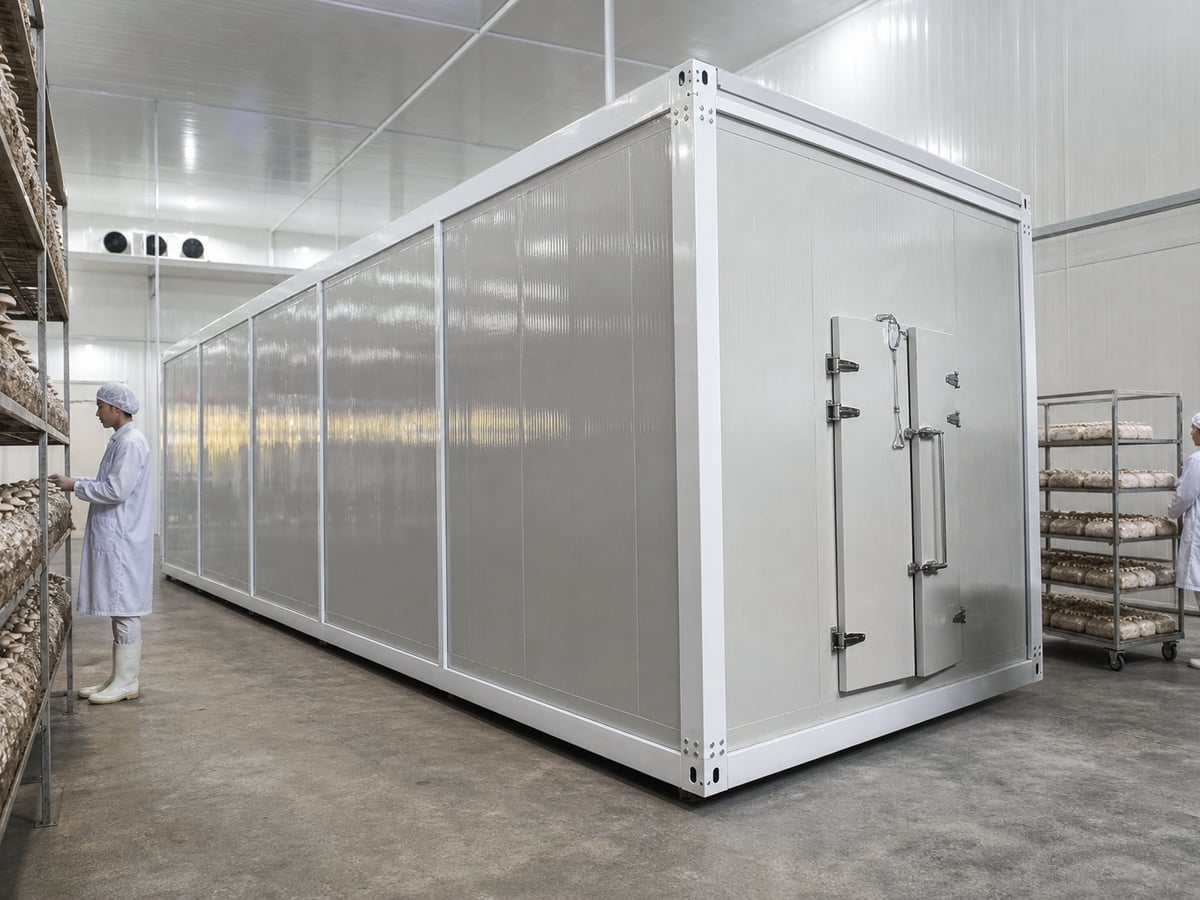
A mushroom growing room is a controlled cultivation space designed to maintain the temperature, relative humidity, carbon dioxide concentration, fresh-air exchange, airflow pattern, lighting, and sanitation conditions needed for commercial mushroom production. It can be a purpose-built insulated room inside a farm building, a modular panel room, or a containerized cultivation unit.
For the Global Market, a commercial mushroom growing room is commonly used to produce oyster mushrooms, shiitake, button mushrooms, king oyster mushrooms, enoki mushrooms, lion’s mane, wood ear mushrooms, and other high-value specialty varieties. Compared with conventional rooms that rely on manual ventilation and seasonal weather, a controlled mushroom room helps growers achieve more predictable crop cycles, reduce labor, protect substrate quality, and plan harvests for wholesale, retail, foodservice, and export channels.
The correct solution is not simply the largest room or the highest-capacity HVAC system. A suitable design begins with the mushroom species, substrate loading, shelf layout, local climate, utility availability, target crop cycle, biosecurity procedures, and production goals. In hot and humid regions, dehumidification and cooling capacity may be critical. In cold climates, heating, insulation, humidification, and frost protection can become the main design priorities.
Shandong Lanhu Air Conditioning Equipment Co., Ltd. supplies modular cultivation solutions, climate equipment, and engineering support for growers, distributors, and agricultural contractors worldwide. Buyers comparing a room-based project with a ready-to-deploy unit may also review Lanhu’s smart mushroom cultivation container solutions.
| Growing Room Type | Typical Scale | Best-Fit User | Main Benefit | Key Consideration |
|---|---|---|---|---|
| Retrofit farm room | Small to medium | Existing farms | Uses available building space | Existing insulation and drainage must be assessed |
| Insulated panel growing room | Medium to large | Commercial farms | Flexible dimensions and clean interior finish | Requires prepared building or structural enclosure |
| Containerized mushroom room | Compact modular scale | Startups, remote projects, pilots | Fast deployment and integrated systems | Internal layout is limited by container dimensions |
| Multi-room mushroom farm | Large commercial scale | Dedicated producers | Separate incubation, fruiting, and packing flows | Needs professional process and utility planning |
| Research cultivation room | Small controlled scale | Universities and labs | Precise environmental trials | May require higher sensor and data requirements |
| Wholesale supply room | Medium to large | Regional distributors | Supports consistent scheduled harvests | Must align output with cold chain and sales demand |
The table above shows why “mushroom growing room” is a broad term. The best option depends on whether the operation needs a single fruiting room, a complete farm process line, a mobile module, or a climate upgrade for an existing facility.
What Is a Mushroom Growing Room and Where Is It Used?
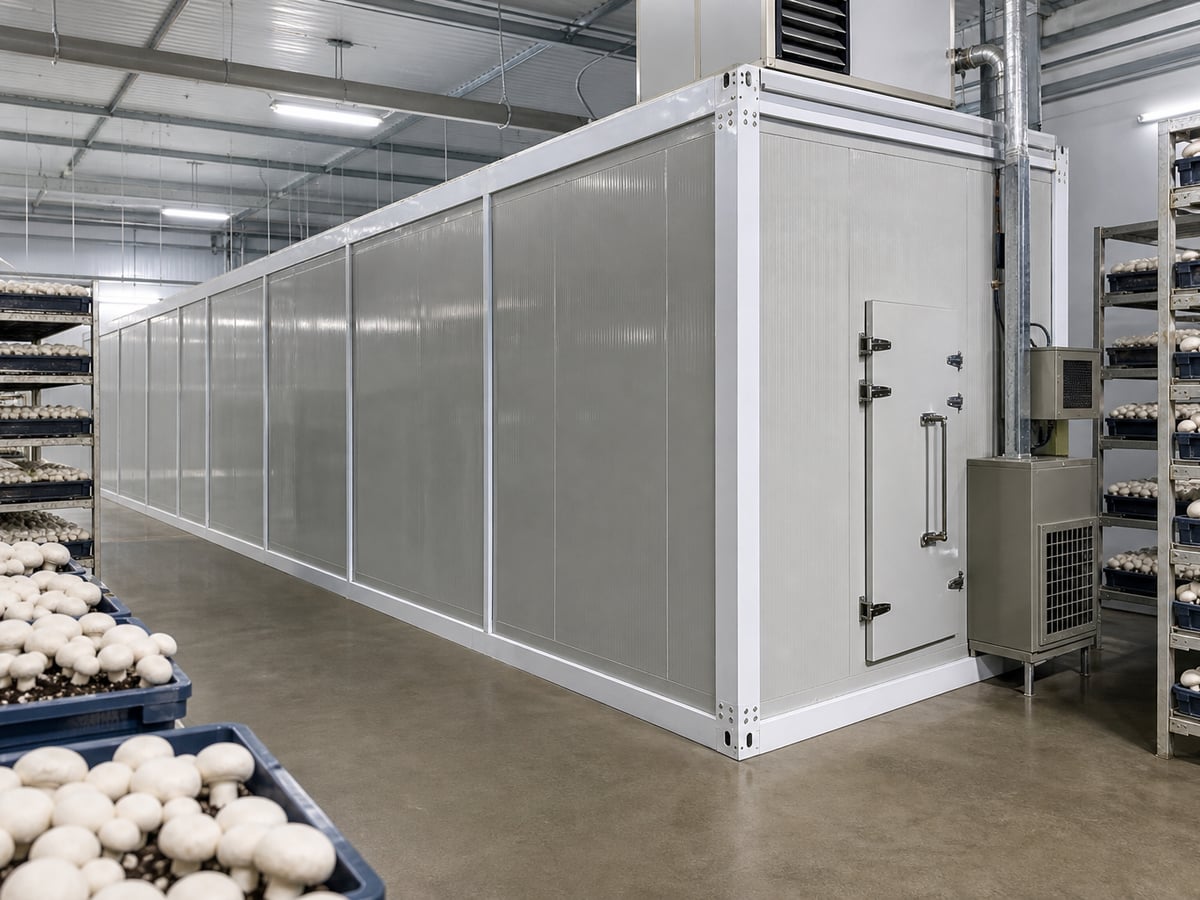
A commercial mushroom growing room is an enclosed agricultural environment where cultivation conditions are engineered rather than left to outdoor weather. The room normally contains insulated walls and ceiling panels, washable surfaces, shelving or hanging systems, climate equipment, airflow distribution components, drainage provisions, electrical systems, and a controller. Depending on the project scope, it may also include a pre-treatment area, incubation room, inoculation area, substrate handling area, cold storage, packing room, and utility room.
Growing rooms are used across the Global Market in urban farms, rural agricultural parks, food-processing zones, greenhouse complexes, research facilities, hospitality farms, cooperative production bases, and export-oriented mushroom projects. In humid tropical regions, growers may use them to avoid overheating, disease pressure, and uncontrolled condensation. In dry climates, they help maintain humidity and limit moisture loss from fruiting bodies. In temperate regions, they provide year-round production beyond the natural mushroom season.
Common commercial locations include agricultural supply corridors near Rotterdam and Hamburg in Europe, food distribution networks around Dubai and Jebel Ali in the Middle East, regional farm hubs near Singapore and Johor Bahru in Southeast Asia, and large urban consumption areas such as Toronto, Sydney, São Paulo, Johannesburg, and Los Angeles. The room itself can be installed close to substrate suppliers, wholesale markets, cold-chain warehouses, restaurants, or retail distribution centers.
Applications vary by crop. Oyster mushrooms generally require reliable fresh air, humidity control, and directional airflow during fruiting. Shiitake production often benefits from stable temperature stages and careful humidity management. Button mushroom farms commonly require more specialized compost, casing, shelving, and high-volume climate handling. Specialty mushrooms may need customized lighting schedules, lower contamination risk, or isolated production zones.
| Industry or User | Typical Application | Room Requirement | Operational Priority | Potential Expansion |
|---|---|---|---|---|
| Commercial mushroom farm | Continuous fresh mushroom production | Multiple fruiting rooms | Yield consistency and crop scheduling | Additional rooms and packing area |
| Agricultural cooperative | Shared production for local markets | Modular rooms with simple controls | Training and operating simplicity | Regional distribution network |
| Foodservice supplier | Fresh specialty mushroom supply | Clean fruiting room and cold handling | Harvest timing and quality | Premium varieties and contracts |
| Research institution | Variety and climate trials | Independent environmental zones | Data accuracy and repeatability | Experimental cultivation programs |
| Urban agriculture project | Local fresh-food production | Compact, efficient footprint | Low noise and remote management | Education, retail, and agritourism |
| Equipment distributor | Supply of turnkey cultivation units | Standardized modular product | Reliable delivery and service support | Local installation partner network |
This comparison explains the broad market use of controlled mushroom rooms. A regional wholesaler may prioritize stable weekly output, while a research project may prioritize environmental data, and a contractor may prioritize installation speed and repeatable system architecture.
Standard Product Configuration and System Boundaries
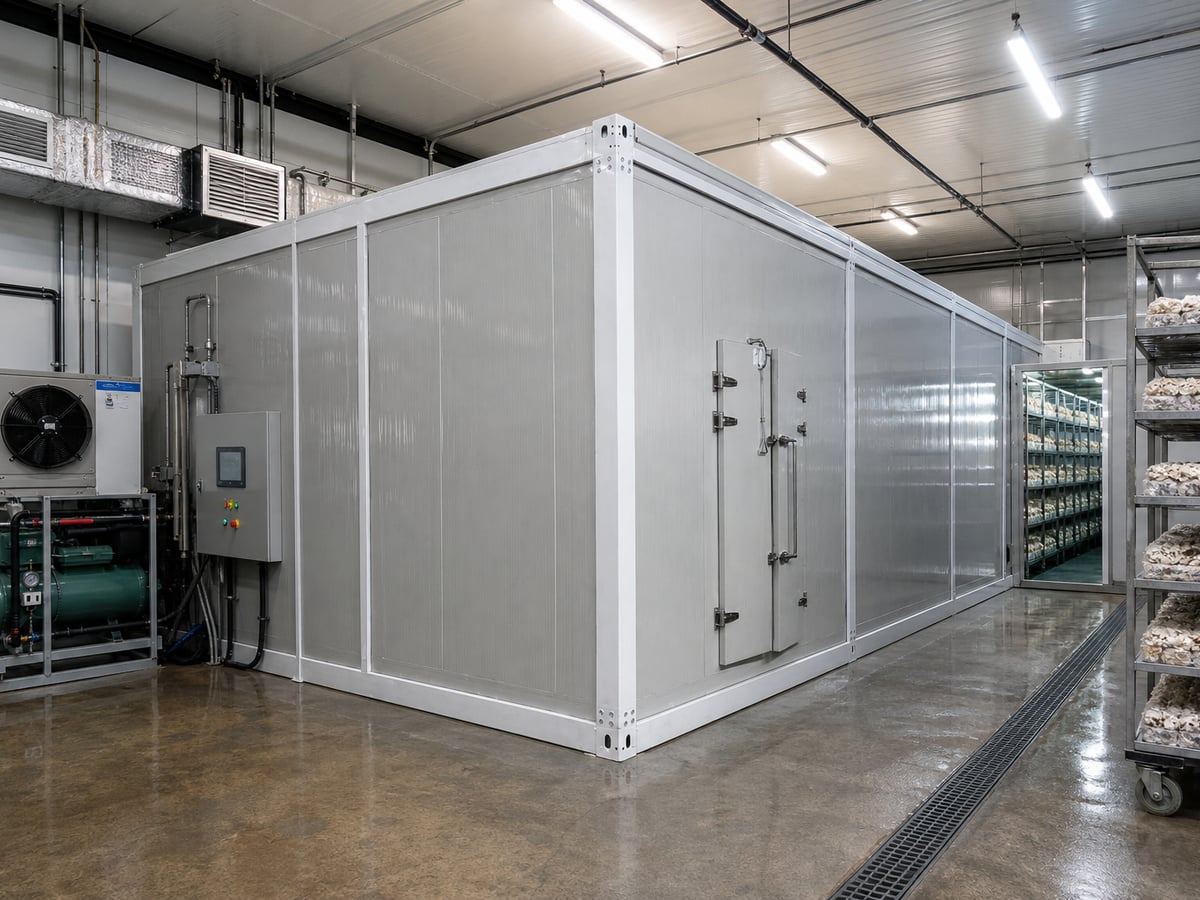
A standard mushroom growing room normally includes the controlled enclosure and the climate-control package required to operate the fruiting environment. The enclosure may use insulated sandwich panels, sealed doors, internal lighting, floor drainage interfaces, and corrosion-resistant internal surfaces. The climate package may include a heat pump or cooling source, electric or other heating option, humidification equipment, supply and return air ducts, fresh-air and exhaust dampers, circulation fans, sensors, electrical controls, and alarm functions.
System boundaries should be clarified before ordering. A supplier’s standard scope may cover room panels, equipment, controller, internal wiring, factory testing, and remote commissioning guidance. Site civil works, a concrete slab, external power connection, water supply pipework, drainage piping beyond the room, warehouse construction, substrate shelving, local permits, and installation labor may be included only when specifically listed in the commercial quotation.
For international projects, this distinction is important. A buyer in an inland location may need to organize local crane access, final electrical connection, water filtration, insulated utility pipes, and customs clearance. Buyers importing through Shanghai, Qingdao, Ningbo, Rotterdam, Hamburg, Jebel Ali, Durban, Santos, or Melbourne should also plan logistics timing, inland transport dimensions, and on-site unloading conditions.
A practical purchase specification should identify the mushroom species, room internal dimensions, number of racks, total substrate capacity, target setpoint range, ambient design conditions, power supply, water quality, drainage route, desired control language, and whether a remote monitoring platform is required. Clear project boundaries reduce delayed installation and prevent mismatched utilities.
| System Element | Common Standard Scope | Usually Confirmed Separately | Buyer Checkpoint | Why It Matters |
|---|---|---|---|---|
| Insulated enclosure | Panels, doors, seals, trims | Building structure or foundation | Internal size and panel thickness | Controls heat gain, loss, and sanitation |
| Climate equipment | Cooling, heating, air movement | External utility room or backup generator | Local ambient temperature | Determines stable crop conditions |
| Humidification | Humidifier and control interface | Water treatment or water tank | Water hardness and pressure | Protects equipment and product quality |
| Ventilation system | Fans, dampers, duct sections | External louvres and building penetrations | Air intake location | Supports CO2 removal and hygiene |
| Electrical control | Control cabinet, sensors, wiring | Main distribution board and site cabling | Voltage, frequency, grounding | Ensures safe and compatible operation |
| Installation support | Manuals and remote guidance | Local installers, lifting equipment | Site access and labor capability | Improves commissioning efficiency |
The table above is a planning tool rather than a fixed supply list. Each project should use its approved technical proposal and commercial contract as the final definition of scope.
Capacity, Dimensions, and Utility Requirements
Capacity should be calculated from usable cultivation area, rack configuration, substrate bag or block dimensions, aisle width, harvest method, and crop-management practices. A room with more shelves does not automatically produce more saleable mushrooms; airflow distribution, access for workers, sanitation, and harvest efficiency must remain adequate. Overloading a room can create stagnant zones, uneven humidity, excess carbon dioxide, and higher contamination risk.
Typical modular rooms can be designed from compact pilot units to larger multi-bay commercial rooms. Internal dimensions should allow workers to load substrate, inspect crop development, clean surfaces, and remove harvested mushrooms without damaging fruiting bodies. The required ceiling height depends on rack height, duct layout, lighting, sprinkler requirements where applicable, and maintenance access.
Utility planning is equally important. Electrical demand depends on cooling, heating, fans, humidification, lighting, controls, and optional refrigeration. Water consumption depends on humidification technology, cleaning procedures, and crop practices. A reliable drainage system is essential because condensation, washing, and humidifier discharge can create standing water if the floor slope and drain capacity are insufficient.
Before production starts, verify local voltage and frequency, such as 380–415V/50Hz three-phase, 208–240V/60Hz, or another site-specific supply. Water should be checked for sediment, hardness, microbial quality, and pressure. In areas with unstable grids, the project may need surge protection, phase-loss protection, voltage stabilization, or a backup power strategy.
| Planning Item | Small Pilot Room | Medium Commercial Room | Large Multi-Room Farm | Design Decision |
|---|---|---|---|---|
| Internal floor area | Typically compact | Designed around rack blocks | Multiple functional zones | Match production plan and building space |
| Substrate loading | Trial or local supply volume | Regular batch production | Staggered harvest program | Allow for aisles and airflow clearance |
| Electrical service | May use smaller connected load | Three-phase commonly preferred | Dedicated distribution and backup planning | Confirm actual equipment nameplate data |
| Water supply | Humidification and cleaning | Higher continuous availability | Treatment, storage, and monitoring possible | Assess pressure and mineral content |
| Drainage | Floor drain required | Graded floor and serviceable drain | Separated sanitation and process drainage | Avoid water accumulation and odors |
| Access route | Personnel and small deliveries | Pallet or trolley access | Dedicated loading and packing flow | Plan doors, aisles, and unloading space |
These categories are illustrative. Lanhu engineering teams can review room loading and environmental conditions to recommend equipment capacity rather than relying on a generic square-meter estimate alone.
Temperature, Humidity, CO2, Airflow, and Control Performance
Mushrooms respond directly to environmental conditions, but ideal values differ by variety, growth stage, substrate formulation, and farm management method. A commercial growing room should therefore be designed around adjustable operating ranges rather than one fixed temperature or humidity number. The controller should coordinate cooling, heating, humidification, ventilation, and circulation so that the environment is stable and changes are gradual enough to avoid crop stress.
Temperature affects mycelial activity, pinning, fruit body formation, harvest timing, and shelf-life quality. Relative humidity influences moisture retention and cap appearance, but excessive humidity combined with poor air movement may encourage condensation and disease. Carbon dioxide is produced by the mushrooms and substrate; it needs to be managed through fresh-air exchange rather than assumed to be controlled by circulation fans alone.
Airflow should be distributed across the crop without creating direct high-speed drafts that dry fruiting bodies. A good design separates supply, return, circulation, and exhaust functions where needed. Sensors should be installed in representative crop zones, not only near a cooling coil or fresh-air intake. Periodic calibration and practical crop observation remain necessary because sensor readings are only one part of environmental management.
Control performance depends on room insulation, outdoor conditions, crop heat load, door-opening frequency, substrate load, equipment selection, and maintenance. Buyers should request design assumptions and confirm that quoted capacities are suitable for their peak summer and winter ambient conditions.
| Environmental Factor | Purpose in Mushroom Production | Control Method | Operational Risk if Unmanaged | Recommended Management Practice |
|---|---|---|---|---|
| Temperature | Supports variety-specific growth stages | Cooling, heating, insulated enclosure | Slow growth, poor pinning, heat stress | Use stage-based setpoints and verify sensors |
| Relative humidity | Limits crop dehydration | Humidifier, fogging, ventilation coordination | Dry caps, condensation, disease pressure | Balance humidity with air movement |
| Carbon dioxide | Influences mushroom morphology and development | Fresh-air intake and controlled exhaust | Elongation, reduced quality, uneven crop | Monitor crop-level CO2 trends |
| Air circulation | Creates even room conditions | Fans, ducts, air distribution design | Dead zones and variable yield | Adjust fan operation after crop loading |
| Fresh-air exchange | Removes metabolic gases and heat | Dampers, intake filtration, exhaust fans | High CO2 and stale air | Protect intakes from dust and pests | Condensation control | Maintains clean crop surfaces | Insulation, airflow, dehumidification strategy | Bacterial blotch and wet surfaces | Inspect ceilings, walls, and ducts regularly |
The table clarifies that environmental variables are interdependent. Raising ventilation may lower CO2 but also reduce humidity and increase heating or cooling demand. Effective mushroom climate control uses coordinated logic instead of isolated equipment operation.
The chart is a general operational illustration, not a crop recipe. Environmental attention normally increases during pinning and fruiting, when crop uniformity, fresh-air exchange, humidity, and airflow balance have the greatest visible impact.
Core Components, Materials, and Protection Features
A durable mushroom growing room combines a hygienic enclosure with reliable climate-control components. Insulated sandwich panels are often selected for walls and ceilings because they provide thermal performance, a smooth cleanable surface, and modular installation. Panel thickness and core material should be selected according to outdoor climate, room setpoints, fire requirements, and local building codes.
Internal materials should resist moisture, routine cleaning, and agricultural operating conditions. Door frames, hinges, fasteners, drainage hardware, duct sections, and rack materials should be chosen with corrosion resistance in mind. In coastal markets near ports such as Jebel Ali, Rotterdam, Santos, Durban, and Manila, salt-laden air and high humidity can increase corrosion exposure, particularly where external equipment is installed.
Protection features may include electrical overload protection, phase-loss protection, high- and low-pressure protection for refrigeration circuits, temperature alarms, water-shortage alarms, emergency stop functions, door seals, intake filters, insect screens, and controller password management. The required protection package should reflect local electrical quality, operating temperatures, staffing level, and insurance requirements.
For food-oriented operations, interior design should support washdown and sanitation. Avoid unnecessary ledges, difficult-to-clean corners, exposed absorbent materials, and unsealed penetrations. Floor slope, drainage access, service clearance, and removable filters can influence long-term hygiene more than decorative finishes.
Automation, Remote Monitoring, and Customization Options
Automation enables a mushroom growing room to run programmed climate stages with less manual switching. A controller can collect temperature, humidity, and CO2 data and activate cooling, heating, humidification, exhaust fans, circulation fans, dampers, lighting, and alarms according to configured logic. Advanced projects may include multi-room coordination, trend records, historical alarms, user permissions, recipe-based stage settings, and remote access through a computer or mobile device.
Lanhu develops smart climate solutions for controlled agriculture, including the smart mushroom climate controller. Automation does not replace skilled crop management; it gives farm teams a more consistent way to apply their cultivation recipes, identify deviations, and respond before a problem affects a full harvest cycle.
Customization options can include room dimensions, door positions, rack arrangement, panel thickness, climate capacity, electrical standard, control language, sensor quantity, ventilation filtration, stainless-steel components, lighting configuration, external equipment housing, and branding for OEM projects. A distributor may require private labeling and standardized documentation, while a farm operator may require a layout built around local substrate crates or shelf dimensions.
By 2026, the Global Market is expected to see wider adoption of connected cultivation systems, energy-management dashboards, predictive maintenance alerts, variable-speed fan control, and data-driven crop recipes. Sustainability expectations are also increasing. Buyers are asking for better insulation, lower-energy heat-pump solutions, water-saving humidification practices, refrigerant compliance planning, and designs that reduce food miles by enabling production near consumption centers.
Policy trends can influence projects as well. Energy-efficiency regulations, refrigerant rules, food traceability requirements, workplace safety standards, and water-discharge regulations vary by country. A responsible project should confirm local permitting, food handling, electrical safety, fire protection, and worker safety obligations before installation.
Installation, Commissioning, Maintenance, and Warranty
Successful installation begins before equipment arrives. The site should have a level foundation or suitable building floor, confirmed drainage, approved electrical supply, water access, ventilation penetrations where required, safe equipment access, and sufficient space for maintenance. Modular panels should be assembled according to the layout drawing, with careful attention to panel joints, vapor sealing, door alignment, floor interfaces, and service openings.
Commissioning should include an inspection of wiring, grounding, phase sequence, fan rotation, drainage, water connections, refrigeration operation, humidification output, sensor readings, controller logic, alarm functions, door seals, and air distribution. The room should be run under no-load and loaded conditions where possible because substrate and crop respiration change the room’s thermal and moisture behavior.
Routine maintenance protects operating stability. Operators should inspect filters, humidifier nozzles or components, drains, coil cleanliness, fan vibration, door gaskets, sensor accuracy, electrical terminals, and alarm history. Water quality should be monitored because mineral buildup can reduce humidification efficiency. Cleaning schedules should include room surfaces, drainage channels, intake screens, and areas behind removable panels or equipment covers where permitted.
Warranty terms should be stated in the sales contract and may vary by equipment type, project scope, destination, installation responsibility, and operating conditions. Buyers should retain commissioning records, maintenance logs, and photographs of any issue to support efficient technical evaluation. Lanhu can provide installation guidance, spare-parts support, international logistics coordination, and after-sales communication for qualified projects. For customized requirements, visit the OEM and ODM service page.
Our Company
Shandong Lanhu Air Conditioning Equipment Co., Ltd. is a Dezhou, Shandong-based manufacturer focused on agricultural climate control equipment, industrial HVAC systems, modular cultivation systems, smart mushroom cultivation containers, hydroponic plant containers, and air-source heat-pump solutions. Its experience in thermodynamic research and development supports practical environmental-control design for modern agriculture.
Technological capability is built around more than 12 years of thermodynamic development experience, a portfolio of more than 45 registered patents, and integrated work in climate control, electrical control, airflow management, and agricultural automation. This allows Lanhu to support room-specific engineering discussions instead of treating every mushroom project as a standard refrigeration purchase.
Manufacturing capability includes a modern facility of more than 30,000 square meters, with product design, engineering development, sheet-metal fabrication, CNC bending, insulation panel production, electrical assembly, system integration, equipment testing, and quality inspection performed within an integrated production process. Systems are subject to functional inspection, electrical verification, performance testing, and operational evaluation before shipment. The company holds ISO 9001, ISO 14001, ISO 45001, and ISO 12100 certifications.
Service capability covers factory-direct supply, engineering assistance, OEM and ODM customization, export logistics support, spare-parts coordination, installation guidance, and after-sales service. Lanhu works with agricultural contractors, equipment distributors, engineering companies, and commercial farming projects across the Global Market. Prospective buyers can review selected mushroom cultivation project cases to understand possible applications, then contact the Lanhu team with site conditions, crop type, and target capacity.
FAQ
What information is needed to quote a mushroom growing room?
Provide the mushroom species, target production capacity, substrate type and loading method, required room dimensions, location, outdoor temperature range, local voltage and frequency, water source, drainage arrangement, and preferred automation level. Photographs or drawings of the installation site are also useful.
Can one mushroom room grow different mushroom species?
It can, but different varieties may require different climate conditions and sanitation procedures. Separate rooms are often more efficient when growing species with significantly different temperature, humidity, CO2, or crop-cycle requirements.
Does the growing room include mushroom racks?
Rack systems may be included as a customized option, but the scope should be confirmed in the quotation. Rack design depends on bag size, block weight, shelf loading, aisle width, harvest method, and cleaning practices.
How important is insulation in a mushroom farm?
Insulation is essential because it reduces heat gain and loss, helps control condensation, lowers climate equipment load, and improves setpoint stability. The appropriate panel specification depends on climate, internal conditions, and local building requirements.
Can the system be monitored remotely?
Selected configurations can support remote monitoring and alarm functions. Internet availability, local network security, controller configuration, and applicable communication methods should be reviewed during project planning.
What maintenance is most important?
Maintain clean filters, drains, humidification components, coils, sensors, fans, door seals, and electrical connections. Regular sanitation and water-quality management are especially important in humid mushroom production environments.
Can Lanhu customize a solution for local standards?
Yes. Projects can be evaluated for local voltage, frequency, climate conditions, language requirements, equipment layout, room dimensions, automation needs, and transportation constraints. Final compliance with site-specific regulations should be confirmed with qualified local professionals where required.
Share this article

About the Author: Shandong Lanhu Air Conditioning Equipment
Lanhu is a professional climate control equipment manufacturer specializing in smart agricultural systems, commercial HVAC solutions, and customized temperature control technologies. With extensive engineering experience, Lanhu provides reliable solutions for plant factories, controlled environment agriculture, and industrial applications.
Need a Custom Climate Control Solution?
From smart agricultural systems to commercial HVAC solutions, Lanhu provides reliable temperature and humidity control solutions tailored to your project needs.
Contact Us