Global Market Mushroom Farm Cost, Yield and ROI Guide
Quick Answer

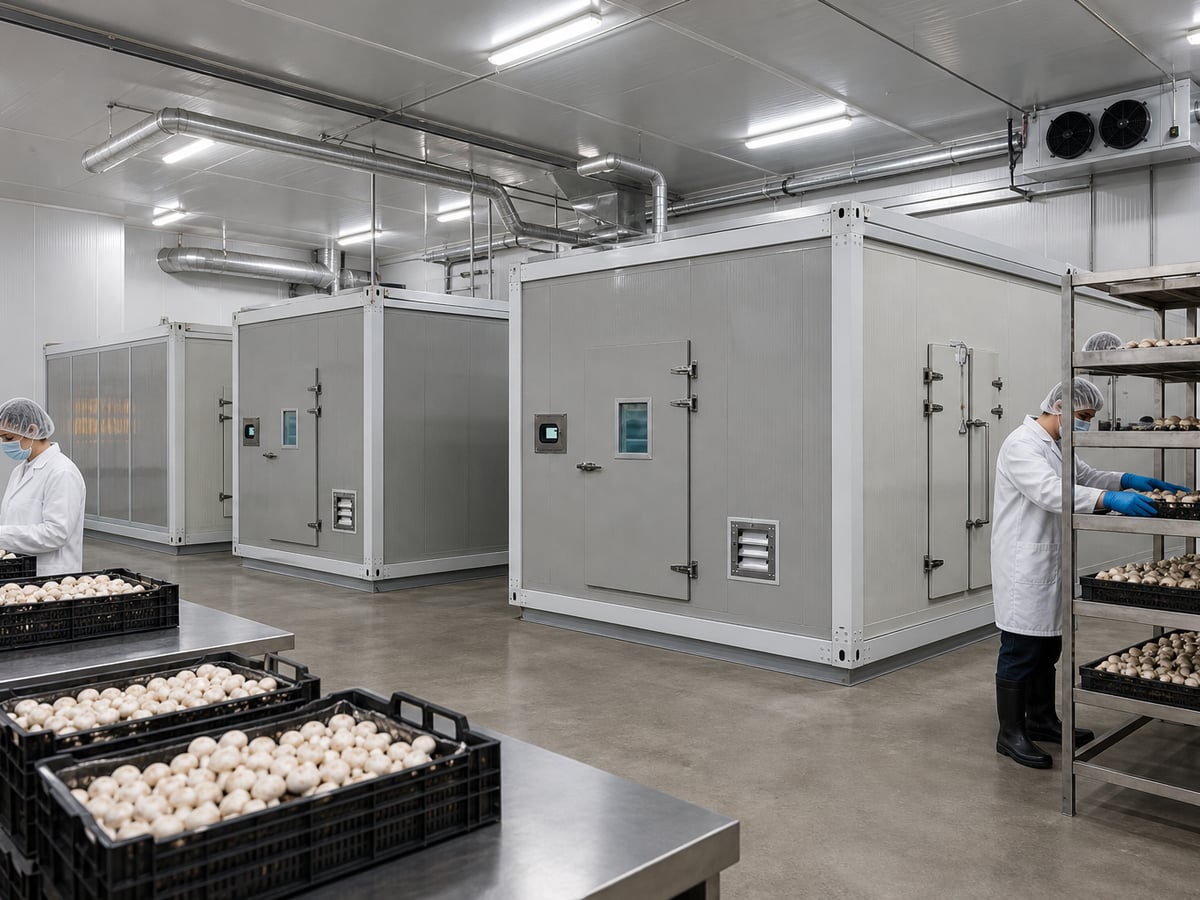
A commercial mushroom farming business plan should calculate total investment, operating expenses, crop capacity, expected yield, selling price, and cash-flow risk before equipment is ordered. For the Global Market, a small controlled mushroom project may start with one insulated cultivation container, while a larger farm may combine several growing rooms, substrate preparation equipment, cold storage, packing facilities, and centralized climate control.
Typical commercial investment ranges vary widely because mushroom species, local construction conditions, energy tariffs, labor rates, import duties, and food-market requirements differ by country. A compact containerized oyster mushroom operation may require approximately US$25,000 to US$90,000 for equipment and installation, excluding land. A purpose-built multi-room commercial farm can require US$150,000 to more than US$1 million depending on production scale, automation, cold-chain infrastructure, and substrate handling.
The most reliable approach is to design the business model from market demand backward. First, identify buyers such as wholesalers, supermarkets, hotels, restaurants, meal-kit companies, processors, and local produce distributors. Then set a weekly sales target, calculate the necessary harvest volume, determine the number of fruiting blocks or growing shelves required, and select climate-control equipment that can maintain stable temperature, humidity, fresh-air exchange, and carbon dioxide levels.
For many growers, the highest-impact factors are not the purchase price of the growing room alone. Electricity consumption, biological contamination, labor efficiency, local sales price, harvesting consistency, and access to reliable substrate can change project profitability more than a small difference in equipment cost. A well-designed smart mushroom cultivation container can reduce construction uncertainty and accelerate start-up, especially where land development, building permits, or skilled farm labor are challenging.
| Commercial Farm Scale | Typical Production Format | Indicative CAPEX Range | Potential Monthly Output | Common Sales Channel | Planning Priority |
|---|---|---|---|---|---|
| Trial commercial | One compact growing container | US$25,000–US$60,000 | 0.8–2.5 tonnes | Local restaurants and direct retail | Validate crop and customer demand |
| Small commercial | One or two insulated growing modules | US$60,000–US$150,000 | 2–6 tonnes | Wholesalers and specialty stores | Standardize weekly harvest |
| Regional supplier | Multi-room controlled farm | US$150,000–US$500,000 | 6–25 tonnes | Retail distribution networks | Cold chain and labor workflow |
| Industrial producer | Dedicated building and substrate line | US$500,000–US$2 million+ | 25–120 tonnes | Supermarkets and processors | Automation and biosecurity |
| Export-oriented farm | Integrated growing, packing, cold storage | US$1 million+ | 50–200 tonnes | Exporters and regional hubs | Certification and logistics |
| Premium specialty farm | Small rooms for several mushroom species | US$80,000–US$350,000 | 2–15 tonnes | Chef, wellness, and gourmet markets | High unit value and branding |
These ranges are planning estimates rather than quotations. A farm near Rotterdam, Dubai, Singapore, Los Angeles, São Paulo, Nairobi, Johannesburg, Mumbai, or Sydney may face very different land costs, power prices, shipping lead times, certification requirements, and labor conditions. Before committing capital, request a technical layout, crop assumptions, electrical load estimate, ventilation calculation, and itemized supply scope.
Mushroom Farming Business Plan: Typical Commercial Cost Structure

A practical mushroom farming business plan separates one-time capital expenditure from recurring operating expenditure. It should also identify working capital, because a growing facility may consume cash for spawn, substrate, utilities, payroll, packaging, and freight before regular customer payments are received.
Commercial mushroom farms usually produce oyster mushrooms, shiitake, king oyster mushrooms, enoki, lion’s mane, button mushrooms, or specialty medicinal varieties. Oyster mushrooms are often selected for modular projects because their crop cycle is relatively fast and they can be cultivated on straw, sawdust, cottonseed hulls, or other locally available agricultural by-products. Shiitake and king oyster production can produce higher prices in some markets, but they often require more precise crop management and longer cycles.
The business model should state whether the operation will buy ready-to-fruit blocks, buy fully colonized substrate, manufacture its own substrate, or operate an integrated spawn-to-harvest facility. Purchasing ready-to-fruit blocks reduces initial technical complexity but increases unit production cost and supplier dependence. Producing substrate internally can improve margin at scale, yet it requires pasteurization or sterilization equipment, mixing, bagging, inoculation areas, quality control, and stricter hygiene.
| Cost Category | Typical Share of Initial Budget | What It Includes | Why It Matters | Common Underestimate | Control Method |
|---|---|---|---|---|---|
| Growing equipment | 20%–40% | Shelves, humidifiers, fans, sensors, controls | Determines crop environment | Backup components | Specify critical spares |
| Building or container | 15%–35% | Insulated room, panels, doors, flooring | Protects climate stability | Site preparation | Complete civil survey |
| Utilities connection | 5%–20% | Electrical works, water, drainage, gas | Supports continuous operation | Power upgrades | Confirm available capacity |
| Cooling and heating | 10%–25% | Heat pumps, refrigeration, ducting | Largest energy influence | Hot-climate sizing | Use local design temperatures |
| Substrate and crop inputs | 5%–15% | Blocks, spawn, bags, additives | Directly affects yield | Waste and rejects | Budget quality losses |
| Working capital | 10%–25% | Payroll, packaging, freight, stock | Protects early cash flow | Slow customer payments | Allow 3–6 months |
Market research should define both selling price and buyer behavior. Fresh mushrooms are perishable, and harvest quality declines quickly without appropriate cold storage and dispatch planning. A grower supplying a wet market may sell at a lower price but receive daily cash payments. A supplier selling to a supermarket may obtain stable volume but may need barcodes, food safety records, standardized packaging, insurance, and payment terms of 30 to 90 days.
CAPEX: Equipment, Building, Utilities, and Controls

Capital expenditure includes every asset needed to create a stable production environment. The basic system normally includes insulated growing space, racks, climate-control equipment, humidification, ventilation, fresh-air intake, exhaust systems, electrical control panels, sensors, water supply, drainage, lighting, packing tools, and cleaning equipment.
For modular projects, containerized production can simplify the construction process. A factory-built cultivation module is typically delivered with insulated panels, internal racking, air distribution, humidification, drainage, control systems, and lighting configured for a defined crop. It can be suitable for farms located near metropolitan demand centers, including Dubai’s food-service market, the logistics zones around Singapore, African city markets such as Lagos and Nairobi, or remote agricultural areas with limited construction capacity.
Building-based farms offer more flexibility for large facilities. They can include separate incubation rooms, fruiting rooms, packing rooms, chilled storage, substrate preparation zones, staff changing rooms, and clean areas. However, they require more project coordination and may involve local architects, HVAC contractors, electrical contractors, food-safety consultants, and municipal approval processes.
| CAPEX Item | Primary Function | Price Driver | Recommended Specification Question | Risk if Omitted | Useful Upgrade |
|---|---|---|---|---|---|
| Insulated cultivation room | Maintains internal conditions | Size, panel thickness, floor design | What is the local ambient temperature range? | High cooling losses | Higher-density insulation |
| Racking system | Holds blocks or trays | Material grade and tier count | How many kilograms per square meter? | Low capacity or corrosion | Food-grade galvanized racks |
| Climate controller | Coordinates temperature and humidity | Automation level and sensor count | Can recipes be adjusted remotely? | Inconsistent crops | Data logging and alarms |
| Fresh-air system | Controls carbon dioxide | Fan capacity and filtration | What airflow is needed at peak fruiting? | Long stems and poor caps | Variable-speed fans |
| Humidification system | Maintains crop humidity | Water quality and nozzle design | Will local water create scale? | Drying and poor flushes | Water filtration |
| Cold room and packing area | Protects harvested product | Storage volume and temperature | How many harvest days must be stored? | Post-harvest losses | Pre-cooling capability |
Controls are central to crop performance. Mushroom climate systems need to manage temperature, relative humidity, carbon dioxide concentration, air movement, fresh-air exchange, and sometimes lighting schedules. The required precision differs by species and stage. A mushroom climate controller can automate these routines, record environmental history, and alert managers when conditions move outside defined limits.
Do not size equipment using average weather alone. Use peak summer temperature, winter minimum temperature, humidity extremes, elevation, solar exposure, and local utility reliability. A farm in Riyadh, inland Australia, northern China, or tropical Southeast Asia may need a substantially different cooling and dehumidification strategy from a farm in northern Europe.
OPEX: Energy, Labor, Water, Consumables, and Maintenance
Operating expenses determine whether a mushroom farm can maintain healthy margins after the initial investment. The major recurring costs are substrate or fruiting blocks, electricity, labor, packaging, water, cleaning supplies, maintenance, freight, sales expenses, and management overhead. Energy can become a major cost where cooling demand is high or electricity tariffs are elevated.
Labor requirements depend on whether the farm purchases ready-to-fruit blocks or makes its own substrate. A simple fruiting operation needs staff for receiving blocks, loading shelves, monitoring crops, harvesting, grading, packing, cleaning, and dispatch. An integrated facility needs additional labor and technical competence for raw-material processing, sterilization, inoculation, incubation, and contamination management.
| OPEX Category | Typical Cost Influence | Examples | Margin Impact | Reduction Strategy | Monitoring Metric |
|---|---|---|---|---|---|
| Substrate or fruiting blocks | Very high | Ready-to-fruit bags, spawn, additives | Direct cost per kilogram | Qualify multiple suppliers | Cost per harvested kg |
| Electricity | High in hot or cold climates | Cooling, heating, fans, pumps | Can erode seasonal profit | Insulation and efficient heat pumps | kWh per kg |
| Labor | High for manual harvest | Harvesting, cleaning, packing | Depends on workflow design | Use standardized racks and routes | Labor hours per tonne |
| Water and treatment | Moderate | Humidification and sanitation | Depends on water quality | Recycle where legally suitable | Liters per kg |
| Packaging | Moderate | Punnets, trays, labels, cartons | Critical for retail customers | Optimize pack sizes | Packaging cost per unit |
| Maintenance and spares | Moderate but essential | Filters, pumps, sensors, belts | Protects uptime | Preventive maintenance plan | Downtime hours |
Water is often treated as a low-cost input, but quality matters. Hard water can block nozzles, create mineral deposits, and increase maintenance. Water containing undesirable microbial loads may compromise hygiene practices. Farms should test local water before selecting humidification equipment and should design drainage to avoid stagnant water, odors, and pest pressure.
Maintenance should include cleaning air filters, inspecting fans, calibrating sensors, checking drainage, servicing refrigeration equipment, verifying electrical safety, and holding basic spare parts. A failed humidity sensor, pump, or fan can affect a crop within hours. The cost of a small spare-parts inventory is usually lower than the loss caused by a missed harvest cycle.
Capacity and Production Assumptions Behind the Estimate
Capacity should be calculated using usable rack area, the number of blocks per shelf, block weight, crop cycle length, biological efficiency, expected contamination rate, flush distribution, and planned harvest frequency. It is not enough to multiply room size by a theoretical yield figure. Real production requires walkways, service access, loading zones, cleaning intervals, and crop rotation space.
For example, a farm using 2.5 kg oyster mushroom fruiting blocks may plan a total fresh yield of roughly 0.5 to 1.0 kg per block over the productive cycle, depending on strain, substrate quality, climate control, and management. A conservative business plan should use lower initial yield assumptions and include a gradual improvement curve as staff learn the crop.
Production should be staggered so that blocks enter fruiting rooms each week. This creates a predictable harvest schedule for customers and improves labor planning. If all blocks are loaded at once, the farm may experience a short harvest surge followed by weeks of low supply, which makes contracts with retailers or wholesalers difficult to maintain.
| Production Assumption | Conservative Scenario | Base Scenario | Strong Scenario | Business Effect | Management Lever |
|---|---|---|---|---|---|
| Yield per 2.5 kg block | 0.50 kg | 0.70 kg | 0.95 kg | Changes revenue directly | Crop recipe and substrate quality |
| Contamination or discard rate | 12% | 6% | 3% | Reduces sellable output | Hygiene and supplier quality |
| Average sales price | US$2.20/kg | US$3.20/kg | US$5.00/kg | Defines gross revenue | Channel and product grade |
| Electricity cost | US$0.25/kWh | US$0.15/kWh | US$0.08/kWh | Changes operating margin | Energy contract and efficiency |
| Labor productivity | Low automation | Organized manual workflow | Highly optimized workflow | Changes payroll per kg | Training and layout |
| Customer payment timing | 60–90 days | 30 days | Cash or weekly payment | Changes working capital need | Credit policy and buyer mix |
Use the base scenario for financing discussions, but make funding decisions only after checking the conservative case. If the farm cannot survive a modest yield reduction, a temporary electricity-price increase, or a lower selling price, it requires additional working capital, a revised scale, or a better sales strategy.
Specifications and Customization That Change Price
Customization changes both equipment price and long-term operating performance. Important specifications include container dimensions, insulation thickness, rack layout, number of growing zones, climate capacity, air-source heat pump sizing, electrical voltage, water treatment, remote monitoring, backup power connection, cold-room integration, and surface materials.
A standard unit can be suitable for growers with a single crop and moderate local climate. A customized project may be preferable when the farm needs to produce several species, operate in extreme heat, use local power standards, meet a retailer’s traceability requirements, or fit a restricted installation site. Farms near ports such as Jebel Ali, Hamburg, Rotterdam, Durban, Santos, or Long Beach should also consider freight dimensions, inland transport access, unloading equipment, and customs documentation.
Buyers should ask for a complete scope list: included equipment, excluded civil works, electrical requirements, water connection point, drainage needs, installation support, spare parts, control language, commissioning scope, warranty terms, and expected delivery schedule. Comparing incomplete quotations can create false savings.
Yield, Revenue, Margin, and Break-Even Scenarios
Revenue equals sellable kilograms multiplied by the realized average selling price. The realized price is not always the quoted retail price. It must account for wholesale discounts, rejected product, promotional allowances, packaging costs, delivery charges, and product mix. Fresh premium mushrooms may achieve higher pricing through chef relationships, farmers’ markets, premium grocers, and direct subscriptions, while bulk supply generally offers lower price but higher volume stability.
Gross margin should cover crop input, packaging, direct labor, energy, and direct logistics. Net margin must also cover rent, administration, interest, depreciation, insurance, quality certification, marketing, repairs, taxes, and owner compensation. Break-even occurs when monthly gross profit covers total fixed monthly costs and debt obligations.
A simple break-even formula is: required monthly kilograms = monthly fixed costs divided by contribution margin per kilogram. If a farm has fixed monthly costs of US$12,000 and earns US$1.50 contribution margin per kilogram after direct costs, it needs approximately 8,000 kg of sales per month to break even. If realized price falls or energy cost rises, the required volume increases quickly.
The chart is illustrative only. Actual results should be calculated using local prices and verified farm data. In high-value urban markets, growers may improve margin by selling mixed mushroom boxes, chef-grade selections, dried mushrooms, powder, or value-added products. These routes require additional food processing controls and branding investment.
Hidden Costs, Risk Allowances, and Sensitivity Analysis
Hidden costs can delay farm profitability. Common examples include land grading, concrete pads, permits, transformer upgrades, backup generators, customs clearance, inland transport, forklift rental, import taxes, water filtration, ventilation duct modification, staff training, certification audits, product insurance, laboratory testing, and unsold inventory.
Risk allowance should be included as a defined line in the business plan, not ignored. For many projects, a contingency of 10% to 15% of equipment and installation spending is prudent. Higher allowances may be appropriate where exchange rates are volatile, construction conditions are uncertain, or equipment is imported across long logistics routes.
Sensitivity analysis should test at least five variables: yield, selling price, block cost, electricity price, and labor cost. The strongest business plans also test delayed commissioning, lower customer demand, crop contamination, and slow payment collection. This is especially important for farms dependent on a single buyer or a single substrate supplier.
By 2026, mushroom farming is expected to become more data-driven. Climate recipe automation, remote fault alerts, energy monitoring, heat-pump integration, water-efficient humidification, carbon-footprint reporting, and digital traceability are becoming stronger purchasing criteria. Sustainability policies in many Global Market regions increasingly favor circular use of agricultural residues, lower food waste, reduced chemical inputs, and shorter supply chains. Farms that can document resource efficiency and consistent food safety may gain improved access to retailers, hospitality groups, and institutional buyers.
Our Company
Shandong Lanhu Air Conditioning Equipment Co., Ltd. supports commercial mushroom projects with controlled-environment equipment designed for agricultural production. Its technological capabilities are built around more than 12 years of thermodynamic research and development, with climate solutions for mushroom cultivation, hydroponic growing, and energy-efficient agricultural HVAC applications. The company develops smart controls that help growers manage temperature, humidity, ventilation, and operating conditions according to crop requirements.
Its manufacturing capabilities include an integrated production facility in Dezhou, Shandong, covering more than 30,000 square meters. The production process includes engineering development, sheet metal fabrication, CNC bending, insulation panel production, electrical assembly, system integration, testing, and quality inspection. Systems undergo functional, electrical, performance, and operational checks before shipment. This supports consistent factory-direct supply for growers, contractors, distributors, and engineering companies across the Global Market.
Lanhu’s service capabilities include OEM and ODM support, technical configuration assistance, international logistics coordination, installation guidance, spare-parts support, and after-sales service. Buyers seeking a specialized layout, local voltage adaptation, crop-specific climate settings, or branded equipment can explore the company’s OEM and ODM customization service. Practical project examples are also available through the mushroom cultivation project cases page.
For a project-specific estimate, prepare your target species, desired weekly output, site location, local summer and winter temperature, available electrical supply, water quality information, preferred sales channel, and whether you will use purchased blocks or in-house substrate. You can then contact the Lanhu project team for equipment recommendations and commercial planning support.
FAQ
How much does it cost to start a commercial mushroom farm?
Commercial start-up cost may range from approximately US$25,000 for a compact controlled growing module to several hundred thousand dollars for a multi-room farm. Land, civil works, local utility upgrades, substrate production, and cold storage can significantly increase the total investment.
Which mushroom type is best for a first commercial project?
Oyster mushrooms are often a practical starting point because they have a relatively short crop cycle and broad market familiarity. The best option still depends on local buyer demand, substrate availability, climate conditions, and the production knowledge available to the farm.
How long does mushroom farm break-even take?
Break-even may occur within two to five years for a well-managed project, but the timeline depends on capital cost, financing terms, crop yield, energy expense, selling price, and market access. Conservative cash-flow planning is essential.
Does a mushroom farm need cold storage?
Cold storage is strongly recommended for most commercial farms. It helps preserve product quality after harvest, supports packing schedules, reduces waste, and allows more reliable dispatch to wholesalers, retailers, restaurants, and export consolidators.
What is the largest operating cost in mushroom cultivation?
For fruiting-only farms, substrate or ready-to-fruit blocks are often the largest direct cost. In hot climates, electricity for cooling can become equally important. For integrated farms, labor, sterilization energy, and raw substrate handling can be major expenses.
Can mushroom cultivation containers operate in hot countries?
Yes, provided that insulation, cooling capacity, ventilation design, drainage, and electrical supply are correctly specified for local weather conditions. A technical assessment should use the site’s peak summer temperature rather than average annual conditions.
What information is needed for an accurate quotation?
Provide the mushroom species, expected production capacity, site location, local climate, power voltage and capacity, water source, available installation area, preferred container or building format, and any special requirements for cold storage, remote monitoring, or automation.
Share this article

About the Author: Shandong Lanhu Air Conditioning Equipment
Lanhu is a professional climate control equipment manufacturer specializing in smart agricultural systems, commercial HVAC solutions, and customized temperature control technologies. With extensive engineering experience, Lanhu provides reliable solutions for plant factories, controlled environment agriculture, and industrial applications.
Need a Custom Climate Control Solution?
From smart agricultural systems to commercial HVAC solutions, Lanhu provides reliable temperature and humidity control solutions tailored to your project needs.
Contact Us