Turnkey Mushroom Farms for the Global Market: Buyer's Guide
Quick Answer

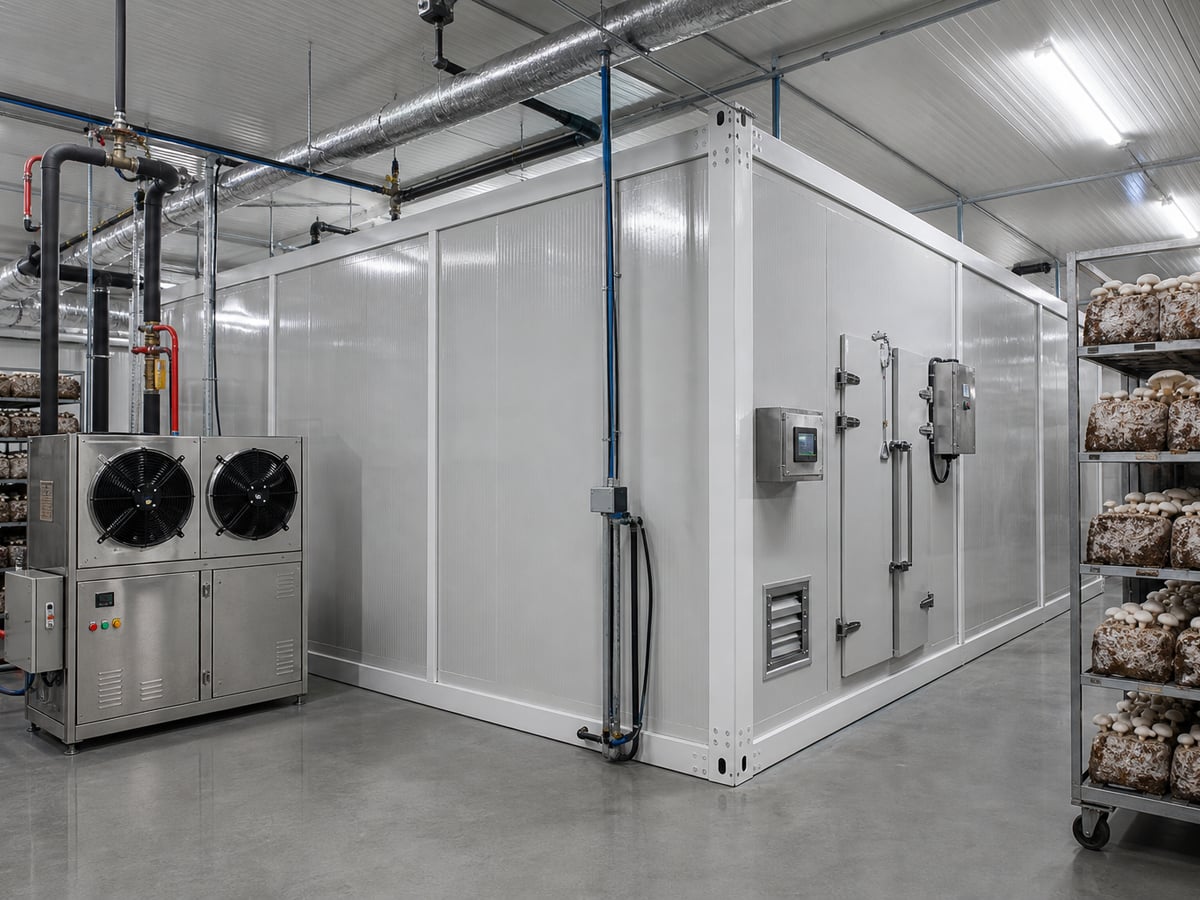
A turnkey mushroom farm is a complete, engineered cultivation system delivered as an integrated project rather than a collection of separate machines. It typically combines insulated growing rooms or modular containers, refrigeration or heat-pump equipment, humidification, fresh-air exchange, CO2 management, circulation fans, sensors, electrical controls, shelving, and commissioning support. The goal is to create repeatable growing conditions for mushrooms such as oyster mushrooms, shiitake, button mushrooms, lion’s mane, enoki, king oyster mushrooms, and specialty varieties.
For the Global Market, a turnkey mushroom farm can range from a compact containerized unit for local restaurants and urban farms to a multi-room commercial facility serving wholesale distributors, food processors, supermarkets, and export-oriented growers. Buyers should evaluate the project as a climate-control and production system, not only as a building. Crop variety, substrate method, room size, local weather, electrical supply, water quality, labour availability, food-safety requirements, and delivery access all influence the final configuration.
A reliable supplier should define what is included, what is excluded, the expected environmental control range, utility requirements, installation responsibilities, and after-sales support. For operators seeking a compact modular solution, a smart mushroom cultivation container can provide a faster route to controlled production where conventional construction is expensive or slow.
What Is a Turnkey Mushroom Farm and Where Is It Used?

A turnkey mushroom farm is designed to simplify the transition from a cultivation plan to an operating production site. Instead of sourcing panels, cooling units, humidifiers, fans, sensors, shelving, and controllers from different vendors, the buyer receives a coordinated system with matched capacities and controls. This approach reduces interface risks, helps shorten commissioning time, and creates clearer accountability for environmental performance.
Turnkey systems are used across climates and business models. In hot and humid regions, they help producers manage cooling load, fresh-air moisture, and contamination pressure. In cold climates, they support stable heating and humidity during winter. In dry regions, they can reduce water waste through controlled atomization and recirculation strategies. In cities such as Dubai, Singapore, London, Toronto, Johannesburg, São Paulo, Rotterdam, Los Angeles, and Sydney, modular mushroom farms can serve fresh local markets with shorter transport distances.
Commercial users include independent mushroom growers, agricultural cooperatives, greenhouse contractors, food-security projects, universities, hospitality groups, supermarket supply programs, and rural development initiatives. Systems may be installed near logistics hubs such as the Port of Rotterdam, Jebel Ali Port, Port of Singapore, Port of Los Angeles, or inland distribution centres to improve access to packaging, substrate inputs, spare parts, and retail channels.
| Application Area | Typical User | Common Mushroom Types | Main Objective |
|---|---|---|---|
| Urban food production | Vertical farms and local brands | Oyster, lion’s mane | Fresh premium produce close to consumers |
| Commercial wholesale farms | Regional growers | Button, shiitake, king oyster | Consistent high-volume supply |
| Hospitality and restaurants | Hotels, chefs, resorts | Oyster, enoki, specialty mushrooms | Year-round specialty harvests |
| Rural agriculture projects | Cooperatives and development programs | Oyster, straw mushrooms | Value-added local food production |
| Research and education | Universities and training centres | Multiple varieties | Crop trials and cultivation training |
| Food processing supply | Processors and exporters | Button, shiitake, oyster | Stable raw material availability |
The table shows why a single “standard mushroom farm” is rarely suitable for every buyer. A restaurant-focused project may prioritize variety and compact footprint, while a processor may require large batch capacity, wash-down surfaces, traceability, and predictable daily harvest volumes.
Standard Product Configuration and System Boundaries

A standard turnkey mushroom farm normally includes the controlled cultivation envelope and the equipment needed to maintain a programmed microclimate. The exact system boundary should be confirmed in a technical quotation. It is important to separate factory-supplied equipment from site works that may be handled by the customer, local contractor, or project developer.
Typical configurations include insulated sandwich-panel rooms, modular container farms, independent fruiting rooms, incubation rooms, cooling rooms, climate-control machines, air ducts, humidification assemblies, fresh-air dampers, circulation fans, LED lighting where needed, control cabinets, sensors, racks, and drainage components. Larger projects may add substrate handling areas, packing rooms, cold storage, hygiene corridors, backup power provisions, and centralized supervisory controls.
Some suppliers offer climate equipment only, while others provide a more complete modular cultivation package. Buyers comparing offers should request an itemized bill of materials, electrical single-line diagram, air-flow layout, floor plan, control logic description, and exclusions list. This prevents assumptions about civil works, plumbing, local permits, unloading machinery, foundations, drainage, and utility connections.
| System Element | Usually Included | Purpose | Buyer Confirmation Needed |
|---|---|---|---|
| Insulated enclosure | Yes | Limits heat gain and heat loss | Panel thickness, floor loading, door size |
| Climate-control equipment | Yes | Cooling, heating, humidity, ventilation | Climate design conditions and redundancy |
| Control cabinet and sensors | Yes | Automatic environmental management | Voltage, language, remote access method |
| Growing racks | Optional or included | Supports bags, blocks, trays, or shelves | Load rating and cultivation format |
| Water and drainage piping | Partially included | Supports humidification and sanitation | External water source and drain connection |
| Civil foundation | Usually excluded | Provides level, durable installation base | Local contractor scope and design |
| Substrate preparation line | Usually excluded | Produces or processes growing substrate | Separate equipment specification |
This boundary review is especially important for international projects. A buyer in Nairobi, Mexico City, Manila, Istanbul, or Casablanca may need different electrical protections, customs documentation, local plumbing fittings, or contractor coordination than a farm in Europe or North America.
Capacity, Dimensions, and Utility Requirements
Capacity should be evaluated using productive growing area, number of shelves, crop cycle length, substrate loading density, biological efficiency, and expected harvest frequency. Container farms are often selected for pilot projects, premium local supply, and remote sites. Panel-room systems are generally more flexible for larger facilities because room dimensions, corridor arrangements, and production zones can be planned around a desired daily output.
Dimensions may be customized based on available land, shipping restrictions, ceiling height, fork-lift access, and the chosen cultivation method. A 20-foot or 40-foot modular unit can be practical for transport through major ports and road networks. Multi-room panel farms may be better suited to industrial land near markets such as Frankfurt, Kuala Lumpur, Vancouver, Buenos Aires, or Riyadh.
Utility demand depends on ambient weather, insulation performance, crop setpoints, equipment selection, room loading, and operating hours. The supplier should calculate cooling and heating capacity from local design temperatures rather than relying solely on a generic equipment size. Water quality also matters because high mineral content may affect nozzles, filters, humidifiers, and maintenance intervals.
| Project Scale | Typical Configuration | Indicative Use | Key Utilities |
|---|---|---|---|
| Starter | One compact controlled room | Training, restaurant, pilot sales | Single-phase or three-phase power, water, drainage |
| Container farm | 20-foot modular unit | Urban production or remote projects | Power, clean water, level foundation, internet option |
| Expanded container farm | 40-foot or linked modules | Retail and local wholesale supply | Three-phase power, drainage, loading access |
| Small commercial farm | Multiple insulated fruiting rooms | Regional distributors | Three-phase power, water treatment, ventilation |
| Medium commercial farm | Separate incubation and fruiting zones | Daily harvest programs | Higher electrical capacity, cold storage, sanitation |
| Industrial project | Multi-room production complex | Processing and export supply | Utility engineering, backup systems, automation network |
These categories are planning references rather than production guarantees. Actual yield is affected by spawn quality, substrate formula, hygiene, staffing, crop genetics, harvest timing, and the operator’s cultivation discipline. Buyers should ask for a capacity model that clearly distinguishes installed growing area from projected saleable output.
Temperature, Humidity, CO2, Airflow, and Control Performance
Mushroom production depends on accurate climate management because the crop responds quickly to changes in temperature, relative humidity, carbon dioxide concentration, fresh-air exchange, and air movement. Different varieties and production stages require different setpoints. Incubation often needs a warmer, more stable environment, while fruiting commonly requires lower temperatures, carefully controlled humidity, and fresh-air renewal.
A well-designed system does not simply cool or humidify a room. It distributes treated air evenly, avoids direct drying drafts on fruiting bodies, manages condensation, and maintains appropriate CO2 levels without creating excessive energy loss. Sensors should be placed in representative positions, protected from direct mist, and calibrated as part of routine maintenance.
For oyster mushrooms, lower CO2 levels during fruiting typically support better cap development and reduce long stems. Shiitake and king oyster mushrooms may require different temperature and humidity profiles. Button mushroom farms often require distinct compost, casing, and crop-room management practices. Therefore, the control program should be crop-specific and adjustable by trained operators.
| Environmental Parameter | Why It Matters | Typical Control Method | Operational Risk if Unstable |
|---|---|---|---|
| Temperature | Controls crop growth rate and fruiting response | Cooling, heating, insulated enclosure | Slow growth, poor quality, crop stress |
| Relative humidity | Maintains moisture around fruit bodies | Humidifier, misting, sensor feedback | Dry caps, cracking, bacterial issues |
| CO2 concentration | Affects mushroom shape and development | Fresh-air damper and exhaust control | Long stems, poor caps, uneven growth |
| Airflow | Balances room climate and removes heat | Circulation fans and duct design | Hot spots, wet zones, inconsistent yield |
| Fresh-air volume | Supplies oxygen and removes excess CO2 | Variable ventilation system | Stagnant air and crop deformities |
| Pressure balance | Helps manage outside air infiltration | Fan selection and door discipline | Contamination and unstable conditions |
Buyers should request stated control tolerances under defined design conditions. Performance claims should identify ambient temperature, room loading, crop heat load, door-opening frequency, and utility stability. Without those conditions, a claim of “precise control” has limited technical value.
Core Components, Materials, and Protection Features
The core components of a turnkey mushroom farm should be selected for wet, high-humidity agricultural environments. Insulated panels help reduce energy consumption and surface condensation. Food-conscious projects commonly use smooth, cleanable internal surfaces, corrosion-resistant metal parts, sealed electrical enclosures, washable flooring, and drainage layouts that prevent standing water.
Climate-control equipment may integrate cooling, heating, dehumidification, humidification, fresh-air intake, exhaust, and circulation functions. Depending on the project, air-source heat pump technology can improve heating efficiency and may provide useful energy savings in regions with suitable electricity costs and climate conditions. Filtration can be added where dust, insects, or airborne contaminants present a higher risk.
Protection features can include overload protection, phase-loss protection, high- and low-pressure alarms, water shortage alarms, sensor fault alerts, anti-freeze logic, emergency stop functions, leakage protection, door alarms, and automatic restart settings after temporary power interruptions. The appropriate protection level should match local electrical codes and the project’s risk assessment.
Material selection should also reflect salt air, dust, tropical rain, cold winters, or desert heat. Farms near coastal trade locations such as Durban, Valparaíso, Hamburg, Busan, or Jakarta may benefit from enhanced corrosion protection and carefully sealed external electrical components.
Automation, Remote Monitoring, and Customization Options
Automation allows growers to maintain repeatable growing conditions while reducing manual adjustment. A mushroom climate controller can collect temperature, humidity, CO2, and equipment-status information, then operate fans, compressors, heaters, humidifiers, dampers, and alarms according to programmed setpoints. A dedicated smart mushroom climate controller can help operators manage different cultivation stages and reduce reliance on manual switching.
Remote monitoring is useful for owners managing multiple sites, equipment distributors supporting customers, and operators who need alerts outside normal working hours. Depending on local network availability, the system can support mobile access, cloud-based dashboards, alarm notifications, historical data review, and parameter adjustment permissions. Remote access should be configured with user roles, secure passwords, and a clear procedure for preventing unauthorized changes.
Customization options may include room size, panel thickness, shelf layout, electrical voltage and frequency, controller language, climate capacity, door configuration, water treatment, exterior finish, filtration level, lighting, drainage, packing-room integration, and branding for OEM or ODM projects. Contractors and distributors can learn more about OEM and ODM customization services when developing market-specific mushroom farming solutions.
| Automation Feature | Function | Operational Benefit | Customization Potential |
|---|---|---|---|
| Programmable setpoints | Schedules climate stages | Repeatable crop management | Crop recipes and language settings |
| CO2 sensor control | Adjusts fresh-air exchange | Improves fruit-body development | Sensor range and alarm thresholds |
| Humidity automation | Starts or stops humidification | Reduces manual misting | Nozzle type and water filtration |
| Remote alarm alerts | Reports abnormal conditions | Faster response to failures | Mobile, email, or platform notification |
| Data logging | Records climate history | Supports troubleshooting and audits | Storage duration and export format |
| Multi-room control | Manages separate growing zones | Supports staggered production | Room quantity and user permissions |
The best automation strategy is practical rather than overly complex. A small owner-operated farm may need clear alarms and simple recipes, while a multi-site commercial group may need central dashboards, production reporting, maintenance reminders, and integration with broader farm-management systems.
Installation, Commissioning, Maintenance, and Warranty
Successful installation begins before shipment. The site should be assessed for vehicle access, crane or forklift requirements, foundation levelness, utility entry points, drainage route, water pressure, electrical capacity, and safe service clearances. For container projects, access roads and unloading space should be checked early. For panel-room facilities, civil construction and coordination with local contractors should follow approved drawings.
Commissioning normally includes equipment inspection, electrical verification, refrigerant-system checks where applicable, sensor confirmation, fan direction checks, water-flow checks, safety test procedures, controller programming, and trial operation. Operators should be trained to adjust setpoints, recognize alarms, clean humidification components, inspect filters, manage drainage, and maintain records.
Preventive maintenance is essential in humid cultivation environments. Regular tasks may include cleaning filters, checking sensor accuracy, inspecting drains, descaling humidification components, tightening electrical connections, cleaning heat-exchanger surfaces, verifying fan operation, checking door seals, and reviewing alarm history. Maintenance frequency should reflect water quality, dust levels, crop intensity, and local weather.
Warranty coverage should state duration, covered components, exclusions, spare-parts terms, response procedures, and responsibilities for labour, travel, local service, and consumable items. Buyers should keep installation records and follow recommended maintenance procedures because poor drainage, unstable voltage, improper water treatment, or unauthorized modification can affect long-term reliability.
Our Company
Shandong Lanhu Air Conditioning Equipment Co., Ltd. supports agricultural climate-control and modular cultivation projects for customers in the Global Market. Based in Dezhou, Shandong, China, the company serves agricultural contractors, equipment distributors, engineering companies, commercial farming projects, and growers seeking controlled-environment production solutions.
Technological Capabilities
Lanhu has more than 12 years of thermodynamic research and development experience and holds more than 45 registered patents. Its product development focuses on practical environmental management for mushroom cultivation, hydroponic plant production, agricultural HVAC applications, and air-source heat-pump systems. Engineering support can help buyers match climate capacity, control functions, airflow approach, and insulation configuration to a crop plan and local climate.
Manufacturing Capabilities
The company operates a modern manufacturing facility covering more than 30,000 square metres. Integrated capabilities include product design, engineering development, sheet-metal fabrication, CNC bending, insulation-panel production, electrical assembly, system integration, equipment testing, and quality inspection. Functional inspection, electrical verification, performance testing, and operational evaluation are completed before shipment. The company holds ISO 9001, ISO 14001, ISO 45001, and ISO 12100 certifications.
Service Capabilities
Lanhu provides factory-direct supply, project consultation, OEM and ODM options, international logistics support, spare-parts support, installation guidance, and after-sales service. Buyers can review selected mushroom cultivation project cases to better understand application possibilities. For project drawings, technical questions, or supplier communication, contact the team through the mushroom farm inquiry page.
FAQ
What should I prepare before buying a turnkey mushroom farm?
Prepare your target mushroom variety, expected output, available site dimensions, local climate data, electrical supply details, water source information, drainage plan, budget range, preferred delivery location, and whether substrate preparation is included. These details allow the supplier to propose a more accurate configuration.
Can a turnkey mushroom farm operate in hot or cold climates?
Yes, but equipment sizing and insulation must be designed for local conditions. A farm in a hot tropical location may require stronger cooling and moisture management, while a cold-climate farm may need greater heating capacity, insulation performance, and freeze protection.
Does a turnkey system guarantee mushroom yield?
No. Climate control supports stable growing conditions, but yield also depends on spawn quality, substrate quality, hygiene, cultivation technique, crop strain, labour practices, harvest timing, and disease prevention. Suppliers should distinguish environmental equipment performance from biological yield guarantees.
How long does installation take?
Timing depends on project size, shipping, customs clearance, site readiness, utility work, and local contractor coordination. A containerized unit can often be deployed faster than a conventional building, while multi-room commercial projects require more detailed civil and mechanical coordination.
What is normally excluded from the supply scope?
Common exclusions may include foundation works, local utility connections, external drainage, substrate production equipment, permits, customs duties, unloading equipment, local labour, and packing or cold-storage systems. Always confirm exclusions in the contract and technical proposal.
What are the key 2026 trends for commercial mushroom farming?
Key trends include energy-efficient heat-pump climate systems, variable-speed fans, improved sensor accuracy, remote fault diagnostics, climate data logging, water-saving humidification, recyclable or durable modular construction, and production closer to urban consumers. Sustainability policies, local food-security programs, stricter energy standards, and interest in low-food-mile supply chains are also encouraging more efficient controlled-environment farms. Buyers should prioritize systems that can be serviced locally, upgraded digitally, and adapted to future electricity, water, and food-safety requirements.
Share this article

About the Author: Shandong Lanhu Air Conditioning Equipment
Lanhu is a professional climate control equipment manufacturer specializing in smart agricultural systems, commercial HVAC solutions, and customized temperature control technologies. With extensive engineering experience, Lanhu provides reliable solutions for plant factories, controlled environment agriculture, and industrial applications.
Need a Custom Climate Control Solution?
From smart agricultural systems to commercial HVAC solutions, Lanhu provides reliable temperature and humidity control solutions tailored to your project needs.
Contact Us