Mushroom Farm Containers for the Global Market Guide
Quick Answer

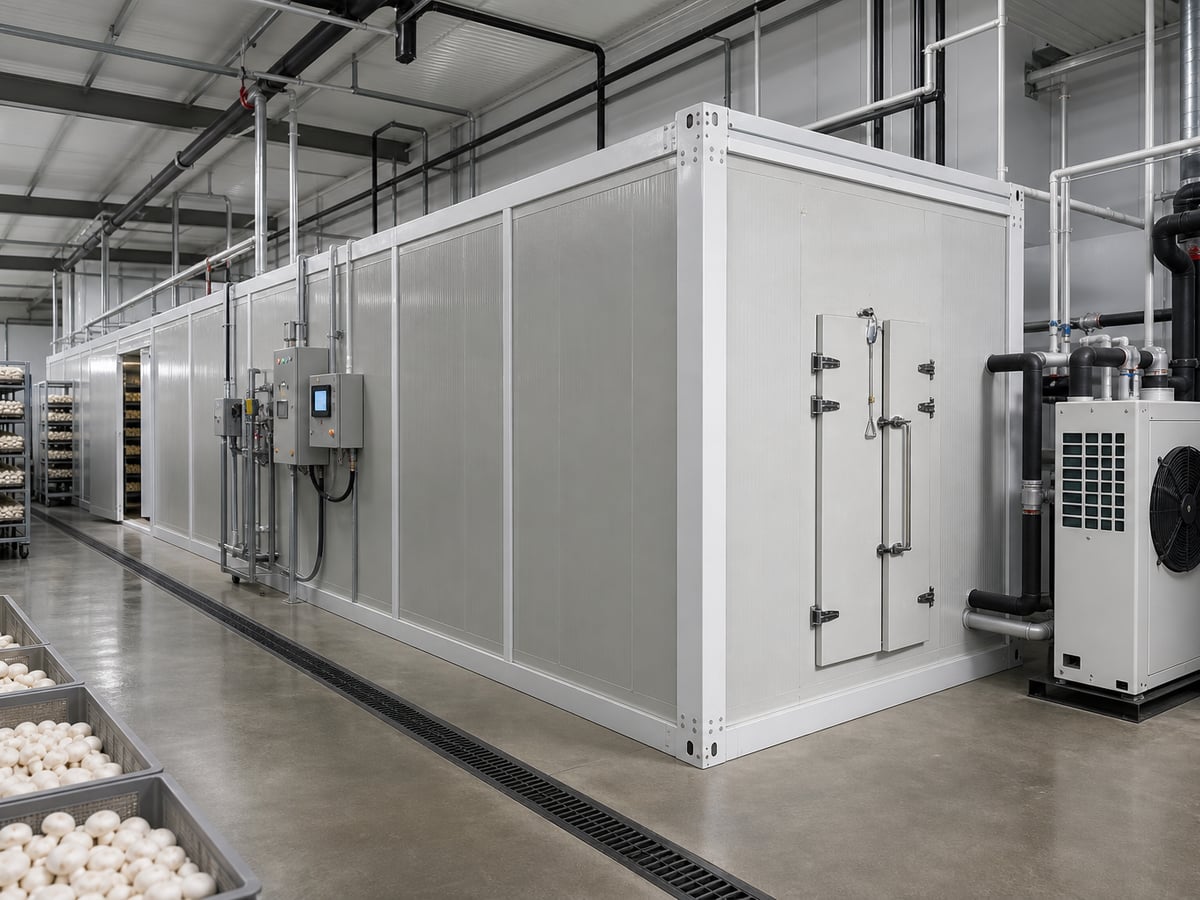
A mushroom farm container is a purpose-built insulated shipping-container-based cultivation room designed to maintain stable temperature, humidity, fresh-air exchange, carbon dioxide concentration, lighting, and sanitation conditions for commercial mushroom production. It provides growers with a compact, modular, and transportable alternative to constructing a conventional mushroom growing house.
For the Global Market, containerized mushroom farms are commonly used to grow oyster mushrooms, shiitake, lion’s mane, enoki, king oyster mushrooms, button mushrooms, and selected specialty fungi. They are especially suitable for farms that need rapid deployment, predictable climate performance, scalable capacity, and production close to urban buyers.
A commercial mushroom cultivation container typically combines an insulated cabin, shelving or hanging systems, refrigeration or heat-pump equipment, humidification, ventilation fans, fresh-air dampers, HEPA or coarse filtration options, electrical controls, sensors, and remote monitoring. The buyer selects the container length, cultivation method, climate range, electrical standard, and automation level based on mushroom species, local weather, substrate format, and harvest target.
For projects requiring a complete modular solution, a smart mushroom cultivation container can reduce construction uncertainty and help standardize production across multiple sites. It is not a substitute for good spawn, substrate preparation, hygiene, trained staff, or post-harvest handling, but it creates the stable growing environment required for those inputs to perform consistently.
What Is a Mushroom Farm Container and Where Is It Used?

A mushroom farm container is usually built from a 20-foot or 40-foot steel container shell or a container-style modular enclosure. The interior is converted into a controlled fruiting room through insulation, vapor sealing, washable interior wall surfaces, drainage provisions, air distribution ducts, environmental equipment, and cultivation racks. Unlike a general cold room, it must manage both sensible heat and biological moisture release while removing carbon dioxide produced by actively growing mushrooms.
These systems are used in commercial mushroom farms, agricultural cooperatives, food-security projects, supermarkets with local-produce programs, vocational schools, research centers, hotels, restaurants, rural entrepreneurship programs, and specialty food businesses. In dense markets such as Rotterdam, Dubai, Singapore, Los Angeles, London, Johannesburg, São Paulo, and Sydney, a container farm can shorten transport distances and support a fresher local mushroom supply.
Container farms are also valuable in locations where conventional construction is expensive, land leases are temporary, or climate conditions make seasonal growing difficult. Growers in hot and humid regions can use high-efficiency cooling and dehumidification strategies, while operators in cold regions can specify insulated panels, heat recovery, freeze protection, and heat-pump heating. At ports and trade hubs including Hamburg, Jebel Ali, Busan, Durban, and Santos, modular container logistics can simplify delivery to projects that need standardized equipment.
| Application | Typical User | Primary Benefit | Common Mushroom Types |
|---|---|---|---|
| Urban fresh-food production | Local farms and retailers | Shorter delivery distance | Oyster, lion’s mane |
| Rural commercial cultivation | Farm cooperatives | All-season climate stability | Oyster, shiitake |
| Export-oriented production | Food processors | Standardized crop environment | King oyster, enoki |
| Training and demonstration | Schools and agencies | Visible, controlled learning space | Oyster, button trials |
| Hospitality and restaurants | Hotels and chefs | On-site premium produce | Lion’s mane, oyster |
| Remote food projects | Community programs | Fast deployment and relocation | Oyster, shiitake |
The applications above show why container growing is not limited to one business model. The same basic enclosure can support different commercial goals when its environmental equipment, rack layout, and sanitation standard are properly matched to the crop and operating location.
Standard Product Configuration and System Boundaries

A standard mushroom farm container is normally delivered as a climate-controlled fruiting room. Typical equipment includes the insulated container body, interior lighting, circulation fans, fresh-air fan, exhaust fan, temperature and humidity sensors, carbon dioxide sensor, climate controller, refrigeration or heat-pump unit, humidification system, electrical control cabinet, access door, cultivation racks, drainage connection, and basic safety protection devices.
System boundaries should be confirmed before ordering. A fruiting container may not include substrate mixing, sterilization, pasteurization, bag filling, inoculation, incubation rooms, cold storage, packing lines, water-treatment equipment, civil foundations, electrical cable from the site distribution board, or a standby generator. These items can be added as part of a wider mushroom project, but they should not be assumed to be included in every quotation.
For example, oyster mushroom growers may use the container primarily as a fruiting chamber after purchasing or producing colonized substrate bags elsewhere. Shiitake operations may need separate incubation capacity and a larger post-harvest workflow. Buyers should request a process-flow review before finalizing the system configuration.
| Standard Item | Typical Function | Usually Included | Buyer Checkpoint |
|---|---|---|---|
| Insulated container body | Limits heat gain and heat loss | Yes | Panel thickness and fire rating |
| Climate controller | Coordinates setpoints and equipment | Yes | Language and electrical standard |
| Cooling and heating unit | Controls room temperature | Yes | Ambient climate design range |
| Humidification system | Maintains fruiting humidity | Yes | Water quality and drainage |
| Racks or shelving | Holds substrate bags or blocks | Often | Load rating and aisle width |
| Fresh-air and exhaust system | Manages CO2 and oxygen supply | Yes | Filtration and duct layout |
| Substrate sterilization line | Prepares growing media | No, unless specified | Separate production area needed |
This boundary review protects buyers from comparing incomplete quotations. The lowest initial price may exclude racks, sensors, remote connectivity, freight preparation, commissioning assistance, or essential utility accessories. A technically useful offer states what is included, what is optional, and what must be prepared on site.
Capacity, Dimensions, and Utility Requirements
The most common formats are 20-foot and 40-foot mushroom containers. A 20-foot unit is often selected for pilot farms, specialty varieties, smaller restaurant projects, and decentralized growing sites. A 40-foot container is more appropriate for commercial production where higher rack density, larger air-handling capacity, and better labor efficiency are required.
Actual production capacity depends on rack levels, bag diameter, substrate block weight, mushroom species, crop cycle, harvest efficiency, and aisle clearance. Capacity should therefore be expressed in several ways: number of substrate bags, total substrate loading, usable growing area, expected fresh mushroom output per cycle, and annual output under the planned crop schedule. A supplier should avoid promising yield without understanding substrate quality and cultivation management.
| Container Format | Approximate External Length | Typical Use | Indicative Substrate Loading | Typical Electrical Requirement |
|---|---|---|---|---|
| 10-foot compact unit | 3.0 m | Trials and demonstrations | 300–700 bags | Single or three phase, project specific |
| 20-foot standard unit | 6.1 m | Small commercial growing | 800–1,800 bags | Three phase preferred |
| 40-foot standard unit | 12.2 m | Commercial fruiting room | 1,800–4,000 bags | Three phase recommended |
| 40-foot high-cube unit | 12.2 m | Higher rack clearance | 2,000–4,500 bags | Three phase recommended |
| Multi-container farm | Modular layout | Scaled regional supply | 5,000+ bags | Central distribution design |
| Custom cabin system | Project specific | Large integrated farms | Defined by layout | Engineered to site conditions |
The figures in this table are planning ranges rather than guaranteed yields. A high-density layout may increase loading but can reduce airflow uniformity, access for harvest, and sanitation efficiency. The correct design balances crop volume with practical work space.
Utility planning is equally important. Most commercial units require a stable electrical supply, clean water, drainage, a level foundation, safe access for delivery vehicles, and reliable internet or cellular coverage if remote monitoring is required. Electrical voltage, frequency, phase arrangement, plug standard, circuit protection, and local certification requirements should be agreed before manufacturing. Projects in the European Union, Gulf countries, North America, Africa, Southeast Asia, and Latin America may have different utility standards and import requirements.
Temperature, Humidity, CO2, Airflow, and Control Performance
Mushroom cultivation is an environmental control process. Different species need different fruiting conditions, and each stage of growth may require its own setpoint profile. The controller should monitor actual conditions continuously and activate cooling, heating, humidification, fresh-air supply, exhaust, and circulation equipment according to configured operating logic.
Temperature control is needed to manage mushroom development and prevent heat accumulation from respiration. Relative humidity supports pin formation and fruit body quality, but excessive wetting can encourage bacterial problems or surface damage. Carbon dioxide management is essential because high CO2 may cause long stems, small caps, poor shape, or reduced market quality in many species. Airflow must distribute conditioned air throughout the rack area without creating strong direct drafts that dry the mushrooms.
| Control Parameter | Typical Fruiting Range | Why It Matters | Recommended Monitoring |
|---|---|---|---|
| Temperature | 10–24°C, species dependent | Controls growth rate and quality | Multiple room sensors |
| Relative humidity | 85–95%, crop dependent | Supports pinning and fresh weight | Protected humidity sensor |
| CO2 concentration | 600–2,000 ppm, crop dependent | Influences stem and cap development | Calibrated CO2 sensor |
| Air velocity | Low to moderate, layout dependent | Prevents stagnant zones | Fan balancing inspection |
| Fresh-air volume | Demand controlled | Removes CO2 and excess heat | Fan and damper feedback |
| Lighting period | Species and customer specific | Supports morphology and labor work | Timer or controller schedule |
These ranges are general operating references. Final parameters must be based on the selected strain, substrate formulation, local ambient conditions, and the grower’s market specification. Oyster mushrooms, for example, can be especially sensitive to stagnant air and elevated CO2 during fruiting, while other species may be cultivated under different temperature and light programs.
Control performance should be evaluated by uniformity, stability, response time, sensor reliability, and equipment sequencing—not only by the displayed setpoint. During commissioning, the operator should check several points along the racks, verify that humidification does not create puddles, confirm exhaust performance, and observe whether the far end of the container receives adequate conditioned air.
The chart illustrates the goal of a controlled fruiting room: stable environmental conditions rather than large swings caused by outdoor weather, manual adjustment, or poorly balanced equipment. Actual data will vary by mushroom species, loading level, and site climate.
Core Components, Materials, and Protection Features
A durable mushroom container should use materials that tolerate frequent moisture exposure, cleaning, and agricultural operation. The shell is normally steel, while the interior thermal envelope may use polyurethane, polyisocyanurate, rock wool, or other project-approved insulated panels. Interior surfaces should be smooth, corrosion-resistant, washable, and sealed at joints to reduce moisture intrusion and simplify sanitation.
Key components include a cooling and heating system sized for the local ambient range, air circulation fans, fresh-air and exhaust fans, humidification equipment, air ducts, insulated doors, lighting, sensor assemblies, control cabinet, electrical protection devices, drainage points, and cultivation racks. Optional features may include UV disinfection, improved filtration, water treatment, condensate management, data logging, camera monitoring, alarm beacons, emergency stop devices, and backup power integration.
Protection features should be reviewed according to the country of use. Coastal sites such as Mombasa, Manila, Cartagena, and Jeddah may need stronger anti-corrosion treatments because of salt-laden air. Hot regions require capacity verification at high outdoor temperatures. Cold regions may need anti-freeze measures. Areas with unstable grids may require voltage protection, surge protection, generator connection points, or uninterrupted power supplies for controllers and communications.
Automation, Remote Monitoring, and Customization Options
Automation helps growers repeat successful growing recipes. A smart controller can automatically manage temperature, humidity, CO2, ventilation, circulation fans, lighting schedules, alarm thresholds, and equipment operating modes. Rather than relying on manual switching, the operator can establish target conditions and adjust crop programs according to each mushroom variety and stage.
Remote monitoring allows farm managers to view key conditions through a mobile phone, computer, or cloud platform, subject to local connectivity and platform configuration. Useful functions include real-time temperature and humidity display, CO2 data, equipment status, historical trend records, alarm notifications, user access control, and remote setpoint adjustment. Remote access should complement, not replace, physical inspections for hygiene, crop quality, water supply, drainage, and equipment condition.
Customization is important because a container delivered to Nairobi, Rotterdam, Lima, Doha, Toronto, or Jakarta may face very different ambient temperatures, energy costs, electrical grids, water quality, and logistics constraints. Buyers can specify container size, rack type, number of layers, voltage, controller language, cooling capacity, heat-pump option, insulation thickness, door position, observation window, shelving layout, ventilation arrangement, and branding requirements.
For distributors and project developers, Lanhu offers OEM and ODM customization services for product appearance, environmental configurations, controls, and project-specific functional requirements. Customization should begin with a clear technical brief covering crop type, local climate, annual production target, power availability, water source, labor plan, and required compliance documentation.
Installation, Commissioning, Maintenance, and Warranty
Site preparation normally includes a level concrete pad, sufficient drainage, electrical supply, water connection, delivery access, and space for doors, service access, and airflow around external equipment. A container should be positioned to avoid flood-prone areas, blocked condenser airflow, severe dust exposure, and direct runoff from adjacent roofs. Crane or forklift access must be planned before delivery.
Commissioning begins after utilities are connected. The installer should verify phase sequence, voltage, grounding, breaker ratings, water pressure, drainage slope, fan direction, refrigeration operation, humidifier function, sensor readings, controller settings, alarm functions, and remote communication. Before substrate loading, the room should be cleaned, disinfected, run under test conditions, and inspected for condensation, air leakage, or uneven airflow.
| Maintenance Task | Recommended Frequency | Purpose | Responsible Role |
|---|---|---|---|
| Clean interior surfaces and drains | After each crop cycle | Reduces contamination risk | Farm operator |
| Inspect humidification nozzles | Weekly | Prevents blockage and uneven misting | Farm operator |
| Check air filters and fan guards | Weekly or monthly | Maintains airflow performance | Maintenance staff |
| Verify CO2 and humidity sensors | Monthly or as specified | Protects control accuracy | Trained technician |
| Inspect refrigeration components | Quarterly | Improves reliability and efficiency | HVAC technician |
| Test electrical protections | Quarterly | Supports operational safety | Qualified electrician |
| Review controller records | Each crop cycle | Improves future crop recipes | Farm manager |
This maintenance schedule is a practical baseline. Local conditions, water mineral content, dust levels, crop loading, and operating hours may require more frequent checks. Warranty terms should be stated clearly in the sales contract and should identify covered components, exclusions, response channels, spare-parts availability, and buyer responsibilities for correct installation and maintenance.
Before purchase, review equipment documentation, electrical diagrams, operating manuals, spare-parts lists, service contacts, and shipping details. Buyers can also examine relevant installation examples through the company’s mushroom container project cases to compare layouts, applications, and deployment concepts.
Our Company
Shandong Lanhu Air Conditioning Equipment Co., Ltd. is a Dezhou, Shandong-based manufacturer serving commercial cultivation and agricultural climate-control projects worldwide. Its technology focus combines thermodynamic design, controlled-environment agriculture, industrial HVAC engineering, and modular equipment integration. With more than 12 years of thermal research and development experience and over 45 registered patents, the company develops smart mushroom cultivation containers, mushroom climate controllers, hydroponic plant containers, and air source heat-pump solutions.
Its manufacturing capabilities include a modern production base exceeding 30,000 square meters, supported by product engineering, sheet metal fabrication, CNC bending, insulation panel production, electrical assembly, system integration, equipment testing, and quality inspection. Each system is subject to functional inspection, electrical verification, performance testing, and operational evaluation before shipment. The company maintains ISO 9001, ISO 14001, ISO 45001, and ISO 12100 certifications, supporting a structured approach to quality, environmental management, occupational safety, and machinery safety.
Lanhu’s service capabilities include factory-direct supply, technical selection support, OEM and ODM development, international logistics coordination, installation guidance, spare-parts support, and after-sales communication. The company supports agricultural contractors, equipment distributors, engineering companies, and commercial farms that need standardized modular climate solutions. Buyers can explore the dedicated smart mushroom climate controller for environmental management options or contact the Lanhu team to discuss a project specification.
Looking toward 2026 and beyond, the Global Market is expected to place greater emphasis on energy-efficient heat pumps, low-GWP refrigeration approaches, AI-supported crop alerts, data-based climate recipes, water-saving humidification, recyclable insulation solutions, solar-compatible power systems, and traceable local food production. Sustainability requirements, food-safety expectations, import compliance, and carbon reporting may increasingly influence buying decisions. A well-designed mushroom container should therefore be evaluated not only on first cost, but also on energy performance, repairability, sensor reliability, water use, service access, and long-term scalability.
FAQ
What mushrooms can be grown in a mushroom farm container?
Oyster mushrooms, shiitake, lion’s mane, king oyster mushrooms, enoki, and other specialty mushrooms can be grown when the climate system and crop recipe are designed for the selected variety. The most suitable type depends on local market demand, substrate supply, and grower experience.
How many mushrooms can a 40-foot container produce?
Production depends on substrate loading, crop cycle, strain, growing method, contamination control, harvest skill, and climate stability. A 40-foot container may hold approximately 1,800 to 4,000 or more substrate bags depending on rack design, but fresh mushroom yield should be calculated from the planned biological efficiency rather than bag count alone.
Does a mushroom container require three-phase electricity?
Many commercial 20-foot and 40-foot units are most efficiently operated with three-phase power because of cooling, heating, fans, humidification, and control equipment. However, electrical configurations can be customized according to local voltage, frequency, and project scale.
Can the container operate in very hot or cold climates?
Yes, but the equipment must be sized according to the site’s summer and winter design conditions. Buyers should provide the project city, seasonal temperature range, humidity conditions, altitude, and installation environment during technical consultation.
What is normally not included with a fruiting container?
Substrate preparation equipment, sterilizers, inoculation rooms, incubation rooms, packaging equipment, cold storage, foundations, utility connections, and local civil works are often separate items unless specifically included in the quotation.
How often should the container be cleaned?
The interior should be thoroughly cleaned and disinfected after every crop cycle. Drainage points, humidification components, racks, doors, and high-contact surfaces should be inspected regularly during production.
Can one container be expanded into a larger mushroom farm?
Yes. Modular expansion is one of the main advantages. Operators can add fruiting containers, incubation containers, cold rooms, packing modules, or a central substrate facility as sales volume and management capacity increase.
What should I send when requesting a quotation?
Provide the mushroom species, desired container size, target country and city, ambient temperature range, power supply details, water source, drainage conditions, automation needs, estimated substrate loading, and whether you require shipping, installation guidance, or customized branding.
Share this article

About the Author: Shandong Lanhu Air Conditioning Equipment
Lanhu is a professional climate control equipment manufacturer specializing in smart agricultural systems, commercial HVAC solutions, and customized temperature control technologies. With extensive engineering experience, Lanhu provides reliable solutions for plant factories, controlled environment agriculture, and industrial applications.
Need a Custom Climate Control Solution?
From smart agricultural systems to commercial HVAC solutions, Lanhu provides reliable temperature and humidity control solutions tailored to your project needs.
Contact Us