Reishi Cultivation Containers for the Global Market
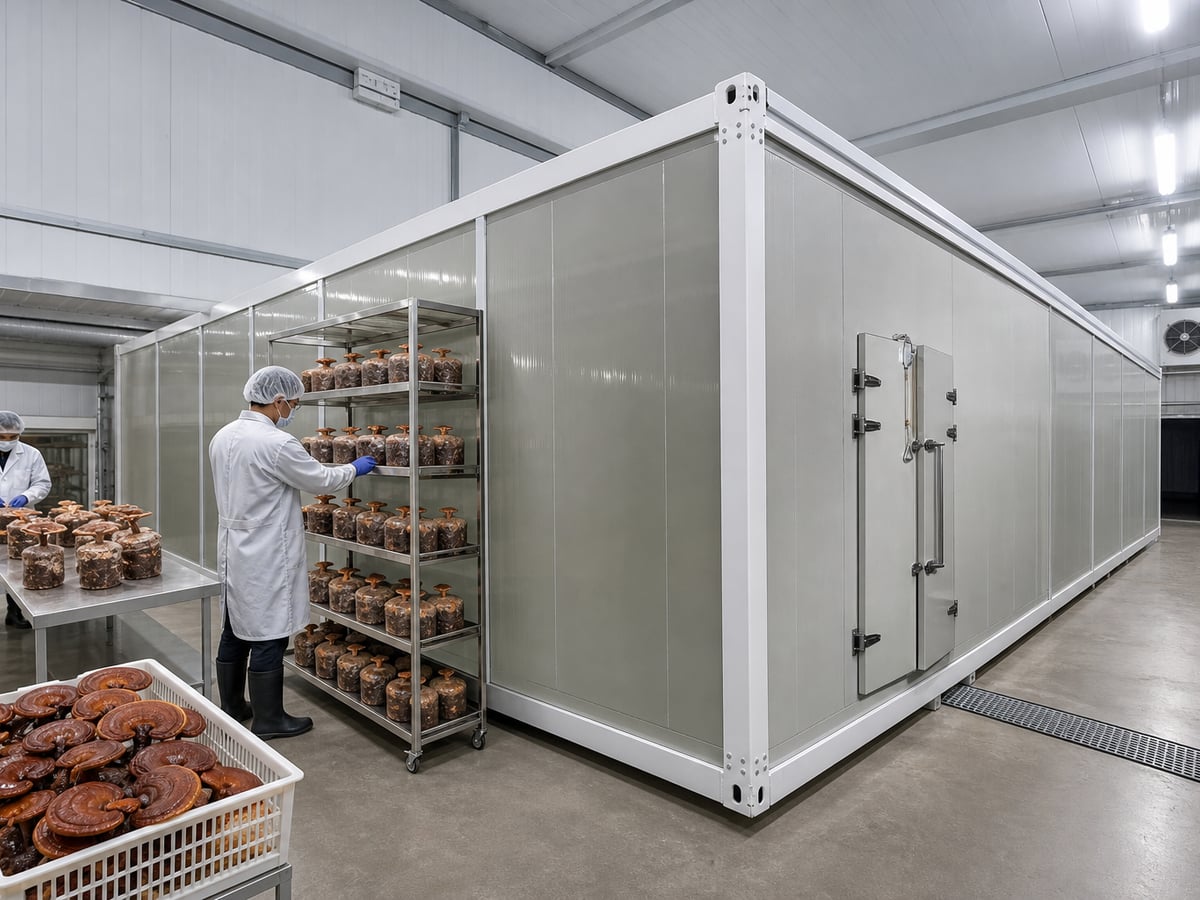
Reishi Cultivation Containers for the Global Market
Quick Answer: Match the Container to the Reishi Product

Choosing a reishi mushroom container is not simply a matter of selecting the largest insulated box or the lowest quoted equipment price. The correct container must match the intended product, crop cycle, fruiting form, loading method, climate, labor model, and expansion plan. Reishi, also known as Ganoderma lucidum and related Ganoderma species, can be cultivated for antler-shaped fruiting bodies, shelf-like conks, dried medicinal ingredients, extracts, decorative products, or spore collection. Each objective changes the required space, air movement, humidity strategy, carbon dioxide control, lighting, and harvesting access.
For most commercial projects, a modular cultivation container should provide stable temperature and relative humidity, adjustable fresh-air exchange, even air distribution, insulated construction, washable interior surfaces, sensor-based control, electrical protection, and sufficient room for workers to inspect and remove blocks. Long reishi crop cycles also make service access and moisture management especially important. A container designed only for rapid-growing mushrooms may not perform well when reishi remains inside for many weeks or months.
Before ordering, prepare a process brief covering the strain, substrate size, number of blocks, target fruiting form, desired harvest date, expected cycle length, local outdoor climate, available electrical supply, water source, delivery route, and operator skill level. This brief allows a manufacturer or engineering supplier to recommend useful dimensions instead of selling a generic enclosure.
- For antler reishi: plan controlled fresh-air exchange, directional air movement, and enough vertical clearance for elongated growth.
- For conk reishi: provide broader shelf spacing, stable humidity, and airflow that reduces wet surfaces without excessive drying.
- For spore production: separate the crop zone from worker circulation and consider filtration, containment, and dedicated cleaning procedures.
- For dried medicinal material: prioritize consistent crop uniformity, hygienic handling, traceability, and a separate post-harvest drying process.
- For commercial scale: use repeatable modules so additional rooms or containers can be added without redesigning the complete farm.
A purpose-built smart mushroom cultivation container can shorten the engineering process by combining insulation, environmental control, monitoring, and access features in one tested unit. However, specifications should still be confirmed against the production method and local operating conditions.
Choosing the Intended Reishi Product

The phrase “reishi cultivation” covers several different production models. A buyer in Vancouver may want compact antler-shaped mushrooms for a specialty wellness brand, while a producer near Jakarta may target dried conks for extraction. A laboratory-linked operation in Germany may need carefully documented conditions and strict hygiene, whereas a farm in São Paulo may focus on low-energy operation in a warm, humid climate. The container should be selected around this commercial purpose.
| Production objective | Typical crop appearance | Main container priority | Important operating concern | Suitable buyer profile | Planning question |
|---|---|---|---|---|---|
| Antler-shaped reishi | Vertical, branched growth | Vertical clearance and directed air | Avoiding uneven drying at the tips | Specialty growers and wellness brands | How tall may the fruiting bodies become? |
| Conk-shaped reishi | Flat or shelf-like caps | Stable humidity and shelf spacing | Maintaining surface quality during long cycles | Medicinal mushroom farms | What diameter and weight are expected? |
| Whole dried fruiting bodies | Uniform mature conks | Consistent climate across all shelves | Harvest timing and clean handling | Dried ingredient suppliers | Will grading be done on the farm? |
| Extract raw material | High-volume mature biomass | Loading capacity and repeatability | Batch identification and throughput | Extraction companies | What monthly dry weight is required? |
| Spore collection | Mature fruiting bodies releasing spores | Containment and worker separation | Cross-contamination and airborne particles | Specialized processing facilities | How will spores be collected and filtered? |
| Decorative or fresh sales | Visually attractive fruiting bodies | Lighting, presentation, and gentle handling | Preventing blemishes and physical damage | Urban farms and direct retailers | How long must the product remain marketable? |
This comparison explains why two buyers can request different container sizes even when their annual production target looks similar. A long crop cycle occupies space for a longer period, and a slow-growing product may require more working capital per square metre than a faster mushroom. The production plan should therefore measure both yield and time in the room.
Reishi blocks are often incubated separately from fruiting. A container intended only for fruiting should not automatically be treated as an incubation room. Incubation commonly needs different light, ventilation, temperature, and humidity conditions. Some farms use a dedicated incubation area and transfer mature blocks into a controlled fruiting container. Others use multi-zone rooms, but these require more complex air and control design.
Container Space for Long Crop Cycles

Reishi can remain in the fruiting environment considerably longer than many fast-cycle mushroom crops. This affects shelf loading, aisle width, worker movement, cleaning intervals, and the number of containers needed to maintain continuous production. A room that appears large on a floor plan may become difficult to operate after racks, humidification equipment, evaporator coils, sensors, lights, ducting, and access doors are installed.
Calculate usable cultivation area rather than relying on external container dimensions. Usable area is the space remaining after deducting service clearances, equipment zones, air-return paths, door swing, and safe worker access. The number of blocks should then be based on shelf pitch, block weight, expected fruiting dimensions, and a practical loading density. Overloading may increase the nominal capacity but reduce crop uniformity and make sanitation difficult.
| Space item | Why it matters | Common planning mistake | Better approach | Impact on cost | Verification method |
|---|---|---|---|---|---|
| Shelf depth | Determines block stability and air access | Choosing shelves from block width alone | Allow space for growth and inspection | Changes rack and container footprint | Review a loaded shelf drawing |
| Vertical clearance | Supports antler and conk development | Using short shelves for tall fruiting bodies | Set clearance from expected mature height | May require a taller module | Confirm growth envelope with samples |
| Worker aisle | Enables harvesting and cleaning | Filling every available square metre | Keep a safe and washable passage | Reduces maximum theoretical load | Perform a real access trial |
| Equipment clearance | Allows filter, fan, and coil maintenance | Placing racks against service panels | Reserve manufacturer-recommended clearance | Prevents expensive relocation later | Approve a maintenance layout |
| Air-return path | Helps prevent stagnant pockets | Blocking lower or rear returns | Keep return grilles unobstructed | May influence rack orientation | Inspect airflow with smoke or sensors |
| Cleaning zone | Supports hygiene after harvest | Leaving no room for washing tools | Provide a staging and drainage plan | Improves labor efficiency | Map cleaning movement before delivery |
For a small pilot, one container may be sufficient. For a commercial farm, several independent modules often provide better risk control. Separate rooms allow staggered loading, harvesting, cleaning, and maintenance. If one module requires service, the entire crop does not need to be shut down. Modular production can also help importers and distributors sell standard units to customers with different farm sizes.
Location affects the space decision. A container placed near Rotterdam, Hamburg, Dubai, Melbourne, or Los Angeles may face different transport, crane, foundation, and utility requirements. Ports, inland freight routes, local building codes, and site access should be reviewed before the final internal layout is approved. A container that cannot be unloaded or positioned safely can create delays even when its climate specification is excellent.
CO2 and Desired Fruiting Form
Carbon dioxide management influences the shape, density, surface development, and uniformity of fruiting bodies. The correct target is not a universal number that applies to every strain and stage. It should be established through cultivation trials, sensor records, and observation of the desired form. Fresh-air exchange must also be balanced against heat loss, humidity loss, contamination risk, and energy consumption.
Antler-shaped reishi generally requires a carefully managed fruiting environment that supports elongated growth without producing weak, irregular, or excessively dry tips. Conk production may call for a different balance between fresh air, surface moisture, and time. Spore-producing crops require additional separation because airborne spores can affect nearby rooms, worker comfort, and cleaning requirements.
| Control factor | Antler production | Conk production | Spore-focused production | What to monitor | Adjustment principle |
|---|---|---|---|---|---|
| Fresh-air exchange | Use controlled exchange for form development | Adjust for even cap formation | Separate and filter where practical | CO2 trend and crop appearance | Change gradually and record results |
| Air velocity | Avoid direct drying on growing tips | Prevent stagnant shelf zones | Control particle movement | Velocity at crop level | Distribute air, not just increase fan speed |
| Humidity response | Protect delicate elongating tissue | Limit persistent wetness on caps | Maintain controlled surface conditions | Relative humidity and condensation | Coordinate humidity with ventilation |
| Lighting | Use a consistent photoperiod if required | Support visual uniformity and orientation | Follow strain and process requirements | Light duration and intensity | Keep lighting repeatable between batches |
| Crop density | Allow vertical development | Allow cap expansion | Maintain collection and cleaning access | Blocks per shelf and module | Reduce density when microclimates appear |
| Monitoring frequency | Frequent checks during shape formation | Regular checks through maturation | Documented checks and controlled access | Sensor history and inspection notes | Use alarms for drift and equipment faults |
A modern mushroom climate controller should display current values and historical trends rather than only switching equipment on and off. Operators should be able to identify whether a high-CO2 event occurred after loading, whether humidity fell during a cold night, or whether a fan fault caused one shelf zone to stagnate. A smart mushroom climate controller can support this process when its sensors, control logic, and alarm settings are properly commissioned.
Do not specify ventilation only by fan capacity. The useful question is how evenly the container exchanges air at the crop surface. A powerful fan aimed directly at one rack may create dry edges while leaving another rack with high CO2. Proper duct position, return location, baffles, fan modulation, and sensor placement are more valuable than a large fan rating by itself.
Temperature and Humidity Management
Temperature and humidity should be planned as a coordinated system. Cooling air often removes moisture, while humidification can add heat or increase the load on a cooling unit. Outdoor conditions create additional challenges: hot, humid weather may require dehumidification, while cold, dry weather may require heating and humidification at the same time. A container for global deployment must therefore be configured for the local climate rather than copied unchanged from one country to another.
Climate planning begins with the process range supplied by the grower or research team. The equipment supplier then calculates heat load from outdoor temperature, lighting, fans, humidifiers, workers, product respiration, door opening, and container insulation. Setpoints, alarm limits, and dead bands should be agreed before fabrication. A temperature controller that is technically capable of a range does not guarantee that the installed system can hold that range under every outdoor condition.
| Climate condition | Primary risk | Equipment or design response | Operator action | Energy consideration | Useful record |
|---|---|---|---|---|---|
| Hot and humid outdoor air | Excess heat and condensation | Cooling capacity and dehumidification planning | Limit unnecessary door opening | Peak electrical demand may rise | Outdoor and indoor temperature trend |
| Hot and dry outdoor air | Rapid moisture loss | Humidification with controlled fresh air | Check crop edges and nozzles | Water and fan use increase | Humidity recovery time |
| Cold outdoor air | Low humidity and temperature drift | Heating, insulation, and preconditioned air | Inspect door seals and frost risks | Heating load becomes dominant | Minimum overnight temperature |
| Cool and humid outdoor air | Condensation on cold surfaces | Air mixing and moisture removal | Keep surfaces clean and dry | Dehumidification may be efficient | Surface temperature checks |
| Rapid weather changes | Frequent control cycling | Modulating equipment and suitable dead bands | Review alarms instead of chasing every fluctuation | Short cycling wastes energy | Hourly climate history |
| Frequent door opening | Climate recovery delays | Door alarms, vestibule planning, and quick recovery | Organize loading and harvesting routes | Increases cooling or heating demand | Door-open duration |
Insulation quality is especially important in a metal container exposed to sun, wind, rain, or snow. Panel joints, door frames, pipe penetrations, and service openings should be considered in the thermal design. Interior surfaces should be durable, smooth, and practical to clean. Condensation is not only a climate issue; it can damage components, increase slip hazards, and complicate sanitation.
Energy efficiency is becoming more important in 2026 as growers face higher electricity prices, carbon reporting requirements, and customer expectations for sustainable supply chains. Variable-speed fans, efficient compressors, heat recovery, better insulation, solar integration, and control strategies that reduce simultaneous heating and cooling can lower operating costs. The correct solution depends on local energy tariffs and the climate of the installation site.
Air Distribution and Moisture Balance
Air distribution determines whether the internal climate is genuinely uniform. Sensors may show acceptable average values while crop-level conditions vary significantly from the door to the rear wall or from the top shelf to the lower shelf. Reishi’s long production period gives these small differences time to become visible as uneven growth, inconsistent color, dry margins, surface wetness, or delayed maturation.
Air should circulate around the racks without creating strong jets that dry one section. Supply and return positions should be reviewed together. A return grille hidden behind dense shelving cannot remove air effectively. Likewise, a humidifier placed beside a temperature sensor may produce a false reading and cause the controller to stop or start equipment at the wrong time.
| Air-system component | Design purpose | Failure symptom | Commissioning check | Maintenance need | Recommended documentation |
|---|---|---|---|---|---|
| Supply duct or grille | Introduces conditioned air evenly | Dry or wet zones near the outlet | Measure several rack positions | Clean surfaces and inspect seals | Airflow layout drawing |
| Return opening | Moves room air back to the unit | High CO2 at distant shelves | Check obstruction after loading | Remove dust and blockages | Return-air inspection schedule |
| Circulation fan | Mixes air within the crop zone | Stagnant corners or uneven caps | Observe airflow at crop height | Inspect bearings and guards | Fan model and service record |
| Humidifier | Adds moisture to the room | Wet floor or localized condensation | Check droplet carryover | Descale and sanitize water path | Water-quality log |
| Drainage system | Removes condensate and wash water | Standing water or odor | Test flow before crop loading | Clean trap and drain line | Drainage and cleaning procedure |
| Climate sensors | Provide reliable control feedback | Unstable or misleading setpoints | Compare with calibrated instruments | Calibrate and replace as needed | Sensor calibration history |
Moisture balance is not the same as maintaining the highest possible relative humidity. Excessive moisture on surfaces can increase contamination risk and create condensation, while insufficient humidity can slow development and damage growing edges. The right balance depends on strain, block moisture, fruiting stage, air exchange, and room temperature. Operators should record crop observations together with sensor values instead of treating the display as the complete truth.
Water quality also deserves attention. Hard water can scale humidifier components, while untreated water may introduce unwanted particles or microorganisms. The equipment supplier should state the water requirements, drain arrangement, cleaning frequency, and replacement parts. A reliable water system supports both crop performance and equipment life.
Spore Management and Worker Access
Reishi spores are very fine particles that can become a significant operational consideration when fruiting bodies reach maturity. A farm producing ordinary dried conks may have different needs from a dedicated spore collection facility, but every operation should consider worker exposure, nearby crop zones, ventilation paths, cleaning, and product separation.
Where spore collection is part of the business model, the room may need controlled access, dedicated garments, suitable filtration, sealed transfer procedures, and a collection method designed around the target product. Air should not move directly from a spore-heavy area into incubation, packaging, offices, or other cultivation rooms. Separate modules can reduce cross-contamination and simplify cleaning.
Worker access is equally important. Operators need to inspect blocks, remove failed units, adjust racks, harvest mature fruiting bodies, clean surfaces, and service equipment. Narrow aisles and blocked panels may appear efficient during the sales stage but become expensive during daily operation. The final design should be reviewed by the people who will actually work inside the container.
- Place electrical panels and service components where technicians can reach them without entering the crop zone when possible.
- Use doors, seals, floors, and wall finishes that tolerate repeated cleaning.
- Provide safe lighting for crop inspection without creating excessive heat.
- Keep lifting and carrying routes practical for wet substrate blocks and harvested fruiting bodies.
- Define personal protective equipment and cleaning procedures before commercial operation.
- Separate spore collection, post-harvest handling, and packaging if product purity requires it.
Containerized farms can be placed near urban markets, inside industrial buildings, beside agricultural warehouses, or at remote sites. In every location, local occupational safety, electrical, drainage, fire, and building requirements should be reviewed. A supplier may provide the equipment, but the site owner remains responsible for permits and safe installation under local law.
Confirming Process Requirements Before Scaling
Scaling should follow a verified process rather than a simple multiplication of container count. Begin with a pilot batch that tests the selected strain, substrate formulation, block dimensions, rack arrangement, climate settings, labor time, water consumption, energy use, and harvest quality. The pilot should run long enough to cover the complete intended cycle, including cleaning and reset.
Use a written process requirement document before requesting a final quotation. It should include the items in the following table.
| Requirement category | Information to provide | Why suppliers need it | Evidence to prepare | Scaling decision | Responsible party |
|---|---|---|---|---|---|
| Crop biology | Species, strain, block type, and cycle | Defines climate and space assumptions | Trial records and photographs | Approve or revise process window | Grower or technical lead |
| Production volume | Blocks per batch and annual target | Determines module quantity | Sales forecast and loading plan | Choose pilot and expansion phases | Owner and production manager |
| Site conditions | Climate, altitude, utilities, and access | Supports heat-load and logistics design | Site survey and utility data | Confirm equipment configuration | Engineering team |
| Quality standard | Fresh, dried, extract, or spore specification | Influences harvesting and hygiene | Buyer specification and sample criteria | Set inspection and release rules | Quality manager |
| Labor model | Workers per shift and access frequency | Guides aisles and workflow | Time study and layout review | Approve ergonomics and staffing | Operations manager |
| After-sales plan | Spare parts, response, and training needs | Reduces downtime after installation | Service agreement draft | Confirm support before purchase | Buyer and supplier |
Performance should be measured with more than yield. Record crop uniformity, reject rate, energy per batch, water use, labor hours, sanitation time, alarm frequency, and equipment downtime. These indicators show whether a larger farm will be profitable and manageable. A technically successful crop may still be commercially weak if harvesting takes too long or if the container consumes excessive energy.
For international projects, confirm voltage, frequency, refrigerant requirements, plug and socket standards, customs documentation, packaging, marine transport protection, spare parts, remote support, and installation responsibilities. Buyers importing through Qingdao, Shanghai, Rotterdam, Jebel Ali, Santos, or other trade hubs should confirm who manages inland transport and final positioning. Clear responsibility prevents delays after the container arrives.
Future systems will increasingly use remote monitoring, predictive maintenance, digital batch records, artificial intelligence-assisted climate recommendations, and energy dashboards. These technologies should support trained operators rather than replace process knowledge. Data is valuable only when sensors are correctly placed, calibrated, and connected to decisions.
Markets, Industries, and Practical Applications
Reishi cultivation containers are used by several types of organizations. Commercial farms may install them to standardize production across multiple sites. Agricultural contractors may include them in turnkey projects for hotels, wellness companies, hospitals, research organizations, or food ingredient producers. Equipment distributors may need a repeatable platform that can be adapted to local climates and customer specifications.
Urban and peri-urban farms benefit from a compact production footprint. A container can be placed near restaurants, herbal product manufacturers, farmers’ markets, or direct-to-consumer distribution centers. Remote agricultural projects may use modular rooms where conventional construction is difficult. Research teams can use an independent environment to compare strains and process settings without disturbing the main farm.
| Industry or user | Typical application | Most important feature | Potential challenge | Recommended planning method | Expansion path |
|---|---|---|---|---|---|
| Commercial mushroom farm | Continuous reishi fruiting | Repeatable climate and loading | Long cycles tie up capacity | Use staggered modules | Add standardized containers |
| Herbal ingredient producer | Drying and extraction supply | Traceability and batch quality | Specification changes from buyers | Link cultivation and post-harvest records | Increase output by contract demand |
| Urban agriculture project | Local fresh or decorative sales | Compact footprint and low noise | Limited utilities and labor | Run a small controlled pilot | Add units near demand centers |
| Research institution | Strain and climate trials | Precise monitoring and flexibility | Frequent process changes | Specify adjustable controls | Replicate validated protocols |
| Agricultural contractor | Turnkey farm installation | Integration and documentation | Different client site conditions | Use a modular engineering template | Offer regional configurations |
| Equipment distributor | Standard product resale | Reliable supply and support | Inventory and spare parts planning | Agree on models and options | Build a local service network |
Application requirements may also differ by sales channel. A food ingredient customer may prioritize dry matter and traceability, while a wellness retailer may value appearance and consistent size. A grower selling whole fruiting bodies may require careful handling and presentation. These commercial details should be included in the original equipment specification instead of added after installation.
Case Planning and Local Supplier Evaluation
When comparing suppliers, buyers should look beyond photographs and headline cooling capacity. Ask for a layout, insulation specification, control philosophy, electrical list, water and drainage requirements, testing procedure, warranty terms, spare parts list, installation boundary, and references from comparable projects. A supplier that can explain how the system behaves during loading, cleaning, hot weather, cold weather, and sensor failure is more useful than one that only provides a standard brochure.
Case experience should be reviewed by process similarity. A container used for oyster mushrooms does not automatically prove suitability for long-cycle reishi. Ask whether the reference project used comparable block dimensions, fruiting duration, humidity range, air exchange, worker access, and harvest requirements. Buyers can review project examples and application information through the cultivation project case studies section, then request details relevant to their own site.
Local supplier support is valuable even when the equipment is manufactured overseas. A regional electrical contractor, refrigeration technician, agricultural engineer, or distributor may assist with foundations, permits, utility connections, commissioning, and emergency service. International buyers should clarify whether the manufacturer provides remote troubleshooting, translated manuals, video training, replacement sensors, controller backups, and recommended local service procedures.
Global sourcing can be practical when factory engineering, customization, and quality control are strong. Buyers should compare the total delivered cost rather than the factory price alone. Include ocean freight, insurance, port charges, customs duties, inland delivery, crane placement, installation, commissioning, spare parts, local taxes, and staff training. A lower purchase price may not be economical if the system is difficult to install or unsupported after delivery.
Our Company: Engineering, Manufacturing, and Service
Shandong Lanhu Air Conditioning Equipment Co., Ltd. develops climate-controlled equipment for agricultural and industrial applications from Dezhou, Shandong, China. Its location connects manufacturing resources in northern China with logistics routes serving domestic projects and international export markets. The company supplies modular cultivation equipment to agricultural contractors, distributors, engineering companies, and commercial farms.
Technological capabilities
Lanhu combines thermodynamic research with agricultural climate-control engineering. Its product range includes smart mushroom cultivation containers, mushroom climate controllers, hydroponic plant containers, and air source heat pumps. The engineering approach focuses on temperature, humidity, ventilation, insulation, monitoring, and system integration rather than treating the container as an isolated shell.
More than 12 years of thermodynamic research and development experience and over 45 registered patents support the company’s work on controlled agricultural environments. For a reishi project, this capability can help address heat-load calculations, sensor arrangement, control sequences, air distribution, and climate recovery after door opening. Buyers should still provide their own crop requirements so the equipment is configured around the intended process.
Manufacturing capabilities
The company operates a manufacturing facility of more than 30,000 square metres with integrated production resources. These include product design, engineering development, sheet metal fabrication, CNC bending, insulated panel production, electrical assembly, system integration, equipment testing, and quality inspection. Bringing these activities together can improve coordination between the enclosure, refrigeration system, electrical cabinet, controller, and access features.
Before shipment, systems undergo functional inspection, electrical verification, performance testing, and operational evaluation. The company holds ISO 9001, ISO 14001, ISO 45001, and ISO 12100 certifications, together with patent certificates and enterprise credibility credentials. Certification does not replace a site-specific acceptance test, but it gives buyers a framework for reviewing quality, environmental, occupational safety, and machinery-risk procedures.
Service capabilities
Lanhu provides factory-direct supply, OEM and ODM customization, engineering assistance, international logistics support, spare parts support, installation guidance, and after-sales service. These services are relevant when a buyer needs a non-standard container length, different voltage, revised rack arrangement, special access, additional monitoring, or integration with a local building and utility system.
Customers can discuss custom requirements through the OEM and ODM customization service. The most useful inquiry includes the destination country, site city, local climate, product objective, crop cycle, block dimensions, required capacity, power supply, desired delivery date, and whether installation support is needed. Clear information improves the accuracy of technical proposals and commercial quotations.
FAQ: Reishi Container Selection
How large should a reishi cultivation container be?
There is no universal size. Start with the number and dimensions of blocks, desired shelf spacing, expected mature fruiting-body size, aisle width, equipment clearances, and service access. Then calculate usable capacity rather than external volume. A pilot container is often preferable to a large room that has not been validated.
Can one container support both incubation and fruiting?
It can be possible with suitable controls and process management, but the requirements may conflict. Incubation and fruiting often use different temperature, light, humidity, and ventilation conditions. Separate areas or separate modules usually simplify scheduling, sanitation, and climate stability.
What is the best humidity setting for reishi?
The best setting depends on the strain, substrate, growth stage, fruiting form, airflow, and room temperature. Avoid selecting a number without trial evidence. Monitor relative humidity together with surface condensation, crop appearance, CO2, and water use. The target should be established through controlled cultivation records.
Does antler reishi need more space than conk reishi?
Antler-shaped growth may require greater vertical clearance and more careful airflow around the growing tips. Conk-shaped production may need more horizontal shelf spacing as caps expand. The final requirement depends on the strain and desired harvest size, so use sample blocks before finalizing the rack design.
How can CO2 be controlled in a container?
CO2 is controlled through a combination of fresh-air exchange, circulation, sensor placement, and control programming. Ventilation should be distributed evenly and balanced against heat and humidity losses. The controller should record trends and provide alarms rather than relying only on manual checks.
Is a humidifier always necessary?
Not always. A humidifier may be needed in dry climates, during heating periods, or when ventilation removes too much moisture. In humid climates, the system may need dehumidification instead. The correct choice depends on outdoor air, insulation, crop load, door opening, and the required operating range.
How should spores be managed?
Use controlled access, suitable cleaning procedures, dedicated clothing where required, and airflow planning that prevents movement into offices, packaging areas, incubation rooms, or other crops. Dedicated collection equipment and filtration may be appropriate for specialized spore production. Local occupational and environmental requirements should also be reviewed.
What should be included in a supplier quotation?
Request the container dimensions, usable cultivation area, insulation, refrigeration capacity, heating and humidification details, fresh-air system, control functions, sensors, electrical requirements, rack layout, drainage, lighting, testing procedure, warranty, spare parts, packaging, delivery terms, installation scope, and after-sales support.
Can these containers be used in tropical countries?
Yes, but the design must account for high outdoor temperature, high humidity, solar exposure, electrical stability, condensate drainage, corrosion protection, and service conditions. A specification prepared for a cool European climate may not provide enough cooling or dehumidification in Southeast Asia, coastal Brazil, or equatorial Africa.
What trends will influence reishi container farming in 2026?
Key trends include sensor-rich climate control, remote alarms, predictive maintenance, energy monitoring, variable-speed equipment, renewable-energy integration, modular expansion, improved water management, digital batch traceability, and lower-impact insulation and refrigerants. Policy and buyer requirements are also increasing attention to energy consumption, worker safety, waste reduction, and documented product quality.
What is the first step before contacting a manufacturer?
Prepare a concise process brief. State the target reishi product, species or strain, block size, crop cycle, desired output, destination city and country, site climate, electrical supply, available footprint, access limitations, and service expectations. This gives the manufacturer enough information to recommend an appropriate container rather than a generic unit.
Reishi container planning succeeds when the product objective, room geometry, climate-control system, worker workflow, and commercial target are treated as one connected project. A well-designed module should protect crop consistency while remaining practical to clean, operate, expand, and service. By confirming process requirements before scaling and selecting a supplier with engineering, manufacturing, testing, and international support capabilities, growers can reduce avoidable risk and build a more reliable production platform for the global market.
Share this article

About the Author: Shandong Lanhu Air Conditioning Equipment
Lanhu is a professional climate control equipment manufacturer specializing in smart agricultural systems, commercial HVAC solutions, and customized temperature control technologies. With extensive engineering experience, Lanhu provides reliable solutions for plant factories, controlled environment agriculture, and industrial applications.
Need a Custom Climate Control Solution?
From smart agricultural systems to commercial HVAC solutions, Lanhu provides reliable temperature and humidity control solutions tailored to your project needs.
Contact Us