Global Market Mushroom Humidity Control for Better Crops
Quick Answer

Stable Mushroom Humidity Control Without Wet Caps
A mushroom humidity controller maintains the relative humidity (RH) required for healthy pinning, fruit-body development, and harvest quality while reducing the risk of wet caps, bacterial blotch, condensation, and excessive moisture on shelving. For growers in the Global Market, reliable humidity control is not simply about reaching a high RH number. It requires balanced control of humidifier output, air circulation, fresh-air exchange, temperature, sensor location, and operating time.
In practical mushroom rooms, the best outcome is usually a stable humidity range rather than a continuously saturated environment. A controller should measure representative room air, operate humidification in controlled cycles, and stop or reduce output before water droplets form on caps, bags, walls, ducts, or insulation panels. The correct setup differs between oyster mushrooms, shiitake, button mushrooms, lion’s mane, enoki, and other varieties, but the control principles remain similar.
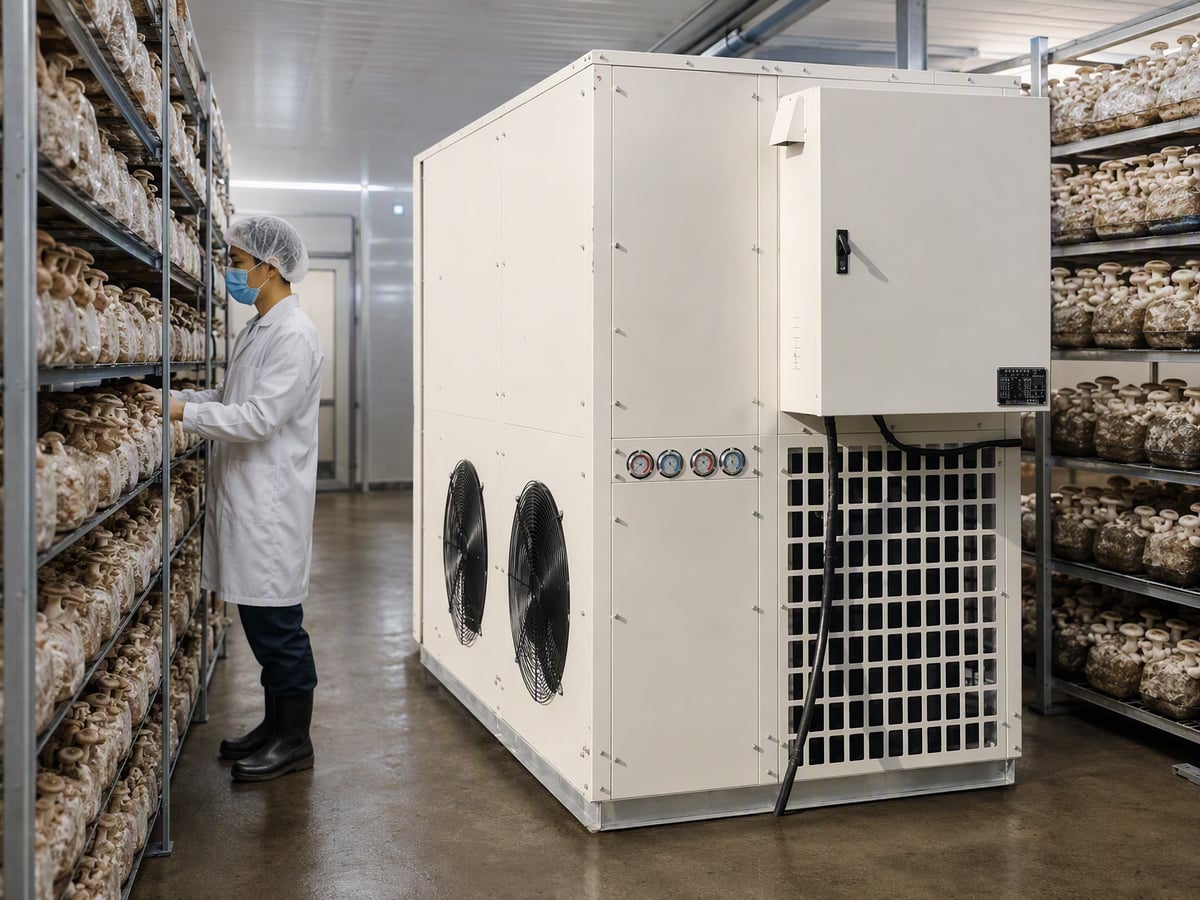
For commercial farms, containers, and modular grow rooms, a smart controller can coordinate humidity, temperature, ventilation, circulation fans, alarms, and scheduled cultivation stages. Explore Lanhu’s smart mushroom climate controller for integrated RH and environmental management designed for controlled cultivation spaces.
| Growing Condition | Typical RH Operating Range | Main Risk if Too Low | Main Risk if Too High |
|---|---|---|---|
| Incubation room | 60–75% RH | Substrate surface drying | Condensation and contamination |
| Early pinning | 88–95% RH | Weak or uneven pin set | Water films on primordia |
| Oyster mushroom fruiting | 85–92% RH | Dry edges and slow growth | Wet caps and elongated stems |
| Shiitake fruiting | 80–90% RH | Cracking and lower weight | Soft surfaces and disease pressure |
| Lion’s mane fruiting | 85–95% RH | Yellowing and sparse spines | Water accumulation in clusters |
| Harvest and post-harvest holding | 80–90% RH | Rapid moisture loss | Surface slime and reduced shelf life |
The ranges above are starting points, not universal recipes. Actual settings should account for species, substrate moisture, air temperature, crop density, room design, ventilation rate, and local climate. A coastal farm near Rotterdam, Hamburg, Singapore, or Durban may face a very different moisture load from a dry inland site near Dubai, Johannesburg, Mexico City, or Almaty.
How Relative Humidity Control Works

Relative humidity describes how much water vapor is present in air compared with the maximum amount that air can hold at the same temperature. Warm air can contain more water vapor than cool air. This means RH can change even when no moisture is added or removed. For example, if a fruiting room cools quickly at night, RH rises because the same amount of water vapor is now held by cooler air. If the temperature rises, RH may fall without any ventilation change.
A humidity controller compares a sensor reading with a setpoint. When RH drops below the lower control limit, the controller activates a humidifier, fogger, ultrasonic unit, high-pressure mist system, or other moisture source. When RH reaches the upper limit, it stops humidification. Advanced systems can also control exhaust fans, intake dampers, heaters, cooling equipment, and circulation fans to keep humidity within a useful operating band.
The goal is not to keep the humidifier running continuously. Continuous output often creates localized saturated air, droplets, and uneven crop conditions. Instead, the controller should deliver moisture in short, measured events and allow room air to mix before taking the next action. In a properly designed cultivation room, moisture is distributed through the room air rather than sprayed directly onto mushrooms.
| Control Component | Primary Function | Good Practice | Common Mistake |
|---|---|---|---|
| RH sensor | Measures room humidity | Place in representative mixed air | Mounting in direct fog stream |
| Controller | Compares RH with target | Use adjustable setpoint and alarms | Using one fixed setting for all stages |
| Humidifier | Adds moisture | Size output to room load | Oversizing without output control |
| Circulation fan | Mixes air and moisture | Use gentle, indirect airflow | Blowing directly on fruit bodies |
| Ventilation system | Removes CO₂ and moisture | Coordinate with RH control | Running exhaust independently |
| Temperature equipment | Influences RH and dew point | Control temperature changes gradually | Ignoring temperature-RH interaction |
This control relationship is especially important in container farms and retrofitted rooms. Compact spaces react quickly to humidifier output, door opening, fan cycling, and fresh-air intake. A modular system should therefore combine sensing, automation, and airflow engineering instead of treating humidity equipment as a standalone purchase.
Sensor Placement Away from Mist

Sensor placement is one of the most important factors in accurate humidity control. A sensor positioned inside a fog plume can read artificially high RH, causing the controller to stop humidification while the far side of the room remains dry. Conversely, a sensor installed beside a heater, cooling coil, exterior wall, open doorway, or exhaust point may read unrepresentative air and trigger unnecessary humidification.
Place the primary sensor where air is well mixed, generally near crop height but away from direct mist, water spray, fan discharge, cold surfaces, and fresh-air jets. In larger rooms, use multiple sensors or verify conditions at several points with a calibrated handheld instrument. For multi-tier racks, measurements should be taken at lower, middle, and upper levels because temperature stratification can create different RH zones.
As a practical guide, keep the sensor out of the humidifier discharge path and allow sufficient distance for droplets to evaporate before reaching the sensing point. A small protective radiation shield or ventilated sensor enclosure can help where mist drift is unavoidable, provided it does not block normal air exchange around the sensor.
| Sensor Location | Expected Reading Quality | Potential Problem | Recommended Action |
|---|---|---|---|
| Directly in fog path | Poor | False high RH reading | Relocate immediately |
| Near crop canopy in mixed air | Good | May vary with dense crops | Verify at several rack levels |
| Beside exhaust fan | Poor | Reads dry incoming air influence | Move toward room center |
| Near cooling coil | Poor | Cold microclimate and condensation | Keep clear of coil discharge |
| Near room center at crop height | Very good | Requires safe cable routing | Use as primary sensor point |
| Upper ceiling zone | Moderate | May not represent crop zone | Use as secondary comparison point |
The table shows why sensor location affects crop quality as much as controller accuracy. Before changing an RH setpoint, confirm that the sensor is reading a representative part of the growing environment. This simple check can prevent over-humidification, reduce water use, and improve uniformity between shelves.
Humidifier Output and Room Response
Humidifier capacity must match the actual moisture demand of the room. Demand comes from ventilation, air leakage, cooling, heating, substrate evaporation, crop transpiration, door openings, and outdoor weather. A humidifier that is too small may run continuously without reaching target RH. A unit that is too large may overshoot rapidly, create fog accumulation, and leave caps visibly wet.
Room response should be observed after each humidity event. If RH rises gradually and settles near the target, output is likely well matched. If RH jumps sharply, the controller may need shorter run times, lower capacity, better air mixing, or a wider physical distribution of moisture. High-pressure fog systems often provide fine droplets that evaporate efficiently when correctly installed, while coarse mist can wet surfaces if nozzle position or pressure is unsuitable.
For projects near major agricultural and logistics hubs such as Shanghai, Qingdao, Antwerp, Los Angeles, Jebel Ali, and Santos, equipment selection should also consider water quality, electrical supply, spare-parts availability, shipping access, and local technical support. The lowest purchase price is rarely the best value if humidification cannot be maintained reliably during peak production.
Deadbands and Minimum Run Times
A deadband is the difference between the point where humidification starts and the point where it stops. For example, with a target range of 88% to 91% RH, the humidifier may start at 88% and stop at 91%. This prevents rapid switching, also called short cycling, when readings fluctuate around a single setpoint.
Minimum run time and minimum off time are equally useful. A humidifier may need to operate for a short minimum period to create meaningful moisture distribution, but it should also remain off long enough for sensors to detect the room response. If cycles are too short, relays, pumps, solenoids, and ultrasonic modules may wear faster. If cycles are too long, RH may overshoot and condensation risk increases.
| Room Characteristic | Suggested Deadband Approach | Minimum Run-Time Consideration | Control Priority |
|---|---|---|---|
| Small insulated container | Narrow to moderate | Short, carefully tested cycles | Prevent fast overshoot |
| Large fruiting room | Moderate | Allow mixing after each cycle | Maintain uniform RH |
| High ventilation rate | Moderate to wider | Long enough to offset air exchange | Respond to moisture loss |
| Dense shelf cultivation | Moderate | Use circulation before rechecking | Reduce microclimates |
| Cold-weather operation | Moderate | Limit long output near cold surfaces | Avoid condensation |
| Hot-weather operation | Narrow to moderate | Coordinate with cooling cycles | Protect crop hydration |
These settings should be commissioned on site, not copied blindly. Record RH, temperature, fan status, ventilation status, and humidifier events over several production days. Adjust one parameter at a time. This method produces a clearer understanding of room behavior and avoids changes that solve one problem while creating another.
Ventilation Effects on Humidity
Ventilation is essential for mushroom production because crops need fresh air and controlled carbon dioxide levels. However, ventilation can quickly change RH. Outdoor air entering a room may be dry, humid, hot, cold, or variable depending on season and location. Exhaust air removes moisture and CO₂ simultaneously, so a controller that ignores fan operation may struggle to stabilize conditions.
When exhaust fans start, RH may fall quickly if incoming air is dry. When ventilation slows, RH may rise due to crop respiration, substrate moisture, and humidifier output. Smart controls can use interlocks: reduce humidification during a ventilation pause, increase output after fresh-air exchange, or delay sensor decisions until air has mixed. This improves both crop consistency and energy use.
Airflow should be gentle enough to avoid drying cap surfaces but strong enough to prevent stagnant humid pockets. Uniform air distribution is especially important in long growing tunnels and stacked containers, where the first racks near an intake may experience different conditions from racks near the exhaust end.
Condensation and Over-Humidification Prevention
High RH is not the same as visible water. A healthy fruiting environment can have high humidity while mushroom caps remain dry to the touch. Condensation occurs when humid air contacts a surface below its dew-point temperature. Common cold surfaces include metal panels, poorly insulated doors, cooling pipes, window frames, uninsulated ducts, and exterior-wall corners.
Prevent condensation by combining humidity control with insulation, temperature stability, airflow management, and proper humidifier placement. Directing fog at crops, ceilings, or cold metal is rarely effective. Instead, introduce fine moisture into moving room air, allow it to evaporate, and use circulation to distribute it evenly. Drainage and washable surfaces are also important because condensation can carry contaminants into the growing area.
Warning signs of over-humidification include droplets on caps, shiny or slimy surfaces, water collecting on shelves, damp filter media, fog lingering in the room, persistent wall wetness, and RH readings that remain near saturation after the humidifier stops. If these signs appear, check sensor placement, humidifier capacity, room temperature, nozzle direction, ventilation timing, and insulation before simply lowering the RH setpoint.
Testing Accuracy in Operating Conditions
A humidity controller should be tested under normal operating conditions, not only in an empty room. Crop load, substrate blocks, shelving, open doors, worker activity, ventilation, lighting, and weather can all change the result. Compare the installed sensor with a calibrated reference meter at the same location after allowing both instruments to stabilize. If readings differ significantly, check calibration, contamination, sensor aging, wiring, and placement.
Test at several times: before humidification, during humidifier operation, after fan activation, after fresh-air exchange, and at the coldest part of the daily cycle. A sensor that appears accurate in still air may react differently in fog, airflow, or rapid temperature changes. Keep a commissioning record so future maintenance teams can recognize deviations.
For a commercial project, test acceptance should include electrical safety, sensor response, humidifier output, alarms, data logging, ventilation interlocks, drainage, access for cleaning, and backup procedures. This is particularly valuable for export projects where a grower may receive equipment through a port such as Qingdao, Rotterdam, or Melbourne and commission it with local contractors.
Our Company
Shandong Lanhu Air Conditioning Equipment Co., Ltd. supports mushroom growers, agricultural contractors, equipment distributors, and engineering companies across the Global Market with climate-control equipment and modular cultivation solutions. The company’s approach focuses on practical environmental stability: matching control equipment to crop requirements, room size, local weather, and operational goals.
Technological Capabilities
Lanhu has more than 12 years of thermodynamic research and development experience and holds more than 45 registered patents. Its systems are developed for coordinated control of temperature, humidity, fresh air, circulation, and crop-stage operation. Smart monitoring features can help growers identify RH drift, equipment alarms, and changing room conditions before quality losses become severe.
Manufacturing Capabilities
With a manufacturing facility exceeding 30,000 square meters in Dezhou, Shandong, Lanhu integrates product design, engineering development, sheet-metal fabrication, CNC bending, insulation-panel production, electrical assembly, system integration, equipment testing, and quality inspection. Systems undergo functional inspection, electrical verification, performance testing, and operational evaluation before shipment. For turnkey cultivation projects, see the smart mushroom cultivation container range.
Service Capabilities
Lanhu provides factory-direct supply, OEM and ODM customization, engineering assistance, international logistics coordination, spare-parts support, installation guidance, and after-sales service. This service model helps clients adapt solutions for regional power standards, crop varieties, local construction practices, and commercial production targets. Customers can review application examples through Lanhu’s mushroom cultivation project cases or discuss tailored requirements through its OEM and ODM customization service.
FAQ
What RH should I use for mushroom fruiting?
Most fruiting rooms operate in a high-humidity range, commonly around 80–95% RH depending on species and stage. Start with the species recommendation, then adjust according to cap condition, pinning performance, temperature, airflow, and ventilation behavior.
Why are my mushroom caps wet even though the controller is accurate?
Wet caps are often caused by direct mist, condensation, poor airflow, excessive humidifier capacity, or a sensor located in an unrepresentative position. Accuracy alone does not guarantee correct room control.
Should the humidity sensor be installed close to the humidifier?
No. The sensor should be away from direct mist and located in representative, mixed air near the crop zone. A sensor too close to the humidifier can create false readings and unstable operation.
Can ventilation and humidification run at the same time?
They can, but the sequence should be coordinated. Continuous high exhaust may waste water and make RH unstable. Smart interlocks and timed control can improve performance while maintaining fresh air and CO₂ management.
How often should RH sensors be checked?
Check installed sensors routinely against a reliable reference instrument, especially before a major production cycle and whenever crop quality changes unexpectedly. Clean sensor guards and inspect cables, connectors, and controller settings during scheduled maintenance.
What trends will influence mushroom climate control in 2026?
In 2026, growers are expected to adopt more sensor networks, remote alarms, energy-aware controls, water-saving fog systems, heat-pump integration, predictive maintenance, and stage-based automation. Sustainability policies and rising energy costs are also increasing demand for insulated modular rooms, efficient ventilation, water recirculation where hygienically appropriate, and precise control that reduces waste without compromising crop quality.
Share this article

About the Author: Shandong Lanhu Air Conditioning Equipment
Lanhu is a professional climate control equipment manufacturer specializing in smart agricultural systems, commercial HVAC solutions, and customized temperature control technologies. With extensive engineering experience, Lanhu provides reliable solutions for plant factories, controlled environment agriculture, and industrial applications.
Previous Post
Need a Custom Climate Control Solution?
From smart agricultural systems to commercial HVAC solutions, Lanhu provides reliable temperature and humidity control solutions tailored to your project needs.
Contact Us