Mushroom Ventilation Systems for the Global Market
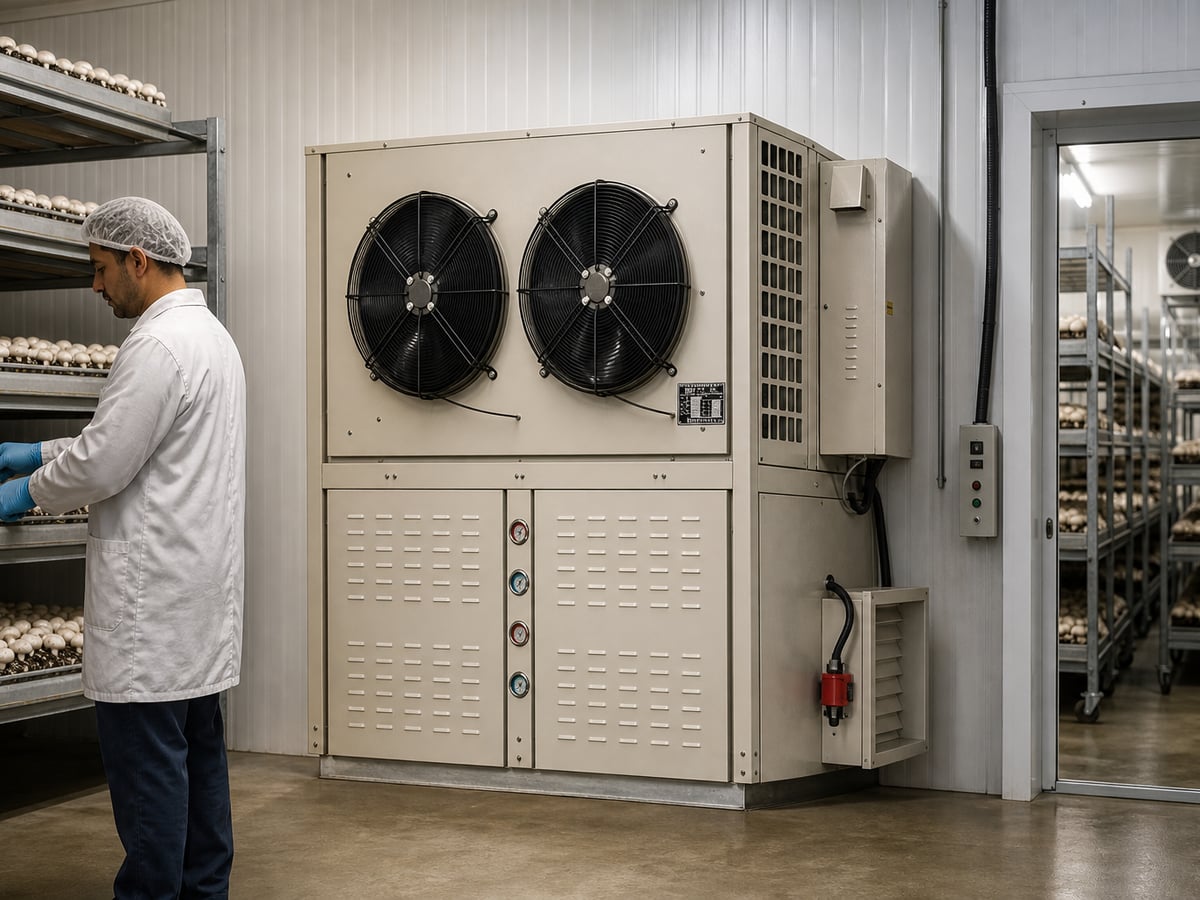
Quick Answer: How Should Mushroom Rooms Be Ventilated?

A reliable mushroom ventilation system separates outdoor fresh-air exchange from internal air circulation. Fresh air supplies oxygen and removes carbon dioxide, heat, moisture, and volatile compounds generated by the crop. Recirculated air equalizes temperature, humidity, and air speed inside the growing room without unnecessarily increasing heating, cooling, or dehumidification loads.
The most effective design combines a filtered outdoor-air intake, controlled supply fan, balanced exhaust path, recirculation fan, sensors, dampers, and an integrated climate controller. Airflow should pass evenly through all loaded shelves rather than creating strong jets near the supply duct and stagnant pockets at the rear of the room. Ventilation demand changes significantly between spawn run, casing, pinning, and fruiting, so a fixed fan speed is rarely suitable for commercial production.
For a practical design, begin with room volume, shelf loading, crop respiration, target CO2, temperature, and humidity. Then select fans and coils that can maintain the required airflow against filter, duct, coil, damper, and room-resistance losses. A balanced system should normally avoid uncontrolled pressure swings, condensation on surfaces, and excessive drying of casing or fruit bodies.
For growers in Europe, North America, the Middle East, Southeast Asia, Africa, and other regions, the right solution depends on local weather, electricity prices, building standards, biosecurity requirements, and crop type. A modular cultivation system can simplify installation where a conventional grow room is difficult to build, while a custom HVAC installation may be more suitable for a large tunnel or multi-room farm.
Separate Fresh Air from Internal Circulation

Fresh-air ventilation and internal circulation perform different jobs. Fresh air changes the composition of the room atmosphere. Internal circulation moves the existing room air so that every shelf experiences similar conditions. Treating both functions as one fan task often leads to poor control.
A fresh-air system normally includes an outside-air louver, weather hood, pre-filter, fine filter, damper, fan, cooling or heating coil, humidification or dehumidification equipment, and a supply distribution network. The exhaust side may use a dedicated fan or a controlled relief path. Internal circulation can use ceiling fans, wall-mounted air movers, ducted recirculation fans, or the return side of an air-handling unit.
Fresh-air intake should be positioned away from exhaust outlets, vehicle routes, compost handling areas, waste storage, and other contamination sources. In a dense industrial area such as Rotterdam, Hamburg, Houston, or Dubai, the intake may also need protection from dust, traffic emissions, salt air, or desert sand. In agricultural locations near Pune, Nairobi, or São Paulo, pollen, spores, insects, and organic dust require careful filtration and maintenance.
| Function | Fresh-air exchange | Internal circulation | Typical control input |
|---|---|---|---|
| Primary purpose | Reduce CO2 and renew oxygen | Equalize room conditions | CO2, temperature, humidity |
| Air source | Outdoor atmosphere | Existing room air | Fan speed or damper position |
| Effect on energy use | Can increase heating or cooling load | Uses mainly fan power | Variable-speed drive |
| Biosecurity concern | Requires filtration and intake protection | Can redistribute room contaminants | Filter pressure monitoring |
| Moisture effect | Depends on outdoor dew point | Redistributes moisture | Humidity and dew-point logic |
| Common failure | Insufficient exchange or poor filtration | Dead zones or excessive air speed | Airflow measurement and balancing |
The table shows why a recirculation fan cannot replace fresh-air capacity. It can make the room feel more uniform while CO2 continues to rise. Conversely, opening a large outdoor-air damper without adequate circulation may create cold, dry, or wet zones near the inlet and leave shelf interiors poorly ventilated.
In many commercial installations, the controller uses a minimum fresh-air position for continuous gas exchange and increases outdoor air when the CO2 sensor detects a rise. Recirculation remains active at a separate speed to maintain mixing. During cold or very dry weather, the system may use more recirculation and less outdoor air while still meeting the crop’s gas-exchange requirement.
Estimate Crop-Stage Ventilation Demand

Ventilation should be sized from the crop’s biological demand, not only from room volume. A useful preliminary calculation is:
Required fresh-air volume = crop CO2 generation ÷ acceptable CO2 increase above outdoor concentration.
Because mushroom respiration varies with species, substrate, biological age, temperature, and yield density, the calculation should be checked against measured CO2 trends. Engineers also need to consider sensible heat, latent moisture, occupancy, lighting, equipment, infiltration, and the required air changes per hour.
Oyster mushrooms, shiitake, lion’s mane, button mushrooms, and specialty varieties do not respond identically. Fruiting rooms with dense blocks or bags generally require more reliable gas exchange than lightly loaded incubation rooms. A room with many shelves may have a high total crop load even when the floor area appears modest.
| Crop stage | Main ventilation objective | Typical control priority | Airflow approach | Common risk | Useful measurement |
|---|---|---|---|---|---|
| Spawn run | Remove metabolic heat without drying substrate | Temperature and gentle CO2 control | Moderate recirculation, limited fresh air | Overcooling or surface drying | Core temperature and CO2 |
| Casing preparation | Maintain stable moisture and gas conditions | Humidity and temperature | Even, low-velocity circulation | Uneven casing moisture | RH at multiple shelf levels |
| Pinning | Support controlled air exchange and uniform climate | CO2, RH, and air speed | Gradually increase fresh air | Aborted pins or uneven formation | CO2 trend and visual inspection |
| Fruiting | Remove CO2, heat, and excess moisture | CO2 and dehumidification | Higher fresh-air exchange with strong mixing | Long stems, wet caps, or drying | CO2, dew point, and cap condition |
| Flush transition | Recover stable conditions after harvest | Temperature and moisture recovery | Short controlled ventilation increase | Condensation or shock | Room recovery time |
| Sanitation | Dry and renew air after cleaning | Humidity and pressure | High purge airflow where permitted | Contaminant spread | RH, pressure, and filter status |
As a starting point, designers often evaluate several air-change scenarios, such as low, medium, and high demand, rather than selecting one nominal rate. The final fan must deliver the required volume at the actual system static pressure. A fan that provides the advertised airflow at zero pressure may deliver substantially less after filters, coils, ducts, and grilles are installed.
Sensor placement is equally important. One CO2 sensor beside the supply duct may read unusually low, while a sensor near a dense shelf may read unusually high. Larger rooms benefit from several sampling points or a multiplexed air-sampling system. Temperature and humidity sensors should also be located at representative crop height, away from direct supply jets and cooling-coil discharge.
When estimating capacity for a new project, include a reasonable margin for filter loading, seasonal weather, crop expansion, and future operating changes. Oversizing should not mean running a large fan continuously at full speed. Variable-speed control allows the system to operate efficiently at normal demand while preserving reserve capacity for warm weather, high crop load, or rapid CO2 recovery.
Balance Supply Air and Exhaust
A balanced ventilation system supplies and removes air in a controlled relationship. If supply greatly exceeds exhaust, the room may become excessively positive, forcing moist air through wall joints and creating condensation in the structure. If exhaust exceeds supply, unfiltered air may enter through doors, cracks, cable penetrations, or service openings.
Slight positive pressure can be useful in clean cultivation areas because it reduces uncontrolled infiltration. However, pressure must be modest and verified with a differential-pressure sensor. The appropriate value depends on the building envelope, door design, hygiene program, and local engineering standards. Pressure should not make doors difficult to open or cause air to bypass the intended filtration path.
Exhaust discharge must be positioned so that it does not return toward the fresh-air intake. This is especially important where several rooms share a plant roof or service yard. In a container farm, intake and exhaust openings should be placed on different faces where possible, with weather hoods and drainage details that prevent rain entry.
| Design item | Recommended practice | Why it matters | Verification method | Warning sign | Corrective action |
|---|---|---|---|---|---|
| Supply fan | Select for duty airflow at operating pressure | Prevents under-delivery | Airflow hood or anemometer | Weak shelf airflow | Rebalance or resize fan |
| Exhaust fan | Use controlled relief or dedicated exhaust | Maintains gas removal | Fan status and airflow proof | CO2 remains high | Inspect damper, fan, and duct |
| Room pressure | Maintain stable, modest pressure | Limits uncontrolled infiltration | Differential-pressure sensor | Door movement or drafts | Adjust supply and exhaust |
| Outdoor-air damper | Use modulating actuator with fail position | Improves control and safety | Command versus feedback | Damper stuck or hunting | Service actuator and linkage |
| Exhaust discharge | Separate from intake and occupied areas | Reduces short-circuiting | Smoke test or airflow study | CO2 or odors at intake | Relocate hood or add separation |
| Door and envelope | Seal penetrations and maintain gaskets | Protects pressure strategy | Visual inspection and pressure test | Unfiltered drafts | Repair seals and penetrations |
Balancing should be completed after installation, not assumed from design drawings. Technicians should measure supply and return airflow at each branch, confirm damper positions, verify fan rotation, inspect flexible connections, and record room pressure under several operating modes. The test should include clean filters and a planned dirty-filter condition so operators know when maintenance is required.
Distribute Air Through Loaded Shelves
Air distribution is often the difference between a technically adequate system and a productive one. Loaded shelves obstruct airflow, create resistance, and produce microclimates. The design must deliver air around and through the crop without striking one shelf directly and bypassing the next.
Ducts may be installed above aisles, along side walls, beneath shelves, or in a combination arrangement. Perforated fabric ducts can provide long, gentle discharge patterns when correctly selected, while rigid ducts with adjustable grilles offer more directional control. The right option depends on room geometry, shelf spacing, cleaning procedures, humidity, and the required air speed around fruit bodies.
Supply air should be mixed with room air before reaching sensitive crop surfaces when the temperature difference is large. Direct cold or dry jets can cause localized dehydration, condensation, or irregular pinning. Return grilles should collect air from representative areas rather than only from the shortest path between supply and exhaust.
| Distribution method | Suitable application | Strength | Limitation | Maintenance point | Design check |
|---|---|---|---|---|---|
| Perforated fabric duct | Long rooms with repeated shelf bays | Uniform low-velocity discharge | Needs cleaning and correct sizing | Washability and drying | Hole pattern and pressure |
| Rigid ceiling duct | Large commercial grow rooms | Durable and serviceable | May need many branches | Internal dust and access panels | Branch balancing |
| Side-wall supply | Rooms with accessible side aisles | Simple installation | Can create near-wall gradients | Grille cleaning | Throw and shelf obstruction |
| Under-shelf supply | Dense multi-level racks | Reaches lower shelves | More difficult to clean | Drainage and blockage | Air speed at crop level |
| Ceiling circulation fan | Supplemental mixing | Easy retrofit | Does not provide fresh air | Motor and guard hygiene | Dead zones below shelves |
| Return-air plenum | Modular rooms and containers | Compact integration | Uneven return if poorly sealed | Panel joints and filter access | Pressure drop and leakage |
Air-speed targets should be based on crop sensitivity and measured at the fruiting surface, not simply at the fan outlet. Operators should inspect the top, middle, and bottom shelves during commissioning. Smoke visualization, lightweight streamers, anemometers, and temporary data loggers can identify short-circuiting and stagnant corners.
Loaded-shelf testing is particularly important after the farm reaches normal production density. An empty-room test may appear excellent while bags, trays, workers, packaging materials, and harvest carts later block the intended flow path. A commissioning record should state the test load, fan speed, damper position, room temperature, humidity, CO2 level, and measured airflow.
Filter Incoming Air and Manage Pressure
Fresh-air filtration supports crop protection, equipment reliability, and worker comfort. A typical arrangement uses a weather screen or coarse pre-filter followed by a finer filter selected for the local environment and the farm’s hygiene requirements. The filtration grade must be matched to fan capacity because higher efficiency usually increases pressure drop.
Filters should be installed where operators can inspect and replace them without entering sensitive production areas whenever possible. Differential-pressure gauges or electronic transmitters provide a more reliable maintenance signal than a calendar alone. A filter may load quickly during harvest dust events, construction nearby, wildfire smoke, monsoon conditions, or agricultural spraying.
Pressure management should cover the entire air path. Sealed panels, properly fitted access doors, drained cooling coils, insulated ducts, and controlled door operation all contribute to stable room conditions. Where rooms have different hygiene classifications, air should flow from cleaner areas toward less clean areas, subject to the facility’s risk assessment and local regulations.
For facilities near coastal ports such as Singapore, Antwerp, Durban, or Los Angeles, corrosion-resistant materials may be appropriate for outdoor-air sections. In dry inland regions, dust control and frequent pre-filter service may be more important. Local suppliers should understand climate conditions, replacement-filter availability, electrical standards, and service access before equipment is ordered.
- Use a weather hood with rain separation and insect protection.
- Keep the fresh-air intake away from exhaust, parking, waste, and chemical storage.
- Monitor filter pressure drop and establish replacement limits.
- Seal duct joints and panel penetrations to protect the pressure strategy.
- Provide safe access for filter changes and coil cleaning.
- Confirm that replacement filters are available in the operating country.
Filtration is not a substitute for sanitation. Incoming air should be clean, but personnel movement, substrate handling, tools, water systems, and surfaces also influence contamination risk. Ventilation design should therefore support the wider biosecurity plan rather than operate as an isolated component.
Coordinate Ventilation with Temperature Control
Ventilation, cooling, heating, humidification, and dehumidification must be coordinated. Increasing outdoor air may reduce CO2 but can add heat, cold, moisture, or dryness depending on outdoor conditions. A control system that responds to CO2 without checking coil capacity may create unstable temperature and humidity.
In a warm and humid climate such as Malaysia, Thailand, southern China, or coastal Brazil, outdoor air may require cooling and dehumidification before entering the room. In winter conditions in Poland, Canada, northern China, or the United Kingdom, fresh air may need heating and humidification. In arid regions such as Saudi Arabia or western Australia, evaporative or steam humidification may be needed even when outdoor temperature is high.
Dew point is a valuable control variable. Relative humidity alone can be misleading because the same RH percentage represents different moisture content at different temperatures. Monitoring supply-air dew point, room dew point, coil leaving temperature, and surface temperature helps operators reduce condensation risk.
| Condition | Ventilation response | Temperature response | Humidity response | Control safeguard | Operator check |
|---|---|---|---|---|---|
| High room CO2 | Increase fresh air and exhaust | Verify coil capacity | Check drying or moisture load | Maximum ramp rate | CO2 recovery time |
| Cold outdoor air | Use minimum required exchange | Preheat supply air | Prevent excessive drying | Low-temperature lockout | Supply temperature |
| Hot, humid weather | Increase only as treatment capacity allows | Cool supply air | Dehumidify to target dew point | Condensation protection | Coil and drain condition |
| Very dry weather | Balance exchange with crop demand | Maintain stable room temperature | Add controlled humidification | Low-RH alarm | Crop surface condition |
| Heavy crop load | Raise exchange progressively | Remove biological heat | Increase moisture removal | Capacity reserve | Heat and CO2 trends |
| Door opening or harvest | Temporarily stabilize pressure | Recover room setpoint | Limit uncontrolled moisture entry | Door-event logic | Recovery duration |
A practical sequence may give temperature control priority during spawn run, then gradually introduce more fresh air as fruiting demand increases. In some rooms, a bypass or mixed-air arrangement allows the controller to use recirculated air for temperature stability while adding measured outdoor air for CO2 control.
Energy recovery ventilation can reduce the cost of fresh-air exchange where climate and hygiene requirements permit it. Heat recovery wheels, plate heat exchangers, or run-around coils should be evaluated for cross-contamination risk, moisture transfer, cleaning access, and pressure drop. The best technology is not automatically the most efficient if it is difficult to clean or unsuitable for the farm’s hygiene protocol.
Verify Performance with CO2 Trends
CO2 trends provide one of the clearest indications of whether ventilation is responding to the crop. A single reading is less useful than the relationship between CO2, fan command, outdoor-air damper position, temperature, humidity, and crop stage. Operators should record both the target and the time required for the room to recover after a ventilation increase.
During commissioning, raise the ventilation command in controlled steps and observe whether CO2 decreases as expected. If CO2 remains high, inspect the intake damper, filters, fan rotation, duct leakage, exhaust path, sensor calibration, and shelf-level distribution. If CO2 falls too quickly while casing or fruit bodies dry, the system may be over-ventilating or distributing air too aggressively.
The chart is an illustrative operating profile, not a universal setpoint. It shows a rising fresh-air command followed by a gradual CO2 reduction. Real targets should be established for the species, cultivar, crop stage, substrate, and market specification. Some crops and production methods tolerate different concentrations, while quality requirements may prioritize cap form, stem length, shelf life, or harvest timing.
Calibration should be part of the maintenance program. CO2 sensors can drift because of dust, humidity, temperature, cleaning chemicals, and age. Compare fixed sensors with a recently calibrated portable instrument. Verify that the sensor responds when people enter the room or when the ventilation mode changes, while recognizing that short-term disturbances are not a substitute for a formal calibration check.
Performance verification should also include:
- Airflow readings at each supply branch and selected return points.
- Temperature and RH readings at upper, middle, and lower shelves.
- Room pressure in normal, minimum-air, and maximum-air modes.
- Filter pressure drop and fan electrical current.
- Cooling, heating, humidification, and dehumidification response.
- Alarm history, sensor status, damper feedback, and recovery times.
Remote monitoring can help compare rooms, identify filter loading, and reduce response time when a fan or sensor fails. It should complement, not replace, local alarms and operator inspections. A good dashboard shows trends and actionable alarms rather than displaying a large volume of unprioritized data.
Market, Product Types, and Buying Advice
The global mushroom industry includes small insulated rooms, converted warehouses, climate-controlled containers, large tunnel farms, research facilities, and vertically stacked urban farms. Each application needs a different balance between modularity, capacity, redundancy, automation, and installation cost.
A mushroom climate controller is usually the central coordination device. It may receive inputs from CO2, temperature, humidity, pressure, airflow, water, and equipment sensors, then control fans, dampers, valves, compressors, heaters, humidifiers, and alarms. A controller should offer clear operating modes, manual override, data logging, password protection, and communication options appropriate to the farm.
| Product type | Best-fit application | Key advantage | Important specification | Buying question | Expansion option |
|---|---|---|---|---|---|
| Standalone climate controller | Existing grow rooms and retrofits | Centralized automation | Sensor and output capacity | Can it integrate with current HVAC? | Additional rooms or modules |
| Packaged air-handling unit | Commercial fruiting rooms | Integrated air treatment | Duty airflow and coil capacity | What is the performance at design conditions? | Parallel units or larger coil |
| Smart cultivation container | Remote, modular, or pilot production | Factory-integrated installation | Internal volume and shelf load | How is service handled locally? | Multiple connected containers |
| Recirculation fan module | Supplemental mixing | Simple airflow improvement | Speed range and washability | Will it tolerate high humidity? | Additional shelf-zone fans |
| Fresh-air and exhaust package | New rooms or major upgrades | Controlled gas exchange | Filter pressure and fan curve | Is balancing included? | Heat recovery or extra room |
| Heat pump climate system | Temperature control with energy focus | Heating and cooling in one platform | Seasonal efficiency and low-temperature output | Does it match local power and climate? | Hydronic or multi-zone expansion |
When comparing suppliers, request a duty-point schedule rather than only a nominal fan capacity. The schedule should identify airflow, external static pressure, entering and leaving air conditions, cooling or heating capacity, humidity assumptions, sound level, power consumption, filter grade, and control method. Ask whether performance data reflects clean filters, dirty filters, or both.
For international projects, also confirm voltage, frequency, control-panel standards, language options, spare parts, customs documentation, packaging, installation drawings, and remote commissioning support. Equipment shipped through Qingdao, Shanghai, Rotterdam, Jebel Ali, or Long Beach may face different logistics timelines and local certification requirements. A supplier that can coordinate factory testing and export documentation can reduce project risk.
Industries and Applications
Ventilation systems serve more than conventional mushroom farms. Agricultural contractors use them in new grow-room construction, while distributors supply packaged equipment for regional projects. Food companies may add cultivation to an existing processing site, and universities or research centers may require precise, repeatable conditions for trials.
- Commercial mushroom farms: Require repeatable climate conditions, efficient operation, service access, and redundancy.
- Container farms: Benefit from compact air paths, factory integration, and fast deployment in locations with limited construction capacity.
- Urban cultivation facilities: Need low noise, heat rejection planning, careful filtration, and efficient use of floor space.
- Food and agricultural companies: Often require integration with existing electrical, water, building-management, and hygiene systems.
- Research and education facilities: Need accurate sensors, flexible recipes, data logging, and easy experimental adjustment.
- Remote or emerging-market farms: Prioritize robust components, local service arrangements, spare parts, and straightforward maintenance.
Applications also vary by species. Oyster mushroom rooms often need strong attention to fresh-air delivery and air speed because fruiting morphology responds visibly to gas exchange. Button mushroom systems may use carefully staged ventilation and humidity management across multiple crop phases. Shiitake and specialty mushrooms may need lower air movement near the crop, with detailed control to prevent surface damage or uneven drying.
In hot climates, the energy cost of outdoor-air treatment can dominate operating expenses. In colder climates, heating and humidification may be the main concern. A life-cycle comparison should include electricity, water, filters, maintenance labor, downtime, crop losses, and expected service life rather than focusing only on the initial purchase price.
Case Studies and Local Supplier Considerations
A useful case study for a modular farm is a containerized cultivation unit installed near a regional food distribution center. The project may use factory-installed insulation, shelves, lighting, climate control, fresh-air filtration, exhaust, and remote monitoring. The main benefits are shorter site preparation and predictable factory assembly. The main planning issues are electrical connection, condensate drainage, crane or lifting access, local weather protection, and service response.
For a warehouse conversion near Manchester, Toronto, or Warsaw, the existing building may provide enough space but have inadequate insulation, drainage, or electrical capacity. A room-by-room air balance study is essential because neighboring rooms, loading doors, and processing areas can influence pressure and humidity. New insulated panels and a dedicated air-handling system may deliver better results than adapting an undersized building HVAC system.
For a farm near Nairobi, Lima, or Ho Chi Minh City, local climate and spare-parts access deserve special attention. A system designed for a mild European climate may not deliver the required cooling or dehumidification in a hot, humid location. The supplier should confirm design conditions using local weather data and provide a maintenance plan for filters, coils, sensors, fans, and control components.
When evaluating local suppliers, ask for evidence of completed installations, airflow-balancing capability, electrical compliance, warranty terms, emergency support, and replacement-part lead times. A local contractor may be excellent at installation but need an international manufacturer for controls or specialist equipment. Conversely, a factory-direct manufacturer may offer strong engineering and production capabilities but require a local partner for construction and routine service.
Potential buyers can review completed project information through mushroom cultivation project examples and discuss whether a modular unit, packaged HVAC system, or custom room solution better fits the site. The objective is not to select the largest equipment, but to create stable, measurable, serviceable airflow for the actual crop load.
Future Trends for 2026 and Beyond
Ventilation technology is moving toward more precise, energy-aware, and data-driven operation. In 2026, commercial growers are likely to place greater emphasis on variable-speed fans, demand-controlled ventilation, predictive maintenance, heat recovery, and integrated energy monitoring. Controllers will increasingly compare CO2, dew point, crop-stage recipes, outdoor weather, and equipment performance before changing fan speed or damper position.
Artificial-intelligence tools may help identify unusual CO2 recovery times, fan degradation, filter loading, or crop-zone differences. These tools should support trained operators rather than make uncontrolled changes. Transparent alarms, manual override, sensor validation, and clear operating limits remain important in a biological production environment.
Sustainability requirements are also influencing equipment selection. Farms may seek lower refrigerant impact, heat-pump heating, energy recovery, renewable-electricity integration, washable or recyclable filter strategies, and reduced water use. Policy in different markets may affect refrigerants, electrical efficiency, building energy performance, indoor-air quality, and product traceability. Buyers should ask suppliers how proposed equipment aligns with current and expected local requirements.
Modular cultivation will continue to expand where land, labor, or construction time is limited. Factory-tested modules can reduce installation uncertainty, while standardized controls can simplify multi-site management. However, modular systems still require a site-specific review of ambient conditions, utility capacity, drainage, fire protection, hygiene zoning, and logistics.
| Trend | Expected value | Technical requirement | Sustainability effect | Implementation caution | Buyer action |
|---|---|---|---|---|---|
| Demand-controlled ventilation | Matches airflow to crop demand | Reliable CO2 and airflow sensors | Reduces unnecessary conditioning | Sensor drift can mislead control | Specify calibration and alarms |
| Heat recovery | Reduces heating or cooling load | Cleanable, low-leakage exchanger | Lower energy consumption | Assess cross-contamination risk | Request hygiene and pressure data |
| Predictive maintenance | Detects fan and filter problems early | Trend logging and analytics | Reduces downtime and waste | Needs accurate baseline data | Define actionable alerts |
| Heat-pump integration | Efficient heating and cooling | Correct capacity at local design conditions | Supports electrification | Check cold-weather or hot-weather limits | Compare seasonal performance |
| Modular cultivation | Faster deployment and replication | Factory integration and lifting plan | Potentially reduces construction waste | Transport and service access matter | Confirm local installation scope |
| Digital energy reporting | Links production to energy use | Submetering and secure data access | Supports efficiency targets | Data quality must be maintained | Request exportable records |
Our Company
Shandong Lanhu Air Conditioning Equipment Co., Ltd. is a manufacturer in Dezhou, Shandong, China, serving agricultural contractors, engineering companies, equipment distributors, and commercial growers in international markets. The company develops agricultural climate-control equipment, industrial HVAC systems, mushroom cultivation containers, smart climate controllers, hydroponic plant containers, and air-source heat pumps.
Its technological capabilities include more than 12 years of thermodynamic research and development experience, over 45 registered patents, and integrated control development for temperature, humidity, CO2, ventilation, pressure, and equipment status. Buyers can review the smart mushroom climate controller to understand how crop-stage recipes and equipment coordination can be organized in one control platform.
Lanhu’s manufacturing capabilities are supported by a modern facility of more than 30,000 square meters. Product development, sheet-metal fabrication, CNC bending, insulation-panel production, electrical assembly, system integration, equipment testing, and quality inspection are coordinated within the manufacturing operation. This integrated approach can help align the air path, enclosure, electrical system, and control logic before shipment.
Each system undergoes functional inspection, electrical verification, performance testing, and operational evaluation. The company maintains ISO 9001, ISO 14001, ISO 45001, and ISO 12100 certifications, together with patent and enterprise-credential documentation. Certification does not replace project-specific verification, but it provides a useful framework for production control, environmental management, occupational safety, and machinery risk assessment.
Its service capabilities include factory-direct supply, OEM and ODM customization, engineering assistance, international logistics support, spare-parts coordination, installation guidance, remote technical support, and after-sales service. Customers planning a custom project can review the OEM and ODM engineering service and provide room dimensions, shelf layout, crop type, local climate, power standard, target production, and preferred control functions.
For a complete modular option, the smart mushroom cultivation container can be evaluated against a conventional room. The final selection should consider shipping route, site preparation, installation method, local regulations, expansion plans, and the availability of qualified service personnel.
FAQ
Is fresh air the same as recirculated air?
No. Fresh air comes from outside and changes the room’s gas composition. Recirculated air remains inside the room and mainly equalizes temperature, humidity, and air speed. Both are usually needed for stable mushroom cultivation.
How do I know how much ventilation a mushroom room needs?
Estimate demand from crop respiration, room volume, shelf loading, crop stage, target CO2, temperature, humidity, and equipment heat. Then verify the design with measured CO2 recovery, airflow readings, and shelf-level climate data. Do not select a fan only from room volume or a nominal catalogue rating.
Should a mushroom room be positive or negative pressure?
Many clean cultivation rooms use modest positive pressure to reduce uncontrolled infiltration, but the correct strategy depends on hygiene zoning and the building. Pressure must be measured and balanced so doors remain usable and moist air does not enter wall cavities.
Where should CO2 sensors be installed?
Place sensors away from direct supply jets, exhaust outlets, doors, and unusual local sources. In larger rooms, use several representative locations or an air-sampling system. Compare readings at different shelf levels and validate sensors with a calibrated portable instrument.
Can circulation fans solve high CO2?
No. Circulation fans redistribute room air but do not remove CO2. They can improve uniformity, yet a separate fresh-air and exhaust function is required to lower the concentration.
What happens if ventilation is too strong?
Excessive ventilation can dry casing and fruit bodies, disturb pinning, increase energy use, create temperature swings, and produce uneven shelf conditions. Control fresh air with CO2, dew point, crop stage, and equipment capacity rather than operating at maximum speed continuously.
How often should mushroom ventilation filters be replaced?
Replacement depends on outdoor dust, operating hours, filter grade, weather, and pressure drop. Inspect filters regularly and use a differential-pressure limit. Calendar-based replacement can be a useful backup, but measured pressure loss is more informative.
Is a containerized mushroom farm suitable for every climate?
A container can be adapted to many climates, but the cooling, heating, dehumidification, insulation, drainage, and electrical design must match local conditions. A container installed in Dubai, Stockholm, or Jakarta needs different climate-control capacity and maintenance planning.
What should be included in a supplier quotation?
Request duty airflow, external static pressure, filter details, cooling and heating capacity, humidity assumptions, electrical data, fan controls, sensors, alarms, installation scope, factory testing, warranty, spare parts, delivery terms, and commissioning support. Ask whether the quotation covers balancing and performance verification.
How can I compare a local HVAC contractor with a factory-direct supplier?
Compare engineering depth, installation quality, local response time, controls integration, spare-parts availability, documentation, warranty handling, and experience with high-humidity agricultural rooms. The strongest project may combine a specialized manufacturer with a qualified local installation and service partner.
What ventilation trends should growers watch in 2026?
Demand-controlled airflow, heat recovery, heat-pump integration, predictive maintenance, energy submetering, modular cultivation, and improved digital crop records are key trends. Buyers should prioritize technologies that are measurable, cleanable, serviceable, and compatible with local regulations.
Share this article

About the Author: Shandong Lanhu Air Conditioning Equipment
Lanhu is a professional climate control equipment manufacturer specializing in smart agricultural systems, commercial HVAC solutions, and customized temperature control technologies. With extensive engineering experience, Lanhu provides reliable solutions for plant factories, controlled environment agriculture, and industrial applications.
Need a Custom Climate Control Solution?
From smart agricultural systems to commercial HVAC solutions, Lanhu provides reliable temperature and humidity control solutions tailored to your project needs.
Contact Us