Global Market Guide to Mushroom Humidity Control Systems
At-a-Glance Answer

The right mushroom humidification system is the one that maintains the required relative humidity without leaving droplets on caps, shelves, walls, or substrate. For most commercial mushroom rooms, the decision is not simply “fogger versus humidifier.” It depends on the crop species, room volume, ventilation rate, incoming-air conditions, water quality, insulation level, airflow pattern, and how precisely the climate controller can coordinate humidity with cooling, heating, fresh-air exchange, and CO₂ control.
For oyster, shiitake, lion’s mane, enoki, button mushroom, and specialty fungi production, ultrasonic humidification and high-pressure mist systems are common choices because they can provide fine droplets and rapid moisture response. However, evaporative pads, steam units, centrifugal humidifiers, and low-pressure spray systems may be more appropriate in specific climates or facilities. A well-designed system should distribute humidity evenly, avoid direct wetting, allow practical sanitation, and provide reliable alarms for low water level, pump faults, sensor errors, and abnormal room conditions.
For buyers in the Global Market, start by calculating the actual moisture demand rather than selecting equipment only by room size. A compact fruiting room with frequent door opening in Dubai may require a different humidification strategy from an insulated cultivation container in Rotterdam, a seasonal farm near Melbourne, or a mushroom facility outside São Paulo. Climate conditions at the site, water mineral content, and available power supply materially affect long-term operating cost.
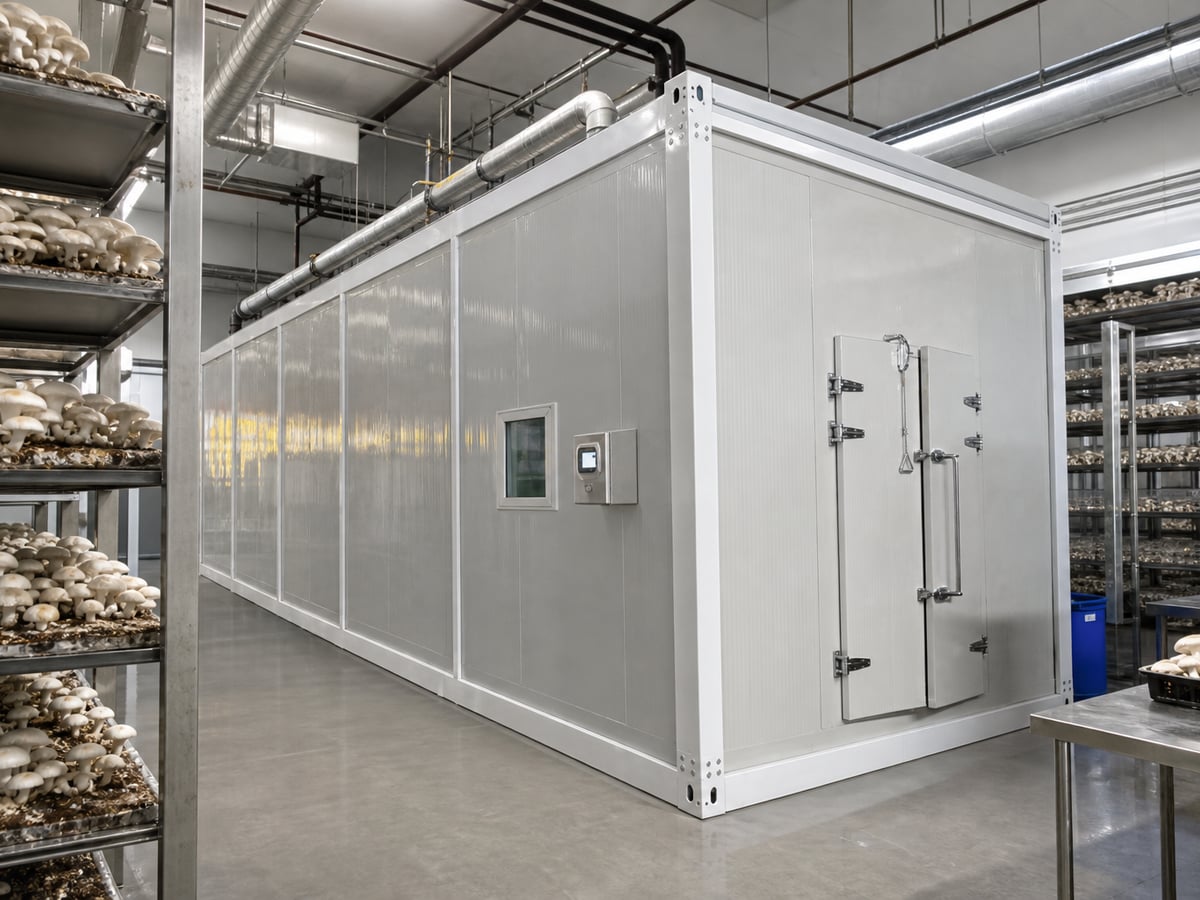
A practical purchasing sequence is: define crop targets; measure room dimensions and air exchange; estimate peak moisture demand; verify water treatment needs; review mist distribution; select controller compatibility; compare cleaning requirements; and evaluate total ownership cost. For turnkey modular projects, a smart mushroom cultivation container can integrate insulation, airflow, cooling, heating, humidification, lighting, and control logic in one coordinated package.
Typical project patterns show why an integrated approach matters. A small urban farm near Singapore may prioritize compact equipment, low noise, and automatic water-level protection. A larger grower serving wholesale channels through Los Angeles or Hamburg may focus on redundancy, sanitation access, spare-parts planning, and batch-to-batch consistency. In both cases, stable humidity is only useful when it works together with temperature, fresh air, and CO₂ management.
Fast selection guide
- Choose ultrasonic humidification when fine mist, quick response, modular output, and low direct heat addition are important.
- Choose high-pressure atomization for larger rooms needing long distribution lines and high moisture capacity, provided water filtration and nozzle maintenance are managed carefully.
- Choose steam humidification where hygiene and immediate evaporation are critical, while accepting higher energy consumption.
- Choose evaporative media or pads when cooling and humidification can be combined in a hot, dry climate and the room design supports the required airflow.
- Choose an integrated controller when production relies on repeatable recipes, remote monitoring, alarms, and coordinated climate equipment operation.
Calculate Room Moisture Load

Moisture demand is the amount of water that must be added to the air each hour to maintain the desired humidity setpoint under actual operating conditions. It is driven primarily by ventilation losses: humid room air is exhausted and replaced with incoming air that may be much drier. Additional losses occur through door openings, leakage, coil dehumidification, heat loads, and changes in crop transpiration or substrate evaporation.
A useful early-stage estimate is based on room volume, air changes per hour, the difference between indoor and incoming-air humidity ratio, and a safety allowance. For detailed engineering, psychrometric calculations should use local design weather data and measured airflow. In a mushroom farm, it is wise to size for peak dry-air conditions rather than yearly averages. A facility near Jeddah, inland Australia, northern China, or the American Southwest may experience sharply higher demand during dry periods than a farm in a humid coastal location.
For preliminary planning, calculate the room volume in cubic metres, estimate fresh-air flow in cubic metres per hour, then determine how many kilograms of water per hour are required to raise the incoming air to the selected indoor moisture content. One litre of water is approximately one kilogram. Add a sensible allowance for doors, imperfect sealing, defrost events, and changes in production stage. Avoid oversizing excessively: too much instantaneous output can cause condensation, wet surfaces, and unstable humidity cycling.
| Room example | Approximate room volume | Typical ventilation condition | Indicative moisture demand | Suitable humidifier range | Planning consideration |
|---|---|---|---|---|---|
| Small incubation room | 30–60 m³ | Low fresh-air requirement | 0.5–2 kg/h | Small ultrasonic unit | Prevent condensation during temperature changes |
| Compact fruiting room | 80–150 m³ | Moderate intermittent ventilation | 2–6 kg/h | Ultrasonic or compact high-pressure system | Use multiple discharge points for even coverage |
| Container cultivation room | 150–250 m³ | Controlled fresh-air cycles | 4–10 kg/h | Integrated atomization system | Coordinate with cooling coil and fan operation |
| Medium commercial room | 300–600 m³ | Regular CO₂-driven ventilation | 8–25 kg/h | High-pressure mist or modular ultrasonic banks | Include maintenance access and water treatment |
| Large growing hall | 800–1,500 m³ | High airflow and frequent access | 20–60 kg/h | Distributed high-pressure or steam system | Plan zones and backup capacity |
| High-throughput production area | More than 1,500 m³ | Continuous ventilation | 50–150+ kg/h | Engineered multi-zone solution | Use full psychrometric and airflow design |
The figures above are planning ranges, not guaranteed sizing values. A 200 m³ room with tight construction and low outside-air exchange may need less capacity than a 100 m³ room with frequent harvesting traffic and dry make-up air. In practice, growers should record indoor temperature, relative humidity, CO₂, fan runtime, outside temperature, and water consumption over several crop cycles. These records identify real peak demand more accurately than nameplate room volume alone.
Humidity setpoints should also be crop-stage specific. Pinning may require a different combination of fresh air, temperature, and humidity from mature fruiting. Maintaining a single high relative humidity number without considering evaporation, air movement, and cap surface condition can encourage bacterial spotting or overly wet clusters. The best target is a stable growing environment rather than the highest possible humidity reading.
Compare Atomization with Other Humidification Options

Atomization systems create fine water droplets that evaporate into the air. In mushroom production, the most widely discussed atomization approaches are ultrasonic fogging and high-pressure misting. Both can deliver rapid humidity, but their installation requirements, water-quality tolerance, droplet behavior, service profile, and capital cost differ.
Ultrasonic systems use vibrating transducers to create a cool fine fog. They are often well suited to smaller rooms, cultivation containers, and segmented zones because output can be modular and responsive. High-pressure systems force filtered water through precision nozzles, often using a pump and distribution tubing. They can serve longer rows and larger rooms efficiently but demand effective filtration, proper line flushing, correct nozzle placement, and periodic service.
Steam humidification introduces water vapor rather than airborne droplets. It is highly effective where immediate evaporation and sanitation are priorities, but energy demand may be significantly higher than cool-mist alternatives. Centrifugal humidifiers and low-pressure spray units can serve some agricultural spaces, though their larger droplets increase the risk of wetting if airflow and throw distance are poorly designed. Evaporative pads add moisture through moving air across wet media and can be attractive where dry outdoor air and cooling demand occur together.
| Method | Typical droplet or vapor behavior | Best-fit application | Main advantage | Main limitation | Water and maintenance priority |
|---|---|---|---|---|---|
| Ultrasonic fogging | Very fine cool fog | Containers, small rooms, modular zones | Fast response and fine mist | Minerals can become airborne if water is untreated | Use clean water; inspect transducers and tank hygiene |
| High-pressure mist | Fine droplets with controlled throw | Medium and large fruiting rooms | High capacity and distributed coverage | Nozzles can clog or drip when service is neglected | Filtration, flushing, nozzle inspection |
| Steam humidification | Water vapor, no droplet carryover | High-hygiene or cold-air duct applications | Immediate absorption and strong sanitation potential | Higher electrical or thermal energy use | Scale management and cylinder maintenance |
| Centrifugal humidifier | Moderate droplet size | Open agricultural areas | Simple mechanical operation | Less precise in compact grow rooms | Clean basin, inspect motor and distribution parts |
| Low-pressure spray | Larger droplets | Low-cost, well-ventilated spaces | Lower initial investment | Higher wetting and uneven evaporation risk | Manage water cleanliness and spray direction |
| Evaporative pad system | Moisture transferred through airflow | Hot, dry regions needing cooling | Can cool and humidify simultaneously | Depends heavily on outdoor climate and airflow design | Pad cleaning, sump treatment, pump checks |
The comparison shows why “best humidifier” claims should be treated carefully. In a tightly controlled mushroom cultivation container, ultrasonic modules may offer excellent staging and simple integration. In a wide commercial room with long aisles, high-pressure lines can offer more uniform capacity when engineered around fan circulation. In a high-value sterile or highly regulated setting, steam may be justified despite its operating cost.
Buying advice should include a practical site review. Ask whether the system can be divided into zones, whether output can modulate rather than operate only on/off, whether nozzles or transducers are accessible, and whether the manufacturer can provide local voltage options. International projects may require 220–240 V, 380–415 V three-phase, or 60 Hz configurations depending on destination. These requirements should be confirmed before shipping through trade hubs such as Shanghai, Ningbo, Rotterdam, Jebel Ali, Durban, or Santos.
Water Quality and Treatment Needs
Water quality is one of the most important and most underestimated humidification decisions. Minerals, suspended solids, hardness, iron, manganese, chlorine residues, microbial growth, and dissolved salts can affect humidifier performance, crop hygiene, and room cleanliness. The finer the mist, the more important water treatment becomes because minerals may dry as deposits on equipment, surfaces, and potentially mushroom caps.
Start with a laboratory water analysis or a reliable local report showing hardness, total dissolved solids, pH, iron, turbidity, and microbiological condition. Municipal water in one city may be suitable for basic filtration, while borehole water in another region may require softening, reverse osmosis, disinfection, or a combination of treatments. Growers sourcing water from wells, stored tanks, rainwater systems, or mixed supplies should assess variability over the year.
| Water condition | Common operational symptom | Potential production risk | Recommended treatment approach | Suitable monitoring point | Service action |
|---|---|---|---|---|---|
| Suspended sediment | Blocked filters and nozzles | Uneven mist output | Sediment pre-filter, staged filtration | Pressure drop across filter | Replace or clean filters on schedule |
| High hardness | White scale on equipment | Reduced output and shortened component life | Softening or reverse osmosis | Hardness test and visual scale checks | Descale approved components carefully |
| High total dissolved solids | Fine residue after fog evaporates | Surface contamination and sensor fouling | Reverse osmosis for fine-mist systems | TDS meter at supply and treated outlet | Inspect membranes and reject-water flow |
| Iron or manganese | Staining and deposits | Clogging and water discoloration | Oxidation, filtration, dedicated removal media | Periodic laboratory analysis | Replace media as capacity is exhausted |
| Microbial contamination | Biofilm, odor, tank slime | Hygiene concern and blocked lines | Tank sanitation, UV or approved disinfection | Tank inspections and water sampling | Flush lines and sanitize according to plan |
| Chlorinated municipal supply | Variable odor or chemical residual | Possible corrosion or process sensitivity | Carbon filtration where appropriate | Residual chlorine testing | Replace carbon media based on use and testing |
Reverse osmosis water is often preferred for ultrasonic foggers and high-pressure nozzles because it reduces mineral residue. However, reverse osmosis systems need their own maintenance: prefilters, membranes, sanitation, pressure monitoring, and management of reject water. A poorly maintained treatment system can create more problems than a simple, well-managed filtration train.
Water storage deserves equal attention. Tanks should be covered, opaque where possible to limit light-driven growth, accessible for cleaning, fitted with an overflow, and monitored for low level. Avoid storing treated water for long periods in warm, stagnant conditions. Where regulations and site procedures permit, sanitation routines should use cleaning agents compatible with the tank, pipework, pump seals, and humidifier components. Always rinse thoroughly before resuming crop-area operation.
For international installations, treatment design should account for local replacement parts. A farm near Cape Town, Lima, Jakarta, or Warsaw needs filters, cartridges, valves, and membranes that can be obtained without long downtime. Standardizing consumables and keeping critical spares on-site protects continuity during peak fruiting periods.
Mist Coverage and Evaporation Throw
Fine mist does not automatically mean even humidity. Mist distribution depends on nozzle height, discharge direction, fan velocity, room geometry, shelving density, temperature, and the distance available for droplets to evaporate. If mist is discharged directly toward bags, blocks, mushroom clusters, cooling coils, or walls, water can settle before evaporation. The result may be wet caps, blotch risk, puddles, corrosion, and misleadingly high humidity readings near the sensor.
The goal is to introduce moisture into moving air, then allow enough time and distance for evaporation before the air reaches the crop. In many mushroom rooms, humidification points work best near supply-air paths or circulation zones rather than aimed at shelves. The exact placement depends on fan layout. A fogger located beside a powerful fan may distribute well in one room but create localized wetting in another because of different air speed or obstructions.
Perform a practical smoke test, lightweight ribbon test, or airflow mapping exercise before finalizing nozzle locations. Observe where supply air moves, where it short-circuits back to returns, and where dead zones exist behind racks. Humidity sensors should not be placed immediately in the mist plume, beside cooling coils, near doors, or at a location that does not represent crop-level conditions.
Distribution checklist
- Install multiple lower-output discharge points instead of one oversized point where room geometry is complex.
- Allow evaporation distance between nozzles or fog outlets and the nearest mushroom surface.
- Coordinate humidifier operation with circulation fans so moisture is mixed through the room.
- Use drainage and washable floor finishes because occasional moisture carryover can occur.
- Inspect upper corners, rack ends, door areas, and ceiling zones for condensation during peak output.
- Verify humidity uniformity at several crop-level positions, not at a single display sensor.
For large halls, zoning is often more effective than a single central humidity source. Zones can be arranged by room section, rack block, or airflow circuit. This approach supports different crop stages, reduces overshoot, and makes maintenance easier because one zone can be isolated without stopping the entire room. It is particularly valuable for mixed production schedules where one section is pinning while another is approaching harvest.
Controls, Sensors, and Tank-Level Alerts
A humidifier should operate as part of the total climate system, not as an isolated appliance. Relative humidity is influenced by cooling, heating, ventilation, coil temperature, outside-air intake, crop respiration, and door activity. A controller that only switches a fogger on and off from one humidity sensor may work in a simple room, but commercial production benefits from coordinated logic.
A dedicated smart mushroom climate controller can combine temperature, humidity, CO₂, fan, heating, cooling, fresh-air damper, alarm, and scheduling functions. This allows the system to reduce humidification when cooling creates sufficient moisture, pause output when a door remains open, increase ventilation for CO₂ control, and maintain crop-stage recipes. A controller should include calibration procedures, data history, adjustable deadband, alarm limits, and manual override for service work.
| Control or alarm feature | Why it matters | Recommended operating response | Typical sensor or device | Failure risk reduced | Management benefit |
|---|---|---|---|---|---|
| Humidity setpoint and deadband | Prevents rapid on/off cycling | Stage humidifier output gradually | Industrial RH sensor | Overshoot and condensation | More stable crop environment |
| Temperature interlock | Humidity reading changes with temperature | Coordinate with cooling and heating | Temperature probe | Incorrect moisture response | Balanced climate control |
| CO₂ ventilation interlock | Fresh air can remove moisture quickly | Increase humidification after ventilation demand | CO₂ sensor and damper logic | Dry-air shock after air exchange | Better morphology control |
| Low-water-level alarm | Protects pump and maintains output | Stop equipment and notify operator | Float switch or level probe | Dry running and humidity collapse | Faster corrective action |
| High-water-level alarm | Identifies filling or valve problems | Close inlet and inspect overflow route | High-level float switch | Flooding and water damage | Improved facility safety |
| Sensor fault alarm | Detects implausible or missing data | Use fallback logic and verify manually | Diagnostic controller input | Uncontrolled operation from bad readings | Reliable traceability |
Sensor placement and calibration are essential. Low-cost sensors can drift in high-humidity environments, especially where mineral residue or condensate is present. Establish a verification routine with a reference instrument and replace sensors according to their condition and documented accuracy. In critical rooms, dual-sensor comparison or alarm logic can help identify drift before it affects an entire crop cycle.
Remote monitoring is increasingly useful for farms with several rooms, distributed sites, or staff operating across shifts. Alerts can be sent for low water, high humidity, low humidity, pump overload, abnormal temperature, communication interruption, and power loss. Remote access should support management, not replace on-site inspection. Operators still need to examine condensation, substrate condition, nozzle output, filter pressure, and cleaning status.
Cleaning, Scale Control, and Hygiene Plans
Humidification equipment operates in a warm, wet environment, so hygiene cannot be treated as an occasional repair task. Water tanks, mist lines, nozzles, transducer basins, filters, and drain points should be included in the farm sanitation program. The exact cleaning frequency depends on water quality, daily runtime, temperature, treatment method, and crop hygiene requirements.
A basic routine has four layers: daily visual checks, weekly functional inspection, periodic cleaning, and scheduled deep sanitation. Operators should examine water level, leaks, unusual noise, mist pattern, filter condition, and surface deposits daily. Weekly tasks can include checking pump pressure, cleaning accessible strainers, reviewing alarms, and confirming sensor readings. Deeper maintenance should be completed between production cycles whenever possible.
Scale should never be removed with unapproved chemicals or abrasive tools that may damage ultrasonic transducers, nozzles, seals, stainless steel, or plastic components. Follow the equipment manufacturer’s cleaning recommendations and ensure all cleaning solutions are thoroughly rinsed. When disinfectants are used, their compatibility with crop areas, worker safety procedures, wastewater rules, and component materials must be reviewed.
Suggested hygiene management routine
- Every day: inspect tank level, leaks, humidity trend, visible residue, and operation of low-level protection.
- Every week: clean strainers, check filter pressure or flow, inspect nozzles, and compare controller readings with a handheld instrument.
- Every month: examine tubing, fittings, valves, pump condition, and accessible internal surfaces for scale or biofilm.
- Between crop cycles: drain, clean, sanitize where appropriate, flush, inspect, and document the work completed.
- Seasonally: review water-quality test results, replace consumables, and reassess capacity against seasonal dry-air demand.
- After an alarm or contamination event: investigate the source before restarting normal automatic operation.
Good hygiene routines also support food safety and staff confidence. The objective is not merely to keep equipment looking clean; it is to maintain predictable atomization, reduce microbial growth opportunities, and prevent mineral accumulation that changes output. Documentation is useful for commercial farms supplying retailers, hotels, food-service distributors, and export customers.
Compare Energy Costs and Maintenance Requirements
The lowest purchase price is rarely the lowest lifetime cost. Buyers should compare electrical use, water use, treatment cost, consumables, labor, spare parts, cleaning downtime, and expected service interval. A low-cost spray system may appear economical initially but can become expensive if it wets crops, requires frequent cleaning, or causes yield losses. Conversely, a high-performance steam unit may be technically excellent but difficult to justify where electricity prices are high.
| System type | Initial investment | Energy profile | Routine service level | Key consumables | Best ownership-cost scenario |
|---|---|---|---|---|---|
| Ultrasonic fogger | Moderate | Low to moderate electrical demand | Moderate | Transducers, filters, cleaning materials | Small to medium controlled rooms with treated water |
| High-pressure mist | Moderate to high | Moderate pump energy | Moderate to high | Filters, nozzles, pump seals, tubing fittings | Large rooms requiring distributed fine mist |
| Steam humidifier | Moderate | High thermal or electrical demand | Moderate | Cylinders, scale-control products, valves | Applications valuing vapor hygiene and immediate absorption |
| Centrifugal humidifier | Low to moderate | Moderate motor demand | Moderate | Filters, bearings, basin-cleaning materials | Open areas with less stringent precision needs |
| Low-pressure spray | Low | Low to moderate | Moderate | Nozzles, filters, hoses | Budget projects with ample evaporation distance |
| Evaporative pad system | Moderate to high | Fan and pump energy | Moderate | Pad media, water-treatment supplies, pump parts | Hot, dry climates needing cooling and humidity together |
The table is most useful when combined with local utility pricing. Electricity in northern Europe, water restrictions in parts of the Middle East, mineral-heavy bore water in southern Africa, and humid seasonal conditions in Southeast Asia can change the business case. Ask suppliers for expected electrical load, water consumption, filter specifications, recommended spare parts, and maintenance intervals under conditions similar to the intended location.
Redundancy should be evaluated for valuable crops. Two smaller humidification modules can provide operational resilience when one unit requires cleaning or repair. For larger rooms, a duty-and-standby pump arrangement may prevent a single failure from causing a severe humidity drop. Spare nozzles, filters, relays, level switches, and sensor probes should be planned as part of commissioning rather than ordered only after a fault occurs.
By 2026, mushroom climate projects are increasingly expected to use variable-output equipment, remote data logging, predictive maintenance alerts, water-saving controls, and lower-waste filtration strategies. Sustainability requirements are also pushing farms to reduce overspray, recover or manage water responsibly, select durable equipment, and document energy use. In markets with stricter environmental policies, the most competitive systems will combine accurate climate control with responsible water treatment and transparent service planning.
About Lanhu
Shandong Lanhu Air Conditioning Equipment Co., Ltd. supports mushroom growers, agricultural contractors, distributors, and engineering companies with climate-control and modular cultivation equipment for the Global Market. Its approach is centered on integrating humidity with the other conditions that influence mushroom quality: temperature, fresh air, CO₂ concentration, circulation, insulation, and operational monitoring.
Technological capabilities
Lanhu develops solutions for controlled agricultural environments, including smart mushroom cultivation containers, mushroom climate controllers, hydroponic plant containers, and air source heat pumps. With more than 12 years of thermodynamic research and development experience and over 45 registered patents, the company focuses on coordinated climate operation rather than standalone hardware selection. Its controller-oriented design can help growers manage humidity recipes, alarms, ventilation logic, temperature response, and equipment status in a practical operating interface.
For projects requiring customized layouts, the company can provide engineering support around room size, rack arrangement, power conditions, local climate, and intended crop workflow. Buyers seeking tailored configurations can explore OEM and ODM customization services for equipment branding, component selection, modular layouts, and project-specific integration.
Manufacturing capabilities
Lanhu operates a modern manufacturing facility in Dezhou, Shandong, China, covering more than 30,000 square metres. Integrated capabilities include product design, engineering development, sheet-metal fabrication, CNC bending, insulation-panel production, electrical assembly, system integration, equipment testing, and quality inspection. This manufacturing structure supports coordinated production of modular rooms and climate equipment while helping maintain consistency from fabrication through final assembly.
Before shipment, systems undergo functional inspection, electrical verification, performance testing, and operational evaluation. The company holds ISO 9001, ISO 14001, ISO 45001, and ISO 12100 certifications. For buyers comparing suppliers, these processes are relevant because humidity performance depends not only on the fogging device but also on enclosure sealing, air distribution, electrical safety, insulation quality, drainage details, and controller reliability.
Service capabilities
Lanhu provides factory-direct supply, technical communication, international logistics support, installation guidance, spare-parts support, and after-sales service for overseas projects. This is valuable for customers coordinating deliveries through international routes from China to ports such as Rotterdam, Felixstowe, Jebel Ali, Mombasa, Santos, Long Beach, and Melbourne. Packaging, voltage confirmation, documentation, destination access, and on-site installation planning should be reviewed early in the purchasing process.
Prospective buyers can review representative applications and project experience through the company’s mushroom cultivation project cases. Whether the requirement is one controlled fruiting room, a modular container farm, or a scalable commercial facility, the recommended solution should be based on measurable climate conditions, water quality, crop requirements, and service access after installation.
Frequently Asked Questions
What humidity level is normally needed for mushroom fruiting?
The correct target varies by species and crop stage. Many fruiting environments operate at high relative humidity, but the exact setpoint must be balanced with temperature, fresh-air exchange, air velocity, and cap dryness. Consult crop-specific growing guidance and observe crop response rather than relying on one universal percentage.
Can a humidifier be oversized for a mushroom room?
Yes. Excess capacity can create fast humidity overshoot, condensation, wet shelves, and direct water deposition on mushrooms. Select sufficient peak capacity but use staged or variable control so output can match actual demand.
Is reverse osmosis water necessary for ultrasonic humidifiers?
It is often strongly recommended when the source water has notable mineral content. Reverse osmosis can reduce white dust, scale, and residue. The final decision should follow a water analysis and the humidifier manufacturer’s requirements.
Where should humidity sensors be installed?
Place sensors at representative crop level, away from direct mist discharge, cooling coil discharge, doors, standing water, and extreme airflow zones. In large rooms, use multiple measurement points or periodically validate conditions across the room.
How often should humidification lines and tanks be cleaned?
Daily checks and scheduled weekly inspections are advisable, while thorough cleaning and sanitation are commonly planned between crop cycles. Water quality, runtime, storage conditions, and local hygiene procedures determine the final schedule.
Can humidification be linked with CO₂ control?
Yes. This is recommended because fresh-air ventilation used to reduce CO₂ can also lower humidity. An integrated controller can compensate for moisture loss while preventing unnecessary humidification when other equipment is affecting room conditions.
Which system is better for a large mushroom farm: ultrasonic or high-pressure mist?
High-pressure mist is often suitable for large rooms because it can distribute water through extended pipework and multiple nozzles. Ultrasonic systems can also work well in modular zones. The best choice depends on water treatment, room geometry, maintenance resources, and desired redundancy.
What should international buyers ask before ordering?
Confirm room dimensions, crop type, local outdoor design conditions, water analysis, voltage and frequency, installation access, treatment requirements, spare-parts list, control functions, warranty terms, shipping method, and commissioning support. These details help ensure the humidification system is practical for the destination market.
Share this article

About the Author: Shandong Lanhu Air Conditioning Equipment
Lanhu is a professional climate control equipment manufacturer specializing in smart agricultural systems, commercial HVAC solutions, and customized temperature control technologies. With extensive engineering experience, Lanhu provides reliable solutions for plant factories, controlled environment agriculture, and industrial applications.
Need a Custom Climate Control Solution?
From smart agricultural systems to commercial HVAC solutions, Lanhu provides reliable temperature and humidity control solutions tailored to your project needs.
Contact Us