Mushroom Room Dehumidification Guide for the Global Market
Quick Answer: Can Cooling Alone Control Mushroom Room Moisture?

Cooling coils can remove a substantial amount of water from a mushroom fruiting room, but cooling alone is not always enough. The coil must operate below the room air dew point, and the system must have enough latent capacity to handle evaporation from the growing blocks, wet floors, sanitation, fresh-air exchange, and humidification. If the room needs high relative humidity while also requiring a stable temperature, conventional cooling may reach its practical limit.
The most reliable strategy is to calculate the moisture load first, then select a coordinated system. Depending on the crop, room size, outdoor climate, air-change rate, and production schedule, the solution may combine cooling-coil dehumidification, a dedicated dehumidifier, controlled fresh air, condensate drainage, and limited reheat. A mushroom climate controller can coordinate these functions without allowing dehumidification to create excessive temperature swings.
Relative humidity is not the same as surface condensation. Air can show an acceptable humidity reading while cold panels, ceilings, ducts, shelves, or product surfaces remain below the dew point. For this reason, growers should measure temperature and humidity at several locations and use dew-point calculations before deciding that the room is adequately dry.
For commercial facilities in the Global Market, including farms near Qingdao, Shanghai, Rotterdam, Hamburg, Dubai, Vancouver, or other humid trade and agricultural hubs, equipment selection should reflect local weather and operating conditions. A system sized for a cool, dry winter in northern Europe may perform very differently during a warm, humid summer in Southeast Asia.
Sources of Excess Moisture in Fruiting Rooms

Fruiting rooms are moisture-intensive environments by design. Mushrooms need a carefully controlled vapor environment for healthy development, yet the same water that supports fruiting can overload air-handling equipment. Moisture management begins with identifying every source rather than focusing only on the humidifier.
Crop evaporation and respiration
Water evaporates from the casing, substrate, grow bags, shelves, and mushroom surfaces. The total rate changes with crop age, air velocity, temperature, exposed surface area, and the difference between the product surface and room air. Large flushes can create a sudden latent load, particularly when a room is densely packed or when fresh-air rates are increased to control carbon dioxide.
Humidifier output
Ultrasonic humidifiers, high-pressure fogging systems, steam humidifiers, and atomizing nozzles can all add more water than the room can hold. A humidifier that operates continuously because of poor sensor placement may fight the dehumidifier at the same time. The control sequence should include minimum run times, dead bands, sensor averaging, and a clear priority between humidity production and moisture removal.
Cleaning and sanitation
Foam cleaning, floor washing, rack sanitation, and water left in drains can produce a large temporary moisture load. This load is often overlooked because it occurs between production cycles. If the room is cooled immediately after washing, the coil may condense heavily, but the room can still remain wet if drainage, air circulation, and drying time are insufficient.
Fresh-air exchange
Outdoor air may be the largest moisture source in coastal, tropical, or monsoon climates. Warm air entering a cool fruiting room loses moisture-holding capacity as it is cooled. The resulting condensation load can be substantial even when the outdoor relative humidity appears similar to the target indoor value.
| Moisture source | Typical trigger | Operational symptom | Useful control response | Measurement to verify | Risk if ignored |
|---|---|---|---|---|---|
| Crop evaporation | Dense crop or active flush | Humidity rises after harvest cycles | Increase latent capacity gradually | Room humidity trend and weight loss | Wet caps, bacterial risk, slow drying |
| Humidifier output | Long fogging or steam cycles | Dehumidifier runs continuously | Adjust setpoints and control dead band | Humidifier flow and run time | Energy waste and unstable humidity |
| Floor and walls | Washing or sanitation | Condensation on panels and drains | Use drying mode and improve drainage | Surface temperature and dew point | Mold growth and panel deterioration |
| Fresh air | Rainy or humid weather | Humidity rises after ventilation | Precondition or reduce unnecessary intake | Outdoor dew point and airflow | Coil overload and condensation |
| Open doors | Loading, harvesting, or inspection | Short humidity spikes | Use door discipline and vestibules | Door-open duration | Local wet spots and temperature shock |
| Drainage leakage | Blocked traps or poor slopes | Standing water near equipment | Inspect drains and condensate pumps | Drain flow and visual inspection | Persistent room moisture and odors |
The table illustrates why a single room humidity reading is not enough. A grower should compare the air sensor with coil condensate volume, outdoor dew point, drain performance, and the production schedule. A temporary humidity increase after sanitation may require a drying sequence, while a continuous increase during fruiting may indicate insufficient latent capacity.
Relative Humidity Versus Surface Condensation

Relative humidity describes how close the air is to saturation at its current temperature. Surface condensation occurs when a surface is colder than the air dew point. These are related, but they are not identical. A room may show 88% relative humidity at 16°C, while a metal duct or ceiling corner at 14°C becomes wet because its surface temperature is below the dew point.
Dew point is the practical condensation indicator
The dew point is the temperature at which water vapor begins to condense. If the room dew point is 14°C and a panel surface is 13°C, condensation is likely. If the surface is 16°C, condensation should not occur under stable conditions. This simple comparison is more useful than relying on a relative-humidity percentage alone.
In a fruiting room, sensors should be positioned away from direct fog, supply-air jets, doors, and cold coil discharge. A useful arrangement includes one central air sensor, one return-air sensor, and several surface or wireless sensors near corners, ceilings, evaporator outlets, and external walls. Sensor calibration should be checked periodically because a small humidity error can create a misleading dew-point calculation.
Common locations for hidden condensation
- Cold corners behind cultivation racks.
- Panel joints and fastener penetrations.
- Supply-air ducts and uninsulated grilles.
- Ceilings below poorly insulated roof areas.
- Metal shelves exposed to cold air discharge.
- Drain pans and condensate pipe connections.
Air movement also matters. A surface may remain dry in moving air but become wet when airflow stops during a defrost, night setback, or fan failure. Good insulation, continuous low-speed circulation, and well-distributed supply air can reduce condensation without lowering room humidity excessively.
| Condition | Air temperature | Relative humidity | Approximate dew-point behavior | Condensation concern | Recommended check |
|---|---|---|---|---|---|
| Cool and moderately humid | 12°C | 80% | Dew point remains near 9°C | Cold metal may still become wet | Measure panel and duct temperatures |
| Typical fruiting condition | 16°C | 90% | Dew point is close to 14°C | High risk on surfaces below 14°C | Review insulation and airflow |
| Warm humid room | 20°C | 90% | Dew point approaches 18°C | Very high risk around cold coils | Check coil leaving-air temperature |
| Drying mode | 18°C | 75% | Dew point is materially lower | Lower risk if surfaces stay warm | Confirm condensate removal |
| Fresh-air event | 18°C indoor | 88% indoor | Outdoor moisture may raise dew point | Localized wetting after ventilation | Compare indoor and outdoor dew points |
| Fan-off period | 15°C | 88% | Dew point remains high | Cold corners can condense quickly | Use standby circulation or timed fans |
For accurate decisions, record air temperature, relative humidity, dew point, and surface temperature together. A controller with trend logging can reveal whether condensation follows ventilation, fogging, door opening, compressor cycling, or fan shutdown.
Moisture Removal Through Cooling Coils
Cooling-coil dehumidification works by passing humid air over a coil whose surface is colder than the air dew point. Water vapor condenses on the coil fins, collects in a drain pan, and leaves the room as liquid condensate. This approach is attractive because the same system can provide sensible cooling and latent moisture removal.
How coil dehumidification reaches its limit
Coil performance depends on entering-air temperature, entering-air humidity, airflow, coil surface temperature, fin spacing, refrigerant or chilled-water conditions, and operating time. If the coil is too warm, it may cool the room without removing enough water. If the coil is made colder, latent removal increases, but the supply air may become too cold for the crop or cause excessive compressor operation.
Airflow is equally important. High airflow can deliver more total cooling but may reduce contact time and produce warmer coil leaving air. Very low airflow can create a cold discharge, poor room distribution, and possible icing. The correct operating point must be established from the actual room load, not from nominal cooling capacity alone.
Condensate management
Every coil-based dehumidification system needs a reliable condensate path. Drain pans should have adequate slope, traps should match the fan pressure, and pipes should be insulated where condensation could damage panels or equipment. In a remote or containerized cultivation room, a condensate pump may be required when gravity drainage is unavailable.
Drain performance should be inspected during the wettest operating period. A system that appears to work during a dry commissioning day may overflow or retain water during summer operation. Water remaining in a pan can re-evaporate into the room when the compressor stops, undermining moisture control.
| Design variable | Why it matters | Possible symptom of undersizing | Possible symptom of oversizing | Commissioning action | Long-term check |
|---|---|---|---|---|---|
| Coil surface temperature | Determines condensation potential | Cooling without drying | Icing or overly cold supply air | Measure entering and leaving air | Review seasonal operating data |
| Airflow volume | Controls contact time and distribution | Poor room mixing | High fan energy or low latent ratio | Balance supply and return paths | Inspect filters and fan speed |
| Latent capacity | Sets water-removal rate | Humidity never reaches setpoint | Unnecessary capital and cycling | Test condensate production | Compare capacity with crop load |
| Drain system | Removes condensed water | Overflow and standing water | Usually limited downside | Pour-test pans and traps | Clean and inspect regularly |
| Insulation | Prevents unwanted surface condensation | Wet ducts or panels | Higher initial cost | Check joints and penetrations | Repair damaged vapor barriers |
| Control logic | Coordinates cooling and humidity | Short cycling or unstable RH | Overly conservative operation | Test sensor response and delays | Analyze alarms and trend logs |
A useful preliminary calculation is to convert the expected moisture load into a required water-removal rate. Include crop evaporation, humidifier water, fresh-air moisture, cleaning water, and infiltration. Then apply a safety margin for weather variation, peak flushes, and equipment fouling. The final selection should be verified by a qualified HVAC engineer because actual performance changes with operating temperature and airflow.
When Reheat May Be Needed
Reheat is used when the system must remove moisture by cooling the air below its dew point but cannot allow the room temperature to fall too far. The coil first cools and dries the air; a reheat coil then raises the supply-air temperature to a suitable delivery condition. Reheat can be electric, hot-water, refrigerant hot-gas, heat-recovery based, or supplied by an air-source heat pump.
Situations that may justify reheat
- The crop requires a narrow temperature range while latent removal must continue.
- High outdoor humidity creates a large moisture load.
- The room is well insulated and sensible heat gain is too low to offset drying.
- Cooling-only operation causes cold stress or excessive compressor cycling.
- Supply air leaves the coil so cold that local condensation or uneven fruiting occurs.
- The facility has recoverable heat from compressors, refrigeration systems, or heat pumps.
Reheat should not be treated as a universal fix. Electric reheat can increase operating costs, especially in regions with high electricity prices. Heat recovery or hot-gas reheat may provide better efficiency, but these options require appropriate system design, controls, and maintenance access.
In some rooms, a dedicated desiccant dehumidifier can reduce dependence on low-temperature cooling. Desiccant systems remove moisture through an adsorbent material and then require regeneration heat. They may be useful when the room needs drying without substantial cooling, during cold weather, or when very low humidity is required for sanitation and transition periods.
| Operating condition | Cooling-only result | Reheat value | Alternative approach | Energy consideration | Selection note |
|---|---|---|---|---|---|
| Moderate humidity, adequate sensible load | Usually satisfactory | Often unnecessary | Optimize coil and airflow | Lowest added energy | Start with cooling-only evaluation |
| High humidity and narrow temperature band | Room becomes too cold | Maintains temperature during drying | Heat recovery or desiccant | Compare seasonal cost | Use load-based control |
| Cold winter operation | Limited condensation potential | May stabilize supply air | Desiccant or controlled ventilation | Heat source availability matters | Consider outdoor dew point |
| Warm coastal summer | High compressor run time | Allows deeper coil drying | Dedicated dehumidifier | Peak demand can be high | Review utility tariff |
| Post-sanitation drying | Can cool surfaces excessively | Speeds drying at safe temperature | Timed ventilation and fans | Short-term energy use | Use temporary drying mode |
| Heat-pump-equipped facility | May need coordinated control | Can use recovered heat | Hot-gas or condenser reheat | Potentially efficient | Confirm manufacturer limits |
The correct question is not simply whether reheat is technically possible. It is whether the value of stable temperature, improved crop quality, and reduced condensation justifies the additional capital and energy. A whole-year simulation using local weather data from cities such as Singapore, Dubai, Amsterdam, Toronto, or Melbourne can produce a more realistic answer than a single design-day estimate.
Fresh-Air Humidity and Seasonal Changes
Fresh air is essential for carbon dioxide control, oxygen supply, odor management, and worker comfort. However, ventilation also imports heat and moisture. The moisture load depends primarily on outdoor dew point and airflow, not only on outdoor relative humidity. For example, air at 30°C and 75% relative humidity carries considerably more water vapor than air at 10°C and 75% relative humidity.
Seasonal operating differences
During humid summers or monsoon periods, fresh air may require cooling and dehumidification before it enters the fruiting room. During cold winters, outdoor air may be dry enough to help remove moisture but can lower the room temperature quickly. In spring and autumn, rapidly changing weather may create frequent transitions between humid and dry operating modes.
Outdoor air should ideally be filtered, measured, and conditioned according to its dew point. An enthalpy or heat-recovery ventilator can reduce sensible and latent loads where appropriate, although the suitability of moisture-transfer cores must be evaluated carefully. In mushroom applications, odor, sanitation, maintenance, and cross-contamination requirements may influence the choice between heat recovery and separate air paths.
Fresh-air control strategies
- Use carbon dioxide concentration, crop stage, and occupancy to determine minimum ventilation.
- Reduce unnecessary outdoor-air volume during extreme dew-point conditions.
- Precondition outdoor air before mixing it with recirculated room air.
- Use variable-speed fans rather than fixed high airflow whenever process requirements allow.
- Protect intake openings from rain and direct water entry.
- Trend outdoor dew point alongside indoor humidity and condensate production.
| Season or climate | Outdoor-air behavior | Primary moisture risk | Preferred operating response | Maintenance priority | Example market location |
|---|---|---|---|---|---|
| Humid tropical season | High dew point day and night | Fresh air overloads coil | Precondition air and limit excess ventilation | Clean coils and drains often | Singapore or Jakarta |
| Coastal summer | Moisture remains high near the sea | Condensation on cold surfaces | Use dew-point control and insulation | Inspect vapor barriers | Qingdao or Rotterdam |
| Cold winter | Low absolute humidity | Room becomes too dry or cold | Reduce ventilation or add controlled humidification | Protect coils from freezing | Hamburg or Toronto |
| Dry desert climate | Low outdoor moisture but high heat | Humidifier demand and cooling load | Use efficient humidification and shading | Check water quality and filters | Dubai or Riyadh |
| Monsoon transition | Rapidly changing dew point | Control instability | Use predictive setpoints and trend logging | Calibrate outdoor sensors | Mumbai or Ho Chi Minh City |
| Temperate shoulder season | Variable temperature and humidity | Frequent mode changes | Coordinate cooling, ventilation, and reheat | Verify valves and dampers | Vancouver or Melbourne |
Fresh-air design should also consider local building regulations, worker safety, fire protection, and food-production hygiene. Importing air from a loading dock, compost area, chemical storage zone, or vehicle route can introduce contaminants even when its humidity is acceptable.
Coordinating Dehumidification with Humidifiers
A stable mushroom room does not require the dehumidifier and humidifier to operate at full capacity simultaneously. The control system should establish a clear sequence based on room humidity, dew point, crop stage, air temperature, and carbon dioxide. The goal is to prevent rapid oscillation between wet and dry conditions.
Recommended control sequence
- Measure temperature and humidity at representative locations.
- Calculate dew point and compare it with critical surface temperatures.
- Check whether humidity is below, within, or above the control band.
- Use ventilation only when it supports carbon dioxide or air-quality requirements.
- Enable humidification gradually when the room is below the lower limit.
- Enable cooling-coil drying or dedicated dehumidification when the room exceeds the upper limit.
- Apply reheat only when drying would reduce room temperature below the crop limit.
- Use minimum off-times and staging delays to protect compressors and pumps.
Sensor placement is central to reliable control. A sensor located beside a fogging nozzle will report an artificially high humidity, while a sensor in a warm return-air stream may report a falsely low value. For larger rooms, several sensors should be averaged, with high and low alarms retained so that local wet spots are not hidden by the average.
Lanhu’s smart mushroom climate controller concept is relevant to this type of integrated operation because it can be configured around temperature, humidity, ventilation, and equipment status. The final control sequence should still be commissioned against the actual crop, equipment, and local operating rules.
Humidification equipment choices
Ultrasonic units are compact and responsive but require clean water and regular transducer maintenance. High-pressure fogging can cover larger rooms but needs correct nozzle sizing, filtration, and droplet control. Steam provides hygienic vapor but usually has a higher energy demand. Evaporative systems may be efficient in dry climates but can add sensible effects and require careful sanitation.
Water quality is important for all systems. Mineral deposits can block nozzles, reduce heat-transfer performance, and create hygiene problems. A water-treatment plan should define filtration, softening, reverse osmosis, or other treatment according to the source water and equipment design.
Confirming Capacity Before Equipment Selection
Equipment should be selected after a room-by-room moisture and heat balance. A product catalogue may list a nominal cooling capacity, but that number does not automatically equal moisture-removal capacity at the required fruiting condition. Buyers should request performance data at entering-air temperature, relative humidity, airflow, and leaving-air conditions close to the real application.
Information required for a preliminary calculation
- Room length, width, height, insulation specification, and door configuration.
- Number and type of growing shelves, blocks, bags, or trays.
- Target temperature, relative humidity, carbon dioxide concentration, and air velocity.
- Expected crop evaporation and peak flush schedule.
- Humidifier type, water flow, and maximum operating time.
- Required fresh-air volume and local outdoor design conditions.
- Cleaning frequency, sanitation water volume, and drying schedule.
- Available electrical supply, drainage arrangement, and installation limitations.
| Buyer question | Why it matters | Evidence to request | Warning sign | Preferred decision basis | Result |
|---|---|---|---|---|---|
| What is the latent capacity? | Shows actual water removal | Performance table at design conditions | Only total cooling is provided | Litres per hour or kilograms per hour | Correct dehumidifier size |
| What is the airflow? | Determines room mixing | Fan curve and operating point | Only maximum airflow is stated | Airflow at system resistance | Better distribution |
| How is condensate drained? | Prevents re-evaporation and overflow | Drain layout and pump data | No trap or slope information | Verified drainage design | Cleaner operation |
| What happens at low load? | Prevents unstable cycling | Capacity staging and controls | Compressor runs on/off rapidly | Variable-speed or staged control | Longer equipment life |
| Can the system reheat? | Maintains crop temperature during drying | Reheat source and capacity | Reheat described only as optional | Seasonal energy comparison | Stable room conditions |
| What service is available? | Supports installation and uptime | Spare-parts and commissioning plan | No local technical contact | Documented after-sales process | Lower project risk |
Comparing product types
Cooling-based systems are often suitable for rooms where temperature control and moisture control can be handled together. Dedicated refrigeration dehumidifiers can offer stronger latent performance, while desiccant systems may be beneficial for low-temperature drying or very dry operating modes. Packaged air-handling units simplify installation, whereas modular equipment may be more flexible for phased expansion.
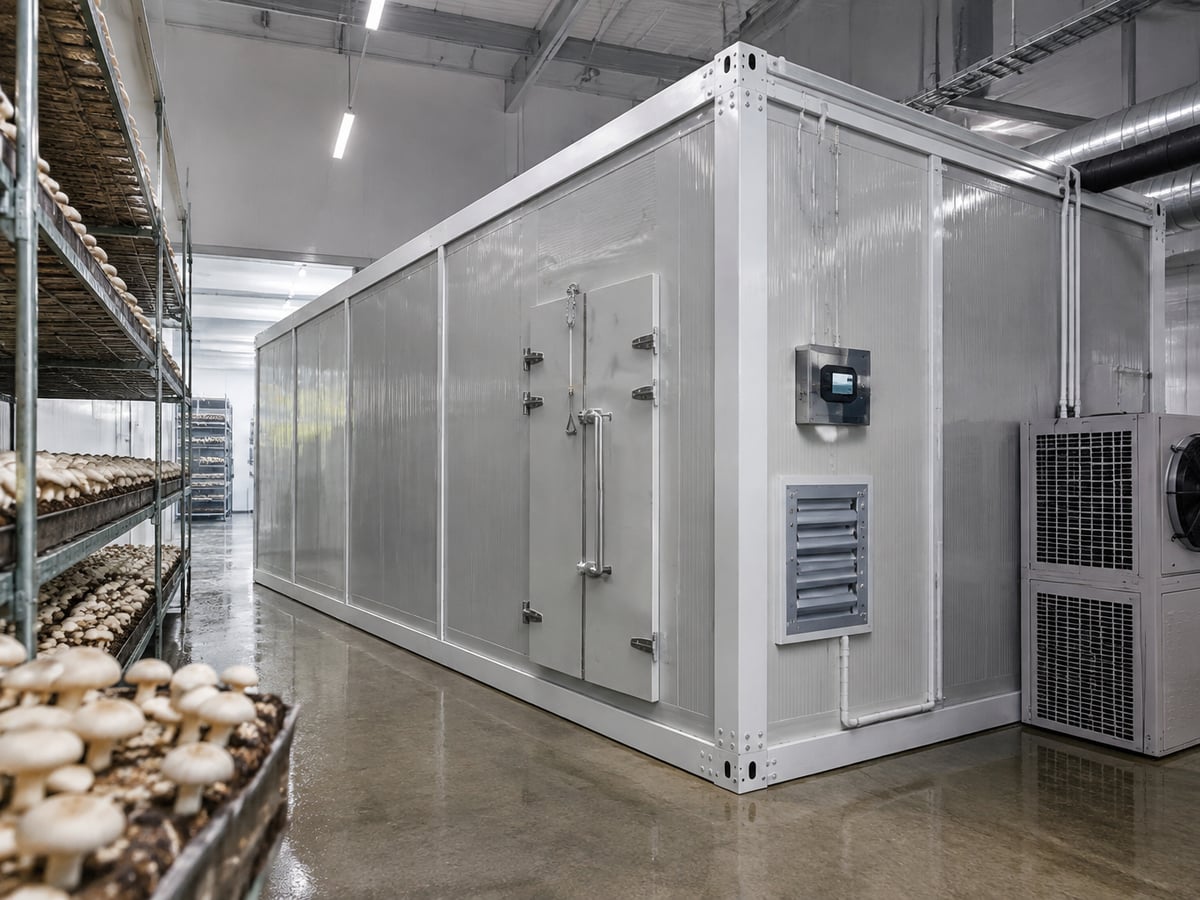
For compact farms, a smart cultivation container can combine insulated construction, air treatment, sensors, humidification, and control in a repeatable package. The smart mushroom cultivation container approach can reduce on-site construction complexity, although buyers should still confirm the unit’s local electrical, drainage, ventilation, and service requirements.
Commissioning and acceptance testing
Acceptance testing should be completed under representative conditions. Measure room temperature uniformity, relative humidity, dew point, airflow, condensate volume, power consumption, and alarm operation. Test door openings, humidifier operation, high-humidity recovery, drain performance, sensor failure alarms, and loss of communication with the controller.
For international projects, documentation should include wiring diagrams, refrigerant information, control sequences, maintenance schedules, spare-parts lists, and recommended commissioning records. This is especially important when equipment is shipped from Asia to agricultural contractors or distributors in Europe, the Middle East, Africa, North America, or Oceania.
Industries and applications
Mushroom farms are the primary users, but moisture-control principles also apply to spawn rooms, substrate preparation areas, post-harvest holding rooms, food-processing spaces, botanical growth rooms, and controlled-environment agriculture. Each application has different hygiene, temperature, air-change, and drying requirements.
In a commercial farm, separate control zones are usually more efficient than one oversized system serving every room. Incubation may need different conditions from fruiting. Harvest holding may require cooling without the same humidification level. Sanitation areas may need rapid drying and strong exhaust. Zoning allows each process to operate closer to its real load.
Examples from Commercial Growing Projects
Actual results depend on building design, crop variety, loading density, weather, and operating discipline. The following examples illustrate how the diagnosis differs from project to project.
Case example: coastal East Asia
A farm near Qingdao operated fruiting rooms with high summer humidity and frequent door openings during harvest. Cooling capacity appeared adequate, but humidity recovery was slow. Investigation found that outdoor air entered through open doors and that condensate drains retained water after compressor shutdown. The improvement plan included a door vestibule, better drain slopes, timed circulation fans, and a controller sequence that reduced unnecessary humidifier operation during recovery.
Case example: Northern European distribution hub
A mushroom facility near Rotterdam experienced overly cold rooms during winter drying cycles. Outdoor air had a low dew point, but the room still required stable crop temperature. The project team reduced fresh-air volume during low carbon dioxide demand, added controlled reheat using recovered condenser heat, and improved sensor placement. The result was more consistent temperature without relying on excessive electric heating.
Case example: Gulf-region production site
A farm near Dubai faced high sensible cooling demand and substantial humidifier use because outdoor air was hot and dry. The design emphasized insulated modules, efficient heat pumps, filtered water for ultrasonic humidification, and careful air distribution. The system was selected for both cooling and humidification rather than treating the humidifier as an independent add-on.
Case example: North American expansion
A growing operation in Vancouver planned modular expansion. Instead of selecting one large central unit, the owner compared separate room modules with a common monitoring platform. Modular equipment allowed production to start in stages and made it easier to isolate one room for cleaning or service. The final decision considered local electrical service, access for replacement components, drainage, and future capacity.
These examples show why local supplier support matters. A low-cost unit may not be the lowest-cost project solution if installation details, controls, drainage, or spare parts are unresolved. Buyers should evaluate total ownership cost, not only the equipment invoice.
Choosing a Local or International Supplier
Global buyers can source equipment from local HVAC contractors, agricultural engineering firms, specialized mushroom-equipment manufacturers, or international factories. Local suppliers may offer faster service and familiarity with regional codes. International manufacturers may provide integrated designs, factory testing, containerized products, OEM customization, and direct access to production engineering.
When comparing suppliers, ask whether the company can provide a complete moisture-control concept rather than only a cooling unit. The supplier should understand cultivation cycles, humidifier coordination, surface condensation, sanitation, fresh-air control, and condensate drainage.
For shipments through ports such as Qingdao, Shanghai, Ningbo, Hamburg, Rotterdam, Dubai, Los Angeles, or Vancouver, confirm packaging, export documentation, voltage, plug standards, customs requirements, and installation responsibilities before placing an order. International logistics assistance is valuable, but the buyer should also identify the local party responsible for lifting, positioning, refrigerant work, electrical connection, and commissioning.
Our Company
Technological capabilities
Shandong Lanhu Air Conditioning Equipment Co., Ltd. develops agricultural climate-control systems, industrial HVAC equipment, modular cultivation solutions, smart mushroom climate controllers, smart cultivation containers, hydroponic plant containers, and air-source heat pumps. Its engineering work is supported by more than 12 years of thermodynamic research and development experience and over 45 registered patents. This background helps the company address the relationship between sensible cooling, latent moisture removal, airflow, humidity, and temperature stability.
Lanhu can assist with control logic, equipment matching, integrated room design, and project-specific configuration. Buyers can discuss target conditions, room dimensions, crop schedules, climate data, fresh-air requirements, and expansion plans before equipment selection.
Manufacturing capabilities
The company operates a manufacturing facility of more than 30,000 square meters in Dezhou, Shandong, China. Its production capabilities include product design, engineering development, sheet-metal fabrication, CNC bending, insulation-panel production, electrical assembly, system integration, equipment testing, and quality inspection. These integrated processes support repeatable manufacturing for standard products as well as customized agricultural projects.
Before shipment, systems undergo functional inspection, electrical verification, performance testing, and operational evaluation. The company maintains ISO 9001, ISO 14001, ISO 45001, and ISO 12100 certifications, together with patent certificates and enterprise credibility credentials. Buyers should still define project-specific acceptance criteria, especially for humidity capacity, airflow, drainage, noise, and control integration.
Service capabilities
Lanhu provides factory-direct supply, OEM and ODM customization, engineering assistance, international logistics support, spare-parts support, installation guidance, and after-sales service for agricultural contractors, equipment distributors, engineering companies, and commercial farms worldwide. Its OEM and ODM service can support private-label products, customized dimensions, control interfaces, and project-specific configurations.
For project evaluation, customers can review the company’s cultivation project cases and request technical information suited to their region. A good inquiry should include room drawings, target conditions, crop type, local weather, power supply, drainage, and expected production volume. This allows the supplier to recommend capacity based on operating requirements rather than a generic catalogue rating.
Future Trends for Mushroom Moisture Control in 2026
In 2026, mushroom-room dehumidification is expected to move toward more integrated and data-driven operation. Sensors, variable-speed compressors, electronically commutated fans, and connected controllers are becoming more accessible to commercial growers. These technologies can reduce energy use when they are commissioned correctly and operated from reliable data.
Predictive climate control
Controllers will increasingly combine crop stage, historical humidity trends, outdoor dew point, carbon dioxide, door status, and weather forecasts. Instead of reacting only after relative humidity exceeds a setpoint, the system can anticipate a moisture increase after a harvest cycle, ventilation event, or expected weather change.
Heat recovery and electrification
Heat recovery can reduce the energy penalty of reheat. Air-source heat pumps may provide cooling, heating, and hot water functions in a coordinated package. The most effective design will depend on utility prices, local climate, refrigerant regulations, and the facility’s simultaneous heating and cooling needs.
Lower-impact refrigerants and efficiency policy
Environmental regulations are encouraging the industry to evaluate refrigerants with lower global-warming impact and equipment with higher seasonal efficiency. Buyers should consider refrigerant availability, technician qualifications, safety requirements, and future serviceability. Policy requirements vary by country, so projects in the European Union, United Kingdom, North America, the Gulf region, and Asia-Pacific may follow different compliance paths.
Water and sanitation efficiency
Better filtration, water-quality monitoring, low-drift fogging, condensate recovery where hygienically appropriate, and improved cleaning procedures can reduce water waste. Sustainability should not compromise microbial control. Any recovered or reused water must be evaluated against food-safety and cultivation-hygiene requirements.
Digital commissioning
Remote trend analysis and digital records can help identify sensor drift, blocked filters, declining coil performance, abnormal humidifier operation, and excessive door opening. A digital commissioning file that records design conditions and measured results can make future maintenance and expansion more reliable.
Frequently Asked Questions
Is a cooling unit automatically a dehumidifier?
No. A cooling unit removes moisture only when its coil surface is below the entering-air dew point and condensate can drain properly. A unit may provide adequate sensible cooling while removing too little water. Always request latent-capacity data at the intended room conditions.
What relative humidity should a mushroom fruiting room maintain?
The correct range depends on species, strain, substrate, crop stage, air velocity, and production objectives. Many fruiting rooms operate at high relative humidity, but the exact setpoint must be established from crop requirements and surface-condensation risk. A high percentage alone is not a sufficient design specification.
Why is there condensation when the humidity reading looks acceptable?
Condensation occurs when a surface is colder than the air dew point. The sensor may be located in a warmer or better-mixed part of the room. Check surface temperatures at panels, corners, ducts, shelves, ceilings, and coil outlets, then compare them with the calculated dew point.
Should I add a dedicated dehumidifier or enlarge the cooling system?
That depends on whether the room needs simultaneous cooling and drying, how often the load peaks, and whether temperature must remain within a narrow band. A larger cooling system may work when sensible and latent loads rise together. A dedicated dehumidifier or desiccant system may be better when strong drying is needed without further cooling.
When is reheat worth considering?
Reheat is worth evaluating when the coil must cool air deeply to remove moisture but the room temperature would otherwise fall below the crop limit. Heat recovery, hot-gas reheat, or heat-pump-based heating can reduce the energy penalty compared with electric reheat. A seasonal cost analysis is recommended.
How does outdoor weather affect equipment sizing?
Outdoor dew point, temperature, ventilation volume, and door infiltration determine how much moisture enters the room. A system sized for a dry winter may be inadequate during a humid summer. Use local design data for the project city and include seasonal and peak-load margins.
Can one climate controller operate several mushroom rooms?
Yes, a central monitoring platform can supervise multiple rooms, but each room should retain appropriate sensors, actuators, alarms, and control limits. Different crop stages may require different temperature, humidity, ventilation, and drying sequences. Zoning is usually more effective than applying one setpoint to every space.
What information should I send to an equipment manufacturer?
Provide room dimensions, insulation details, target conditions, crop type, growing density, humidifier output, fresh-air volume, local climate, electrical supply, drainage, door schedule, and desired automation level. Drawings and photographs are also useful. Complete information improves capacity selection and reduces later changes.
How often should mushroom-room dehumidification equipment be maintained?
Inspect filters, coils, drain pans, pumps, sensors, humidifier components, fans, and electrical connections according to operating hours and site conditions. High-humidity rooms often require more frequent coil and drain cleaning than conventional comfort-air-conditioning spaces. Keep records of condensate volume, alarms, humidity recovery, and power use to identify degradation early.
Share this article

About the Author: Shandong Lanhu Air Conditioning Equipment
Lanhu is a professional climate control equipment manufacturer specializing in smart agricultural systems, commercial HVAC solutions, and customized temperature control technologies. With extensive engineering experience, Lanhu provides reliable solutions for plant factories, controlled environment agriculture, and industrial applications.
Need a Custom Climate Control Solution?
From smart agricultural systems to commercial HVAC solutions, Lanhu provides reliable temperature and humidity control solutions tailored to your project needs.
Contact Us