Global Market Guide to Mushroom Farm Climate Systems
Quick Answer: What a Complete Mushroom Climate System Includes

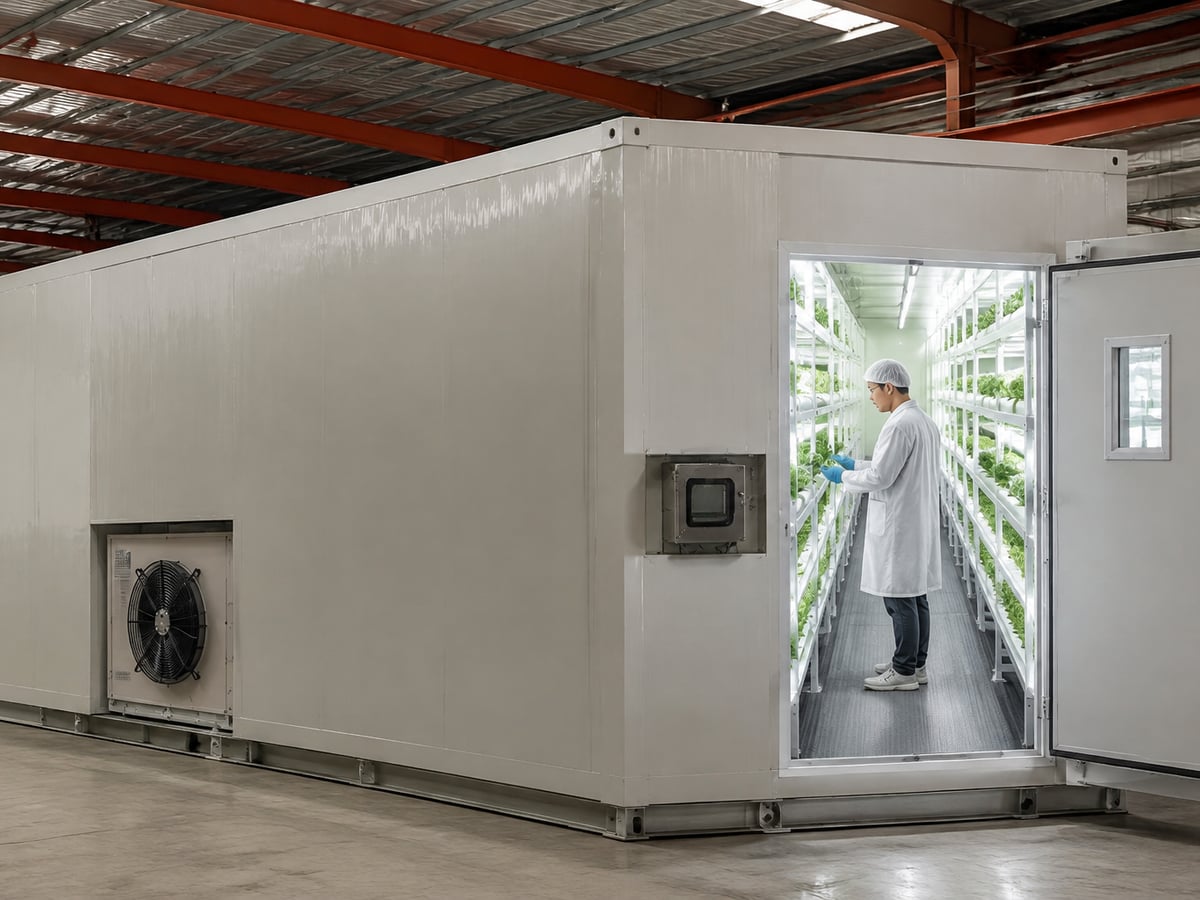
A complete mushroom climate solution is more than an air-conditioning unit. It combines the crop room and building envelope, cooling and heating capacity, humidity management, fresh-air exchange, air distribution, sensors, controls, utilities, drainage, and commissioning. These elements must be specified together for the actual crop, growing stage, room dimensions, substrate load, local weather, and operating schedule.
Start by defining the facility boundary: which rooms, corridors, plant spaces, and external services are included in the project? Then describe the crop conditions required at each growing stage and how the facility will behave at full load. A supplier can only propose a meaningful system after receiving room drawings, insulation details, substrate and rack information, local design weather, utility data, and the intended production cycle.
For a commercial project, distinguish the HVAC equipment from the wider climate-control system. The HVAC package may supply cooling, heating, humidification, dehumidification, and fresh air, while the complete system also includes sensors, dampers, ductwork, electrical connections, control logic, alarms, and interfaces with building services. Put the division of responsibilities in writing before ordering equipment.
This guide explains how growers, contractors, distributors, and engineering teams can define a practical mushroom-growing environment, compare system proposals, and prepare a clear scope for review in markets worldwide.
Define the Crop Environment and Facility Boundaries

Begin with the biology and production plan, not a catalogue of equipment. Mushroom species, strain, substrate recipe, filling density, rack arrangement, and growth stage all influence heat, moisture, and carbon-dioxide loads. A room used for spawn running may have a different temperature and ventilation strategy from one used for pinning or fruiting. A facility that grows several products may need separate zones rather than one shared setpoint.
Record the expected operating range for air temperature, relative humidity, fresh-air delivery, and carbon dioxide. These are project criteria, not universal values: the grower or cultivation consultant should confirm them for the selected species and production method. Define whether requirements refer to room air, canopy level, or another measurement position. Also state allowable variation across racks and from one end of a room to the other.
Facility boundaries are equally important. Identify whether the scope includes only cultivation rooms or also loading areas, substrate preparation, corridors, packing rooms, service rooms, and waste handling. Note which party supplies insulated panels, doors, floor drains, electrical distribution, water treatment, condensate disposal, and external equipment foundations. A vague boundary can leave essential connections unpriced.
For each room, provide internal length, width, and clear height; wall, ceiling, and floor construction; insulation type and thickness; door dimensions and opening frequency; and the number of people and lights. Include adjacent-room conditions and exposure to sun, wind, or unconditioned spaces. For retrofits, document leakage, damaged insulation, existing drains, and available equipment locations. For new construction, coordinate HVAC routes with structural steel, fire protection, lighting, and sanitation requirements.
| Information to define | Why it matters | Useful project evidence |
|---|---|---|
| Species and production stages | Different crops and stages produce different climate demands | Production schedule and cultivation protocol |
| Room dimensions and capacity | Establishes the treated volume and practical equipment arrangement | Dimensioned plans and rack elevations |
| Substrate load and filling pattern | Biological activity and loading affect heat and moisture loads | Batch weight, tray count, and loading sequence |
| Envelope and door details | Heat gain, infiltration, and condensation risk depend on construction | Panel specifications, door schedule, and site photos |
| Operating calendar | Shows peak production, turnaround, and cleaning periods | Crop-cycle calendar and shift schedule |
| Site climate and utilities | Outdoor conditions and supply limits constrain system selection | Weather design data, voltage, water, and drainage details |
This information is also the basis for comparing suppliers. If one quotation assumes a lightly loaded room and another assumes the maximum substrate load, their capacities and prices are not directly comparable. Ask every bidder to list assumptions, exclusions, and design conditions.
Separate HVAC Units from the Full Control System

An HVAC unit is one component of the installation. It may contain fans, coils, filters, humidification equipment, dampers, heating components, and a local controller. The full climate-control system connects that unit to room sensors, actuators, operator settings, alarms, data records, and facility services. The difference matters because an attractive unit specification does not establish that the crop room will remain uniform or that the controls can operate the required production sequence.
Clarify which functions are included in the equipment package and which are supplied by the building contractor or controls integrator. A proposal should say whether the supplier provides room temperature and humidity sensors, carbon-dioxide measurement, duct probes, pressure switches, control panels, cabling, network interfaces, and programming. It should also identify who commissions the system and who trains operators.
Control logic should reflect cultivation operations. A system may need different modes for room preparation, filling, incubation, fresh-air ramp-up, fruiting, harvest, washdown, and standby. It should define how cooling, heating, humidification, and ventilation interact so that one function does not undermine another. For example, introducing outdoor air can change both temperature and moisture load; the control sequence needs to account for those effects.
Ask for a plain-language sequence of operation and an input/output list. These documents make it possible to review what the system measures, what it controls, and what happens when a sensor fails or a limit is exceeded. If remote monitoring is required, specify network ownership, data access, user permissions, cybersecurity expectations, and what information remains available if the internet connection is lost.
| System element | Typical responsibility | Questions for the supplier |
|---|---|---|
| HVAC equipment | Conditions and circulates treated air | What components and capacities are included? |
| Room sensors | Measure crop-room conditions | How many sensors, where, and with what accuracy? |
| Control panel and logic | Coordinates equipment and operating modes | Are programming and commissioning included? |
| Dampers and actuators | Regulate outdoor, return, and supply air paths | Who supplies, wires, and tests each actuator? |
| Building management interface | Exchanges data with wider facility systems | Which communication protocols and points are available? |
| Alarms and records | Alert staff and support operational review | What is logged, for how long, and who can access it? |
For projects where a dedicated controller is required, review the functions of a mushroom climate-control system alongside the HVAC proposal. Confirm compatibility, sensor quantity, operating modes, alarm behavior, and the limits of remote access before treating the controller as a complete solution.
Connect Cooling, Humidity, and Fresh-Air Functions
Mushroom climate functions are interdependent. Cooling removes sensible heat, while dehumidification removes moisture from the air. Humidification adds moisture when conditions are too dry. Fresh air supports gas exchange and removes carbon dioxide, but it can also introduce heat, cold, or moisture from outdoors. A design that sizes these functions separately without checking their combined operation can cycle inefficiently or struggle to hold the crop target.
Ask the engineer to describe the expected loads at several operating conditions, not only at a single nominal point. The room’s load may change with substrate activity, crop stage, harvest, door openings, outdoor weather, and cleaning. A capacity schedule should state the outdoor design conditions, room setpoints, airflow assumptions, and whether the equipment is expected to operate continuously or modulate.
Humidity control needs particular attention. The selected approach may involve steam, atomization, evaporative methods, or another technology suitable for the project. Each option has requirements for water quality, sanitation, maintenance, and droplet management. Ensure the layout avoids wetting the crop, walls, sensors, and electrical components. Define how standing water and condensate are collected and discharged.
Fresh-air design should be based on the crop and operating sequence. Specify the intended range of outside-air flow, the means of measuring or proving airflow, and how the system responds to carbon-dioxide readings if that measurement is used. Filters and intake locations should be appropriate for local dust, insects, pollution, and prevailing wind. Exhaust discharge should not be positioned where it can be drawn straight back into the intake.
In hot, humid climates, outdoor air may increase both cooling and dehumidification demand. In cold or dry climates, it can increase heating demand or reduce room humidity. Coastal sites may face salt exposure, while dusty inland locations may require more frequent filter inspection. The climate schedule should therefore use local design conditions and identify any seasonal operating limits.
| Function | Design question | Operating risk if overlooked |
|---|---|---|
| Cooling | What room load and outdoor design condition are assumed? | Room temperature may drift at peak crop or weather load |
| Heating | Is heat needed during startup, cold weather, or fresh-air operation? | Cold supply air or uneven room conditions |
| Humidification | What water quality, distribution, and sanitation are required? | Dry crop conditions, deposits, or hygiene concerns |
| Dehumidification | How is moisture removed during humid or high-load periods? | Condensation, wet surfaces, or unstable humidity |
| Fresh-air supply | How is required airflow measured and controlled? | Insufficient exchange or unnecessary energy use |
| Exhaust and relief | Where does extracted air discharge, and how is pressure balanced? | Recirculation, infiltration, or door-operating problems |
Do not compare units solely by nominal cooling capacity. Request selection data at the actual design conditions, including airflow, entering-air condition, control range, and any capacity reduction at high outdoor temperatures. Where multiple rooms are served, establish whether each room can be controlled independently and what happens during cleaning or crop changeover.
Map Sensors, Ducts, Dampers, and Utilities
Room measurements are only useful when sensors represent the crop environment. A single wall-mounted sensor near a supply outlet can report a condition that differs significantly from the air among the racks. Ask for a sensor-location plan showing room temperature, humidity, and any carbon-dioxide measurement points. Consider representative positions at crop level and in areas expected to experience the highest or lowest conditions.
Sensor placement should avoid direct exposure to spray, sunlight, heater discharge, supply jets, and open doors. If measurements are used for control, agree on calibration, replacement access, and the response to implausible readings. A practical arrangement may include multiple room points with documented averaging or control logic, subject to the engineer’s assessment and project requirements.
Air distribution should be reviewed on drawings, not left to an assumption that “the fan will mix it.” Show supply and return locations, duct sizes, branch routes, grilles, perforated fabric or other terminals, dampers, access panels, and balancing points. Consider rack geometry and the space occupied by trays, trolleys, and workers. The objective is to deliver air to the intended zones without creating damaging high-velocity jets or stagnant pockets.
List every utility connection. This commonly includes electrical power, water for humidification, condensate drainage, equipment clearances, communication wiring, and possibly heating or cooling services. State the voltage, frequency, phase, available fault protection, and installation location. International projects should confirm local electrical codes, plug and cable requirements, control-panel standards, and inspection responsibilities before manufacturing begins.
| Item to map | Drawing or schedule detail | Review point |
|---|---|---|
| Temperature and humidity sensors | Quantity, height, room position, and cable route | Representative of crop conditions and serviceable |
| Carbon-dioxide sensors | Measurement locations and control relationship | Suitable measurement range and calibration plan |
| Supply and return ducts | Route, dimensions, terminals, and access | Clear of structure, racks, lights, and fire services |
| Outside-air and exhaust paths | Intakes, discharge points, filters, and weather protection | Low risk of short-circuiting or contamination |
| Dampers and actuators | Location, control signal, and fail position | Accessible for inspection and functional testing |
| Utilities and drains | Connection size, capacity, isolation, and route | Compatible with local services and maintenance access |
In facilities near industrial areas or major transport corridors, include intake-air quality in the design review. For export-oriented projects, coordinate equipment access and shipping dimensions early. A unit that fits the climate requirement but cannot pass through the available doorway or be lifted onto its plinth can cause costly site changes.
Identify Building Work and External Equipment
Building work is often the source of gaps between an equipment quotation and a functioning facility. Define who supplies and installs the insulated envelope, vapor-control details, hygienic finishes, sealed penetrations, doors, thresholds, drains, and equipment supports. The design team should coordinate these elements with condensation control and cleaning practice. Equipment performance depends partly on the building remaining sufficiently airtight and insulated.
External equipment may include condensers, heat pumps, pumps, water-treatment equipment, electrical panels, and weatherproof enclosures. Confirm location, service clearances, noise considerations, access for lifting and maintenance, exposure to sun or corrosive air, and required foundations. For rooftop equipment, verify structural capacity and safe access. For ground-mounted equipment, review flood risk, drainage, security, and protection from vehicles.
Responsibility schedules are useful where several contractors are involved. State who provides each item, who connects it, who tests it, and who accepts it. Include penetrations through insulated walls, fire-rated barriers, roof waterproofing, and commissioning documentation. For international projects, identify the party responsible for customs documentation, inland transport, local permits, and any locally required electrical or safety approvals.
When comparing suppliers across regions, assess engineering support and practical logistics as well as equipment price. For example, projects serving farms near Rotterdam, Hamburg, or Antwerp may use major European import and distribution routes; installations around Singapore or Port Klang may involve different freight, humidity, and service considerations. In North America, delivery through Los Angeles, Vancouver, or New York can affect shipping schedules and inland transport. These examples are planning references, not recommendations of a particular route or supplier.
| Work package | Boundary to define | Evidence for handover |
|---|---|---|
| Insulated room construction | Panels, seals, doors, floor, and penetrations | Panel data and installation inspection |
| Electrical installation | Incoming supply, isolators, cables, and protection | Electrical test and connection records |
| Water and drainage | Supply quality, isolation, traps, and discharge point | Flow check and drainage inspection |
| Equipment foundations | Plinths, supports, vibration control, and anchoring | Approved dimensions and structural confirmation |
| Refrigerant or heat-pump connections | Line sets, charge, pressure testing, and insulation | Applicable commissioning records and leak checks |
| Controls and communications | Field wiring, network connection, and integration | Point-to-point test and operator demonstration |
Choose a supplier with a clear response to the project’s geographic and regulatory context. Ask how spare parts are identified, packed, and shipped; whether manuals and control interfaces can be supplied in the required language; and how technical support is delivered across time zones. Do not assume that a product certification automatically replaces local building approval or installation inspection.
Set Performance Criteria for the Loaded Facility
Performance should be defined for a loaded, operating crop room, not just for an empty demonstration space. State the expected crop and substrate load, rack configuration, door activity, lighting, staffing, room schedule, and outdoor design condition. Ask the engineering team to explain the expected response at startup, at stable operation, during a crop-stage transition, and under the anticipated peak load.
Set criteria that can be measured. These may include the allowable temperature and humidity range, the maximum permitted variation between specified room points, the required fresh-air range, the acceptable recovery behavior after a door opening, and alarm limits. Values should be developed with the cultivation and engineering teams for the particular species and process. Avoid copying generic figures without checking whether they fit the crop, site, and production method.
Commissioning should verify more than whether the fan starts. It should check electrical operation, sensor readings, airflow, damper response, cooling and heating functions, humidity control, alarm behavior, drainage, and the programmed operating modes. The commissioning plan should say which tests are completed at the factory and which are repeated at the site. It should also define how readings are recorded and what happens if a criterion is not met.
Where a supplier provides performance claims, ask for the conditions behind them. Clarify whether reported capacity is tested at the relevant ambient temperature and humidity, whether airflow is measured at the unit or room terminal, and whether the guarantee covers the entire installed system or only supplied equipment. Make sure exclusions such as building leakage, unsuitable water, incorrect voltage, or unapproved control changes are visible in the contract.
| Criterion | How to state it | How to verify it |
|---|---|---|
| Room temperature | Target range and specified measurement locations | Logged readings during an agreed operating period |
| Relative humidity | Target range and allowable room variation | Calibrated sensors and recorded trend data |
| Air distribution | Required airflow or distribution objective by zone | Airflow checks and review of crop-level conditions |
| Fresh-air function | Required range and mode of control | Damper, fan, and measurement-point checks |
| Controls and alarms | Modes, limits, notification route, and fault response | Functional simulation and operator demonstration |
| Energy and maintenance | Monitoring boundary and planned maintenance tasks | Meter readings, service records, and filter inspections |
Energy comparison is most useful when operating assumptions are consistent. Request estimated consumption or efficiency data with stated weather, setpoints, hours, and load assumptions. Consider the cost of filters, water treatment, cleaning, and replacement parts alongside initial price. A lower equipment price may not represent the lowest lifecycle cost if controls are difficult to service or essential parts have long lead times.
Prepare a System Scope for Engineering Review
A concise scope document helps the grower, consultant, contractor, and supplier review the same project. It does not replace detailed design or local code checks. Instead, it identifies the required outcome, the site constraints, and the questions that need engineering resolution before manufacture or installation.
Include a room-by-room schedule, dimensioned drawings, crop and production data, expected operating modes, target conditions, local design weather, utility information, and a list of known constraints. Attach photos and note whether the project is new construction, an expansion, or a retrofit. If drawings are preliminary, label them with their issue date and revision so the supplier does not base a final selection on outdated information.
Request a proposal that separates equipment, controls, ductwork, installation, commissioning, training, freight, and optional services. Ask for technical selections, assumptions, exclusions, equipment dimensions, electrical loads, connection points, service clearances, and expected delivery sequence. The proposal should identify required owner-supplied items and the information still needed to finalize engineering.
For customization, describe what is fixed and what may be adapted. This may include room dimensions, voltage, communication protocol, casing material, controls language, branding, packaging, or local service interfaces. A defined customization process reduces revision cycles and helps the manufacturer identify changes that could affect performance, certification, lead time, or warranty.
| Scope package | Information to submit | Review outcome |
|---|---|---|
| Project overview | Location, project type, schedule, and responsible contacts | Shared understanding of objectives and decision process |
| Crop-room data | Species, stages, substrate load, racks, and operating calendar | Basis for climate and capacity assessment |
| Building information | Plans, envelope, doors, adjacent areas, and site photos | Defined room boundary and installation constraints |
| Utilities and codes | Power, water, drainage, local requirements, and interfaces | Feasible equipment selection and connection plan |
| Performance requirements | Targets, tolerances, modes, alarms, and test expectations | Reviewable acceptance criteria |
| Commercial and service needs | Delivery terms, warranty, training, spares, and support | Comparable proposals and post-sale responsibilities |
Before contract award, hold a technical review with the people responsible for cultivation, building work, electrical services, controls, and maintenance. Resolve open items in a written action list. This is especially important for international projects where the equipment manufacturer, local installer, and owner may work in different languages and regulatory environments.
Our Company: Engineering, Manufacturing, and Support
Shandong Lanhu Air Conditioning Equipment Co., Ltd. is based in Dezhou, Shandong, China, and develops agricultural climate-control equipment, industrial HVAC systems, and modular cultivation solutions. Its product range includes mushroom cultivation containers, climate controllers, hydroponic cultivation containers, and air-source heat pumps. The company’s work is relevant to growers and project teams seeking a coordinated equipment package or a customized solution for a particular facility.
Technological capabilities: Lanhu draws on more than 12 years of thermodynamic research and development experience and a portfolio of over 45 registered patents. Its engineering work covers climate-control equipment and cultivation applications, where equipment selection, control logic, air treatment, and room configuration need to be considered together. Technical discussions should still be based on the customer’s crop protocol, drawings, utilities, and local conditions; a product description cannot substitute for project engineering.
Manufacturing capabilities: The company operates a manufacturing site covering more than 30,000 square meters, with integrated processes that include product design, engineering development, sheet-metal fabrication, CNC bending, insulation-panel production, electrical assembly, system integration, testing, and quality inspection. According to the company, equipment undergoes functional inspection, electrical verification, performance testing, and operational evaluation before shipment. Lanhu reports certifications including ISO 9001, ISO 14001, ISO 45001, and ISO 12100; project buyers should verify the applicable certificate scope and documentation for their procurement requirements.
Service capabilities: Lanhu offers factory-direct supply, OEM and ODM customization, engineering assistance, international logistics support, spare-parts support, installation guidance, and after-sales service for agricultural contractors, equipment distributors, engineering companies, and commercial farming projects. For a customized project, buyers can review the company’s OEM and ODM customization service and provide drawings, operating requirements, and target-market details for an initial technical discussion.
Lanhu’s mushroom cultivation solutions may be considered for projects ranging from a controlled growing room to a modular unit. Review the available mushroom cultivation container configuration against the intended crop, room capacity, shipping route, installation site, and local service plan. The appropriate equipment scope depends on project-specific engineering review rather than on product category alone.
For buyers in global markets, the procurement conversation should cover delivery terms, export packing, electrical compatibility, documentation, spare-parts availability, installation responsibilities, and commissioning expectations. To discuss a project, submit the location, crop, room schedule, drawings, utility details, and desired delivery window through the company contact page.
FAQ: Planning a Mushroom Growing Climate System
Is a standard commercial HVAC unit suitable for mushroom cultivation?
Not automatically. Standard HVAC equipment may not provide the required humidity control, fresh-air modulation, crop-stage operating modes, room-level sensing, or corrosion and sanitation provisions. A suitability review should compare the unit’s documented operating range with the crop requirements and room loads.
Can one system serve several growing rooms?
It may be possible, but the design must account for each room’s crop stage, schedule, load, and desired independence. Shared equipment can create operational dependencies. Ask the engineer to explain how room temperatures, humidity, airflow, and cleaning periods are managed when rooms have different requirements.
What information should I send before requesting a quotation?
Provide room dimensions, envelope details, location, species, growing stages, substrate load, rack arrangement, target conditions, operating hours, outdoor design data, and utility specifications. Drawings, site photos, and a written responsibility boundary help suppliers avoid assumptions.
Do I need a separate climate controller?
That depends on the equipment package and the functions required. Confirm whether the HVAC unit’s included controller can manage all needed sensors, modes, dampers, alarms, and interfaces. If not, define the separate controller’s scope and compatibility before placing an order.
How should humidity equipment be selected?
Selection depends on the required moisture range, room load, local water quality, sanitation plan, distribution method, and maintenance capability. Ask for the supplier’s requirements for water treatment, drainage, cleaning, and protection from droplets or condensation.
What is the difference between fresh air and recirculated air?
Recirculated air is drawn from the room and treated or redistributed; fresh air is introduced from outdoors, usually with some air discharged from the room. Their balance affects gas exchange, temperature, humidity, pressure, and energy use. The appropriate approach should follow the cultivation protocol and engineering assessment.
How can I compare quotations fairly?
Use a shared schedule of room data and performance requirements. Compare stated design conditions, included controls, sensors, ductwork, utilities, commissioning, warranties, freight, and exclusions. Ask suppliers to identify assumptions and submit equipment selections at the same outdoor and indoor conditions.
Does factory testing guarantee performance after installation?
Factory checks can verify equipment functions under defined test conditions, but site performance also depends on installation, building integrity, utilities, ductwork, room loading, and control setup. Include site commissioning and acceptance testing in the project plan.
What trends should buyers consider for 2026?
In 2026, projects are increasingly evaluating connected monitoring, more precise variable-speed control, fault alerts, and data that can help operators review crop-room stability. Sustainability planning is also emphasizing energy measurement, equipment efficiency, refrigerant considerations, water management, and serviceable components. Policy and code requirements vary by country and may change; confirm current refrigerant, electrical, energy, building, and import rules with qualified local professionals. Treat these trends as design considerations, not as a substitute for verifying site requirements.
How should an overseas buyer plan service and spare parts?
Agree on a parts list, identification method, recommended maintenance stock, warranty process, and technical support channel before shipment. Confirm shipping dimensions, export packing, installation guidance, manuals, and response expectations across time zones. A local contractor should understand the equipment interfaces and be included in handover where possible.
When should engineering review begin?
Begin during facility planning, before panel layouts, service routes, and equipment locations are finalized. Early coordination can prevent conflicts with structure, drainage, electrical distribution, doors, and access. For a retrofit, collect accurate measurements and site conditions before requesting a final equipment selection.
Share this article

About the Author: Shandong Lanhu Air Conditioning Equipment
Lanhu is a professional climate control equipment manufacturer specializing in smart agricultural systems, commercial HVAC solutions, and customized temperature control technologies. With extensive engineering experience, Lanhu provides reliable solutions for plant factories, controlled environment agriculture, and industrial applications.
Need a Custom Climate Control Solution?
From smart agricultural systems to commercial HVAC solutions, Lanhu provides reliable temperature and humidity control solutions tailored to your project needs.
Contact Us