Global Market Indoor Mushroom Farming Operations Guide
Quick Answer

Indoor mushroom farming is a controlled-environment production system that uses insulated rooms, containers, climate equipment, shelving, substrate handling, and disciplined sanitation to produce mushrooms consistently throughout the year. For commercial operators in the Global Market, success depends less on the building alone than on maintaining stable temperature, humidity, fresh-air exchange, carbon dioxide concentration, airflow distribution, hygiene, and crop scheduling.
The most practical starting point is to match the facility design to the selected mushroom species, intended production volume, local energy conditions, labor availability, and sales channel. Oyster mushrooms, shiitake, button mushrooms, lion’s mane, enoki, and specialty varieties have different climate requirements, crop cycles, substrate formats, and market values. A small climate error during pinning or fruiting can reduce yield, deform mushrooms, increase contamination, shorten shelf life, or create uneven harvest labor.
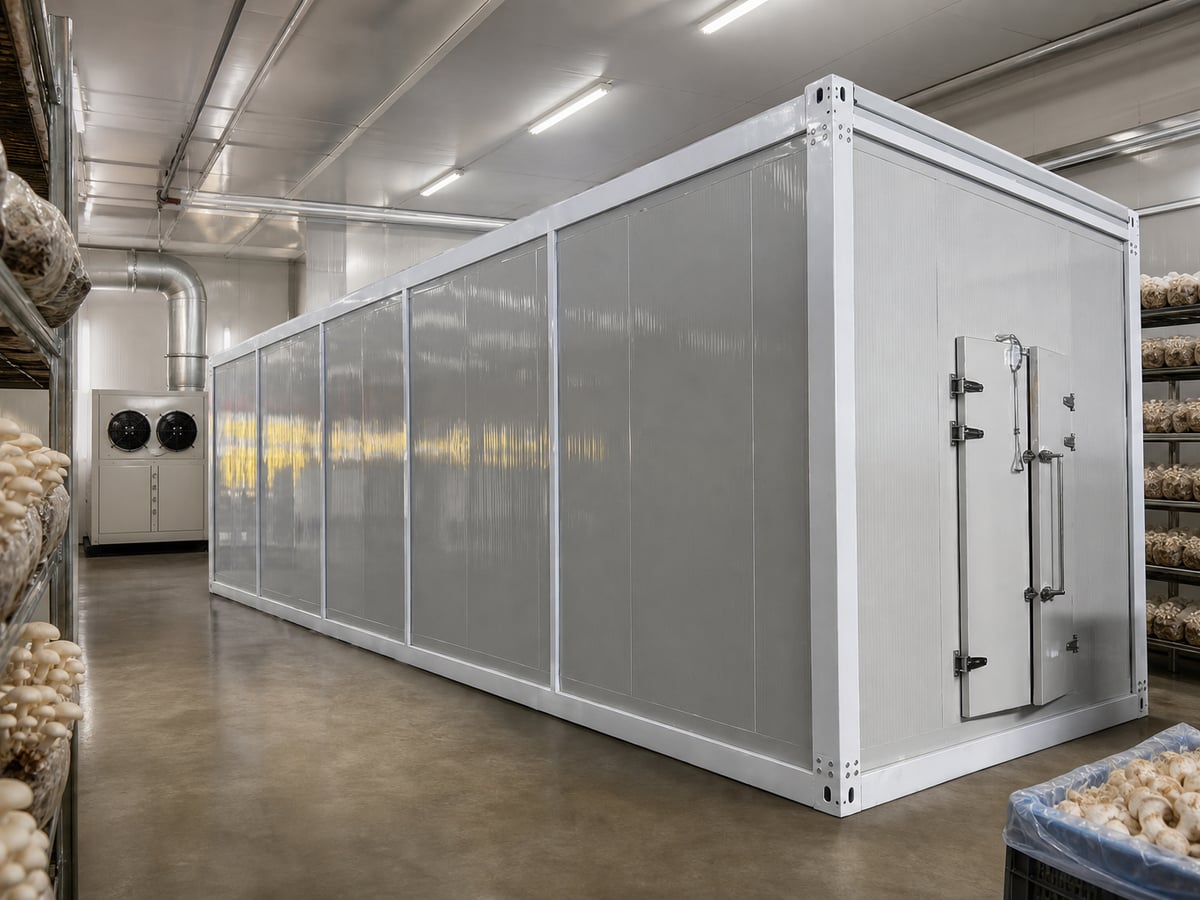
Commercial projects should therefore treat indoor mushroom cultivation as an integrated operational system: clean substrate in, controlled incubation, controlled fruiting, fast harvesting, rapid cold-chain handling, and repeatable room sanitation. Modular systems can reduce project risk because they combine insulated panels, climate control, electrical systems, shelving layouts, drainage, and control logic in a standardized package.
| Commercial objective | Primary operational focus | Typical risk if neglected | Recommended response |
|---|---|---|---|
| Stable weekly supply | Staggered crop scheduling | Harvest peaks and supply gaps | Use multiple rooms or batches |
| High biological efficiency | Substrate quality and climate stability | Low yield per kilogram of substrate | Track batch yield and room conditions |
| Premium quality | Fresh air, humidity, cold chain | Long stems, wet caps, short shelf life | Optimize airflow and post-harvest cooling |
| Low contamination rate | Sanitation and zoning | Mold outbreaks and product loss | Separate clean and dirty workflows |
| Efficient labor use | Ergonomic shelving and harvest planning | High picking cost and damage | Design aisles and harvest stations early |
| Controlled utility cost | Insulation and load management | Excess electricity and water use | Specify efficient HVAC and controls |
This table shows why commercial mushroom farms should be designed around operational outcomes rather than only equipment price. The lowest initial-cost facility may become the most expensive option if it causes unstable climate control, frequent crop losses, high labor use, or excessive energy consumption.
What Commercial Operators Should Know About Indoor Mushroom Farming
Indoor mushroom cultivation is expanding across the Global Market because urban food demand, hotel and restaurant supply chains, specialty grocery retail, meal-kit brands, and health-oriented consumers increasingly require dependable, traceable, locally available fungi. Cities such as Dubai, Singapore, Rotterdam, Los Angeles, Melbourne, Johannesburg, São Paulo, and Riyadh have strong demand for year-round fresh produce where weather, water limitations, land costs, or logistics can make conventional seasonal production less predictable.
Unlike leafy greens, mushrooms do not need sunlight for fruiting. They require a well-managed biological environment. The crop responds directly to carbon dioxide, moisture, temperature, fresh-air volume, air movement, and substrate condition. This makes mushroom farming suitable for insulated rooms, warehouses, agricultural buildings, converted cold stores, and purpose-built cultivation containers.
Commercial operators should decide early whether they will purchase ready-to-fruit blocks, produce substrate internally, or operate a fully integrated spawn-to-harvest farm. Ready-to-fruit blocks reduce technical complexity and permit faster market entry. In-house substrate production can improve long-term margin and supply independence, but it requires additional equipment, steam or heat treatment, mixing capacity, inoculation hygiene, laboratory procedures, and stronger quality control.
Product selection also determines the commercial model. Oyster mushrooms are generally fast-growing and adaptable. Shiitake can command a stronger specialty price but requires longer crop planning. Lion’s mane appeals to premium culinary and wellness markets. Button mushroom systems require composting, casing, and more specialized infrastructure. Enoki is technically demanding and usually best suited to advanced controlled-environment operations.
| Mushroom type | Commercial strength | Typical production complexity | Preferred market channel |
|---|---|---|---|
| Oyster mushroom | Fast cycle and broad consumer acceptance | Moderate | Retail, foodservice, wholesale |
| Shiitake | Premium flavor and strong restaurant demand | Moderate to high | Specialty retail and restaurants |
| Lion’s mane | High-value specialty positioning | Moderate | Gourmet, wellness, direct sales |
| King oyster | Dense texture and export potential | High | Asian retail and foodservice |
| Button mushroom | High-volume mainstream demand | High | Supermarkets and processors |
| Enoki | Distinctive premium product | High | Specialty distributors and restaurants |
The table provides a practical product-selection framework. Operators should validate local demand before choosing a species. For example, a premium lion’s mane crop may offer attractive selling prices in London, Toronto, Seoul, or Sydney, but only when buyers understand the product and distributors can maintain a cold chain. Oyster mushrooms may be easier to sell in high-volume fresh markets, but margins can be compressed where local suppliers are numerous.
Why It Matters to Yield, Quality, and Operating Risk
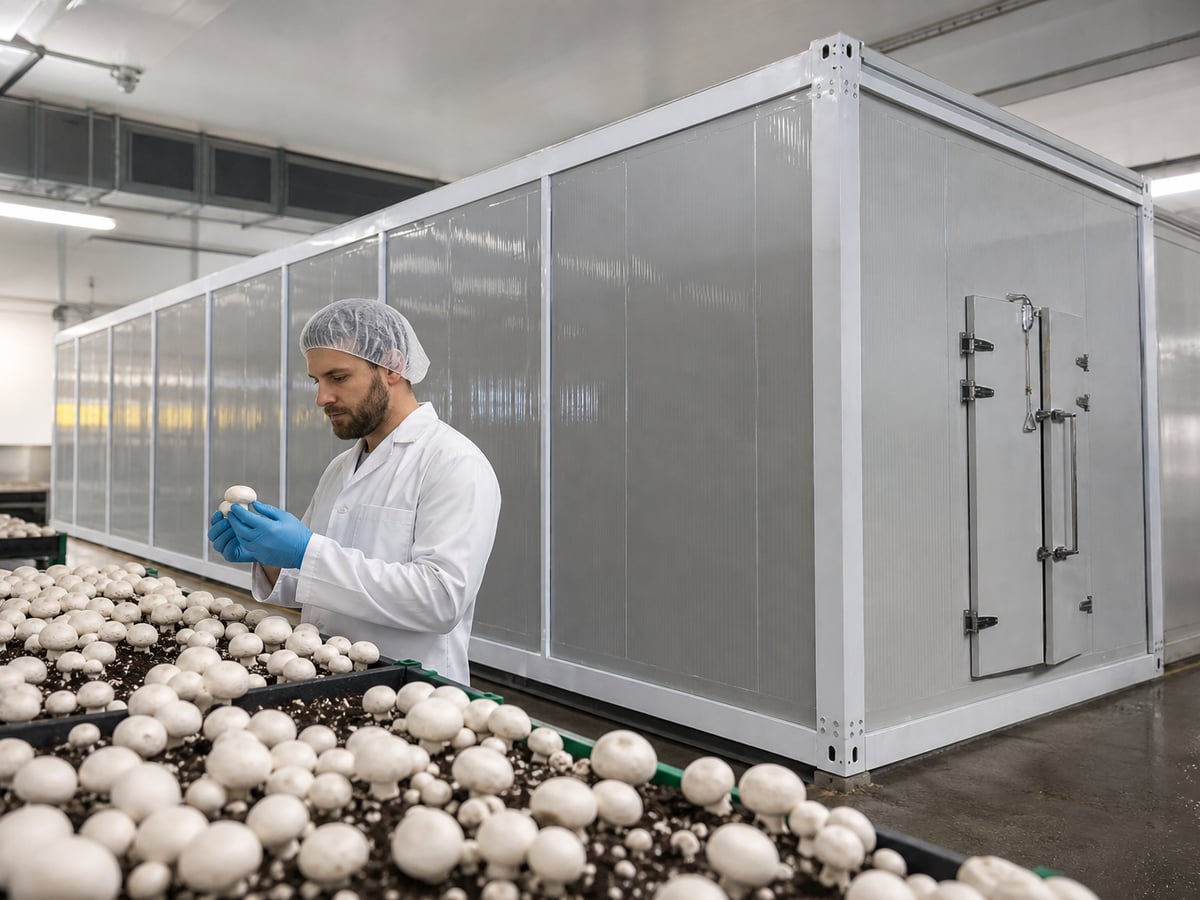
Mushrooms are highly responsive to environmental changes. The correct climate encourages uniform pin formation, balanced cap development, desirable texture, and predictable harvest timing. Incorrect climate conditions can produce elongated stems, undersized caps, excessive moisture, cracked surfaces, yellowing, bacterial blotch, slow fruiting, or incomplete flushes.
Yield risk is often caused by a combination of small operational weaknesses rather than a single major failure. For example, insufficient fresh air may raise carbon dioxide and create poor morphology. Excessive humidity may leave water on caps and increase disease pressure. Uneven airflow can make the crop on upper shelves behave differently from the crop on lower shelves. Poor room cleaning may transfer contamination from one batch to the next.
Quality affects market access. Retail buyers often require consistent pack weight, color, cleanliness, shelf life, traceability, and delivery schedules. Restaurants value flavor, visual uniformity, and reliability. Processors may prioritize volume, size specification, and cost. A production room that delivers only one good flush before declining may not meet weekly customer commitments.
Operating risk includes energy volatility, water quality, equipment downtime, raw material inconsistency, labor shortages, and seasonal heat load. In hot climates such as the Gulf region, Southeast Asia, parts of Africa, and inland Australia, cooling capacity and insulation quality are especially important. In colder regions, humidification, condensation control, heat recovery, and winter ventilation design can have a greater effect on utility costs.
Key Parameters, Measurements, and Design Assumptions
Before purchasing a cultivation system, define the crop species, target weekly harvest, number of production rooms, substrate block size, shelf loading, local ambient design conditions, electrical supply, water source, drainage route, and sales plan. Climate design should be based on heat loads from respiration, lighting, personnel, fans, equipment, outdoor weather, and fresh-air exchange.
Temperature and humidity targets vary by species and crop stage. Carbon dioxide should be measured rather than estimated because concentrations can change rapidly inside dense fruiting rooms. Room sensors should be located where they represent crop conditions, not only near supply air outlets. In larger rooms, multiple sensor points are advisable.
| Parameter | Why it is measured | Typical commercial control approach | Design consideration |
|---|---|---|---|
| Air temperature | Controls crop development rate | Cooling, heating, staged control | Account for outdoor peak conditions |
| Relative humidity | Supports pinning and cap quality | High-pressure fog, ultrasonic or evaporative systems | Avoid standing water and condensation |
| Carbon dioxide | Influences morphology and respiration | Fresh-air dampers and exhaust fans | Use calibrated sensors |
| Airflow velocity | Balances temperature and moisture | Ducts, circulation fans, diffusers | Prevent direct drying on caps |
| Substrate temperature | Indicates biological heat generation | Probe checks and batch monitoring | Useful during incubation and peak fruiting |
| Water quality | Protects humidification equipment and crop hygiene | Filtration, treatment, testing | Consider hardness and microbial quality |
This measurement matrix should be translated into a written operating standard. Each room needs target ranges, alarm limits, recording intervals, corrective actions, and responsibility assignments. For example, a carbon dioxide alarm should not only send a notification; the team should know whether to inspect filters, fan direction, dampers, exhaust operation, block density, or controller settings.
Design assumptions should also include aisle width, harvest cart movement, rack loading, washable wall surfaces, floor slope, drain capacity, door opening frequency, and loading-zone hygiene. A cultivation room can perform well technically but still lose money if workers cannot safely harvest, clean, or move product efficiently.
Required Equipment, Controls, and Infrastructure
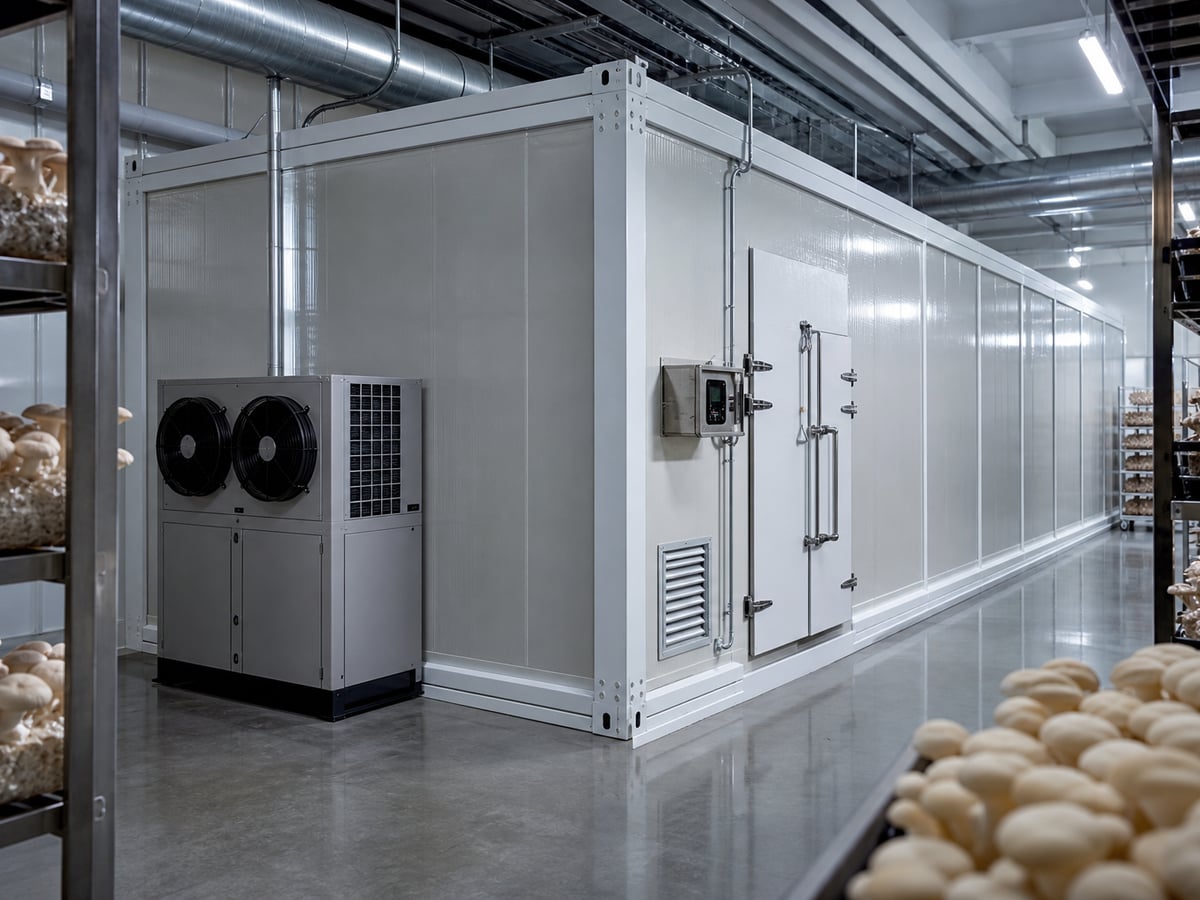
A commercial indoor mushroom farm usually requires insulated cultivation rooms or containers, refrigeration and heating equipment, humidification, fresh-air intake and exhaust, air circulation fans, ducts or air distribution channels, climate sensors, controllers, shelving, drainage, washable wall and ceiling surfaces, electrical distribution, water filtration, packaging space, and cold storage.
For projects that need rapid deployment, a smart mushroom cultivation container can combine many of these elements in a transportable, factory-integrated format. This approach can be particularly suitable for farms near logistics hubs such as Jebel Ali, Rotterdam, Durban, Santos, Felixstowe, or Singapore, where modular delivery and phased expansion can reduce construction uncertainty.
Climate control should be specified for the actual crop load and local climate, not simply room volume. A room full of actively fruiting blocks generates moisture and heat. Fresh air must be conditioned when outside air is hot, cold, dry, or humid. Equipment should also be accessible for filter replacement, cleaning, maintenance, and electrical inspection.
| Equipment category | Main function | Specification priority | Operational note |
|---|---|---|---|
| Insulated panels | Reduce heat gain and moisture migration | Panel thickness, vapor sealing, fire requirements | Seal joints carefully |
| Cooling and heating system | Maintains temperature setpoints | Capacity under local extremes | Include redundancy for critical rooms |
| Humidification unit | Maintains crop moisture environment | Droplet size and water quality compatibility | Clean routinely to prevent biofilm |
| Fresh-air system | Controls carbon dioxide and oxygen balance | Air volume, filtration, damper response | Coordinate with exhaust system |
| Climate controller | Automates room conditions and alarms | Sensor accuracy and data logging | Use remote access where practical |
| Racking and shelving | Maximizes productive floor area | Load rating, corrosion resistance, access | Allow cleaning clearance |
For more detailed automation options, operators can review a smart mushroom climate controller designed to coordinate temperature, humidity, carbon dioxide, ventilation, and alarm management. The value of automation is not merely convenience; it helps create traceable climate records and reduces dependence on constant manual adjustments.
Recommended Workflow and Operating Procedure
A reliable workflow begins with clean receiving and ends with documented sanitation. The facility should separate incoming substrate, incubation, fruiting, harvesting, packing, cold storage, waste handling, and cleaning activities as far as the project scale allows. Workers should move from cleaner zones to dirtier zones, not the reverse.
- Receive substrate blocks or raw materials and inspect for damage, contamination, age, and supplier documentation.
- Label each batch with species, block date, supplier or production lot, room allocation, and expected harvest window.
- Move blocks into incubation or fruiting according to the crop schedule.
- Confirm room setpoints, sensor status, water supply, drainage, ventilation, and door seals before loading.
- Monitor climate readings, crop appearance, contamination signs, and pin development at scheduled intervals.
- Harvest at the required maturity stage using sanitized tools and clean containers.
- Move harvested mushrooms promptly to packing and cold storage.
- Record yield, defects, labor hours, waste, customer shipment volume, and room cleaning completion.
Standard operating procedures should include opening and closing checks, daily walk-through inspections, weekly equipment maintenance, calibration schedules, cleaning chemical instructions, personal hygiene rules, pest control, waste removal, and emergency response. It is useful to photograph representative crop conditions by batch because visual records help identify recurring problems.
In multi-room farms, staggered loading is essential. Loading all rooms on the same day may simplify initial work but creates a harvest peak followed by idle periods. Weekly batch scheduling smooths labor, packaging demand, cooling load, and customer deliveries.
Capacity, Energy, Labor, and Cost Considerations
Capacity should be planned from expected saleable kilograms per week, not from the number of rooms alone. Start with confirmed buyer demand, then work backward through crop cycle, expected biological efficiency, block weight, flush pattern, room turnover time, and acceptable loss allowance. Include capacity for cleaning, maintenance, and crop separation.
Energy costs vary widely across the Global Market. Electricity-intensive cooling can be a major cost in Dubai, Manila, Bangkok, Lagos, and Mexico City during warm periods. In colder climates such as northern Europe, Canada, or inland China, heating and humidification may become more important. High insulation performance, correctly sized equipment, variable-speed fans, timed ventilation, quality door seals, and data-based setpoint adjustments can reduce avoidable consumption.
| Cost category | Main cost driver | How to manage it | Planning warning sign |
|---|---|---|---|
| Substrate or blocks | Supplier price, freight, yield consistency | Qualify multiple suppliers and test lots | Low price with inconsistent performance |
| Electricity | Cooling, heating, fans, humidification | Improve insulation and automate controls | Equipment runs continuously without data review |
| Labor | Harvesting, cleaning, packing, movement | Use ergonomic layout and staggered batches | Harvest requires overtime every week |
| Packaging | Retail format, labeling, product protection | Standardize pack sizes and forecast demand | High damage or condensation in packs |
| Maintenance | Filters, pumps, refrigeration, sensors | Schedule preventive service and keep spares | Frequent emergency repairs |
| Logistics | Cold transport and delivery distance | Plan delivery routes and order cutoffs | Product sits warm before dispatch |
The table highlights that profitability is managed through systems, not only by increasing production. A farm that tracks cost per saleable kilogram, labor minutes per kilogram, energy per kilogram, contamination loss, and rejected-pack rate can make informed improvements. A farm that records only total harvest cannot see why margin changes.
Labor requirements depend on crop type, shelf density, packing format, and the number of harvest days. Operators should budget for supervisors who understand crop physiology, not only general maintenance staff. Skilled observation is one of the strongest protections against yield loss.
Common Mistakes, Failure Modes, and Corrective Actions
The most common commercial mistake is installing equipment before defining crop requirements and operating procedures. A room may have cooling equipment, humidification, and fans, yet still fail because air is poorly distributed, sensors are incorrectly placed, drainage is inadequate, or staff have no response plan for alarms.
Another common failure is overloading rooms. Excessive block density can restrict air movement, increase carbon dioxide, create uneven temperature zones, and make harvesting difficult. More blocks do not always mean more saleable mushrooms.
| Failure mode | Likely cause | Visible symptom | Corrective action |
|---|---|---|---|
| Long stems or poor cap formation | High carbon dioxide or weak fresh air | Deformed mushroom shape | Verify ventilation volume and sensor calibration |
| Wet caps and bacterial issues | Over-humidification or condensation | Water droplets and soft spots | Adjust humidification cycle and airflow |
| Uneven shelf performance | Air distribution imbalance | Different crop stages in one room | Rebalance ducts, fans, and rack spacing |
| Slow pinning | Incorrect temperature, humidity, or fresh air | Delayed harvest window | Review crop recipe and batch condition |
| Recurring contamination | Inadequate cleaning or infected incoming blocks | Mold patches and crop decline | Improve zoning, sanitation, and supplier inspection |
| High energy bills | Low insulation or uncontrolled door opening | Long compressor runtime | Repair seals, review controls, reduce infiltration |
Corrective action should always include verification. If ventilation is increased to correct high carbon dioxide, confirm the change with data, crop appearance, and subsequent yield. If contamination occurs, identify whether it originated from substrate, handling, room surfaces, water, tools, or air intake. Treating symptoms without tracing the source often leads to repeated losses.
Implementation Checklist for a Commercial Project
A commercial project should begin with a feasibility review that includes market demand, product selection, buyer specifications, site utilities, local regulations, financial assumptions, logistics, and technical support. Food safety, worker safety, electrical standards, refrigerant rules, wastewater disposal, and building permits vary by country and municipality. Operators should check requirements before importing or installing equipment.
- Confirm weekly sales volume, customer types, expected pack sizes, and delivery radius.
- Select mushroom species based on local demand, technical capability, and gross-margin potential.
- Choose whether to buy ready-to-fruit blocks or install substrate production capacity.
- Measure site power, water pressure, drainage, access roads, and climate conditions.
- Plan clean and dirty workflow zones, staff changing areas, packing, cold storage, and waste handling.
- Specify room dimensions, shelf layout, crop loading, climate setpoints, and expansion capacity.
- Request equipment drawings, electrical schedules, utility requirements, and control logic.
- Prepare commissioning tests, operator training, spare-parts inventory, and maintenance schedules.
- Run pilot batches before committing to full production volume.
- Track yield, defect rate, energy, labor, and customer feedback from the first harvest.
Lanhu can support this process through technological, manufacturing, and service capabilities. Technologically, the company applies more than 12 years of thermodynamic research experience to controlled agricultural environments, including climate management for mushroom rooms and modular cultivation units. Its systems are designed to integrate temperature, humidity, ventilation, and carbon dioxide management into an operational control strategy.
From a manufacturing perspective, Shandong Lanhu Air Conditioning Equipment Co., Ltd. operates a production facility of more than 30,000 square meters in Dezhou, Shandong. Integrated capabilities include engineering development, sheet metal fabrication, CNC bending, insulation-panel production, electrical assembly, system integration, testing, and quality inspection. This in-house approach supports consistency across modular farming equipment, industrial HVAC components, and cultivation-room projects.
For international customers, service capability matters as much as hardware. Lanhu provides factory-direct supply, OEM and ODM customization, engineering assistance, installation guidance, international logistics support, spare-parts support, and after-sales service. Commercial buyers can explore OEM and ODM cultivation solutions when their projects require custom dimensions, branding, electrical standards, or crop layouts. Operators can also review practical deployment examples in the company’s commercial cultivation project cases.
FAQ
How much space is needed for a commercial indoor mushroom farm?
Required space depends on species, substrate type, rack height, harvest volume, packing area, cold storage, and whether substrate is produced onsite. A modular container can support pilot-scale production, while a multi-room warehouse model is more suitable for larger weekly contracts.
Which mushroom is best for a new commercial operator?
Oyster mushrooms are often a practical starting point because they have relatively fast cycles and broad market acceptance. However, the best choice depends on local buyer demand, available substrate, climate conditions, and technical support.
Can indoor mushroom farming operate in hot countries?
Yes. Insulation, correctly sized cooling, humidity control, fresh-air management, and reliable power are critical in hot regions. Projects in locations such as Dubai, Nairobi, Jakarta, or Doha should pay particular attention to peak ambient temperature and refrigeration redundancy.
How important is carbon dioxide control?
It is essential. High carbon dioxide can significantly affect mushroom shape, growth, and uniformity. Commercial farms should use reliable sensors and balance fresh-air intake with cooling, humidity, and energy requirements.
Should a new farm buy substrate blocks or make its own?
Buying blocks usually lowers startup complexity and allows faster market testing. In-house substrate production may improve long-term control and margin, but it requires stronger sanitation systems, equipment, labor skills, and process management.
What trends will shape indoor mushroom farming in 2026?
Key trends include remote climate monitoring, predictive maintenance, energy-efficient heat pumps, variable-speed ventilation, water-saving humidification, modular expansion, traceability software, biodegradable packaging, and stronger food-safety documentation. Sustainability policies and carbon reporting expectations are also increasing interest in efficient insulation, renewable-energy integration, lower-waste substrate sourcing, and locally distributed production.
How can buyers evaluate a mushroom cultivation equipment supplier?
Ask for technical drawings, load calculations, control specifications, manufacturing quality procedures, commissioning support, spare-parts plans, case examples, warranty terms, and export experience. Confirm that the supplier understands your crop, climate, local voltage, and workflow rather than offering a generic room design.
How can a commercial operator request project support?
For equipment selection, custom container dimensions, climate-control configuration, or phased commercial planning, contact the team through the mushroom farming project inquiry page.
Share this article

About the Author: Shandong Lanhu Air Conditioning Equipment
Lanhu is a professional climate control equipment manufacturer specializing in smart agricultural systems, commercial HVAC solutions, and customized temperature control technologies. With extensive engineering experience, Lanhu provides reliable solutions for plant factories, controlled environment agriculture, and industrial applications.
Need a Custom Climate Control Solution?
From smart agricultural systems to commercial HVAC solutions, Lanhu provides reliable temperature and humidity control solutions tailored to your project needs.
Contact Us