Global Market Commercial Mushroom Farming Operations Guide
Quick Answer

Commercial mushroom farming is a controlled-environment food production business that converts prepared substrate into fresh mushrooms through tightly managed incubation, fruiting, harvesting, cooling, and distribution. For Global Market operators, profitability depends less on simply growing mushrooms and more on maintaining repeatable climate conditions, clean workflows, reliable substrate supply, disciplined labor planning, and cold-chain execution.
A commercially viable mushroom operation normally requires separate functional zones for substrate handling, inoculation or block receiving, incubation, fruiting, harvesting, packing, refrigeration, cleaning, and waste management. Oyster mushrooms, shiitake, lion’s mane, button mushrooms, and specialty varieties each require different humidity, temperature, carbon dioxide, airflow, light, and cropping-cycle settings. A facility that cannot control these variables consistently will experience reduced biological efficiency, uneven flushes, contamination, poor shelf life, and unstable operating costs.
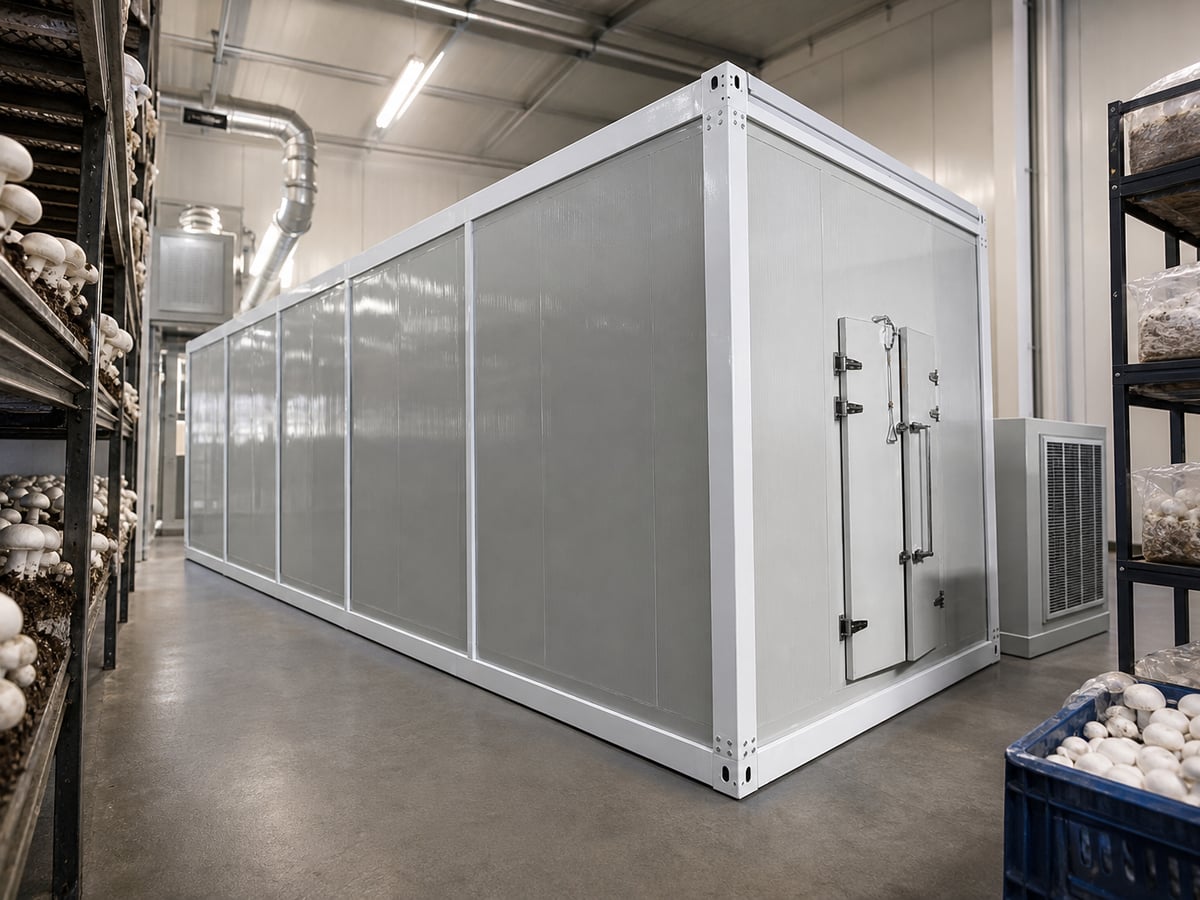
For many new projects, a modular solution can reduce construction uncertainty and shorten commissioning time. A smart mushroom cultivation container can provide an integrated growing room for pilot production, decentralized farming, remote-site projects, or phased capacity expansion. Larger farms may use insulated panel rooms with centralized HVAC, while multi-site operators often standardize climate controls and operating procedures across locations.
The practical priority is straightforward: design production capacity around market demand, then size incubation volume, fruiting area, refrigeration, labor, utilities, and substrate supply accordingly. Do not start with the number of grow rooms alone. Start with weekly sales volume, target species, pack format, customer delivery requirements, and acceptable product-loss rate.
What Commercial Operators Should Know About Commercial Mushroom Farming
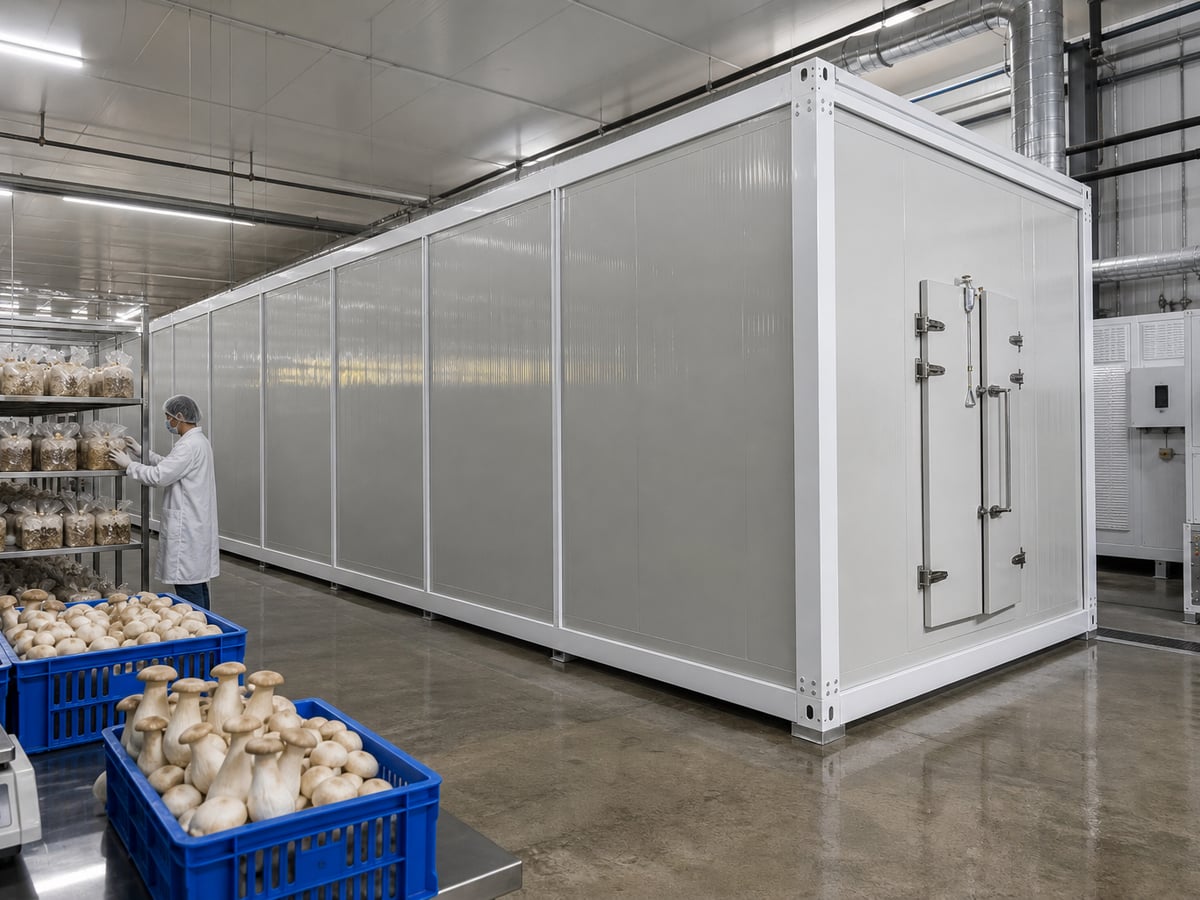
Commercial mushroom farming is a biological manufacturing process. Inputs such as substrate, spawn, water, electricity, labor, packaging, sanitation materials, and equipment capacity must be converted into saleable kilograms with predictable quality. Unlike field crops, mushrooms can be produced year-round, but this advantage is only realized when climate management and hygiene are reliable every day.
Global Market demand is increasingly divided between high-volume fresh mushrooms, premium specialty mushrooms, dried mushrooms, medicinal or functional ingredients, and locally grown products sold with short transport distances. Major consumption and distribution centers include Rotterdam, Dubai, Singapore, Los Angeles, Toronto, São Paulo, Johannesburg, Sydney, Hamburg, and Tokyo. Producers supplying these markets must consider not only cultivation performance but also packaging standards, traceability, refrigeration, food safety documentation, and retailer consistency.
There are several broad commercial production models:
- Fresh specialty mushroom farms: Usually oyster, shiitake, lion’s mane, king oyster, chestnut, enoki, or mixed gourmet species sold to restaurants, retailers, meal-kit companies, and wholesalers.
- Button mushroom facilities: Large-scale production based on compost, casing soil, tunnel systems, and dedicated harvesting labor.
- Block-fruiting operations: Farms purchase colonized blocks from a substrate supplier and focus on fruiting, harvesting, packing, and sales.
- Integrated substrate-to-market farms: Operators prepare substrate, sterilize or pasteurize, inoculate, incubate, fruit, pack, and distribute from one controlled facility.
- Containerized farms: Compact units used for local production, demonstrations, remote projects, supermarkets, hospitality sites, research, or staged commercial expansion.
- Hybrid farms: Centralized substrate production combined with satellite fruiting rooms near urban markets.
The best model depends on market access and management capacity. A startup near a large city may reduce technical risk by buying colonized blocks initially. An experienced operator with secure demand and trained technical staff may gain better long-term control by integrating substrate production. In either case, the farm should calculate contribution margin per kilogram after substrate, labor, packaging, cold storage, delivery, spoilage, and overheads.
| Production Model | Main Product | Capital Requirement | Technical Complexity | Typical Commercial Benefit |
|---|---|---|---|---|
| Block-fruiting farm | Fresh specialty mushrooms | Moderate | Moderate | Fast entry with fewer substrate-processing risks |
| Integrated bag farm | Oyster, shiitake, lion’s mane | Medium to high | High | Greater control of supply and unit economics |
| Button mushroom facility | Agaricus mushrooms | High | High | Large-volume retail and wholesale production |
| Container farm | Specialty and local fresh mushrooms | Moderate | Moderate | Rapid deployment and modular expansion |
| Satellite fruiting site | Fresh mushrooms near cities | Moderate | Moderate | Lower delivery time and fresher local product |
| Research or demonstration unit | Trial crops and training | Low to moderate | Low to moderate | Testing varieties, procedures, and local demand |
This comparison shows why commercial planning must match the operating model to the available technical team, investment budget, and route to market. A highly integrated facility is not automatically better if demand is uncertain or if substrate-quality control cannot be maintained.
Why It Matters to Yield, Quality, and Operating Risk
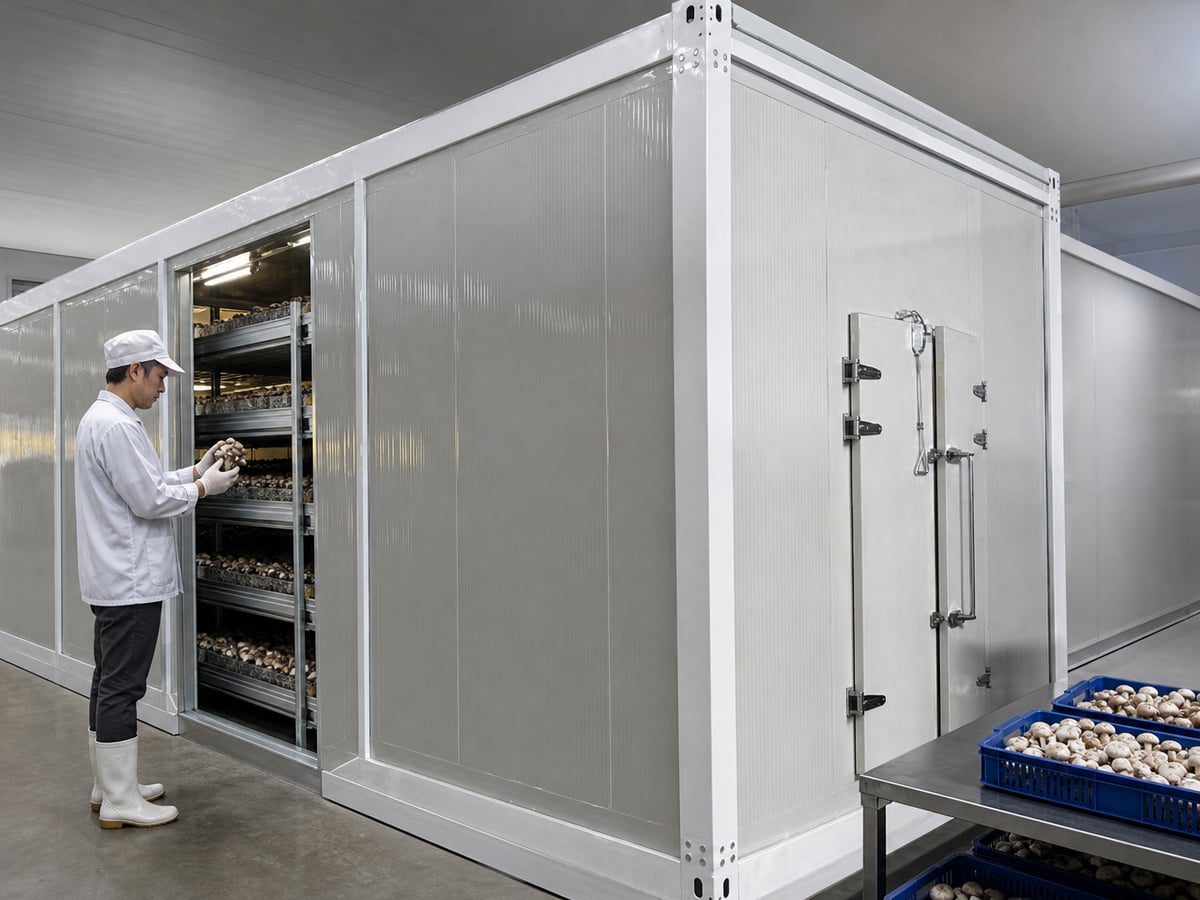
Mushrooms respond quickly to environmental imbalance. Excess carbon dioxide can cause long stems, small caps, distorted clusters, and slower growth. Insufficient humidity can produce dry caps, cracked edges, low weight, and poor visual quality. Excess humidity combined with weak airflow can create condensation, bacterial blotch, soft tissue, and surface contamination. Temperature swings may delay pinning, compress the harvesting window, or trigger uneven flushes.
Yield is commonly evaluated through biological efficiency, kilograms harvested per kilogram of dry substrate, crop conversion performance, and saleable yield after grading losses. However, a high gross yield is not enough. Commercial growers should monitor saleable pack-out, first-grade percentage, average harvest weight, labor minutes per kilogram, spoilage before dispatch, and returns from customers. These indicators show whether the climate system and workflow are producing marketable output rather than merely biomass.
Operating risk is also linked to crop concentration. If every room is loaded on the same day, harvesting peaks can overwhelm labor and cooling capacity, followed by periods of low output. Staggered loading spreads production through the week, improves delivery consistency, and makes labor scheduling more efficient. This is particularly important for supermarket programs, foodservice distributors, and export customers operating through trade hubs such as Rotterdam, Jebel Ali, Singapore, and Los Angeles.
| Risk Factor | Likely Cause | Commercial Impact | Early Warning Sign | Corrective Priority |
|---|---|---|---|---|
| High carbon dioxide | Insufficient fresh-air exchange | Deformed mushrooms and lower grade | Long stems and small caps | Check sensors, dampers, fan capacity |
| Surface drying | Low humidity or excessive air speed | Weight loss and poor appearance | Cracked caps and dry edges | Adjust humidification and airflow direction |
| Condensation | Cold surfaces and poor air mixing | Bacterial risk and crop damage | Water droplets on walls or caps | Improve insulation, airflow, and dew-point control |
| Contamination | Weak sanitation or poor substrate quality | Reduced yield and spread between rooms | Green mold, sour odor, abnormal growth | Isolate affected material and review hygiene |
| Uneven flushing | Inconsistent room climate | Labor peaks and irregular deliveries | Different maturity across shelves | Balance airflow and recalibrate controls |
| Warm product after harvest | Slow cooling or overloaded cold room | Short shelf life and customer complaints | Soft texture and condensation in packs | Pre-cool immediately and verify cold-chain capacity |
The table illustrates that most costly failures develop before harvest. Routine monitoring, staff training, room segregation, and fast corrective action protect both crop yield and customer relationships.
Key Parameters, Measurements, and Design Assumptions
Commercial design should begin with a production specification. Define species, substrate format, weekly block loading, incubation duration, fruiting duration, expected flush pattern, target kilograms per block, harvest days per week, pack sizes, and delivery frequency. These figures determine room count, rack area, cooling load, ventilation demand, water use, labor requirements, and storage capacity.
Typical fruiting conditions vary by species and strain, so operators must validate settings with their spawn supplier and local trials. Oyster mushrooms often fruit in cooler, humid, fresh-air-rich environments; shiitake requires a longer development cycle and careful humidity control; lion’s mane is sensitive to carbon dioxide and airflow patterns; button mushrooms require separate composting, casing, and crop-management protocols. Use room-level setpoints as operating baselines, not universal guarantees.
Measure conditions at crop level, not only at the controller location. A sensor near the evaporator coil or supply duct may not represent the climate inside dense racks. Place temperature, relative humidity, and carbon dioxide sensors where mushrooms grow, and verify readings with calibrated handheld instruments. Record trends every day, especially during changes in weather, loading, harvest peaks, and equipment maintenance.
| Parameter | Why It Is Measured | Typical Operational Goal | Measurement Location | Management Action |
|---|---|---|---|---|
| Air temperature | Controls growth rate and pinning response | Species-specific stable range | Crop zone and return air | Adjust heating, cooling, and air mixing |
| Relative humidity | Maintains crop moisture and weight | High but non-condensing condition | Crop zone away from mist outlet | Balance humidification and ventilation |
| Carbon dioxide | Influences morphology and respiration | Species-specific ceiling | At rack height in dense crop areas | Increase fresh air or optimize exhaust |
| Air velocity | Prevents stagnant zones without drying caps | Gentle, uniform circulation | Multiple rack positions | Redirect diffusers and balance fans |
| Substrate temperature | Shows biological heat and crop condition | Within safe strain range | Representative bags, blocks, or beds | Modify room temperature and loading density |
| Room pressure | Supports hygiene zoning | Controlled directional airflow | Doorways and adjacent rooms | Review fan balance and door discipline |
For design assumptions, include the highest expected outdoor temperature, lowest seasonal temperature, local humidity, electricity quality, water availability, drainage conditions, and freight access. A farm in Dubai requires different cooling and dehumidification logic than a farm in Hamburg, Nairobi, Jakarta, or Vancouver. Global Market projects should also consider the availability of replacement parts, refrigerant regulations, generator backup, and local technician support.
Required Equipment, Controls, and Infrastructure
A commercial mushroom facility needs more than shelves and humidifiers. It requires a coordinated system that delivers stable climate conditions while allowing easy cleaning, safe access, and consistent data collection. The core growing-room components are insulated walls and ceilings, washable surfaces, racking, air handling, cooling and heating equipment, humidification, fresh-air and exhaust systems, drainage, lighting, sensors, controllers, and electrical protection.
A dedicated smart mushroom climate controller helps operators automate temperature, humidity, carbon dioxide, ventilation, lighting, alarms, and historical data review. Automation does not replace trained staff, but it reduces dependence on manual switching and gives managers better visibility across rooms, shifts, and sites.
Infrastructure should separate clean and dirty traffic. Raw agricultural materials, spent substrate, cleaning tools, harvested mushrooms, packaging, and staff changing areas should not share uncontrolled routes. Provide handwashing points, boot sanitation where appropriate, washable carts, pest exclusion, floor drains, and a clear waste path. A refrigerated packing room or rapid pre-cooling area is strongly recommended when supplying retail or long-distance customers.
Technological capability matters when selecting a supplier. Shandong Lanhu Air Conditioning Equipment Co., Ltd. applies more than 12 years of thermodynamic research and development to agricultural climate control, including smart cultivation environments, air source heat pumps, and integrated climate-management systems. Its equipment approach supports monitored temperature, humidity, ventilation, and crop-room operation for standardized mushroom production.
Manufacturing capability should also be assessed. Lanhu operates a manufacturing facility of more than 30,000 square meters in Dezhou, Shandong, with integrated engineering, sheet-metal fabrication, CNC bending, insulation panel production, electrical assembly, testing, and quality inspection. This integrated process can help commercial buyers maintain consistency when specifying modular rooms, container farms, or customized equipment packages for international projects.
| System or Equipment | Primary Function | Commercial Selection Consideration | Maintenance Focus |
|---|---|---|---|
| Insulated room panels | Reduce heat gain, heat loss, and condensation | Panel thickness, joints, washable finish, fire compliance | Seal inspection and surface cleaning |
| Cooling and heating unit | Maintains crop temperature | Climate design load, redundancy, energy efficiency | Coils, refrigerant circuit, filters |
| Humidification system | Maintains crop moisture conditions | Droplet size, water quality, room coverage | Nozzles, water treatment, sanitation |
| Fresh-air and exhaust fans | Controls carbon dioxide and air renewal | Airflow capacity, filtration, variable-speed control | Belts, motors, dampers, screens |
| Racks and shelving | Maximizes productive growing area | Load capacity, airflow gaps, corrosion resistance | Cleaning and structural checks |
| Cold storage and packing area | Protects shelf life after harvest | Peak harvest volume and dispatch schedule | Door seals, temperature records, sanitation |
The correct equipment package is not necessarily the largest package. It is the system sized for the crop load, room volume, outdoor design conditions, local energy cost, and required uptime. Oversized cooling can create rapid cycling and condensation; undersized ventilation can compromise mushroom shape and quality.
Recommended Workflow and Operating Procedure
A reliable workflow reduces contamination, crop losses, and labor confusion. The process should be documented through standard operating procedures, daily checklists, cleaning schedules, harvest specifications, and escalation rules. Every employee should understand which areas are clean, which are dirty, which room doors must remain closed, how product is handled, and when abnormal crop conditions must be reported.
- Receive and inspect substrate or raw materials: Check supplier batch, appearance, temperature, odor, moisture, packaging integrity, and delivery documentation.
- Inoculate or receive colonized blocks: If inoculating in-house, maintain clean-room discipline. If buying blocks, quarantine suspect deliveries before introducing them to the farm.
- Incubate: Maintain appropriate temperature and airflow for full colonization. Track batch age, room location, and expected transfer date.
- Transfer to fruiting rooms: Schedule loading in small, regular batches to smooth weekly production.
- Initiate fruiting: Apply the verified species-specific climate transition, including temperature, humidity, fresh air, lighting, and carbon dioxide adjustment.
- Monitor crop development: Inspect at least daily for pinning uniformity, crop density, abnormal morphology, pests, contamination, and water management.
- Harvest and grade: Harvest at the agreed maturity stage. Keep product off the floor and minimize handling damage.
- Pre-cool, pack, and dispatch: Remove field heat rapidly, record batch details, and maintain refrigeration through delivery.
- Clean and reset: Remove spent material, wash and disinfect surfaces, inspect equipment, and confirm room readiness before the next load.
Service capability is important during implementation and operation. Lanhu offers factory-direct supply, OEM and ODM customization, engineering assistance, international logistics support, spare-parts support, installation guidance, and after-sales service. For projects in ports and inland logistics corridors, this can assist buyers coordinating shipments from China through Qingdao, Shanghai, Ningbo, Rotterdam, Jebel Ali, Durban, or regional distribution networks.
Operators can review practical project configurations through the supplier’s commercial mushroom farming project cases. Case-based evaluation is useful because it reveals how room size, climatic conditions, crop type, local power supply, and installation constraints affect final equipment selection.
Capacity, Energy, Labor, and Cost Considerations
Capacity planning should work backward from confirmed sales. For example, if a farm intends to supply 5,000 kilograms per week, it must calculate the number of blocks or beds entering fruiting each week, expected yield per unit, crop-cycle duration, harvest profile, rejection rate, and buffer inventory. The farm must then confirm that packing, refrigeration, vehicles, labor, and customer orders can absorb the peak daily harvest.
Energy is often one of the largest controllable costs. Cooling, heating, humidification, ventilation, refrigeration, lighting, and substrate sterilization can create substantial demand. Energy consumption depends on outdoor conditions, insulation quality, room loading, air leakage, equipment efficiency, operating setpoints, and maintenance. Heat recovery, variable-speed fans, high-performance insulated panels, efficient heat pumps, night-time operating strategies, and precise climate controls can lower utility consumption without compromising crop quality.
Labor is another major cost. Harvesting is often labor-intensive because mushrooms must be selected by maturity and handled gently. Farms should measure labor minutes per kilogram for loading, moving, harvesting, trimming, packing, cleaning, and dispatch. If labor productivity declines, investigate crop uniformity, rack layout, crate flow, pack design, room scheduling, and harvesting standards before simply adding workers.
| Cost Category | Main Cost Driver | Control Method | Commercial Metric |
|---|---|---|---|
| Substrate and spawn | Supplier pricing, yield quality, freight | Batch testing and multi-supplier planning | Cost per saleable kilogram |
| Electricity | Cooling, heating, ventilation, refrigeration | Insulation, controls, efficient equipment | kWh per kilogram produced |
| Labor | Harvesting, packing, cleaning | Staggered production and ergonomic layout | Labor hours per kilogram |
| Packaging | Retail specification and product protection | Right-size packs and reduce damage | Packaging cost per kilogram |
| Product loss | Overmaturity, poor cooling, rejection | Harvest discipline and cold-chain control | Percentage of non-saleable output |
| Maintenance | Fans, coils, sensors, humidification | Preventive maintenance calendar | Maintenance cost per operating hour |
The table should be converted into a monthly management dashboard. Comparing costs per kilogram by room, crop, customer, and season helps management identify whether losses come from biological performance, operational inefficiency, or commercial pricing.
Capital expenditure should include site preparation, building works, electrical upgrades, drainage, water treatment, climate equipment, racks, cold storage, packing equipment, backup power, installation, commissioning, and working capital. Buyers seeking customized dimensions, branding, crop configurations, or project engineering can explore OEM and ODM mushroom cultivation solutions before finalizing equipment specifications.
Common Mistakes, Failure Modes, and Corrective Actions
A common mistake is treating climate setpoints as fixed numbers rather than crop responses. If mushrooms show long stems, dry edges, weak caps, or uneven clusters, the answer may not be a single humidity or carbon dioxide adjustment. Operators must examine airflow pattern, sensor position, fresh-air volume, loading density, substrate temperature, crop age, and the interaction between room conditions and outdoor weather.
Another frequent failure is underestimating post-harvest handling. Mushrooms can look acceptable at harvest but lose quality quickly if they remain in a warm room, are packed wet, or enter a cold room that is too small for peak production. Retail customers often judge suppliers by shelf life and appearance after delivery, not by how the crop looked inside the growing room.
New projects also fail when they build production capacity before securing commercial channels. A farm should have a realistic mix of wholesale, retail, foodservice, direct-to-consumer, processing, or export buyers. Selling only to restaurants may create demand volatility; selling only to a single distributor may create pricing risk. Diversified channels and clear specifications protect revenue.
- Mistake: One large fruiting room loaded at once. Correction: Divide capacity into smaller batches and stagger weekly loading.
- Mistake: No backup plan for power interruptions. Correction: Provide generator capacity, alarms, emergency ventilation procedures, and temperature-response plans.
- Mistake: Sensors installed in one convenient location. Correction: Validate multiple crop-zone positions and recalibrate regularly.
- Mistake: Excessive misting to solve dryness. Correction: Review air velocity, supply-air temperature, room leakage, and humidification distribution.
- Mistake: Mixed clean and dirty equipment routes. Correction: Establish color-coded tools, sanitation stations, and controlled traffic flow.
- Mistake: Choosing equipment only by purchase price. Correction: Compare lifecycle energy use, spare-parts availability, automation, service response, and expected uptime.
By 2026, commercial mushroom farming will increasingly reward farms that combine biological discipline with digital management. Market trends include remote climate monitoring, automated alarm systems, energy optimization algorithms, heat-pump integration, water-saving humidification, recyclable packaging, spent-substrate valorization, and traceability records. Policy trends in many Global Market regions are also favoring lower-emission food systems, reduced food waste, energy efficiency, responsible water use, and clearer food-safety documentation.
Implementation Checklist for a Commercial Project
A commercial mushroom project should move through defined decision gates. The first gate is market validation: identify customer segments, volume, species, pack sizes, price expectations, payment terms, and delivery radius. The second gate is technical feasibility: assess site conditions, climate, electricity, water, drainage, labor, substrate supply, logistics, and permits. The third gate is financial viability: calculate investment, working capital, operating cost, expected yield, sales margin, and downside scenarios.
- Define target mushroom species and weekly sales volume.
- Confirm substrate, spawn, packaging, and cold-chain suppliers.
- Choose integrated, block-fruiting, containerized, or hybrid production model.
- Map clean and dirty zones before purchasing equipment.
- Size incubation, fruiting, packing, and cold-storage capacity from weekly output.
- Specify climate setpoints, sensor locations, alarm thresholds, and data logging.
- Assess site utility capacity, drainage, water quality, insulation, and backup power.
- Create standard operating procedures for hygiene, harvesting, packing, cleaning, and maintenance.
- Train supervisors to identify crop stress and contamination early.
- Plan staggered production schedules for stable weekly deliveries.
- Set quality standards for maturity, weight, appearance, shelf life, and packaging.
- Establish preventive maintenance and critical spare-parts inventory.
When requesting proposals, provide suppliers with the crop type, target output, local climate, indoor dimensions, power supply, preferred voltage, installation country, available water, drainage plan, and desired level of automation. This allows equipment suppliers to design a more accurate solution rather than offering a generic room package. For tailored project consultation, operators can contact the mushroom cultivation equipment team with layout drawings, capacity targets, and local operating conditions.
For Global Market projects, consider local compliance early. Requirements may cover building approvals, electrical codes, refrigeration standards, food handling, worker safety, wastewater discharge, packaging labeling, import procedures, and fire safety. Early coordination avoids expensive redesign after equipment arrives on site.
FAQ
What is the most important factor in commercial mushroom farming?
The most important factor is consistency. Stable climate control, clean handling, reliable substrate quality, staggered production, and rapid post-harvest cooling together create predictable saleable yield.
Which mushrooms are suitable for a new commercial farm?
Oyster mushrooms are often chosen for early commercial projects because of relatively fast cropping cycles and broad market acceptance. Shiitake, lion’s mane, king oyster, and other specialty mushrooms may offer premium pricing but require reliable technical control and established buyers.
Should a new farm make its own substrate?
Not always. Purchasing colonized blocks can reduce early technical complexity and allow management to focus on fruiting and sales. In-house substrate production may become attractive once demand, staff skills, and quality-control systems are established.
How many growing rooms are needed?
The number depends on weekly sales, crop cycle, room size, species, and desired production stability. Multiple smaller rooms generally provide better scheduling flexibility and lower risk than one large room.
How can a farm reduce energy costs?
Use strong insulation, efficient cooling and heating equipment, variable-speed fans, calibrated sensors, well-sealed doors, preventive maintenance, and crop-specific setpoints. Track energy use per kilogram rather than total monthly electricity alone.
Why is carbon dioxide control important?
Carbon dioxide strongly affects mushroom form, growth rate, and grade. Excessive levels can lead to elongated stems, small caps, dense clusters, and inconsistent quality, particularly in many specialty mushroom species.
What should be included in a mushroom farm business plan?
Include product mix, customer channels, production model, crop schedule, yield assumptions, equipment list, labor plan, energy estimate, substrate supply, cold-chain plan, capital budget, working capital, risk management, and quality-control procedures.
What commercial trends will matter in 2026?
Important trends include automation, remote climate management, energy-efficient heat-pump systems, modular farms near cities, traceability, lower-waste packaging, circular use of spent substrate, and demand for premium functional mushrooms with reliable food-safety records.
Share this article

About the Author: Shandong Lanhu Air Conditioning Equipment
Lanhu is a professional climate control equipment manufacturer specializing in smart agricultural systems, commercial HVAC solutions, and customized temperature control technologies. With extensive engineering experience, Lanhu provides reliable solutions for plant factories, controlled environment agriculture, and industrial applications.
Need a Custom Climate Control Solution?
From smart agricultural systems to commercial HVAC solutions, Lanhu provides reliable temperature and humidity control solutions tailored to your project needs.
Contact Us