Global Market Guide to Commercial Mushroom Farm Systems
At a Glance: Commercial Mushroom Farm Equipment

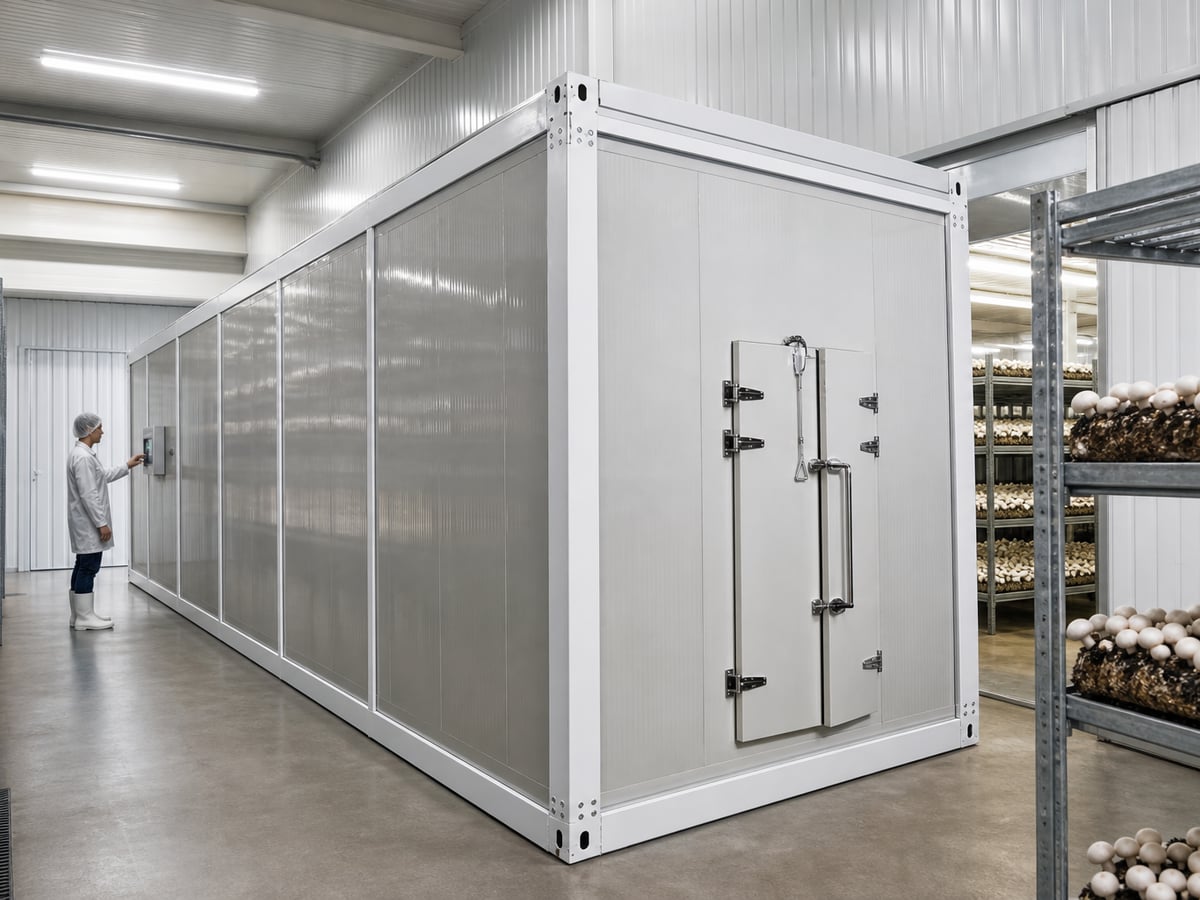
Commercial mushroom farm equipment is an integrated set of environmental, structural, electrical, and control systems designed to create stable growing conditions for mushrooms. Rather than being a single machine, a mushroom farming system may combine insulated growing rooms or containers, shelving, refrigeration, heating, humidification, fresh-air ventilation, exhaust fans, carbon dioxide monitoring, lighting, electrical panels, sensors, and a climate control platform.
For the Global Market, the practical purpose of mushroom cultivation equipment is to help growers manage the critical variables that affect mycelium growth, pinning, fruiting, quality, yield consistency, and crop-cycle timing. The correct configuration depends on mushroom species, substrate type, production scale, local climate, building conditions, labor availability, utility cost, and local food-safety requirements.
Modern systems are widely used for oyster mushrooms, shiitake, king oyster mushrooms, enoki, button mushrooms, lion’s mane, reishi, and specialty medicinal mushrooms. Small farms may use a compact climate-controlled room, while commercial operators may select modular cultivation containers, multiple fruiting chambers, or facility-wide HVAC and automation systems.
A well-designed system is not simply “cold storage with humidity.” Mushroom rooms require balanced air distribution, responsive temperature management, high humidity without excessive condensation, staged fresh-air exchange, and controls that can coordinate several pieces of equipment. Growers should therefore buy equipment based on measurable environmental performance and system boundaries rather than on a low initial machine price alone.
| Production Need | Typical Equipment Category | Primary Function | Common User |
|---|---|---|---|
| Small trial production | Compact grow room controller | Controls temperature, humidity, ventilation, and timing | Startup growers and research farms |
| Container farming | Smart mushroom cultivation container | Provides an insulated, integrated fruiting environment | Urban farms and distributed production projects |
| Multi-room cultivation | Centralized HVAC and climate control system | Manages several zones with coordinated operation | Commercial mushroom farms |
| High-humidity production | Humidification and fogging equipment | Maintains crop-specific relative humidity | Oyster, shiitake, and specialty mushroom growers |
| CO2-sensitive fruiting | Fresh-air and exhaust system | Controls CO2 concentration and air renewal | High-density bag and shelf farms |
| Remote farm management | Internet-enabled controller | Provides alarms, records, and remote access | Operators managing multiple sites |
The table above shows why commercial mushroom equipment should be specified as a working system. A controller alone cannot compensate for undersized refrigeration, poor insulation, insufficient outside-air capacity, or badly arranged racks. Similarly, a large container is not necessarily productive if airflow does not reach each cultivation level evenly.
What Mushroom Farm Equipment Is and Where It Is Used
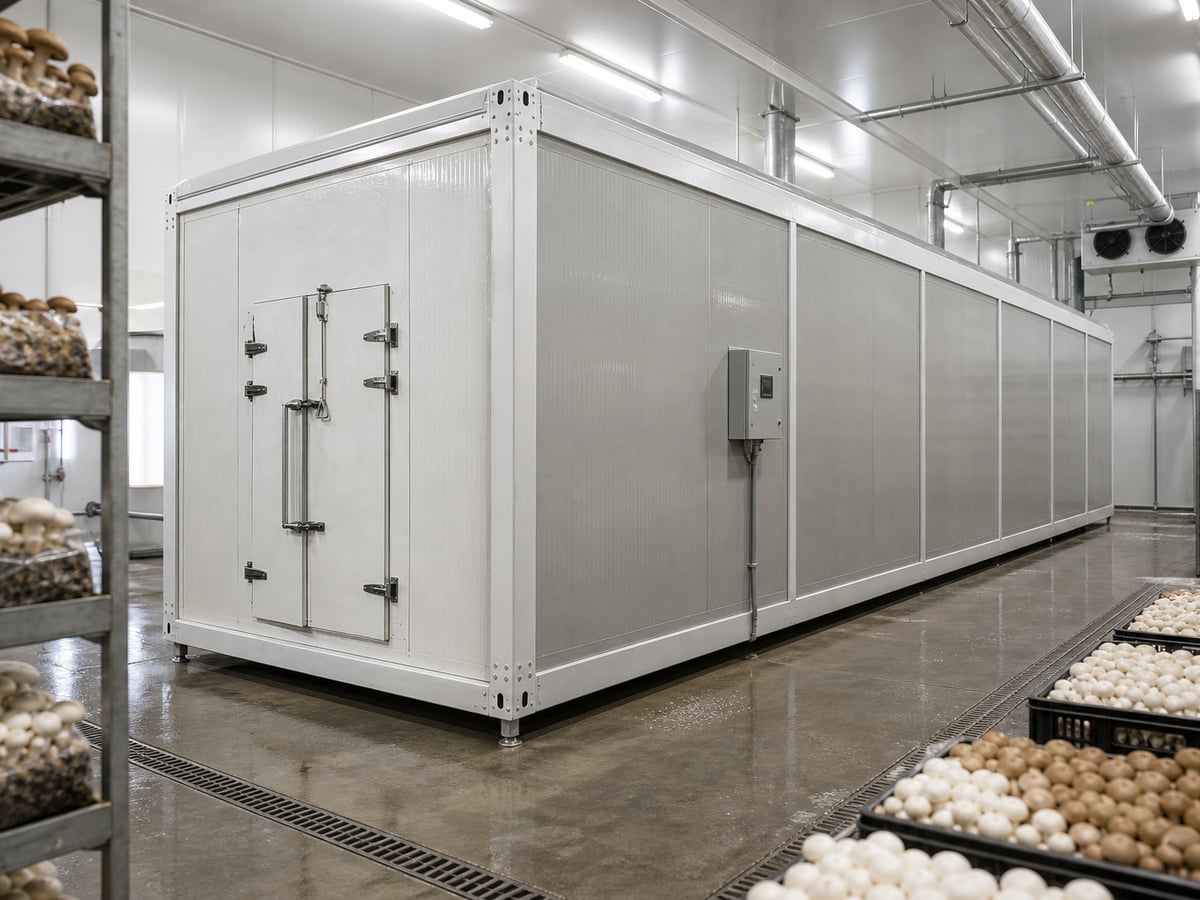
Mushroom farm equipment refers to the equipment used to condition, circulate, monitor, and protect the growing environment from incubation through harvest. Depending on the project scope, it may also include container structures, insulated wall panels, doors, drainage provisions, rack systems, electrical distribution, water treatment, pre-cooling, packaging-room climate equipment, and air source heat pumps.
It is used in rural mushroom production bases, peri-urban farms, food-processing zones, agricultural cooperatives, universities, research institutes, supermarkets with local-growing concepts, hotel and restaurant supply projects, and controlled-environment agriculture initiatives. In regions with hot summers, cold winters, high humidity, dusty conditions, or unstable seasonal weather, climate-controlled equipment helps reduce dependence on outdoor conditions.
In the Global Market, demand is shaped by different supply-chain realities. Farms near Rotterdam and Hamburg may prioritize reliable year-round delivery to wholesale markets. Projects serving Dubai, Doha, or Riyadh may focus on cooling efficiency and heat resistance. Facilities near Singapore, Jakarta, and Ho Chi Minh City often need corrosion-aware materials and strong moisture management. Growers in Toronto, Chicago, Warsaw, and Seoul may need dependable heating capacity and freeze-protection planning during winter operation.
Commercial users can choose between purpose-built mushroom buildings and modular units. A smart mushroom cultivation container can be suitable for rapid deployment, pilot projects, contract farming networks, and sites where conventional construction is slow or expensive. A permanent building system can be more appropriate when the farm needs many fruiting rooms, central utilities, material flow separation, and large-scale daily harvesting.
Industries and applications
- Fresh mushroom farms supplying supermarkets, restaurants, and wholesale produce channels.
- Specialty mushroom producers growing gourmet and medicinal varieties.
- Spawn and substrate operators needing controlled incubation and fruiting areas.
- Agricultural demonstration projects, vocational schools, and research facilities.
- Containerized urban agriculture projects close to consumers in major cities.
- Food-security and rural-development programs requiring modular deployment.
- Export-oriented farms seeking more consistent quality and harvest scheduling.
Equipment selection should consider the entire process. Fruiting rooms have different needs from incubation rooms; clean work areas differ from bag-opening areas; and packing rooms may need lower humidity than grow rooms. Separating zones where practical can improve hygiene, product quality, and energy control.
Standard Configuration and System Boundaries
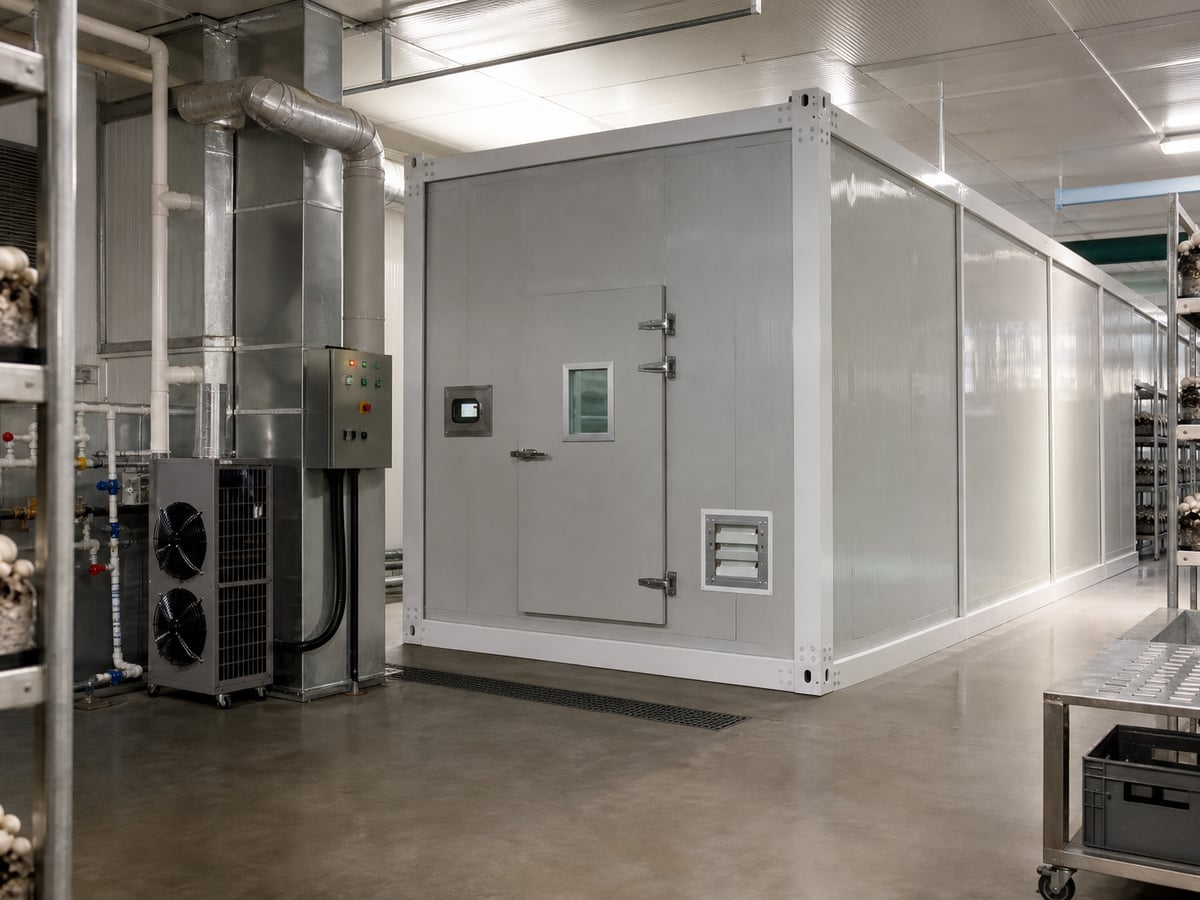
A standard commercial mushroom climate package usually covers the equipment needed to maintain the fruiting-room environment. However, the exact boundary of supply must be stated in the quotation. Buyers should distinguish between the equipment manufacturer’s supply, the contractor’s installation work, and the farm owner’s site responsibilities.
A basic package may include a climate controller, temperature and humidity sensors, CO2 sensor, air handling equipment, heating or cooling source, humidification device, supply fan, exhaust fan, electrical control cabinet, cables within the system boundary, and operating logic. A more complete package may add insulated panels, a container body, doors, racks, lighting, drainage, water filtration, remote monitoring, and power distribution.
| System Item | Usually Included in an Integrated Package | Often Site-Supplied or Optional | Buyer Verification Point |
|---|---|---|---|
| Climate controller | Yes | Cloud subscription may be optional | Confirm sensor quantity and control points |
| Cooling and heating equipment | Usually included when specified | External boiler or backup generator may be excluded | Confirm design ambient temperatures |
| Humidification system | Usually included | Water softener or reverse-osmosis system may be optional | Confirm water quality requirements |
| Ventilation fans and ducts | Often included | Building-side duct extensions may be excluded | Confirm airflow path and installation location |
| Insulated room or container shell | Included only in turnkey modular scope | Concrete building and foundations are commonly local work | Confirm panel thickness and floor loading |
| Racks and growing shelves | Optional or project-specific | Can be locally fabricated | Confirm tier count, aisle width, and corrosion resistance |
| Electrical connection | Internal control wiring may be included | External mains cable, transformer, and utility connection are often local | Confirm voltage, phase, frequency, and protection device |
The boundary table is important because apparently similar offers can contain very different scopes. One supplier may quote only the climate equipment, while another may include the insulated enclosure, internal wiring, and racks. Comparing unit price without comparing scope can lead to unexpected installation costs.
For modular projects, buyers should ask whether transport dimensions, lifting points, container floor construction, drainage slope, door configuration, and pre-shipment testing are included. For building-based projects, ask whether the system is designed for an existing room or for a new construction layout.
Technology capability for controlled cultivation
Shandong Lanhu Air Conditioning Equipment Co., Ltd. develops agricultural climate control systems, industrial HVAC equipment, modular cultivation solutions, mushroom climate controllers, hydroponic plant containers, and air source heat pumps. With more than 12 years of thermodynamic research and development experience and over 45 registered patents, the company can support equipment selection around environmental control logic rather than supplying isolated components only.
For farms that require a defined cultivation environment, a smart mushroom climate controller can coordinate setpoints, sensor feedback, ventilation stages, alarms, and operating schedules. The best control strategy remains crop-specific: growers should set target bands according to the species, strain, substrate, crop stage, and local operating conditions.
Capacity, Dimensions, and Utility Requirements
Capacity should be calculated from usable growing area and crop loading, not only from the outside dimensions of a room or container. A long container with narrow aisles and low rack spacing may provide less usable production space than a carefully designed smaller room. Capacity planning should include bag diameter, substrate block size, shelf levels, working clearance, harvest access, air distribution space, and sanitation access.
Commercial systems are commonly customized around 20-foot or 40-foot modular structures, insulated rooms of different lengths and widths, or multi-chamber buildings. Exact dimensions should be determined after the supplier knows the mushroom type, the number of bags or blocks per cycle, expected turnover, local shipping restrictions, and whether forklifts or manual handling will be used.
| Planning Parameter | Why It Matters | Information Needed for Design | Typical Risk if Ignored |
|---|---|---|---|
| Growing area | Determines rack layout and crop loading | Room length, width, height, and aisle needs | Overcrowded shelves and poor access |
| Substrate loading | Influences cooling load and air circulation needs | Bag count, bag weight, and crop cycle | Insufficient environmental capacity |
| Outdoor climate | Determines heating and cooling design condition | Seasonal maximum and minimum temperatures | Unstable room conditions in extreme weather |
| Electrical supply | Sets motor and controller compatibility | Voltage, phase, frequency, and available kW | Equipment mismatch or nuisance trips |
| Water supply | Supports humidification and cleaning | Pressure, flow, hardness, and water quality | Nozzle blockage, scale, or poor humidity output |
| Drainage | Removes condensate and wash-down water | Drain position, slope, and wastewater rules | Standing water and hygiene issues |
| Internet signal | Enables remote monitoring where selected | Network type, router location, and access policy | Loss of remote alarms or data access |
The planning table should be completed before a final quotation. A supplier may request floor plans, local climate data, photos of the installation site, utility information, desired harvest volume, and the target mushroom species. For overseas projects shipped through Qingdao, Shanghai, Ningbo, Rotterdam, Los Angeles, Jebel Ali, or other trade hubs, buyers should also confirm delivery access, unloading equipment, container handling rules, and local electrical code requirements.
Energy consumption is affected by insulation quality, outside weather, door-opening frequency, fresh-air demand, internal crop heat, lighting, fan operation, and setpoint discipline. It should not be estimated from floor area alone. Request an operating-load discussion based on actual design conditions, while recognizing that farm practices and weather can materially change energy use.
Temperature, Humidity, CO2, Airflow, and Control Performance
Mushroom quality depends on a balanced microclimate. Temperature influences metabolic activity and crop development. Humidity affects evaporation, cap formation, surface moisture, and yield appearance. CO2 affects stem length, cap development, and morphology for many species. Airflow distributes conditioned air, removes excess heat and moisture, and helps prevent stagnant zones. Control performance is therefore the combined result of equipment sizing, sensor placement, air pattern, automation logic, and operator practice.
Each mushroom type has different environmental requirements. Oyster mushrooms often require different fresh-air management from shiitake, while enoki production may demand a more specialized low-temperature approach. Buyers should not use a single generic setpoint range as a design guarantee. Instead, the supplier and grower should agree on crop stages, target environmental bands, allowable deviations, room loading, and test conditions.
| Environmental Variable | Control Objective | Equipment Used | Commissioning Check |
|---|---|---|---|
| Temperature | Maintain crop-stage conditions with minimal fluctuation | Cooling, heating, heat pump, sensors, controller | Check readings at several rack locations |
| Relative humidity | Maintain moisture without excessive wetting | Fogging, humidifier, water controls, sensors | Check uniformity and condensation points |
| CO2 concentration | Provide appropriate fresh-air exchange for morphology and growth | CO2 sensor, supply fan, exhaust fan, dampers | Verify response after ventilation stages operate |
| Airflow | Distribute air across all growing levels | Fans, ducts, diffusers, return-air pathway | Check dead zones and direct drafts |
| Pressure balance | Support cleaner airflow direction where required | Fan balancing, dampers, door seals | Observe door behavior and air leakage |
| Alarm response | Warn operators of out-of-range conditions | Controller, notification settings, backup logic | Test high/low alarm simulation |
The table identifies the key verification tasks during commissioning. A room may reach the correct temperature at one wall-mounted sensor while racks in the far corner experience different conditions. For this reason, good commissioning uses multiple measurement locations and tests at representative crop loading where possible.
Airflow must be gentle enough to avoid drying mushroom surfaces yet sufficient to prevent stale humid air from collecting between bags or shelves. Excessive direct airflow can cause surface drying and quality losses. Inadequate airflow can lead to uneven CO2, condensation, localized disease pressure, and inconsistent pinning. Duct position, fan capacity, air-return path, rack geometry, and room length should be designed together.
Control performance also depends on sensor care. CO2 sensors require suitable placement away from direct supply air and water spray. Humidity sensors should be protected from direct fog exposure. Temperature probes should not be installed next to heat sources, doors, or evaporator discharge points. A maintenance schedule should include calibration checks or replacement according to the device manufacturer’s recommendations.
Core Components, Materials, and Protection Features
The core components of a commercial mushroom system should be selected for a wet, biologically active, and frequently cleaned environment. Material choices have a direct impact on corrosion resistance, cleanability, service life, and operational safety. The preferred configuration varies by site, but buyers should understand the purpose of each component.
- Insulated enclosure: Helps reduce heat gain or loss and limits outside moisture infiltration.
- Cooling and heating source: Maintains the required thermal condition across seasonal changes.
- Humidification equipment: Adds moisture through fogging, atomization, or other selected methods.
- Supply and exhaust fans: Move fresh air and maintain circulation.
- CO2, temperature, and humidity sensors: Supply data for control decisions and alarms.
- Electrical cabinet: Houses protection devices, control hardware, terminals, and operator interface.
- Racks or shelves: Support bags, blocks, trays, or bottles while allowing airflow and harvesting access.
- Drainage and waterproofing details: Help manage condensate, cleaning water, and wet-floor conditions.
Galvanized steel, coated sheet metal, stainless steel, aluminum components, insulated sandwich panels, moisture-resistant wiring methods, and sealed electrical enclosures may be considered according to the equipment location and local environment. In coastal areas such as Manila, Mombasa, Lagos, or Cartagena, corrosion exposure can be higher, so material protection deserves particular attention. In cold regions, insulation continuity and door sealing become especially important.
Protection features may include overload protection, phase-loss protection where applicable, circuit breakers, emergency stop provisions, high- and low-limit alarms, fan interlocks, compressor protection logic, drainage design, and electrical enclosure ratings suitable for the installation environment. Final electrical installation should always comply with applicable local codes and be completed by qualified personnel.
Manufacturing capability and quality control
Lanhu operates a manufacturing facility of more than 30,000 square meters in Dezhou, Shandong, China. Its integrated production capability includes product design, engineering development, sheet metal fabrication, CNC bending, insulation panel production, electrical assembly, system integration, equipment testing, and quality inspection. This integrated approach can help align the structural enclosure, climate equipment, wiring, and controls within one project scope.
Before shipment, systems undergo functional inspection, electrical verification, performance testing, and operational evaluation. The company holds ISO 9001, ISO 14001, ISO 45001, and ISO 12100 certifications, alongside patent certificates and enterprise credibility credentials. Buyers should still review the project-specific technical proposal, drawings, components list, and acceptance criteria because final configuration depends on the order.
Automation, Remote Monitoring, and Customization Options
Automation can reduce routine manual adjustment and provide a clearer record of environmental performance. In a commercial farm, the controller can use sensor feedback and programmed logic to operate cooling, heating, humidification, ventilation, exhaust, lighting, and alarms. The operator sets crop-specific targets, while the system responds within the configured control sequence.
Remote monitoring is useful for farms with several rooms, multiple container sites, or management teams that travel frequently. Depending on the selected configuration and network availability, operators may review environmental data, receive abnormal-condition alarms, adjust authorized setpoints, and compare room performance. Remote access should be managed with user permissions, secure passwords, and a defined responsibility for alarm response.
Customization options can include container dimensions, room layout, rack configuration, door location, panel thickness, voltage and frequency, language settings, control interface, humidification type, fresh-air arrangement, air source heat pump integration, and exterior branding. OEM and ODM projects may also require customized product appearance, control functions, or equipment combinations. Learn more about available OEM and ODM cultivation equipment services when preparing a project-specific design.
For 2026 and beyond, mushroom farm equipment is moving toward more data-driven, resource-efficient operation. Important trends include variable-speed fan control, higher-efficiency heat pump integration, sensor-based ventilation, predictive maintenance alerts, batch-level traceability, remote diagnostics, and energy reporting. Sustainability requirements are also increasing in many markets, particularly around refrigerant management, energy efficiency, water use, recyclable packaging, worker safety, and environmental documentation.
Policy direction varies by country, but buyers should anticipate stronger expectations for electrical compliance, food-production hygiene, water discharge management, occupational safety, and energy performance. A future-ready project should allow room for additional sensors, software upgrades, expansion modules, and replacement parts. It should also avoid control systems that depend on a single unserviceable proprietary component.
Installation, Commissioning, Maintenance, and Warranty
Successful mushroom equipment installation begins with site preparation. The foundation or floor must be level and able to support the equipment and crop load. The site needs suitable electrical capacity, water supply, drainage, access for unloading, ventilation clearance, and adequate maintenance space. For container systems, lifting equipment and transport access should be confirmed before delivery.
Installation commonly includes positioning the container or enclosure, assembling panels where required, connecting ducts and fans, installing racks, connecting water lines, completing electrical wiring, testing safety devices, configuring the controller, and checking drainage. International projects may combine factory guidance with local contractors, depending on the agreed service scope and local regulations.
Commissioning sequence
- Verify the mechanical installation, door seals, drainage, electrical grounding, and correct utility connections.
- Confirm sensor installation locations and compare displayed values with verification instruments.
- Test cooling, heating, humidification, supply air, exhaust air, lighting, and alarm functions.
- Run the room under representative operating conditions before full crop loading.
- Check airflow at different rack levels and adjust dampers, fan settings, or operational logic as required.
- Train operators on setpoints, alarms, cleaning, water management, inspection, and emergency procedures.
Routine maintenance protects environmental stability and reduces unexpected downtime. A daily walk-through should check room conditions, abnormal noise, visible leaks, water supply, fan operation, door closure, and alarm status. Weekly tasks may include cleaning filters, inspecting nozzles, checking drains, and reviewing records. Seasonal maintenance should inspect refrigeration components, electrical terminals, motors, sensor condition, and enclosure seals.
Warranty terms should be stated in the commercial contract. Buyers should request the warranty period, covered components, exclusions, response process, spare-parts availability, remote support conditions, and responsibilities for labor and travel. Consumable parts, water-related blockage, damage caused by poor local power quality, improper operation, and unauthorized modification may have different coverage conditions, so written clarification is essential.
Service capability for international projects
Lanhu provides factory-direct supply, engineering assistance, international logistics support, spare-parts support, installation guidance, and after-sales service for agricultural contractors, distributors, engineering companies, and commercial farms worldwide. This service model can support projects from early equipment selection through shipment coordination and operational handover.
For buyers evaluating deployment results, the company’s mushroom cultivation project cases provide useful examples of application formats. Project discussions should remain specific: a successful case in one climate or mushroom type does not replace capacity calculations for another location.
Commercial Specification and RFQ Checklist
A clear request for quotation, or RFQ, helps suppliers provide comparable technical and commercial proposals. The buyer should describe the crop, capacity objective, location, utilities, room type, desired automation level, and delivery scope. Sending only a request for “mushroom equipment price” normally produces an incomplete comparison because the equipment could range from a controller to a turnkey container farm.
| RFQ Item | What the Buyer Should Provide | Why It Improves the Quotation |
|---|---|---|
| Mushroom species | Oyster, shiitake, button, enoki, lion’s mane, or another type | Determines environmental and layout requirements |
| Production target | Bag count, block count, growing area, or expected harvest volume | Supports capacity and rack calculations |
| Project location | Country, city, indoor or outdoor installation, and local climate | Supports heating, cooling, material, and logistics planning |
| Building format | Existing room, new building, 20-foot container, 40-foot container, or custom module | Defines system boundaries and physical design |
| Electrical supply | Voltage, phase, frequency, available power, and backup power status | Prevents electrical incompatibility |
| Water and drainage | Water source, pressure, hardness, filtration, and drain arrangement | Supports humidification and hygiene design |
| Automation requirement | Local control only, remote monitoring, alarms, history, or multi-site management | Matches controller and communication scope |
| Commercial terms | Target delivery date, destination port, Incoterms preference, and installation scope | Improves freight and service planning |
After receiving proposals, compare more than price. Review cooling and heating design conditions, humidification method, sensor brands or specifications where relevant, airflow capacity, electrical component protection, insulation construction, rack material, remote functions, shipment packaging, commissioning support, warranty, and spare-parts recommendations.
Ask each supplier to identify assumptions. For example, does the quoted system assume a fully insulated room? Does it include racks? Is the cooling capacity calculated for the site’s hottest month? Is the unit intended for incubation, fruiting, or both? Is installation included? Are local taxes, customs clearance, foundation work, and external utility connections excluded? Transparent answers make commercial comparisons more reliable.
For a tailored proposal, buyers can share their crop plan, facility drawing, target city, and utility details through the Lanhu project inquiry channel. Including photos and a short description of intended workflow can help the engineering team recommend an appropriate system scope.
Frequently Asked Questions
Is mushroom farm equipment suitable for both small and large farms?
Yes. Small operations may use a compact controlled room or modular unit, while larger farms may use multiple rooms with centralized climate management. The essential difference is capacity, zoning, redundancy, automation level, and site infrastructure.
What information is needed before ordering a commercial mushroom growing system?
Provide the mushroom species, target production capacity, project location, room or container dimensions, local climate, available electrical supply, water quality, drainage arrangement, desired automation level, destination port or delivery address, and installation expectations.
Can one climate-controlled room grow different mushroom species?
It can, but it is usually more effective to group crops with similar environmental requirements. Different species and growth stages may require different temperature, humidity, CO2, and fresh-air conditions. Separate rooms or independent zones provide better control and scheduling flexibility.
Why is CO2 control important in mushroom fruiting rooms?
CO2 concentration can strongly influence mushroom shape, stem length, cap development, and overall crop quality. Accurate sensing and appropriate fresh-air exchange help the farm maintain a crop-specific environment while avoiding unnecessary energy loss from over-ventilation.
Does remote monitoring replace on-site operators?
No. Remote monitoring improves visibility, alarm response, and record keeping, but on-site operators are still needed for crop inspection, harvesting, sanitation, water management, maintenance, and responding to physical issues such as blocked drains or damaged equipment.
What should be included in a mushroom equipment warranty discussion?
Confirm warranty duration, covered components, exclusions, claim procedure, spare-parts availability, technical support method, remote diagnostic support, labor responsibility, and whether freight or travel costs are covered. These details should be written into the final commercial agreement.
Can a mushroom cultivation container be shipped internationally?
Yes, subject to container dimensions, shipping route, destination regulations, unloading access, and the agreed delivery terms. Buyers should confirm port handling, inland transport, lifting equipment, utility connection requirements, and any import documentation before shipment.
How can a farm prepare for 2026 sustainability expectations?
Prioritize effective insulation, efficient cooling and heating selection, variable-speed ventilation where appropriate, water filtration and maintenance, reliable drainage, operational data logging, safe electrical design, and a serviceable system with available spare parts. These choices can support lower resource waste and more resilient long-term operation.
Share this article

About the Author: Shandong Lanhu Air Conditioning Equipment
Lanhu is a professional climate control equipment manufacturer specializing in smart agricultural systems, commercial HVAC solutions, and customized temperature control technologies. With extensive engineering experience, Lanhu provides reliable solutions for plant factories, controlled environment agriculture, and industrial applications.
Need a Custom Climate Control Solution?
From smart agricultural systems to commercial HVAC solutions, Lanhu provides reliable temperature and humidity control solutions tailored to your project needs.
Contact Us