Global Market Mushroom Climate Control Systems Guide
Quick Answer

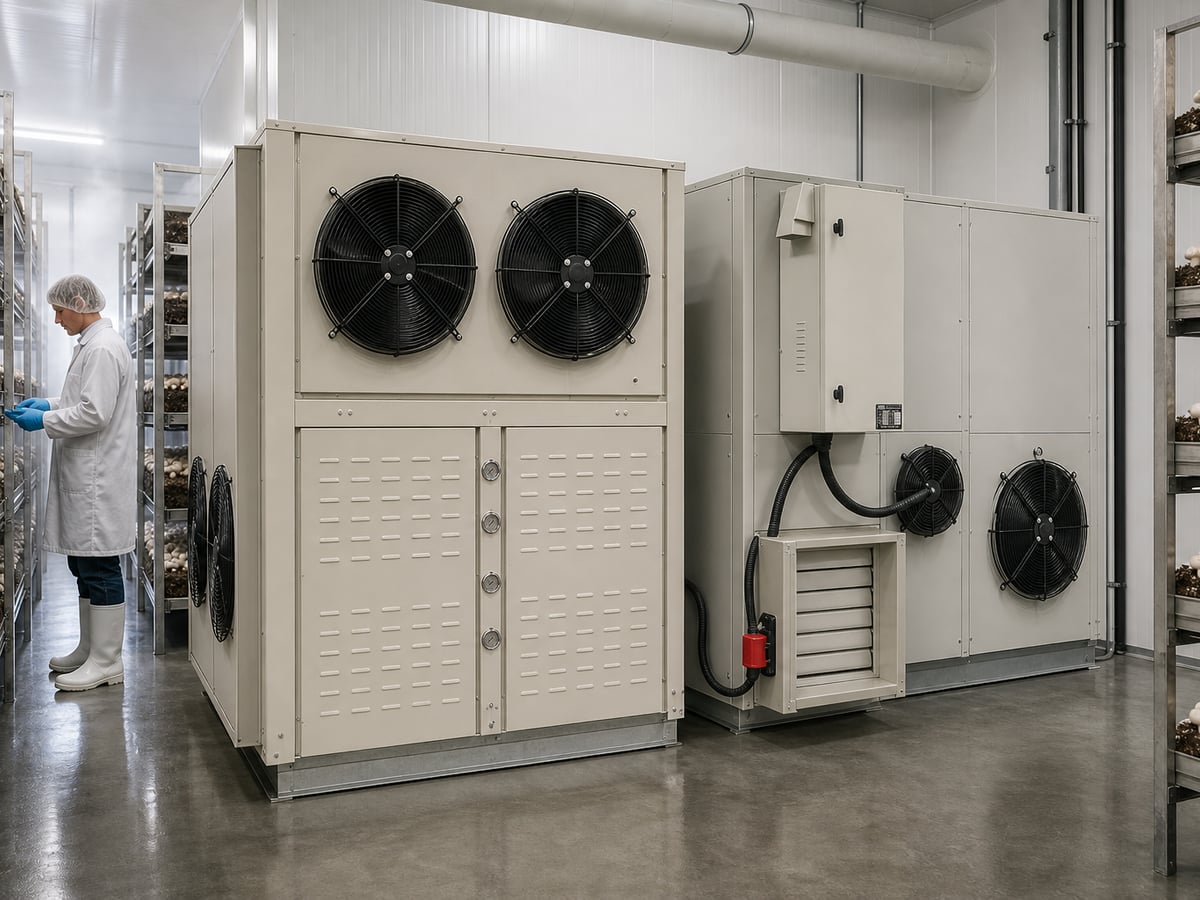
A mushroom climate control system is an integrated environmental management solution designed to maintain stable temperature, relative humidity, carbon dioxide concentration, fresh-air exchange, airflow, and hygiene conditions inside mushroom growing rooms, cultivation containers, tunnels, and modular farms. It helps growers create repeatable fruiting conditions for species such as oyster mushrooms, shiitake, button mushrooms, enoki, lion’s mane, king oyster mushrooms, and other specialty fungi.
For the Global Market, a commercial mushroom environmental control system commonly combines cooling, heating, humidification, dehumidification, ventilation, filtration, sensors, electrical controls, and automated operating logic. Instead of operating separate fans, air conditioners, humidifiers, and exhaust equipment manually, the system coordinates these functions according to programmed growing recipes and real-time sensor feedback.
The most suitable configuration depends on crop variety, room insulation, substrate load, outside climate, cultivation phase, production target, local electricity standards, and sanitary requirements. A properly engineered system can improve yield consistency, reduce labor dependence, lower climate-related losses, and give farm managers better visibility over operating data.
Shandong Lanhu Air Conditioning Equipment Co., Ltd. supplies climate solutions for commercial growers, agricultural contractors, distributors, and engineering companies. Its equipment range includes smart mushroom cultivation containers and mushroom climate controllers designed for projects requiring controlled production conditions and scalable operation.
What Is a Mushroom Climate Control System and Where Is It Used?
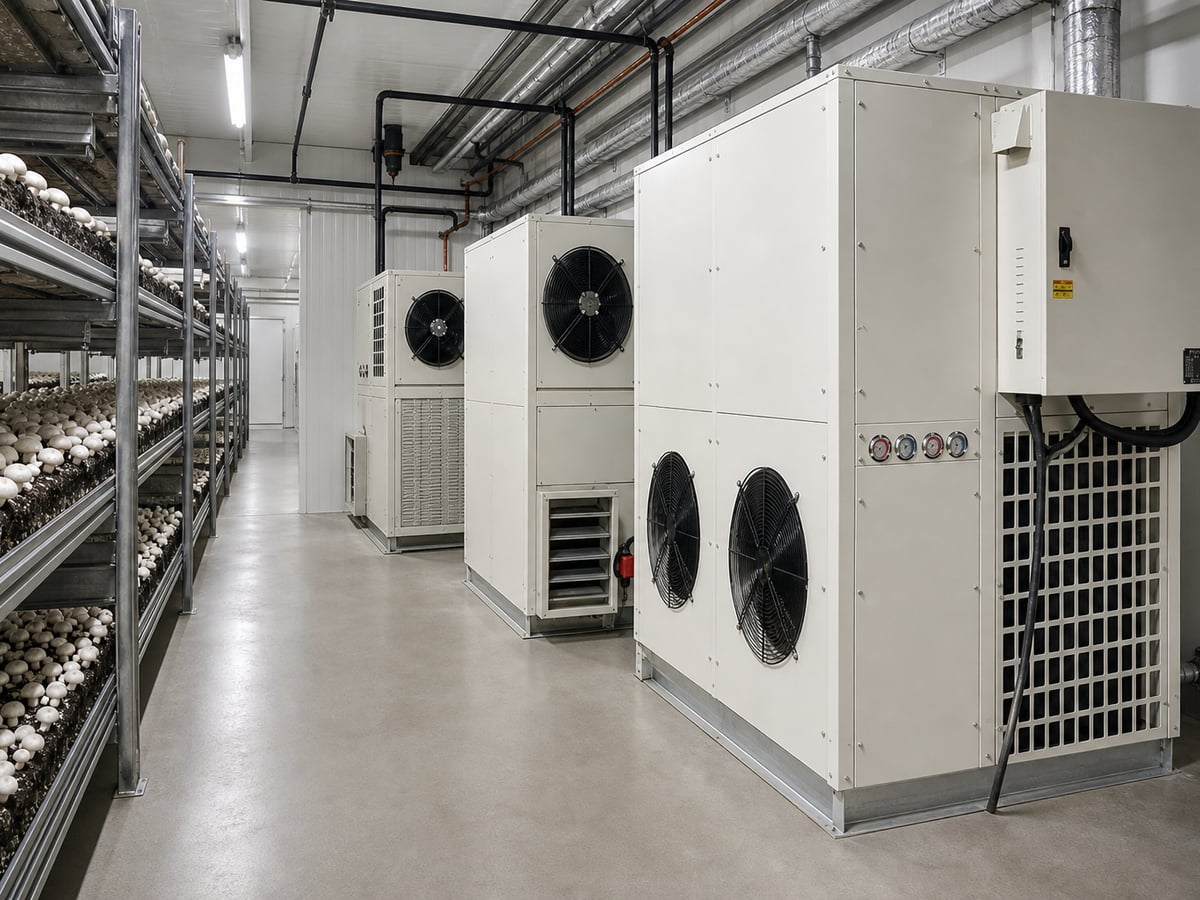
Mushroom cultivation is highly sensitive to environmental change. A room may have adequate moisture but insufficient fresh air, resulting in excessive carbon dioxide and elongated stems. Another room may have the correct temperature but unstable airflow, leading to uneven pinning and different mushroom sizes across shelves. The purpose of a mushroom climate control system is to manage these variables as one coordinated process rather than as independent pieces of equipment.
Typical applications include indoor mushroom farms, converted warehouses, insulated growing chambers, container farms, agricultural research facilities, spawn-running rooms, fruiting rooms, harvest staging areas, and specialty mushroom demonstration projects. In dense urban markets, modular systems can support local production near consumption centers such as Rotterdam, Dubai, Singapore, Los Angeles, Hamburg, Sydney, São Paulo, Johannesburg, and Istanbul.
Commercial farms often divide their facilities into multiple zones. Incubation or spawn-running rooms generally require different settings from fruiting rooms. Button mushroom compost tunnels, oyster mushroom bag rooms, and shiitake block cultivation areas also have distinct requirements. A flexible controller allows the operator to save separate climate recipes for each room and production stage.
The equipment is used by fresh mushroom farms, food distributors with integrated production sites, agricultural cooperatives, research institutions, food-security projects, hotel farms, container farming operators, and rural development programs. In regions with hot summers, cold winters, coastal humidity, or strong daily temperature variation, environmental control becomes especially important for year-round output.
| Application Area | Typical Mushroom Type | Primary Climate Need | Recommended System Approach |
|---|---|---|---|
| Fruiting room | Oyster mushroom | Humidity, fresh air, balanced airflow | Integrated cooling, humidification, CO2 control |
| Block cultivation room | Shiitake | Stable temperature and staged recipes | Multi-stage programmable controller |
| Container farm | Specialty mushrooms | Compact, insulated, remote operation | Container HVAC with integrated sensors |
| Compost tunnel | Button mushroom | Ventilation and temperature uniformity | High-air-volume handling equipment |
| Research facility | Lion’s mane and trials | Precise data logging and alarms | Advanced PLC or smart controller |
| Urban vertical farm | Premium fresh mushrooms | Low footprint, sanitation, traceability | Modular climate zone solution |
The table shows why mushroom environmental systems should not be selected solely by room size. Species, production method, operational objectives, and stage-specific environmental targets all influence equipment design.
Standard Product Configuration and System Boundaries
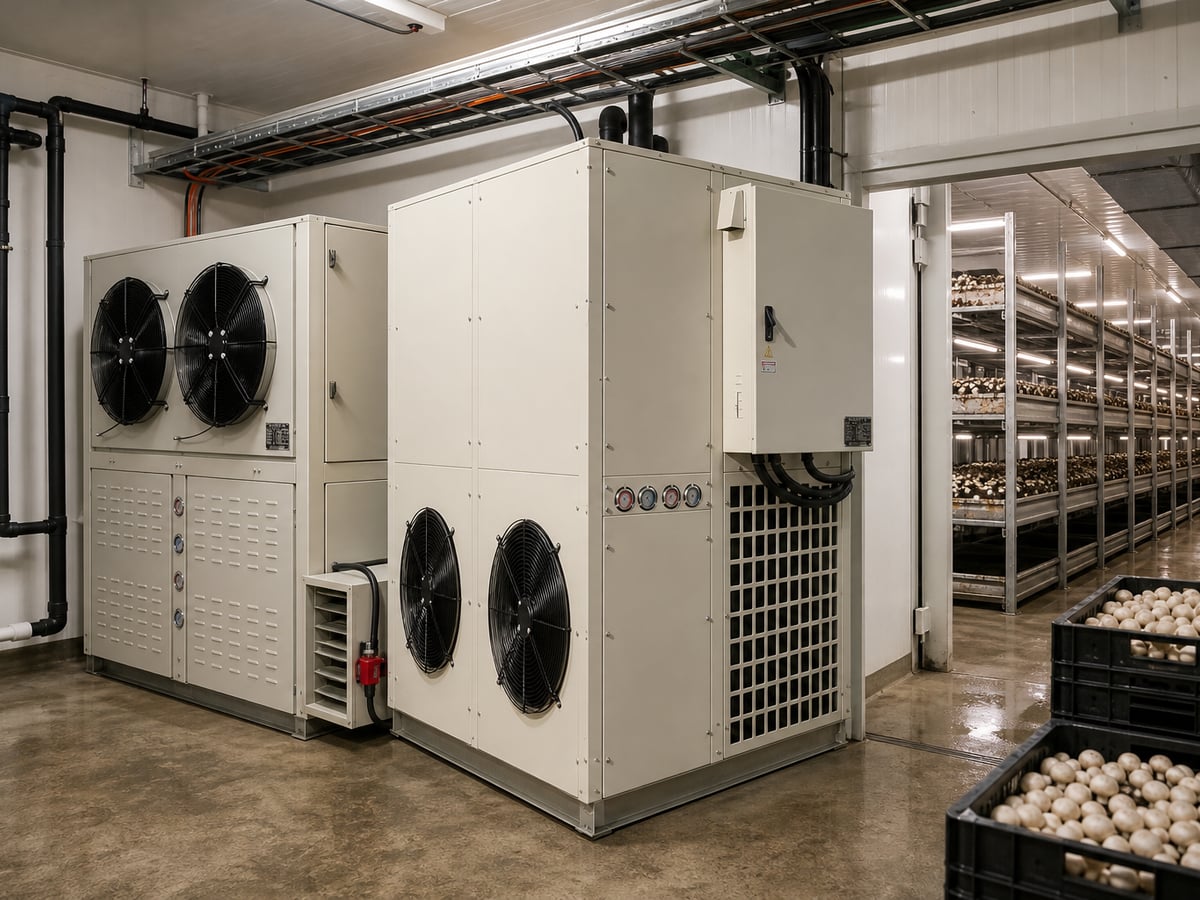
A standard commercial system usually includes an air-conditioning or heat-pump section, supply and return air paths, circulation fans, fresh-air and exhaust dampers, humidification equipment, sensors, electrical control cabinet, and safety devices. Depending on the project, dehumidification, heat recovery, UV treatment, air filtration, ducting, drainage, insulated panels, shelving, and remote monitoring may be added.
The system boundary should be clearly defined before ordering. Suppliers may provide only the climate machine and controller, or they may provide a complete cultivation-room package including insulated enclosure panels, electrical accessories, ductwork, installation drawings, and commissioning support. For international projects, buyers should also confirm whether the quotation includes export packing, shipping terms, spare parts, local installation labor, and site utilities.
A packaged mushroom climate unit is suitable for many standard rooms because it reduces on-site assembly. Larger facilities may use multiple units, centralized chilled-water systems, air-source heat pumps, or dedicated air handling equipment. Modular designs are often preferred where farms expect future expansion because additional rooms can be equipped with matching units and connected to the same monitoring platform.
Lanhu supports both standard and tailored system planning. Its engineering team can evaluate room dimensions, insulation level, cultivation density, local ambient temperature, power supply, and mushroom variety to recommend a practical configuration. For projects requiring branded panels, special controls, customized dimensions, or distributor labeling, OEM and ODM climate-control services can be considered.
| Component | Standard Function | Buyer Confirmation Point | Optional Upgrade |
|---|---|---|---|
| Cooling and heating module | Maintains room temperature | Cooling load, heating capacity, ambient design condition | Air-source heat pump configuration |
| Humidification unit | Raises relative humidity | Water quality, mist volume, drainage arrangement | High-pressure or ultrasonic humidification |
| Fresh-air damper | Introduces outside air | Air intake location and insect protection | Motorized proportional damper |
| Exhaust fan | Removes CO2 and stale air | Airflow rate and discharge route | Variable-speed exhaust control |
| Climate controller | Coordinates system operation | Language, power standard, recipe capacity | Cloud monitoring and remote alarms |
| Sensor set | Measures climate conditions | Sensor accuracy and calibration access | Additional CO2 and differential-pressure sensors |
| Electrical cabinet | Protects and controls electrical circuits | Voltage, frequency, enclosure rating | Surge protection and emergency-stop options |
Buyers should request a system boundary list with every quotation. This prevents uncertainty about whether items such as ducting, humidifier piping, drains, installation materials, room lights, shelves, insulated panels, or local electrical wiring are included.
Capacity, Dimensions, and Utility Requirements
There is no universal capacity rating for a mushroom climate control system because heat and moisture loads vary significantly. The same 100 square meter room may require different equipment when used for oyster mushrooms in tropical Kuala Lumpur, shiitake in northern Europe, or button mushrooms in a high-density production facility near Mexico City. Crop respiration, substrate moisture, lighting, personnel, outside temperature, insulation performance, and air leakage all affect sizing.
As a planning reference, small units may serve compact rooms or containers, while larger modular systems can support multiple fruiting rooms. Commercial buyers should provide the internal room length, width, height, insulation thickness, rack layout, substrate quantity, target production cycle, and local weather data. A supplier can then estimate cooling, heating, humidification, ventilation, and electrical demand more accurately.
Utility planning is equally important. The site must normally provide a stable electrical supply, water source for humidification, drainage point, fresh-air intake location, safe exhaust route, and adequate service access. Water treatment may be advisable where mineral content is high, because scale can reduce humidifier performance. For coastal regions or areas with unstable grid supply, corrosion protection and voltage-stabilization options should be reviewed.
| Planning Item | Typical Requirement | Why It Matters | Information Needed for Quotation |
|---|---|---|---|
| Room volume | Length × width × height | Determines air volume and distribution needs | Internal dimensions in meters |
| Insulation | PU, PIR, EPS, or existing structure | Influences cooling and heating losses | Panel thickness and wall construction |
| Outdoor climate | Summer high and winter low temperatures | Defines equipment design capacity | Project city and seasonal conditions |
| Electrical power | Single-phase or three-phase supply | Determines motor and controller specification | Voltage, frequency, available amperage |
| Water supply | Clean water for humidification | Supports stable mist generation | Water pressure and quality details |
| Drainage | Floor drain or condensate connection | Prevents standing water and hygiene issues | Drain location and slope condition |
| Access space | Maintenance clearance around equipment | Allows cleaning and repair | Door size and equipment placement plan |
For container projects, dimensions are often based on 20-foot or 40-foot structures, but internal layout must account for insulation, air channels, racks, access aisle width, and equipment location. A complete mushroom cultivation container solution can simplify transport and site preparation, particularly for remote farms, island projects, demonstration centers, and new market pilots.
Temperature, Humidity, CO2, Airflow, and Control Performance
Climate performance must be evaluated as a balanced system. Temperature influences mycelial activity and fruiting development. Relative humidity helps prevent drying and supports pin formation. Carbon dioxide concentration affects stem length, cap development, and morphology. Airflow distributes conditioned air but should not create excessive direct draft across mushrooms. Fresh-air exchange is needed to manage CO2, odors, and heat, while filtration supports cleaner air intake.
Exact setpoints depend on mushroom species and production phase. Oyster mushroom fruiting commonly requires cool, humid, fresh-air-rich conditions, but the preferred range differs among warm-weather and cold-weather strains. Shiitake, king oyster, enoki, and lion’s mane each require their own environmental recipes. Buyers should avoid using generic settings without consultation from an experienced grower or cultivation specialist.
Commercial controllers can use sensor feedback to start cooling, heating, humidification, ventilation, and exhaust equipment automatically. Better systems use staged or variable-speed logic to reduce temperature swings and avoid repeated on-off cycling. CO2-based ventilation control can improve air quality while preventing unnecessary loss of cooled or heated air.
| Climate Variable | Operational Purpose | Common Control Method | Risk of Poor Control |
|---|---|---|---|
| Temperature | Supports species-specific growth stages | Cooling, heating, heat-pump modulation | Slow growth, low yield, crop stress |
| Relative humidity | Protects pins and fruit body moisture | Humidifier with humidity sensor | Dry caps, poor pinning, surface defects |
| CO2 concentration | Maintains mushroom morphology and respiration balance | Fresh-air damper and exhaust fan | Long stems, small caps, uneven development |
| Airflow | Distributes climate evenly through racks | Circulation fans and duct design | Hot spots, wet spots, inconsistent crop |
| Fresh-air exchange | Introduces oxygen-rich air and removes stale air | Timed or sensor-driven ventilation | High CO2, odors, condensation issues |
| Pressure balance | Helps manage airflow direction and contamination risk | Dampers and fan balancing | Uncontrolled infiltration and air leakage |
Performance verification should include testing sensor readings, comparing room conditions at different rack levels, observing air distribution, confirming humidifier operation, checking condensate drainage, and verifying alarm functions. A single sensor reading near the machine does not prove that the whole room is uniform. For larger rooms, multiple sensors and well-designed supply-return paths are recommended.
Core Components, Materials, and Protection Features
The durability of agricultural HVAC equipment depends on materials, manufacturing quality, electrical safety, moisture resistance, and ease of cleaning. Mushroom rooms are humid environments, so corrosion resistance and drainage design deserve special attention. Galvanized sheet steel, coated metal surfaces, stainless-steel components in wet zones, insulated panels, sealed electrical enclosures, and protected wiring can all improve long-term reliability.
A typical system includes refrigeration components, heat exchangers, fans, compressors, humidification assemblies, water lines, drainage trays, filters, temperature and humidity sensors, CO2 sensors, relays, contactors, circuit breakers, and a programmable control interface. Depending on design, it may also include inverter drives, electronic expansion valves, UV sterilization modules, heat recovery sections, and cloud communication hardware.
Lanhu’s technological capabilities are supported by more than 12 years of thermodynamic research and development experience and a portfolio of more than 45 registered patents. The company develops integrated environmental-control solutions for agricultural and industrial applications, with functional testing focused on operational stability before shipment. Its system design process can incorporate crop conditions, room layout, and local climate differences rather than relying solely on a generic machine selection.
Protection features should include overload protection, phase-loss protection where applicable, short-circuit protection, motor protection, high- and low-pressure refrigeration safety functions, water shortage protection for humidification equipment, sensor fault alerts, and emergency shutdown options. Buyers in hot climates, high-altitude locations, and areas with frequent grid fluctuation should ask for project-specific electrical and refrigeration safeguards.
Automation, Remote Monitoring, and Customization Options
Automation allows growers to maintain environmental conditions with less manual intervention. A smart mushroom controller can store climate recipes, switch between incubation and fruiting programs, display live readings, log historical data, manage alarms, and coordinate fans, dampers, humidifiers, cooling, heating, and exhaust equipment. For farms operating several rooms, centralized monitoring can improve management efficiency and support faster troubleshooting.
Remote monitoring is particularly valuable for projects where owners manage farms from another city or country. A distributor in Rotterdam, an investor in Dubai, or a farm manager supervising multiple facilities around Nairobi can review status data and receive alarms when temperature, humidity, CO2, water supply, or electrical conditions move outside the target range. Remote access does not replace daily crop inspection, but it provides an additional layer of operational control.
Customization options may include multilingual controller interfaces, voltage and frequency adaptation, left- or right-side equipment layout, special panel colors, branded control screens, high-humidity coating, different air duct arrangements, water filtration packages, remote communications, and custom room dimensions. Integration with existing farm management software may also be available for larger engineering projects.
Lanhu’s manufacturing capabilities include product design, engineering development, sheet-metal fabrication, CNC bending, insulation panel production, electrical assembly, system integration, equipment testing, and quality inspection within its manufacturing base in Dezhou, Shandong. This integrated approach supports consistency between enclosure construction, HVAC equipment, electrical controls, and final system testing.
The 2026 trend is toward more sensor-driven cultivation. Farms are increasingly using recipe libraries, mobile alarms, variable-speed fans, energy monitoring, predictive maintenance alerts, and crop-batch traceability. Sustainability targets are also encouraging higher-efficiency compressors, heat-pump heating, improved insulation, reduced water waste, optimized ventilation schedules, and lower-GWP refrigerant selection where permitted by local regulations.
Installation, Commissioning, Maintenance, and Warranty
Correct installation strongly affects climate-control performance. The equipment must be positioned to allow service access and appropriate air circulation. Fresh-air intake should avoid contamination sources, exhaust air should be discharged safely, and condensate should drain freely. Duct connections, panel joints, electrical wiring, water lines, and sensor locations should follow approved drawings and local codes.
Commissioning should include electrical verification, fan rotation confirmation, refrigeration checks, humidifier testing, drain inspection, sensor calibration review, damper operation, controller programming, alarm testing, and room-temperature stabilization. The operator should receive basic training on setpoint adjustment, recipe selection, cleaning, alarm response, and routine inspections. Before loading a full crop, many growers perform an empty-room test to confirm stable operation.
Routine maintenance usually includes cleaning filters, checking humidifier nozzles or mist components, inspecting drainage, tightening electrical terminals, checking fan motors, cleaning heat exchangers, reviewing sensor readings, and verifying refrigerant-system condition according to service requirements. Maintenance frequency depends on water quality, dust exposure, operating hours, and local climate.
Lanhu provides service capabilities including factory-direct supply, engineering assistance, export logistics support, spare-parts support, installation guidance, and after-sales communication for international projects. Buyers can review mushroom cultivation project cases to understand possible applications, then submit their room data through the project inquiry channel for a technical recommendation.
| Maintenance Item | Suggested Check Interval | Purpose | Operational Note |
|---|---|---|---|
| Air filters | Weekly to monthly | Maintain airflow and air cleanliness | Increase frequency in dusty areas |
| Humidifier components | Weekly | Prevent scaling and blocked mist output | Use treated water if mineral content is high |
| Drainage system | Weekly | Prevent overflow and standing water | Clean drain traps and confirm slope |
| Temperature and humidity sensors | Monthly or as required | Maintain reliable environmental readings | Compare with calibrated reference device |
| CO2 sensor | According to sensor specification | Support accurate ventilation control | Check calibration and placement |
| Electrical cabinet | Quarterly | Identify loose connections or heat damage | Service only by qualified personnel |
| Heat exchanger and fan section | Seasonally | Preserve cooling and heating efficiency | Clean carefully without damaging fins |
Warranty scope should be confirmed in writing before purchase. Clarify the warranty period, covered components, excluded consumables, remote troubleshooting process, spare-parts availability, response procedure, and whether on-site service is included or arranged locally. A good commercial quotation should distinguish equipment warranty from installation workmanship warranty.
Commercial Specification and RFQ Checklist
A detailed request for quotation helps suppliers calculate capacity and propose appropriate equipment. Rather than asking only for “a mushroom air conditioner,” provide the crop type, room information, project location, desired output, and site utilities. This enables a more realistic engineering response and makes quotations easier to compare.
For the Global Market, shipping and compliance should be planned early. Buyers importing through ports such as Rotterdam, Hamburg, Jebel Ali, Durban, Santos, Long Beach, Melbourne, or Singapore should confirm container loading dimensions, packing method, required certificates, customs documentation, destination power standard, and local installation rules. Contractors should also review whether the project requires CE-related documentation, electrical conformity documents, sanitation records, or local refrigeration compliance.
| RFQ Item | What to Provide | Why the Supplier Needs It | Buyer Decision Supported |
|---|---|---|---|
| Project location | Country, city, altitude, local weather | Calculates outdoor design conditions | Cooling and heating capacity |
| Mushroom variety | Species and strain where known | Defines climate recipe needs | Controller programming and system type |
| Room drawings | Dimensions, doors, racks, ceiling height | Plans airflow and equipment placement | Layout and duct configuration |
| Substrate loading | Bag count, block weight, compost quantity | Estimates biological heat and moisture load | Capacity selection |
| Insulation details | Panel type and thickness | Calculates heat gain and loss | Energy performance planning |
| Electrical supply | Voltage, frequency, phase, available power | Matches motors and electrical cabinet | Compatibility and installation cost |
| Required scope | Machine only, full room, container, controls | Defines quotation boundary | Budget comparison |
| Automation expectation | Local screen, remote app, data logging, alarms | Configures control level | Management and labor strategy |
When comparing suppliers, assess more than the initial price. Consider climate design capability, manufacturing control, component specification, electrical safety, insulation quality, test procedures, spare-parts planning, documentation, project communication, and after-sales support. A low-cost unit that is incorrectly sized or difficult to service can create larger losses than a correctly engineered solution.
For buyers seeking a manufacturer with agricultural climate-control experience, Lanhu operates a modern production facility exceeding 30,000 square meters and maintains quality-management, environmental-management, occupational-health, and machinery-safety certifications including ISO 9001, ISO 14001, ISO 45001, and ISO 12100. Its service model supports equipment distributors, commercial growers, agricultural contractors, and engineered farm developments.
Local suppliers can be useful for installation labor, electrical connections, refrigerant service, and emergency response. However, buyers should verify whether the local provider understands mushroom-specific climate control rather than general building HVAC only. The preferred approach is often a coordinated model: specialized equipment engineering from the manufacturer combined with qualified local installation and maintenance support.
FAQ
What is the main purpose of a mushroom climate control system?
Its purpose is to maintain suitable temperature, humidity, CO2 concentration, fresh-air exchange, and airflow for each cultivation stage. This helps create more stable crop quality and reduces dependence on manual climate adjustment.
Can one system be used for different mushroom varieties?
Yes, if the controller can store different recipes and the equipment has sufficient capacity. Each species may require distinct temperature, humidity, and CO2 targets, so the system should be configured with separate programs for each crop and stage.
How do I determine the correct equipment capacity?
Provide the room dimensions, insulation information, local climate, mushroom type, substrate load, rack arrangement, and power supply. The supplier should calculate cooling, heating, ventilation, and humidification needs based on these project conditions.
Is remote monitoring necessary for a small farm?
It is not mandatory, but it can be valuable. Remote alarms can notify the grower of temperature, humidity, CO2, water, or electrical problems before they become severe. It is especially useful for farms with multiple rooms or limited on-site staffing.
What utilities are normally required?
Most systems require electrical power, clean water for humidification, drainage, fresh-air intake, exhaust routing, and sufficient service access. Exact requirements depend on the system type and project scale.
How often should a mushroom climate system be maintained?
Filters, humidification components, drainage, sensors, fans, and electrical connections should be inspected regularly. The maintenance schedule should reflect local water quality, dust levels, operating hours, and the manufacturer’s recommendations.
Can a system be customized for a shipping container farm?
Yes. Container projects can be designed with integrated insulation, racks, lighting, climate equipment, water connections, drainage, remote control, and project-specific voltage options. This is suitable for modular production and phased expansion.
What should be included in a commercial quotation?
The quotation should state equipment capacity, components, dimensions, power requirements, automation functions, system boundaries, optional items, delivery terms, warranty, commissioning scope, packing details, and spare-parts recommendations.
What trends will influence mushroom climate control in 2026?
Key trends include energy-efficient heat pumps, variable-speed airflow, IoT-based monitoring, predictive maintenance, lower water consumption, improved insulation, data-driven crop recipes, and compliance with evolving energy and refrigerant policies. Growers are increasingly seeking systems that balance yield consistency with lower operating costs and sustainability goals.
Share this article

About the Author: Shandong Lanhu Air Conditioning Equipment
Lanhu is a professional climate control equipment manufacturer specializing in smart agricultural systems, commercial HVAC solutions, and customized temperature control technologies. With extensive engineering experience, Lanhu provides reliable solutions for plant factories, controlled environment agriculture, and industrial applications.
Need a Custom Climate Control Solution?
From smart agricultural systems to commercial HVAC solutions, Lanhu provides reliable temperature and humidity control solutions tailored to your project needs.
Contact Us