Mushroom HVAC Systems for the Global Market Buyers
Quick Answer

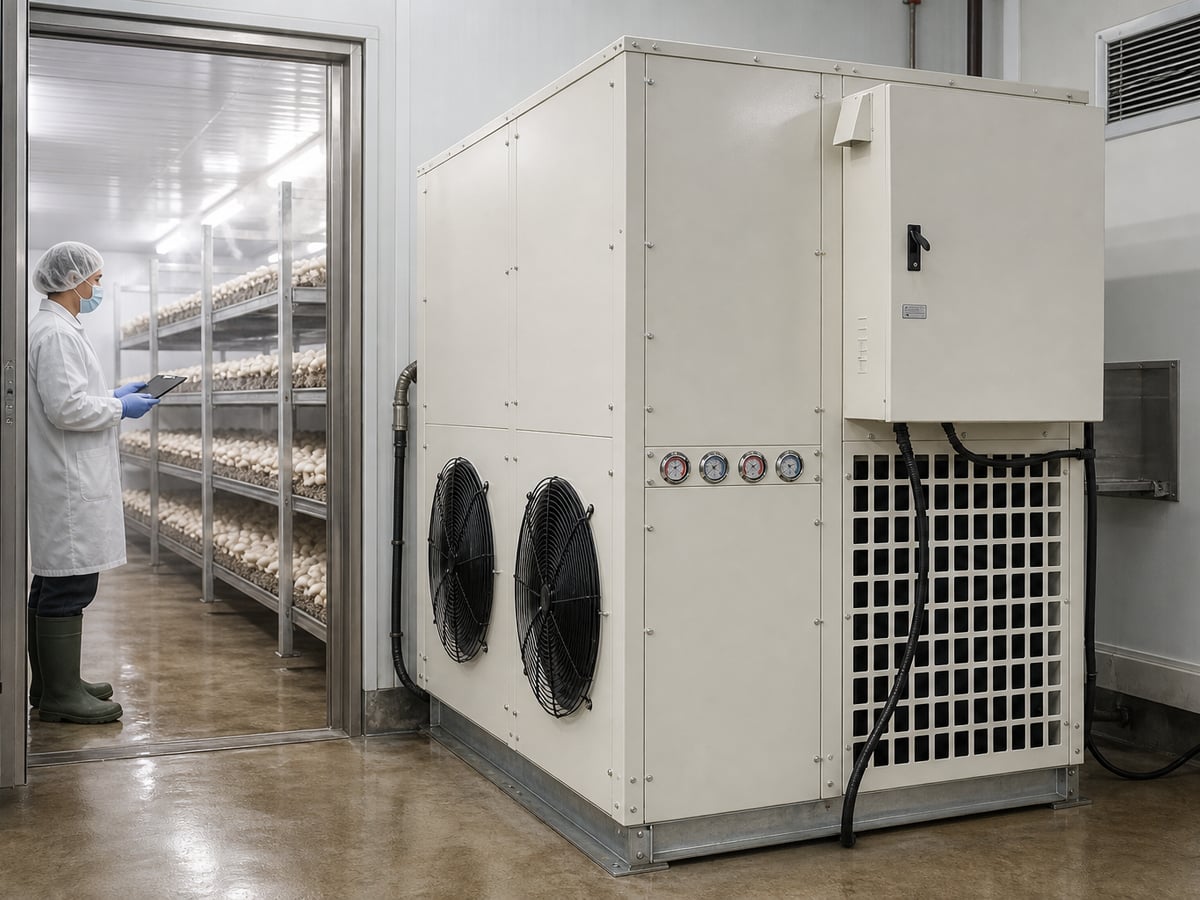
A mushroom HVAC system is a purpose-built climate-control solution designed to manage temperature, relative humidity, fresh-air exchange, carbon dioxide concentration, airflow, and filtration inside mushroom growing rooms, containers, tunnels, and cultivation facilities. Unlike standard comfort air conditioning, mushroom climate equipment must respond to the biological requirements of mycelium growth, pinning, fruiting, harvesting, and room sanitation.
For the Global Market, a commercial mushroom HVAC system commonly combines cooling, heating, humidification, dehumidification, ventilation fans, dampers, filters, sensors, variable-speed drives, and a programmable controller. It can be supplied as a split system, packaged air-handling unit, container-mounted climate unit, or customized central system for multiple growing rooms.
The correct system is selected according to mushroom species, room size, substrate load, outside climate, crop cycle, insulation level, local electrical standard, available water source, and target production output. Oyster mushroom, shiitake, button mushroom, enoki, lion’s mane, and specialty fungi can require different climate recipes. A reliable design therefore starts with a heat-load calculation and a cultivation process review rather than choosing equipment only by room area.
For growers, contractors, and distributors, the practical buying goal is simple: stable crop conditions with low energy consumption, easy maintenance, and controls that remain usable in real operating conditions. A properly matched mushroom HVAC system helps reduce crop stress, improve uniformity across shelves or beds, limit condensation, manage CO2 during fruiting, and support predictable production planning.
What Is a Mushroom HVAC System and Where Is It Used?
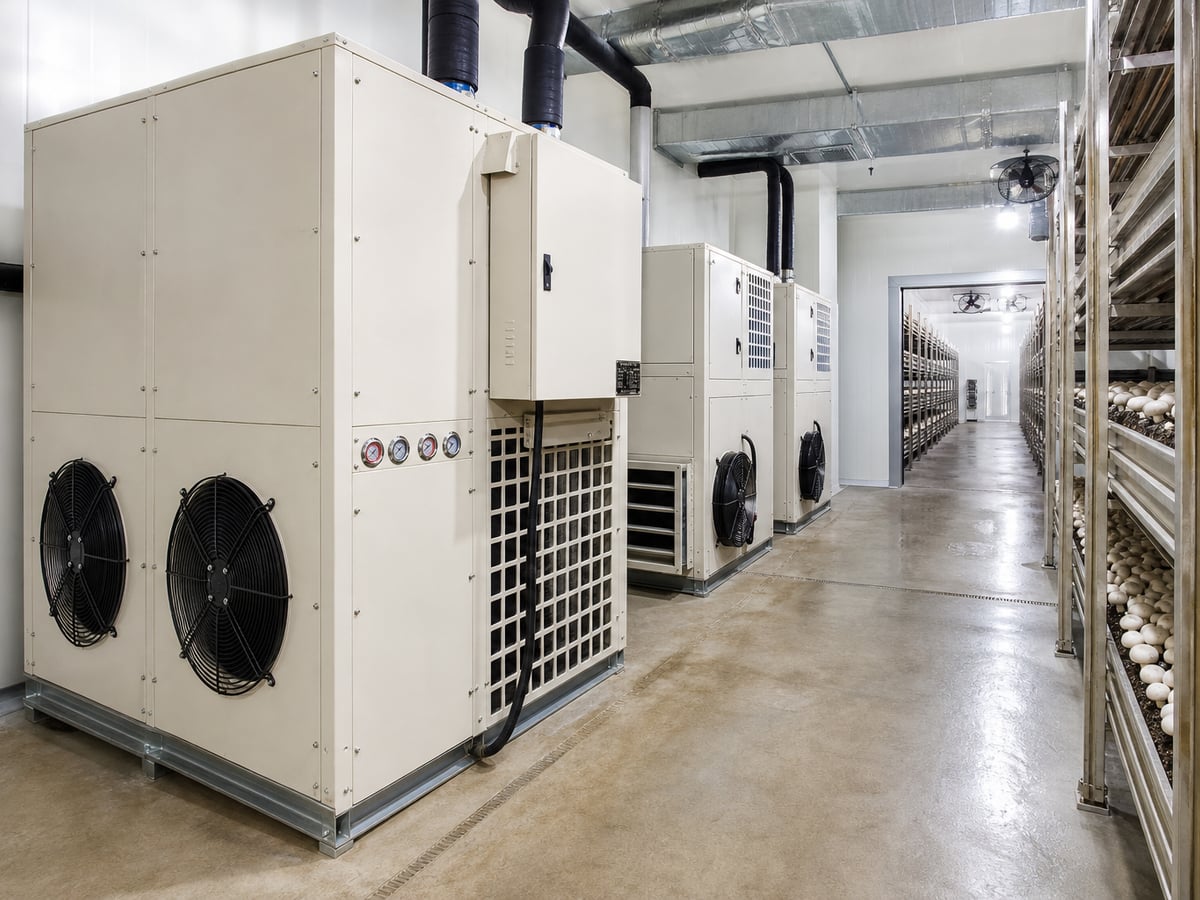
A mushroom HVAC system is an integrated environmental-control package engineered for fungal cultivation. It conditions and circulates air while balancing moisture and gas concentration. In a production room, mushrooms themselves, substrate bags, compost, workers, lighting, motors, and outdoor air all affect the indoor climate. The HVAC system manages these changing loads so the growing environment stays within the setpoints defined by the farm’s crop recipe.
These systems are used in commercial mushroom farms, spawn laboratories, fruiting rooms, incubation rooms, container farms, mushroom processing support areas, agricultural research facilities, and modular cultivation projects. They are suitable for independent farms and large-scale operations with several climate zones. In markets with high land costs or limited building infrastructure, container-based systems are particularly useful because the cultivation room and climate equipment can be integrated before delivery.
Common global project destinations include farms near Rotterdam and Antwerp serving European produce distribution routes, indoor agriculture projects around Dubai and Jebel Ali, food-production facilities near Singapore, growing operations in California and Vancouver, and commercial agricultural clusters near Sydney, São Paulo, Johannesburg, Istanbul, and Manila. Equipment exported through Qingdao Port, Shanghai Port, Ningbo-Zhoushan Port, or Shenzhen can be configured for regional voltage, frequency, climate conditions, and shipping limitations.
Typical Applications by Growing Stage
| Application Area | Main Climate Objective | Typical Control Focus | Common Equipment Arrangement |
|---|---|---|---|
| Spawn incubation room | Support stable mycelium colonization | Temperature stability and limited fresh air | Cooling/heating unit with circulation fans |
| Fruiting room | Initiate and sustain fruit body development | Humidity, CO2, fresh air, gentle airflow | Air handler, humidifier, exhaust and intake dampers |
| Container mushroom farm | Provide compact all-season production | Full automatic climate management | Integrated packaged HVAC and controller |
| Compost or substrate room | Manage biological heat and moisture release | Ventilation, cooling and odor management | High-airflow ventilation and cooling system |
| Research cultivation chamber | Repeat experimental environmental conditions | High sensor precision and data logging | Precision controller with independent zones |
| Harvest and short-term holding room | Preserve quality after picking | Cooling and hygiene control | Low-temperature refrigeration and filtered air |
The table shows why one “standard air conditioner” is rarely sufficient for mushroom production. Fruiting rooms require coordinated humidity and fresh-air control, while incubation rooms may emphasize stable temperature and air circulation. A supplier should understand the crop stage before recommending capacity and configuration.
For new modular projects, growers can review smart mushroom cultivation containers as an alternative to constructing a conventional insulated growing room. These units are useful where construction schedules, land leases, seasonal production, or remote-site logistics make modular deployment attractive.
Standard Product Configuration and System Boundaries
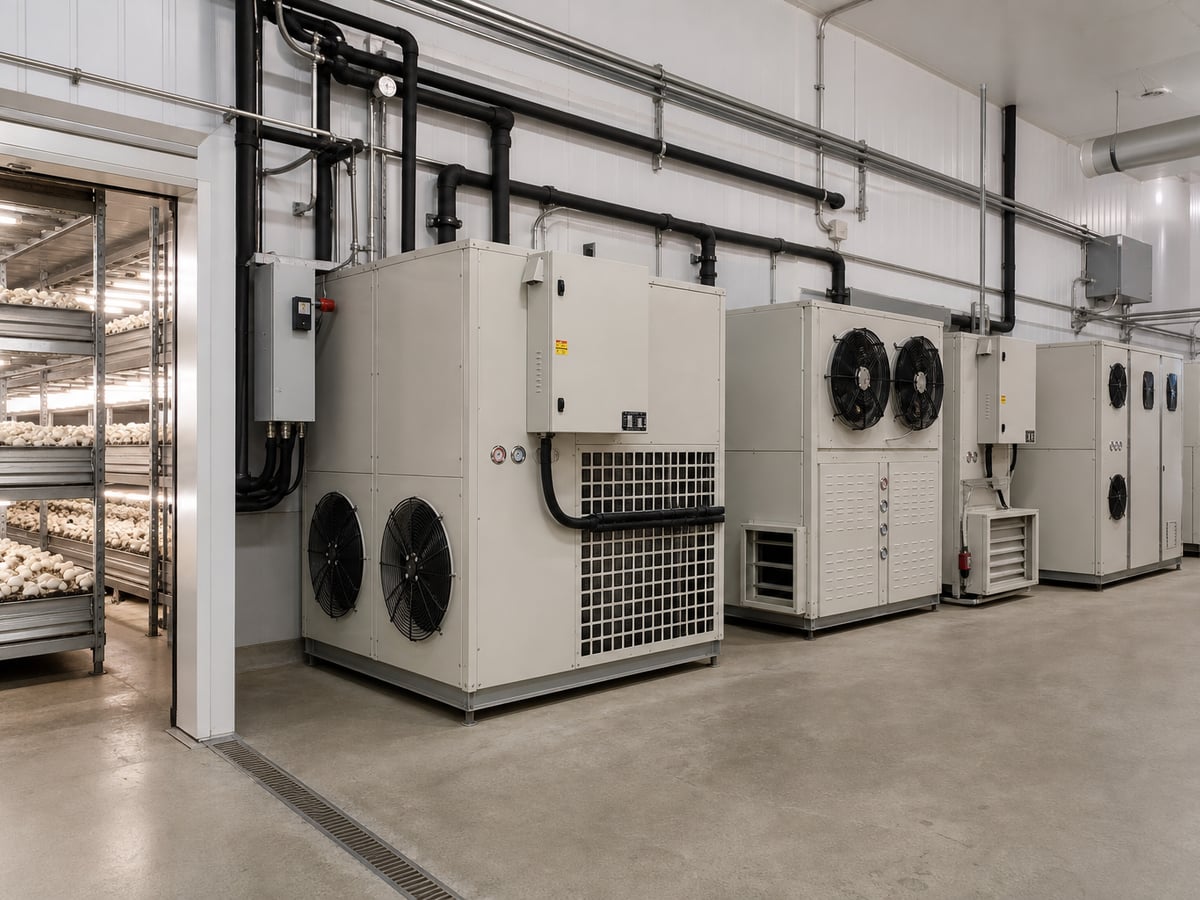
A standard mushroom HVAC package is normally designed as a climate-control assembly, not merely a cooling machine. Its core boundary generally includes the air-conditioning section, ventilation section, humidification section, sensors, electrical control cabinet, and local operating interface. Depending on the project, it may also include ductwork, air distribution outlets, heat recovery, ultraviolet treatment, drain systems, remote communications, and integration with farm-management software.
System boundaries must be clearly agreed before ordering. For example, the HVAC supplier may provide the air-handling equipment and controller, while the customer or local contractor provides room insulation, building power cables, water piping, drainage connection, exterior weather cover, concrete pad, and commissioning labor. Defining these responsibilities early prevents delays during installation.
Typical Standard Configuration
| Subsystem | Standard Function | Typical Included Items | Optional Upgrade |
|---|---|---|---|
| Cooling and heating | Maintain room temperature | Compressor, coils, expansion device, heat exchanger | Heat pump or low-ambient operation kit |
| Fresh-air ventilation | Reduce CO2 and renew indoor air | Supply fan, exhaust fan, intake damper | Heat recovery ventilator |
| Humidification | Maintain crop moisture conditions | High-pressure misting or ultrasonic humidifier | Water treatment and automatic flushing |
| Air filtration | Reduce dust and airborne contaminants | Washable pre-filter or panel filter | Higher-grade filtration or UV treatment |
| Control system | Coordinate climate equipment | PLC or dedicated climate controller, display | Remote cloud access and alarm notifications |
| Air distribution | Deliver air evenly through the room | Duct connections and basic outlets | Fabric ducting, perforated duct or zoning dampers |
This configuration table should be used as a procurement checklist. The buyer should compare not only the equipment list but also the control logic, sensor quantity, filtration grade, ducting scope, installation materials, and after-sales obligations. A low initial quotation may exclude components essential for stable crop performance.
For projects requiring a dedicated control platform, the smart mushroom climate controller can be specified as a separate component or integrated with a complete climate system. This approach is useful for retrofit projects where the farm has existing cooling or ventilation hardware but needs more specialized environmental control.
Capacity, Dimensions, and Utility Requirements
Mushroom HVAC capacity is determined by more than room volume. The design team should evaluate outside temperature and humidity, room insulation, wall and roof solar gain, number of substrate blocks or compost beds, biological heat generation, fresh-air requirement, lighting, equipment heat, worker occupancy, door opening frequency, and crop-specific humidity targets. Farms in hot and humid regions may require significant latent cooling and dehumidification capacity, while cold-climate farms may need stronger heating and frost protection.
Typical commercial systems may range from compact 3 kW to 10 kW climate units for small modular rooms to 20 kW, 40 kW, 60 kW, or larger engineered systems for multi-room farms. Actual capacity should always be confirmed by a project-specific calculation. Oversized equipment can cause short cycling and uneven humidity, while undersized equipment may fail to control temperature during peak summer conditions.
Illustrative Capacity and Utility Planning Guide
| Project Scale | Indicative Room Volume | Typical Cooling Range | Electrical Supply | Water and Drainage Needs |
|---|---|---|---|---|
| Small test room | 20–50 m³ | 3–6 kW | 220–240 V, single phase or local equivalent | Humidifier water line and floor drain |
| Compact container farm | 50–100 m³ | 6–15 kW | 380–415 V, three phase preferred | Filtered water, condensate and washdown drainage |
| Single fruiting room | 100–250 m³ | 15–30 kW | Three phase, 50 Hz or 60 Hz | Water supply, drain trap and wastewater route |
| Medium commercial farm | 250–800 m³ | 30–80 kW | Three phase with dedicated breaker | Humidification water treatment may be required |
| Multi-room cultivation site | 800–2,000 m³ | 80–200 kW | Three phase distribution board | Central drainage, make-up water and service access |
| Large engineered facility | Above 2,000 m³ | Custom engineered | Project-specific electrical design | Central utilities, backup plan and monitoring |
The ranges above are for preliminary planning only and are not a substitute for engineering selection. Capacity can vary considerably between a well-insulated room in Northern Europe and an exposed building in a tropical coastal location. A grower in Mombasa, Ho Chi Minh City, Miami, or Jakarta may require a different moisture-removal strategy from a project in Warsaw, Toronto, or Almaty.
When requesting a quotation, provide room drawings, interior height, insulation panel thickness, local summer and winter design temperatures, mushroom variety, planned substrate quantity, shelf layout, electrical standard, water quality details, and preferred shipping port. This information enables the supplier to select appropriate fans, coils, compressor protection, pipe connections, and control parameters.
Temperature, Humidity, CO2, Airflow, and Control Performance
Climate performance should be judged by stability, uniformity, response time, and controllability rather than by cooling capacity alone. Mushroom crops are sensitive to sudden environmental swings. High CO2 may cause long stems or deformed caps in some varieties, while excessive direct airflow can dry fruit bodies. Low humidity may reduce yield or cause cracking, whereas uncontrolled high humidity and poor circulation can increase condensation and disease risk.
A professional mushroom HVAC system continuously measures key variables and adjusts cooling, heating, ventilation, humidification, and fan speed. Setpoints may change automatically by growth stage. For example, a farm may use one recipe for incubation, another for pinning, and another for fruiting and harvest preparation. Multi-stage control helps avoid manual adjustments that are inconsistent across shifts.
Typical Environmental Control Parameters
| Parameter | Why It Matters | Typical Monitoring Method | Control Equipment |
|---|---|---|---|
| Temperature | Influences growth rate, pinning and crop quality | Digital room temperature sensor | Cooling coil, heater, heat pump |
| Relative humidity | Supports fruit body development and reduces drying | Humidity sensor in representative air zone | Humidifier, cooling coil, ventilation logic |
| CO2 concentration | Affects morphology and fresh-air demand | NDIR CO2 sensor | Fresh-air damper and exhaust fan |
| Air velocity | Promotes uniform conditions without crop damage | Commissioning measurement and fan feedback | Variable-speed circulation fan and ducts |
| Static pressure | Helps manage air balance between rooms | Pressure sensor or airflow calibration | Dampers, supply fans and exhaust fans |
| Condensate condition | Indicates cooling and drainage performance | Visual inspection and drain monitoring | Drain pan, trap, slope and alarm option |
The correct setpoints vary by species, strain, substrate formulation, cultivation method, and local farm practice. Suppliers should avoid promising one universal temperature or humidity setting for all mushrooms. Instead, the control system should allow growers to create and protect their own recipes, with password levels for operators, supervisors, and technicians.
Air distribution is often underestimated. Even a powerful cooling unit can perform poorly if cold air is discharged directly onto mushrooms or if shelves at the far end of the room receive little circulation. Perforated ducts, fabric ducts, side-wall supply arrangements, return-air grilles, and variable-speed fans may be used to create gentler and more even air movement. During commissioning, temperature and humidity should be checked at several shelf levels and room positions, not only beside the wall controller.
Core Components, Materials, and Protection Features
Commercial mushroom production is a high-humidity environment, so equipment materials and protective details matter. Components may be exposed to continuous moisture, cleaning chemicals, organic dust, condensate, and frequent operation. A durable mushroom HVAC system should therefore use corrosion-resistant materials, properly sealed electrical assemblies, accessible filters, insulated panels, stable fan assemblies, and drainage components designed to avoid standing water.
Core cooling components commonly include a compressor, condenser, evaporator coil, expansion device, refrigerant piping, and protective switches. The air side includes supply and return fans, dampers, filters, ducts, and distribution outlets. Control components include temperature, humidity, and CO2 sensors, a programmable controller, contactors or variable-frequency drives, circuit breakers, alarms, and an operator interface.
Materials and Protective Design Checklist
| Component Area | Preferred Construction | Protection Benefit | Buyer Verification Point |
|---|---|---|---|
| Cabinet panels | Powder-coated steel, galvanized steel or stainless steel option | Improves resistance to damp environments | Confirm coating and panel thickness |
| Insulated enclosure | High-density insulated sandwich panels | Reduces heat gain and surface condensation | Check insulation thickness and joint sealing |
| Heat exchanger coil | Corrosion-resistant coil design | Supports longer operation in humid air | Ask about coating and cleaning access |
| Electrical cabinet | Sealed enclosure with labeled wiring | Helps protect controls from moisture and dust | Confirm enclosure rating and service access |
| Drainage section | Sloped drain pan and trapped condensate line | Reduces stagnant water and odor risks | Verify drain outlet location and slope |
| Fan and motor | Balanced impeller with protected motor | Improves airflow stability and equipment life | Confirm motor rating and speed-control option |
This table highlights the difference between equipment built for agricultural production and general indoor comfort applications. Buyers should also ask whether filters can be replaced from a service side, whether sensors can be calibrated, whether electrical wiring is numbered, and whether spare components are available for the intended market.
For humid coastal locations such as Lagos, Manila, Colombo, Cartagena, or Auckland, corrosion protection should receive special attention. For dusty agricultural regions, accessible pre-filtration and coil-cleaning arrangements become equally important. A site assessment can identify whether additional weather protection, external condenser placement, sun shading, or salt-air protection is necessary.
Automation, Remote Monitoring, and Customization Options
Automation improves consistency by converting cultivation knowledge into repeatable climate recipes. A modern mushroom HVAC controller can schedule temperature, humidity, CO2, ventilation, and lighting-related actions by stage or time period. It can also record alarms, show historical curves, support automatic restart after power recovery, and notify managers when a condition moves outside the permitted range.
Remote monitoring is valuable for farms with multiple rooms, distant owners, contract growers, or centralized technical teams. Depending on the communication infrastructure, the system may support Ethernet, Wi-Fi, mobile-network gateways, or cloud-based dashboards. Remote access should supplement, not replace, local controls. The farm must still be able to safely operate essential functions when internet service is unavailable.
Common Automation and Customization Options
| Option | Operational Value | Best-Fit Project | Important Selection Note |
|---|---|---|---|
| Recipe-based climate control | Automates stage changes | Multi-cycle commercial farms | Require editable crop recipes |
| Remote dashboard | Displays room status and historical data | Multi-site operators and investors | Confirm data ownership and access levels |
| Mobile alarm notification | Speeds response to failures | Unattended or night-operated farms | Set escalation contacts clearly |
| Variable-frequency fan drive | Adjusts airflow while saving energy | Fruiting rooms with changing loads | Confirm minimum airflow safeguards |
| Heat recovery ventilation | Reduces energy loss from fresh-air exchange | Cold climates and high ventilation demand | Review cleaning and bypass requirements |
| OEM control interface | Matches local brand or project standards | Distributors and equipment integrators | Define branding, language and documentation scope |
The table demonstrates how automation options should be matched to operational priorities. A small farm may only need reliable local controls and alarm lights, while a distributed farming company may prioritize data visibility, role-based access, trend reports, and remote technical support.
Customization can include voltage and frequency selection, cooling capacity, housing dimensions, duct orientation, air inlet position, filtration grade, refrigerant configuration, controller language, remote protocol, branding, and packaging. Through OEM and ODM customization services, distributors and project developers can develop systems aligned with local standards, customer preferences, and their own commercial identity.
Looking toward 2026, mushroom climate control is expected to move further toward sensor-driven optimization, predictive maintenance, energy monitoring, and integrated production data. More growers are expected to evaluate heat recovery, high-efficiency variable-speed compressors, air-source heat pumps, water-saving humidification, lower-impact refrigerant choices, and renewable-energy integration. Sustainability policies, energy-cost volatility, food-security programs, and carbon-reporting expectations are increasing demand for measurable energy performance rather than equipment selected only by purchase price.
Installation, Commissioning, Maintenance, and Warranty
Successful installation begins before the equipment arrives. The site should have a level equipment base, completed insulated room envelope, correctly sized electrical supply, water connection where required, drainage point, service clearance, and prepared duct openings. Outdoor equipment should be placed where airflow is not blocked and where technicians can safely access panels for cleaning and repair.
For export projects, installation planning should account for container unloading, forklift or crane access, local electrical codes, customs documentation, and availability of qualified refrigeration technicians. Farms near logistics hubs such as Hamburg, Los Angeles, Durban, Santos, Dubai, and Singapore may have strong contractor availability, while remote agricultural projects should consider spare-parts kits and detailed remote commissioning support.
Commissioning and Maintenance Schedule
| Activity | Recommended Timing | Purpose | Responsible Party |
|---|---|---|---|
| Electrical verification | Before first start-up | Confirm voltage, grounding and protective devices | Qualified local electrician |
| Airflow balancing | During commissioning | Ensure even distribution across growing area | HVAC technician and farm manager |
| Sensor calibration check | At commissioning and periodically | Protect climate-control accuracy | Technician or trained operator |
| Filter inspection | Weekly or according to dust load | Maintain airflow and hygiene | Farm operator |
| Coil and drain cleaning | Monthly or seasonal | Prevent efficiency loss and water blockage | Maintenance technician |
| Full performance review | Before peak growing season | Identify wear, leaks and control issues | Authorized service provider |
This schedule is a general guide. Actual maintenance intervals depend on operating hours, water quality, dust levels, cleaning methods, outdoor conditions, and crop cycles. Records should include alarm history, sensor checks, filter changes, drain cleaning, refrigerant service, and any changes made to crop recipes.
Commissioning should include confirming fan rotation, refrigerant-system operation, heating response, humidifier output, CO2 sensor readings, fresh-air damper movement, alarm functions, drainage, control setpoints, and airflow distribution. The farm team should receive practical training on daily operation, alarm interpretation, cleaning, seasonal preparation, and emergency procedures.
Warranty terms should be stated in the commercial agreement. Buyers should verify the warranty period, covered components, exclusions, response process, required maintenance conditions, spare-parts availability, and whether remote technical support is included. Clear photographs, controller screenshots, electrical readings, and operating logs can speed up troubleshooting when international after-sales support is required.
Our Company
Shandong Lanhu Air Conditioning Equipment Co., Ltd. supports global agricultural and industrial climate-control projects from Dezhou, Shandong, China. The company focuses on mushroom cultivation climate solutions, smart cultivation containers, climate controllers, hydroponic plant containers, and air-source heat pump applications for commercial growers, contractors, distributors, and engineering companies.
Technological Capabilities
Lanhu applies more than 12 years of thermodynamic research and development experience to climate-control product design. Its engineering approach considers cooling, heating, moisture management, ventilation, airflow balance, CO2 control, and intelligent operation as one coordinated system. With more than 45 registered patents, the company can support standard products as well as application-specific configuration for mushroom farms operating in diverse climates.
Manufacturing Capabilities
The company operates a manufacturing facility of more than 30,000 square meters. Integrated capabilities include product design, engineering development, sheet metal fabrication, CNC bending, insulation panel production, electrical assembly, system integration, equipment testing, and quality inspection. Systems are functionally inspected, electrically verified, performance tested, and operationally evaluated before shipment. Relevant management and safety credentials include ISO 9001, ISO 14001, ISO 45001, and ISO 12100 certifications.
Service Capabilities
Lanhu provides factory-direct supply, engineering assistance, OEM and ODM support, international logistics coordination, spare-parts support, installation guidance, and after-sales service. The team can help project owners prepare technical information before procurement and support equipment selection for new farms, container projects, retrofit rooms, and distributor programs. Growers can review practical installations through the company’s mushroom cultivation project cases or discuss a planned facility directly through the project inquiry channel.
FAQ
How is a mushroom HVAC system different from a normal air conditioner?
A normal air conditioner mainly controls room temperature for human comfort. A mushroom HVAC system is designed to manage temperature, humidity, CO2, fresh-air volume, air distribution, filtration, and crop-stage automation. It must work reliably in high-humidity cultivation conditions and avoid airflow patterns that can damage mushrooms.
Can one HVAC unit serve several mushroom rooms?
Yes, but each room should ideally have independent sensors and zoning controls because crop stages and loads may differ. A central system can serve multiple rooms using dampers, separate air handlers, or dedicated branches, but the design must prevent one room’s conditions from negatively affecting another.
What information is needed for an accurate quotation?
Provide room dimensions, insulation details, crop type, substrate quantity, desired growing stages, local weather data, electrical specification, water availability, drainage conditions, expected operating hours, installation country, and preferred delivery port. Photos and drawings are also helpful.
Does high humidity mean the system does not need dehumidification?
No. Mushroom rooms often require high relative humidity, but excess moisture can still cause condensation, wet surfaces, poor air quality, and disease pressure. Cooling coils, controlled ventilation, airflow management, and dehumidification logic may be needed to maintain the correct moisture balance.
Can the controller be monitored remotely?
Remote monitoring can be configured for suitable projects. Available features may include live temperature, humidity and CO2 values, equipment status, historical records, alarm notifications, and user access control. The exact functions depend on the selected controller and local network conditions.
What should be considered for tropical or coastal climates?
Projects in hot, humid, or salt-air environments should consider larger latent cooling capacity, corrosion protection, weather covers, drainage reliability, filtration, sun protection, and equipment service access. Local outdoor design conditions should be included in the engineering calculation.
Can the system be customized for local voltage and branding?
Yes. Commercial configurations can be adapted for local voltage, frequency, electrical components, housing dimensions, airflow direction, controller language, communication options, and OEM branding. Final specifications should be confirmed before production.
How often should filters and drains be maintained?
Filters should be inspected regularly, often weekly in dusty environments, while drains and coil surfaces should be checked according to operating conditions and cleaning schedules. A preventive maintenance plan is essential for stable airflow, energy efficiency, and hygienic operation.
Share this article

About the Author: Shandong Lanhu Air Conditioning Equipment
Lanhu is a professional climate control equipment manufacturer specializing in smart agricultural systems, commercial HVAC solutions, and customized temperature control technologies. With extensive engineering experience, Lanhu provides reliable solutions for plant factories, controlled environment agriculture, and industrial applications.
Need a Custom Climate Control Solution?
From smart agricultural systems to commercial HVAC solutions, Lanhu provides reliable temperature and humidity control solutions tailored to your project needs.
Contact Us