Mushroom Air Conditioners for the Global Market Guide
Quick Answer

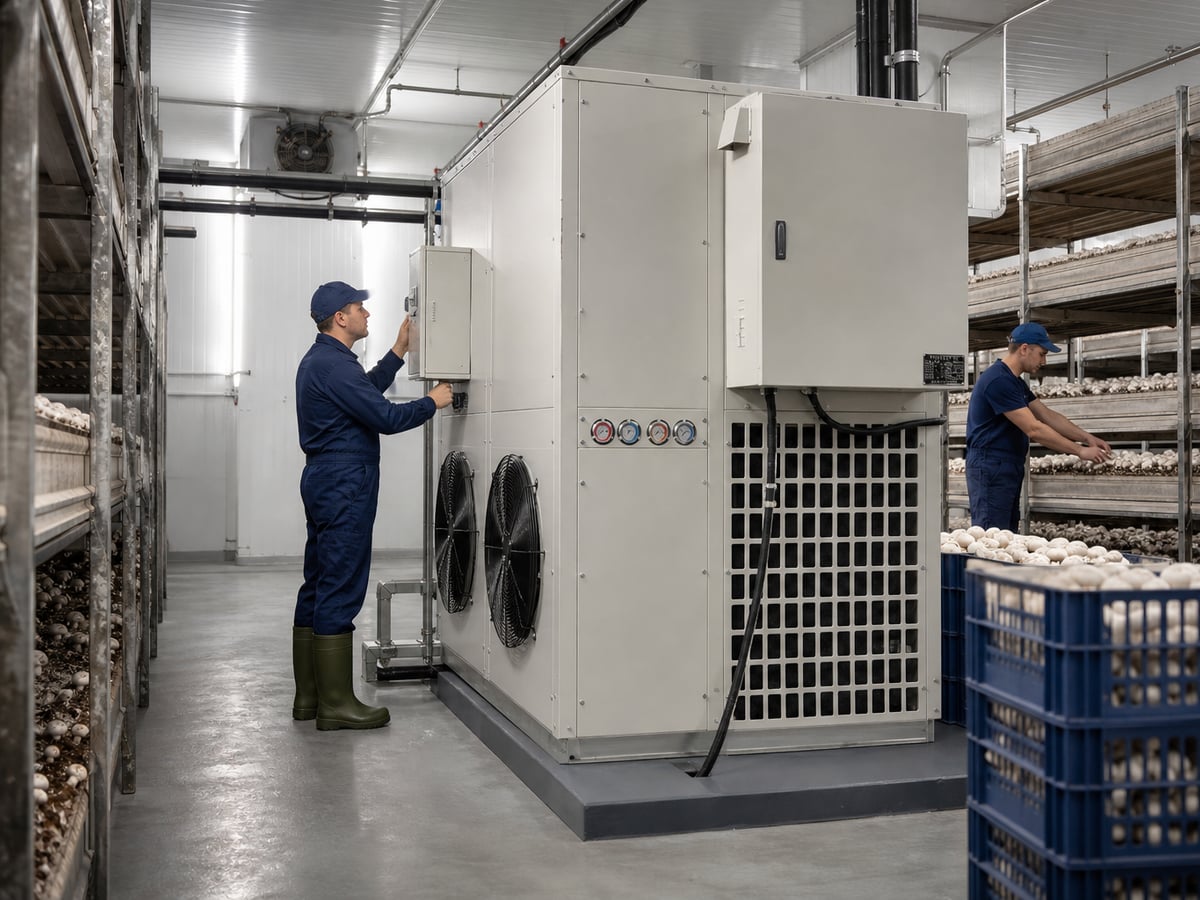
A mushroom air conditioner is an integrated climate-control system designed to maintain the temperature, humidity, fresh-air volume, carbon dioxide concentration, airflow pattern, and cleanliness required in commercial mushroom growing rooms. Unlike ordinary comfort air conditioning, a mushroom cultivation HVAC unit is engineered for high-humidity environments, frequent fresh-air exchange, heavy biological loads, and crop-specific climate stages.
For the Global Market, mushroom air conditioners are commonly used in oyster mushroom farms, button mushroom tunnels, shiitake fruiting rooms, enoki facilities, morel trials, spawn-run rooms, compost rooms, and modular container farms. The equipment can be supplied as a standalone climate machine, a split-type agricultural HVAC system, an integrated air handling unit, or a complete controlled-environment package for a smart mushroom cultivation container.
Buyers should select a system based on room volume, insulation quality, local summer and winter design conditions, crop species, daily substrate load, production stage, target CO2 level, water quality, utility availability, and service access. A correctly sized mushroom climate-control system can help stabilize yield quality, reduce crop stress, lower manual intervention, and support repeatable production across seasons.
| Buyer Need | Recommended Mushroom Air Conditioner Feature | Commercial Benefit |
|---|---|---|
| High summer temperatures | Refrigeration cooling with corrosion-resistant coil protection | Maintains fruiting temperatures during heat waves |
| Dry indoor or desert climate | High-capacity humidification and humidity feedback control | Helps prevent cap cracking and dehydration |
| High CO2 during fruiting | Fresh-air damper, exhaust fan, and CO2 sensor integration | Supports morphology and stem-length control |
| Cold winter regions | Heat pump heating or electric/hot-water auxiliary heating | Protects production continuity in low ambient temperatures |
| Container farming projects | Compact integrated unit with remote alarms | Reduces installation complexity and operating risk |
| Multi-room mushroom farms | Centralized controller and zoning capability | Allows different recipes for incubation and fruiting rooms |
The table above shows why mushroom air conditioning should be treated as a process system rather than a standard building cooling purchase. Climate requirements vary by species and production phase, so system selection should begin with crop data and room heat-moisture calculations.
What Is a Mushroom Air Conditioner and Where Is It Used?
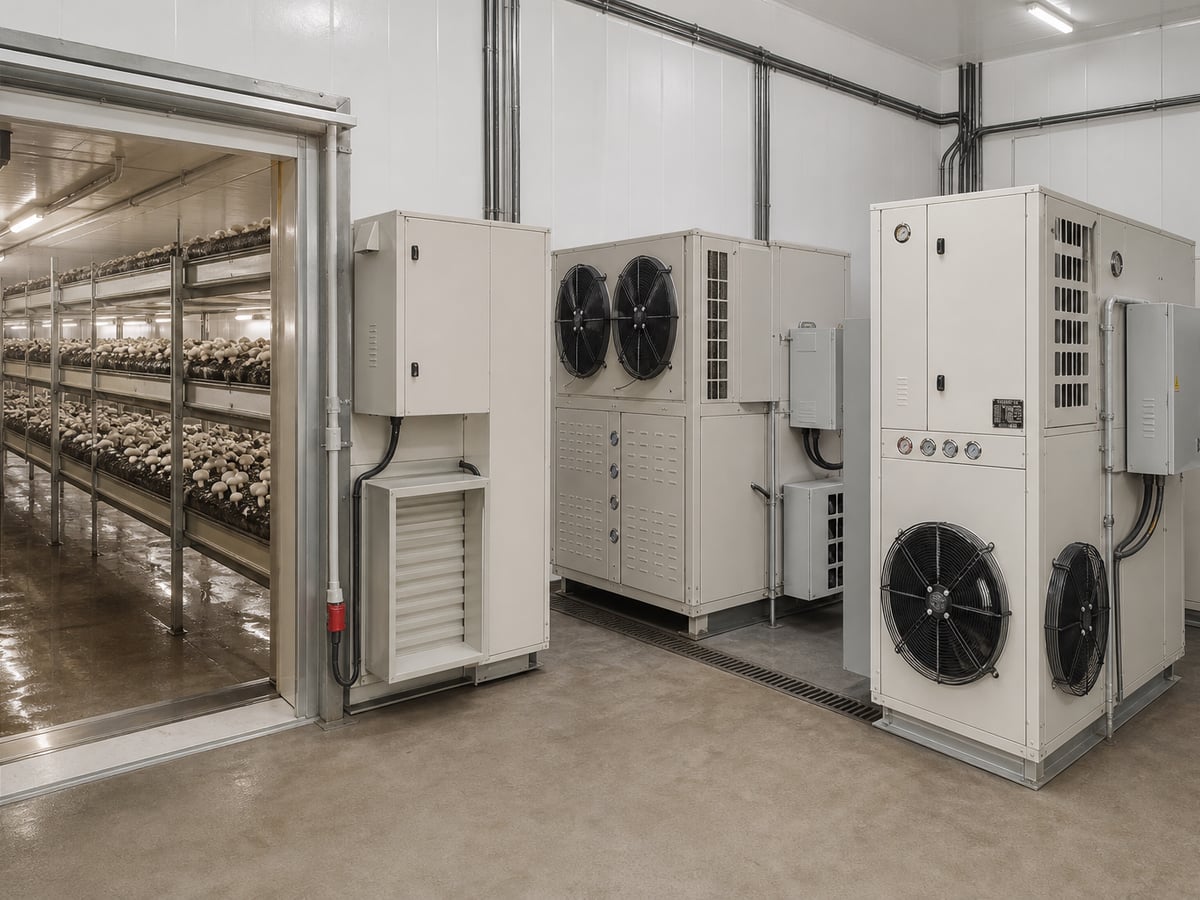
A mushroom air conditioner, also called a mushroom growing room air conditioner, mushroom HVAC unit, mushroom climate machine, or cultivation air handling system, conditions air specifically for fungal production. It removes sensible heat, manages latent moisture, introduces filtered outside air, exhausts stale air, and circulates conditioned air through the crop room. Control logic coordinates these functions according to sensor feedback and programmed recipes.
Commercial mushroom farms in Rotterdam, Dubai, Singapore, São Paulo, Johannesburg, Los Angeles, Melbourne, and other trade-connected agricultural markets may face dramatically different ambient conditions. A farm near the Port of Rotterdam may prioritize winter heating efficiency and moisture recovery. A project in the Gulf region may require strong cooling capacity and reliable humidification. A tropical Southeast Asian facility may need dehumidification, hygiene-focused filtration, and corrosion resistance. The same mushroom species can therefore require different equipment configurations depending on location.
Typical applications include purpose-built mushroom houses, insulated fruiting chambers, converted warehouses, agricultural tunnels, research facilities, supermarkets with local-growing demonstrations, and containerized farms. For smaller projects, an integrated unit can manage one or two cultivation rooms. Large farms often use multiple zoned units, dedicated fresh-air systems, and independent controls for incubation, pinning, fruiting, harvesting, and sanitation periods.
Mushroom air conditioners are also used beyond traditional edible fungi. They support medicinal mushroom production, specialty fungi research, mycelium material development, spawn storage, and controlled composting applications. For cultivation projects requiring compact, transportable infrastructure, a smart mushroom climate controller can coordinate environmental equipment, alarms, and crop-stage parameters.
| Application Area | Typical Climate Priority | Common System Arrangement |
|---|---|---|
| Oyster mushroom fruiting room | Fresh air, humidity, low-to-medium temperature | Cooling, humidification, exhaust, CO2 control |
| Button mushroom growing room | Stable temperature and directional airflow | Air handler with cooling/heating and duct distribution |
| Shiitake fruiting chamber | Humidity consistency and gentle air movement | Integrated HVAC with fogging and recirculation fans |
| Enoki mushroom facility | Low temperature and precise airflow | High-efficiency refrigeration and controlled air circulation |
| Spawn-run room | Moderate temperature, limited fresh-air demand | Heating/cooling with basic ventilation control |
| Container mushroom farm | Compact operation and remote supervision | Packaged climate unit with PLC or touch-screen control |
This application comparison illustrates that “mushroom air conditioner” covers several product types. Buyers should identify whether the primary requirement is fruiting-room conditioning, incubation control, container climate management, or a complete multi-stage farm solution before requesting a quotation.
Standard Product Configuration and System Boundaries
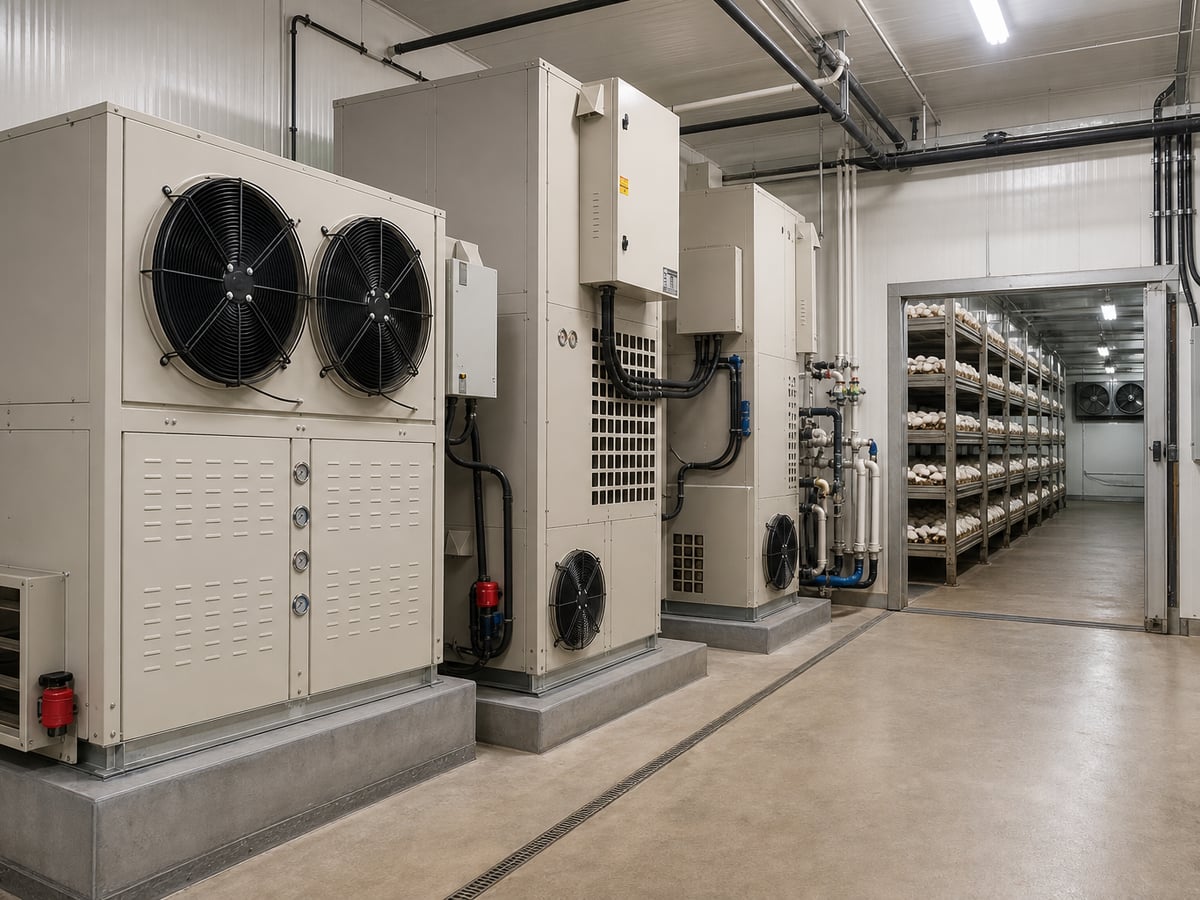
A standard commercial mushroom air conditioner normally includes a refrigeration section, air circulation section, electrical control cabinet, temperature and humidity sensors, and connections for drainage, power, fresh air, exhaust air, and water supply where humidification is included. Depending on the project, the unit may also include heating, heat recovery, filtration, UV treatment, a CO2 transmitter, ductwork interfaces, variable-speed fans, and remote communication hardware.
System boundaries must be clarified during procurement. The climate unit itself may be factory supplied, while the customer or local contractor provides room insulation, structural supports, main electrical cables, water piping, condensate drainage, external ductwork, civil works, and final utility connections. For export projects shipped through Qingdao, Shanghai, Ningbo, Hamburg, Jebel Ali, or Long Beach, defining the scope early helps avoid omissions in container loading, customs documentation, site labor, and commissioning schedules.
| Item | Usually Included in Standard Supply | Usually Confirmed Separately |
|---|---|---|
| Refrigeration circuit | Compressor, heat exchangers, expansion components | Special refrigerant compliance requirements |
| Air circulation | Fans, internal casing, basic supply-air connection | Long duct runs and room diffusers |
| Humidity control | Humidifier interface or integrated humidification option | Water-treatment equipment and water piping |
| Fresh-air management | Damper control or ventilation interface | Outdoor louvers, weather hoods, exhaust ducts |
| Electrical control | Control panel, sensors, basic alarms | Site power cable, backup generator, networking |
| Installation service | Remote guidance or agreed technical support | Civil work, crane service, local mechanical labor |
The scope table should be used as a commercial checklist rather than a fixed rule. A turnkey mushroom farm may include insulated panels, racks, lighting, drainage, humidification, climate equipment, and automation. A replacement air conditioner may include only the packaged unit and controller. Clear boundaries protect budget accuracy and simplify installation responsibility.
Capacity, Dimensions, and Utility Requirements
Mushroom air conditioner capacity is not determined by floor area alone. Heat from substrate metabolism, outside-air load, lighting, personnel, equipment, wall transmission, infiltration, humidification, and harvest operations all affect sizing. For example, a heavily loaded oyster mushroom room may have a significantly different cooling and ventilation demand than an empty room of the same size.
Commercial systems may range from compact units for 20–80 m² rooms to larger modular air handling solutions for multi-room facilities. Dimensions depend on capacity, airflow, compressor arrangement, humidification method, filter grade, service access, and whether the condenser is air cooled or water cooled. Buyers should reserve enough clearance for coil cleaning, electrical access, fan replacement, and condensate-drain maintenance.
| Project Scale | Typical Room Area | Indicative Cooling Range | Typical Electrical Supply | Common Installation Form |
|---|---|---|---|---|
| Trial or pilot farm | 20–50 m² | 3–8 kW | Single or three phase, project dependent | Wall-mounted or compact packaged unit |
| Small commercial room | 50–120 m² | 8–20 kW | Three phase commonly preferred | Split or integrated air handler |
| Medium fruiting room | 120–250 m² | 20–45 kW | Three phase industrial supply | Ducted air handling system |
| Large cultivation hall | 250–600 m² | 45–100 kW | Three phase industrial supply | Multiple zoned units |
| Container farm | 12–30 m² internal area | 3–15 kW | Container-specific electrical design | Integrated packaged climate system |
| Multi-room farm complex | 600 m² and above | 100 kW and above | Dedicated electrical distribution | Centralized or modular equipment |
The capacities above are preliminary planning ranges only, not final engineering values. Final selection requires local climate data, room drawings, insulation thickness, crop species, production load, target setpoints, and utility conditions. Water quality should also be assessed if ultrasonic, high-pressure, or fogging humidification is used, because mineral deposits can affect nozzles, sensors, and maintenance intervals.
In areas with unstable grid power, such as remote agricultural zones or rapidly expanding industrial corridors, buyers should consider phase protection, voltage stabilization, generator compatibility, and remote restart procedures. A drainage slope, trap arrangement, and frost protection may be required depending on the installation climate.
Temperature, Humidity, CO2, Airflow, and Control Performance
The purpose of a mushroom climate-control system is to maintain a balanced growing environment rather than to maximize one parameter. Lowering temperature without sufficient humidity can dry the crop. Increasing humidity without air exchange can raise CO2 and disease pressure. High fan speed may improve mixing but can damage delicate fruiting bodies or create uneven evaporation. Successful commercial control combines sensors, airflow design, staged equipment operation, and crop-specific recipes.
Temperature setpoints vary by mushroom species and stage. Fruiting oyster mushrooms may often require cooler conditions than incubation. Enoki systems usually require more intensive low-temperature control. Button mushroom operations may focus on compost heat removal, airflow distribution, and stable conditions across shelving. CO2 control is especially important because it influences stem length, cap development, pinning behavior, and overall crop appearance.
| Control Parameter | Typical Commercial Control Objective | Important Design Consideration |
|---|---|---|
| Temperature | Maintain crop-stage setpoint with minimal fluctuation | Account for metabolic heat from substrate blocks or beds |
| Relative humidity | Maintain suitable moisture without surface condensation | Use reliable sensor placement away from direct mist |
| CO2 concentration | Control fresh air according to crop morphology needs | Calibrate sensors and avoid stagnant air zones |
| Airflow velocity | Distribute conditioned air evenly across shelves | Prevent direct drafts on young pins and mature mushrooms |
| Fresh-air volume | Remove CO2, odors, and excess heat | Balance outside-air load against energy consumption | Pressure and filtration | Reduce ingress of dust and contaminants where needed | Match filter selection to local environment and maintenance capacity |
The performance table shows why multiple sensors are useful in larger rooms. One temperature sensor near a supply outlet may not represent conditions at the center shelf or exhaust side. Well-designed projects may use return-air sensors, room sensors, CO2 sensors, high/low temperature alarms, water-level switches, and door-status signals. Controllers can then coordinate compressors, heaters, humidifiers, fresh-air dampers, exhaust fans, and circulation fans.
For energy-conscious operations, variable-frequency fan control, staged compressors, heat-pump heating, insulated wall panels, and heat recovery can reduce unnecessary utility use. Results depend on local tariffs, ambient climate, room loading, maintenance quality, and cultivation practice.
Core Components, Materials, and Protection Features
A commercial mushroom air conditioner operates in a moist, organic, and sometimes chemically demanding environment. Material selection matters. Galvanized sheet metal may be appropriate for protected external panels, while coated coils, stainless steel drainage components, insulated panels, sealed electrical enclosures, and corrosion-resistant fasteners can improve long-term reliability in high-humidity cultivation rooms.
Core refrigeration components generally include compressors, evaporator coils, condenser coils, fans, expansion devices, filters, pressure protections, and refrigerant piping. Air-side components can include supply fans, return-air sections, fresh-air dampers, exhaust interfaces, filters, humidification modules, and duct connections. The electrical section may include a PLC, touch display, contactors, relays, overload protection, variable-frequency drives, communication modules, and alarm indicators.
| Component | Primary Function | Recommended Protection Feature |
|---|---|---|
| Compressor | Provides refrigeration capacity | High/low pressure protection and overload control |
| Evaporator coil | Removes heat from cultivation-room air | Corrosion-resistant coating and accessible cleaning area |
| Circulation fan | Distributes conditioned air | Variable speed option and vibration isolation |
| Humidification module | Adds moisture to maintain crop conditions | Water filtration, low-water alarm, and easy cleaning access |
| CO2 sensor | Measures air quality for ventilation control | Calibration access and protected mounting location |
| Electrical cabinet | Controls and protects system operation | Moisture-resistant enclosure and phase-loss protection |
Protection features should be selected according to farm risk. Common options include compressor delay, anti-freeze protection, fan overload protection, water shortage alarms, high-temperature alarms, sensor fault alarms, emergency stop functions, leakage protection, phase sequence protection, door alarms, and remote fault notifications. In coastal markets near ports such as Santos, Busan, Antwerp, Mombasa, or Manila, salt-laden air and high humidity may justify upgraded anti-corrosion treatment.
Buyers should ask how filters, drain pans, coil surfaces, humidification nozzles, and sensor probes can be accessed for cleaning. A highly specified unit is not automatically the best choice if routine maintenance is difficult for the farm team.
Automation, Remote Monitoring, and Customization Options
Automation allows mushroom farms to convert climate targets into repeatable production recipes. A modern controller can store different setpoints for incubation, primordia formation, fruiting, harvesting, and room sanitation. It can automatically switch cooling, heating, humidification, fresh-air ventilation, exhaust, and airflow levels based on time schedules and sensor readings.
Remote monitoring is valuable for farms with multiple sites, night operations, or limited technical staff. Depending on local network conditions, the system can provide mobile alerts, web-based status viewing, historical trend records, alarm logs, remote parameter adjustment, and user-permission management. Remote access should be configured with secure credentials and sensible limits on who can alter critical crop settings.
Customization may include voltage and frequency adaptation, bilingual or multilingual interfaces, rack-layout airflow design, special casing dimensions, HEPA or higher-grade filtration, alternative refrigerant solutions, heat recovery, humidification type, stainless steel contact surfaces, solar-compatible power strategy, and integration with farm management platforms. Lanhu can also support OEM and ODM projects through its OEM and ODM customization service for distributors, contractors, and branded agricultural equipment programs.
The 2026 market direction is toward more sensor-driven cultivation, lower-emission refrigeration choices, energy-performance tracking, predictive maintenance, and water-conscious humidification. Buyers increasingly request systems that document operating conditions for food-safety programs, retailer requirements, financing reviews, and environmental reporting. Policy changes concerning refrigerants, electrical efficiency, water use, and indoor agricultural compliance may differ by country, so equipment specifications should be reviewed against local regulations before final order placement.
Sustainability does not mean reducing fresh air below crop needs. It means using insulation, intelligent staging, efficient motors, balanced ventilation, heat recovery where viable, leak prevention, clean coils, maintained drainage, and accurate sensor control to deliver the required environment with less waste.
Installation, Commissioning, Maintenance, and Warranty
Installation quality strongly affects mushroom air conditioner performance. Before delivery, the site should have completed insulation, drainage, electrical capacity, equipment pads or suspension points, water connections, external weather protection, and duct routes where applicable. The cultivation room should be cleaned and sealed before commissioning so that air leakage and construction dust do not distort test results.
Commissioning normally includes checking electrical phase sequence, refrigerant operating pressures, airflow direction, fan rotation, condensate drainage, sensor readings, humidification output, fresh-air damper operation, alarm functions, and controller schedules. The technician should verify that air reaches all crop zones and that no strong direct draft is hitting the shelving or substrate blocks.
| Maintenance Task | Suggested Frequency | Why It Matters |
|---|---|---|
| Clean air filters | Weekly to monthly, depending on dust load | Maintains airflow and reduces fan energy use |
| Inspect drain pan and pipe | Weekly | Prevents overflow, odor, and microbial buildup |
| Check humidification nozzles or media | Weekly to monthly | Reduces uneven humidity and mineral blockage |
| Clean evaporator and condenser coils | Quarterly or as conditions require | Protects cooling capacity and compressor efficiency |
| Verify sensors and alarms | Monthly, with scheduled calibration | Improves accuracy of climate decisions | Inspect electrical terminals and fan assemblies | Quarterly | Helps identify heat damage, vibration, and wear early |
The maintenance schedule above should be adjusted for local water quality, dust levels, operating hours, crop turnover, and seasonal conditions. Farms operating near desert areas may need more frequent filter servicing, while high-mineral water regions may require stronger humidifier cleaning programs.
Warranty terms should clearly state coverage period, included components, exclusions, response process, spare-parts availability, and responsibilities for installation and maintenance. Proper commissioning records, regular cleaning, correct power supply, and approved operating conditions help support effective warranty service. Before purchase, ask whether remote troubleshooting, wiring diagrams, spare-parts lists, video guidance, and on-site technical assistance are available in your region.
Our Company
Shandong Lanhu Air Conditioning Equipment Co., Ltd. is a China-based manufacturer serving commercial cultivation and agricultural climate-control projects for the Global Market. The company develops equipment for mushroom farming, hydroponic cultivation, industrial HVAC applications, modular growing facilities, and air-source heat pump systems.
In technological capability, Lanhu draws on more than 12 years of thermodynamic research and development experience and holds over 45 registered patents. Its engineering team can evaluate room dimensions, cultivation methods, climate targets, local ambient conditions, and operating utilities to propose suitable cooling, heating, humidification, ventilation, and control arrangements. Projects can be designed around independent mushroom rooms or integrated modular farms.
In manufacturing capability, Lanhu operates a modern production facility of more than 30,000 square meters in Dezhou, Shandong. Production resources include product engineering, sheet-metal fabrication, CNC bending, insulation-panel manufacturing, electrical assembly, system integration, equipment testing, and quality inspection. Functional testing, electrical verification, performance checks, and operational evaluation are completed before shipment. The company maintains ISO 9001, ISO 14001, ISO 45001, and ISO 12100 certifications.
In service capability, Lanhu provides factory-direct supply, engineering support, OEM and ODM options, international logistics coordination, spare-parts support, installation guidance, and after-sales assistance. Buyers can review practical project examples in the company’s mushroom cultivation case studies and discuss project requirements through the technical inquiry contact page. This approach supports agricultural contractors, distributors, engineering firms, and commercial mushroom producers seeking scalable climate-control equipment.
FAQ
How do I select the right mushroom air conditioner capacity?
Provide room length, width, height, insulation details, mushroom type, substrate quantity, target temperature and humidity, local summer and winter temperatures, fresh-air needs, power supply, and water conditions. Capacity should be calculated from the actual heat and moisture load rather than room area alone.
Can one machine control cooling, heating, humidity, and CO2?
Yes. An integrated mushroom climate-control system can coordinate cooling, heating, humidification, circulation, fresh-air intake, exhaust, and CO2-based ventilation. The exact configuration depends on the crop stage, climate zone, and room design.
Is a mushroom air conditioner suitable for a shipping container farm?
Yes. Container farms are a common application because the insulated enclosure, compact layout, and centralized controls support predictable environmental management. Equipment must be sized carefully because container rooms have limited air volume and can experience rapid temperature changes.
What information should I send before requesting a quotation?
Send room drawings or container dimensions, crop type, production capacity, local climate information, required setpoints, electricity voltage and frequency, water source details, desired automation level, installation location, and any special compliance requirements.
How often should CO2 sensors be checked?
CO2 sensors should be visually checked during regular maintenance and calibrated according to the manufacturer’s recommendations and farm quality procedures. Sensor position is important: avoid direct humidifier spray, supply-air discharge, and locations where condensation can affect readings.
Can the system be customized for different countries?
Yes. Typical country-specific adjustments include voltage, frequency, plug and protection standards, casing materials, refrigerant preferences, language display settings, communications methods, filtration, heating capacity, corrosion protection, and shipping dimensions.
What is the main difference between ordinary HVAC and mushroom HVAC?
Ordinary HVAC is generally designed for human comfort. Mushroom HVAC is designed around biological production needs, including high humidity, crop respiration, CO2 management, controlled fresh-air exchange, gentle airflow, corrosion resistance, and programmed cultivation stages.
Share this article

About the Author: Shandong Lanhu Air Conditioning Equipment
Lanhu is a professional climate control equipment manufacturer specializing in smart agricultural systems, commercial HVAC solutions, and customized temperature control technologies. With extensive engineering experience, Lanhu provides reliable solutions for plant factories, controlled environment agriculture, and industrial applications.
Previous Post
Need a Custom Climate Control Solution?
From smart agricultural systems to commercial HVAC solutions, Lanhu provides reliable temperature and humidity control solutions tailored to your project needs.
Contact Us