Global Market Mushroom Farm Profitability Cost & ROI Guide
Quick Answer

Mushroom farm profitability in the Global Market depends on three connected factors: installed production capacity, biological yield consistency, and the selling price achieved through local or export channels. A small commercial operation can be profitable, but only when climate control, substrate supply, labor planning, contamination management, and sales routes are designed together.
For many commercial farms, the largest initial investment is not the mushroom shelves alone. CAPEX usually includes insulated growing rooms or modular containers, refrigeration, humidification, ventilation, controls, electrical distribution, water treatment, shelving, harvesting tools, packing areas, and commissioning. OPEX is dominated by labor, energy, substrate or grow bags, spawn, packaging, transport, repairs, and crop-loss allowances.
A practical planning range for fresh mushroom production is often 20–35 kg per m² of growing shelf area per crop for oyster mushrooms, while premium varieties such as shiitake, lion’s mane, king oyster, and specialty medicinal mushrooms can have different cycle lengths, yields, and market prices. The strongest projects do not rely on the highest theoretical yield; they budget for normal operating losses and build stable sales contracts.
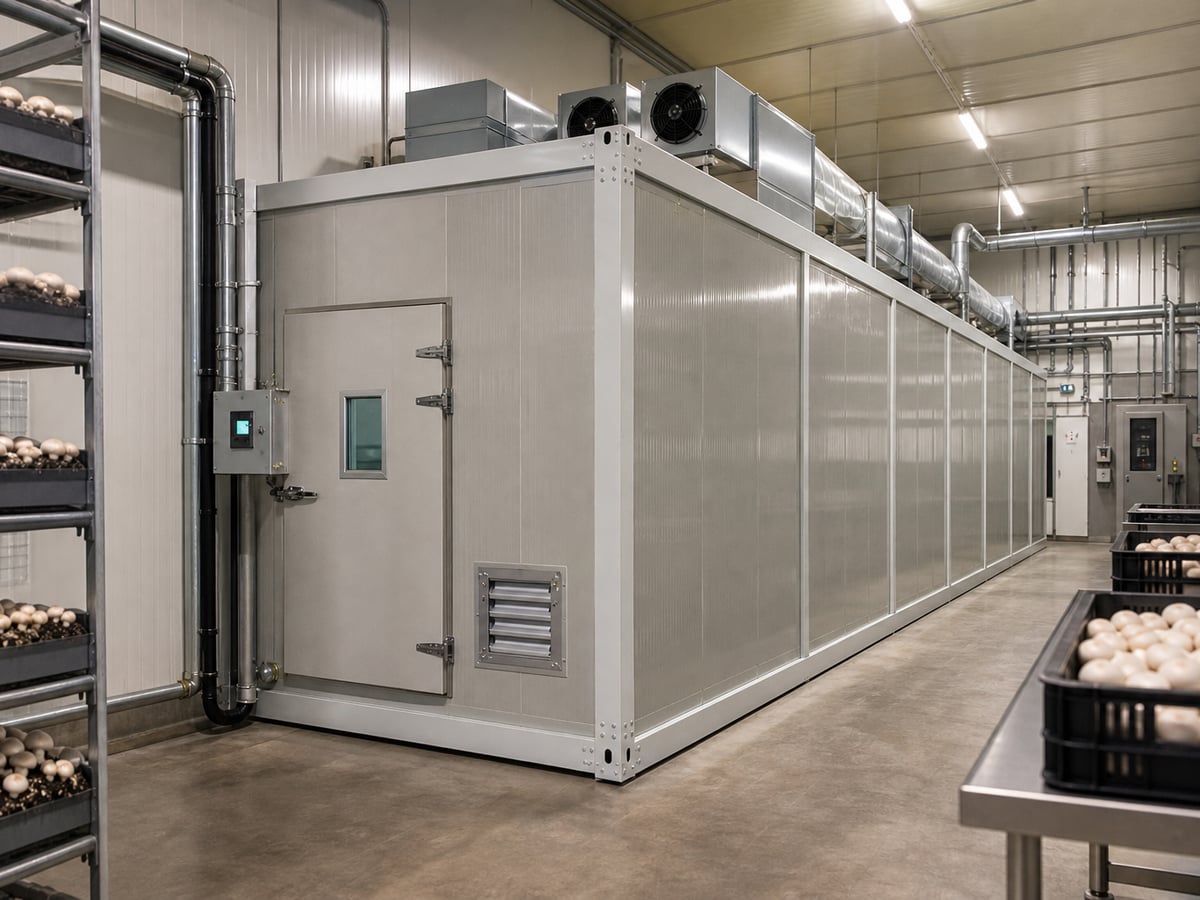
For growers seeking a controlled, compact entry point, a smart mushroom cultivation container can reduce construction uncertainty by integrating insulation, air handling, humidity control, lighting, shelving, and digital monitoring into one engineered system. It is particularly suitable for urban farms, remote sites, distributors, restaurants, agricultural demonstration projects, and phased expansion plans.
| Farm Type | Typical Scale | Primary Investment Focus | Typical Crop | Profitability Driver | Main Risk |
|---|---|---|---|---|---|
| Micro commercial farm | 50–150 m² | Basic rooms, racks, humidification | Oyster mushroom | Direct local sales | Owner labor dependency |
| Container farm | 1–10 modular units | Integrated climate control | Oyster, shiitake, lion’s mane | Consistent year-round supply | Electricity price volatility |
| Regional fresh mushroom farm | 500–2,000 m² | Growing rooms and packing line | Oyster, button, king oyster | Wholesale volume | Distribution pressure |
| Specialty mushroom farm | 200–1,500 m² | Precision environmental control | Lion’s mane, reishi, shiitake | Premium retail pricing | Demand uncertainty |
| Substrate-integrated farm | 1,000 m² and above | Pasteurization and bagging equipment | Multiple species | Lower unit substrate cost | Higher process complexity |
| Industrial mushroom facility | 5,000 m² and above | Automation and cold chain | Button and high-volume varieties | Scale efficiency | Large fixed-cost exposure |
The table shows why there is no single “mushroom farm cost” for every project. A container farm may have a higher cost per m² than a basic converted building, yet it can shorten installation time, improve crop consistency, and reduce the risks associated with poor insulation, incorrect airflow, or incomplete electrical design.
Mushroom Farm Profitability: Typical Commercial Cost Structure

Commercial mushroom farming is a controlled-environment food production business. Its economics should be measured by production batches, crop cycles, kilograms sold, and contribution margin rather than by room size alone. The cost structure varies by species, climate zone, labor cost, local energy tariff, available substrate materials, and distance to market.
In the Global Market, farms near major consumption centers frequently focus on freshness and short delivery times. Producers serving Dubai, Singapore, London, Los Angeles, Tokyo, Sydney, Rotterdam, Johannesburg, São Paulo, and major Gulf cities may receive better prices for premium fresh mushrooms than farms supplying low-margin commodity channels. However, urban land costs, wages, and electricity can be substantially higher.
For an investor, the most useful planning sequence is: define target buyers, select mushroom species, set annual sales volume, calculate required growing area, estimate biological inputs, size the climate-control system, and then test the project against conservative yield and price assumptions. This approach avoids purchasing equipment that is technically impressive but mismatched to the local market.
| Cost Category | Typical Share of Total Cost | What It Includes | How It Changes by Region | Control Method | Planning Priority |
|---|---|---|---|---|---|
| Building and insulation | 15–35% | Rooms, panels, doors, drainage | Higher in urban and cold regions | Use insulated modular construction | High |
| Climate-control equipment | 20–35% | Cooling, heating, humidity, fans | Higher in hot or humid climates | Correct load calculation | High |
| Shelving and handling | 8–15% | Racks, trolleys, harvest tools | Depends on material and automation | Optimize aisle and shelf layout | Medium |
| Electrical and controls | 8–15% | Panels, sensors, wiring, alarms | Higher where grid standards are strict | Use integrated control systems | High |
| Labor | 20–45% of OPEX | Loading, harvesting, packing, cleaning | Highest in developed labor markets | Workflow design and training | High |
| Substrate and spawn | 15–35% of OPEX | Grow bags, compost, spawn, additives | Varies with agricultural residues | Multi-supplier sourcing | High |
| Energy and water | 10–30% of OPEX | Cooling, heating, fans, humidification | Strongly climate and tariff dependent | Efficiency monitoring | High |
For a realistic profitability model, separate fixed expenses from variable expenses. Building rent, insurance, management salaries, loan payments, licenses, and depreciation are usually fixed or semi-fixed. Grow bags, spawn, packaging, transport commissions, and harvest labor usually rise with production volume. This distinction is essential when calculating break-even output.
CAPEX: Equipment, Building, Utilities, and Controls

CAPEX is the investment required before commercial production begins. It should include equipment cost, logistics, import duties where applicable, civil works, installation, spare parts, test runs, training, and working capital for the first operating cycles. Buyers often underestimate the final 10–20% of project cost because they focus only on the quoted equipment price.
A commercial facility generally needs a cleanable insulated structure, air circulation, cooling or heating capacity, humidification, fresh-air control, carbon dioxide management, drainage, lighting, water supply, electrical protection, racking, and packing capability. In hot climates such as the Middle East, India, Southeast Asia, northern Australia, and many African regions, cooling load and dehumidification strategy deserve special attention. In cold regions such as Canada, Northern Europe, Central Asia, and northern China, heating and freeze protection may be more significant.
A modular solution can simplify early-stage CAPEX. Lanhu designs cultivation systems around insulated panels, airflow management, automated temperature and humidity control, and crop-specific operating logic. A mushroom climate controller can help growers monitor temperature, humidity, carbon dioxide, ventilation status, alarms, and equipment performance from a centralized interface.
| CAPEX Item | Purpose | Cost Sensitivity | Common Specification Choices | Potential Hidden Addition | Buyer Checkpoint |
|---|---|---|---|---|---|
| Insulated building or container | Stable growing environment | High | Panel thickness, floor type, doors | Foundation and drainage | Confirm local wind and temperature conditions |
| Cooling and heating system | Temperature control | High | Air source heat pump, refrigeration unit | Electrical cable upgrade | Verify design ambient temperature |
| Humidity and ventilation | Crop moisture and fresh air | Medium to high | Ultrasonic, high-pressure mist, fans | Water filtration and ducting | Check droplet size and cleaning access |
| Racks and shelves | Maximize growing area | Medium | Galvanized steel, stainless steel | Assembly labor | Measure aisle width and loading method |
| Electrical controls | Automated operation | Medium | PLC, sensors, remote monitoring | Local compliance documentation | Require wiring diagrams and alarm logic |
| Water and drainage | Humidification and sanitation | Medium | Filters, UV, tanks, floor drains | Wastewater connection | Test water quality before ordering |
| Packing and cold storage | Preserve fresh quality | Medium to high | Cold room, scales, sealing equipment | Food-grade room finishes | Size according to daily dispatch volume |
When comparing quotations, ask whether the price includes delivery to a named port such as Rotterdam, Jebel Ali, Singapore, Santos, Durban, Mombasa, or Los Angeles. Clarify Incoterms, container loading, inland transport, customs documentation, commissioning scope, wiring requirements, and local installation support. A lower factory price can become more expensive if essential site work is excluded.
OPEX: Energy, Labor, Water, Consumables, and Maintenance
Operating expenses determine whether a mushroom farm remains viable after installation. Fresh mushrooms are perishable, crop cycles are continuous, and growing rooms must be cleaned, loaded, monitored, harvested, and reset on schedule. The best climate-control system cannot compensate for poor sanitation, inconsistent substrate, delayed harvesting, or weak sales planning.
Energy use is affected by ambient temperature, insulation quality, room loading density, ventilation rate, heat generated by substrate, equipment efficiency, and operating discipline. Farms in tropical climates may need more cooling and dehumidification. Farms in dry regions may consume more water for humidification. Farms with expensive electricity should prioritize high-efficiency fans, insulated doors, staged cooling, heat recovery where practical, and accurate sensors.
Labor is often the largest recurring cost after substrate. Harvesting is especially labor-intensive because mushrooms need to be picked at the correct maturity stage, sorted, packed, and cooled quickly. Labor savings can come from better rack design, trolleys, batch scheduling, standard operating procedures, and clear crop-room labeling rather than from automation alone.
| OPEX Item | Typical Measurement | Cost Reduction Opportunity | Quality Risk if Underfunded | Monitoring Frequency | Suggested Allowance |
|---|---|---|---|---|---|
| Electricity | kWh per crop or kg sold | Insulation, efficient controls, maintenance | Temperature instability | Daily | 5–15% contingency |
| Water | m³ per month | Filtration, leak control, optimized misting | Contamination or poor humidification | Weekly | 3–8% contingency |
| Labor | Hours per kg harvested | Training, workflow, rack layout | Late harvest and packing losses | Daily | 10–20% seasonal allowance |
| Substrate and grow bags | Cost per bag or tonne | Supplier contracts and quality inspection | Low yield or contamination | Every batch | 5–10% waste allowance |
| Spawn and supplements | Cost per batch | Reliable sourcing and storage control | Poor colonization | Every delivery | 5% backup stock |
| Packaging | Cost per kg sold | Volume purchasing and right-sized packs | Shorter shelf life | Weekly | 3–8% price variance |
| Maintenance and sanitation | Monthly budget | Preventive inspection schedule | Breakdowns and cross-contamination | Weekly | 2–5% of equipment value annually |
Water quality deserves specific attention. Minerals, biological contamination, iron content, and hardness can affect fogging nozzles, ultrasonic units, drainage, cleaning effectiveness, and crop hygiene. A water analysis before installation can prevent premature equipment wear and avoid costly redesigns after the farm is running.
Capacity and Production Assumptions Behind the Estimate
Capacity should be measured in usable growing shelf area, not simply floor area. A room with multi-tier racks can hold several times more growing surface than a floor-based layout, but it also requires enough airflow, cooling capacity, access space, and harvesting labor. Overloaded rooms can develop uneven temperature, high carbon dioxide zones, weak pinning, and inconsistent quality.
A basic production model needs the following assumptions: number of shelves, shelf area, bags or blocks per shelf, average bag weight, biological efficiency or expected yield, crop cycle length, number of cycles per year, expected grade distribution, saleable percentage, and average selling price. Use conservative assumptions for the first year while the team learns the production process.
For example, if a farm operates 500 m² of usable shelf area and achieves 25 kg/m² per crop across six annual crop turns, gross annual output could reach approximately 75,000 kg before accounting for losses, grading, and rejected mushrooms. If 8% is not saleable, net sales volume becomes 69,000 kg. The actual result will depend heavily on substrate quality, crop variety, management skill, and environmental stability.
The chart is illustrative rather than a forecast. It shows why pricing and yield improvements can significantly improve margin, while energy and labor inflation can quickly reduce profitability. Every project should use local utility bills, wage rates, substrate quotes, and actual buyer price indications.
Specifications and Customization That Change Price
Mushroom farm pricing changes when the project specification changes. A basic growing room designed for mild weather and oyster mushrooms is not equivalent to a high-performance, multi-zone facility designed for hot climates, premium varieties, remote monitoring, cold storage, and export-grade packing.
Important customization variables include external dimensions, panel thickness, floor insulation, refrigeration capacity, heating method, humidity system, fresh-air rate, carbon dioxide control, rack material, number of tiers, electrical standard, local voltage, language of the interface, remote access, backup power compatibility, water treatment, and packaging area configuration.
Buyers should define the intended crop before finalizing equipment. Oyster mushrooms generally tolerate a broader operating range than some specialty mushrooms, while shiitake, king oyster, lion’s mane, and medicinal varieties may require more precise management of temperature, humidity, fresh air, and fruiting timing. The lowest equipment price may not deliver the reliability needed for a premium product strategy.
Lanhu supports OEM and ODM projects for distributors, engineering companies, and commercial farms that need branded housings, customized dimensions, crop-specific climate settings, local electrical configurations, and integrated systems. Buyers can review the available OEM and ODM customization options when planning a differentiated modular farming offer.
Yield, Revenue, Margin, and Break-Even Scenarios
Revenue equals saleable kilograms multiplied by the average realized selling price. The realized price is often lower than the advertised retail price because farms may sell through wholesalers, distributors, restaurants, retailers, online channels, or market agents. Packaging, spoilage, promotional discounts, delivery, and commissions should be deducted before calculating net revenue.
Break-even occurs when gross margin covers fixed costs. A farm selling premium lion’s mane directly to restaurants may break even at lower volume than a farm selling commodity oyster mushrooms to a wholesaler, but the specialty farm may also face more demand risk. Product diversification can reduce exposure when one buyer segment weakens.
| Scenario | Saleable Yield | Average Selling Price | Revenue Potential | Margin Outlook | Management Requirement |
|---|---|---|---|---|---|
| Low-yield wholesale | Below target | Low | Limited | Often weak | Urgent crop and sales correction |
| Stable wholesale | Expected range | Moderate | Predictable | Moderate | Strong cost discipline |
| Direct retail oyster mushroom | Expected range | Higher | Improved | Good potential | Branding and delivery capability |
| Restaurant-focused specialty crop | Moderate to high | Premium | High per kg | Potentially strong | Quality consistency and chef relationships |
| Mixed crop portfolio | Diversified | Blended | Balanced | Resilient | More complex production planning |
| Contracted institutional supply | Stable | Moderate | Reliable | Moderate to good | Compliance and delivery discipline |
A sensible break-even calculation should include loan interest or lease expense, depreciation, rent, management payroll, local taxes, insurance, audit costs, product certification, marketing, sampling, waste disposal, and a reserve for crop failures. Farms that exclude these costs may appear profitable on paper while generating insufficient cash flow in practice.
Hidden Costs, Risk Allowances, and Sensitivity Analysis
Hidden costs commonly appear after equipment is ordered. They can include site leveling, concrete pads, drainage, utility upgrades, transformers, backup generators, import duties, customs handling, forklift rental, local permits, food safety certification, laboratory testing, initial packaging stock, staff accommodation, replacement sensors, cleaning chemicals, and working capital.
Risk allowances should be included in both CAPEX and OPEX. A first-time commercial farm should not plan on perfect biological efficiency from the first crop. It should also assume that at least one supplier delivery, equipment setting, market forecast, or logistics schedule will need adjustment.
Sensitivity analysis is particularly valuable in the Global Market because exchange rates, shipping costs, electricity prices, fuel costs, wages, and buyer prices can change quickly. Test the project under several conditions: yield down by 10–20%, energy cost up by 20%, selling price down by 10%, labor cost up by 15%, or a delayed project launch. If the farm only works in the best-case scenario, the investment should be redesigned.
For equipment sourcing, growers should request detailed technical drawings, utility requirements, production assumptions, warranty terms, spare-parts lists, and commissioning responsibilities. Reviewing completed cultivation projects can also help buyers evaluate practical performance; examples are available through Lanhu’s mushroom cultivation project cases.
Looking toward 2026, the most competitive farms are expected to adopt more sensor-driven growing management, remote fault alarms, energy-efficient heat pump systems, water reuse strategies where regulations permit, recyclable or lower-impact packaging, and traceability records for food buyers. Sustainability requirements are increasing in Europe, North America, the Gulf region, and major Asian retail markets. Farms that measure energy, water, crop waste, and yield per batch will be better positioned for future compliance and buyer audits.
Our Company
Shandong Lanhu Air Conditioning Equipment Co., Ltd. supports commercial growers, agricultural contractors, equipment distributors, and controlled-environment agriculture projects in the Global Market. The company focuses on climate-controlled cultivation equipment, modular mushroom production solutions, agricultural HVAC systems, hydroponic plant containers, and air source heat pump applications.
Technological capability is based on more than 12 years of thermodynamic research and development experience. Lanhu develops integrated environmental solutions that combine temperature management, humidity control, ventilation, carbon dioxide management, electrical controls, sensor feedback, and operating alarms. This engineering approach is designed to help growers maintain stable crop conditions instead of relying on manual adjustments alone.
Manufacturing capability includes a modern production facility of more than 30,000 square meters in Dezhou, Shandong, China. The company integrates design, engineering development, sheet metal fabrication, CNC bending, insulated panel production, electrical assembly, system integration, testing, and quality inspection. Functional inspection, electrical verification, performance testing, and operational evaluation are completed before shipment.
Service capability includes factory-direct supply, project communication, OEM and ODM customization, engineering assistance, international logistics coordination, spare-parts support, installation guidance, and after-sales support. Lanhu holds ISO 9001, ISO 14001, ISO 45001, and ISO 12100 certifications, together with multiple patents and enterprise credentials. For a crop plan, technical discussion, or quotation request, growers can contact the Lanhu project team.
FAQ
How much does a commercial mushroom farm cost?
Cost depends on capacity, country, crop type, building condition, utility requirements, automation level, and whether substrate production is included. A small modular farm may require a lower total investment than a large conventional facility, but cost per kilogram should be evaluated over several crop cycles.
Which mushrooms are usually most profitable?
Profitability depends on local demand. Oyster mushrooms can provide fast turnover and broad acceptance, while shiitake, lion’s mane, king oyster, and medicinal mushrooms may command higher prices in specialty markets. The best crop is the one with reliable buyers, suitable climate settings, and manageable production risk.
How long does it take to reach break-even?
Break-even can range from under two years to several years depending on sales price, utilization rate, financing cost, crop yield, energy expenses, and market access. A detailed cash-flow model is more useful than a generic payback claim.
Can a mushroom container operate in hot climates?
Yes, provided that cooling capacity, insulation, ventilation, humidity control, and electrical infrastructure are correctly sized for the local design temperature. Hot and humid regions require especially careful load calculations.
What is the biggest operating risk in mushroom farming?
The largest risks are often contamination, unstable substrate quality, weak sales channels, inadequate climate control, high energy costs, and insufficient trained labor. Risk can be reduced through standard operating procedures, preventive maintenance, diversified suppliers, and conservative financial planning.
Should a new farm produce its own substrate?
Not always. Purchasing reliable prepared grow bags or blocks can simplify startup and reduce process complexity. Larger farms may later integrate substrate production when volume, local raw materials, technical staff, and quality-control systems justify the investment.
Share this article

About the Author: Shandong Lanhu Air Conditioning Equipment
Lanhu is a professional climate control equipment manufacturer specializing in smart agricultural systems, commercial HVAC solutions, and customized temperature control technologies. With extensive engineering experience, Lanhu provides reliable solutions for plant factories, controlled environment agriculture, and industrial applications.
Need a Custom Climate Control Solution?
From smart agricultural systems to commercial HVAC solutions, Lanhu provides reliable temperature and humidity control solutions tailored to your project needs.
Contact Us