Commercial Mushroom Cultivation Containers: Global Market
Quick Answer

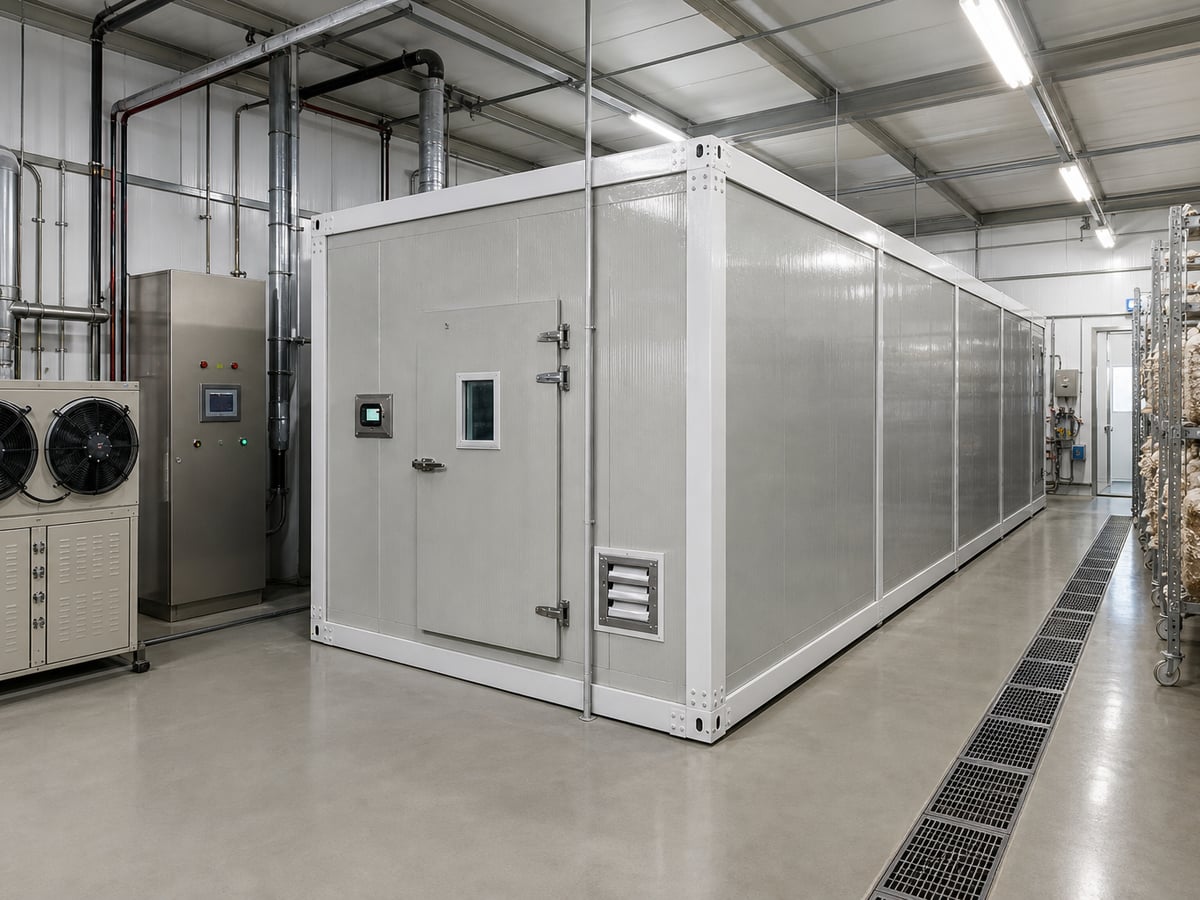
A mushroom cultivation container is a factory-built, insulated growing room designed to create stable conditions for commercial mushroom production. It combines a weather-resistant container structure with refrigeration or heating, humidification, fresh-air exchange, carbon dioxide management, lighting, shelving, drainage, and digital controls. For growers in the Global Market, it provides a fast way to establish a controlled fruiting environment without constructing a conventional agricultural building.
Commercial mushroom containers are commonly used for oyster mushrooms, shiitake, lion’s mane, king oyster mushrooms, enoki, button mushroom trials, medicinal fungi, and other specialty varieties. They are particularly useful where land is limited, climate conditions are extreme, project schedules are tight, or consistent production is more valuable than seasonal output. A containerized farm can be installed near cities, food distribution centers, restaurants, agricultural parks, universities, remote communities, and processing sites.
The right unit should be selected according to mushroom species, substrate format, production target, local climate, electrical supply, water quality, drainage conditions, and operator experience. A properly engineered system controls temperature, relative humidity, carbon dioxide concentration, airflow direction, and fresh-air volume as one coordinated climate process rather than as separate pieces of equipment.
Shandong Lanhu Air Conditioning Equipment Co., Ltd. supplies smart mushroom cultivation containers for commercial growers, agricultural contractors, distributors, and controlled-environment farming projects worldwide. Configurations can be adapted for different climates, harvest volumes, substrate blocks, shelving layouts, and power standards.
What Is a Mushroom Cultivation Container and Where Is It Used?

A mushroom cultivation container is a modular indoor fruiting chamber built within a standard shipping-container-style enclosure or a purpose-designed insulated cabin. It is not simply a refrigerated container with shelves. A professional mushroom growing container is an integrated biological production environment that balances cooling or heating, moisture addition, dehumidification where necessary, filtered fresh air, recirculation, air distribution, and programmable control logic.
Unlike greenhouse production, container mushroom farming can operate with minimal dependence on outdoor light and weather. This makes it practical in hot, humid, cold, dry, coastal, urban, and high-altitude regions. In tropical locations such as Singapore, Jakarta, Manila, Lagos, and Mombasa, the system may prioritize refrigeration capacity, insulated panels, corrosion protection, and moisture removal. In colder markets such as Canada, Northern Europe, Central Asia, and parts of China, heating performance, freeze protection, and energy recovery can become more important.
Typical applications include commercial farms producing fresh mushrooms for supermarkets, small-scale urban farms supplying restaurants, spawn-to-fruit demonstration projects, agricultural training centers, research institutions, rural cooperative projects, disaster-resilient food production programs, and export-oriented specialty mushroom facilities. Containers can also support phased project growth: a producer may begin with one fruiting container, then add incubation rooms, packing areas, cold storage, or additional units as market demand increases.
Container farms are frequently positioned near major trade and logistics hubs. Examples include Rotterdam and Hamburg for European distribution, Dubai and Jebel Ali for Gulf-region imports and regional foodservice supply, Los Angeles and Savannah for North American logistics, Sydney and Melbourne for Australian retail channels, and Shanghai, Qingdao, and Shenzhen for East Asian agricultural equipment trade. Location near a market can reduce the time between harvest and delivery, which is valuable because fresh mushrooms have a short shelf life.
| Application Location | Typical User | Primary Production Goal | Important Configuration Priority |
|---|---|---|---|
| Urban food district | Restaurant supplier | Daily fresh specialty mushrooms | Compact footprint and quiet operation |
| Rural agricultural park | Commercial grower | Scaled year-round harvests | High rack capacity and service access |
| Hot coastal region | Distributor-operated farm | Stable production in humid weather | Cooling capacity and anti-corrosion treatment |
| Cold inland region | Cooperative or family farm | Off-season mushroom supply | Heating, insulation, and freeze protection |
| University or training center | Research institution | Species trials and teaching | Flexible climate recipes and data logging |
| Remote community | Food security project | Local protein and nutrition production | Reliable controls and simplified maintenance |
This table shows why a single standard container design is not always sufficient. The physical enclosure may look similar across projects, but climate equipment selection, shelf layout, access arrangement, filtration level, control settings, and utility requirements should reflect the actual operating environment.
Standard Product Configuration and System Boundaries

A standard commercial mushroom cultivation container normally includes an insulated container body, internal stainless steel or galvanized shelving, an HVAC climate unit, humidification equipment, circulation fans, fresh-air and exhaust fans, air ducts or air distribution outlets, LED lighting, electrical cabinet, climate sensors, a programmable controller, drainage components, access doors, and internal washable surfaces. Depending on the project, the container can be configured as a fruiting room, incubation room, multi-purpose cultivation room, or test-production unit.
System boundaries should be defined clearly before purchase. The supplier may provide the container and internal cultivation equipment, while the site owner is usually responsible for foundations, incoming power, water supply, site drainage, access roads, lifting equipment, and local permits. For international deliveries, buyers should also clarify whether the quotation includes export packaging, inland transport, ocean freight, customs clearance, destination installation, spare parts, or remote commissioning.
A standard unit is generally designed for fruiting substrate blocks or bags that have already completed inoculation and incubation. If a project requires substrate mixing, sterilization, inoculation, bagging, spawn handling, cold storage, packing, or waste processing, these functions should normally be planned as separate rooms or modules. Separating clean and dirty processes reduces contamination risk and makes workflow easier to manage.
| System Item | Usually Included | Buyer Should Confirm | Typical Boundary |
|---|---|---|---|
| Insulated container body | Yes | Panel thickness, door type, floor finish | Foundation normally excluded |
| Climate control system | Yes | Local ambient design temperature | Incoming electrical connection excluded |
| Humidification system | Yes | Water pressure and water quality | Site water piping excluded |
| Racks and shelving | Usually | Bag size, block weight, aisle width | Loading and unloading labor excluded |
| Control cabinet | Yes | Voltage, frequency, communication preference | Internet service usually excluded |
| Installation support | Available | Remote or on-site scope | Local civil work and permits excluded |
The table helps buyers avoid a common misunderstanding: a cultivation container can be delivered as a complete growing environment, but it still needs a prepared site and dependable utilities. A detailed technical proposal should state what is included, what is optional, and what must be completed by the project owner before commissioning.
Capacity, Dimensions, and Utility Requirements
Most mushroom cultivation containers are based on 20-foot or 40-foot formats, although custom dimensions are available for projects with specific transport, land, or production requirements. A 20-foot container is often selected for pilot farms, restaurant supply, research, or areas with limited access. A 40-foot container is more common for commercial fruiting because it provides greater rack length, more usable cultivation volume, and better labor efficiency per unit of climate equipment.
Capacity is influenced by interior layout rather than external length alone. The number of substrate blocks depends on rack tiers, block dimensions, block weight, mushroom species, desired airflow paths, harvest access, and sanitation space. Overloading a cultivation room can reduce airflow uniformity and create local humidity or carbon dioxide differences. Buyers should request a rack drawing that indicates aisle width, shelf spacing, load per shelf, and expected block quantity.
Utility planning is equally important. Electrical consumption varies with outdoor temperature, target room conditions, insulation performance, lighting, fan operation, humidification method, and crop stage. Water is required for humidification and cleaning. A floor drain or managed wastewater route is necessary because mushroom rooms produce condensate and require regular washdown. For remote locations, backup power should be evaluated because prolonged interruption of cooling, ventilation, or humidity can damage the crop.
| Container Format | Typical External Length | Common Use | Indicative Substrate Capacity | Utility Planning Focus |
|---|---|---|---|---|
| 20-foot standard unit | About 6 m | Pilot production and urban farms | Approximately 800–1,500 blocks | Single-phase or three-phase power review |
| 40-foot standard unit | About 12 m | Commercial fruiting room | Approximately 2,000–4,000 blocks | Higher cooling and ventilation demand |
| High-cube 40-foot unit | About 12 m | Extra vertical rack space | Depends on shelf design | Ceiling airflow and maintenance access |
| Dual-container project | Two connected modules | Incubation plus fruiting | Project-specific | Separate climate zones and workflow |
| Custom wide cabin | Site-designed | Large farm expansion | Higher capacity possible | Transport route and local assembly |
| Mobile demonstration unit | Transportable format | Training and exhibitions | Lower density preferred | Quick connection and portability |
The capacities shown are indicative planning ranges rather than guaranteed production figures. Actual loading should be confirmed after reviewing the selected mushroom species and substrate format. Oyster mushroom blocks may be arranged differently from shiitake logs, king oyster bottles, or specialty mushroom grow bags.
Temperature, Humidity, CO2, Airflow, and Control Performance
Mushrooms respond directly to their climate environment. During fruiting, temperature affects growth speed, cap development, color, shelf life, and flush timing. Relative humidity supports pin formation and prevents surface drying, yet excessive condensation can increase disease pressure. Carbon dioxide concentration influences stem length, cap shape, density, and overall appearance. Airflow must move conditioned air through the crop evenly without creating strong drafts that dry developing mushrooms.
A well-designed mushroom climate system uses sensors and programmed control logic to maintain setpoints within an appropriate operating band. The exact settings are species-specific and can also vary by strain, substrate, crop stage, and grower preference. For example, oyster mushrooms commonly require strong fresh-air management during fruiting, while shiitake may have different temperature and moisture expectations. The climate controller should allow users to create recipes, schedule day and night conditions where needed, set alarms, and review historical records.
CO2 control requires more than installing a sensor. The system must have enough fresh-air capacity, suitable exhaust positioning, balanced intake paths, and recirculation that prevents stagnant zones around densely loaded shelves. Humidity control also requires correct droplet size, installation location, water quality, and drainage. Directly wetting mushroom caps or substrate surfaces continuously is not a substitute for maintaining a controlled room humidity level.
| Climate Parameter | Why It Matters | Typical Control Method | Operational Risk if Poorly Managed |
|---|---|---|---|
| Temperature | Determines crop development rate | Cooling, heating, insulated enclosure | Slow growth, weak quality, crop stress |
| Relative humidity | Supports pinning and mushroom moisture | High-pressure mist, ultrasonic or fogging system | Dry caps, cracking, excess condensation |
| Carbon dioxide | Shapes mushroom morphology | Fresh-air intake and controlled exhaust | Long stems, small caps, poor yield quality |
| Airflow | Distributes climate conditions evenly | Circulation fans, ducts, diffusers | Hot spots, dry zones, uneven flushes |
| Fresh-air filtration | Helps protect the growing environment | Filter sections and screened inlets | Dust, insects, and contamination exposure | Condensate drainage | Maintains hygiene and floor safety | Sloped floor, drains, drain piping | Standing water and sanitation problems |
For buyers comparing suppliers, it is useful to ask for target design conditions rather than only asking for cooling capacity. The supplier should understand the maximum local summer temperature, seasonal humidity, elevation, expected crop load, number of door openings, and target interior setpoints. A unit designed for mild weather may not deliver consistent performance in the hot, humid conditions experienced in ports such as Durban, Cartagena, Ho Chi Minh City, or Chennai.
This illustrative chart demonstrates the type of stable environmental record growers can monitor through a digital controller. Real performance records should be assessed alongside door-opening events, crop stage, outdoor conditions, sensor calibration, and actual carbon dioxide readings.
Core Components, Materials, and Protection Features
The enclosure is the foundation of container performance. High-quality insulated wall and ceiling panels help reduce heat gain or loss, lower energy demand, and prevent external weather from affecting the growing room. Internal surfaces should be smooth, washable, moisture resistant, and suitable for regular sanitation. Floors require slip resistance, sufficient load capacity, sealed joints, and drainage design that directs water away from work areas.
Racks are commonly made from galvanized steel, coated steel, stainless steel, or a combination of materials selected according to budget, humidity level, and sanitation requirements. Stainless steel is often preferred for high-humidity zones and projects demanding intensive washdown, while hot-dip galvanized or corrosion-protected steel can offer a cost-effective solution when correctly specified. Electrical components should be arranged safely, protected from moisture, and labeled clearly for maintenance.
Protection features can include circuit breakers, overload protection, phase-loss protection, high-pressure and low-pressure refrigeration safeguards, fan protection, emergency stop functions, door alarms, water-level alarms, high-temperature alarms, low-temperature alarms, sensor fault notifications, and remote alert functions. In salt-air environments near ports or islands, buyers should request enhanced anti-corrosion treatment for external metal surfaces, fasteners, coils, and electrical enclosures.
Lanhu’s engineering capability is supported by more than 12 years of thermodynamic research and development experience and more than 45 registered patents. This background is important because mushroom cultivation equipment depends on refrigeration, heat transfer, air distribution, moisture control, and automation working together. The company can integrate climate-control design with the physical container layout instead of treating the room and equipment as unrelated products.
Automation, Remote Monitoring, and Customization Options
Automation reduces the need for continuous manual adjustment and helps growers repeat successful production cycles. A smart mushroom container can automatically operate cooling, heating, humidification, exhaust fans, fresh-air dampers, circulation fans, lighting, and alarms based on programmed setpoints. Operators can select manual mode during testing, then use automatic recipes after the desired growth pattern has been established.
Remote monitoring is increasingly valuable for projects with multiple sites, limited technical staff, or owners located away from the farm. Depending on configuration and local network availability, operators may view temperature, humidity, carbon dioxide, equipment status, historical trends, and alarm notifications through a mobile device or computer. Remote access does not replace regular physical inspections, but it enables faster response when a parameter moves outside the accepted range.
Customization may include voltage and frequency adaptation, control-language options, shelf dimensions, aisle layout, insulated panel thickness, air supply direction, external color, observation windows, additional doors, cold-weather packages, tropical-climate packages, water filtration, ultraviolet treatment options, higher-grade filters, backup-generator interfaces, and branded OEM labeling. Buyers seeking a private-label product or project-specific engineering can review Lanhu’s OEM and ODM customization service.
By 2026, the controlled-environment mushroom sector is expected to place greater emphasis on energy efficiency, sensor reliability, traceable production data, low-water humidification methods, refrigerants with lower environmental impact, and modular farms located closer to consumers. Sustainability requirements are also affecting procurement decisions. Buyers increasingly ask about insulation quality, energy consumption, component lifecycle, water management, recyclable materials, and reduced food miles. Policies supporting urban agriculture, food resilience, energy conservation, and local fresh-food supply may further encourage modular cultivation projects in many markets.
Installation, Commissioning, Maintenance, and Warranty
Successful installation begins before the container reaches the site. The buyer should prepare a level, load-bearing foundation; electrical connection point; water supply; drainage route; clear delivery access; lifting plan; and safe working space around the container. A concrete pad, steel base, or engineered compacted foundation may be used depending on local soil conditions and project requirements. The container should be positioned to allow doors to open fully and maintenance staff to access equipment panels.
Commissioning normally includes checking physical installation, electrical connections, fan rotation, refrigerant system operation, drainage flow, humidification output, sensor readings, controller settings, alarms, and communication functions. The room should be run empty before crop loading so the team can confirm that it reaches setpoints and that airflow is distributed correctly. Operators should receive guidance on daily inspections, setpoint adjustment, cleaning routines, filter maintenance, alarm response, and basic troubleshooting.
Preventive maintenance protects crop quality and extends equipment life. Weekly tasks may include checking water supply, drains, filters, floor cleanliness, humidification nozzles, door seals, and controller alarms. Monthly or seasonal tasks can include cleaning heat-exchange coils, inspecting electrical terminals, calibrating sensors, checking fan bearings, reviewing refrigerant performance, and inspecting rack corrosion. Water treatment is particularly important where mineral content is high because scale can block misting components and reduce humidification efficiency.
Warranty scope should be stated in the contract. Buyers should confirm the warranty period, covered components, exclusions, troubleshooting process, spare-parts availability, remote support method, and responsibilities for local labor. Lanhu supports projects with factory-direct supply, engineering assistance, international logistics coordination, installation guidance, spare-parts support, and after-sales communication. Early technical discussion helps prevent avoidable issues related to electrical standards, utility preparation, or crop-specific configuration.
Our Company
Shandong Lanhu Air Conditioning Equipment Co., Ltd. is based in Dezhou, Shandong, China, and serves the Global Market with agricultural climate-control equipment, industrial HVAC solutions, modular cultivation systems, smart hydroponic plant containers, mushroom climate controllers, and air source heat pumps.
Technological Capabilities
Lanhu develops integrated climate solutions for controlled agriculture, combining temperature regulation, humidity management, fresh-air exchange, carbon dioxide control, airflow design, and intelligent controls. Its product development approach considers the biological requirements of mushrooms alongside thermodynamic performance. For projects requiring a standalone controls upgrade or custom environmental management panel, buyers can explore the smart mushroom climate controller.
Manufacturing Capabilities
The company operates a modern manufacturing facility of more than 30,000 square meters. Its in-house capabilities include product design, engineering development, sheet metal fabrication, CNC bending, insulation panel production, electrical assembly, system integration, equipment testing, and quality inspection. Each system undergoes functional inspection, electrical verification, performance testing, and operational evaluation before shipment. The company holds ISO 9001, ISO 14001, ISO 45001, and ISO 12100 certifications.
Service Capabilities
Lanhu works with agricultural contractors, equipment distributors, engineering companies, commercial farms, and development projects worldwide. Support can include technical proposal preparation, OEM and ODM configuration, export coordination, documentation, remote installation guidance, spare-parts planning, and after-sales service. Buyers can review completed project examples through the mushroom container case studies page or contact the team through the project inquiry page for a tailored recommendation.
FAQ
What mushroom species can be grown in a cultivation container?
Containers are commonly configured for oyster mushrooms, shiitake, lion’s mane, king oyster mushrooms, enoki, reishi, and other specialty species. The climate recipe, shelf spacing, fresh-air volume, humidity method, and loading density should be adjusted for the selected species and production stage.
How many substrate blocks can a 40-foot mushroom container hold?
A typical 40-foot unit may hold approximately 2,000 to 4,000 substrate blocks, but actual capacity depends on block size, rack tiers, aisle width, harvest method, and airflow requirements. The best approach is to request a layout based on your specific substrate dimensions.
Can the system operate in hot or cold climates?
Yes. Equipment can be selected for hot, humid tropical regions, dry desert zones, cold climates, or temperate areas. Buyers should provide the site’s highest and lowest seasonal temperatures, local humidity conditions, elevation, and utility details during the design stage.
Does the container include incubation equipment?
A standard fruiting container is usually designed primarily for mushroom fruiting. Incubation can be included as a separate climate zone or separate container when the project requires a complete production workflow. Keeping incubation and fruiting areas separate is often beneficial for process control and hygiene.
What utilities are needed before delivery?
Most projects require a prepared foundation, appropriate electrical supply, water source, drainage route, delivery access, and sufficient space for maintenance. Exact electrical and water requirements depend on the selected model, climate package, and local conditions.
Can a mushroom cultivation container be monitored remotely?
Remote monitoring can be configured for many projects. Functions may include viewing temperature, humidity, carbon dioxide, equipment status, alarm history, and trend data. Internet availability and local communication infrastructure should be confirmed before selecting remote-access features.
How do I choose a reliable mushroom container supplier?
Evaluate technical experience, manufacturing capability, climate design knowledge, quality-control procedures, customization ability, export experience, project references, service response, spare-parts support, and clarity of the quotation. A reliable supplier should ask detailed questions about your crop, site, climate, utilities, and production goals rather than offering a one-size-fits-all solution.
What information should I send for a quotation?
Provide the mushroom species, target daily or monthly output, substrate block size and weight, project location, outdoor climate conditions, power standard, water source, installation site photos, preferred container size, and required delivery schedule. This information allows the supplier to prepare a more accurate configuration and commercial proposal.
Share this article

About the Author: Shandong Lanhu Air Conditioning Equipment
Lanhu is a professional climate control equipment manufacturer specializing in smart agricultural systems, commercial HVAC solutions, and customized temperature control technologies. With extensive engineering experience, Lanhu provides reliable solutions for plant factories, controlled environment agriculture, and industrial applications.
Need a Custom Climate Control Solution?
From smart agricultural systems to commercial HVAC solutions, Lanhu provides reliable temperature and humidity control solutions tailored to your project needs.
Contact Us