Global Market Mushroom Fruiting Container Buying Guide
Quick Answer

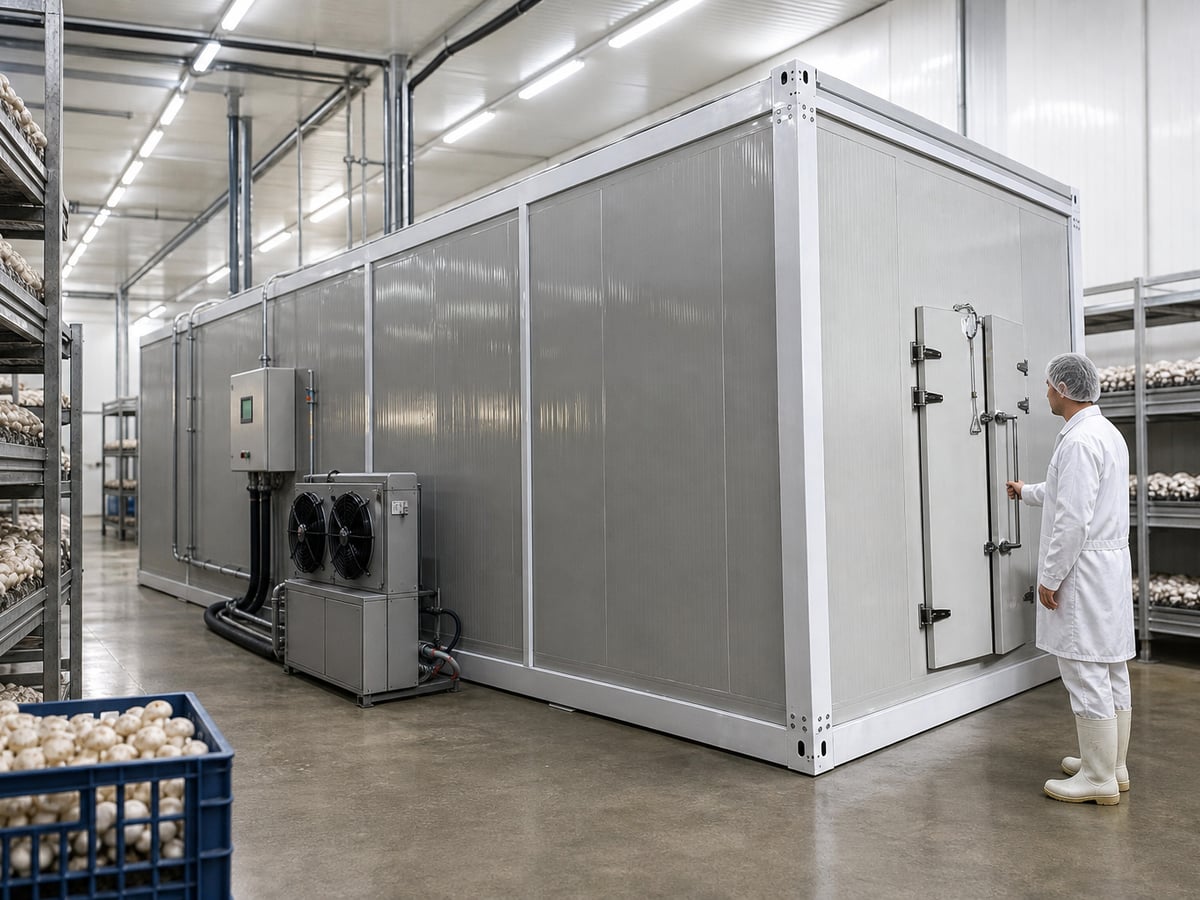
A mushroom growing container is a controlled fruiting room built inside a modified insulated shipping container or modular enclosure. It is designed to create the stable temperature, humidity, fresh-air exchange, carbon dioxide management, lighting, and hygiene conditions required for commercial mushroom fruiting. A complete unit normally combines the insulated structure, racks, refrigeration or heat-pump equipment, humidification, ventilation fans, filtration, drainage, lighting, electrical controls, and a programmable logic controller (PLC).
For buyers in the Global Market, the most important point is to define what “complete” means before comparing quotations. Some suppliers offer only a container shell with insulation and shelves. Others supply a ready-to-operate fruiting system including climate equipment, wiring, sensors, controller programming, testing, and remote support. A lower initial price may exclude refrigeration capacity, water treatment, electrical distribution, site installation, crop recipes, or commissioning assistance.
A properly configured mushroom growing container can be used for oyster mushrooms, shiitake, lion’s mane, enoki, king oyster mushrooms, chestnut mushrooms, and other specialty varieties, depending on the environmental range and racking layout. The container does not replace substrate production or spawn handling unless those processes are specifically included. Its principal function is to provide a clean, repeatable environment for the fruiting phase.
For farms serving cities such as Dubai, Singapore, Rotterdam, Los Angeles, Sydney, São Paulo, Nairobi, and Johannesburg, containerized fruiting rooms can reduce the need for permanent building construction and enable phased expansion. They are particularly useful where fresh specialty mushrooms are sold to supermarkets, restaurants, distributors, hotels, meal-kit companies, and urban agriculture projects.
| Container Component | Main Function | Why It Matters for Fruiting |
|---|---|---|
| Insulated enclosure | Separates the crop room from outdoor weather | Reduces heat gain, condensation, and energy waste |
| Cooling and heating equipment | Maintains crop-specific temperature conditions | Supports pinning, yield consistency, and quality |
| Humidification system | Adds moisture to the supply air | Helps prevent dry caps, cracking, and poor development |
| Fresh-air ventilation | Introduces outside air and exhausts stale air | Controls carbon dioxide and supports proper morphology |
| PLC climate controller | Coordinates sensors and equipment automatically | Reduces manual adjustments and records operating data |
| Racks and washable surfaces | Organizes crop bags or blocks hygienically | Improves labor flow, sanitation, and use of space |
The table shows why a fruiting container should be evaluated as an integrated environmental system rather than as a metal box. Crop performance depends on how its parts work together. For example, high humidity without sufficient fresh air can lead to excess condensation and elongated stems, while strong ventilation without humidity compensation can dry the crop surface.
How a Mushroom Growing Container Works

A commercial mushroom fruiting container works by continuously measuring and correcting the air conditions surrounding the crop. Sensors monitor room temperature, relative humidity, and often carbon dioxide concentration. The controller compares actual readings with the selected crop targets, then activates cooling, heating, humidification, exhaust fans, fresh-air dampers, circulation fans, and lights as needed.
In a typical operating cycle, cooled or conditioned air enters the fruiting room through an air duct or distribution plenum. Circulation fans move air through the racking area so that shelves near the door receive conditions similar to those at the far end. Humidification introduces fine moisture into the air stream, while exhaust fans remove carbon dioxide generated by the mushrooms. Fresh air is introduced in controlled quantities, often through filtered inlets, to maintain the required gas balance.
The crop itself is a living load. As blocks or bags fruit, they release moisture, heat, and carbon dioxide. The environmental demand changes with crop variety, loading density, flush stage, weather, door openings, and the number of workers entering the room. Therefore, an effective container uses proportional control logic rather than relying only on a timer. A system that performs well in mild coastal weather may require a larger condenser, stronger insulation, or different dehumidification strategy in hot, humid regions such as Southeast Asia, the Gulf, West Africa, or northern Australia.
Most projects use containers in one of three ways: as a stand-alone farm module, as a fruiting extension connected to a substrate facility, or as a demonstration and training unit for distributors and agricultural contractors. The smart mushroom cultivation container format is especially suitable for modular farm planning because additional units can be added as demand, staffing, and substrate supply increase.
| Operating Stage | Typical System Action | Operator Check |
|---|---|---|
| Loading | Climate mode is stabilized before crop blocks enter | Confirm racks, drains, and surfaces are clean |
| Pinning initiation | Temperature, fresh air, and humidity shift to crop recipe settings | Check sensor readings against an independent meter |
| Early fruit development | Ventilation and humidity cycle more frequently | Look for uneven pins or wet shelf zones |
| Harvest flush | Airflow is balanced to avoid drying the caps | Remove mature mushrooms on schedule |
| Between flushes | Recipe returns to recovery conditions | Remove debris and inspect water nozzles |
| Turnaround and sanitation | Climate equipment is stopped or set to cleaning mode | Wash, disinfect, dry, and document the room condition |
This sequence explains why container selection should follow crop planning. A lion’s mane producer supplying premium restaurants in London or New York may prioritize gentle airflow and tight humidity control. An oyster mushroom grower distributing through wholesale markets in Jakarta, Mexico City, Lagos, or Istanbul may prioritize loading capacity, harvest access, rapid fresh-air exchange, and reliable serviceability.
Fruiting Equipment and System Boundaries

Before ordering, create a written equipment boundary list. This prevents misunderstandings between the buyer, farm designer, installer, electrician, and container manufacturer. The boundary list should state what is factory-installed, what is supplied loose for site assembly, what must be sourced locally, and what is excluded.
A fully integrated fruiting unit can include the container body, insulated wall panels, interior stainless or coated surfaces, door system, shelving, refrigeration unit, heat pump, humidifier, ventilation fans, air ducts, filters, LED lights, electrical cabinet, PLC controller, sensors, alarms, drainage fittings, and a basic operating manual. However, water tanks, reverse-osmosis equipment, site wiring, concrete pads, cranes, network routers, backup generators, substrate blocks, and local permits are frequently outside the standard scope unless noted in the contract.
Capacity claims should also be clarified. “20-foot container” or “40-foot container” describes external transport dimensions, not guaranteed mushroom yield. Productive capacity depends on the usable rack area, crop block size, substrate formula, biological efficiency, loading cycle, number of flushes, environmental uniformity, and harvest management. Ask the supplier to identify the rack tiers, aisle width, estimated substrate load, and crop assumptions behind any output estimate.
| Item to Confirm | Included in a Full Fruiting System? | Common Boundary Risk |
|---|---|---|
| Container and insulation | Usually included | Insulation thickness or floor insulation is not specified |
| Racks and lighting | Often included | Rack material or load rating is unclear |
| Climate equipment | Usually included in turnkey quotations | Capacity is not matched to local ambient temperature |
| Water supply connection | Usually site-provided | No filtration, pressure, or drainage plan is prepared |
| Site electrical cable and protection | Usually site-provided | Voltage, phase, and breaker capacity do not match the unit |
| Installation and commissioning | May be optional | Buyer assumes on-site labor is included |
The table should be treated as a contract-review tool, not merely a technical checklist. For container shipments arriving through Rotterdam, Jebel Ali, Singapore, Durban, Santos, or Long Beach, buyers should also distinguish between factory packing, export documentation, sea freight, local customs clearance, inland trucking, crane unloading, and final utility connection. Each step has cost, timing, and responsibility implications.
Where project requirements differ from a standard model, an OEM or ODM partner can revise dimensions, rack layouts, electrical specifications, climate capacity, control language, and exterior finishes. Buyers seeking tailored layouts can review OEM and ODM cultivation system options during the design stage.
Insulation, Racks, and Washable Surfaces
Insulation is the structural foundation of a mushroom fruiting container. It lowers the heat transfer between the exterior environment and the crop room, helping the cooling and heating equipment maintain setpoints with less energy consumption. In tropical, desert, or high-solar-load locations, insulation performance is especially important. Poorly insulated walls can create hot spots, compressor overloading, interior condensation, and unstable crop conditions.
Buyers should ask about panel core type, thickness, density, fire-performance requirements, floor insulation, thermal bridges, vapor sealing, door gasket quality, and roof construction. A refrigeration-grade insulated door with a robust seal is generally preferable to a light industrial door because repeated opening is a major source of temperature and humidity loss. Door dimensions should allow safe movement of crop trolleys, blocks, and harvest crates without damaging wall panels.
Interior surfaces should be smooth, corrosion-resistant, non-absorbent, and easy to wash. Common design choices include coated metal panels, food-grade composite surfaces, stainless steel for high-wear details, sealed joints, coved corners, and sloped floors leading to drains. Avoid untreated wood, exposed absorbent insulation, difficult-to-clean shelf joints, and unsealed floor-wall gaps. These areas can retain organic debris and increase the risk of mold, flies, bacteria, and cross-contamination.
Rack design affects both productivity and climate uniformity. More shelves may increase theoretical capacity, but very narrow aisles can make harvesting slow, restrict airflow, and complicate cleaning. The best rack arrangement balances usable growing area with worker movement, air distribution, block dimensions, and sanitation access. Galvanized steel, aluminum alloy, and stainless steel may be selected according to humidity exposure, corrosion risk, cleaning method, and budget.
| Design Feature | Recommended Evaluation | Operational Benefit |
|---|---|---|
| Wall insulation | Verify thickness and thermal performance for local climate | More stable room temperature and lower cooling load |
| Floor finish | Confirm anti-slip, washable, and drain-compatible construction | Safer cleaning and reduced standing water |
| Door seal | Check gasket compression and closing hardware | Limits air leakage and humidity loss |
| Rack material | Select corrosion-resistant, cleanable metal construction | Longer service life in a humid environment |
| Aisle spacing | Match to harvest crates, workers, and cleaning tools | Improves labor efficiency and hygiene access | Drainage layout | Ensure floor slope and drain position are practical | Reduces puddles and sanitation risks |
These construction details have direct commercial value. In regions where labor costs are high, such as Western Europe, Japan, Canada, Australia, and parts of the United States, easily washable racks and efficient aisle layouts reduce routine work. In humid coastal locations such as Mombasa, Manila, Ho Chi Minh City, Cartagena, or Guayaquil, corrosion resistance and drainage become even more important for long-term reliability.
Cooling, Humidity, and Fresh Air
Cooling, humidity, and fresh air are the core environmental functions of a fruiting room. They must be engineered as one system. Cooling removes heat from the room, but it may also remove moisture. Humidification restores moisture, but excessive moisture can create wet surfaces. Fresh-air exchange lowers carbon dioxide, but it can introduce hot, cold, dry, or humid outdoor air. The controller must balance these effects according to crop requirements and outdoor conditions.
Cooling capacity should be selected based on container size, insulation level, local design temperature, solar exposure, crop respiration heat, lighting load, fan load, door opening frequency, and outside-air volume. A unit intended for a cool northern climate may not have sufficient capacity for an exposed site in Riyadh, Muscat, Bangkok, Darwin, Accra, or inland India. Ask for the ambient design condition used in the supplier’s calculation and confirm whether the condenser will be installed outdoors, on the roof, or in a shaded equipment area.
Humidification systems may use ultrasonic units, high-pressure mist, fogging, wet media, or other methods. The appropriate choice depends on water quality, room size, maintenance skills, droplet control, and the desired integration with the air distribution system. Water with high mineral content can block nozzles and leave deposits, so filters, softening, or treatment may be necessary. Humidity sensors should be positioned away from direct mist discharge and supply-air streams to avoid misleading readings.
Fresh-air design must prevent stagnant zones without blowing directly onto delicate mushrooms. Carbon dioxide levels influence mushroom shape, stem length, cap development, and crop density. Exhaust fans, inlet dampers, duct placement, and circulation fans should work together to distribute fresh air evenly. A reliable mushroom climate controller can coordinate these devices based on temperature, humidity, CO2 thresholds, schedules, and alarm parameters.
For many farms, energy use is a major operating cost. Practical efficiency measures include high-quality insulation, variable-speed fans, well-sealed doors, shaded condensers, heat-pump technology where appropriate, optimized defrost logic, maintenance of clean coils, and crop recipes that avoid unnecessary equipment cycling. The objective is not simply the lowest instantaneous power draw; it is reliable crop quality at the lowest practical cost per kilogram of saleable mushrooms.
PLC Controls and Crop Recipes
A PLC-based control system gives the operator a central interface for setting environmental targets and monitoring equipment. Depending on the project level, the controller may display temperature, relative humidity, CO2 concentration, fan status, compressor status, lighting schedules, alarm history, and sensor trends. It can operate in manual mode for testing, automatic mode for routine production, and alarm mode when readings exceed defined limits.
Crop recipes are programmed operating profiles rather than universal settings. A recipe may define day and night temperature targets, humidity ranges, CO2 limits, lighting intervals, ventilation priorities, recovery periods, and alarm thresholds. Different recipes are needed for oyster mushrooms, shiitake, king oyster, lion’s mane, and other varieties. Even the same variety can require adjustment for bag formulation, crop age, intended morphology, local water quality, and market preference.
The value of automation is consistency, not elimination of skilled growers. Operators should still inspect the crop daily, compare sensor readings with portable instruments, observe condensation, review crop morphology, verify water supply, clean filters, and respond to alarms. A PLC will follow programmed instructions, but it cannot identify every biological issue such as contaminated substrate, poor block hydration, insect introduction, or delayed harvesting.
Remote monitoring can help multinational operators, distributors, and project managers supervise containers in remote locations. However, remote access should have clear user permissions, secure network setup, local manual override, and an emergency plan for internet loss. For projects in areas with unstable electricity, a backup generator, voltage protection, and restart procedures are often more important than advanced cloud features.
By 2026, buyers increasingly expect data logging, mobile alarm notifications, variable-speed control, predictive maintenance prompts, and recipe libraries that can be adapted by crop and climate zone. Sustainability expectations are also rising. Many commercial farms are evaluating solar-assisted power, lower-global-warming-potential refrigerants, water recirculation where hygienically appropriate, energy meters, and better reporting of electricity and water use. Policy trends in many markets are moving toward tighter refrigerant, energy-efficiency, food-safety, worker-safety, and traceability requirements, so modular systems should be specified with future compliance in mind.
Site Utilities and Operator Tasks
A container can leave the factory fully assembled yet still require careful site preparation. The farm must provide a level foundation, drainage route, safe access for delivery trucks, crane or forklift planning, electrical supply, water supply, wastewater handling, and enough clearance around condensers and doors. In densely developed markets, local planning approval, noise restrictions, zoning rules, fire requirements, and food-production registration may also apply.
Electrical specifications must be confirmed before production. Voltage, frequency, single-phase or three-phase supply, grounding, cable size, breaker rating, residual-current protection, and surge protection should match the site and the equipment nameplate. Global Market buyers should not assume a Chinese factory electrical standard will match installations in the European Union, the United Kingdom, North America, the Middle East, Africa, Latin America, or Oceania. The required configuration should be written into the purchase order.
Water requirements include supply pressure, flow rate, quality, filtration, and drain capacity. Operators need enough clean water for humidification, routine washdown, and sanitation. If the site relies on borehole water, tanker delivery, or municipal water with high mineral content, treatment requirements should be assessed in advance. Wastewater should be directed to an approved drainage point rather than allowed to accumulate around the container foundation.
Daily operator tasks include checking crop appearance, harvesting mature mushrooms, recording yield, inspecting alarms, verifying water levels, removing debris, cleaning floors, and confirming that doors close properly. Weekly tasks generally include checking filters, inspecting humidification nozzles, cleaning drains, reviewing controller logs, and assessing fan noise or vibration. Preventive maintenance is less costly than emergency repairs during a fruiting cycle.
| Site or Routine Requirement | Buyer Responsibility | Practical Planning Point |
|---|---|---|
| Foundation | Prepare level, load-bearing base | Use a design suitable for local soil and drainage conditions |
| Electricity | Provide compatible supply and protection | Confirm voltage and phase before manufacturing begins | Water | Provide clean supply with required pressure | Test hardness and filtration needs |
| Drainage | Provide approved wastewater route | Prevent standing water near the container | Crop inspection | Conduct daily visual checks | Use crop observations to refine recipes | Preventive maintenance | Follow service schedule | Keep filters, coils, fans, and sensors in good condition |
This table is useful during pre-installation meetings with electricians, plumbers, farm managers, and civil contractors. Clear local coordination is especially important when containers are delivered to industrial estates near major trade hubs such as Hamburg, Antwerp, Melbourne, Busan, Casablanca, Chennai, or Panama City, where delivery access and utility permissions may be managed by separate parties.
Questions to Ask Before Ordering
Before purchasing a mushroom growing container, buyers should compare proposals on technical scope, not only on external size and price. Start by defining the mushroom species, expected weekly production, substrate source, harvest market, local climate, available utilities, and expansion plan. Then ask each supplier to explain how the proposed system meets those conditions.
Useful questions include: What crop and substrate loading assumptions were used for the capacity estimate? What outdoor temperature and humidity conditions were used to select the refrigeration equipment? What insulation thickness is included in the walls, roof, floor, and door? What rack dimensions, shelf count, and load rating are supplied? Is CO2 monitoring included, optional, or absent? Which parts are installed before shipment? What must the buyer prepare on site? What is the warranty coverage and spare-parts recommendation?
Ask whether the system has been tested before shipment. Factory testing should confirm electrical wiring, fan operation, cooling and heating response, humidification function, sensor communication, controller logic, alarms, lighting, and door operation. Video records, test reports, photographs, wiring diagrams, equipment lists, and packing lists can help overseas buyers inspect the scope before final shipment.
Buyers should also request examples relevant to their intended application. A container used for farm training in a temperate city may not be an adequate reference for a high-output commercial operation in a hot-humid climate. Review mushroom cultivation container project cases to understand how layouts and system configurations can vary by crop, region, and scale.
Local supplier support matters after delivery. In some markets, a distributor or refrigeration contractor can assist with installation, refrigerant service, replacement parts, and control troubleshooting. In other regions, factory remote support combined with locally available standard components may be the most practical model. Ask which components are proprietary, which are internationally serviceable, how quickly spare parts can be dispatched, and whether local technicians can receive remote commissioning guidance.
Do not overlook trade documentation. International buyers may need commercial invoices, packing lists, bills of lading, certificates of origin, electrical documents, customs classifications, and compliance files. Requirements differ between countries. The buyer or appointed import agent should verify local import duties, inspection rules, and certification requirements before payment and shipment arrangements are finalized.
Our Company
Shandong Lanhu Air Conditioning Equipment Co., Ltd. develops modular climate-control solutions for agricultural and industrial applications, including mushroom fruiting containers, intelligent climate controllers, hydroponic plant containers, and air-source heat pumps. The company serves agricultural contractors, distributors, engineering companies, and commercial farming projects across the Global Market.
From a technological capability perspective, Lanhu draws on more than 12 years of thermodynamic research and development and holds more than 45 registered patents. Its engineering focus is the practical integration of refrigeration, heating, humidity, fresh-air exchange, automation, and crop-room structure. This approach helps customers specify a container system around crop targets, ambient conditions, electrical requirements, and operational workflow rather than selecting unrelated equipment items.
From a manufacturing capability perspective, the company operates a modern manufacturing facility of more than 30,000 square meters in Dezhou, Shandong, China. Integrated processes include product design, engineering development, sheet-metal fabrication, CNC bending, insulation panel production, electrical assembly, system integration, testing, and quality inspection. Functional inspection, electrical verification, performance testing, and operational evaluation are conducted before shipment. The company’s management and safety framework includes ISO 9001, ISO 14001, ISO 45001, and ISO 12100 certifications.
From a service capability perspective, Lanhu provides factory-direct supply, customization support, engineering assistance, international logistics coordination, spare-parts support, installation guidance, and after-sales service. This is valuable for buyers who require a standard container for rapid deployment as well as for projects requiring modified rack layouts, local voltage adaptation, branding, alternative climate configurations, or phased farm expansion.
For an international project, the best starting point is a technical discussion covering crop type, location, summer and winter weather, production goals, utility details, container size, transport route, and expected commissioning method. This allows the equipment package to be matched to real farm conditions instead of relying on a generic specification.
FAQ
What is included in a mushroom fruiting container?
A complete configuration generally includes an insulated container structure, racks, climate equipment, humidification, ventilation, lighting, controls, sensors, and internal electrical wiring. Exact scope varies by quotation, so buyers should request a detailed bill of materials and boundary list.
Can one container grow different mushroom species?
Yes, if the controller and climate equipment support the required ranges. However, different species often need different recipes, handling routines, and airflow conditions. Operating one crop type per container is usually simpler for hygiene, scheduling, and production consistency.
How much mushroom production can a container deliver?
Output depends on usable rack area, block loading, species, substrate quality, biological efficiency, number of flushes, environmental control, and labor management. Ask for a capacity estimate based on clearly stated crop assumptions rather than relying only on container length.
Does the container need a separate cold room?
Often yes. A fruiting container creates the growing environment, while harvested mushrooms typically need rapid cooling and cold storage before delivery. Farms supplying supermarkets, hotels, or export channels should plan harvest handling, packing, and cold-chain logistics separately.
Can the unit operate in hot or cold climates?
Yes, but refrigeration, heating, insulation, condenser selection, and fresh-air strategy must be designed for the local environment. Buyers should provide maximum summer temperature, winter minimum, humidity profile, altitude, and site exposure during the quotation stage.
What maintenance is required?
Routine work includes cleaning the interior, inspecting drains, replacing or washing filters, checking humidification equipment, cleaning coils, inspecting fans, verifying sensor accuracy, and reviewing controller alarms. A documented maintenance plan supports crop quality and equipment life.
Is remote monitoring available?
Many PLC-based systems can support remote monitoring or alarm communication when a suitable network connection is available. The final configuration should define access permissions, local override functions, data needs, and support arrangements.
What should be prepared before delivery?
Prepare the foundation, electrical connection, water supply, drainage, delivery route, unloading equipment, clearance around the container, and any local approvals. Confirm all responsibilities with the supplier, installer, freight provider, and local contractors before shipment.
Share this article

About the Author: Shandong Lanhu Air Conditioning Equipment
Lanhu is a professional climate control equipment manufacturer specializing in smart agricultural systems, commercial HVAC solutions, and customized temperature control technologies. With extensive engineering experience, Lanhu provides reliable solutions for plant factories, controlled environment agriculture, and industrial applications.
Need a Custom Climate Control Solution?
From smart agricultural systems to commercial HVAC solutions, Lanhu provides reliable temperature and humidity control solutions tailored to your project needs.
Contact Us