Smart Mushroom Cabin Buying Guide for the Global Market
Fast Overview

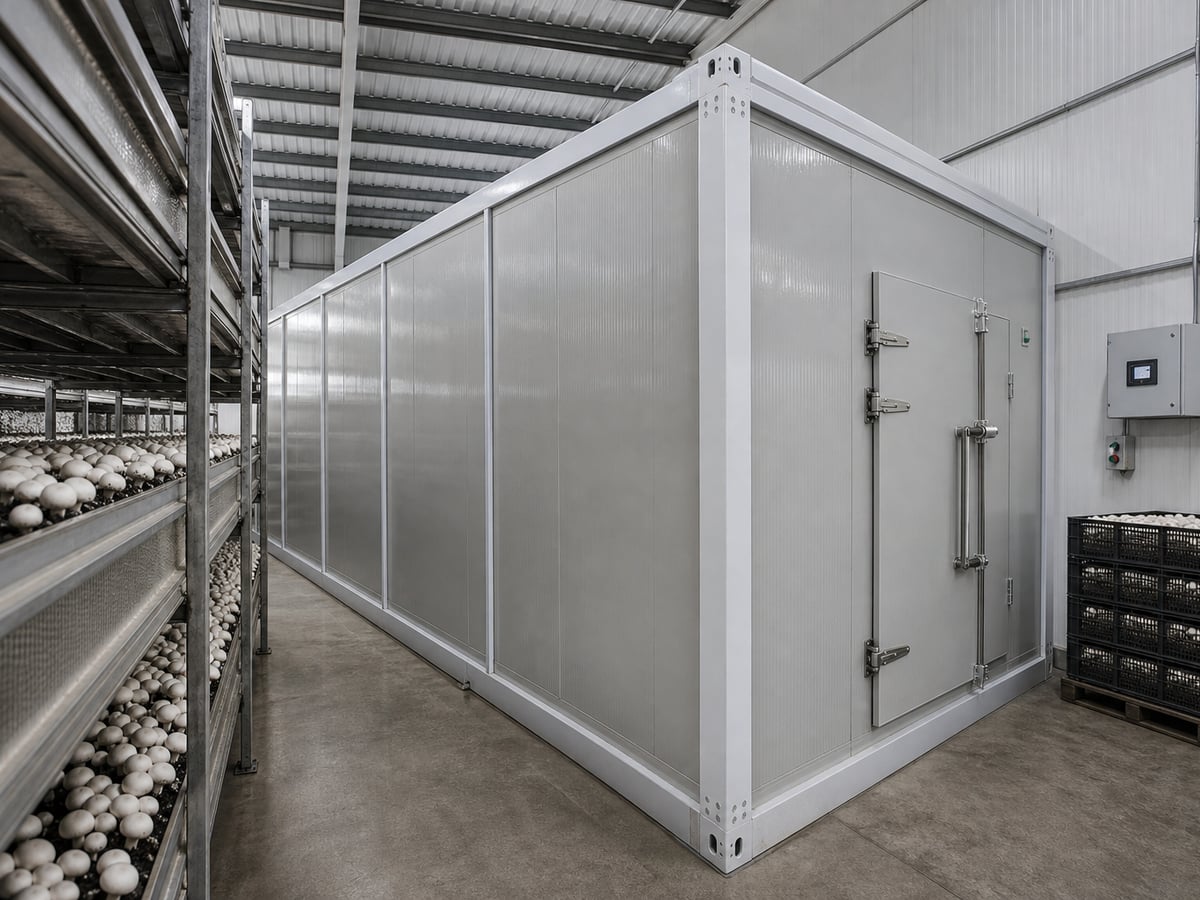
A smart mushroom cabin is a modular, insulated cultivation unit designed to maintain stable growing conditions for mushrooms through automatic control of temperature, humidity, fresh-air exchange, carbon dioxide concentration, lighting, and equipment operation. For growers in the Global Market, the most valuable cabin features are not simply digital screens or remote access. They are reliable climate uniformity, easy cleaning, suitable rack layouts, dependable alarms, service access, and crop programs that match the biology of the selected mushroom species.
A well-configured mushroom cultivation cabin can help commercial farms, agricultural contractors, distributors, food companies, research centers, and urban agriculture projects shorten construction time compared with building a conventional growing room. The cabin can be delivered as a self-contained growing environment or integrated into a larger mushroom farm with central utilities, packaging rooms, incubation areas, cold storage, and substrate handling zones.
When comparing options, growers should first define the target mushroom variety, expected production volume, local climate, labor model, available utilities, hygiene requirements, and expansion plan. Oyster mushrooms, shiitake, lion’s mane, enoki, button mushrooms, and specialty medicinal mushrooms all require different environmental strategies. A cabin designed for high-humidity oyster mushroom fruiting may require different airflow, shelving, insulation, and drainage arrangements than a low-temperature shiitake system.
For projects supplied internationally through ports such as Shanghai, Qingdao, Rotterdam, Hamburg, Dubai, Singapore, Los Angeles, Santos, Mombasa, and Melbourne, modular cabins can reduce site construction uncertainty. However, buyers should confirm transport dimensions, local electrical standards, water quality, drainage availability, import documentation, and after-sales support before placing an order.
What Defines an Intelligent Mushroom Growing Cabin?

An intelligent mushroom growing cabin combines a controlled growing enclosure with sensors, mechanical equipment, programmable controls, safety functions, and data visibility. The goal is to make the crop environment repeatable. Rather than relying entirely on manual opening of vents, hand-operated humidifiers, and visual judgments, the system uses measured values and programmed logic to manage the growing room.
The core of a smart cabin is usually an insulated enclosure with corrosion-resistant interior surfaces, a climate control unit, humidification equipment, ventilation fans, air distribution ducts, LED lighting, drainage, electrical controls, and mushroom climate management software. Depending on the project, the cabin may also include heating, cooling, dehumidification, ultraviolet treatment, fresh-air filtration, heat recovery, water filtration, cameras, access control, and remote communication hardware.
The definition of “smart” should be practical. A cabin is truly useful when it can stabilize the conditions that affect yield, quality, pinning consistency, disease risk, harvest timing, and labor efficiency. A sophisticated controller is of limited value if air is uneven across shelves, condensate is difficult to remove, or technicians cannot easily access fans and filters for maintenance.
For commercial operators, smart mushroom cabins are commonly used in the following situations:
- New farms requiring fast deployment without long civil construction schedules.
- Urban farming projects near retail markets in London, Toronto, Dubai, Singapore, Tokyo, and New York.
- Remote agricultural sites where standardized factory-built modules reduce on-site engineering work.
- Demonstration farms, training centers, universities, and research projects.
- Seasonal mushroom operations that need controlled year-round production.
- Food-service, retail, or direct-to-consumer brands seeking local fresh mushroom supply.
- Expansion projects requiring additional fruiting capacity without rebuilding an existing facility.
For growers comparing a modular solution with a traditional room, the cabin should be evaluated as a complete production system. The enclosure, rack layout, air handling, automation logic, sanitation design, electrical protection, and field service plan must work together. Learn more about complete smart mushroom cultivation containers when reviewing integrated production options.
| Smart Cabin Element | Primary Function | Why It Matters to Growers |
|---|---|---|
| Insulated cabin structure | Separates the crop from outside weather conditions | Improves climate stability and can reduce heating or cooling losses. |
| Climate controller | Processes sensor signals and operates equipment | Supports repeatable crop recipes and reduces dependence on constant manual adjustment. |
| Humidity system | Adds controlled moisture to the growing air | Helps maintain fruit body development and reduces drying stress. |
| Fresh-air and exhaust fans | Manage CO2 removal and air exchange | Supports healthy morphology and limits stale-air conditions. |
| Air distribution ducts | Deliver conditioned air through the crop area | Helps reduce temperature and humidity differences between rack levels. |
| Drainage and washable surfaces | Remove water and support sanitation | Reduces standing water, odor, contamination risk, and cleaning time. |
The table shows why a smart cabin should be assessed as more than a container with equipment installed inside. Every element affects either crop quality, operating cost, hygiene, maintenance, or the consistency of production planning.
Cabin Dimensions and Crop Layout Options

Cabin size should be selected according to the crop method rather than transport dimensions alone. Common modular mushroom cabins are based on shipping-container-inspired footprints, but the internal usable growing area depends on insulation thickness, equipment room placement, door configuration, air ducts, drainage channels, and rack geometry. A longer unit may increase capacity, but it can also create airflow challenges if the climate system is undersized or poorly distributed.
Typical layouts include single-side racks, double-side racks with a central aisle, multi-tier shelving, hanging bag systems, tray systems, and mobile rack arrangements. Bag-grown oyster mushrooms may require wider aisles for harvest access, while bottle-based specialty mushroom production may emphasize loading and unloading flow. Farms using substrate blocks need sufficient turning space for carts, while high-density projects need enough clearance to clean walls, inspect ducts, and service lighting.
For projects in dense urban areas such as Amsterdam, Seoul, Hong Kong, Paris, São Paulo, or Johannesburg, compact cabins can enable pilot production close to consumers. In agricultural regions with available land, cabins can be grouped in clusters with dedicated incubation rooms, packing areas, boiler or heat-pump rooms, and substrate storage. The best approach depends on labor cost, production scale, utility infrastructure, and local market demand.
| Cabin Configuration | Typical Use | Layout Consideration | Best Fit |
|---|---|---|---|
| Compact pilot cabin | Trials, training, direct sales | Simple rack layout with one central access aisle | Start-ups, schools, research teams |
| Standard fruiting cabin | Regular fresh mushroom production | Multi-tier racks and balanced supply-air distribution | Small commercial farms |
| High-density rack cabin | Maximum output per floor area | Requires carefully designed airflow and cleaning access | Urban farms and premium crop projects |
| Multi-cabin cluster | Separate crops or staggered harvest cycles | Shared utility corridor and independent climate zones | Expanding farms and distributors |
| Incubation-focused cabin | Mycelium colonization | Less fresh-air demand but stable temperature is essential | Substrate producers and integrated farms |
| Specialty mushroom cabin | Lion’s mane, shiitake, medicinal species | Species-specific light, humidity, and airflow settings | High-value niche producers |
This comparison helps buyers match the cabin type to their operating model. It is often better to start with two smaller independently controlled cabins than one large room if the farm plans to grow several species or stagger harvest cycles. Separate zones reduce the risk that one crop issue affects all production.
Capacity calculations should be based on usable shelf area, substrate loading weight, crop cycle length, expected biological efficiency, harvest frequency, and labor availability. Suppliers should provide a realistic capacity estimate rather than only stating the external cabin size. Buyers should ask whether the quoted output assumes ideal laboratory conditions or practical farm conditions with loading, harvest, sanitation, and crop changeover time included.
Sensors and Automatic Equipment Management
Sensors are the information layer of a smart mushroom cabin. The controller uses their data to determine when to activate cooling, heating, humidification, fans, exhaust dampers, lights, alarms, and other equipment. Core sensors generally include air temperature, relative humidity, carbon dioxide, and sometimes water temperature, surface temperature, outside temperature, pressure, tank level, door status, and electrical load.
Temperature and humidity sensors should be positioned where they represent the crop environment, not only near the supply-air outlet or controller cabinet. Carbon dioxide sensors are especially important in fruiting rooms because CO2 levels can change rapidly with crop respiration, loading density, and ventilation conditions. Placement, calibration, and protection from direct mist are critical for reliable readings.
Automatic equipment control should use sensible logic. For example, when humidity is below the setpoint, the controller may activate a humidifier, but it should also consider temperature, fan status, airflow, and condensation risk. When CO2 rises above the target, the system may introduce fresh air and exhaust stale air, but the controller should avoid excessive energy waste during extreme outdoor weather.
Advanced cabins may coordinate multiple devices through staged operation. A heat pump can provide cooling or heating, while fans distribute air, humidifiers add moisture, and dampers regulate fresh-air volume. This integrated strategy supports stable growing conditions and can reduce unnecessary equipment cycling.
| Sensor or Device | Controlled Variable | Typical Automation Action | Operational Benefit |
|---|---|---|---|
| Temperature sensor | Air temperature | Starts heating or cooling equipment | Protects crop development from heat or cold stress. |
| Humidity sensor | Relative humidity | Activates humidification or dehumidification | Supports pinning, fruiting quality, and moisture retention. |
| CO2 sensor | Carbon dioxide concentration | Adjusts fresh-air and exhaust fan operation | Helps maintain suitable mushroom shape and growth rate. |
| Water-level switch | Humidifier water supply | Triggers refill warning or protects pump operation | Prevents dry running and unexpected humidity interruption. |
| Door contact sensor | Door open or closed status | Issues alert or adjusts climate response | Helps identify energy loss and accidental access events. |
| Fan current monitor | Electrical load or running condition | Raises fault signal when abnormal | Supports preventive maintenance and faster troubleshooting. |
The table demonstrates that automation is valuable when it converts environmental data into reliable actions. Growers should ask which sensors are included, whether calibration is supported, how faults are identified, and whether manual fallback is available if a sensor fails.
For a detailed view of controller functions, growers can review a smart mushroom climate controller designed for integrated temperature, humidity, CO2, ventilation, and lighting management. The correct control platform should be selected according to crop complexity, staffing level, and the need for remote supervision.
Crop Recipes and Manual Control Options
Crop programs, sometimes called recipes, are pre-set sequences of environmental targets for different stages of mushroom production. Instead of maintaining one fixed climate condition throughout the cycle, a program can adjust temperature, humidity, fresh air, CO2, lighting, and fan operation as the crop moves from incubation to primordia formation, pinning, fruit body development, harvest, and cleaning.
For example, oyster mushroom growers may use one program for colonized substrate loading, another for pinning initiation, and another for harvest flush management. Shiitake growers may require different temperature and moisture strategies. Lion’s mane production often benefits from careful CO2 and airflow control to support desirable shape and density. The best crop program should be tested with the specific substrate formulation, bag size, strain, local water quality, and production target.
Automation should not eliminate grower judgment. Manual overrides remain essential for troubleshooting, emergency response, crop experiments, maintenance, and unusual weather conditions. A good system allows authorized staff to switch equipment into manual mode, adjust setpoints within safe limits, pause schedules, and return to automatic operation without losing the operating history.
Farm managers should define access levels. Operators may need permission to start cleaning mode or adjust a daily lighting period, while senior growers or technical managers may control recipe parameters, alarm thresholds, and remote access. This reduces accidental changes that could affect a full crop cycle.
| Crop Stage | Typical Program Focus | Manual Override Example | Grower Check |
|---|---|---|---|
| Cabin preparation | Cleaning, drying, and ventilation | Run exhaust fans continuously after washdown | Confirm surfaces and drains are dry and clean. |
| Loading | Moderate climate stabilization | Temporarily increase lighting for staff safety | Check rack loading balance and airflow clearance. |
| Early fruiting | Humidity and CO2 transition | Fine-tune fresh-air rate after crop observation | Inspect pinset uniformity across all shelves. |
| Fruit development | Stable air movement and moisture management | Pause misting if surface condensation appears | Assess cap quality, stem length, and moisture. |
| Harvest period | Crop protection and worker access | Adjust fans during intensive harvesting activity | Monitor damage, cleanliness, and yield records. |
| Changeover | Sanitation and reset | Operate cleaning mode manually for longer duration | Inspect seals, filters, racks, and equipment service points. |
This table shows why crop programs should be understood as working guides rather than fixed formulas. Strong growers use automatic recipes to create consistency while still observing crop behavior daily. The combination of automation and experienced visual inspection is particularly important when a farm begins using new substrate suppliers, strains, or market-driven harvest schedules.
Remote Supervision and Alarm Handling
Remote monitoring allows farm managers to view key cabin conditions without being physically present at the site. Depending on the system, users may check temperature, humidity, CO2, equipment status, alarms, trend charts, and operating schedules through a web platform, mobile interface, industrial touch screen, or remote computer connection.
This feature is useful for farms operating multiple cabins, distributed production sites, or facilities located outside major cities. A manager in Rotterdam may monitor a cabin project in an agricultural region, while an equipment distributor in Dubai may support a customer with remote technical guidance. Remote visibility can also help managers compare performance across cabins and identify abnormal trends before crop quality declines.
However, remote monitoring is not the same as remote control without responsibility. Alarm response procedures should be established before production begins. The farm should identify who receives alerts, how quickly they respond, what actions they can take, and when to escalate to a technician. Critical alarms may include high temperature, low humidity, high CO2, fan failure, water shortage, power loss, communication interruption, or door-open events.
Internet reliability should also be considered. In regions with unstable connectivity, the cabin controller should continue operating local programs even if remote communication is temporarily unavailable. Remote access should be secured with passwords, user permissions, and appropriate network practices to protect operational data and prevent unauthorized equipment changes.
A practical alarm plan includes an on-site emergency contact, spare fuses and sensors, backup water options, power protection, documented setpoints, and a clear maintenance record. Larger farms may also consider backup power solutions where prolonged outages could cause serious crop loss.
Cleaning Access and Maintenance Clearance
Sanitation is one of the most important yet underestimated factors in mushroom cabin design. Mushroom fruiting environments are humid, biologically active, and frequently exposed to substrate particles, spores, water, and worker traffic. If surfaces, corners, drains, filters, ducts, or equipment compartments are difficult to access, cleaning quality can decline over time.
A practical cabin should have smooth, washable interior finishes, sealed panel joints, corrosion-resistant components, sloped drainage where appropriate, accessible floor drains, service panels, adequate aisle width, and enough clearance around racks. Doors should be durable and easy to clean. Lighting fixtures and electrical components should be protected from moisture. Humidification nozzles, water lines, filters, and fan assemblies should be reachable without dismantling major parts of the cabin.
Cleaning access should be evaluated during the buying stage. Ask the supplier to show internal photographs, layout drawings, service access routes, drainage details, and maintenance procedures. A cabin that looks compact and efficient on paper may become difficult to operate if workers cannot move carts safely, clean behind racks, or inspect the rear side of climate equipment.
In high-throughput farms, cleaning time directly affects available production days. If a cabin requires several days of difficult sanitation between cycles, the annual output may be lower than expected. Good design shortens cleaning and inspection time while improving biosecurity.
Recommended maintenance practices include routine cleaning after each crop cycle, weekly drain inspection, scheduled filter checks, periodic sensor verification, humidifier water-system sanitation, fan belt or motor inspection where applicable, and annual electrical safety review. The exact schedule should be adapted to crop volume, local water conditions, and the cabin’s equipment configuration.
Selecting Cabin Features for Your Farm Requirements
Matching a smart mushroom cabin to farm needs begins with clear operational questions. What species will be grown? How many substrate blocks or bags will be loaded per week? Will production run all year? What are the summer and winter outdoor conditions? Is the farm located near a major market or in a remote rural area? Does the operator have trained technicians? Are expansion, franchising, or distributor sales part of the plan?
For example, a small direct-sales oyster mushroom project near Berlin may prioritize compact capacity, quiet operation, easy cleaning, and attractive exterior finishes. A commercial producer near Qingdao or Ho Chi Minh City may prioritize heat and humidity resistance, high-volume air exchange, efficient drainage, and container logistics. A project in Riyadh or inland Australia may require stronger cooling capacity and careful fresh-air strategy due to extreme outdoor temperatures. A farm in northern Europe or Canada may place greater emphasis on insulation, heating efficiency, and freeze protection.
Buyers should avoid selecting equipment only by the lowest initial price. The cost of unstable climate, crop loss, high electricity consumption, difficult cleaning, inadequate local service, or unavailable spare parts can exceed the original purchase difference. The best value is a cabin that suits the crop, climate, labor team, and production schedule.
| Farm Requirement | Recommended Cabin Priority | Questions to Ask Before Buying |
|---|---|---|
| Hot climate operation | Cooling capacity, insulation, heat-resistant components | What outdoor design temperature is used for equipment sizing? |
| Cold climate operation | Thermal insulation, heating control, frost protection | How are pipes, drainage, and fresh-air systems protected? |
| Limited skilled labor | Simple interface, automatic recipes, remote support | Can operators receive training and use manual overrides safely? |
| Premium specialty mushrooms | Precise CO2, humidity, lighting, and airflow management | Can the controller store crop-specific programs? |
| Rapid expansion plan | Modular utility connections and scalable controls | Can future cabins be added without redesigning the entire system? |
| Strict hygiene market | Washable surfaces, drainage, access, filtration options | How are corners, ducts, drains, and racks cleaned? |
The table provides a purchasing framework that can be used during supplier discussions. Buyers should request a technical proposal that addresses their local conditions instead of accepting a generic configuration. This is especially important for projects that cross climate zones, electrical standards, and regulatory requirements.
Smart mushroom cabins are used across fresh food production, restaurant supply chains, agricultural education, medicinal mushroom cultivation, demonstration farms, rural development programs, and controlled-environment agriculture projects. Their modular nature can also support phased investment: start with a pilot cabin, validate the crop and sales model, then add additional units as demand grows.
Our Company
Shandong Lanhu Air Conditioning Equipment Co., Ltd. supports mushroom growers and agricultural equipment partners with modular climate control solutions for the Global Market. The company is based in Dezhou, Shandong, China, an important manufacturing area with convenient links to major logistics routes through Qingdao Port, Shanghai Port, and international shipping networks.
From a technological perspective, Lanhu applies more than 12 years of thermodynamic research and development experience to agricultural climate control, industrial HVAC systems, smart mushroom cultivation containers, mushroom climate controllers, hydroponic plant containers, and air source heat pumps. The company holds more than 45 registered patents and develops equipment around practical requirements such as temperature stability, humidity control, ventilation balance, energy performance, and operational reliability.
From a manufacturing perspective, Lanhu operates a modern facility covering more than 30,000 square meters. Its integrated capabilities include product design, engineering development, sheet metal fabrication, CNC bending, insulation panel production, electrical assembly, system integration, equipment testing, and quality inspection. Each system undergoes functional inspection, electrical verification, performance testing, and operational evaluation before shipment. The company maintains ISO 9001, ISO 14001, ISO 45001, and ISO 12100 certifications, supporting structured quality, environmental, occupational safety, and machinery safety practices.
From a service perspective, Lanhu provides factory-direct supply, OEM and ODM customization, technical engineering assistance, installation guidance, international logistics support, spare parts support, and after-sales service. This approach is suitable for agricultural contractors, machinery distributors, engineering companies, commercial mushroom farms, and controlled-environment agriculture projects that require configurable solutions rather than one-size-fits-all equipment. Businesses seeking tailored product development can explore the company’s OEM and ODM customization services.
For buyers evaluating supplier experience, practical project evidence matters. Reviewing production layouts, technical configurations, installation conditions, and crop applications can help decision-makers compare solutions. Visit available mushroom cabin project cases to understand how modular climate-controlled systems can be adapted for different production requirements.
Looking toward 2026, smart mushroom cabin development is expected to focus on more accurate sensor calibration, energy-saving air handling, heat recovery, low-water-use humidification, predictive maintenance, cloud-based multi-site management, and data-driven crop optimization. Sustainability expectations are also increasing. Farms and equipment buyers are paying closer attention to insulation performance, lower refrigerant impact, water treatment, renewable electricity compatibility, reusable modular structures, and reduced food miles through local production.
Policy trends may further support controlled-environment agriculture through urban food resilience programs, water-efficiency initiatives, energy-performance standards, local food procurement, and food safety requirements. Growers should monitor regulations in their destination market, especially concerning electrical certification, refrigerants, wastewater discharge, worker safety, food handling, and building placement. A modular cabin supplier should be able to discuss how the system can be adapted to local standards and site conditions.
Frequently Asked Questions
How does a smart mushroom cabin differ from a standard growing room?
A smart mushroom cabin is usually a factory-built modular structure with integrated insulation, climate equipment, sensors, controls, lighting, drainage, and ventilation. A standard growing room may also use automation, but it is typically constructed on site. The cabin format can simplify deployment, standardize quality, and support scalable expansion.
Which mushroom species can be grown in a cabin?
Smart mushroom cabins can be configured for oyster mushrooms, shiitake, lion’s mane, enoki, button mushrooms, reishi, and other specialty species. The required climate program, rack arrangement, lighting, airflow, and humidity strategy should be selected for the specific crop and production method.
What utilities are needed for installation?
Most cabins require suitable electrical power, water supply, drainage, and a prepared level foundation. Depending on the configuration, the project may also require internet access, external condensate management, backup power, ventilation clearance, or utility connections for central systems. Buyers should confirm exact requirements from the technical drawing.
Can the cabin operate in very hot or very cold climates?
Yes, but equipment sizing must match the local design conditions. Projects in tropical, desert, continental, coastal, or cold-climate regions require different insulation levels, cooling capacities, heating strategies, ventilation logic, and weather protection. Provide the supplier with local seasonal temperature and humidity data before design approval.
Is remote monitoring necessary?
Remote monitoring is not mandatory, but it is valuable for commercial projects, multiple cabins, remote locations, and farms with limited technical staff. It can help managers identify temperature, humidity, CO2, water, fan, or power problems quickly. Local automatic control should continue operating even during a temporary internet interruption.
How often should a mushroom cabin be cleaned?
Cleaning should be carried out after every crop cycle, with routine inspection during production. Floors, drains, racks, door seals, humidification components, filters, and accessible ducts should be included in the sanitation plan. The exact frequency depends on crop type, loading density, contamination pressure, and water quality.
Can one cabin grow different mushroom species at the same time?
It is possible only when the species have compatible climate requirements. In many cases, separate cabins provide better control because different mushrooms may need different temperatures, CO2 levels, humidity targets, lighting periods, and harvest schedules. Independent zones also reduce cross-contamination risk.
What should international buyers confirm before shipping?
International buyers should confirm cabin dimensions, shipping method, port of destination, unloading equipment, electrical standard, local certification needs, site foundation, water and drainage connections, spare-parts plan, installation support, and customs documentation. Early planning is especially important for deliveries through busy trade hubs such as Singapore, Jebel Ali, Rotterdam, Long Beach, and Santos.
Can a smart mushroom cabin be customized for distributors or large projects?
Yes. Customization can include cabin dimensions, exterior finish, rack layouts, climate capacity, electrical standards, controller language, branding, sensor packages, air source heat pump options, humidity systems, and remote management features. OEM and ODM services are useful for distributors, engineering firms, and agricultural equipment brands building specialized product lines.
Share this article

About the Author: Shandong Lanhu Air Conditioning Equipment
Lanhu is a professional climate control equipment manufacturer specializing in smart agricultural systems, commercial HVAC solutions, and customized temperature control technologies. With extensive engineering experience, Lanhu provides reliable solutions for plant factories, controlled environment agriculture, and industrial applications.
Need a Custom Climate Control Solution?
From smart agricultural systems to commercial HVAC solutions, Lanhu provides reliable temperature and humidity control solutions tailored to your project needs.
Contact Us