Global Market Guide to Modular Mushroom Growing Rooms
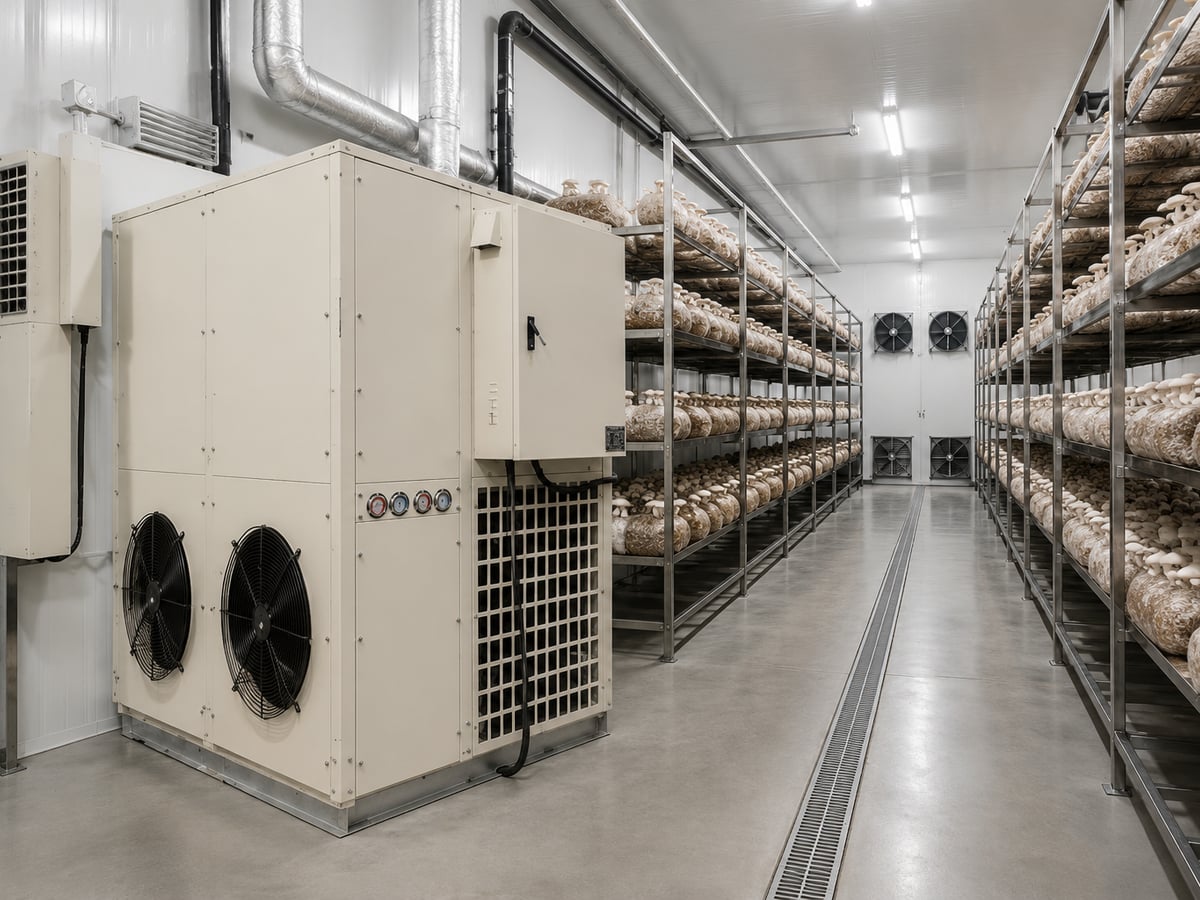
Fast Comparison of Mushroom Growing Room Options

For most commercial mushroom projects in the Global Market, a smart cultivation container is the best choice when speed, predictable performance, mobility, and smaller production volumes matter most. An insulated panel growing room is usually the stronger option when a farm has a permanent building, needs larger production capacity, or wants to use existing warehouse space.
Neither option is universally better. The practical decision depends on the mushroom species, substrate volume, harvest schedule, available utilities, local labor, freight access, sanitation requirements, and future expansion plan. Oyster mushroom growers may prioritize frequent fresh-air exchange and simple washdown. Shiitake producers may need longer environmental cycles and carefully managed humidity. Button mushroom farms often require larger room volumes, robust air circulation, and integrated shelving systems.
A container is a compact, factory-built production unit. It normally combines insulated walls, refrigeration or heat pump equipment, fresh-air fans, humidification, electrical controls, drainage, lighting, and racks in one transportable structure. A panel room is built on site using insulated sandwich panels, sealed doors, floor insulation, climate equipment, and custom racks. Both can achieve controlled temperature, humidity, carbon dioxide, and air movement when engineered correctly.
| Decision Factor | Smart Mushroom Container | Insulated Panel Growing Room | Best Fit |
|---|---|---|---|
| Initial deployment speed | Usually delivered as a ready-to-operate unit | Requires site preparation and installation | Container for urgent projects |
| Production scale | Compact and modular | Can be designed for large batches | Panel room for high-volume farms |
| Mobility | Can be relocated when required | Permanent installation | Container for leased sites |
| Internal layout flexibility | Standardized dimensions and rack spacing | Customized dimensions and aisle width | Panel room for unusual layouts |
| Construction quality control | Factory controlled assembly and testing | Depends on local installation quality | Container for remote markets |
| Expansion approach | Add units in phases | Extend the building or add rooms | Depends on land and capital plan |
| Typical applications | Demonstration farms, premium mushrooms, urban farms | Commercial farms, warehouses, processing sites | Match system to operating model |
The table shows why procurement should begin with the farming model rather than the product category. A buyer in Dubai may need a container with high ambient-temperature cooling capacity. A producer near Rotterdam may place greater emphasis on energy recovery, strict hygiene procedures, and integration with warehouse logistics. A farm outside Nairobi may prefer a durable modular unit that can be shipped through Mombasa and installed with limited local construction work.
Defining the Purpose of the Growing Room

Before comparing containers and insulated rooms, define what the space must do. A mushroom growing room may be used for incubation, fruiting, temporary holding, research, spawn trials, demonstration farming, or year-round commercial harvesting. Each function has different environmental demands.
Incubation rooms generally maintain stable temperatures with lower fresh-air requirements, depending on the substrate and species. Fruiting rooms need more active control of temperature, humidity, carbon dioxide, and air distribution. Fresh-air exchange is particularly important because mushroom mycelium and fruiting bodies release carbon dioxide. If carbon dioxide rises too high, stems may elongate, caps may become smaller, and yield uniformity can decline.
Commercial planning should also distinguish between a single-purpose room and a multi-stage production system. A single fruiting room can be appropriate for small farms, training centers, restaurants, agricultural schools, and pilot projects. Larger farms commonly separate substrate preparation, incubation, fruiting, harvest handling, cold storage, packing, and waste management. Separating clean and dirty workflows helps reduce contamination risk.
| Room Function | Main Environmental Priority | Operational Requirement | Suitable Structure |
|---|---|---|---|
| Oyster mushroom fruiting | Fresh air, humidity, moderate cooling | Frequent harvesting and washdown | Container or panel room |
| Shiitake fruiting | Stable temperature and humidity cycles | Longer crop management period | Container or panel room |
| Button mushroom cropping | Large airflow volume and uniform cooling | High-capacity shelving and workflow | Panel room commonly preferred |
| Incubation | Temperature stability | Limited access and clean handling | Both options suitable |
| Research and trials | Independent setpoint control | Data logging and repeatable conditions | Container often advantageous |
| Farm demonstration | Visibility and reliable automation | Simple operation for visitors | Container often advantageous |
| Urban food production | Compact footprint and low disruption | Close-to-market harvesting | Container commonly preferred |
This functional definition also shapes equipment selection. A fruiting room may require cooling, heating, humidification, dehumidification, ventilation fans, air ducts, sensors, alarms, lighting, and a programmable controller. For a more integrated solution, buyers can review a smart mushroom climate controller that manages temperature, humidity, carbon dioxide, fresh-air exchange, and operating schedules.
For the Global Market, climate data should be assessed at the actual farm location. Coastal humidity in Singapore, dry heat in Riyadh, seasonal cold in Warsaw, and tropical rainfall near Ho Chi Minh City create very different load conditions. The correct room is not based only on nominal dimensions; it must be designed around the most demanding operating period.
Comparing Containers and Insulated Panel Rooms

Smart mushroom cultivation containers are prefabricated, insulated structures built around shipping-container dimensions or custom modular frames. They are attractive because production systems can be assembled, wired, tested, and inspected before shipment. Once delivered, the site normally needs a level foundation, electrical connection, water supply, drainage, and space for airflow around the equipment.
Insulated panel rooms use polyurethane, polyisocyanurate, or similar sandwich panels installed within a new or existing building. They can be designed around nearly any practical floor plan. This makes them suitable for large farms, processing facilities, converted warehouses, and projects where racks, doors, corridors, and service areas must be customized. Proper sealing at panel joints, floor-wall transitions, doors, and penetrations is essential because uncontrolled air leakage increases energy use and makes climate control less stable.
Container construction offers standardized geometry. This simplifies export packing, freight planning, and phased deployment. A customer can begin with one cultivation unit, verify market demand, and add more modules later. This model is useful for distributors, agricultural contractors, community farming projects, hotels, supermarkets, and farms that operate on leased land.
Panel-room construction offers more freedom for ceiling height, room width, central aisles, double-door access, shelving levels, and loading systems. It can also integrate with existing chilled-water systems, renewable-energy systems, or central boiler and heat-pump plants. However, the total result depends heavily on civil works, local contractors, drainage quality, and commissioning discipline.
| Construction Element | Container Approach | Panel-Room Approach | Procurement Consideration |
|---|---|---|---|
| Envelope | Factory-installed insulated structure | Panels assembled on site | Check insulation thickness and fire rating |
| Doors | Predefined door positions | Custom personnel and loading doors | Plan hygiene and material flow |
| Floor | Integrated steel base with finished surface | Concrete slab with insulation and coating | Confirm load, slope, and cleanability |
| Electrical work | Prewired control cabinet possible | Installed by local contractor | Verify voltage and local electrical standards |
| Climate equipment | Compact integrated equipment package | Custom-sized equipment selection | Calculate local design conditions |
| Freight logistics | Suitable for containerized international shipping | Panels and equipment shipped separately | Compare port access and inland transport |
| Site dependency | Lower construction dependency | Higher civil and installation dependency | Assess contractor capability early |
For buyers importing equipment through Shanghai, Qingdao, Rotterdam, Jebel Ali, Los Angeles, Santos, Durban, or Melbourne, shipping format can materially affect the project schedule. Containers may simplify international handling, while panel-room projects can be more efficient when the site is already under construction and local labor is available.
Floor Area, Racking, and Crop Capacity Planning
Available floor area does not equal usable growing area. The productive capacity of a mushroom room depends on rack levels, aisle width, access requirements, equipment location, door clearance, drainage channels, and the need to move substrate blocks or trays safely. Overfilling a room can reduce airflow and make harvesting difficult, even when the nominal substrate capacity appears attractive.
A narrow container may use wall-mounted or central racks with a service aisle. A wider panel room may use multiple rack banks with cross aisles and dedicated harvest access. The layout should allow workers to inspect every shelf, remove damaged blocks, clean surfaces, and harvest without brushing against mature mushrooms. In high-humidity environments, easy access is also important for finding condensation, leaks, and mold growth early.
Rack design must account for substrate weight. Wet mushroom blocks, compost trays, and reusable growing containers can impose significant loads. Galvanized steel, stainless steel, aluminum, or coated metal racks may be selected according to hygiene, corrosion resistance, and budget. Avoid untreated materials that can absorb water and become difficult to sanitize.
| Layout Variable | Why It Matters | Recommended Planning Question |
|---|---|---|
| Rack levels | Increases vertical production density | Can workers reach and harvest safely? |
| Aisle width | Supports movement, cleaning, and harvest carts | Will staff have clear access to every crop block? |
| Ceiling height | Affects rack capacity and air distribution | Can air reach the highest shelf evenly? |
| Equipment zone | Prevents obstruction around fans and coils | Is service access available for maintenance? |
| Door opening | Determines loading and unloading efficiency | Can racks, pallets, or carts enter safely? |
| Drain position | Controls washdown water and hygiene | Does the floor slope direct water to drainage? |
| Crop separation | Reduces cross-contamination and scheduling conflict | Should different ages or species be separated? |
Capacity projections should be conservative. A supplier should specify usable rack area, recommended block loading, anticipated crop cycle, and the limitations of the climate system. A room advertised with large rack space may still underperform if cooling, humidification, or fresh-air capacity is insufficient for the intended biological load.
For projects that need a complete factory-built unit, a smart mushroom cultivation container can be configured with suitable racks, climate equipment, lighting, control systems, and operational layout before dispatch.
Climate Loads and Air Distribution Design
Climate control is the operational core of every mushroom growing room. Mushrooms respond not only to room temperature but also to humidity, carbon dioxide concentration, air velocity, substrate temperature, and the consistency of conditions between shelves. A high-quality room envelope reduces heat gain and heat loss, but it cannot compensate for incorrectly sized equipment or poorly designed airflow.
Climate load calculations should consider outside temperature, solar exposure, insulation level, door opening frequency, lighting heat, fan heat, equipment heat, worker activity, substrate respiration, humidification demand, and fresh-air requirements. Tropical locations may require continuous cooling and dehumidification. Cold-climate sites may need heating and frost protection. Desert operations may need heavy cooling capacity and water-efficient humidification strategies.
Air distribution should avoid direct high-velocity air on mushroom caps, which can cause drying or uneven development. At the same time, stagnant corners should be avoided because they encourage inconsistent carbon dioxide levels, condensation, and disease pressure. Duct design, fan placement, supply-air direction, return-air paths, and rack spacing must work together.
| Climate Variable | Operational Risk if Poorly Controlled | Design Response |
|---|---|---|
| Temperature | Slow growth, premature fruiting, reduced quality | Size cooling and heating for local extremes |
| Relative humidity | Dry caps, cracking, condensation, bacterial issues | Use responsive humidification and ventilation control |
| Carbon dioxide | Long stems, weak caps, irregular morphology | Use sensors and controlled fresh-air exchange |
| Air velocity | Drying or stagnant air zones | Balance fans, ducts, and rack arrangement |
| Substrate heat | Crop stress and uneven flushing | Monitor biological load and room circulation |
| Outside air quality | Dust, insects, spores, and contamination | Use filtration and protected air intakes |
| Door openings | Sudden humidity and temperature loss | Use disciplined workflow and suitable door seals |
Automation can improve consistency by recording environmental trends, alerting operators to faults, and coordinating fans, humidifiers, cooling equipment, and dampers. It does not replace crop management, but it gives growers better visibility. Daily observation of mushroom development remains important because a sensor can show a number, while an experienced grower can identify changes in cap texture, pin formation, color, and substrate condition.
The chart is a general planning illustration, not a replacement for engineering calculations. A well-designed insulated room can outperform a poorly selected container, and a correctly configured container can outperform a poorly constructed panel room. The objective is to match equipment capacity and construction quality to crop biology and site conditions.
Drainage, Hygiene, and Washdown Requirements
Drainage is frequently underestimated during mushroom room planning. High humidity, routine cleaning, crop residue, and occasional washdown create moisture that must be managed safely. Water should not stand under racks, flow toward doorways, or collect near electrical equipment. A cleanable floor with a suitable slope to drains supports better hygiene and reduces slip risk.
Panel rooms should normally be planned with a sealed floor finish, coved wall-to-floor details where practical, and properly located drains. Containers should include a drainage concept that matches the local site connection. In either case, wastewater handling must comply with local rules, particularly where substrate residue, cleaning agents, or organic matter may enter the drainage system.
Washdown procedures must be compatible with electrical enclosures, fans, sensors, lights, and climate equipment. A room should not be pressure-washed without understanding the protection rating of installed components. Cleaning schedules should include racks, wall surfaces, floors, drains, door gaskets, humidification lines, filters, and condensate trays.
For food-related production, hygiene planning should extend outside the growing room. Harvest containers, worker footwear, handwashing stations, packaging surfaces, and cold-chain handling can affect final product quality. The best growing room is part of a controlled production process rather than an isolated box.
Construction Schedule and Expansion Planning
Construction time can shape investment decisions. A prefabricated container can reduce on-site building work because major equipment integration occurs at the factory. This is valuable in regions with short growing seasons, remote construction sites, high local labor costs, or limited access to specialist refrigeration technicians. Site work still matters: foundations, utility connections, drainage, permits, crane access, and commissioning must be prepared before arrival.
Insulated panel rooms normally require more coordination. Civil works, structural support, floor preparation, panel installation, electrical work, refrigeration installation, controls, drainage, racking, and testing may involve several contractors. The longer schedule can be justified when the project requires a custom footprint or very large production capacity.
Expansion should be planned from the beginning. A container farm can reserve space and utility capacity for additional modules. A panel-room project can reserve structural space for future rooms, corridors, refrigeration capacity, and drainage branches. Adding production space later is easier when electrical supply, water flow, wastewater capacity, and loading access have been designed for growth.
By 2026, modular farming investment is expected to place greater emphasis on phased capacity deployment. Producers may start with one or two controlled rooms, secure customers, validate labor requirements, and expand only after establishing stable sales channels. This reduces the risk of building oversized facilities before local demand is proven.
Selecting the Right Room for Your Location
Choosing a room for your site requires a practical assessment of location, market access, and utilities. A farm near major urban markets such as London, Toronto, Johannesburg, Jakarta, Mexico City, or Sydney may value daily harvesting and short delivery times. A rural farm may prioritize robust construction, easy maintenance, and dependable power solutions. Export-oriented producers near ports such as Qingdao, Rotterdam, Jebel Ali, Mombasa, Santos, or Long Beach should plan equipment delivery and spare-parts availability early.
Buyers should compare local suppliers, imported modular manufacturers, refrigeration contractors, panel installers, and agricultural engineering firms. A local supplier may provide rapid site service but may not have specific mushroom climate-control experience. An international manufacturer may offer integrated design and factory testing but requires clear communication about voltage, weather, codes, freight, site preparation, and after-sales support.
Ask every supplier for the operating assumptions behind the proposal. These should include outdoor design temperatures, room setpoints, humidity targets, fresh-air volume, estimated substrate load, insulation specification, power consumption assumptions, drain requirements, rack loading, and maintenance recommendations. Avoid selecting only by the lowest equipment price, because unstable climate conditions can create recurring crop losses that outweigh the initial savings.
Useful buying questions include:
- What mushroom species and production stage will the room support?
- What ambient climate range was used for the equipment calculation?
- How are temperature, humidity, carbon dioxide, and fresh-air exchange controlled?
- What insulation thickness and panel construction are included?
- How will drainage, condensate, and washdown water be handled?
- What site utilities and foundations are required before delivery?
- What commissioning, spare-parts, and remote support services are available?
Lanhu Manufacturing, Technology, and Service Support
Shandong Lanhu Air Conditioning Equipment Co., Ltd. supports Global Market mushroom projects with modular cultivation systems and agricultural climate-control equipment. The company’s technical strength is based on more than 12 years of thermodynamic research and development experience, practical climate-control engineering, and a portfolio of more than 45 registered patents. Its product development focuses on coordinated control of cooling, heating, ventilation, humidity, and environmental monitoring for controlled cultivation.
From a manufacturing perspective, Lanhu operates a modern production facility of more than 30,000 square meters in Dezhou, Shandong, China. Integrated capabilities include equipment design, sheet metal processing, CNC bending, insulation-panel production, electrical assembly, system integration, testing, and quality inspection. Functional inspection, electrical verification, performance testing, and operational evaluation are conducted before shipment to help reduce commissioning uncertainty at the customer site.
Lanhu also provides factory-direct supply, OEM and ODM customization, engineering assistance, international logistics coordination, installation guidance, spare-parts support, and after-sales service. This combination is relevant for agricultural contractors, distributors, engineering companies, commercial farms, and development projects that require a partner capable of adapting equipment to different site conditions. Buyers can explore OEM and ODM mushroom cultivation solutions for branding, dimensions, control configurations, and project-specific requirements.
Quality management and operational safety are supported by certifications including ISO 9001, ISO 14001, ISO 45001, and ISO 12100. For prospective buyers, the most useful next step is to share the mushroom variety, daily or weekly substrate loading, local climate data, electrical standard, water source, available footprint, and target commissioning date. This allows the technical team to recommend whether a container, a panel room, or a combined modular system is the more appropriate option.
Examples of completed cultivation concepts and project applications can be reviewed through Lanhu’s mushroom cultivation project cases. Case-based evaluation helps buyers compare layouts, climate-control approaches, and modular deployment strategies before finalizing procurement.
Frequently Asked Questions
Is a mushroom container cheaper than an insulated panel room?
Not always. A container may reduce site labor, design coordination, and construction time, while a panel room may offer lower cost per square meter at larger scale. Compare the total installed cost, including foundations, utilities, freight, racks, climate equipment, installation, commissioning, and future expansion.
Can one room grow different mushroom species?
It is possible, but not always recommended. Different species and crop stages may require different temperature, humidity, carbon dioxide, and airflow conditions. Separate rooms improve environmental control and reduce cross-contamination risks.
How important is humidity control?
Humidity is essential for healthy mushroom development. Low humidity can dry fruiting bodies and reduce quality, while excessive humidity and condensation can increase disease pressure. Humidity must be balanced with air movement, temperature, and fresh-air exchange.
Do containers work in hot climates?
Yes, provided the insulation, cooling equipment, ventilation design, and electrical capacity are engineered for local peak temperatures. Hot-climate projects should not use generic equipment calculations designed for mild weather.
What utilities are needed for a mushroom growing room?
Most projects require stable electricity, water, drainage, site access, and a level foundation. Exact needs depend on the climate system, humidification method, room size, and local regulations. Backup power may be important in areas with unreliable grids.
How should growers prepare for 2026 sustainability requirements?
Growers should prioritize energy-efficient insulation, variable-speed fans, accurate sensor control, heat-pump technology where appropriate, water-conscious humidification, recyclable packaging, and substrate reuse or composting plans. Environmental reporting and energy-cost transparency are becoming more important in many Global Market supply chains.
Can a modular container farm be expanded later?
Yes. One of the main advantages of modular cultivation containers is phased expansion. Farms can add units as sales, labor, substrate supply, and utility capacity grow, provided the original site plan reserves adequate space and infrastructure.
What is the most important purchasing mistake to avoid?
The most common mistake is selecting a room based only on external dimensions or purchase price. Successful mushroom production depends on the complete system: insulation, climate capacity, airflow, drainage, racking, controls, hygiene, installation quality, and service support.
Share this article

About the Author: Shandong Lanhu Air Conditioning Equipment
Lanhu is a professional climate control equipment manufacturer specializing in smart agricultural systems, commercial HVAC solutions, and customized temperature control technologies. With extensive engineering experience, Lanhu provides reliable solutions for plant factories, controlled environment agriculture, and industrial applications.
Need a Custom Climate Control Solution?
From smart agricultural systems to commercial HVAC solutions, Lanhu provides reliable temperature and humidity control solutions tailored to your project needs.
Contact Us