Global Market Guide to Turnkey Mushroom Farm Scope
Quick Answer

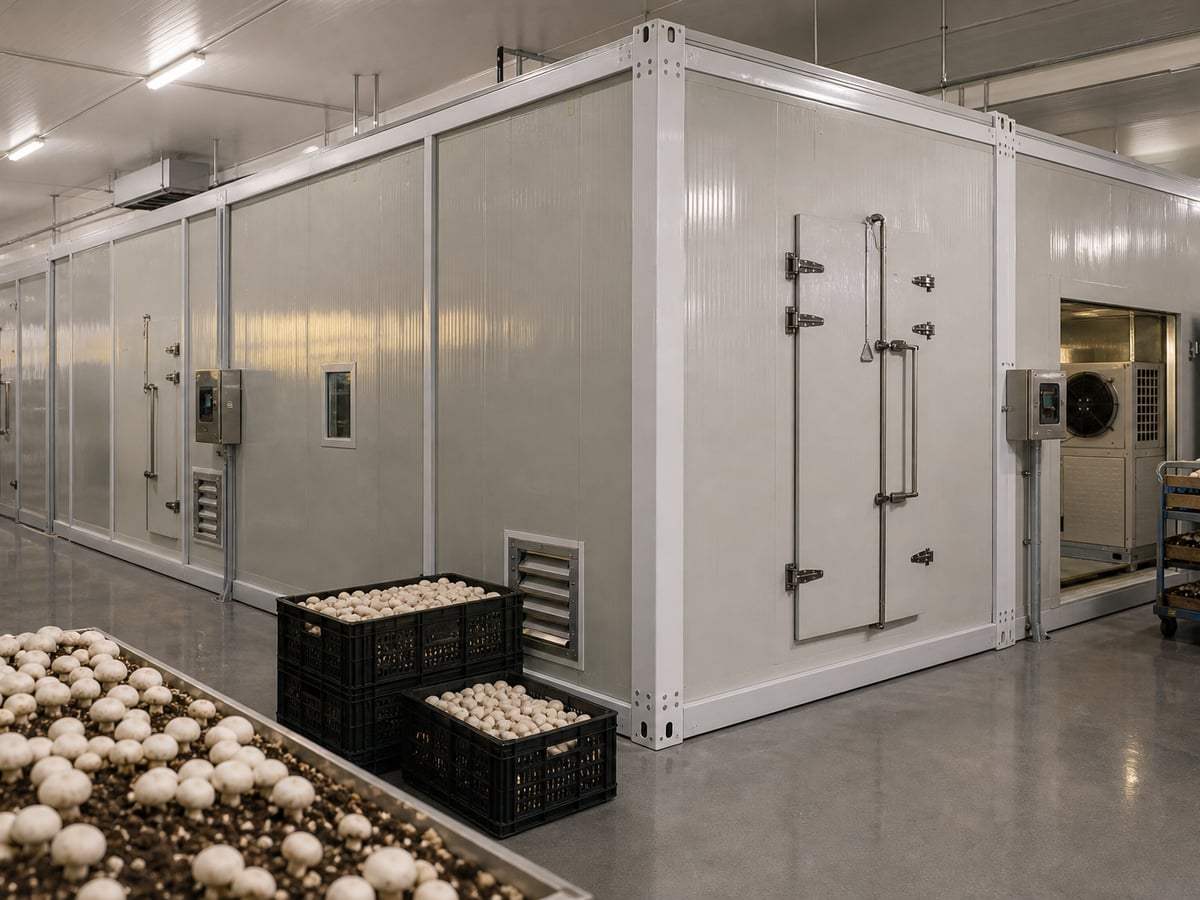
A turnkey mushroom farm should mean a clearly defined, operational production system rather than a loose collection of equipment. In the Global Market, the term is often used differently by suppliers, contractors, and buyers. One quotation may include cultivation rooms, climate equipment, shelving, electrical controls, installation guidance, and commissioning. Another may only include room panels and a controller. The price difference can look attractive until the buyer discovers that refrigeration piping, drainage, substrate equipment, civil foundations, or operator training were never included.
The practical definition of a turnkey mushroom farm is simple: the supplier and buyer agree in writing on the complete boundary between the farm’s existing site and the production-ready mushroom facility. This boundary should identify what is supplied, who installs it, which utilities are required, what performance conditions are targeted, how the system is tested, and what training is delivered before handover.
For commercial farms producing oyster mushrooms, shiitake, button mushrooms, enoki, king oyster mushrooms, or specialty varieties, the equipment scope usually includes cultivation rooms, insulated panels, air handling, cooling and heating systems, humidity management, fresh-air exchange, carbon dioxide control, lighting where required, shelving or racks, electrical control panels, sensors, alarms, drainage provisions, and basic commissioning. A more complete project may also include substrate preparation, sterilization or pasteurization, inoculation areas, incubation rooms, packing stations, cold rooms, and logistics planning.
Buyers should request a scope matrix before comparing prices. The matrix should list every room, machine, accessory, service, and excluded item. This prevents a low initial quotation from becoming a high-cost project after site work, imported components, installation labor, or missing utilities are added. For a complete overview of containerized options, buyers can review smart mushroom cultivation containers designed for controlled agricultural production.
| Scope Area | Common Turnkey Inclusion | Often Excluded Unless Specified | Buyer Verification Question |
|---|---|---|---|
| Cultivation rooms | Insulated panels, doors, basic internal layout | Concrete slab, external roof, building permits | Does the quote include every panel, door, trim, and seal? |
| Climate control | Cooling, heating, fans, sensors, controller | Refrigerant piping route, outdoor equipment foundation | What temperature, humidity, and CO₂ range is guaranteed? |
| Racking | Galvanized or stainless cultivation shelves | Installation labor and aisle marking | What is the usable growing area and load rating? |
| Utilities | Internal wiring and equipment connections | Incoming electrical supply, water tank, transformer | Where does supplier responsibility end? |
| Substrate process | Only when separately listed | Boiler, mixer, sterilizer, inoculation line | Is substrate preparation included or farm-managed? |
| Commissioning | Basic controller setup and testing | Crop recipe optimization and long-term staffing | How many commissioning days are included? |
This table matters because “turnkey” is not a universal technical standard. It is a commercial promise that must be converted into drawings, bills of quantities, utility schedules, delivery terms, and acceptance criteria. Whether the project is located near Rotterdam, Dubai, São Paulo, Johannesburg, Los Angeles, Singapore, or a rural production area, the written scope should remain equally precise.
What Turnkey Should Mean in Writing

A reliable turnkey agreement begins with documentation. Verbal confirmation, promotional images, and general product descriptions are not enough for a commercial mushroom project. The contract should define the physical scope, the service scope, the performance target, the project schedule, and the handover method. It should also separate guaranteed equipment functions from biological outcomes that depend on substrate quality, spawn quality, crop hygiene, and farm management.
For example, a supplier can reasonably specify that a cultivation room will maintain a defined temperature range under stated outdoor design conditions, maintain relative humidity through installed equipment, circulate a designed air volume, and monitor carbon dioxide through calibrated sensors. It is less realistic to guarantee a fixed mushroom yield without controlling raw materials, cultivation formula, contamination control, labor quality, harvest timing, and local operating practices.
A strong written scope normally includes general arrangement drawings, room dimensions, equipment layout, electrical load data, water consumption estimates, drainage needs, installation interfaces, shipping packaging details, and a list of consumables or spare parts. It should state whether materials are galvanized steel, stainless steel, food-grade plastic, polyurethane insulated panel, rock wool panel, or another specified construction material.
| Written Document | Why It Is Needed | Minimum Information to Include | Risk If Missing |
|---|---|---|---|
| Scope of supply list | Defines what is sold | Model, quantity, dimensions, accessories | Missing components and disputes |
| Layout drawing | Confirms workflow and room arrangement | Doors, aisles, racks, machinery, service access | Poor circulation and unusable space |
| Utility schedule | Prepares the site | Power, voltage, water, drainage, compressed air | Delayed commissioning |
| Climate design sheet | Sets operating expectations | Temperature, humidity, airflow, outdoor conditions | Performance misunderstandings |
| Installation responsibility list | Allocates labor and tools | Supplier tasks, buyer tasks, local contractor tasks | Unplanned labor expenses |
| Acceptance protocol | Defines completion | Testing steps, inspection points, records, sign-off | No clear handover standard |
The explanation behind this documentation is straightforward: a mushroom facility is a system, not a single machine. Each part affects the next. An undersized electrical supply can limit cooling capacity. A poorly designed drain can create standing water and hygiene risks. Insufficient fresh-air capacity can lead to excessive carbon dioxide during pinning and fruiting. A room without suitable access doors may make rack loading, cleaning, and harvest collection inefficient.
International buyers should also identify the applicable delivery term, export packing requirements, customs documentation responsibility, and destination-site support. Projects shipped through Qingdao, Shanghai, Ningbo, Hamburg, Jebel Ali, Durban, Santos, or Long Beach may face different handling conditions, local compliance requirements, and onward transport limitations. Container dimensions, unloading equipment, road access, and local lifting capacity should all be reviewed before production begins.
Cultivation Rooms and Climate Equipment

Cultivation rooms are the central production assets in a controlled mushroom farm. A well-designed room must support stable environmental conditions while allowing cleaning, loading, harvesting, maintenance, and worker movement. The selected room size depends on mushroom species, substrate format, harvest cycle, daily production target, labor method, and available site space. For smaller commercial projects, modular rooms or containerized systems can simplify deployment. For larger farms, insulated room blocks with centralized or semi-centralized climate systems may offer better scale efficiency.
The climate package should be selected according to crop requirements and local weather. In hot and humid locations such as Southeast Asia, the Gulf region, coastal Africa, and tropical Latin America, dehumidification, sensible cooling, and condensation control may be more important than heating. In cold climates across Northern Europe, Central Asia, Canada, and inland China, heating capacity, frost protection, insulated construction, and heat recovery may be central design considerations.
A mushroom room typically combines cooling or heating equipment, circulation fans, fresh-air dampers, exhaust arrangements, humidification devices, ducts or air distribution structures, sensors, and a climate controller. The system should be designed for uniformity, not simply capacity. A powerful cooling unit cannot compensate for poor airflow distribution, blocked racks, insufficient return-air paths, or uncontrolled infiltration around doors.
Modern climate automation can improve operational consistency by recording temperature, humidity, carbon dioxide, fan status, alarm history, and equipment operating hours. A smart mushroom climate controller can help operators manage stage-based recipes, reduce manual adjustments, and identify deviations early. However, automation should be paired with sensible room design, quality sensors, routine maintenance, and trained staff.
| Climate Component | Primary Function | Key Selection Factor | Typical Buyer Check |
|---|---|---|---|
| Insulated panels | Reduce heat gain, heat loss, and condensation | Panel thickness, core material, joint sealing | Are walls, ceiling, doors, and joints fully insulated? |
| Cooling unit | Removes sensible and latent heat | Local outdoor design temperature and room load | What capacity is available at peak ambient conditions? |
| Heating source | Maintains crop temperature in cold weather | Energy source, safety, control accuracy | Is backup heating required for winter operation? |
| Humidification system | Maintains crop moisture environment | Water quality, droplet size, sanitation | Can it avoid direct wetting of mushrooms and surfaces? |
| Fresh-air system | Controls CO₂ and renews room air | Crop stage, occupancy, room loading density | How is fresh air measured and distributed? |
| Climate controller | Coordinates equipment and alarms | Sensor inputs, recipe logic, remote access | Are alarms, data records, and manual overrides included? |
The table illustrates why comparing only the cooling-unit nameplate is inadequate. A complete climate solution includes room envelope quality, control strategy, air movement, humidity method, sensor placement, drainage, and service access. Buyers should request a room-by-room design statement that identifies expected operating ranges and the conditions under which those ranges are intended to be achieved.
For projects that require fast deployment, modular cultivation units can be useful for pilot farms, urban agriculture projects, research facilities, remote sites, distributor demonstrations, and expansion phases. Their value is not only mobility; it is also factory-controlled assembly, repeatable configuration, and simplified export logistics. The final choice between a container, modular room, or conventional building should reflect production scale and long-term operating cost rather than initial purchase price alone.
Substrate Preparation and Incubation Boundaries
Substrate preparation and incubation are frequently misunderstood parts of a turnkey mushroom farm quotation. Some suppliers focus on fruiting rooms only. Others offer equipment from raw material handling through incubation and harvest. Neither approach is automatically better, but the boundary must be explicit. A farm buying ready-to-fruit blocks from a specialized substrate producer has different equipment needs from a vertically integrated operation making its own bags, bottles, compost, or bulk substrate.
Typical substrate preparation equipment may include straw cutters, sawdust handling systems, mixers, water dosing equipment, bagging machines, bottle filling systems, boilers, steam sterilizers, pasteurization tunnels, cooling rooms, clean inoculation areas, inoculation machines, and transfer conveyors. These systems require more than equipment selection. They require steam, water, drainage, ventilation, electrical capacity, hygiene zoning, labor planning, and raw-material storage.
Incubation rooms also need dedicated design. Their temperature, fresh-air requirement, lighting level, and humidity strategy may differ substantially from fruiting rooms. In many production methods, incubation requires stable conditions and careful heat removal from actively colonizing substrate. Crowded racks, blocked airflow, or uneven substrate loading can create temperature differences that increase contamination risk or lead to inconsistent crop development.
Buyers should decide early whether their project will have three separate boundaries: substrate production, incubation, and fruiting. Separating these zones improves hygiene control and workflow clarity. It can also make phased investment easier. A producer may begin by purchasing prepared substrate, then add incubation capacity, and later invest in substrate processing once market demand and operator experience are established.
| Process Stage | Possible Equipment | Turnkey Scope Decision | Critical Interface |
|---|---|---|---|
| Raw material storage | Bins, sheds, conveyors, weighing system | Included in integrated farms or buyer-provided | Dry storage, dust control, vehicle access |
| Mixing and moisture adjustment | Mixer, water dosing, conveyor | Specify capacity per batch or per hour | Water quality and accurate formulation |
| Bagging or filling | Bagging machine, bottle filler, sealing unit | Depends on substrate format | Film, bags, bottles, caps, labor supply |
| Sterilization or pasteurization | Steam boiler, retort, tunnel, chamber | Must include safety and steam boundary | Fuel, water treatment, pressure compliance |
| Inoculation | Clean room, laminar unit, inoculation machine | Often separate from cultivation package | Spawn handling and sanitation procedures |
| Incubation | Insulated room, racks, cooling, ventilation | Include if blocks are not purchased ready-colonized | Heat load, batch tracking, room turnover |
This process table helps buyers identify a common hidden cost: a fruiting room can be technically complete while the production chain remains incomplete. A supplier should explain which parts are included, which are optional, and which are outside the equipment scope. If a buyer plans to source substrate externally, the supplier should still understand substrate dimensions, block weight, bag material, loading pattern, and expected delivery rhythm because these factors influence rack spacing, room loading, airflow, and harvest scheduling.
Packing and Cold Storage Requirements
Packing and cold storage are essential when mushrooms are sold to supermarkets, hotels, restaurants, wholesalers, distributors, food processors, or export channels. Fresh mushrooms are highly perishable, and the post-harvest process often determines the commercial value of the crop. A cultivation room may produce excellent mushrooms, but poor handling after harvest can reduce shelf life, increase moisture loss, damage appearance, and create customer complaints.
A practical packing area should support clean workflow from harvest arrival to sorting, trimming, weighing, packaging, labeling, crate handling, and dispatch. Depending on the product and market, the facility may require stainless worktables, wash stations, scales, packaging sealers, label printers, plastic crates, carton handling areas, and waste collection points. The room should be easy to clean, adequately lit, and separated from dirty material flow.
Cold storage requirements depend on species, packaging method, harvest volume, delivery schedule, and ambient conditions. The scope should clarify whether the cold room is designed for rapid pull-down, temporary holding, overnight storage, or multi-day inventory. It should also identify the usable storage volume rather than only external room dimensions. Doors, floor insulation, shelving, evaporator location, condensate drainage, and loading access all influence practical performance.
For distribution centers near major trade hubs such as Dubai, Singapore, Rotterdam, Istanbul, Mexico City, Nairobi, and Sydney, buyers may need additional staging capacity because delivery schedules can be affected by traffic, customs procedures, flight connections, or retailer receiving windows. A cold room should be sized for operational reality, not simply average daily harvest.
Site Works and Utility Responsibilities
Site works are one of the largest sources of confusion in mushroom farm projects. Equipment suppliers commonly manufacture and deliver the controlled-environment system, while buyers arrange civil construction, local permits, incoming utilities, and local installation labor. This is normal, but the division of responsibility must be stated before purchase.
Typical buyer-side works include land preparation, building construction, concrete foundations, drainage channels, external roofing, transformer installation, incoming electrical cable, water supply, wastewater discharge, fuel supply, local fire protection requirements, internet access, and access roads for delivery vehicles. Typical supplier-side works may include room panels, internal equipment, controls, rack systems, electrical panels, equipment drawings, remote installation guidance, and commissioning support.
Not every project uses the same boundary. A modular container project may require only a level pad, power, water, drainage, and access for unloading. A large integrated farm may require extensive civil work, boiler-house planning, ventilation stacks, utility rooms, warehouses, staff changing facilities, and wastewater management. Buyers should have local engineers review structural, electrical, fire, environmental, and occupational safety obligations in their region.
| Site or Utility Item | Usually Buyer Responsibility | Possible Supplier Support | Pre-Delivery Check |
|---|---|---|---|
| Concrete foundation | Yes | Foundation load and dimension drawings | Levelness, drainage slope, curing completion |
| Incoming electricity | Yes | Load list, voltage and phase requirements | Capacity, grounding, protection devices |
| Water supply | Yes | Consumption estimate and connection location | Pressure, filtration, water quality |
| Drainage and wastewater | Yes | Internal drain point locations | Flow direction, traps, discharge approval |
| Local construction permits | Yes | Equipment technical documents where needed | Permit timeline and inspection requirements |
| Equipment installation | Varies by contract | Guidance, video support, engineers, manuals | Labor, lifting tools, accommodation, safety plan |
The value of this table is that it converts broad responsibility statements into practical actions. Before shipment, both parties should review a site readiness checklist. The checklist should confirm room location, utility points, foundation condition, access road width, unloading method, storage space for delivered equipment, local tools, lifting equipment, and availability of installation workers.
For international projects, electrical standards deserve special attention. Voltage, frequency, phase configuration, cable standards, breaker specifications, grounding rules, and plug types differ between countries. Buyers should provide local electrical information early, particularly when equipment will be installed in Africa, the Middle East, Europe, the Americas, or island markets where replacement parts and technical support must be planned carefully.
Training and Commissioning Deliverables
Commissioning is the process of confirming that the installed system operates as designed. Training is the process of ensuring that farm personnel can use, inspect, clean, and maintain that system responsibly. Neither should be treated as a minor add-on. A climate-controlled mushroom farm is only as effective as the operator’s ability to interpret conditions, respond to alarms, maintain hygiene, and follow crop-stage procedures.
A basic commissioning package should include equipment inspection, electrical verification, fan rotation checks, refrigeration or heating checks, sensor review, controller configuration, alarm testing, drainage inspection, and trial operation. If the project includes multiple rooms, each room should be tested individually. The handover record should identify settings used during testing and any items requiring local follow-up.
Training should cover controller navigation, recipe adjustment, daily checks, cleaning routines, air filter maintenance, humidification sanitation, basic troubleshooting, alarm response, door discipline, rack loading patterns, harvesting workflow, and record keeping. Biological cultivation guidance can also be useful, but buyers should distinguish equipment training from mushroom agronomy consultancy. Both have value, but they are separate services with different responsibilities.
Remote support can be highly valuable for Global Market projects after equipment delivery. Digital manuals, wiring diagrams, spare-parts lists, controller screenshots, video guidance, and remote fault analysis can reduce downtime. Buyers should confirm the support channel, response expectations, language requirements, available time zone coverage, and whether remote access hardware is included.
Comparing Quotes with Equal Scope
Comparing quotations fairly requires an “apples-to-apples” method. The lowest number on the first page is rarely the lowest project cost. Buyers should compare room capacity, insulation specification, rack area, climate capacity, automation level, electrical scope, shipping terms, installation service, warranty, spare parts, and exclusions. A quotation with fewer listed components may be cheaper because the buyer must supply the missing items later.
Create one buyer-controlled comparison sheet and ask every supplier to complete it. Include dimensions, production capacity assumptions, equipment brands where relevant, component quantities, utility needs, lead time, export packing, delivery term, warranty conditions, installation method, commissioning days, and after-sales support. Do not allow suppliers to use different definitions of growing area, room capacity, or production yield without clarification.
When evaluating suppliers, also review technical credibility. Look for evidence of engineering capability, manufacturing control, project experience, quality processes, and service responsiveness. Product photos alone do not demonstrate that a supplier can support the full project lifecycle. Buyers can study installed-system examples through the mushroom cultivation project case gallery and ask for a scope discussion based on their own site conditions.
Future purchasing decisions will increasingly consider energy efficiency, refrigerant choices, water consumption, remote monitoring, data logging, modular expansion, renewable-energy integration, and food-safety traceability. By 2026 and beyond, mushroom projects will face growing pressure to document energy use, reduce waste, improve worker safety, and meet stricter sustainability expectations from retailers, investors, and public-sector buyers. Efficient insulation, heat-pump integration, variable-speed fans, water-saving humidification, and intelligent control strategies can improve both environmental performance and operating resilience.
Policy trends also matter. More markets are strengthening requirements around electrical safety, refrigerant management, food processing hygiene, worker protection, wastewater control, and energy reporting. Buyers should avoid designs that only meet short-term cost targets. A scalable, maintainable system with documented components and sensible service access is usually a stronger long-term investment.
Our Company
Shandong Lanhu Air Conditioning Equipment Co., Ltd. supports commercial agricultural climate-control projects from Dezhou, Shandong, China. The company serves agricultural contractors, equipment distributors, engineering companies, and farm investors seeking modular cultivation solutions, climate control equipment, and customized project assistance for international markets.
From a technological capability perspective, Lanhu focuses on controlled-environment agriculture, industrial HVAC integration, agricultural climate management, smart controllers, and air-source heat-pump applications. More than 12 years of thermodynamic research and development and a portfolio of registered patents support the development of systems intended to manage temperature, humidity, ventilation, and operational monitoring for mushroom and hydroponic production environments.
From a manufacturing capability perspective, the company operates a modern facility exceeding 30,000 square meters. Its integrated processes include product design, engineering development, sheet-metal fabrication, CNC bending, insulation-panel production, electrical assembly, system integration, equipment testing, and quality inspection. Functional checks, electrical verification, performance tests, and operational evaluation are completed before shipment. Relevant management and safety certifications include ISO 9001, ISO 14001, ISO 45001, and ISO 12100.
From a service capability perspective, Lanhu provides factory-direct supply, OEM and ODM customization, project engineering assistance, international logistics support, spare-parts support, installation guidance, and after-sales service. Buyers seeking customized configurations can explore the company’s OEM and ODM mushroom farming equipment service for support with dimensions, climate requirements, branding, layout, and application-specific technical needs.
For a buyer in the Global Market, the most useful starting point is a site brief that includes location, mushroom species, desired output, available building area, ambient temperature range, utility details, substrate strategy, local labor resources, target sales channel, and budget stage. This allows a supplier to propose a system boundary that is practical rather than generic.
FAQ
Does turnkey always include the building?
Not necessarily. Some turnkey offers include only the controlled-environment rooms and equipment installed inside an existing building. Others include modular structures or containers. Civil construction, permits, foundations, and external utilities are often buyer responsibilities unless explicitly listed.
Can a turnkey mushroom farm guarantee yield?
Equipment suppliers can define environmental performance under stated conditions, but crop yield depends on spawn, substrate formula, contamination control, labor, harvest management, and farm discipline. Yield assumptions should be treated as planning estimates unless the supplier controls the entire biological production process.
Should incubation and fruiting rooms use the same climate settings?
No. Incubation and fruiting commonly have different temperature, ventilation, light, humidity, and carbon dioxide needs. Separate rooms or independently controlled zones generally provide better crop management and hygiene control.
What information should be sent when requesting a quotation?
Provide the site location, target species, daily or annual production goal, substrate format, building dimensions, outdoor climate data, electrical supply, water supply, drainage availability, packing requirements, shipping destination, and desired level of installation support.
Why do two mushroom farm quotations differ so much in price?
The difference may be caused by room size, panel thickness, rack material, cooling capacity, automation level, electrical scope, shipping terms, installation service, included accessories, warranty, or exclusions. Use a shared scope matrix to compare every item.
What spare parts should be ordered with a new farm?
Recommended spares commonly include sensors, controller components where practical, relays, contactors, fuses, fan belts if used, humidification nozzles, filters, door seals, and other wear items specific to the supplied equipment. The final list should be based on the installed system and local parts availability.
Can a modular mushroom container be expanded later?
Yes. Modular units can support phased expansion when site access, utility capacity, workflow, and crop planning are considered in advance. Buyers should reserve space for future units, service corridors, drainage, electrical distribution, and packing capacity.
Share this article

About the Author: Shandong Lanhu Air Conditioning Equipment
Lanhu is a professional climate control equipment manufacturer specializing in smart agricultural systems, commercial HVAC solutions, and customized temperature control technologies. With extensive engineering experience, Lanhu provides reliable solutions for plant factories, controlled environment agriculture, and industrial applications.
Need a Custom Climate Control Solution?
From smart agricultural systems to commercial HVAC solutions, Lanhu provides reliable temperature and humidity control solutions tailored to your project needs.
Contact Us