Global Market Guide to Commercial Fruiting Chamber Systems
Quick Answer

A commercial mushroom fruiting chamber is a controlled cultivation room, insulated container, or modular growing space designed to maintain stable temperature, humidity, carbon dioxide concentration, fresh-air exchange, lighting, and airflow during mushroom fruiting. For the Global Market, the most reliable design is not simply the cheapest cooling unit or humidifier; it is a balanced system where room size, crop load, climate conditions, water quality, ventilation, shelving, and control logic are engineered together.
When sizing a commercial fruiting chamber, start with the weekly production target, substrate block weight, crop cycle, mushroom species, expected biological efficiency, and harvest workflow. Then calculate peak heat release, moisture load, outside-air demand, refrigeration duty, and worker access. Oyster mushrooms, shiitake, lion’s mane, enoki, king oyster, button mushrooms, and specialty medicinal mushrooms can require very different climate strategies.
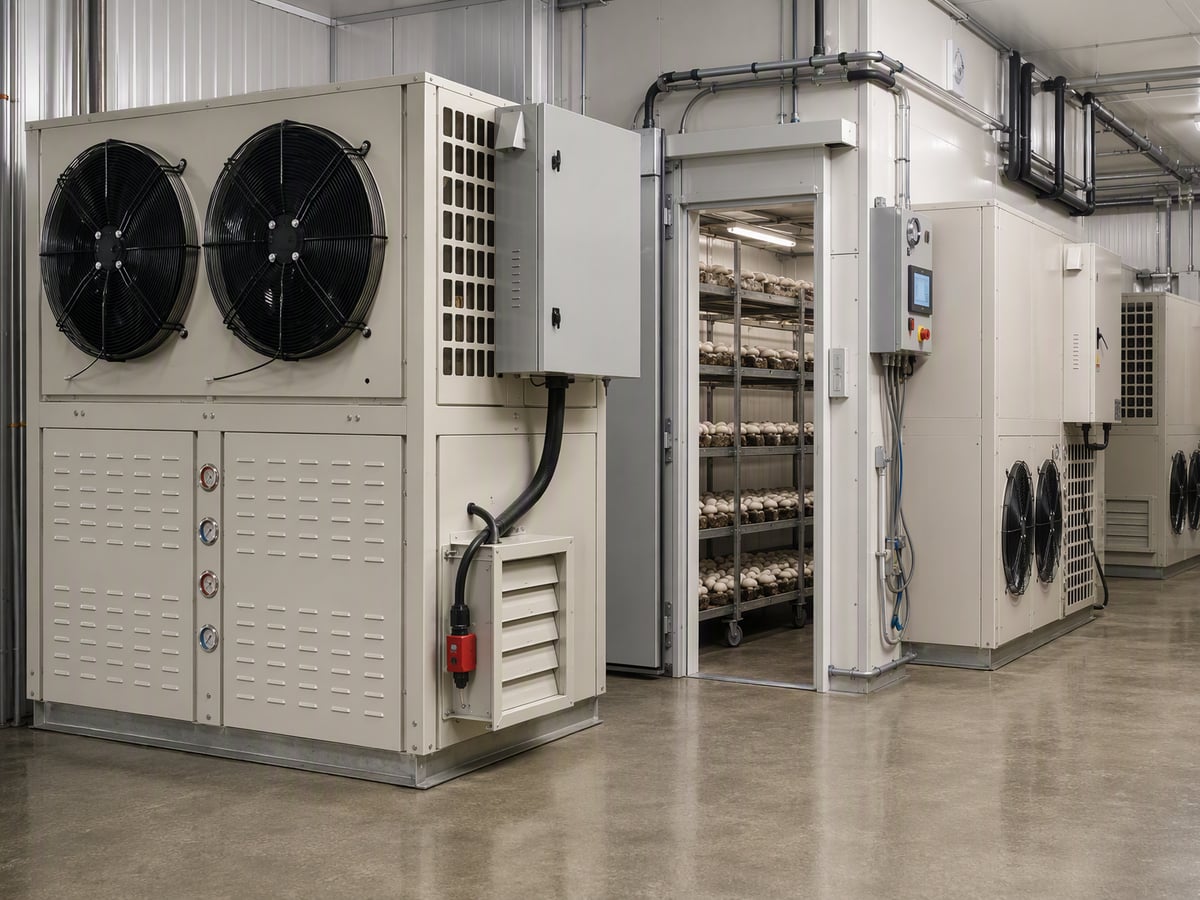
For many commercial farms, modular chambers offer a faster route to deployment than conventional construction. A pre-engineered smart mushroom cultivation container can combine insulated panels, climate equipment, lighting, racks, drainage, and automation in one transportable system. Larger projects may use multiple rooms so crops at different stages can be managed separately and cleaning downtime does not stop the entire operation.
The most important buying principle is simple: purchase capacity for the fully loaded chamber during the warmest, wettest, or most demanding operating condition—not for an empty room on a mild day. A chamber that appears oversized during testing may become undersized once hundreds of hydrated substrate blocks, workers, lighting, fresh-air exchange, and fruiting mushrooms are introduced.
| Planning Factor | Why It Matters | Typical Commercial Question | Design Risk If Ignored |
|---|---|---|---|
| Production target | Determines total substrate and harvest capacity | How many kilograms must be harvested each week? | Insufficient room volume and rack capacity |
| Mushroom species | Defines temperature, CO₂, humidity, and light needs | Is the chamber for oyster, shiitake, lion’s mane, or mixed crops? | Poor pinning, long cycles, malformed fruit bodies |
| Local climate | Changes cooling, heating, dehumidification, and insulation demand | Will the project operate in Dubai, Lagos, Rotterdam, Sydney, or São Paulo? | Seasonal capacity failure and high energy cost |
| Substrate load | Blocks release heat and moisture during active fruiting | What is the maximum loaded wet weight? | Underestimated refrigeration and ventilation requirement |
| Water quality | Affects nozzles, humidifiers, hygiene, and maintenance | Is municipal, borehole, softened, or filtered water available? | Scale buildup, blocked nozzles, microbial contamination |
| Harvest workflow | Influences aisle width, door size, rack design, and labor efficiency | Will workers use carts, crates, lifts, or manual picking? | Congestion, product damage, unsafe access |
This planning table should be treated as a pre-purchase checklist. It helps growers compare proposals on operational performance rather than only chamber dimensions or equipment price. A supplier should be able to explain how each factor affects the final system selection.
Sizing a Commercial Fruiting Chamber

Commercial chamber sizing starts with crop throughput rather than room floor area. A farm harvesting 2,000 kg per week needs enough active fruiting substrate, suitable rack levels, a staggered crop schedule, and adequate packing capacity. The required room volume depends on the number of blocks in fruiting, their spacing, the expected number of flushes, and the desired harvest frequency.
A practical approach is to divide production into multiple independently controlled chambers. Instead of one large room holding all substrate, a farm may operate separate rooms for early pinning, peak fruiting, late flushes, and crop turnover. This limits cross-contamination, makes climate adjustments more precise, and allows one room to be washed and sanitized while other rooms remain productive.
For example, a container-based operation near the Port of Rotterdam may choose several modular chambers because land is expensive and expansion is phased. A tropical farm serving Kuala Lumpur, Manila, or Mombasa may prioritize strong insulation, corrosion-resistant equipment, and substantial latent-load control. A cold-climate project near Toronto, Warsaw, or Ulaanbaatar may need heat recovery and reliable winter heating capacity.
Calculate capacity at maximum occupancy. Wet substrate blocks, floor washdown, humidification, worker entry, lighting, air exchange, and mushroom respiration all add load. The design should also include a reasonable allowance for door opening, harvest carts, future production expansion, and the need to maintain conditions after a hot or humid outdoor air event.
| Chamber Scale | Typical Use | Suggested Layout Approach | Key Equipment Priority |
|---|---|---|---|
| 20–40 m² | Starter commercial farm or pilot production | One compact room or insulated container | Integrated controller and easy-clean racks |
| 40–100 m² | Local restaurant, retail, and distributor supply | Two or three crop-stage rooms | Separate fresh-air and circulation zones |
| 100–300 m² | Regional wholesale mushroom production | Multiple chambers with dedicated service corridor | Redundant cooling and reliable drainage |
| 300–800 m² | Commercial farm with daily harvests | Stage-based rooms and centralized monitoring | Heat recovery, water treatment, alarm system |
| 800–2,000 m² | Industrial fresh mushroom facility | Dedicated fruiting zones by species or crop age | Integrated HVAC engineering and backup planning |
| More than 2,000 m² | Large contract growing or export-oriented operation | Campus-style room blocks with logistics separation | Energy management, redundancy, remote supervision |
The scale guide provides a starting point, not a final engineering calculation. Ceiling height, rack configuration, substrate bag size, local regulations, and crop density can substantially change the final design. A taller chamber can increase cubic volume but may also create stratification if circulation fans and supply-air distribution are not designed correctly.
Before ordering equipment, ask suppliers for a room loading calculation that states the outdoor design temperature, indoor setpoints, substrate heat load, lighting load, ventilation load, safety margin, and assumed occupancy. This makes quotations easier to compare and reduces the risk of purchasing equipment based only on nominal horsepower or generic room area.
Cooling and Heating Equipment

Cooling equipment removes both sensible heat and latent moisture. Sensible heat comes from warm outside air, lighting, motors, workers, and mushroom metabolism. Latent moisture comes from humidification, wet floors, crop transpiration, and incoming humid air. In warm climates, cooling coils must often handle both temperature reduction and moisture removal, especially where outdoor humidity is high.
Air-cooled condensing units, packaged refrigeration systems, ducted fan coils, air source heat pumps, chilled-water systems, and integrated climate machines can all be suitable depending on project size. Small modular chambers often benefit from compact direct-expansion systems. Large farms may prefer multi-zone equipment, centralized plant rooms, or heat-pump-based solutions with stronger service access.
Heating is equally important. Many mushroom species need stable temperatures during winter, overnight periods, or cold-region operations. Electric heaters are simple but can be expensive where electricity tariffs are high. Heat pumps can improve efficiency in temperate regions, while hydronic coils, hot-water systems, or waste-heat recovery may suit larger facilities. Heating equipment must be coordinated with humidity control so warm air does not dry the crop surface excessively.
| Equipment Type | Best Fit | Main Advantage | Key Buying Consideration |
|---|---|---|---|
| Direct-expansion cooling | Containers and small chambers | Compact and responsive | Confirm coil corrosion protection and condensate drainage |
| Air source heat pump | Moderate climates and all-season projects | Heating and cooling in one system | Check low-ambient heating performance |
| Packaged climate unit | Fast installation projects | Integrated cooling, heating, fans, and control | Review maintenance access and spare parts availability |
| Chilled-water fan coil | Multi-room commercial farms | Flexible zoning and centralized plant option | Requires piping, pumps, controls, and trained service support |
| Electric resistance heater | Backup heat or small rooms | Simple installation and fast response | Evaluate operating cost and electrical supply capacity |
| Hot-water heating coil | Large farms with boiler or heat recovery | Effective for centralized heating | Requires freeze protection and hydraulic balancing |
This comparison shows why “best equipment” depends on the farm’s climate, utility costs, maintenance capability, and production model. A solution that works well in coastal China may not be optimal for inland Saudi Arabia, Kenya, Chile, or northern Europe. Site-specific engineering is more valuable than copying another farm’s equipment list.
Future-ready systems increasingly use variable-speed compressors, electronically controlled expansion valves, inverter fans, heat recovery, and remote energy monitoring. By 2026, more commercial mushroom projects are expected to prioritize lower-GWP refrigerants, reduced electricity use, demand-based ventilation, and climate systems that can document energy performance for sustainability reporting.
Humidity Generation and Water Treatment
Humidity generation must keep the air moist without soaking mushrooms, creating puddles, or encouraging bacterial blotch and mold. The goal is not simply to reach a high relative humidity number. The system must also maintain suitable air movement, dew-point control, droplet size, and distribution throughout rack levels.
Common options include ultrasonic humidifiers, high-pressure mist systems, centrifugal humidifiers, fogging systems, and steam injection. High-pressure mist can distribute moisture efficiently across larger rooms when filtration and nozzle maintenance are managed correctly. Ultrasonic units are compact and useful in smaller spaces, but they require clean water and careful placement. Steam systems offer hygienic moisture but may consume more energy.
Water treatment is a production issue, not an optional accessory. Hard water can block mist nozzles, leave deposits on surfaces, and reduce humidifier performance. Borehole water may contain minerals, sediment, iron, or microbiological contaminants. Depending on the source, treatment may include sediment filtration, carbon filtration, softening, ultraviolet treatment, reverse osmosis, or controlled disinfection.
| Humidity Method | Recommended Application | Water Quality Need | Maintenance Focus |
|---|---|---|---|
| High-pressure mist | Medium and large fruiting rooms | Filtered and preferably softened water | Nozzle cleaning, pump inspection, line flushing |
| Ultrasonic humidifier | Small chambers and targeted zones | Low-mineral water is preferred | Tank sanitation and transducer cleaning |
| Centrifugal humidifier | Robust industrial environments | Filtered water required | Rotor cleaning and drainage checks |
| Steam humidification | High-hygiene production applications | Treated water recommended | Scale control and energy monitoring |
| Evaporative pad system | Dry climates with adequate exhaust capacity | Filtered water with bleed-off management | Pad replacement and mineral control |
| Manual spraying | Very small farms or emergency backup only | Clean potable-quality water | Labor consistency and surface wetness control |
The table highlights that every humidification method has a water-management requirement. Commercial farms should install drains, overflow protection, accessible filters, and a regular cleaning schedule. Stagnant water reservoirs, dirty misters, and poorly sloped floors can quickly undermine an otherwise well-designed fruiting chamber.
Good practice includes separate water lines for humidification and sanitation where possible, food-safe plumbing components, documented filter replacement intervals, and regular inspection for leaks. In markets where municipal water quality varies, such as rapidly developing agricultural zones around Jakarta, Nairobi, Mexico City, or Lima, incoming-water testing should be completed before selecting nozzles and filtration equipment.
Fresh Air, Exhaust, and Circulation
Fresh-air management is central to mushroom morphology and yield. Mushrooms release carbon dioxide as they grow, and high CO₂ levels can cause long stems, small caps, poor clustering, reduced firmness, or species-specific deformities. At the same time, bringing in too much outside air can overload cooling, heating, and humidification equipment.
A commercial design uses controlled fresh-air intake, exhaust air, and internal circulation as separate but coordinated functions. Fresh air dilutes CO₂. Exhaust removes stale air and excess heat or moisture. Circulation fans distribute conditioned air through the crop canopy and reduce temperature differences between racks. The objective is even climate conditions without blowing directly onto developing mushrooms.
Air distribution should be checked from floor level to the highest shelf, especially in tall rooms. Supply ducts, perforated fabric ducts, adjustable louvers, wall-mounted fans, and ceiling circulation fans can be used depending on room geometry. Dead zones behind racks often produce inconsistent fruiting and should be corrected during commissioning.
| Airflow Component | Primary Function | Common Failure Sign | Corrective Action |
|---|---|---|---|
| Fresh-air intake fan | Supplies oxygen-rich air and dilutes CO₂ | High CO₂ despite open dampers | Check fan capacity, filters, dampers, and controller command |
| Exhaust fan | Removes stale air, heat, and excess moisture | Condensation or odor buildup | Verify fan direction, discharge path, and airflow balance |
| Circulation fan | Equalizes air around all rack levels | Uneven pinning across the room | Adjust fan locations and avoid direct crop blast |
| Motorized damper | Modulates intake and exhaust volume | Rapid climate swings | Calibrate actuator positions and control logic |
| Air filter | Reduces dust and incoming contaminants | Weak airflow or dirty chamber surfaces | Inspect pressure drop and replace filters on schedule |
| Air distribution duct | Delivers conditioned air evenly | Hot, cold, wet, or dry rack zones | Rebalance outlets and inspect for obstructions |
This airflow table is useful during troubleshooting. A chamber can show correct average temperature and humidity on a wall sensor while the crop at the back of a rack receives poor air quality. Multiple sensors and physical checks with handheld instruments are important, particularly after rack layouts are changed.
Fresh-air systems should consider local pollution and weather. Farms near busy logistics areas such as Shanghai, Antwerp, Los Angeles, Jebel Ali, or Singapore may need improved filtration and protected intake locations. Exhaust should be routed away from doors, worker areas, neighboring buildings, and fresh-air intakes to avoid recirculation.
Sensors and Climate Control Logic
Climate control logic turns individual devices into a reliable fruiting environment. At minimum, a commercial chamber should monitor temperature, relative humidity, CO₂, and equipment status. More advanced systems can also track dew point, supply-air temperature, return-air temperature, water pressure, filter condition, door status, refrigerant alarms, power consumption, and remote notifications.
Sensors should be positioned where they represent crop conditions rather than being exposed to direct mist, cold supply air, sunlight, or heater discharge. One sensor near the door is rarely sufficient. Larger rooms benefit from multiple temperature and humidity sensors at different heights, plus CO₂ monitoring in representative return-air locations.
A strong control sequence uses priorities. For example, if temperature rises above the upper limit, cooling may activate first. If humidity falls below setpoint, the controller may add fog only when the cooling coil is not already producing excess condensation. If CO₂ rises, the system opens dampers and increases exhaust, while temporarily compensating for the temperature and humidity impact of incoming air.
Smart systems should include alarm thresholds, data logging, manual override, device interlocks, and restart behavior after power interruption. For growers managing multiple sites, a smart mushroom climate controller can provide centralized setpoint adjustment, equipment coordination, historical trend review, and remote alarm awareness.
By 2026, climate automation is moving toward predictive control. Instead of reacting only after room temperature changes, systems can use outdoor weather forecasts, historical crop data, occupancy schedules, and equipment performance trends to anticipate demand. This supports energy reduction, more stable crop conditions, and earlier maintenance planning.
Racks, Lighting, and Working Access
Racks determine how efficiently a chamber converts climate-controlled volume into saleable mushrooms. Commercial shelving should support wet substrate weight, allow sufficient air movement, resist corrosion, and provide safe access for harvesting and cleaning. Galvanized steel, coated steel, aluminum, food-grade plastics, and stainless steel may be selected according to humidity, budget, cleaning chemicals, and expected service life.
Aisles must be wide enough for workers, harvest crates, carts, and cleaning tools. If the farm expects to use rolling trolleys or pallet handling, this must be decided before racks are fabricated. Narrow aisles may increase theoretical block capacity but reduce labor productivity and can make crop inspection difficult.
Lighting requirements are species-dependent. Many mushrooms do not need strong illumination, but they benefit from consistent low-to-moderate light for directional growth and harvest visibility. LED lighting is commonly preferred because it produces less heat, uses less electricity, and can be controlled with timers. Fixtures should be moisture-resistant, easy to clean, and installed to avoid shadows inside dense rack systems.
Working access also includes door dimensions, non-slip flooring, drainage slopes, washable wall surfaces, service clearance around equipment, emergency lighting, and safe electrical routing. A chamber should be designed for cleaning as carefully as it is designed for production. Poor access increases contamination risk and turns routine maintenance into costly downtime.
Commissioning a Fully Loaded Chamber
Commissioning should occur in stages. First, test the empty chamber for cooling, heating, humidification, fresh-air exchange, drains, lighting, controls, alarms, and electrical protection. Then operate the room with simulated loads or partial substrate loading. Finally, verify performance under full crop load when metabolic heat, evaporation, CO₂ generation, and harvest activity are present.
During the fully loaded test, compare sensor readings at the front, center, and rear of the room; on upper and lower shelves; near supply air; and in return-air zones. Inspect for condensation, dry corners, direct airflow damage, insufficient drainage, and uneven pinning. Record the time required to recover setpoints after doors are opened or fresh air is increased.
A commissioning checklist should include calibrated instruments, control setpoint records, airflow adjustment notes, humidifier cleaning instructions, spare-parts lists, and operator training. The farm team should understand normal operating ranges and recognize early warning signs such as rising CO₂, blocked drains, noisy fans, ice formation, water leaks, or persistent temperature gradients.
Commercial projects can benefit from reviewing real installation experience before committing to a design. The mushroom cultivation project cases page can help buyers compare modular applications, room layouts, and climate-control approaches used for different production requirements.
Our Company
Shandong Lanhu Air Conditioning Equipment Co., Ltd. supports commercial mushroom projects with integrated climate-control and modular cultivation solutions for customers across the Global Market. The company’s approach combines agricultural climate engineering with industrial HVAC manufacturing, making it possible to coordinate the fruiting chamber structure, cooling and heating equipment, humidity equipment, air management, controls, racks, and electrical integration as one system.
Technological capabilities: Lanhu has more than 12 years of thermodynamic research and development experience and more than 45 registered patents. Its engineering work focuses on practical climate control for mushrooms, hydroponic crops, agricultural containers, and air source heat pump applications. This capability supports the design of stable temperature, humidity, CO₂, and airflow systems for different mushroom species and regional operating conditions.
Manufacturing capabilities: The company operates a modern manufacturing facility in Dezhou, Shandong, China, covering more than 30,000 square meters. Internal capabilities include product design, engineering development, sheet metal fabrication, CNC bending, insulation panel production, electrical assembly, system integration, equipment testing, and quality inspection. Functional inspection, electrical verification, performance testing, and operational evaluation are completed before shipment to help reduce installation risk for overseas projects.
Service capabilities: Lanhu provides factory-direct supply, OEM and ODM customization, engineering assistance, international logistics support, spare parts support, installation guidance, and after-sales service. This is valuable for agricultural contractors, equipment distributors, engineering companies, and commercial farms shipping through trade routes connected to Qingdao, Shanghai, Rotterdam, Dubai, Hamburg, Durban, and other major logistics hubs. Buyers seeking a tailored system can review the company’s OEM and ODM customization services for project-specific chamber layouts, branding, climate specifications, and equipment configurations.
The company holds ISO 9001, ISO 14001, ISO 45001, and ISO 12100 certifications, alongside patent certificates and enterprise credibility credentials. For buyers, this supports a more structured procurement process covering design confirmation, manufacturing control, shipping preparation, installation coordination, and long-term equipment support.
FAQ
How large should a commercial mushroom fruiting chamber be?
The right size depends on weekly harvest target, substrate block weight, species, crop cycle, rack configuration, and labor workflow. Start with active substrate volume and fully loaded climate calculations rather than only floor area. Many growing businesses achieve better control by using several smaller chambers instead of one very large room.
What temperature and humidity should a fruiting chamber maintain?
Setpoints vary by species and strain. Oyster mushrooms may fruit in different ranges depending on variety, while shiitake, lion’s mane, king oyster, and button mushrooms require different strategies. Consult the substrate supplier or strain provider, then design the chamber with enough adjustment range to maintain those conditions under local outdoor weather extremes.
Why is CO₂ control so important for mushrooms?
Mushrooms produce CO₂ continuously. If concentration becomes too high, fruit body shape, cap development, stem length, and yield can be affected. A controlled combination of fresh-air intake, exhaust, circulation, and CO₂ sensing provides more consistent morphology than opening doors or running fans manually.
Can one chamber grow several mushroom species?
It is possible when species have similar environmental needs, but it is usually not ideal for commercial consistency. Separate chambers or independently controlled zones are recommended when crops require different temperatures, humidity levels, CO₂ ranges, or sanitation schedules.
Do commercial fruiting rooms need water treatment?
Yes, especially when using high-pressure mist, ultrasonic humidifiers, or borehole water. Filtration and appropriate treatment reduce nozzle blockage, mineral scaling, residue on crops and surfaces, and maintenance downtime. Water testing should be completed before finalizing humidification equipment.
What should buyers request in a supplier quotation?
Ask for chamber dimensions, insulation specification, equipment capacities, power requirements, climate setpoint range, ventilation design, water-treatment recommendation, rack loading, control features, spare-parts list, commissioning support, warranty terms, and shipping details. The quotation should explain its design assumptions for your local climate and full substrate load.
How can a farm reduce energy use in a fruiting chamber?
Use well-insulated panels, correctly sized equipment, variable-speed fans, heat-pump technology where suitable, demand-controlled ventilation, accurate sensors, sealed doors, efficient LED lighting, and preventative maintenance. Avoiding unnecessary fresh-air exchange and preventing humidifier or cooling-coil conflicts can significantly improve energy performance.
What future trends will affect commercial mushroom chambers?
Key trends include lower-GWP refrigerants, heat recovery, water-saving fogging systems, remote climate monitoring, predictive control software, energy reporting, modular farm expansion, and stricter sustainability expectations from retailers and investors. Farms that collect reliable production and climate data will be better positioned to optimize yields and document responsible resource use.
Share this article

About the Author: Shandong Lanhu Air Conditioning Equipment
Lanhu is a professional climate control equipment manufacturer specializing in smart agricultural systems, commercial HVAC solutions, and customized temperature control technologies. With extensive engineering experience, Lanhu provides reliable solutions for plant factories, controlled environment agriculture, and industrial applications.
Need a Custom Climate Control Solution?
From smart agricultural systems to commercial HVAC solutions, Lanhu provides reliable temperature and humidity control solutions tailored to your project needs.
Contact Us