Global Market Guide to Upgrading Mushroom House Climate Systems
At a Glance

Upgrading an existing mushroom growing house is usually more cost-effective than replacing the entire facility, provided that the building envelope, air distribution system, and core utilities can be improved safely. For growers in the Global Market, the best results normally come from treating climate control as one connected system rather than buying a larger cooling unit alone. Insulation, door sealing, fresh-air intake, humidity generation, heating capacity, CO2 control, duct layout, fan coverage, sensors, and control logic all affect crop uniformity.
A practical upgrade begins with a room-by-room assessment. Measure temperature variation, relative humidity, CO2 concentration, static pressure, airflow direction, compressor run time, energy use, and crop performance. Then correct the largest losses first: damaged panels, unsealed doors, leaking ducts, blocked evaporators, poor fan throw, and undersized heating or cooling equipment. Once the building is stable, automation can maintain more repeatable conditions during incubation, pinning, and fruiting.
For commercial farms, compost yards, spawn operations, container farms, agricultural contractors, and mushroom equipment distributors, an upgraded climate system can help reduce crop inconsistency, limit condensation, improve labor efficiency, and lower unnecessary energy consumption. The right configuration depends on mushroom species, room volume, substrate load, outdoor design conditions, production calendar, and local electrical infrastructure.
| Upgrade Priority | Typical Warning Sign | Likely Root Cause | Recommended First Action |
|---|---|---|---|
| Building envelope | Temperature changes rapidly after doors open | Gaps, weak insulation, damaged panels | Repair seals, panels, penetrations, and access doors |
| Cooling system | Room cannot pull down after harvest or hot weather | Insufficient capacity or dirty heat-exchange surfaces | Check load calculation, coils, refrigerant circuit, and drainage |
| Heating system | Cold corners or slow temperature recovery | Undersized heater or poor air mixing | Increase capacity and improve circulation coverage |
| Humidity control | Dry caps, wet floors, or condensation | Poor droplet control or incorrect sensor location | Match humidification method to room and ventilation rate |
| CO2 management | Long stems, uneven pinning, variable yields | Inadequate fresh-air exchange or sensor drift | Verify sensors and balance intake, exhaust, and recirculation |
| Air distribution | Different crops perform differently in one room | Leaking ducts, dead zones, incorrect fan placement | Map airflow and redesign duct outlets or fan positions |
The table above shows why a climate upgrade should be sequenced. Installing a larger air conditioner in a leaking mushroom house may increase power consumption without fixing temperature swings. Similarly, adding foggers without correcting ventilation can create wet surfaces and disease pressure. A whole-system review protects the investment.
Assessing an Existing Mushroom House

Before selecting equipment, document the current room condition. Record room length, width, height, rack arrangement, growing area, substrate weight, door count, lighting load, people traffic, fresh-air openings, electrical supply, drainage, and outdoor weather exposure. In tropical ports such as Singapore, Jakarta, Mombasa, and Santos, latent moisture loads can be especially significant. In continental locations such as Chicago, Warsaw, Ulaanbaatar, or inland northern China, winter heating loads and frost protection may become the governing design factors.
Assessment should include both instrumentation and crop observation. Place temporary data loggers at the supply-air point, center aisle, side walls, upper racks, lower racks, and exhaust path. Compare readings through a complete day, including harvest activity and door openings. If the difference between locations is large, the issue may be airflow distribution rather than equipment capacity. Check whether the current controller uses calibrated temperature, humidity, and CO2 sensors, and determine whether it supports alarms, historical records, staged operation, and remote monitoring.
Inspect structural details carefully. Common problem areas include panel joints, roof-to-wall connections, pipe penetrations, poorly insulated floors, cracked drain seals, warped personnel doors, loading doors, and obsolete observation windows. Water ingress can damage insulation cores and lower thermal resistance long before visible interior deterioration becomes obvious. Condensation behind panels may also lead to corrosion, mold growth, and hygiene risks.
| Inspection Area | What to Measure or Observe | Good Upgrade Decision | Risk of Ignoring It |
|---|---|---|---|
| Room envelope | Panel condition, gaps, thermal bridges, door seals | Repair before resizing HVAC equipment | Higher energy use and unstable setpoints |
| Cooling coils | Cleanliness, icing, drainage, airside pressure drop | Service or replace based on actual performance | Reduced cooling and water carryover |
| Heating source | Heat output, safety controls, distribution path | Confirm capacity at the coldest design condition | Slow recovery and cold stress |
| Ventilation path | Fresh-air intake, filters, dampers, exhaust balance | Use controlled, filtered air exchange | CO2 imbalance and contamination exposure |
| Humidification | Droplet size, nozzle condition, wetting pattern | Install properly sized, zoned humidification | Wet caps, dry beds, or surface condensation |
| Controls | Sensor accuracy, calibration history, alarm records | Upgrade to integrated climate management | Delayed fault response and poor consistency |
The assessment phase is also the right time to define production objectives. Oyster mushrooms, shiitake, button mushrooms, enoki, lion’s mane, and specialty strains do not share identical climate recipes. A retrofit should support the crop schedule rather than force every crop room into the same operating pattern. Farms with multiple species may benefit from independent zones, configurable setpoint recipes, and separate fresh-air control.
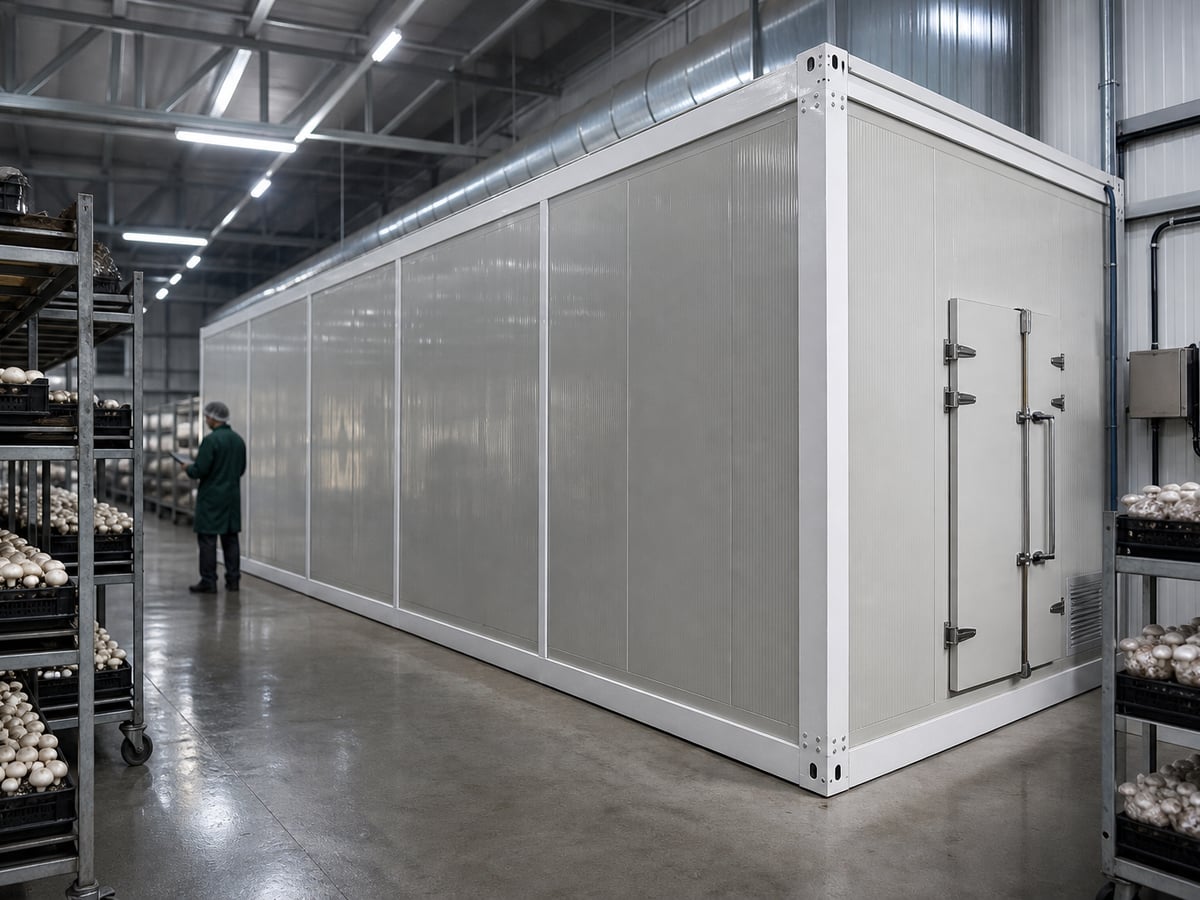
For growers considering modular expansion instead of a complex retrofit, a smart mushroom cultivation container can provide a separate, controlled production zone for trials, overflow capacity, premium varieties, or year-round supply contracts. This approach can be useful where existing buildings have severe structural limitations.
Repairing Insulation and Air Leakage

Insulation and air leakage repairs are often the highest-return part of a mushroom house climate upgrade. Cooling and heating systems can only control the air that remains inside the room. When warm, humid air enters through panel gaps or poorly sealed doors, the system must remove extra heat and moisture. In cold climates, the same leaks can cause drafts, cold spots, frosting, and surface condensation.
Use insulated wall and ceiling panels suitable for agricultural washdown conditions. Replace damaged panel sections rather than covering them with temporary materials. Seal joints with compatible food-area or agricultural-grade sealing products, insulate pipe and cable penetrations, and verify that door gaskets compress evenly around the entire perimeter. For frequent harvest traffic, consider rapid-roll doors, insulated strip curtains, vestibules, or operational procedures that limit door-open time.
Insulation upgrades should also consider the floor. Cold slab edges, uninsulated drainage channels, and cracks around floor-wall joints can become major thermal bridges. Where full floor replacement is impractical, repair damaged coatings, improve drain sealing, and manage cold-air movement near the base of racks. Preventing external humid air from reaching cold surfaces is important for reducing condensation and maintaining sanitary conditions.
| Leak or Insulation Problem | Practical Repair | Expected Operating Benefit | Verification Method |
|---|---|---|---|
| Loose wall-panel joints | Re-fastening, sealing, replacing failed joint material | Lower infiltration and steadier temperature | Visual inspection and smoke-pencil test |
| Worn personnel-door gasket | Install full-perimeter compression seal | Less draft and moisture ingress | Paper-strip closure test |
| Unsealed pipe openings | Add insulated sleeves and flexible sealant | Reduced thermal bridging and pest entry | Light and airflow check |
| Damaged ceiling insulation | Replace wet or compressed insulation panels | Less heat gain or heat loss through roof | Thermal imaging where available |
| Cold drain perimeter | Repair insulation and seal floor transitions | Reduced localized condensation | Surface temperature monitoring |
| Frequent loading-door opening | Add vestibule, curtain, or rapid door | Improved recovery after logistics activity | Trend room recovery time |
The repairs in this table should be completed before final equipment sizing. A post-repair load calculation can prevent overinvestment in cooling or heating equipment. It can also reduce the required generator capacity at sites where power supply is constrained or expensive.
Upgrading Cooling and Heating Capacity
Cooling and heating equipment must be selected from the actual thermal load, not only from room dimensions. The calculation should account for outdoor temperature, solar exposure, panel performance, infiltration, substrate respiration, lighting, motors, people, fresh-air volume, moisture removal, and desired pull-down time. Mushroom substrate can release substantial heat during active growth, so the room may need cooling even when outdoor weather feels moderate.
Common upgrade options include packaged air-conditioning systems, dedicated air handling units, evaporator and condensing unit combinations, air source heat pumps, hot-water coils, electric heaters, and staged hybrid systems. In regions with seasonal temperature swings, an air source heat pump can provide both heating and cooling with fewer separate pieces of equipment. The final selection must suit local grid voltage, ambient limits, service access, refrigerant regulations, and backup requirements.
A correctly designed system should not run continuously at maximum output under ordinary production conditions. It needs enough reserve capacity to recover after loading, harvesting, sanitation, door openings, hot weather, or cold snaps. At the same time, gross oversizing can create short cycling, poor humidity management, unstable temperatures, and higher initial cost. Variable-speed compressors, electronically controlled fans, staged heating, and proportional dampers can improve part-load stability.
| Equipment Option | Best Fit | Main Benefit | Planning Consideration |
|---|---|---|---|
| Packaged cooling unit | Small to medium mushroom rooms | Compact installation and straightforward service | Confirm airflow and dehumidification performance |
| Air handling unit | Larger rooms with duct distribution | Flexible fresh-air and recirculation control | Requires proper duct design and access space |
| Air source heat pump | Sites needing both heating and cooling | Efficient multi-season operation | Check low-ambient capacity and defrost planning |
| Electric duct heater | Small zones or fast-response supplemental heat | Simple integration with controls | Requires adequate electrical capacity |
| Hot-water coil | Farms with boiler or recovered heat source | Even, controllable heating distribution | Needs pump, piping, and water treatment |
| Hybrid staged system | Variable climates and critical production sites | Redundancy and better load matching | Requires clear control sequences |
Global buyers should also consider logistics and maintainability. Equipment shipped through Rotterdam, Dubai’s Jebel Ali, Los Angeles, Durban, or Melbourne should be specified with export-ready packaging, accessible spare parts, clear electrical drawings, and components available locally when possible. The lowest purchase price is not always the lowest lifecycle cost if replacement filters, sensors, fans, or control components are difficult to source.
Adding Humidity and CO2 Control
Humidity and CO2 are central to mushroom morphology, pinning quality, cap condition, and yield consistency. However, relative humidity alone does not describe the full moisture situation. Air temperature, surface temperature, air velocity, evaporation rate, fresh-air volume, and droplet behavior all influence how the crop experiences the room. A humidity system must add moisture without soaking mushrooms, shelves, floors, sensors, or duct surfaces.
Low-pressure fogging, high-pressure misting, ultrasonic humidification, and evaporative methods may all be used depending on room size and water quality. The selected method should produce appropriate droplets, use filtered water where necessary, include automatic flushing, and be installed where airflow can distribute moisture evenly. In many retrofit projects, zoning humidifiers by room section prevents one end of the house from becoming too wet while another stays dry.
CO2 control requires reliable measurement and coordinated ventilation. A sensor located directly in a fresh-air stream, near a door, or beside an exhaust point can produce misleading readings. Install sensors at representative crop level, maintain them according to the manufacturer’s guidance, and compare readings against a portable reference instrument during scheduled checks. Fresh-air dampers and exhaust fans should operate with clear logic that avoids unnecessary energy loss.
A modern mushroom climate controller can coordinate temperature, humidity, CO2, fresh air, exhaust, heating, cooling, alarm functions, and recipe stages. For multi-room farms, centralized records help managers identify whether poor crop performance coincides with climate deviations, door-open events, sensor faults, or equipment alarms.
The chart is an illustrative planning tool rather than a fixed engineering formula. Building-envelope repairs and airflow improvements frequently rank first because they affect nearly every other climate-control function. A site survey should determine the actual order for each project.
Improving Ducts and Fan Coverage
Uniform air distribution is one of the most overlooked elements in an existing mushroom house. A room can have sufficient cooling capacity but still produce uneven crops if air does not reach every shelf, bed, or rack level. Dead zones often develop in corners, behind tall racks, beneath duct runs, near doors, and at the far end of long rooms. Excessively high air velocity can also damage crop quality by drying caps or increasing evaporation.
Begin with a simple airflow map. Use smoke visualization, lightweight streamers, handheld anemometers, or professionally measured air balancing to observe supply direction, return paths, and stagnant areas. Inspect flexible ducting for tears, compression, loose joints, and blocked outlets. Confirm that outlet size and spacing are appropriate for the fan’s available static pressure. A larger fan alone may not solve a duct system with high resistance or poor outlet layout.
Improvements may include insulated supply ducts, perforated air tubes, directional grilles, additional return-air paths, variable-speed circulation fans, balanced exhaust points, and adjustable dampers. Keep ventilation intake and exhaust paths separated enough to prevent short-circuiting, where fresh air exits before it reaches the crop. In facilities with stacked shelving, vertical airflow must be considered as carefully as horizontal coverage.
| Airflow Symptom | Probable Cause | Upgrade Option | Crop-Level Check |
|---|---|---|---|
| Dry caps near air outlet | Air speed is too high or outlet is poorly aimed | Add diffuser or redirect supply air | Compare cap moisture across rack positions |
| Wet lower shelves | Moisture settles with weak lower-level circulation | Add low-level mixing or revise humidifier position | Inspect floor and lower rack surfaces |
| Warm rear corner | Insufficient supply throw or blocked return path | Extend ducting or add return-air route | Log temperature at rear crop level |
| CO2 differs by aisle | Poor fresh-air distribution | Rebalance intake and exhaust points | Take readings at multiple locations |
| Noisy fan operation | High static pressure or worn components | Resize ducting, service fan, use speed control | Check airflow after adjustment |
| Uneven pinning on upper racks | Heat stratification or inadequate top-level flow | Add circulation fan or upper duct outlet | Compare upper and lower rack conditions |
These corrections are especially valuable in converted warehouses and older agricultural buildings, where room geometry was not originally designed for mushroom production. Farms near busy trade hubs such as Ho Chi Minh City, Lagos, Istanbul, and Mexico City may also face variable outdoor dust loads, requiring intake filtration and a maintenance plan that preserves fan performance.
Scheduling Work Between Crop Cycles
Climate upgrades should be planned around crop cycles to protect production and hygiene. The most suitable window is usually after harvest, during room emptying, sanitation, maintenance, or a scheduled production break. Work that opens wall panels, ceiling sections, ducts, drains, or electrical enclosures should not take place beside active crops unless strict containment and sanitation procedures are in place.
Create a phased schedule. First, complete survey work and equipment procurement without interrupting production. Next, prepare off-site fabricated panels, duct sections, control cabinets, pipework, and mounting brackets. During the shutdown window, carry out envelope repairs, mechanical installation, electrical connection, commissioning, cleaning, and dry testing. Finally, run the room empty before introducing substrate to confirm that all climate stages operate correctly.
For farms supplying supermarkets, hotels, food-service distributors, or export buyers, communicate the planned downtime early. Some producers temporarily shift volume to another room, lease modular capacity, or use a cultivation container during the renovation period. This reduces the risk of missing supply commitments while allowing the main house to receive a more comprehensive upgrade.
Checking Results After the Upgrade
Commissioning is not complete when the equipment starts. The upgraded mushroom house should be tested under realistic operating conditions, including cooling demand, heating demand where practical, humidification, fresh-air exchange, exhaust operation, alarm response, door opening recovery, and sensor verification. Record baseline performance before work begins so that results can be compared objectively after the upgrade.
Key indicators include temperature uniformity at crop level, humidity stability, CO2 control, time required to recover after doors open, energy use per production cycle, alarm frequency, compressor cycling, fan noise, drainage behavior, condensation occurrence, and crop uniformity. Crop performance should be reviewed over more than one cycle because variation in substrate, weather, and labor practices can influence results.
| Post-Upgrade KPI | How to Check It | Why It Matters | Recommended Review Frequency |
|---|---|---|---|
| Temperature spread | Compare multiple crop-level sensors | Shows airflow and capacity consistency | Daily during first production cycle |
| Relative humidity trend | Review controller data and visual crop condition | Helps prevent drying and condensation | Daily |
| CO2 concentration | Compare fixed sensor with portable reference | Supports morphology and ventilation control | Weekly and at recipe changes |
| Recovery time | Measure return to setpoint after door opening | Indicates envelope and capacity performance | During commissioning |
| Energy consumption | Track meter readings by room or system | Identifies efficiency gains and abnormal loads | Monthly |
| Crop uniformity | Compare size, quality, yield, and harvest timing | Connects climate performance to profitability | Every crop cycle |
The table above creates a practical acceptance checklist. If results are not as expected, review sensor placement, setpoint recipes, fan direction, damper calibration, water quality, drainage, door discipline, and operator procedures before assuming that major equipment is defective.
By 2026, mushroom climate upgrades are increasingly moving toward connected sensors, variable-speed equipment, remote alarms, predictive maintenance, energy dashboards, and recipe-based automation. Sustainability expectations are also growing. Many buyers now evaluate low-leakage insulated construction, reduced water waste, heat recovery opportunities, lower-carbon heating options, responsible refrigerant selection, and traceable operating records. Regional energy codes, refrigerant policies, food-safety expectations, and worker-safety requirements should be reviewed before finalizing a system design.
Our Company
Shandong Lanhu Air Conditioning Equipment Co., Ltd. supports agricultural climate-control projects for the Global Market with integrated mushroom cultivation and HVAC solutions. Its technological capability is built on more than 12 years of thermodynamic research and development, practical climate-control engineering, and a portfolio of more than 45 registered patents. The company develops systems for controlled mushroom rooms, smart cultivation containers, plant cultivation applications, climate controllers, and air source heat pump projects.
Its manufacturing capability includes a modern facility in Dezhou, Shandong, China, covering more than 30,000 square meters. In-house processes include equipment design, engineering development, sheet metal fabrication, CNC bending, insulation panel production, electrical assembly, system integration, functional testing, electrical verification, performance evaluation, and quality inspection. This integrated approach helps coordinate the enclosure, mechanical components, electrical controls, and operating logic required in a climate-control retrofit.
Service capability is designed for international contractors, distributors, engineering companies, and commercial farms. Lanhu offers factory-direct supply, OEM and ODM customization, engineering assistance, installation guidance, spare-parts support, after-sales coordination, and international logistics support. The company’s quality-management and operational credentials include ISO 9001, ISO 14001, ISO 45001, and ISO 12100 certifications. Buyers can also review selected project experience through the company’s mushroom cultivation project cases and discuss tailored requirements through its OEM and ODM customization service.
For upgrade projects, useful information to provide includes room drawings, location, mushroom species, crop volume, existing equipment photos, local ambient temperatures, power supply details, desired automation level, and target completion date. This allows the equipment configuration to be aligned with the actual farm rather than a generic room template.
Frequently Asked Questions
Should I replace my entire mushroom house or upgrade it?
Upgrade is often suitable when the structure is sound and the main issues are insulation defects, air leakage, outdated cooling, inadequate heating, poor humidity control, weak ventilation, or obsolete controls. Replacement may be more sensible if panels are extensively damaged, drainage is fundamentally unsuitable, electrical systems are unsafe, or the room layout cannot support the intended production scale.
What should be upgraded first in an older mushroom growing room?
Start with a professional condition assessment. In many cases, insulation repairs, sealing, drainage correction, duct repair, and airflow balancing should come before installing larger HVAC equipment. These measures reduce the load that new equipment must handle.
Can one system control temperature, humidity, and CO2?
Yes. An integrated mushroom climate controller can coordinate cooling, heating, humidification, fresh-air intake, exhaust, circulation fans, alarms, and crop-stage recipes. The system must still use suitable sensors, correctly sized mechanical equipment, and a well-designed air distribution layout.
How do I know whether cooling capacity is insufficient?
Common signs include long pull-down time, continuous compressor operation, high room temperature during warm weather, weak recovery after harvest activity, and large differences between room locations. A load calculation and on-site performance test are more reliable than judging capacity by room size alone.
How can I avoid excessive condensation after adding humidification?
Use the correct humidification method, control droplet size, position nozzles or units away from direct crop wetting, maintain air movement, repair cold bridges, and avoid operating humidity control without coordinated ventilation and temperature management. Sensor placement and calibration are equally important.
Can climate upgrades be completed without stopping production?
Some survey, control-panel preparation, and external work can be done while production continues. Work involving internal ducting, humidifiers, panel repairs, electrical shutdowns, or sanitation-sensitive areas is best scheduled between crop cycles or during a controlled room shutdown.
What information should I send when requesting a retrofit quotation?
Provide room dimensions, crop type, rack layout, photographs, existing equipment specifications, local climate data, utility details, current problems, required output, and any preferred delivery port or destination city. This supports a more accurate technical proposal and logistics plan.
Share this article

About the Author: Shandong Lanhu Air Conditioning Equipment
Lanhu is a professional climate control equipment manufacturer specializing in smart agricultural systems, commercial HVAC solutions, and customized temperature control technologies. With extensive engineering experience, Lanhu provides reliable solutions for plant factories, controlled environment agriculture, and industrial applications.
Need a Custom Climate Control Solution?
From smart agricultural systems to commercial HVAC solutions, Lanhu provides reliable temperature and humidity control solutions tailored to your project needs.
Contact Us