Global Market Guide: 20ft Mushroom Container Sizing
Quick Answer

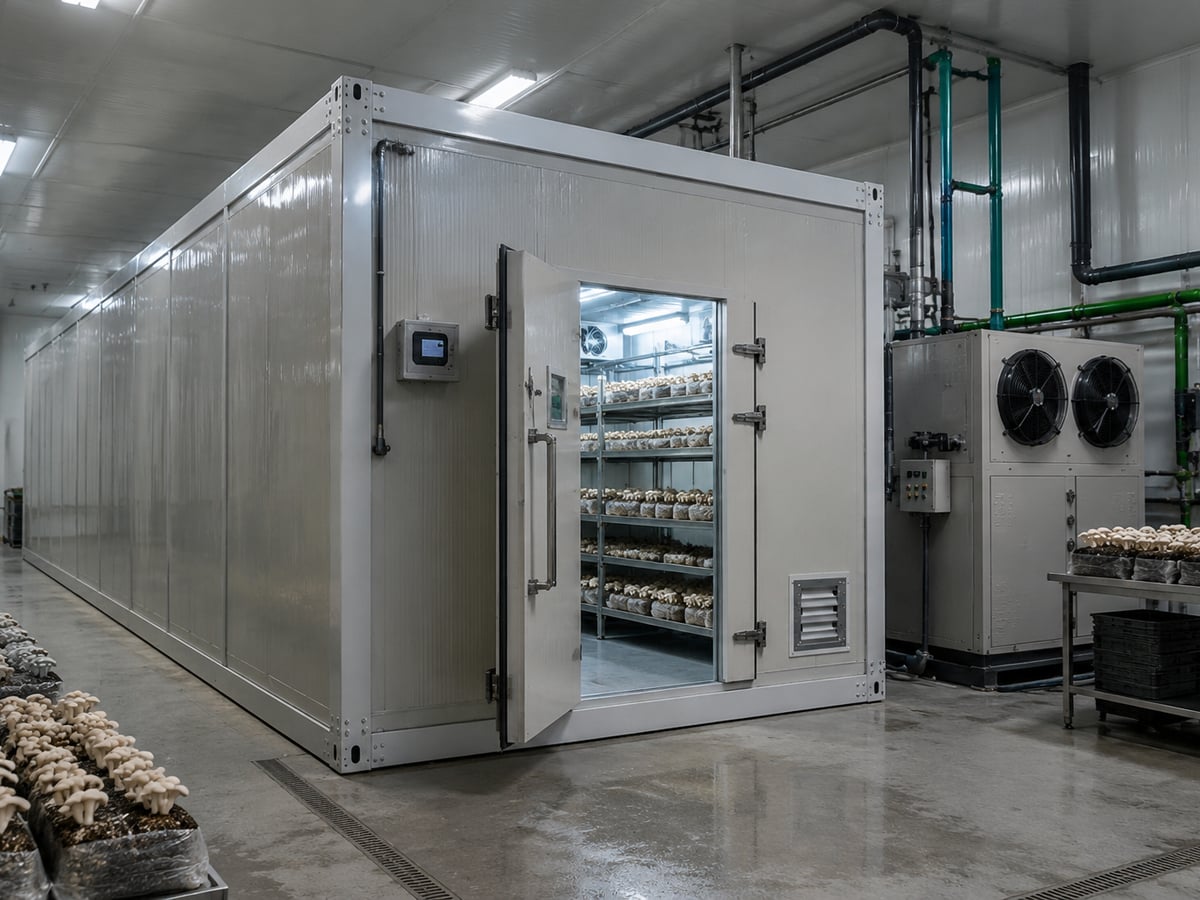
A 20ft mushroom container is usually a practical choice for pilot farms, specialty mushroom growers, research facilities, restaurants, agricultural cooperatives, urban farms, and commercial projects that need controlled production without constructing a permanent building. For the Global Market, this format is especially useful where land is expensive, building permits are slow, seasonal production is required, or a farm needs to expand in modular stages.
A standard 20ft shipping-container-based cultivation unit has an exterior length of approximately 6.06 m, an exterior width of 2.44 m, and an exterior height of 2.59 m. Once insulated panels, internal cladding, doors, air ducts, racks, lighting, humidification equipment, and service space are included, the productive growing area is much smaller than the exterior dimensions suggest. Most well-designed systems provide a central aisle with rack rows on one or both sides, allowing growers to manage substrate blocks, inspect fruiting bodies, clean surfaces, and maintain air circulation.
For oyster mushrooms, shiitake, lion’s mane, enoki, king oyster mushrooms, and similar specialty crops, a 20ft unit can commonly support a moderate batch of substrate blocks rather than an industrial-scale volume. The correct capacity depends on the block dimensions, cultivation stage, rack configuration, climate equipment, required aisle width, harvest workflow, and local operating conditions. A container that is overloaded may look efficient on paper but can suffer from poor fresh-air distribution, uneven humidity, disease pressure, difficult harvesting, and reduced biological efficiency.
The best buying approach is to define the crop, block weight, planned harvest cycle, target output, local electrical supply, water source, delivery route, and staffing method before ordering. Buyers should also compare the unit’s quoted external dimensions with its verified internal clear dimensions after insulation and equipment installation. A properly engineered smart mushroom cultivation container should be evaluated as a complete climate-controlled production room, not simply as an empty shipping container.
| Planning Item | Typical 20ft Container Consideration | Why It Matters |
|---|---|---|
| Exterior length | About 6.06 m | Used for transport planning, site layout, crane access, and permitting review. |
| Exterior width | About 2.44 m | Determines delivery route compatibility and the maximum possible rack arrangement. |
| Finished interior width | Often about 2.05–2.20 m | Reduced by insulation, wall liners, cable routes, and internal service channels. |
| Finished interior height | Often about 2.10–2.25 m | Controls rack tier count, airflow movement, and safe working clearance. |
| Central aisle | Usually 0.60–0.85 m | Provides access for loading, harvesting, cleaning, and emergency movement. |
| Production capacity | Depends on crop and rack design | Must be calculated from usable shelf area rather than container floor area alone. |
The figures above are planning ranges, not a substitute for a factory layout drawing. Wall thickness, insulation specification, refrigeration layout, air-supply duct location, and door design can materially change the final usable space.
When a 20ft Format Fits

The 20ft format fits projects that need controlled mushroom production but do not yet require the throughput of a 40ft container or a dedicated cultivation building. It is frequently selected by growers launching a new premium mushroom brand, farms testing a new variety, distributors demonstrating cultivation systems, universities conducting crop trials, and hospitality businesses seeking hyperlocal food production.
In dense markets such as Singapore, Dubai, Rotterdam, London, Tokyo, Sydney, and New York, a compact container can be valuable because it uses a defined footprint and can be installed near kitchens, wholesale markets, greenhouse clusters, food hubs, or cold-chain facilities. In agricultural regions, it can support decentralized production near substrate preparation sites, farm shops, rural cooperatives, or packing centers. For island markets and remote project sites, containerized systems can also simplify shipping compared with building a fully equipped climate room from locally sourced components.
A 20ft unit is most appropriate when daily handling can be completed by one or two trained workers, harvest targets are moderate, and the crop program benefits from separate environmental zones. For example, a farm may operate one 20ft container as a fruiting room for oyster mushrooms while maintaining incubation elsewhere. Another grower may use multiple 20ft containers, each dedicated to a different strain, humidity profile, temperature band, or harvest schedule.
The format becomes less suitable when the project requires frequent forklift movement inside the growing room, very high daily substrate turnover, large palletized loading, long racks with automatic harvesting, or many simultaneous crop stages. In those cases, a 40ft container, modular panel room, or purpose-built cultivation facility may produce a lower cost per kilogram. A 20ft container should be chosen because it improves operational control and deployment speed, not merely because it is the smallest available option.
| Project Situation | 20ft Format Suitability | Recommended Approach |
|---|---|---|
| New specialty mushroom startup | High | Start with one controlled fruiting unit and validate crop demand before expansion. |
| Restaurant or hotel farm | High | Use compact production for fresh premium mushrooms and visible sustainability messaging. |
| Research and variety trials | High | Assign a dedicated climate recipe for repeatable experimental conditions. |
| Village cooperative | Medium | Use several units only if block supply, training, and sales channels are established. |
| Large export-oriented mushroom farm | Low to medium | Consider 40ft units or a building-based operation for greater handling efficiency. |
| Remote construction or mining camp | Medium to high | Confirm utility stability, water quality, waste handling, and maintenance support first. |
This comparison shows that the 20ft format is strongest where control, mobility, phased investment, and crop separation are more valuable than maximum volume. It is also useful for distributors and agricultural contractors that require a standardized unit for demonstration projects across different countries.
Usable Space After Insulation

Buyers should never calculate growing capacity from the external size alone. A nominal 20ft container is transformed into a cultivation chamber by insulation panels, antimicrobial liners, floor insulation, drainage slope, electrical conduits, pipework, air ducts, lighting fixtures, humidification lines, evaporator equipment, and door frames. These elements improve crop stability and sanitation, but they reduce usable space.
For a standard-width container, internal width can decrease by 200–350 mm or more after both side walls are insulated and finished. Internal height may also decrease because insulated ceiling panels, lights, ducts, and air outlets must be accommodated. The rear wall may carry refrigeration components, electrical cabinets, fresh-air dampers, or circulation equipment, while the entrance area may require a service zone for loading and cleaning.
Insulation thickness should be matched to local ambient conditions. A unit operating in Kuala Lumpur, Doha, Lagos, São Paulo, or Bangkok may need different thermal design priorities than one operating in Stockholm, Toronto, Warsaw, or Hokkaido. High outdoor temperatures, solar exposure, humidity, wind, dust, and utility costs all influence panel selection and cooling load. Overly thin insulation can increase compressor run time and reduce environmental uniformity. Excessively thick insulation without good rack planning may consume valuable cultivation volume.
Modern climate-managed containers increasingly use high-density polyurethane or similar insulated panels, washable internal surfaces, sealed joints, thermal breaks, and corrosion-resistant materials. The right solution balances energy efficiency, food-production hygiene, service access, and available growing volume. Buyers should ask for an internal layout drawing showing finished dimensions, not only photographs of an empty shell.
| Space-Loss Element | Typical Impact on Layout | Buyer Check |
|---|---|---|
| Side-wall insulation | Reduces clear internal width | Request finished wall-to-wall measurement at the narrowest point. |
| Ceiling insulation | Reduces rack and worker headroom | Confirm clear height beneath lights, ducts, and ceiling fixtures. |
| Floor insulation and drain slope | Changes finished floor level | Verify door threshold height and drainage direction. |
| Evaporator or cooling coil | Consumes end-wall or ceiling space | Ensure it does not obstruct loading or rack access. |
| Fresh-air ducting | May reduce upper rack clearance | Review air outlet position relative to mushroom blocks. |
| Electrical cabinet | Requires protected service space | Confirm it is accessible without moving production racks. |
These deductions explain why two containers with identical external dimensions may have different block capacities. The finished interior is the real production asset, and it should be evaluated before a purchase contract is signed.
Rack Tiers and Aisle Width
Rack configuration determines whether a container feels efficient or difficult to operate. In most 20ft mushroom containers, growers use metal racks positioned along one or both side walls. Rack tier count is commonly influenced by finished internal height, block height, crop morphology, lighting arrangement, airflow requirements, and worker reach. More tiers do not automatically mean more profitable production.
For many bagged substrate crops, four to six rack tiers may be possible. However, high tiers can create uneven temperature, carbon dioxide concentration, humidity, and light exposure if the air distribution system is poorly engineered. Lower shelves may receive more moisture, while upper shelves can become warmer or drier. A balanced design uses suitable shelf spacing and air outlets that distribute conditioned air through the crop zone rather than only across the ceiling.
A central aisle typically needs enough width for a worker carrying blocks, trays, harvest crates, sanitation tools, and a small rolling cart where applicable. An aisle that is too narrow increases damage to fruiting bodies and makes daily work slower. An aisle that is too wide reduces shelf area and may lower total output. For many manual operations, 600–850 mm is a practical range, with final sizing based on worker safety, harvest method, and local labor practices.
Rack material should resist humidity and repeated washing. Stainless steel offers strong corrosion resistance but may increase cost. Galvanized steel, powder-coated steel, aluminum, and food-grade composite solutions may be suitable depending on the operating environment. Shelf design should allow drainage and airflow while supporting the planned block weight. Weld quality, shelf load rating, corner protection, and rack anchoring matter during road transport and international delivery.
| Rack Design Factor | Typical Range or Choice | Operational Effect |
|---|---|---|
| Rack rows | One or two side rows | Two rows improve capacity but require careful aisle planning. |
| Rack tiers | Four to six tiers | More tiers increase shelf area but may complicate airflow balance. |
| Aisle width | 0.60–0.85 m | Supports worker movement, harvest collection, and cleaning tasks. |
| Shelf spacing | Crop-dependent | Must allow fruit body development and avoid contact between bags. |
| Rack material | Galvanized, coated, aluminum, or stainless steel | Affects corrosion resistance, sanitation, durability, and project cost. |
| Rack load rating | Based on wet block weight | Prevents deformation and improves safety during full loading. |
For farms producing wide-capped oyster mushrooms, shelf spacing should accommodate lateral fruiting and harvesting access. For species grown in bottles or narrow bags, a denser arrangement may be possible. The table provides a planning framework, but crop-specific rack drawings are essential before manufacturing.
Realistic Substrate Block Loading
Substrate block loading should be calculated from shelf area, block dimensions, wet weight, crop spacing, and production workflow. It is not enough to multiply the number of shelves by the apparent length of the racks. Each block requires airflow around it, access for inspection, room for mushroom development, and enough separation to reduce moisture accumulation and contamination transfer.
A typical oyster mushroom block may weigh several kilograms when fully hydrated, while shiitake blocks, sawdust bags, bottle systems, and specialty substrates may have different dimensions and handling requirements. A container loaded with too many blocks may have high initial inventory but weak harvest consistency. Air cannot move evenly through packed shelves, carbon dioxide can build up in stagnant zones, and harvesting can become inefficient.
A realistic loading plan should separate incubation capacity from fruiting capacity. If blocks are brought into the container only when ready to fruit, the fruiting room can be operated more efficiently. If incubation occurs in the same container, production scheduling becomes more complex because the temperature, fresh-air exchange, humidity, and lighting needs of incubation can differ significantly from fruiting conditions.
For commercial planning, growers should estimate weekly block entry, expected flush pattern, average yield, crop cycle duration, rejection rate, and harvest labor. This creates a more reliable forecast than simply claiming a maximum number of blocks. It also helps determine whether one 20ft unit is sufficient or whether staged expansion with additional containers will be more economical.
| Loading Variable | Practical Question | Reason for Review |
|---|---|---|
| Block size | What are the exact bag or bottle dimensions? | Controls the number of units that fit safely on each shelf. |
| Wet block weight | How much weight will each shelf carry at full load? | Supports rack engineering and safe transport design. |
| Fruiting orientation | Do mushrooms fruit from the side, top, or cut surface? | Determines spacing and whether blocks can be stacked closely. |
| Crop cycle | How many weeks remain in the room? | Determines weekly loading and harvest scheduling. |
| Expected yield | What yield is realistic for the strain and substrate? | Prevents unrealistic revenue assumptions based on maximum occupancy. |
| Reject allowance | What percentage may be damaged or contaminated? | Improves financial planning and sanitation management. |
The table highlights why capacity should be discussed in blocks, kilograms of wet substrate, shelf load, and expected harvest output together. A reputable supplier should be willing to match rack design to the grower’s actual substrate format rather than offering a generic capacity claim.
Equipment Footprint and Service Access
Climate-control equipment occupies physical and operational space. A mushroom container may include a cooling system, heating function, humidifier, fresh-air fan, exhaust fan, air filtration components, sensors, lighting, electrical control cabinet, drainage system, water line, and remote monitoring equipment. Every component must be positioned so that it can be inspected, cleaned, repaired, and replaced without dismantling the rack system.
Service access is often overlooked during early purchasing discussions. A system can perform well during commissioning but become difficult to maintain if filters are inaccessible, electrical panels are blocked by substrate bags, condensate drains cannot be cleaned, or humidifier components require workers to climb over shelves. The best layout gives priority to both crop capacity and maintenance safety.
In hot regions, refrigeration equipment may need additional capacity and clear airflow around external condensers. In dusty areas, washable filters and protected air intakes become more important. In coastal locations such as Manila, Mombasa, Santos, Jakarta, or Durban, corrosion-resistant finishes and regular maintenance programs can protect equipment from humid and saline conditions. In cold climates, freeze protection for water lines and appropriate heat recovery strategies may be needed.
Climate automation is increasingly valuable because mushroom crops respond quickly to changes in temperature, relative humidity, carbon dioxide, and fresh-air exchange. A smart mushroom climate controller can help operators monitor environmental data, manage equipment schedules, set alarm thresholds, and maintain consistent crop recipes. Automation does not replace good hygiene or crop management, but it provides a stronger foundation for repeatable production.
Power, Water, and Delivery Needs
Before ordering a 20ft mushroom container, confirm local electrical standards. Global projects may require different voltage, frequency, plug standards, earthing requirements, breaker specifications, and certification expectations. A buyer in the European Union may need a different electrical configuration from a buyer in the Gulf region, North America, Australia, South Africa, or Southeast Asia. The factory should receive the exact local power specification before electrical assembly begins.
Power demand depends on ambient climate, insulation level, refrigeration capacity, heating requirement, humidification technology, fresh-air volume, lighting, and operating schedule. A container located in a shaded temperate area will not have the same cooling demand as one installed in direct sun near Dubai, Muscat, Accra, or Darwin. For regions with unstable grids, buyers may need voltage stabilization, backup generation, battery support for controls, or alarm systems that warn of temperature excursions.
Water quality is equally important. Humidification systems can be affected by hardness, mineral content, sediment, biological contamination, and chlorine levels. A basic filtration approach may be adequate in some areas, while other sites need sediment filtration, softening, reverse osmosis, ultraviolet treatment, or regular nozzle maintenance. Drainage should be planned before installation, especially where frequent washing, condensate discharge, or wastewater restrictions apply.
Delivery planning begins with the route from factory to final site. International buyers should assess the destination port, road width, bridge clearance, turning radius, site gate width, unloading equipment, and ground bearing capacity. Major logistics hubs such as Shanghai, Qingdao, Ningbo, Rotterdam, Hamburg, Jebel Ali, Los Angeles, Melbourne, and Singapore can support container movement, but final-mile access may still be challenging in rural, mountainous, island, or urban locations.
| Site Requirement | What to Confirm Before Shipment | Common Risk If Missed |
|---|---|---|
| Electrical supply | Voltage, frequency, phase, breaker capacity, and grounding | Equipment incompatibility or unsafe commissioning delays. |
| Water source | Pressure, quality, filtration needs, and connection distance | Humidifier blockage, poor sanitation, or unreliable operation. |
| Drainage | Floor drain route and approved wastewater handling | Standing water, odor, slip hazards, and hygiene problems. |
| Foundation | Level concrete pads, steel supports, or engineered base | Door misalignment, poor drainage, and structural stress. |
| Delivery route | Road clearance, gate width, turning space, unloading location | Container cannot reach the intended installation point. | Unloading equipment | Crane, forklift, reach stacker, or truck-mounted lifting plan | Unsafe unloading or expensive last-minute logistics changes. |
This checklist is particularly important for overseas projects. The most efficient purchase is one that arrives with a clear utility plan, prepared foundation, confirmed unloading method, and local technician support arranged before delivery.
Confirming Dimensions Before Ordering
Buyers should request a dimension confirmation package before releasing final payment or approving production. The package should show external dimensions, finished internal dimensions, door opening size, rack dimensions, aisle width, rack tier spacing, equipment locations, electrical cabinet position, water inlet, drain outlet, ventilation openings, external condenser placement, and maintenance clearance.
Ask whether the quoted size refers to a standard shipping container shell, a high-cube shell, or a custom modular structure. A high-cube version can offer valuable additional height for racks and ducting, but it may have different availability, shipping cost, and route restrictions. If the container will be placed inside an existing warehouse, greenhouse, tunnel, or food-production facility, verify the building door height and internal maneuvering space as well.
For buyers ordering customized projects, a pre-production layout approval is essential. This is also the stage to confirm crop type, block dimensions, equipment voltage, language of control interface, branding, remote monitoring requirements, and optional accessories. Projects requiring private labeling, special rack arrangements, or nonstandard climate programs can benefit from OEM and ODM customization services that align the unit with local market needs.
Manufacturing capability matters because accurate customization requires more than modifying a drawing. It depends on coordinated sheet-metal fabrication, CNC bending, insulation-panel production, electrical assembly, system integration, equipment testing, and final quality inspection. A manufacturer with integrated production can manage dimensional consistency from frame design through final commissioning preparation.
| Document or Check | Minimum Information Needed | Decision Benefit |
|---|---|---|
| General arrangement drawing | External and internal dimensions, doors, racks, equipment | Confirms that the unit fits the site and production workflow. |
| Rack drawing | Shelf count, spacing, material, and load rating | Validates substrate loading assumptions. |
| Electrical schedule | Voltage, frequency, installed load, and protection devices | Allows local electrician review before shipment. |
| Water and drainage plan | Connection points, pipe sizes, filters, and drain outlets | Prepares the site for fast installation. |
| Equipment list | Cooling, heating, humidification, fans, controls, and sensors | Clarifies scope and simplifies future spare-parts planning. | Inspection record | Functional, electrical, and operational testing information | Provides confidence that the system was checked before dispatch. |
The table demonstrates that dimension verification is not a single measurement. It is a coordinated review of the structure, racks, utilities, equipment, and service workflow. A clear approved drawing reduces costly changes after the unit reaches the project site.
Our Company
Shandong Lanhu Air Conditioning Equipment Co., Ltd. supports mushroom growers, agricultural contractors, distributors, and engineering companies seeking modular climate-controlled cultivation solutions for the Global Market. Based in Dezhou, Shandong, China, the company combines agricultural climate-control knowledge with practical container integration for projects ranging from pilot farms to commercial expansion programs.
Its technological capabilities are built on more than 12 years of thermodynamic research and development experience and a portfolio of more than 45 registered patents. The company develops environmental control solutions for mushroom cultivation, hydroponic plant containers, agricultural climate applications, and air source heat pump systems. Temperature management, humidity control, fresh-air exchange, carbon dioxide management, automated operating logic, and crop-specific climate recipes are considered together because a mushroom fruiting room must operate as a coordinated biological environment.
Its manufacturing capabilities include integrated design, engineering development, sheet-metal fabrication, CNC bending, insulated-panel production, electrical assembly, system integration, equipment testing, and quality inspection. Operating from a manufacturing facility of more than 30,000 square meters, Lanhu can support standardized configurations as well as customized container layouts. Functional inspection, electrical verification, performance testing, and operational evaluation are completed before shipment to help customers receive systems prepared for installation.
Its service capabilities include factory-direct supply, engineering assistance, OEM and ODM support, international logistics coordination, spare-parts support, installation guidance, and after-sales service. The company holds ISO 9001, ISO 14001, ISO 45001, and ISO 12100 certifications, supporting a quality-focused approach for global agricultural equipment projects. Buyers can also review application examples through the company’s mushroom cultivation project cases when comparing possible layouts and deployment scenarios.
For customers evaluating a 20ft mushroom container, the most productive discussion begins with the crop plan and site conditions. By sharing expected block dimensions, target climate range, local electrical specification, water quality, destination port, delivery constraints, and desired rack arrangement, buyers can receive a more relevant technical recommendation instead of a generic capacity estimate.
FAQ
How many substrate blocks can a 20ft mushroom container hold?
Capacity varies widely according to block size, crop type, rack tiers, shelf spacing, service area, and aisle width. Buyers should request a layout based on their exact block dimensions and wet weight. A realistic capacity plan includes airflow and worker access rather than filling every visible shelf space.
Is a 20ft container large enough for commercial mushroom farming?
It can be commercially useful for premium mushrooms, local supply programs, pilot farms, restaurant production, research projects, and modular expansion. Large-volume wholesale operations may need several units, 40ft containers, or a larger building-based facility.
What mushrooms can be grown in a 20ft cultivation container?
Common options include oyster mushrooms, shiitake, lion’s mane, king oyster mushrooms, enoki, and other specialty varieties. The suitable crop depends on the climate system, substrate format, local market demand, and the grower’s technical experience.
Does insulation significantly reduce internal growing space?
Yes. Insulated walls, ceiling panels, floor systems, ducts, lighting, refrigeration equipment, and electrical cabinets reduce the finished internal dimensions. Always compare the usable internal layout instead of relying on the external 20ft container measurement.
What electrical supply is needed?
The required supply depends on the climate equipment and destination country. Voltage, frequency, phase, breaker capacity, grounding, and local compliance requirements should be confirmed before manufacturing. Projects in hot climates may require higher cooling capacity and more available electrical power.
Can the container be customized for local conditions?
Yes. Buyers can specify climate targets, rack configuration, power supply, insulation requirements, control language, branding, monitoring options, and equipment placement. Customization is especially valuable for projects in hot, cold, humid, coastal, remote, or high-altitude locations.
What should be prepared at the site before delivery?
Prepare a level foundation, electrical connection, water source, drainage route, unloading area, and access route for the delivery truck or lifting equipment. Confirm site dimensions, gate width, turning radius, and overhead clearance before shipment.
What trends will affect mushroom containers in 2026?
In 2026, the Global Market is expected to place greater emphasis on remote climate monitoring, energy-efficient refrigeration, heat recovery, water-saving humidification, lower-impact insulation materials, food traceability, modular urban farming, and reduced transport distance between farm and consumer. Sustainability reporting, energy performance expectations, and local food-security policies may further increase demand for efficiently designed controlled-environment cultivation systems.
Share this article

About the Author: Shandong Lanhu Air Conditioning Equipment
Lanhu is a professional climate control equipment manufacturer specializing in smart agricultural systems, commercial HVAC solutions, and customized temperature control technologies. With extensive engineering experience, Lanhu provides reliable solutions for plant factories, controlled environment agriculture, and industrial applications.
Need a Custom Climate Control Solution?
From smart agricultural systems to commercial HVAC solutions, Lanhu provides reliable temperature and humidity control solutions tailored to your project needs.
Contact Us