Global Market Guide to 40ft Mushroom Container Design
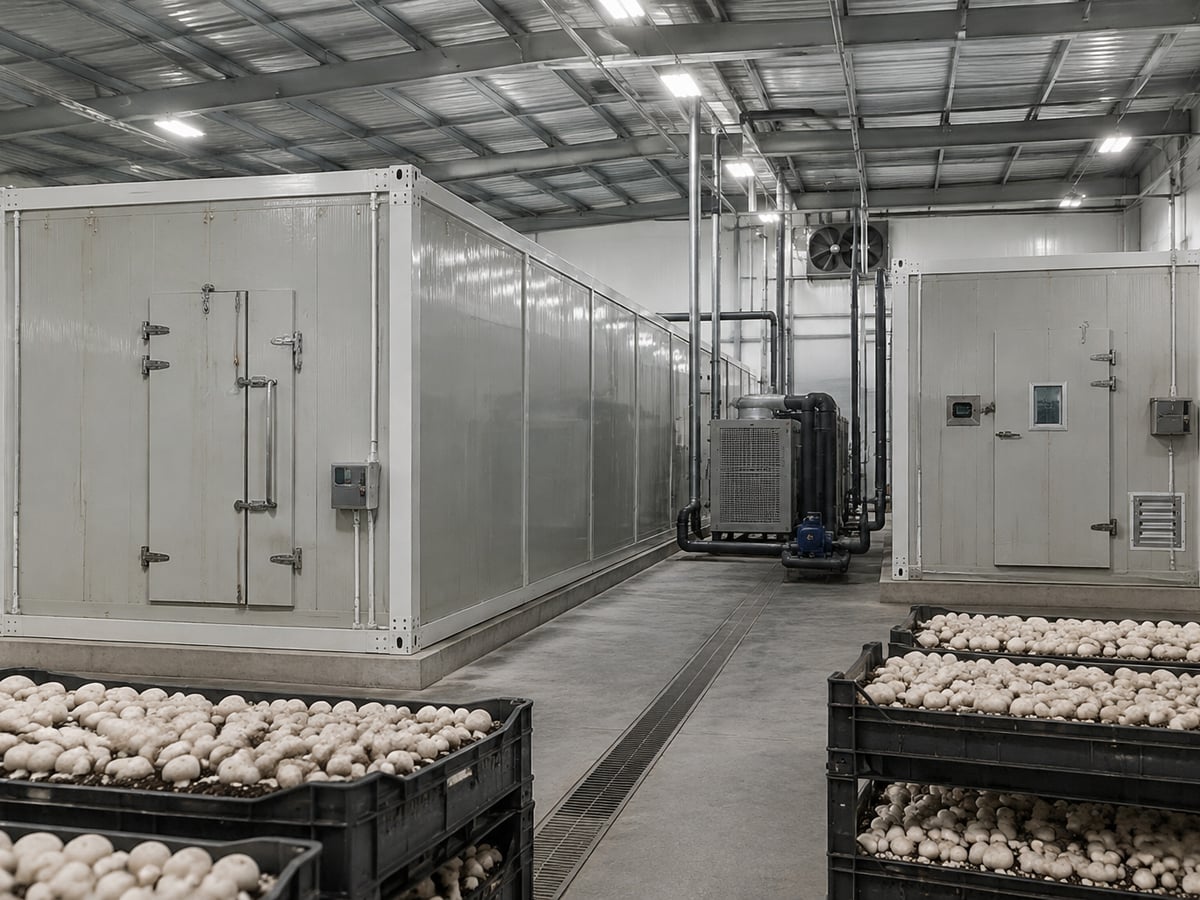
Fast Guidance for 40ft Mushroom Container Planning

A 40ft mushroom cultivation container can provide substantially more growing capacity than a 20ft unit, but it must be designed as a controlled production room rather than simply a longer insulated box. The additional length changes how air travels, where carbon dioxide gathers, how workers harvest, how water drains, and whether added substrate capacity becomes saleable mushrooms.
For Global Market buyers, the practical rule is simple: increase rack capacity only after confirming that the HVAC system, fresh-air arrangement, return-air path, drainage slope, and working aisle can support uniform crop conditions from the front door to the far end. A long container with uneven air distribution may load more bags or blocks but produce lower-grade mushrooms, variable pinning, delayed flushes, and higher labor cost.
Well-planned 40ft systems are widely used by commercial mushroom farms, agricultural contractors, distributors, urban farming projects, food-service growers, research facilities, and remote production sites. They can support oyster mushrooms, shiitake, lion’s mane, king oyster mushrooms, enoki, and other species when the climate recipe, shelving density, and sanitation routine are matched to the crop.
The best purchasing approach is to request a dimensioned final drawing before production. It should show rack bays, aisle width, evaporator or air-handling locations, supply and return airflow, fresh-air connection, condensate routing, drain location, lighting, electrical panels, access doors, sensors, and service clearances. Buyers shipping through Rotterdam, Hamburg, Dubai, Singapore, Los Angeles, Santos, Durban, or Melbourne should also verify transport dimensions, electrical standards, and local installation requirements before dispatch.
| Planning Item | Why It Matters in a 40ft Unit | Recommended Buyer Check |
|---|---|---|
| Container length | Longer travel distance increases airflow resistance and climate variation. | Review supply-air and return-air routes across the full interior length. |
| Rack depth | Deep shelves can restrict air movement around mushroom blocks. | Confirm shelf spacing, open-area ratio, and crop access from both sides. |
| Central aisle | A narrow aisle may increase capacity but slows picking and cleaning. | Measure harvest cart clearance and worker turning space. |
| Fresh-air intake | Insufficient outdoor air allows CO2 to rise near the far end. | Ask for fresh-air volume and CO2 sensor positions. |
| Drainage layout | Long floors can retain wash water if slope and drain placement are poor. | Verify floor gradient, drain size, and cleaning-water direction. |
| Service access | Fans, coils, sensors, and electrical parts need safe maintenance access. | Check panel doors, filter replacement space, and maintenance clearance. |
In most projects, a 40ft container is economically attractive when the grower has stable substrate supply, trained labor, reliable utilities, a defined sales channel, and enough demand to harvest on a regular cycle. It is less suitable when production will be highly irregular, access is severely limited, or the farm cannot maintain a disciplined cleaning and crop-monitoring schedule.
How Extra Container Length Affects the Production Design

A 40ft shipping-container footprint is typically about twice the length of a 20ft unit, yet the climate engineering challenge rises by more than a simple factor of two. Air loses pressure as it travels through ducts, shelf corridors, crop masses, filters, and turning points. Moisture can condense at different rates along the room. Heat from lighting, people, humidification equipment, and actively fruiting mushrooms can also be unevenly distributed.
The starting point is a crop-specific production brief. Oyster mushroom fruiting generally requires a different fresh-air strategy from shiitake browning, lion’s mane fruiting, or incubation. Buyers should provide the target species, block or bag dimensions, expected biological efficiency, ambient temperature range, utility voltage, seasonal humidity, harvest staffing, and intended daily production. This allows the supplier to size the refrigeration, heating, humidification, dehumidification, ventilation, and control system properly.
In Global Market projects, outdoor conditions differ sharply. A container operating in Dubai may need strong heat rejection and robust insulation performance. A site near Rotterdam may prioritize humidity control during cool, wet seasons. Farms in São Paulo, Nairobi, Jakarta, Toronto, or Sydney may face very different combinations of temperature swings, salt air, rainfall, power quality, and local maintenance availability. A generic climate package is not always sufficient.
Longer rooms also require zoning logic. Even if there is only one main climate zone, sensors should monitor several points: supply air, room center, far-end return air, outdoor air, coil temperature, relative humidity, and carbon dioxide. The controller should respond to meaningful measurements rather than relying on a single sensor mounted near the door.
| Design Variable | Shorter Container Effect | 40ft Container Effect | Design Response |
|---|---|---|---|
| Air throw distance | Air often reaches the full room with limited loss. | Far-end velocity can fall below useful circulation levels. | Use distributed supply outlets or a balanced duct layout. |
| CO2 removal | Fresh air may dilute the room relatively quickly. | CO2 can stratify or accumulate behind crop racks. | Place return paths and sensors away from direct supply air. |
| Humidity uniformity | Moisture source influences most of the room. | Near-end wetness and far-end dryness may occur. | Balance misting, airflow, and sensor feedback. |
| Temperature recovery | Door opening affects a smaller air volume. | Harvest traffic can create longer recovery periods. | Size equipment for realistic door-opening load. |
| Cleaning route | Washdown distance is limited. | Water, debris, and disinfectant travel farther. | Provide continuous floor slope and accessible drains. |
| Harvest movement | Workers reach racks with fewer steps. | Walking time can reduce picking efficiency. | Maintain practical aisle width and harvest workflow. |
Product type also affects the internal arrangement. Some growers need high-density shelf systems for small bagged blocks; others require larger spacing for heavy fruiting clusters or hanging bags. Incubation containers can normally use denser loading because fresh-air demand is lower, while fruiting containers need more open space and stronger air movement around the crop. A mixed-use container may look flexible but can compromise performance if incubation and fruiting requirements are not separated.
For farms expanding from a pilot unit, a smart mushroom cultivation container with documented layout options can reduce planning uncertainty. However, the buyer should still compare local labor practices, crop varieties, market grade requirements, and cleaning protocols rather than copying another farm’s rack arrangement without adjustment.
Rack Length, Shelf Layout, and Harvesting Access

Rack planning determines more than the number of cultivation blocks that fit inside the room. It affects airflow channels, worker safety, crop visibility, harvesting speed, cleaning quality, and the ability to remove contaminated blocks promptly. In a 40ft mushroom container, overly long uninterrupted racks can create difficult-to-reach areas and stagnant pockets behind the crop.
A common layout uses racks along both sidewalls with a central service aisle. This arrangement gives workers direct access to the growing faces while preserving an air corridor. Depending on the crop, racks may be one-sided, two-sided, or arranged in separated bays. Double-sided center racks can increase density but require careful airflow engineering and enough aisle width on both sides. For many commercial operators, a slightly lower block count with reliable access produces a better overall financial result.
Harvest access should be evaluated with real working motions. Can a worker carry a harvest crate without brushing mature clusters? Can they inspect lower shelves without damaging blocks? Can a cart pass an open rack door or another worker? Can spent substrate be removed without crossing clean harvest routes? These questions are particularly important for farms supplying supermarkets, hotels, restaurants, and premium fresh-produce distributors where appearance and shelf life influence saleable yield.
| Rack Layout Option | Capacity Potential | Harvest Access | Airflow Consideration |
|---|---|---|---|
| Sidewall single-sided racks | Moderate | Excellent visibility and simple picking route | Open central aisle supports return-air movement. |
| Sidewall double-sided racks | High | Good when rear access is available | Requires clearance behind racks and balanced circulation. |
| Central double-sided island racks | High | Good only with wide side aisles | Can create dead zones if shelves are too dense. |
| Hanging bag system | Variable | Efficient for selected mushroom species | Needs clear air movement around every hanging line. |
| Mobile rack system | Very high | Lower during harvest and cleaning | Not ideal unless ventilation design is highly controlled. |
| Separated rack bays | Moderate to high | Strong access and contamination management | Creates defined air paths and easier crop zoning. |
As a buying guideline, do not accept “maximum capacity” as the main specification. Ask the supplier to state the proposed number of blocks, expected fresh mushroom output range, recommended rack loading pattern, aisle dimensions, and harvest workflow. Capacity claims should be tied to crop species and block size. A rack that holds a high number of small oyster bags may not accommodate the same quantity of larger shiitake blocks.
Rack materials must also match the sanitation environment. Galvanized steel, coated metal, stainless steel in selected wet areas, food-appropriate plastics, and corrosion-resistant fasteners may all be relevant depending on washdown intensity and regional humidity. Weld quality, shelf load rating, edge finishing, and adjustable feet should be checked. Poorly protected racks can corrode, become difficult to clean, and contaminate the operational appearance of the room.
Managing Air Distribution from Front to Far End
Air distribution is the central engineering issue in long mushroom containers. Cooling or heating capacity alone does not prove that the crop will receive uniform conditions. The objective is to deliver conditioned air through the room, pass it across and through the rack arrangement, collect it through a clear return path, and repeat the cycle without creating damaging drafts or stagnant corners.
Effective systems often use a combination of supply-air ducting, carefully positioned outlets, return-air openings, circulation fans, and fresh-air exchange. The precise arrangement depends on the crop and room geometry. High air velocity directly onto mushroom caps can dry surfaces, distort growth, or reduce quality. Too little velocity permits CO2 accumulation and uneven humidity. The design target is controlled, consistent movement around the productive crop zone.
For a 40ft unit, buyers should ask whether the system uses end-to-end airflow, side distribution, ceiling ducts, perforated ducts, multiple supply points, or another engineered configuration. They should request the estimated airflow volume, fan static pressure, number of circulation fans, fresh-air capacity, filtration arrangement, and return-air location. A drawing should identify the direction of airflow with arrows, not simply show equipment symbols.
The chart illustrates the principle rather than a fixed crop recipe: balanced airflow maintains useful movement along the room, while an unbalanced setup loses velocity as air passes through rack resistance. Site testing is still necessary. During commissioning, the farm should compare temperature, humidity, and CO2 readings at the front, middle, and far end under realistic crop loading, not only in an empty container.
Air filtration is equally important for reliable production. Intake filters can help reduce dust, insects, spores, and outdoor contaminants; however, filters also add resistance and require routine replacement. The final design should make filters accessible without dismantling major equipment. In coastal markets such as Singapore, Durban, or ports in the Gulf region, corrosion protection and regular coil cleaning may also be important operational considerations.
Smart controls improve visibility when they are used with clear operating procedures. A mushroom climate controller can coordinate temperature, humidity, fresh air, fans, alarms, and scheduled stages, while remote data access helps managers compare rooms and diagnose deviations. The best control system still needs correctly placed sensors, calibrated probes, sensible setpoints, and trained staff who understand the crop response.
Preventing Carbon Dioxide Buildup at the Distant End
Mushrooms release carbon dioxide as they metabolize substrate. In fruiting rooms, elevated CO2 can influence stem length, cap development, density, color, and overall market quality. Long containers are particularly vulnerable when fresh air enters near one end but does not mix effectively through the rack system. The far end may appear acceptable during a brief inspection while still operating at a higher CO2 level than the front.
CO2 management is not simply a matter of installing a larger exhaust fan. Excessive ventilation can lower humidity, increase heating or cooling demand, and create drafts. The correct solution balances outdoor air exchange, recirculation, air distribution, sensor location, and crop loading. The ventilation rate should adapt to the crop stage, block count, substrate activity, and outdoor conditions.
At least one CO2 sensor should be located where it represents the crop environment rather than being placed directly in the supply-air stream. For larger or high-value projects, multiple sensors provide better verification: a near-supply sensor, a central crop-zone sensor, and a far-end sensor. The controller can use these readings for alarms and staged ventilation, while farm staff can identify whether an issue relates to crop respiration, blocked airflow, a dirty filter, fan failure, or an excessive rack load.
| CO2 Risk Factor | Typical Symptom | Likely Cause | Corrective Action |
|---|---|---|---|
| Far-end CO2 rise | Long stems or uneven fruit body form | Insufficient return-air path | Improve circulation and verify return opening placement. |
| High CO2 after loading | Slow pinning or reduced quality | Crop respiration exceeds ventilation assumptions | Review block count and increase staged fresh-air exchange. |
| Variable sensor readings | Unreliable control response | Sensor installed in direct supply airflow | Move sensor to representative crop-zone location. |
| Humidity loss during ventilation | Dry caps or cracking | Fresh air added without humidity compensation | Coordinate humidification with ventilation cycles. |
| Weak air movement behind racks | Uneven flush development | Dense shelf loading or obstructed outlets | Open airflow gaps and adjust outlet direction. |
| Recurring alarm events | Unstable production schedule | Dirty filters, failed fans, or poor maintenance | Implement inspection records and preventive service. |
For buying decisions, request a stated CO2 operating range for the target crop, but treat it as a production guideline rather than a universal number. Different species and market objectives may require different conditions. The supplier should explain how the fresh-air fan, exhaust fan, dampers, circulation system, and control logic work together. It is also useful to ask whether the unit can retain historical data for audits, troubleshooting, and production comparisons.
Future-facing projects are increasingly using sensor redundancy, remote alarm messaging, variable-speed fans, and data-based climate adjustments. These technologies can reduce unnecessary energy use while improving consistency. They are especially valuable for growers managing multiple containers across different locations or supplying customers who demand documented food-production processes.
Drainage, Washdown, and Hygiene in Longer Containers
Drainage is often overlooked during container purchasing because it is not as visible as racks or refrigeration equipment. Yet poor drainage can create standing water, odor, slip risks, microbial pressure, difficult cleaning, and damaged insulation details. In a 40ft mushroom container, cleaning water must travel a longer distance to the drain, so floor slope and drainage route need careful attention.
The floor should direct water toward a practical drainage point without disrupting rack stability or worker movement. The drain should be easy to access and protected from block debris. Depending on local regulations and the farm’s wastewater plan, the buyer may need to connect the container to a site drain, collection tank, treatment system, or approved discharge point. This is particularly relevant for commercial installations near urban areas, food hubs, and regulated agricultural zones.
Cleaning design includes more than the drain. Internal wall panels should resist moisture and allow wiping or washdown. Corners, rack feet, cable routes, pipe penetrations, and equipment bases should avoid unnecessary dirt traps. Electrical components must be appropriately protected from the intended cleaning method. Door thresholds and seals should prevent water ingress while allowing practical cleaning access.
| Hygiene Feature | Purpose | Buyer Verification Point |
|---|---|---|
| Sloped floor | Directs wash water toward drainage. | Confirm slope direction on the final section drawing. |
| Drain channel or floor drain | Removes water and cleaning residue. | Check location, diameter, removable cover, and debris access. |
| Sealed wall joints | Reduces moisture entry behind panels. | Ask about joint sealant and panel connection method. |
| Washable interior surfaces | Supports sanitation between crop cycles. | Confirm compatible cleaning agents and water exposure limits. |
| Raised rack feet | Allows water flow and easier cleaning below racks. | Verify clear floor access beneath the lowest shelf. | Protected electrical fittings | Reduces risk during humid operation and cleaning. | Confirm enclosure protection suitable for the planned environment. |
A formal sanitation plan should define who cleans the room, what products are used, how long the room is dried before reloading, and how contaminated materials are removed. A well-designed container helps this process, but farm discipline determines the result. Growers should avoid storing packaging, tools, chemicals, and personal items inside the fruiting room because clutter blocks air routes and complicates hygiene.
Sustainability trends are also shaping drainage decisions. Water-efficient fogging, controlled washdown, recovery of condensate where appropriate, and careful wastewater management can reduce resource use. In regions where water availability or discharge compliance is a concern, buyers should plan the full site system before container delivery rather than treating drainage as an afterthought.
Balancing Block Capacity with Saleable Mushroom Yield
The highest loading capacity is not automatically the highest profit. Saleable yield depends on biological performance, crop uniformity, appearance, harvest timing, labor efficiency, shrinkage, contamination control, and customer requirements. When racks are overloaded, airflow around the blocks declines, CO2 rises, humidity becomes inconsistent, and workers may damage clusters while harvesting. These losses can outweigh the revenue from extra blocks.
A more useful metric is saleable kilograms per square meter, per container, or per labor hour. Growers should track total substrate loaded, first-flush output, second-flush output, rejects, average fruit size, harvest time, and energy consumption. This data makes it possible to compare a dense loading pattern with a slightly lower-density layout that produces cleaner, more consistent mushrooms.
For example, a farm selling through a wholesale market may prioritize tonnage and efficient harvesting. A grower supplying premium restaurants in London, Tokyo, Dubai, New York, or Melbourne may prioritize cap quality, uniformity, and same-day delivery. The internal design should match the sales model. A container intended for retail-ready specialty mushrooms may need more aisle space, better lighting, careful climate stability, and lower density than one producing bulk commodity mushrooms.
Labor is a major part of the equation. A long container increases the distance workers walk during loading, inspection, misting checks, harvesting, and unloading. The final layout should allow a predictable one-way work route where possible. Harvest crates should not obstruct doors, drains, or electrical access. If the operation uses carts, confirm the floor surface, turning radius, and aisle clearance with the actual cart dimensions.
Before committing, buyers can ask for operational examples and documented project experience. Relevant container cultivation project cases can help compare different crop types, climate zones, rack systems, and capacity objectives. The most valuable case information explains the design challenge and operating approach, not only the finished appearance of the container.
Reviewing the Supplier’s Final Technical Drawing
The final drawing is the buyer’s best opportunity to prevent expensive changes after manufacturing begins. It should be reviewed by the farm owner, production manager, electrician, site contractor, and any local compliance advisor before approval. For international projects, the drawing should also confirm the shipping orientation, lifting points, external equipment arrangement, cable entry, drainage connection, and door swing relative to the prepared site.
Start with dimensions. Confirm internal clear width, clear height beneath ducts or lights, rack depth, shelf spacing, aisle width, door opening, and equipment service space. Then review process flow: where blocks enter, where workers change footwear or protective gear, how harvest crates exit, where spent substrate moves, and how cleaning water drains. Finally, review utilities: voltage, frequency, phase, breaker requirements, maximum connected load, water supply if needed, drain connection, and network access for remote monitoring.
The drawing should also identify insulation panel thickness, floor construction, air-handling equipment, fan locations, duct routes, lighting, control cabinet, emergency stops where applicable, sensor points, and condensate lines. Buyers should ask for component brands or technical specifications for critical items, plus a spare-parts recommendation suitable for their country. A farm in a remote area may choose to keep sensors, contactors, relays, fan belts where relevant, filters, and controller backup parts on site.
For OEM or project-specific work, a supplier should be willing to discuss practical customization such as alternate door placement, rack geometry, branding, electrical configuration, climate package upgrades, and modular integration. Buyers seeking tailored engineering can review available OEM and ODM cultivation equipment support while ensuring that each requested modification is documented in the approved technical drawing.
Do not approve a drawing solely because the listed capacity looks attractive. Confirm that every block position can receive appropriate climate conditions, that every rack position can be harvested safely, and that all maintenance tasks can be performed without dismantling the growing area. A detailed pre-production review is usually faster and less costly than correcting design omissions after installation.
About Our Mushroom Climate and Container Solutions
Shandong Lanhu Air Conditioning Equipment Co., Ltd. supports Global Market customers with modular cultivation solutions, agricultural climate-control equipment, industrial HVAC products, smart mushroom cultivation containers, hydroponic plant containers, climate controllers, and air source heat pumps. The company works with agricultural contractors, equipment distributors, engineering companies, commercial growers, and project developers seeking practical controlled-environment production systems.
Technological capability is built on more than 12 years of thermodynamic research and development experience and more than 45 registered patents. For mushroom container projects, this experience supports the integration of refrigeration, heating, humidification, ventilation, fresh-air exchange, sensor feedback, and automated climate control. The objective is to help growers maintain production conditions that are stable, observable, and adaptable to crop stages and local environmental conditions.
Manufacturing capability is supported by a modern facility of more than 30,000 square meters in Dezhou, Shandong, China. Integrated processes include product design, engineering development, sheet metal fabrication, CNC bending, insulation panel production, electrical assembly, system integration, equipment testing, and quality inspection. Each system undergoes functional inspection, electrical verification, performance testing, and operational evaluation before shipment. Quality management credentials include ISO 9001, ISO 14001, ISO 45001, and ISO 12100 certifications.
Service capability includes factory-direct supply, engineering assistance, OEM and ODM customization, international logistics coordination, installation guidance, spare-parts support, and after-sales service. For a 40ft mushroom container, this means buyers can discuss local voltage, ambient climate, target crop, rack arrangement, shipment route, site utilities, and desired control functions before the design is finalized. This collaborative approach is useful for projects headed to Europe, the Middle East, Africa, the Americas, Oceania, and Asian trade centers.
Looking toward 2026 and beyond, mushroom production is expected to place greater emphasis on energy-efficient variable-speed systems, remote management, traceable climate records, low-water operation, refrigerant transition planning, durable modular construction, and waste-to-value substrate strategies. As sustainability policies and food-supply resilience programs expand internationally, controlled mushroom containers can offer a compact way to support local production when they are engineered for real operating conditions rather than advertised only by nominal capacity.
Frequently Asked Questions About 40ft Mushroom Containers
Is a 40ft mushroom container always better than a 20ft container?
No. A 40ft unit offers more production space, but it requires stronger planning for air distribution, CO2 control, drainage, harvest access, and labor flow. It is most suitable when the farm has reliable substrate, utilities, staffing, and market demand.
How many mushroom blocks can a 40ft container hold?
The answer depends on block dimensions, mushroom species, rack layout, shelf spacing, required airflow, and whether the room is used for incubation or fruiting. Ask for a crop-specific loading proposal rather than relying on one universal capacity figure.
Why does CO2 often increase at the far end of a long container?
Air can lose velocity while passing through dense racks and crop mass. If the return-air path is weak or sensors are poorly positioned, fresh air may not mix effectively through the full growing area. Distributed supply and return design, circulation fans, and representative CO2 sensors help address this issue.
What aisle width should be used for harvesting?
Aisle width should accommodate workers, harvest crates, cleaning tools, and any carts used on site. The correct width depends on the rack layout and labor process. It should be confirmed on the final drawing using the actual equipment and working method of the farm.
Can one 40ft container grow different mushroom species?
It can, but mixed species are practical only when their temperature, humidity, fresh-air, and CO2 requirements are compatible. Dedicated rooms generally provide more consistent results for commercial production, especially when premium quality is required.
What should be checked before the supplier begins manufacturing?
Confirm the final dimensions, rack layout, airflow arrows, HVAC capacity, fresh-air system, return-air path, sensor locations, drainage slope, electrical requirements, door location, service access, transport arrangement, and local site connections. Written approval of the final drawing is essential.
How can growers reduce energy use in a 40ft container?
Use suitable insulation, balanced airflow, variable-speed fans where appropriate, well-maintained filters and coils, door-management practices, sensor-based climate control, and crop schedules that avoid unnecessary heating, cooling, or ventilation. Energy performance should be considered alongside yield quality.
What support is useful for international buyers?
International buyers benefit from clear technical drawings, electrical documentation, shipping coordination, installation guidance, recommended spare parts, remote controller support, and communication about local climate conditions. These details help the container perform reliably after arrival at the project site.
Share this article

About the Author: Shandong Lanhu Air Conditioning Equipment
Lanhu is a professional climate control equipment manufacturer specializing in smart agricultural systems, commercial HVAC solutions, and customized temperature control technologies. With extensive engineering experience, Lanhu provides reliable solutions for plant factories, controlled environment agriculture, and industrial applications.
Need a Custom Climate Control Solution?
From smart agricultural systems to commercial HVAC solutions, Lanhu provides reliable temperature and humidity control solutions tailored to your project needs.
Contact Us