Global Market Guide to Insulated Mushroom Grow Rooms
Key Takeaway

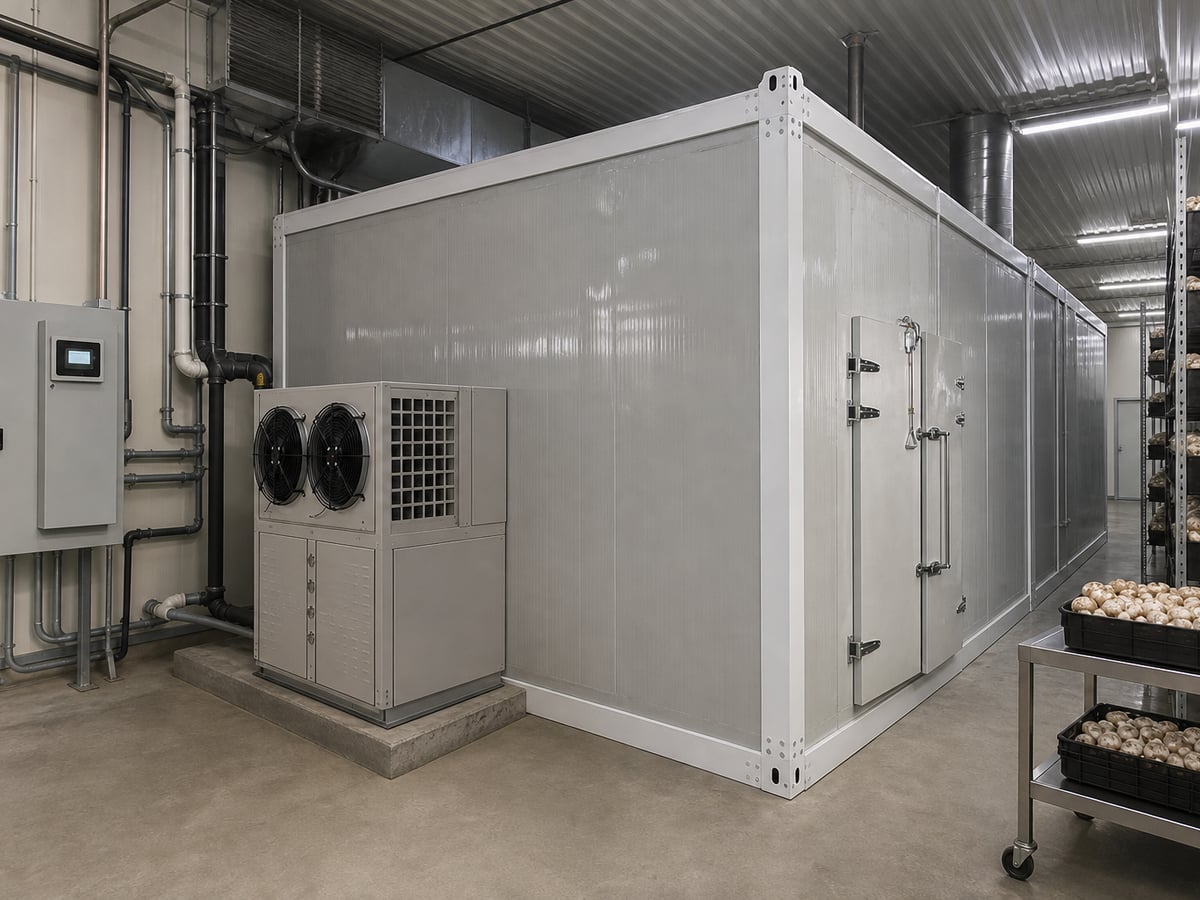
Insulated mushroom containers are not simply metal boxes with cooling equipment. They are controlled wet-room environments where insulation panels, vapor barriers, floors, drainage, doors, and sealing details must work together. A weak joint, poorly insulated floor, damaged door gasket, or unsealed service opening can create condensation, heat loss, unwanted air exchange, and unstable humidity.
For Global Market buyers, the most practical approach is to specify an integrated thermal envelope rather than purchasing insulated panels as a standalone item. The enclosure should be designed around the crop, local climate, energy availability, transport route, wash-down practice, and required production schedule. Oyster mushrooms, shiitake, button mushrooms, lion’s mane, and specialty fungi may require different temperature and humidity profiles, but all depend on stable room conditions.
A properly engineered insulated mushroom grow room typically includes insulated wall and ceiling panels, insulated flooring, vapor-sealed joints, hygienic internal surfaces, drainage slopes, sealed penetrations, a reliable door system, and climate equipment sized for the real heat load. Buyers should request thermal ratings, panel core density, fire-performance documentation where applicable, corrosion specifications, and written details for panel joints and floor-to-wall transitions.
When evaluating a modular cultivation unit, do not focus only on panel thickness. A thicker panel can still perform poorly if joints leak, the floor is uninsulated, or the door frame forms a thermal bridge. The best container solution combines appropriate insulation values with correct installation, inspection, and climate-control integration.
| Envelope Element | Main Purpose | Common Failure Risk | Recommended Buyer Check |
|---|---|---|---|
| Wall panels | Limit heat gain and heat loss | Gaps at panel locks or damaged skins | Confirm core thickness, density, and joint profile |
| Ceiling panels | Control upward heat transfer and condensation | Unsealed seams above humid crop areas | Inspect vapor sealing and panel support layout |
| Floor insulation | Reduce ground-related thermal loss | Cold floor surfaces and moisture migration | Request floor cross-section and load rating |
| Door system | Maintain airtight access points | Flattened gaskets and poor door alignment | Check compression seals and closing hardware |
| Drain penetrations | Remove wash water safely | Air leakage around pipes and drain bodies | Verify sealed collars and insulated transitions |
| Cable openings | Allow equipment installation | Unsealed service penetrations | Require grommets, sealant, and access details |
The table shows why an insulated mushroom container must be treated as a system. Every opening through the envelope affects thermal performance. This is particularly important in humid production environments where the indoor air may be much cooler or warmer than the surrounding climate, depending on season and crop stage.
Why Insulation Is Essential in Humid Growing Rooms

Mushroom cultivation rooms operate under high humidity, frequent air circulation, wash-down cleaning, and often continuous refrigeration or heating. These conditions make insulation more important than in dry storage rooms. Without a strong thermal envelope, the climate controller must work harder to maintain setpoints, causing higher electricity consumption, larger temperature swings, and less predictable fruiting performance.
In tropical, coastal, desert, continental, and cold-climate regions, the external environment can place very different demands on a modular grow room. Buyers in Southeast Asian ports such as Singapore, Ho Chi Minh City, and Jakarta often need protection against persistent heat and moisture. Projects supplied through Dubai, Jebel Ali, Mombasa, Santos, Rotterdam, Los Angeles, or Sydney may encounter long shipping periods, high solar exposure, salty air, or temperature changes during inland transport.
Insulation also reduces the chance of surface condensation. When warm humid air contacts a cold internal or external surface, moisture can condense. In a mushroom facility, condensation can drip onto substrate bags, shelving, electrical equipment, floors, or wall surfaces. This may increase cleaning requirements and create favorable conditions for unwanted mold or bacterial growth.
The thermal envelope influences more than energy use. It affects crop consistency, labor comfort, equipment reliability, sanitation, room recovery after door openings, and the ability to run multiple production cycles. A well-insulated container can return to its set temperature faster after harvesting, loading, cleaning, or maintenance.
Market demand and common product configurations
Global Market demand is growing for prefabricated cultivation rooms because they shorten site construction time and make expansion easier for commercial farms, food distributors, agricultural contractors, research centers, and urban farming projects. Common product formats include standard shipping-container conversions, purpose-built insulated cabins, modular panel rooms inside warehouses, multi-room mushroom farms, and hybrid units combining incubation and fruiting spaces.
Smaller growers may select a compact container for pilot production, local restaurants, farm shops, or training programs. Larger operators may use several modular rooms to separate incubation, fruiting, packing, and cold holding. Separation improves hygiene and makes it easier to use different climate recipes for different species.
| Product Type | Typical User | Insulation Priority | Suitable Application |
|---|---|---|---|
| Compact cultivation container | Start-up farm or training center | Fast temperature recovery | Oyster mushroom pilot production |
| Standard modular fruiting room | Commercial grower | Balanced wall, roof, and floor performance | Continuous harvest schedules |
| Multi-room farm system | Large agricultural project | Room separation and sealed passages | Incubation and fruiting zones |
| Warehouse panel room | Urban agriculture operator | Vapor sealing against building conditions | Indoor specialty mushroom farming |
| Mobile research container | University or agricultural institute | Flexible climate control and durable surfaces | Variety trials and crop testing |
| Integrated cold-chain grow unit | Distributor or food processor | High thermal continuity at doors | Growing, packing, and short-term storage |
These configurations should not use identical panel specifications automatically. The correct design depends on location, operating temperatures, daily door cycles, shelving load, wash-down frequency, and the heat generated by lighting, fans, people, humidification, and equipment.
Panel Thickness and Thermal Performance

Panel thickness is one of the first specifications buyers compare, but it is only one part of thermal performance. The panel core material, density, facing material, joint design, installation quality, structural support, and edge sealing are equally important. Polyurethane and polyisocyanurate insulated panels are common choices because they can provide good thermal resistance at relatively moderate thicknesses. Other materials may be selected for specific fire, cost, or local building requirements.
For mushroom rooms, the objective is to create stable interior conditions with reasonable energy demand. A thin panel may be acceptable in mild climates for low-differential applications, while hotter regions, cold winters, or highly controlled production rooms may require thicker insulation. Roof panels are often exposed to the highest solar load, especially in places such as Riyadh, Nairobi, Perth, Mexico City, Durban, or inland logistics areas near Guangzhou.
Ask suppliers to provide the declared thermal conductivity of the insulation core, the resulting R-value or U-value, and the test standard used. Avoid relying on vague descriptions such as “high-density foam” or “excellent insulation.” A serious quotation should identify the panel thickness, core material, density range, surface skins, joint configuration, and expected thermal performance.
| Panel Location | Typical Design Consideration | Performance Concern | Specification Question |
|---|---|---|---|
| External walls | Outdoor temperature variation | Heat transfer through large surfaces | What is the declared U-value? |
| Roof or ceiling | Solar gain and rising warm air | Condensation and roof heat load | Is roof insulation thicker than wall insulation? |
| Internal partitions | Separate climate zones | Cross-room temperature migration | What panel thickness is used between rooms? |
| Floor system | Ground contact and wash-down | Cold bridging and moisture entry | What insulation is below the finished surface? |
| Door leaf | Frequent opening cycles | Thermal loss at access point | Is the door insulated to match the wall? |
| Frame and corners | Structural connections | Thermal bridges | How are metal-to-metal bridges minimized? |
The table helps buyers compare quotations on a like-for-like basis. A supplier offering a nominally thick panel without U-value data, detailed joint drawings, or floor information may not be providing a complete thermal-envelope solution. For projects with strict energy targets, consider requesting a heat-load calculation that includes transmission through panels, ventilation demand, equipment load, occupancy, lighting, and local ambient conditions.
Buying advice for selecting panel construction
Choose panel thickness according to the worst realistic operating condition rather than the annual average temperature. If the container will operate through hot summers, cold winters, or both, the panel system should be selected for those peak periods. Consider solar radiation, wind, rain exposure, altitude, site shading, building orientation, and whether the unit will stand on a concrete pad, steel frame, or raised foundation.
Internal surfaces should be smooth, washable, corrosion-resistant, and appropriate for humid agricultural use. Painted steel, stainless steel, coated aluminum, and food-oriented surface options may be considered depending on budget and cleaning chemicals. Verify that panel facings resist moisture exposure and that cut edges are protected.
Vapor Sealing at Joints and Openings
Vapor sealing is essential because mushroom rooms contain moist air that can migrate into panel joints, behind trims, around doors, and through service penetrations. Once moisture enters hidden cavities, insulation performance can decline and corrosion risk can increase. A visible panel seam may look neat while still allowing vapor movement if it lacks continuous sealing.
Panel joints should use a compatible joint profile, compressible sealing material, and where needed, approved sealant. The installation sequence matters. Sealing should be continuous at wall-to-floor connections, wall-to-ceiling joints, corners, door frames, pipe penetrations, condensate lines, cable routes, and ventilation openings. Sealant alone is not a substitute for a correctly designed panel joint.
Pay particular attention to pipework for humidifiers, drains, refrigeration lines, fresh-air ducts, sensor cables, and electrical conduits. Every penetration should have a defined detail. Improvised drilling after delivery often creates leaks unless the opening is sealed and insulated correctly.
| Joint or Opening | Preferred Sealing Approach | Inspection Method | Why It Matters |
|---|---|---|---|
| Panel-to-panel joint | Interlocking profile with continuous gasket or sealant | Visual seam inspection | Prevents air and vapor movement |
| Wall-to-floor transition | Sealed cove or sanitary transition detail | Check continuous bead and finish | Protects against wash-water infiltration |
| Ceiling perimeter | Vapor-tight trim with sealed fasteners | Inspect corners and overlaps | Reduces condensation above crop zones |
| Drain pipe penetration | Insulated collar and flexible seal | Check from both sides | Controls moisture and air leakage |
| Electrical conduit | Grommet, gland, and compatible sealant | Verify cable movement does not open gaps | Maintains envelope continuity |
| Air duct connection | Flanged, sealed, and insulated connection | Check fasteners and perimeter seal | Stops bypass air and sweating |
For larger farms, an air-leakage test can be useful before the room enters production. A smoke pencil, low-pressure fan test, or infrared inspection may reveal leaks at doors, joints, and penetrations. The goal is not only to identify visible openings but to find hidden pathways that cause recurring humidity control problems.
Floor Insulation and Drainage Details
The floor is often underestimated in insulated mushroom containers. It must carry racks, substrate, workers, carts, water, and cleaning activity while reducing heat transfer and supporting effective drainage. In hot climates, an uninsulated floor can introduce continuous heat into a cooled room. In cold climates, it can create cold surfaces, condensation, and uncomfortable working conditions.
A suitable floor system commonly includes structural support, insulation, a moisture-resistant layer, a durable finished surface, and drainage components. The exact build-up depends on whether the room is containerized, installed on a slab, elevated on a steel platform, or assembled inside an existing building. Buyers should request a cross-section drawing rather than accepting a simple statement that the floor is “insulated.”
Drainage should remove wash water without leaving standing puddles. Flooring should slope toward drains in a controlled manner while remaining safe for workers and trolleys. Drain locations should not interfere with rack layouts, and drain traps or seals should be selected to avoid odors, pest entry, or air leakage. In humid rooms, cold drain lines may also need insulation to reduce external sweating.
For operations that sanitize frequently, select surfaces compatible with the chemicals and cleaning process used. The floor finish should resist abrasion and avoid cracks where organic debris can accumulate. Smooth transitions between wall and floor simplify cleaning and improve hygienic performance.
Door Gaskets and Air Leakage
Doors are usually the most frequently disturbed part of the thermal envelope. Even excellent insulated panels cannot compensate for a door that does not close squarely, has damaged gaskets, or is opened repeatedly without operational controls. Each opening allows temperature and humidity exchange, especially when the room is under pressure differences created by supply and exhaust fans.
Specify insulated doors with continuous compression gaskets, robust hinges, adjustable latches, corrosion-resistant hardware, and an internal finish suitable for wet-room cleaning. For busy commercial farms, consider self-closing hardware, strip curtains, vestibules, or air-lock arrangements where crop handling requires frequent movement. A small entry lobby can significantly reduce thermal disturbance in high-throughput facilities.
Door frames require the same attention as the door leaf. Metal frames can create thermal bridges, and poorly sealed frame-to-panel interfaces can leak. During acceptance inspection, close the door from inside and outside, check for uniform gasket compression, inspect daylight around edges, and verify that the threshold does not create a water trap.
Operators should include gasket inspection in routine maintenance. Gaskets can harden, flatten, tear, or detach over time due to cleaning chemicals, sunlight, mechanical impact, and repeated use. Replacing inexpensive seals before they fail is often more economical than operating an inefficient climate-control system for months.
Material Ratings to Request from Suppliers
Clear documentation helps buyers compare suppliers and protect project quality. Request technical data sheets early in the purchasing process, especially when the equipment will be imported through global trade hubs or installed under local construction rules. Documents should match the actual quoted configuration rather than showing generic brochure values.
At minimum, buyers should request insulation core information, panel thickness, thermal conductivity, U-value or R-value, skin material, steel thickness where applicable, coating description, corrosion resistance information, fire-performance documentation where required, panel loading limits, floor load data, door specification, gasket material, and sealing method. For refrigerated or tightly controlled rooms, ask for climate equipment capacity and a heat-load basis.
| Requested Rating or Document | What It Confirms | Why Buyers Need It | Supplier Evidence to Request |
|---|---|---|---|
| Thermal conductivity | Insulation core efficiency | Supports energy and panel comparisons | Technical data sheet |
| U-value or R-value | Overall thermal resistance | Helps size climate-control equipment | Calculation or test declaration |
| Core density | Foam structure and consistency | Indicates panel quality control | Production specification |
| Fire-performance rating | Reaction-to-fire classification | Supports local compliance planning | Applicable test certificate |
| Surface coating data | Corrosion and wash-down resistance | Protects humid-room durability | Material or coating report |
| Floor load rating | Structural carrying capacity | Prevents damage from racks and carts | Floor construction drawing |
| Door gasket specification | Seal material and temperature suitability | Supports airtight operation | Door assembly specification |
The table does not replace local engineering review, but it gives procurement teams a practical checklist. For international projects, confirm which standards are mandatory at the installation site. Requirements may differ between the European Union, Gulf countries, North America, Australia, Africa, Latin America, and Southeast Asia. A capable supplier should be able to explain available configurations and identify information needed for local compliance review.
Future trends for 2026 and beyond
By 2026, more mushroom projects are expected to combine high-performance insulated rooms with automated climate recipes, remote monitoring, predictive maintenance, and energy-management systems. Smart sensors can track temperature, humidity, carbon dioxide, differential pressure, door activity, refrigeration runtime, and power consumption. This data allows growers to identify air leakage, oversized equipment, and inefficient operating practices.
Sustainability expectations are also increasing. Buyers are seeking longer-life materials, lower-energy cooling strategies, solar-ready installations, heat recovery options, recyclable metal skins, and designs that reduce water waste during cleaning. Some projects will prioritize refrigerants and equipment choices aligned with evolving environmental policies. Others will focus on decentralized food production near major cities to reduce transport distances and improve freshness.
Policy trends may also affect fire safety, insulation materials, energy labeling, electrical protection, and worker hygiene requirements. Global Market buyers should plan for future expansion by choosing modular rooms that can be connected, monitored, and upgraded rather than selecting a low-cost enclosure that is difficult to repair or improve.
Inspecting the Completed Thermal Envelope
A finished insulated mushroom grow room should be inspected before substrate is loaded. Acceptance should include visual checks, dimensional verification, door operation, drainage testing, seal inspection, electrical safety review, and climate performance testing. The inspection should cover both obvious finishes and hidden details such as panel joints behind trims, ceiling corners, pipe penetrations, and floor-edge seals.
Begin with panel alignment. Surfaces should be straight, secure, and free from major dents, exposed foam, damaged coatings, or unsealed cut edges. Check that fasteners and trims are installed correctly. Review all sealant lines for continuity, especially around drains, cable openings, door frames, refrigeration lines, and ventilation ducts.
Then test drainage by introducing clean water in representative areas. Water should flow toward the drain without pooling around walls, door thresholds, or rack positions. Confirm that the floor finish remains stable and that drain penetrations are properly sealed. Operate doors repeatedly and inspect the gasket contact pattern.
Finally, commission the climate system under realistic conditions. Run the room to its intended setpoint and monitor how quickly it stabilizes, how often equipment cycles, and whether condensation develops. A stable room should maintain reasonable control without excessive compressor runtime or unexplained humidity swings. For detailed solutions, buyers can review the smart mushroom climate controller options available for integrated cultivation environments.
Practical acceptance checklist
- Confirm panel thickness and surface materials match the signed technical specification.
- Inspect every visible joint, corner trim, and service penetration for complete sealing.
- Check that the insulated floor has the agreed construction, finish, slope, and loading capacity.
- Test drainage using water and verify that no standing water remains after normal flow.
- Open and close each door repeatedly to verify alignment, latch pressure, and gasket compression.
- Operate cooling, heating, humidification, ventilation, and controls through a commissioning cycle.
- Record temperature, humidity, and carbon dioxide stability at multiple room locations.
- Keep photographs, inspection notes, and equipment serial numbers for future maintenance.
About Lanhu
Shandong Lanhu Air Conditioning Equipment Co., Ltd. supports Global Market mushroom-growing projects with modular climate-control and cultivation solutions manufactured in Dezhou, Shandong, China. The company works with agricultural contractors, distributors, engineering firms, commercial farms, and project developers seeking factory-direct equipment for controlled-environment agriculture.
Technological capabilities
Lanhu applies more than 12 years of thermodynamic research and development experience to cultivation climate design. Its product range includes smart mushroom cultivation containers, environmental controllers, hydroponic plant containers, and air source heat pumps. These systems are designed to help growers manage temperature, humidity, fresh-air exchange, carbon dioxide, and operating schedules in enclosed agricultural spaces.
For mushroom projects, engineering support can help align insulation performance with refrigeration capacity, humidification needs, airflow layout, and crop density. Buyers can explore a smart mushroom cultivation container solution when planning a compact or modular production facility.
Manufacturing capabilities
Lanhu operates a modern manufacturing facility of more than 30,000 square meters. Its integrated capabilities cover product design, engineering development, sheet metal fabrication, CNC bending, insulated-panel production, electrical assembly, system integration, testing, and quality inspection. This coordinated manufacturing process helps maintain consistency between the enclosure, climate equipment, controls, electrical components, and finishing details.
Each system undergoes functional checks, electrical verification, performance testing, and operational evaluation before shipment. The company holds ISO 9001, ISO 14001, ISO 45001, and ISO 12100 certifications, alongside registered patents and related enterprise credentials. Buyers evaluating design options can also view selected mushroom cultivation project cases for practical application references.
Service capabilities
Lanhu provides factory-direct supply, OEM and ODM customization, engineering assistance, international logistics support, spare-parts support, installation guidance, and after-sales service. This is useful for projects shipped through ports such as Qingdao, Shanghai, Rotterdam, Jebel Ali, Durban, Santos, or Los Angeles, where packaging, transport coordination, and site readiness can affect project timing.
For distributors and engineering partners requiring customized panel layouts, branded control interfaces, room dimensions, or integrated equipment packages, the company offers OEM and ODM cultivation equipment services. The recommended process is to define crop type, target production capacity, ambient climate, local power supply, water availability, installation location, and delivery schedule before finalizing the enclosure specification.
Frequently Asked Questions
What is the most important insulation feature in a mushroom container?
The most important feature is continuity. Wall panels, ceiling panels, floor insulation, doors, joints, and service openings must form one sealed thermal envelope. High-quality panels alone cannot prevent heat loss or condensation if there are air leaks and thermal bridges.
How thick should insulation panels be for a mushroom grow room?
The correct thickness depends on the local climate, required indoor setpoints, solar exposure, operating hours, and energy cost. Hot climates, cold climates, and rooms with strict temperature control generally require stronger insulation than mild-climate projects. Request U-value information and a heat-load calculation rather than selecting thickness by appearance alone.
Do mushroom growing rooms need insulated floors?
Yes, insulated floors are strongly recommended for most controlled mushroom rooms. They reduce heat transfer from the ground or structural base, improve comfort, help prevent cold surface condensation, and reduce the load on cooling or heating equipment. The floor must also support racks, carts, water, and routine cleaning.
How can buyers detect air leakage after installation?
Visual inspection, smoke testing, low-pressure air testing, and infrared checks can help identify leaks. Focus on doors, panel joints, corners, drains, cable entries, pipe penetrations, and duct connections. Unusual compressor runtime, unstable humidity, or localized condensation may also indicate leakage.
Which door details should be included in the purchase specification?
Specify an insulated door leaf, continuous compression gaskets, adjustable hinges and latches, corrosion-resistant hardware, sealed frame connections, an appropriate threshold, and replacement gasket availability. High-traffic rooms may benefit from self-closing mechanisms, strip curtains, or a vestibule.
What documents should an international supplier provide?
Ask for panel drawings, thermal data, core material details, density information, surface specifications, floor construction details, door specifications, electrical diagrams, climate equipment data, packing information, installation guidance, warranty terms, and applicable quality or safety certificates. Local regulations may require additional documentation.
Can one container support different mushroom species?
It can, but different species often require different climate settings and crop-management methods. A flexible controller and well-sealed room can support multiple production programs over time. For simultaneous cultivation of species with different requirements, separate rooms or independently controlled zones are usually more effective.
What should be checked before loading substrate into a new room?
Verify panel sealing, drainage, door closure, rack stability, electrical safety, climate-control operation, sensor accuracy, water connections, ventilation performance, and surface cleanliness. Run the system at target conditions before introducing substrate so issues can be corrected without risking a crop cycle.
Share this article

About the Author: Shandong Lanhu Air Conditioning Equipment
Lanhu is a professional climate control equipment manufacturer specializing in smart agricultural systems, commercial HVAC solutions, and customized temperature control technologies. With extensive engineering experience, Lanhu provides reliable solutions for plant factories, controlled environment agriculture, and industrial applications.
Need a Custom Climate Control Solution?
From smart agricultural systems to commercial HVAC solutions, Lanhu provides reliable temperature and humidity control solutions tailored to your project needs.
Contact Us