Commercial Mushroom Equipment Guide for Global Markets
Fast Overview of Commercial Mushroom Equipment

Commercial mushroom growing equipment is best selected as a connected production system rather than as individual machines. For a Global Market farm, the core equipment normally includes cultivation rooms or containers, growing racks, cooling and heating units, humidification, fresh-air fans, CO2 management, sensors, controllers, electrical protection, and harvest handling tools. The exact configuration depends on mushroom species, local climate, production volume, labor availability, food-safety requirements, and the level of automation required.
The most important principle is simple: build environmental stability before expanding capacity. Oyster mushrooms, shiitake, lion’s mane, enoki, button mushrooms, and specialty varieties all require different temperature, humidity, airflow, and CO2 ranges. A large room with poor climate control can lose more yield than a smaller, well-managed room. In humid coastal areas near Rotterdam, Singapore, Mombasa, Santos, or Ho Chi Minh City, dehumidification, insulation, and corrosion resistance are often as important as cooling capacity. In dry inland regions, humidification water quality and air exchange design may be the larger priorities.
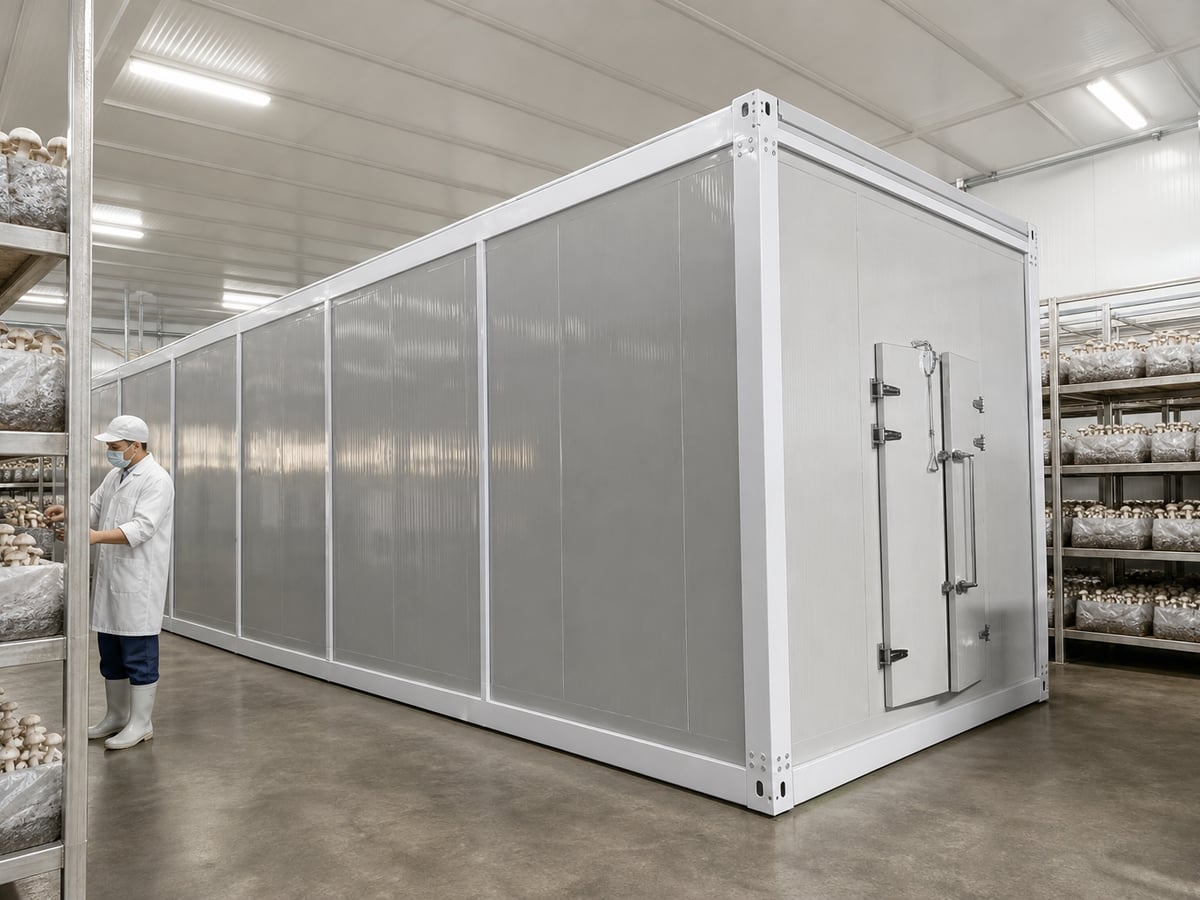
For many new farms, the most practical commercial solution is a modular fruiting room or an integrated smart mushroom cultivation container. These systems reduce construction uncertainty by combining insulated panels, air distribution, climate-control hardware, and production space in a standardized format. They can be deployed near urban wholesale markets, food-service clusters, supermarkets, agricultural estates, and logistics hubs with shorter planning and installation cycles than conventional buildings.
A reliable equipment plan should also separate the farm into clean and dirty zones. Substrate preparation, inoculation, incubation, fruiting, harvesting, packing, cold storage, and waste handling should not share uncontrolled airflow. This prevents spores, dust, pests, and contaminated material from moving into clean production areas. The best equipment package is therefore not necessarily the one with the most machines; it is the one that supports consistent biological performance, safe operation, efficient labor, and manageable maintenance.
| Production Area | Main Equipment | Primary Objective | Typical Priority |
|---|---|---|---|
| Substrate receiving | Scales, pallets, moisture meter, storage bins | Verify raw-material quality and inventory | Medium |
| Substrate preparation | Mixer, bagger, pasteurizer or sterilizer | Prepare a consistent growing medium | High for integrated farms |
| Inoculation area | Clean bench, filters, sealing tools | Reduce contamination risk | High when producing own blocks |
| Incubation room | Insulated room, racks, ventilation, sensors | Support stable colonization | High |
| Fruiting room | Racks, HVAC, humidification, CO2 control | Produce uniform mushrooms | Essential |
| Packing and cold chain | Tables, scales, sealer, cold room | Protect freshness and presentation | High for retail sales |
This table shows why equipment selection must follow the production flow. Farms that buy ready-to-fruit blocks can postpone expensive substrate equipment and invest first in fruiting capacity, cooling, humidity control, and packing. Farms that manufacture their own substrate need additional sterilization, mixing, filling, inoculation, and hygiene infrastructure.
Equipment Needed at Every Production Stage

The equipment required at each production stage changes with the business model. A farm purchasing colonized blocks from a regional supplier may need only receiving space, incubation capacity, fruiting rooms, harvesting tools, and a cold chain. A vertically integrated farm that produces spawn, substrate, and fresh mushrooms needs significantly more equipment, utilities, hygiene procedures, and trained operators.
Raw Material Receiving and Storage
Straw, sawdust, cottonseed hulls, bran, gypsum, lime, supplements, bags, and packaging materials need dry, pest-controlled storage. Basic equipment includes pallet racking, floor scales, moisture meters, forklifts or pallet jacks, bins, and covered receiving areas. Raw materials should be checked for moisture, odor, mold, particle size, and supplier consistency. Near large agricultural trade routes such as the Port of Antwerp-Bruges, Jebel Ali, Durban, or Los Angeles-Long Beach, imported packaging and equipment may be readily available, while locally sourced straw or sawdust may fluctuate by season.
Substrate Processing and Thermal Treatment
Substrate equipment ranges from simple batch pasteurizers for oyster mushroom growers to automated mixing, filling, sterilization, and cooling lines for larger specialty-mushroom operations. Key machines can include shredders, mixers, conveyors, bag fillers, compactors, boilers, steam generators, retorts, autoclaves, and cooling rooms. Equipment must be sized not only by daily substrate weight but also by labor capacity, steam availability, cleaning time, and the number of shifts planned.
Pasteurization is often used for straw-based oyster mushroom substrate, while supplemented sawdust blocks commonly require sterilization. Temperature records, pressure gauges, cycle alarms, and safe steam piping are critical. Poor thermal treatment can create widespread contamination, meaning a low-cost sterilizer with unstable operation may be more expensive over time than a properly engineered unit.
Inoculation and Incubation
Inoculation equipment should support clean handling. Small farms may use a filtered inoculation cabinet, stainless worktable, alcohol sprayers, bag sealers, and hand tools. Larger operations may introduce positive-pressure clean rooms, air filtration, automated inoculation stations, and material pass-throughs. Incubation rooms require shelving or racks, moderate ventilation, temperature control, and environmental monitoring. Unlike fruiting rooms, incubation usually does not need very high humidity, but it requires stable conditions and good sanitation.
| Equipment Category | Starter Farm Option | Growth Farm Option | Operational Consideration |
|---|---|---|---|
| Substrate mixer | Small batch mixer | Automated ribbon or paddle mixer | Match output to daily block target |
| Bag filling | Manual filling station | Semi-automatic bagging line | Weight consistency affects colonization |
| Thermal treatment | Batch pasteurizer | Steam sterilizer with cycle control | Choose by substrate formula and species |
| Inoculation | Clean bench and hand sealer | Filtered clean room and dosing system | Hygiene is more important than speed |
| Incubation storage | Fixed shelves | Multi-tier mobile racks | Allow access for inspection and removal |
| Harvest handling | Mobile carts and manual scales | Conveyors and grading stations | Reduce product handling damage |
The table highlights a practical development path. A farm can automate labor bottlenecks gradually, but climate-control equipment should be correctly sized from the beginning because it protects every crop cycle. When expansion is expected, leave space for additional electrical panels, water treatment, drainage, air ducts, and future rooms.
Fruiting Rooms and Mushroom Growing Racks

Fruiting rooms are where environmental engineering meets crop biology. A well-designed room provides stable temperature, humidity, fresh-air exchange, CO2 control, uniform air distribution, hygiene, drainage, lighting where needed, and safe working access. The room envelope is fundamental. Insulated sandwich panels, sealed doors, washable surfaces, insulated floors, and well-designed condensate drainage help reduce energy loss and prevent water damage.
Growing racks determine how efficiently floor area becomes production capacity. Common options include galvanized steel shelving, epoxy-coated racks, aluminum structures, stainless-steel racks for high-hygiene zones, and movable rack systems. The appropriate rack depends on substrate format: bags, bottles, trays, shelves, or hanging blocks. Racks must hold the expected wet weight safely and maintain enough aisle space for airflow, harvesting, sanitation, and trolley movement.
For oyster mushrooms, multi-tier shelf racks are common because they provide high block density and easy harvesting. For shiitake, wider shelf spacing can improve cap development and access. For bottle cultivation, automated systems may use bottle conveyors and specialized shelving. A farm should avoid filling every available space with blocks; overcrowding can restrict air circulation, elevate CO2, increase disease pressure, and create uneven flushes.
| Rack Design Factor | Recommended Planning Question | Risk if Ignored | Practical Result |
|---|---|---|---|
| Tier quantity | Can staff harvest every level safely? | Slow labor and unsafe lifting | Use accessible multi-tier layouts |
| Aisle width | Can carts and workers pass comfortably? | Crop damage and poor cleaning | Plan for harvest traffic |
| Rack material | Will humidity cause corrosion? | Structural deterioration | Select coated or corrosion-resistant steel |
| Block spacing | Does air reach each fruiting surface? | Long stems and uneven growth | Maintain species-specific spacing |
| Load capacity | What is the maximum wet substrate weight? | Rack deformation or failure | Specify engineered load ratings |
| Cleaning access | Can all surfaces be washed and disinfected? | Persistent contamination | Choose open, washable designs |
Modular fruiting rooms can be installed beside existing farm buildings, warehouses, food-processing plants, hotels, or urban agriculture facilities. This is useful in markets where lease terms or permitting timelines make permanent construction difficult. A containerized unit can also be relocated or replicated as demand grows. For examples of modular cultivation deployments and practical layouts, review the company’s mushroom cultivation project cases.
Cooling, Heating, and Humidity Control Systems
Cooling, heating, and humidity equipment should be selected as an integrated climate-control system. Mushroom rooms generate moisture and biological heat, while outside weather can change rapidly. Tropical climates may require strong cooling and dehumidification; cold regions may need heating and heat recovery; dry climates may require high-capacity humidification and careful water management. In all regions, insulation quality has a direct impact on energy use and environmental stability.
Cooling systems can include direct-expansion condensing units, packaged air conditioners, chilled-water coils, air-source heat pumps, and purpose-built mushroom climate units. Heating may be supplied through heat pumps, electric heaters, hot-water coils, boilers, or recovered heat. Heat pumps can be especially useful where farms require both cooling and heating during different seasons, but selection must consider local electricity prices, ambient temperature, defrost behavior, and service support.
Humidity is usually delivered through ultrasonic humidifiers, high-pressure fogging systems, centrifugal humidifiers, evaporative equipment, or controlled water atomization. The wrong humidification technology can produce large droplets, wet caps, pooling water, and bacterial risk. The goal is not simply “high humidity”; it is stable relative humidity with fine distribution, minimal condensation, and air movement appropriate to the species.
| Climate Challenge | Equipment Response | Design Focus | Typical Operating Concern |
|---|---|---|---|
| Hot and humid climate | Cooling coil, insulated room, controlled ventilation | Latent moisture removal | Condensation and high energy demand |
| Hot and dry climate | Cooling plus fine-mist humidification | Water quality and humidity stability | Rapid drying of primordia |
| Cold winter climate | Heat pump or heating coil | Envelope insulation and freeze protection | High heating costs |
| Coastal climate | Corrosion-resistant HVAC components | Salt-air protection | Metal degradation |
| High-altitude region | Adjusted airflow and heating design | Pressure and temperature variation | Different fan performance |
| Variable seasonal climate | Reversible heat pump and automation | Wide operating range | Frequent setpoint changes |
Humidity sensors should be positioned away from direct fog streams, cooling coils, doors, and exhaust points. Temperature sensors should represent crop-level conditions rather than merely measuring ceiling air. Drainage lines must be sloped, insulated where necessary, and accessible for cleaning. Standing water in a fruiting room creates sanitation risks and attracts insects.
Energy efficiency is becoming a decisive procurement factor across the Global Market. Farms increasingly compare insulation thickness, compressor efficiency, fan motor type, heat recovery options, variable-speed drives, refrigerant choices, and remote diagnostics. By 2026, more mushroom facilities are expected to adopt intelligent heat-pump systems, demand-based ventilation, energy monitoring, and lower-impact refrigerants in response to energy cost volatility and sustainability policies.
Fresh Air Supply and CO2 Management
Fresh air and CO2 management are essential to mushroom morphology and yield. Mushrooms release carbon dioxide as they grow. When CO2 becomes too high, many species develop long stems, small caps, poor texture, and lower market value. When fresh-air exchange is excessive, rooms can lose humidity and temperature stability. Effective design balances outside air, recirculated air, filtration, exhaust, pressure, air velocity, and sensor feedback.
A typical system includes supply fans, exhaust fans, ducts, dampers, louvers, filters, diffusers, CO2 sensors, variable-frequency drives, and a controller. Fresh air should be introduced in a way that avoids blasting cold or dry air directly onto developing mushrooms. Air should circulate evenly through rack levels, not simply travel from one wall to another. Smoke tests, ribbon tests, and practical crop observation can reveal dead zones and high-velocity zones.
Air intake location matters. Avoid drawing air from loading docks, waste areas, diesel vehicle routes, dusty roads, compost piles, or neighboring poultry and livestock operations. In dense industrial zones around Dubai, Mexico City, Jakarta, Lagos, or Istanbul, filtration and intake placement deserve careful engineering. Farms serving premium retail and food-service customers may also need documented environmental records for quality assurance.
The chart illustrates a common starter-farm priority order. Insulation, cooling, humidity, and fresh-air management usually deliver stronger early production benefits than advanced automation. Automation becomes more valuable once the farm has stable crop recipes, consistent block quality, and enough production volume to justify reduced labor and improved traceability.
Controllers, Sensors, and Operator Interfaces
Climate controllers turn separate mechanical components into an operating system. A mushroom climate controller can coordinate cooling, heating, humidification, exhaust fans, fresh-air dampers, circulation fans, lighting, alarms, and scheduled crop recipes. Instead of relying on manual switching, operators can define setpoints and response logic for each stage of cultivation.
The minimum sensor package should normally include temperature, relative humidity, and CO2 monitoring. More advanced systems can add external weather sensors, differential pressure sensors, door contacts, water-level alarms, power meters, airflow confirmation, refrigerant alarms, and camera monitoring. Sensor accuracy is valuable only when calibration, placement, cleaning, and data review are handled correctly.
Operator interfaces should be easy to use under farm conditions. A clear touchscreen or web dashboard should show real-time data, equipment status, alarms, historical trends, and manual override controls. Remote access is useful for managers operating several farms or for technicians providing support across borders, but local manual controls remain important during internet interruptions or commissioning.
Lanhu develops integrated environmental management solutions including the smart mushroom climate controller. Its technological capabilities are supported by more than 12 years of thermodynamic research and development and a portfolio of more than 45 registered patents. The focus is on coordinating equipment behavior around measurable crop conditions rather than treating cooling, humidification, and ventilation as isolated devices.
| Sensor or Interface | What It Measures or Controls | Why It Matters | Maintenance Practice |
|---|---|---|---|
| Temperature sensor | Room or crop-zone temperature | Protects growth rate and flush timing | Verify against a reference thermometer |
| Humidity sensor | Relative humidity | Reduces drying and condensation risks | Keep clear of mist and debris |
| CO2 sensor | Carbon dioxide concentration | Supports cap shape and stem development | Calibrate on a defined schedule |
| Water-level alarm | Humidifier or tank water availability | Prevents unexpected humidity loss | Clean tanks and inspect floats |
| Power meter | Electrical consumption | Identifies rising operating costs | Review monthly energy trends |
| Touchscreen dashboard | Setpoints, alarms, schedules, manual control | Improves operator response time | Protect from moisture and unauthorized access |
Data should guide decisions but not replace crop inspection. Operators still need to observe pin formation, cap color, stem length, moisture on surfaces, odor, block condition, insect activity, and harvest timing. The best farms combine sensor data with disciplined crop walks and clear operating procedures.
Limits of Substrate and Packing Equipment
Substrate and packing equipment are important, but they should not be confused with fruiting-room climate equipment. A supplier specializing in climate-controlled mushroom containers, HVAC systems, racks, and controllers may not supply every mixer, boiler, autoclave, filling machine, or retail packaging line. Clear equipment boundaries help buyers build realistic project budgets and avoid gaps during installation.
Substrate machinery often requires specialized process knowledge because formulas, moisture levels, sterilization cycles, bag formats, and spawn handling vary by mushroom species. Packing equipment also depends on the sales channel. Wholesale mushrooms may require crates and basic weighing, while supermarkets may require tray sealing, labeling, barcode printing, checkweighing, modified-atmosphere packaging, and cold storage.
For new projects, define interfaces between equipment packages early. Confirm electrical loads, water supply, drainage, steam requirements, floor loading, room dimensions, air-flow openings, and control communication protocols. For example, a pasteurizer may create heat and humidity that must be isolated from incubation and fruiting areas. A packing room may need separate hygiene rules and lower temperatures than a harvest staging area.
What to Confirm Before Ordering
Ask every supplier whether its quotation includes installation materials, electrical panels, control wiring, refrigerant piping, ductwork, drainage accessories, spare parts, commissioning, training, remote support, operating manuals, and warranty terms. If equipment is shipped internationally through Qingdao, Shanghai, Ningbo, Hamburg, Rotterdam, or Callao, clarify container loading, Incoterms, customs documents, local electrical standards, and destination-site lifting arrangements.
A complete commercial mushroom project may involve several specialist vendors: climate-control supplier, building contractor, substrate machinery supplier, refrigeration installer, water-treatment provider, packaging supplier, and local electrician. One supplier can coordinate an integrated scope, but the buyer should still maintain a written responsibility matrix to prevent missing interfaces.
How to Prioritize Equipment for a Starter Farm
A starter mushroom farm should prioritize equipment that protects crop consistency, simplifies daily work, and supports sales growth without excessive debt. Begin with the intended market. Restaurants and premium grocers may value specialty varieties, stable weekly supply, and visual quality. Wholesale markets may prioritize volume and price. Hotels, meal-kit businesses, food processors, and local distributors may need predictable delivery schedules and refrigerated packing.
For a farm purchasing ready-to-fruit blocks, the recommended first investment sequence is usually: insulated fruiting space, dependable cooling and heating, humidification, fresh-air and CO2 control, racks, drainage, basic monitoring, harvest carts, scales, packing tables, and cold storage. For a farm producing substrate, add processing equipment only after confirming raw-material supply, water quality, sanitation capacity, technical skills, and demand volume.
Buyers should calculate capacity from market demand backward. Estimate weekly sales, expected yield per block, crop cycle length, losses, flush schedule, and harvest labor. Then size rooms and racks accordingly. Avoid buying a room based only on the number of blocks it can physically hold; environmental capacity, cooling load, dehumidification, fresh-air demand, and worker access determine usable production capacity.
| Starter Farm Budget Priority | Why It Comes First | Can It Be Delayed? | Buying Advice |
|---|---|---|---|
| Insulated fruiting envelope | Reduces climate instability and energy loss | No | Choose washable, sealed panels and doors |
| Cooling and heating capacity | Maintains crop temperature year-round | No | Size for local peak weather conditions |
| Humidity and water system | Supports pinning and mushroom quality | No | Include filtration and easy cleaning |
| Fresh-air and CO2 equipment | Controls morphology and worker conditions | No | Use sensors and adjustable fan control |
| Growing racks and carts | Improves space utilization and labor flow | Limited | Prioritize safe access and corrosion resistance | Advanced automation | Improves scale and traceability | Yes | Add after crop procedures are stable |
Service capability should influence the purchase decision as much as initial price. International buyers should look for clear drawings, responsive technical communication, spare-parts availability, installation guidance, and support after commissioning. For projects requiring tailored dimensions, local voltage, branding, or specialized room layouts, Lanhu offers OEM and ODM customization services for commercial cultivation and climate-control projects.
By 2026, starter farms are likely to prioritize modular deployment, remote alarm management, energy monitoring, water-saving humidification, recyclable insulation solutions, and more traceable production records. Food-security policies, urban agriculture programs, and pressure to reduce imported perishables may further encourage local controlled-environment mushroom production in cities and regional trade hubs worldwide.
About Our Company
Shandong Lanhu Air Conditioning Equipment Co., Ltd. is based in Dezhou, Shandong, China, and serves agricultural contractors, equipment distributors, engineering companies, and commercial farming projects across the Global Market. The company specializes in agricultural climate-control equipment, industrial HVAC systems, modular cultivation solutions, smart mushroom cultivation containers, climate controllers, hydroponic plant containers, and air-source heat pumps.
Its manufacturing capabilities are built around a modern production facility of more than 30,000 square meters. Internal capabilities include product design, engineering development, sheet-metal fabrication, CNC bending, insulated-panel production, electrical assembly, system integration, equipment testing, and quality inspection. This integrated production approach helps maintain consistency between the room enclosure, airflow components, electrical controls, insulation system, and operational requirements.
Before shipment, systems undergo functional inspection, electrical verification, performance testing, and operational evaluation. The company holds ISO 9001, ISO 14001, ISO 45001, and ISO 12100 certifications, supporting quality management, environmental management, occupational health and safety, and machinery safety practices. These controls are especially relevant for overseas buyers who need documented production processes and dependable project communication.
Lanhu’s service capabilities include factory-direct supply, customized engineering support, international logistics coordination, spare-parts support, installation guidance, and after-sales assistance. For mushroom farms in climates ranging from cold continental interiors to humid tropical ports, system design can be adapted around room size, mushroom type, outside temperature, electricity conditions, and operating workflow. The objective is to provide practical, scalable climate-control infrastructure rather than a one-size-fits-all equipment list.
Frequently Asked Questions
What equipment is essential for a commercial mushroom fruiting room?
The essential equipment includes an insulated room or container, racks, cooling and heating equipment, humidification, fresh-air fans, exhaust fans, CO2 sensors, temperature and humidity sensors, a controller, lighting where required, drainage, and harvest handling tools. The exact system depends on species and local climate.
Can a starter farm begin without making its own substrate?
Yes. Many growers begin by purchasing colonized or ready-to-fruit substrate blocks. This reduces initial investment in mixers, sterilizers, boilers, clean rooms, and inoculation equipment. It allows the business to focus on fruiting-room management, harvest quality, customer development, and cold-chain operations.
How do I choose between a conventional room and a mushroom cultivation container?
A conventional room may be suitable when a farm already has a well-insulated building and reliable construction support. A modular container is often attractive when rapid deployment, standardized engineering, mobility, or expansion in phases is important. Compare delivered cost, climate performance, local permits, utility access, and future expansion plans.
Why is CO2 control important for mushroom quality?
CO2 affects mushroom shape, stem length, cap development, texture, and overall marketability. Excessive CO2 can create undesirable morphology, while excessive ventilation can dry the crop and increase energy use. A sensor-controlled ventilation strategy provides more consistent results than manual fan operation.
What should international buyers confirm before importing equipment?
Confirm electrical voltage and frequency, local refrigerant regulations, climate design conditions, shipping terms, customs documentation, spare-parts lists, installation responsibilities, drainage requirements, lifting access, and after-sales communication procedures. Buyers should also verify whether local technicians are needed for refrigerant piping or electrical connection.
What sustainability trends will affect mushroom farms in 2026?
Key trends include higher-efficiency heat pumps, variable-speed fans, remote energy monitoring, heat recovery, lower-impact refrigerants, water-use control, reusable packaging, agricultural-waste substrate utilization, and digital crop records. Farms that lower energy and water intensity while maintaining stable quality are likely to be better positioned for future customer and policy requirements.
Share this article

About the Author: Shandong Lanhu Air Conditioning Equipment
Lanhu is a professional climate control equipment manufacturer specializing in smart agricultural systems, commercial HVAC solutions, and customized temperature control technologies. With extensive engineering experience, Lanhu provides reliable solutions for plant factories, controlled environment agriculture, and industrial applications.
Need a Custom Climate Control Solution?
From smart agricultural systems to commercial HVAC solutions, Lanhu provides reliable temperature and humidity control solutions tailored to your project needs.
Contact Us