Sizing Mushroom Cultivation Systems for the Global Market
Quick Answer: Start with Production, Not Equipment

The correct way to size mushroom cultivation equipment is to work backward from the harvest target. Begin with the species, weekly sales requirement, biological efficiency, crop cycle, substrate format, room dimensions, local weather, and labor model. Only after those variables are defined should you select climate controllers, air-handling equipment, humidifiers, cooling systems, heating systems, racks, sensors, and electrical components.
A practical sizing sequence is:
- Set the weekly and annual harvest target.
- Convert the target into the number and weight of fruiting blocks required.
- Calculate the usable fruiting area and total room volume.
- Define temperature, relative humidity, carbon dioxide, fresh-air, and lighting requirements.
- Adjust cooling, heating, dehumidification, and humidification for the local climate.
- Plan rack capacity around block dimensions, harvest access, cleaning, and labor.
- Verify electrical power, water quality, drainage, ventilation, and backup capacity.
- Review every component as one integrated environmental-control system.
For example, a small oyster mushroom farm supplying restaurants in Dubai, Singapore, or London may require very different equipment even when the weekly harvest is identical. Dubai demands greater cooling and dehumidification resilience, Singapore requires strong moisture management and corrosion protection, while London may require more heating during winter and careful fresh-air control. The production target is the starting point, but weather, utility prices, building structure, and labor availability determine the final system size.
Commercial growers should also distinguish between nominal equipment capacity and useful capacity under real operating conditions. A cooling unit rated at a laboratory condition may deliver less performance when outdoor air is hot, filters are dirty, doors are frequently opened, or the room contains wet substrate. A reliable project specification therefore includes design margins, service access, sensor locations, control logic, and a clear commissioning plan.
Turn Harvest Targets into Crop Loads

Crop load is the bridge between a sales plan and an equipment specification. It describes how much biological material is in production at one time and how much heat, moisture, carbon dioxide, and airflow that material will generate or consume.
Start by selecting the mushroom species and production format. Oyster mushrooms may be grown in hanging bags, blocks, or shelves. Shiitake is commonly produced on blocks or logs, while button mushrooms often require specialized composting, casing, and room-management procedures. Lion’s mane can need careful airflow and humidity control because excessive air movement may dry the delicate fruit bodies.
The basic calculation is:
Required blocks per week = weekly saleable harvest ÷ expected saleable yield per block.
If a farm needs 500 kilograms of saleable mushrooms per week and each 2.5-kilogram oyster block produces 0.75 kilograms of saleable mushrooms during the planned harvest window, the farm needs approximately 667 blocks entering or completing production each week. The actual number should be increased for contamination, grading loss, crop variation, and missed harvests.
Next, account for the crop cycle. If blocks remain in the fruiting room for five weeks, a steady-state operation may hold roughly five weekly batches at one time. In the example above, that is about 3,335 blocks in fruiting production before adding incubation stock, quarantine space, or a reserve for seasonal demand.
| Planning input | Example value | Why it matters | Typical adjustment | Equipment effect | Management note |
|---|---|---|---|---|---|
| Weekly sales target | 500 kg | Defines the required output | Add 5–15% sales buffer | Sets room and airflow scale | Use saleable weight, not gross harvest |
| Block weight | 2.5 kg | Determines handling and rack load | Confirm actual supplier specification | Influences shelf spacing and labor | Wet blocks are heavier than dry substrate |
| Saleable yield per block | 0.75 kg | Converts blocks into crop output | Reduce for contamination and grading | Changes the number of active blocks | Use farm trial data when possible |
| Fruiting duration | 5 weeks | Sets simultaneous crop inventory | Add cleaning and transition time | Determines room volume and rack quantity | Shorter cycles require stronger scheduling |
| Contamination allowance | 8% | Protects the harvest forecast | Use historical records | May require spare capacity | Separate contaminated material quickly |
| Peak harvest factor | 1.2 | Accounts for flush concentration | Review species and market pattern | Affects labor and cold-room demand | Do not size only for average daily output |
The table shows why a simple “room size per kilogram” rule can be misleading. Two farms producing the same annual tonnage may need different equipment if one harvests concentrated flushes while the other spreads production evenly. A farm selling to hotels in Doha or wholesalers at the Rotterdam market may also need additional short-term holding capacity because delivery schedules can create sharp peaks in harvest and cooling demand.
Crop load also changes through the fruiting cycle. Fresh blocks may release more moisture and carbon dioxide than older blocks. During a heavy first flush, the room may need greater fresh-air exchange and stronger moisture removal. Equipment should therefore be evaluated against peak biological load rather than average load.
Calculate the Required Fruiting Space

Fruiting space should be calculated from usable rack area, not the gross floor area of a building. A room with 100 square meters of floor space does not provide 100 square meters of growing surface. Access aisles, doors, evaporators, ducting, drains, service zones, loading areas, and safety clearances reduce the productive area.
Useful rack area can be estimated as:
Total usable growing area = number of racks × rack length × rack depth × number of productive levels.
For hanging bags, the equivalent calculation may use hanging positions and vertical rows. The chosen arrangement must preserve enough space for air distribution, inspection, harvesting, cleaning, and replacement of failed blocks. Overfilling a room can reduce yield even when the nominal rack capacity appears adequate.
| Fruiting-space factor | Planning question | Typical consequence of undersizing | Better design response | Operational benefit | Validation method |
|---|---|---|---|---|---|
| Rack footprint | How much floor area does each rack occupy? | Blocked aisles and difficult cleaning | Map equipment and access before purchase | Safer movement and faster harvest | Use a scaled floor plan |
| Vertical levels | How many shelves can be productive? | Unused room height or excessive reach | Match levels to worker height and trolley access | Better cubic-meter utilization | Test with loaded sample racks |
| Aisle width | Can staff and carts pass safely? | Slow harvest and block damage | Set aisle widths around actual carts | Lower labor time | Conduct a movement trial |
| Air gap | Can air circulate around every block? | Wet pockets and uneven pinning | Leave side, top, and rear clearances | More uniform crop quality | Measure room airflow after loading |
| Service zone | Can coils, fans, and sensors be maintained? | Long downtime during repairs | Reserve accessible technical space | Lower maintenance risk | Review maintenance access drawings |
| Expansion zone | Can future capacity be added? | Expensive relocation later | Reserve power, drains, and floor area | More flexible growth | Include a two-stage master plan |
For a commercial farm, rack design should be coordinated with block dimensions. A shelf built for 600-millimeter blocks may waste space when used with 450-millimeter blocks, while a narrow shelf may create unstable loading when blocks are larger. Consider wet weight, shelf deflection, corrosion resistance, cleaning chemicals, and the need to remove a single block without disturbing neighboring crops.
Room volume is also important. A high room can hold more racks, but greater height increases air stratification and may require better supply-air distribution. In a warm coastal city such as Ho Chi Minh City or Lagos, a tall, heavily loaded room may develop temperature and humidity differences between the upper and lower levels unless the air-handling design is carefully balanced.
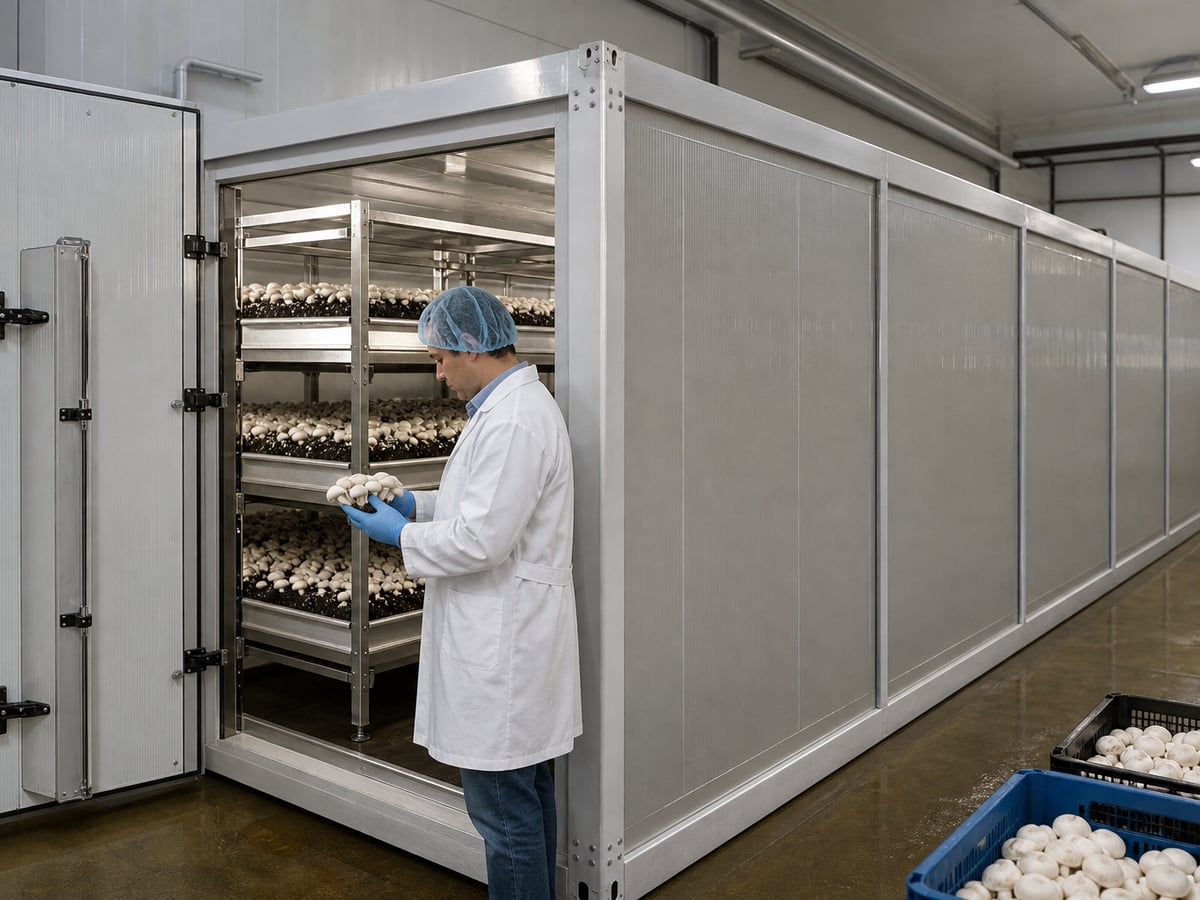
For modular projects, a smart mushroom cultivation container can simplify the relationship between room volume, insulation, controls, and equipment placement. Containers are especially useful for pilot farms, remote sites, staged expansion, and projects that need a repeatable factory-built module. They still require correct foundation, electrical supply, drainage, loading access, and climate adaptation.
Match Climate Capacity to Local Weather
Climate capacity must be based on the local design condition, not on an annual average. The same room can require substantially different cooling, heating, dehumidification, and fresh-air equipment in different regions.
Important weather inputs include outdoor dry-bulb temperature, outdoor humidity, solar exposure, wind, rainfall, seasonal temperature range, and the frequency of extreme conditions. Building orientation, roof insulation, nearby machinery, and door-opening patterns also contribute to the load.
Cooling load usually includes heat entering through walls and ceilings, heat from people and lighting, fan and motor heat, fresh outdoor air, product respiration, humidification energy, and heat from compressors or nearby equipment. Heating load includes transmission losses, outdoor air, evaporation, and the required warm-up after sanitation or a long door opening.
| Location example | Primary climate risk | Equipment priority | Control strategy | Construction consideration | Commercial note |
|---|---|---|---|---|---|
| Dubai | High summer heat and dry outdoor air | Cooling, filtration, and humidification | Limit uncontrolled fresh air and recover energy | Use strong insulation and sun protection | Plan for high peak electricity demand |
| Singapore | Warm, humid air year-round | Dehumidification and corrosion resistance | Condition incoming air before mixing | Protect metalwork and drainage points | Monitor mold risk during wet periods |
| London | Cold winter periods and variable humidity | Heating, heat recovery, and modulation | Maintain stable fresh-air volume | Seal doors and insulate panels | Consider energy pricing and carbon goals |
| Toronto | Cold winters and large seasonal variation | Heating and freeze protection | Use staged heating and frost alarms | Insulate pipes and service areas | Protect equipment during power interruptions |
| São Paulo | Warm periods and variable rainfall | Cooling, drainage, and airflow control | Adapt set points to seasonal crop demand | Design for condensation management | Review local voltage and service support |
| Nairobi | Moderate climate with elevation effects | Efficient cooling and heating flexibility | Use sensors to avoid over-conditioning | Plan for dust filtration and water quality | Remote monitoring can reduce service visits |
Local logistics also affect the design. A project near the Port of Rotterdam may have easy access to replacement components but strict delivery scheduling. A farm near Jebel Ali Port may benefit from modular imports but must protect equipment from heat during storage and installation. Projects serving the Port of Los Angeles, Port Klang, Hamburg, or Durban should confirm container dimensions, customs documents, local electrical standards, and spare-parts lead times before finalizing the equipment list.
Climate calculations should include a safety margin without creating excessive oversizing. An oversized compressor may short-cycle, waste energy, and create unstable humidity. A system that is too small may run continuously and fail to recover after harvesting or sanitation. Variable-speed compressors, staged fans, modulating dampers, and proportional humidification can help match output to changing crop demand.
A smart mushroom climate controller should coordinate temperature, relative humidity, carbon dioxide, fresh-air dampers, cooling, heating, humidification, alarms, and schedules. Independent devices can work, but integrated logic generally provides better stability and clearer troubleshooting.
Size Humidification for Fresh-Air Demand
Humidity control is not simply a matter of adding a misting device. The humidification system must replace moisture lost through fresh-air exchange, evaporation, leakage, condensation, harvesting activity, and dry construction materials. At the same time, the room may need dehumidification when the crop releases more moisture than the air can hold.
The approximate moisture requirement for fresh air can be estimated from:
Moisture load = air mass flow × difference in humidity ratio between room supply conditions and outdoor air.
In practical terms, a cold and dry winter climate can create a large humidification demand even when the room is already full of wet blocks. A hot and humid climate may require little added moisture but substantial dehumidification after fresh air enters the room. The design therefore needs psychrometric analysis rather than a fixed humidifier size based only on room volume.
| Humidity-control input | What to measure | Risk if ignored | Recommended design feature | Sensor or alarm | Maintenance point |
|---|---|---|---|---|---|
| Fresh-air volume | Actual outdoor air per hour | Drying or excessive cooling load | Modulating damper and airflow proof | Airflow or pressure sensor | Inspect dampers and filters |
| Outdoor humidity | Humidity ratio, not only relative humidity | Incorrect humidifier sizing | Outdoor temperature and humidity sensor | High and low humidity alarm | Keep sensor shielded and calibrated |
| Crop evaporation | Moisture released by blocks and fruit | Condensation or wet surfaces | Dehumidification staging | Room humidity trend logging | Clean coils and drains |
| Water quality | Minerals, hardness, and microbiological condition | Nozzle blockage or contamination | Filtered or treated water supply | Low-flow and water-level alarm | Follow sanitation schedule |
| Distribution pattern | Where moisture enters the room | Wet spots and dry shelves | Fine atomization and air mixing | Multiple room sensors | Check nozzles and manifolds |
| Condensation control | Surface temperature and dew point | Drips, corrosion, and microbial growth | Insulated surfaces and drain pans | Dew-point or leak alarm | Keep drains open and accessible |
Ultrasonic humidifiers, high-pressure fogging systems, evaporative units, and steam humidifiers each have different advantages. High-pressure fogging can provide efficient fine droplets when water treatment and nozzle maintenance are well managed. Steam offers clean moisture but may use more energy. Ultrasonic systems can be compact but require careful control of mineral content and aerosol hygiene. The choice should follow the crop, room size, water quality, energy cost, and sanitation policy.
Fresh-air demand must also be tied to carbon dioxide control. Reducing carbon dioxide with outdoor air can remove moisture in one climate and add moisture in another. A controller that uses only a fixed timer may waste energy or create crop variation. A better sequence uses carbon dioxide, humidity, temperature, and minimum ventilation limits together, with different set points for pinning, fruit development, and recovery after door opening.
Plan Racks Around Blocks and Labor
Rack planning is both an engineering issue and a labor issue. The highest theoretical block density is not always the lowest-cost design. Workers need to see fruiting bodies, reach every shelf, move harvest containers, remove failed blocks, wash surfaces, and inspect sensors without unsafe stretching or frequent ladder use.
Plan the material flow from receiving to inoculation, incubation, fruiting, harvesting, cooling, packing, and dispatch. Avoid routing dirty substrate, finished product, and waste through the same narrow passage where possible. The layout should reduce cross-contamination and avoid unnecessary walking.
For farms near wholesale markets such as Rungis in Paris, New Covent Garden in London, or the Hong Kong wholesale food market, harvest timing may be concentrated in early morning hours. Rack design should support fast picking and staging. For remote farms, the priority may be lower labor intensity, remote alarms, and longer intervals between service visits.
| Labor activity | Layout requirement | Common design mistake | Better approach | Result | Measurement |
|---|---|---|---|---|---|
| Loading blocks | Clear route from staging to racks | Carrying blocks through finished-product areas | Use dedicated trolley paths | Faster and cleaner loading | Time a full batch movement |
| Daily inspection | Visibility of every shelf | Deep racks with hidden rear zones | Use accessible depth and lighting | Earlier problem detection | Record inspection minutes per room |
| Harvesting | Space for bins and carts | Placing racks directly against doors | Reserve harvest staging space | Lower product damage | Track kilograms per labor hour |
| Sanitation | Washable surfaces and drainage | Unsealed wood or inaccessible corners | Use corrosion-resistant, cleanable materials | Improved hygiene | Complete sanitation checklist |
| Block removal | Single-block access | Stacking blocks so one removal disturbs all | Use stable spacing and planned batch positions | Less crop disturbance | Count handling events per block |
| Maintenance | Access to fans, coils, and controls | Installing equipment behind full racks | Keep a service corridor or removable panel | Shorter downtime | Review maintenance response time |
Rack materials should be selected for high humidity and repeated cleaning. Galvanized steel, stainless steel, coated aluminum, and suitable food-grade plastics may be appropriate depending on the area and chemical regime. Confirm load ratings using wet block weight and dynamic handling loads, not only dry block weight. Shelves should not obstruct supply air or create dead zones behind densely packed blocks.
When planning modular rooms, coordinate rack height with container ceiling height, evaporator position, light fixtures, access doors, and emergency egress. A factory-built room can reduce installation time, but internal space is fixed; a few centimeters of poorly planned clearance can affect the whole operation.
Check Utility Capacity Before Purchase
Utility verification should happen before equipment purchase, not after delivery. Many cultivation projects experience delays because the building has insufficient electrical capacity, poor water pressure, limited drainage, undersized transformers, or no practical route for heat rejection.
Prepare a utility schedule listing connected load, operating load, starting current, voltage, frequency, phase, water flow, water pressure, drainage size, exhaust requirements, and backup requirements. Include every device: compressors, pumps, fans, humidifiers, heaters, lighting, controls, packaging machines, cold rooms, and sanitation equipment.
| Utility | Verification item | Why it matters | Potential upgrade | Backup option | Purchase-stage question |
|---|---|---|---|---|---|
| Electrical supply | Voltage, phase, frequency, and available amperage | Prevents trips and motor damage | Transformer, panel, or service upgrade | Generator or automatic transfer system | What is the measured site capacity? |
| Water supply | Pressure, flow, hardness, and microbiology | Protects humidifiers and crop hygiene | Filtration, softening, or treatment | Storage tank and booster pump | Can water quality be tested before commissioning? |
| Drainage | Pipe diameter, slope, and discharge route | Handles condensate and wash water | Floor drains, pumps, or separators | High-level alarm and secondary pump | Where does every drain terminate? |
| Heat rejection | Outdoor space and airflow around condensers | Ensures cooling performance | Raised platform or remote condenser | Standby cooling capacity | Can hot air recirculation be avoided? |
| Internet and controls | Stable network and remote access policy | Supports alarms and data logging | Dedicated network or gateway | Local autonomous control | Does the room remain safe if the network fails? |
| Fuel or heat source | Availability and safety requirements | Supports winter heating | Electric, hot-water, or heat-pump system | Secondary heater or thermal storage | What is the local energy cost and code? |
Electrical standards differ across markets. A system shipped to the Gulf region may need a different voltage arrangement from one installed in Australia, South Africa, Japan, or North America. Confirm local conformity requirements, protective devices, grounding, emergency stops, cable glands, control-panel labeling, and inspection procedures. Importing a machine is not the same as making it ready for local operation.
Energy planning should include peak demand and annual consumption. Heat pumps can reduce heating costs in suitable climates, while heat recovery can reduce the energy penalty of fresh-air exchange. Variable-speed drives help fans and pumps follow demand. Nevertheless, energy-saving features are valuable only when they preserve stable crop conditions and can be maintained by local technicians.
Review Equipment as an Integrated System
A mushroom farm is not a collection of unrelated machines. The humidifier affects humidity, temperature, condensate, and electrical demand. The fresh-air fan affects carbon dioxide, cooling load, heating load, and contamination risk. The rack density affects airflow resistance and biological moisture release. The controller must understand these interactions.
At minimum, review these system relationships:
- Cooling capacity against room heat gain, crop heat, fan heat, and outdoor-air load.
- Heating capacity against winter transmission loss and ventilation demand.
- Humidification output against fresh-air moisture loss and crop evaporation.
- Dehumidification capacity against wet blocks, harvest activity, and condensation risk.
- Fan pressure against filters, coils, ducts, dampers, and rack resistance.
- Sensor placement against room stratification and control response time.
- Controller logic against crop stages, alarms, manual override, and power recovery.
Commissioning should include an empty-room test, a loaded-room test, a door-opening test, a power-recovery test, a sensor verification test, and an alarm test. Record temperature and humidity at multiple rack levels. Test carbon dioxide recovery after fresh-air activation. Confirm that humidifiers stop correctly, drains flow freely, and heating and cooling do not operate against one another.
The chart is a planning aid rather than a universal engineering formula. It illustrates that crop load, air exchange, humidity, room volume, racks, and utilities must be reviewed together. In a hot climate, weather may increase the influence of cooling and fresh-air design. In a cold climate, heating and humidification may dominate. The final equipment schedule should be based on calculated loads and verified operating conditions.
Controls should provide clear data trends, not only current readings. Historical graphs can reveal gradual filter blockage, a failing humidifier nozzle, a drifting sensor, abnormal door opening, or declining cooling performance. Remote access is valuable for farms with multiple locations, but local control must remain available if the internet is interrupted.
Our Company: Engineering, Manufacturing, and Support
Technological capabilities
Shandong Lanhu Air Conditioning Equipment Co., Ltd. develops agricultural climate-control and industrial HVAC solutions from its base in Dezhou, Shandong, China. Its work is supported by more than 12 years of thermodynamic research and development experience and a portfolio of over 45 registered patents. This background is relevant to mushroom projects because crop rooms require coordinated control of heat, moisture, airflow, filtration, and automation rather than a single standalone appliance.
Lanhu’s product range includes smart mushroom cultivation containers, mushroom climate controllers, smart hydroponic plant containers, and air-source heat pumps. The company can adapt system configuration to crop type, room volume, regional weather, local electrical conditions, and the customer’s production plan. For an engineering company or agricultural contractor, this can simplify the transition from a performance brief to a coordinated equipment package.
Manufacturing capabilities
Lanhu operates a manufacturing facility of more than 30,000 square meters with integrated capabilities covering product design, engineering development, sheet-metal fabrication, CNC bending, insulation-panel production, electrical assembly, system integration, equipment testing, and quality inspection. Keeping these activities within one manufacturing organization can help reduce interface problems between panels, air systems, control cabinets, and mechanical equipment.
Before shipment, systems undergo functional inspection, electrical verification, performance testing, and operational evaluation. The company maintains ISO 9001, ISO 14001, ISO 45001, and ISO 12100 certifications, alongside patent and enterprise-credibility credentials. Buyers should still request project-specific drawings, electrical schedules, test records, spare-parts lists, and installation requirements for every order.
Service capabilities
Lanhu supplies equipment directly from the factory and supports OEM and ODM projects for agricultural contractors, distributors, engineering companies, and commercial farms. Service capabilities include engineering assistance, international logistics coordination, installation guidance, spare-parts support, and after-sales assistance. These services are important for customers shipping systems to markets such as the United Kingdom, Saudi Arabia, Australia, Mexico, Kenya, or Brazil, where commissioning conditions and local technician availability may differ.
Potential buyers can review cultivation project examples to understand how equipment may be applied in different operating environments. For private-label or customized projects, the OEM and ODM service page provides a starting point for discussing branding, dimensions, controls, and engineering requirements.
FAQ: Practical Questions Before Ordering
How do I calculate mushroom equipment capacity?
Begin with saleable weekly harvest, expected yield per block, fruiting duration, and peak flush factor. Convert the result into active blocks, usable rack area, room volume, fresh-air demand, humidity load, cooling load, heating load, and electrical load. Ask the supplier to show the assumptions behind every capacity figure.
Should I buy a complete system or separate machines?
A complete integrated system is often easier to commission because the controller, fans, coils, humidification, sensors, panels, and electrical cabinet are designed together. Separate machines can be appropriate when a farm already has trusted local contractors or needs to replace one component, but compatibility and responsibility for performance must be clearly defined.
Is a larger room always more economical?
No. A larger room can reduce the number of doors, controllers, and service visits, but it may increase crop risk, airflow complexity, and the cost of a single failure. Smaller modular rooms can isolate batches, support staged expansion, and make cleaning easier. Compare total cost per saleable kilogram, not only initial equipment price.
What design margin should be included?
There is no universal percentage because the correct margin depends on climate data, crop variability, building quality, and operating schedule. Include allowances for contamination, peak harvest, outdoor extremes, filter loading, door openings, and future expansion. Avoid indiscriminate oversizing that causes short cycling and poor humidity stability.
How many sensors does a fruiting room need?
At least one reliable temperature and humidity sensor should be placed in the representative crop zone, but larger or densely racked rooms normally require multiple sensors at different heights and positions. Add carbon dioxide measurement where ventilation is controlled by crop demand. Sensors should be protected from direct fog, supply-air jets, sunlight, and accidental contact.
Which humidifier is best for mushroom production?
The answer depends on room size, water quality, sanitation policy, climate, and energy cost. High-pressure fogging, ultrasonic humidification, evaporative systems, and steam each have different maintenance and hygiene requirements. Select the technology only after calculating the moisture load and confirming local water treatment capability.
Can a shipping container be used as a mushroom farm?
Yes, a purpose-designed cultivation container can work for pilot production, remote sites, research, or modular expansion. It must have adequate insulation, climate equipment, drainage, electrical protection, rack layout, access, and service clearance. A standard freight container without suitable thermal and hygienic conversion is usually not an adequate fruiting room.
What should I ask a local supplier or importer?
Ask about installation responsibility, local electrical compliance, spare-parts availability, response time, warranty boundaries, commissioning tests, remote support, refrigerant requirements, water treatment, and technician training. A low purchase price may become expensive if replacement sensors, compressors, control boards, or filters require long international shipments.
How can I compare suppliers in different countries?
Compare documented performance at the same design conditions. Request room dimensions, crop load assumptions, outdoor design temperature, humidity set points, airflow volume, fan pressure, cooling and heating output, connected power, sound level, materials, control functions, and test procedures. Also compare technical support and lifecycle cost.
What trends will influence mushroom equipment after 2026?
Future systems are likely to use more sensor-based control, predictive maintenance, variable-speed equipment, heat recovery, low-global-warming refrigerants, digital crop records, and modular construction. Policy pressure on energy efficiency, refrigerants, water use, worker safety, and waste reduction will influence equipment selection. Farms may also use renewable electricity, thermal storage, and recovered heat from refrigeration or other processes.
What sustainability measures provide practical value?
Start with insulation, sealed doors, efficient fans, variable-speed drives, heat recovery, water filtration, condensate reuse where hygienically appropriate, LED lighting, and accurate scheduling. Preventing over-ventilation and unnecessary humidification often saves more energy than adding complex technology. Measure energy and water per kilogram of saleable mushrooms to evaluate improvements.
How long should equipment last?
Service life depends on material quality, humidity exposure, cleaning chemicals, maintenance, operating hours, and replacement-part availability. Panels, racks, fans, controls, compressors, pumps, and humidifiers do not all have the same service interval. A supplier should provide maintenance recommendations and identify wear components before the purchase contract is finalized.
For a reliable project, prepare a written performance brief before requesting quotations. Include species, block dimensions, weekly production, fruiting duration, room dimensions, local weather, utility conditions, target set points, sanitation methods, labor flow, expansion plans, delivery location, and commissioning expectations. This gives manufacturers and engineering partners a common basis for designing a system that is stable, maintainable, and suitable for the Global Market.
Share this article

About the Author: Shandong Lanhu Air Conditioning Equipment
Lanhu is a professional climate control equipment manufacturer specializing in smart agricultural systems, commercial HVAC solutions, and customized temperature control technologies. With extensive engineering experience, Lanhu provides reliable solutions for plant factories, controlled environment agriculture, and industrial applications.
Need a Custom Climate Control Solution?
From smart agricultural systems to commercial HVAC solutions, Lanhu provides reliable temperature and humidity control solutions tailored to your project needs.
Contact Us