Enoki Mushroom Container Design for the Global Market
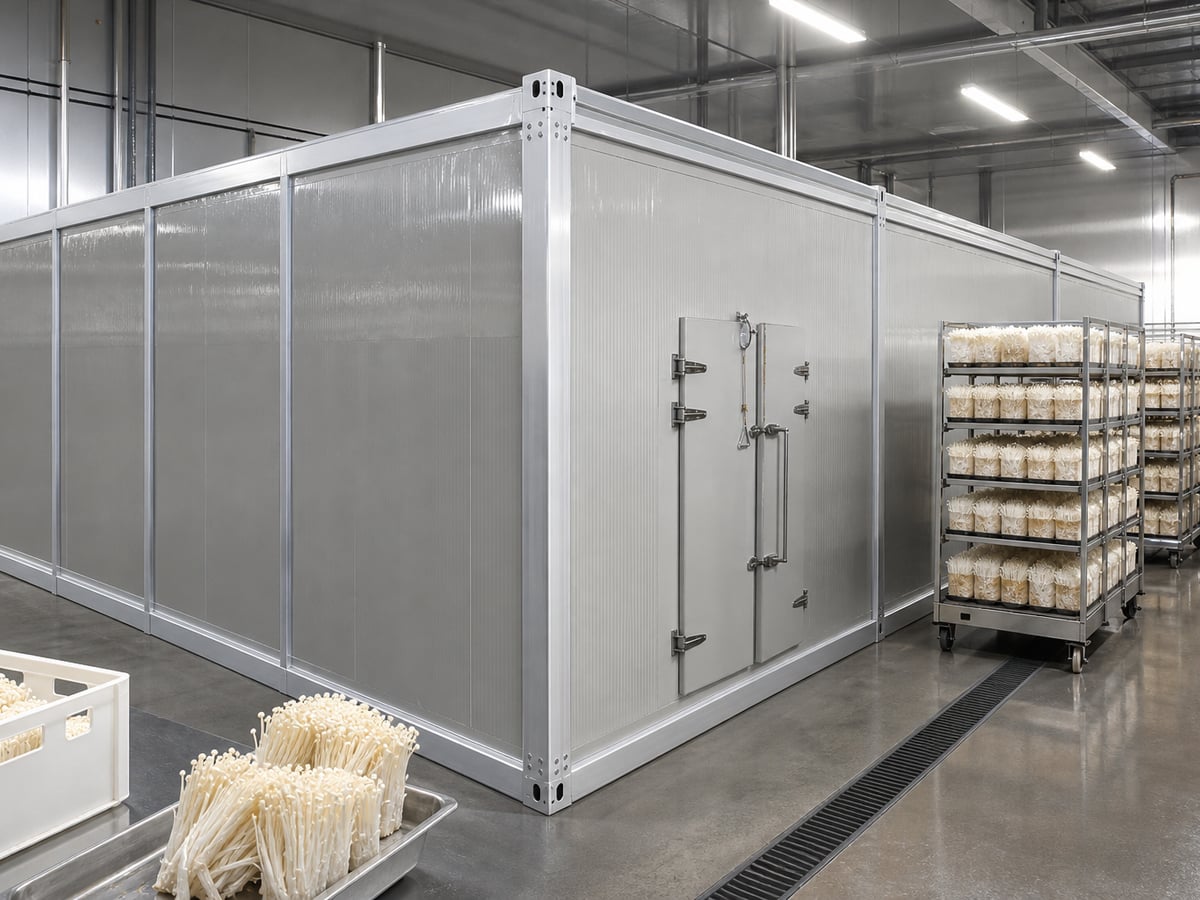
Quick Answer

Successful enoki production starts with a container and climate system designed around the complete crop cycle rather than cooling capacity alone. Before buying a smart mushroom cultivation container, confirm the production method, bottle dimensions, loading density, handling routes, low-temperature demand, air distribution, carbon dioxide removal, humidity control, condensation management, and the separation between incubation and fruiting.
For most commercial operations, the safest design is a well-insulated room or modular cultivation container with independently controlled cooling, fresh-air exchange, circulation fans, humidification, drainage, lighting, sensors, and alarms. Enoki commonly requires a cool fruiting environment, but the exact temperature, humidity, carbon dioxide target, light schedule, and crop duration depend on the strain, substrate formula, bottle size, and desired appearance. Use the supplier’s strain data and validate the final recipe with pilot trials before filling a large facility.
- Define whether the project is for laboratory testing, small retail supply, wholesale production, or continuous industrial output.
- Measure bottle diameter, height, neck design, cap type, and total loaded weight before designing racks.
- Calculate sensible and latent heat loads from the crop, lighting, people, motors, infiltration, and door openings.
- Use distributed sensors to identify warm or humid zones instead of relying on one room sensor.
- Provide a drainage and cleaning strategy for cold surfaces, floor channels, door thresholds, and evaporator areas.
- Separate incubation from fruiting whenever possible so each phase can receive its own climate recipe.
For buyers in the Global Market, regional climate and logistics are also important. A container shipped to Dubai, Rotterdam, Singapore, Vancouver, or Lagos may face very different ambient temperatures, humidity levels, power standards, and service conditions. A reliable specification should therefore state the intended destination, seasonal design conditions, voltage, refrigerant requirements, insulation standard, loading method, and after-sales expectations.
How to Define the Enoki Production Method

Before selecting equipment, document the biological and operational process. Enoki can be produced in bottles, bags, trays, or other vessels, but bottle cultivation is widely used where uniform vertical growth, automated handling, and repeatable harvest quality are priorities. The production method determines the internal layout, cooling load, cleaning routine, and labor requirement.
A typical bottle workflow includes substrate preparation, filling, sterilization, inoculation, incubation, bottle cleaning, scratching or surface preparation where applicable, fruiting, harvesting, packing, and sanitation. These steps may occur in separate rooms or in a modular sequence. Incubation often needs stable conditions and limited disturbance, while fruiting requires more active control of air exchange, humidity, temperature, and light. Combining every stage in one room can reduce the initial investment, but it often limits throughput and makes recipe control less precise.
Decide whether the facility will use manual, semi-automatic, or automated handling. Manual operations need wider aisles, staging areas, ergonomic shelf heights, and clear routes for carts. Automated operations require accurate rack geometry, machine access, transfer points, electrical provisions, and repeatable bottle positioning. A container that appears spacious when empty may become difficult to operate once racks, humidifiers, evaporators, sensors, lamps, and maintenance clearance are installed.
| Design question | Why it matters | Information to record |
|---|---|---|
| Which vessel will be used? | Determines rack pitch, loading weight, and airflow resistance. | Bottle, bag, tray, dimensions, material, cap design. |
| What is the target weekly output? | Sets room volume, staging space, and cooling capacity. | Units per batch, batches per week, harvest weight. |
| Will incubation and fruiting be separated? | Improves recipe accuracy and reduces conflicting climate demands. | Room count, transfer method, batch timing. |
| How will bottles move? | Influences door width, aisle width, and floor loading. | Hand cart, pallet truck, conveyor, or robot. |
| How will the crop be harvested? | Controls rack access and the location of packing benches. | Manual cutting, cluster removal, weighing method. |
| What sanitation method is planned? | Protects panels, electrical parts, seals, and drains. | Foam cleaning, low-pressure wash, disinfectant type. |
The production method should also reflect the market. Premium fresh enoki sold through restaurants in Tokyo, Seoul, Singapore, or London may require particularly uniform stems, clean packaging, and frequent deliveries. Wholesale channels around Chicago, Rotterdam, Johannesburg, or Melbourne may place greater emphasis on yield, shelf life, pallet efficiency, and stable weekly volume. A system specification should connect climate settings to the commercial product, not merely to a generic crop label.
Planning Bottle Layout and Handling Space

Bottle layout directly affects yield per square metre, labor cost, cooling uniformity, and the ability to inspect the crop. High density is attractive, but tightly packed bottles can block air movement, create warm pockets, increase condensation, and make harvesting difficult. The correct layout balances biological requirements with safe handling.
Start with the bottle envelope, including the cap, label, any collar, and the clearance required for removal. Measure the actual bottle batch rather than relying on nominal dimensions. Manufacturing tolerances can change rack fit, especially when bottles are supplied by different vendors. Record filled weight because a shelf that supports empty containers may deflect under sterilized substrate and mature crop loads.
Rack shelves should permit consistent vertical and horizontal spacing. Avoid placing bottles directly against insulated walls, evaporator housings, air outlets, or drains. Leave enough space for air to pass through the crop and for workers to remove individual bottles without disturbing adjacent units. If carts are used, consider turning radii, door swing, threshold height, and the route from incubation to fruiting.
| Item | Recommended verification | Operational consequence |
|---|---|---|
| Bottle diameter | Measure several filled bottles at the widest point. | Sets horizontal pitch and total rack width. |
| Bottle height | Include cap, neck, and expected crop clearance. | Sets shelf spacing and usable rack levels. |
| Filled bottle mass | Weigh representative sterilized units. | Determines shelf, frame, and floor loading. |
| Harvest access | Test removal with gloves and a full crop head. | Reduces breakage and improves labor speed. |
| Air passage | Check clearance between rows and rack backs. | Limits stagnant humidity and temperature layers. |
| Cleaning access | Inspect the underside, corners, and floor beneath racks. | Supports sanitation and pest prevention. |
A practical layout usually includes a clean loading side and a harvest side, even when the room is compact. This supports one-way movement and reduces cross-contamination. Larger facilities may divide zones into substrate preparation, sterilization, inoculation, incubation, fruiting, packing, and waste handling. Smaller growers can use a modular container for fruiting while outsourcing sterilized substrate or using a nearby clean room.
Handling space must include temporary staging. Bottles may wait after transfer, during inspection, or before harvest. If every square metre is filled with racks, operators may place containers in doorways or against cooling equipment, creating safety and climate problems. Mark floor lanes, keep electrical panels accessible, and define a maintenance route before finalizing the rack plan.
Confirming Low-Temperature Capacity and Power Demand
Enoki fruiting commonly depends on a cool and stable environment. The required setpoint is not universal: strains, substrate heat, crop density, room dimensions, packaging activity, and local ambient conditions all affect the design. A cooling system that reaches the target temperature when the room is empty may fail when bottles, workers, lights, fresh air, and door openings add heat.
Ask the equipment supplier for a load calculation based on the actual project. The calculation should include transmission through walls and ceilings, solar exposure where relevant, infiltration through doors, sensible heat from fans and pumps, lighting, workers, motors, humidification, and biological heat from the crop. Fresh air can be a major load in hot or humid regions such as Bangkok, Jakarta, Mumbai, or coastal West Africa. Cold-season operation in northern Europe or Canada creates a different challenge because overcooling may be easy while humidity and frost management become more important.
Capacity should be evaluated at the design ambient condition, not only at a nominal laboratory condition. Condensing temperature, evaporator selection, refrigerant, defrost method, compressor control, and electrical supply all influence real performance. Ask whether the system can modulate at partial load. Oversized equipment may cause short cycling, temperature swings, poor dehumidification, and unnecessary energy consumption.
| Load source | What to measure | Design implication |
|---|---|---|
| Insulated enclosure | Panel thickness, thermal conductivity, joints, doors. | Controls transmission heat gain and surface temperature. |
| Crop respiration | Loaded bottle count, substrate mass, batch age. | Adds heat that varies during the production cycle. |
| Fresh-air intake | Air volume, outdoor temperature, outdoor humidity. | May require pre-cooling and dehumidification. |
| Door openings | Opening frequency, duration, door size. | Raises infiltration load and can destabilize humidity. |
| Internal equipment | Fans, lamps, pumps, controls, motors. | Nearly all electrical energy becomes room heat. |
| People and carts | Occupancy, work duration, cart entry frequency. | Creates intermittent sensible and latent heat. |
Electrical planning should be completed at the same time as refrigeration planning. Confirm voltage, phase, frequency, starting current, control voltage, protection devices, backup power, and emergency shutdown requirements. A project in the United States may require different electrical coordination from one in Saudi Arabia, Brazil, South Africa, or Germany. International shipments should include clear documentation and locally compatible components where possible.
Energy efficiency is becoming a purchasing requirement rather than a bonus. Variable-speed compressors, EC fans, high-performance insulation, heat recovery, intelligent defrost, door alarms, and demand-based fresh-air control can reduce operating costs. In 2026, buyers are also likely to compare systems using energy per kilogram of saleable mushrooms, refrigerant environmental impact, remote monitoring capability, and repairability.
Using CO2 and Airflow to Support Crop Development
Air movement and carbon dioxide control influence stem development, cap formation, moisture balance, and uniformity. Enoki is often marketed for its long, slender stems and compact appearance, but those characteristics must be produced within the biological limits of the selected strain. Excessive carbon dioxide, insufficient exchange, or uneven circulation can create inconsistent crops across the same rack.
Do not treat the room fan as a substitute for fresh air. Circulation fans move existing air, while ventilation introduces oxygen and removes carbon dioxide, heat, and moisture. The system needs both functions. Air should move gently and evenly through the rack faces without blasting directly onto delicate fruiting bodies. High local velocity can dry exposed surfaces, while low velocity can leave stagnant pockets behind racks and beneath shelves.
Place carbon dioxide sensors at representative crop height, away from direct supply air. One sensor near the door may give a misleading reading. Larger rooms benefit from multiple sensors, trend logging, and alarms for sensor disagreement. If carbon dioxide is controlled by ventilation, verify that the incoming air is filtered and conditioned. In humid climates, unconditioned outdoor air may add a substantial moisture load.
| Control point | Preferred approach | Common risk |
|---|---|---|
| Supply air location | Distribute air across the room or along a controlled plenum. | Direct jets dry one rack while others remain stagnant. |
| Return air location | Collect air from the opposite or lower side of the room. | Short-circuiting leaves crop zones untreated. |
| Sensor placement | Use crop-height sensors and protect them from spray. | Wall or doorway readings do not represent the crop. |
| Ventilation control | Use measured carbon dioxide, time schedules, or both. | Fixed fan operation wastes energy or misses peaks. |
| Fan speed | Adjust circulation to crop density and moisture demand. | Excess velocity causes surface drying and uneven growth. |
| Filter maintenance | Inspect filters and record pressure or replacement dates. | Blocked filters reduce airflow and increase fan energy. |
Climate controllers should record temperature, relative humidity, carbon dioxide, fan status, compressor status, door openings, and alarms. Historical data helps distinguish a crop problem from an equipment problem. For example, a sudden rise in carbon dioxide after a rack transfer may indicate blocked airflow, while repeated humidity spikes after door opening may indicate insufficient airlock design or poor ventilation scheduling.
The smart mushroom climate controller from Lanhu can be evaluated as part of a broader control architecture. Buyers should confirm sensor compatibility, data access, alarm routing, language options, remote support, and the ability to adapt recipes to local production conditions.
Managing Condensation on Cold Surfaces
Condensation is one of the most underestimated risks in a cold cultivation container. When warm, humid air meets a surface below its dew point, water forms on panels, doors, evaporator housings, pipes, lights, sensors, and structural members. Persistent condensation can support microbial growth, damage finishes, increase cleaning requirements, and create slip or electrical hazards.
Condensation control begins with dew-point management. The room air temperature and relative humidity determine the dew point, while the surface temperature depends on insulation, air movement, thermal bridges, and refrigeration operation. A panel with a good insulation core can still condense at a joint, fastener, door frame, or poorly sealed penetration. Inspect these areas during commissioning under the coldest and most humid expected conditions.
Use sloped surfaces where water may form, provide accessible drains, and avoid concealed cavities that cannot be cleaned. Evaporator condensate lines should have suitable traps, insulation where needed, and a fall that prevents standing water. Door frames and thresholds require special attention because they are frequently touched, exposed to warm air, and vulnerable to seal damage.
| Area | Inspection or design action | Reason |
|---|---|---|
| Panel joints | Check sealant continuity and thermal bridging. | Small gaps can create cold wet lines. |
| Doors and frames | Use suitable gaskets, closers, and insulated thresholds. | Door openings are frequent condensation points. |
| Evaporator coil | Provide condensate collection and safe drainage. | Melting frost can release large water volumes. |
| Ceiling fixtures | Use sealed fittings and avoid unprotected horizontal ledges. | Drips may fall directly onto bottles or workers. |
| Pipe penetrations | Seal and insulate refrigerant, cable, and drain entries. | Penetrations can bypass panel insulation. |
| Floor and drains | Use washable finishes and verify fall during commissioning. | Standing water increases sanitation and safety risks. |
Humidity control should be coordinated with cooling. A cold coil can remove moisture, but if the compressor cycles off too often, dehumidification may be inadequate. Conversely, excessive drying can reduce crop quality. The appropriate strategy may combine controlled humidification, coil-based dehumidification, ventilation, and staged fan operation. Avoid placing humidifiers directly beside temperature or humidity sensors.
Cleaning procedures should specify how condensation-prone surfaces are dried. A sanitation team needs access to drains, fan guards, shelves, and the rear of racks. The best system is not simply one that resists water; it is one that makes water visible, removable, and easy to verify.
Separating Incubation from Fruiting Conditions
Incubation and fruiting are different biological stages and should be managed as separate climate recipes whenever production volume permits. During incubation, the priority is stable temperature, cleanliness, low disturbance, and consistent colonization. During fruiting, operators must manage air exchange, humidity, cooling, light, bottle preparation, and harvest access. One room can perform both roles, but it usually requires compromises in scheduling and climate stability.
Separate rooms or containers allow continuous production. One batch can incubate while another fruits, reducing idle time and making labor more predictable. Separation also limits the movement of workers, tools, and potentially contaminated materials between stages. If the project is small, a partitioned modular system may provide a practical intermediate solution.
Transfer design matters. Bottles should move through a defined route with minimal exposure and without crossing waste or dirty equipment paths. Doors should be sized for the chosen carts. Consider an airlock or buffer area where climate shock, cleaning, and visual inspection can occur. Operators should know which clothing, gloves, tools, and carts belong to each zone.
| Factor | Incubation priority | Fruiting priority |
|---|---|---|
| Temperature | Stable strain-specific colonization range. | Cool, precise, and uniform crop development. |
| Air exchange | Controlled to protect cleanliness and process stability. | Adjusted to carbon dioxide, heat, and moisture load. |
| Humidity | Prevent excessive surface moisture and contamination risk. | Maintain crop hydration without persistent wetness. |
| Lighting | Usually limited according to the production protocol. | Applied according to strain and appearance objectives. |
| Handling | Minimize movement and vibration. | Allow regular inspection and harvest access. |
| Cleaning | Prioritize clean transfer and low contamination risk. | Manage crop residues, water, and frequent access. |
Recipes should identify not only setpoints but also ramp rates and operating limits. A gradual transition may be preferable to an abrupt temperature or airflow change. Record batch age, bottle position, climate history, contamination observations, and harvest results. This information turns the room into a measurable production system rather than a space operated by guesswork.
Validating the Crop Recipe with Trials
No equipment specification can replace crop trials. A recipe that works in one region or facility may perform differently in another because of strain, substrate moisture, bottle geometry, air distribution, water quality, labor practices, or seasonal conditions. Pilot trials reduce risk before a full commercial installation.
Begin with a representative sample of bottles and use the actual substrate, caps, rack arrangement, sensors, and handling practices planned for production. Test both the warmest and coolest rack positions. Measure temperature and humidity at several heights, record carbon dioxide trends, inspect surface moisture, and compare crop development by location. If the crop is intended for export, include packaging and cold-chain testing as part of the trial rather than treating them as separate activities.
| Measurement | Method | Decision supported |
|---|---|---|
| Room temperature | Log several crop-height points continuously. | Confirms cooling uniformity and setpoint stability. |
| Relative humidity | Use calibrated sensors away from spray and outlets. | Identifies drying, wetness, and condensation risk. |
| Carbon dioxide | Trend multiple locations during the crop cycle. | Verifies ventilation and rack airflow. |
| Fresh weight | Weigh representative harvest groups. | Compares yield by recipe and rack position. |
| Stem and cap quality | Use a consistent grading sheet and photographs. | Links climate settings to market specifications. |
| Energy use | Record refrigeration, fans, humidification, and lighting. | Estimates cost per kilogram and operating margins. |
Run trials across more than one season where possible. A container commissioned in a cool European spring may behave very differently during a hot summer in the Gulf region. Likewise, a humid coastal location such as Shanghai, Ho Chi Minh City, or Lagos may need different ventilation and dehumidification settings from a dry inland site such as Madrid, Denver, or Riyadh.
Use a structured acceptance test before signing off the project. Confirm pull-down time, recovery after door opening, temperature uniformity, alarm operation, sensor calibration, drainage, lighting, electrical protection, remote access, and cleaning access. Ask the supplier to provide operating manuals, wiring diagrams, spare-parts lists, and recommended maintenance intervals.
Buying Guidance, Product Types, and Applications
Buyers generally choose among a purpose-built smart cultivation container, a prefabricated cold room, a converted shipping container, or a custom-built agricultural climate room. The best choice depends on output, mobility, local construction capability, climate, installation time, and the desired degree of integration.
| System type | Strength | Limitation | Suitable application |
|---|---|---|---|
| Smart cultivation container | Integrated enclosure, controls, cooling, and modular deployment. | Internal space is limited and expansion needs planning. | Small commercial farms and distributed production. |
| Prefabricated cold room | Flexible dimensions and familiar refrigeration technology. | Controls and crop features may need separate integration. | Medium facilities with local engineering support. |
| Converted shipping container | Potentially mobile and widely available. | Thermal bridges, corrosion, and layout limitations require care. | Remote pilots or temporary projects. |
| Custom climate hall | Highest flexibility for large output and automation. | Longer design period and higher construction coordination. | Industrial mushroom farms and processing campuses. |
| Modular multi-room system | Supports staged expansion and separate crop recipes. | Requires coordinated utilities and traffic planning. | Growing businesses with phased investment. |
| Research or demonstration unit | Fast recipe testing with controlled batch sizes. | Not necessarily optimized for low unit cost. | Universities, breeders, retailers, and pilot farms. |
Ask for evidence rather than relying on general claims. Useful evidence includes factory test records, insulation specifications, control screenshots, equipment schedules, sensor calibration procedures, customer references, and commissioning reports. A supplier serving the Global Market should be able to explain shipping dimensions, export packaging, customs documentation, installation requirements, and technical support across time zones.
Applications extend beyond dedicated mushroom farms. Restaurants and supermarket distribution centers may use compact units for local supply. Agricultural contractors can deploy modular rooms near urban markets. Universities and food technology centers can use pilot containers for strain comparison. Remote hospitality projects, island communities, and controlled-environment agriculture parks may benefit from containerized production where conventional construction is slow or expensive.
For a broader overview, review the smart mushroom cultivation container solution and compare its enclosure, climate functions, rack layout, and customization options with the project’s actual crop recipe.
Case Planning and Local Supplier Considerations
Every successful installation begins with a site-specific design brief. A project near the Port of Hamburg may prioritize European electrical compliance, rapid spare-parts access, and integration with an existing cold chain. A buyer near Jebel Ali Port may require high-ambient cooling and corrosion-resistant finishes. An operation near Shanghai, Busan, or Ningbo may emphasize dense urban delivery and humidity management. A farm near Los Angeles, Santos, or Durban may need a different combination of energy strategy, import documentation, and service coverage.
Local supplier involvement is valuable even when the main equipment is factory-built. Regional contractors can support foundations, drainage, electrical connection, lifting, ducting, water treatment, and permits. However, responsibilities should be written clearly. The purchase specification should identify who supplies refrigerant, who connects power, who performs commissioning, who calibrates sensors, who trains operators, and who responds to warranty issues.
Consider total delivered cost rather than factory price alone. Include freight, insurance, port handling, customs duties, local transport, unloading equipment, installation labor, commissioning travel, spare parts, and annual maintenance. A lower-cost system can become expensive if it requires unfamiliar components or lacks local troubleshooting support.
- Request a layout drawing showing racks, doors, equipment, drains, sensors, and maintenance clearances.
- Confirm container dimensions and shipping weight before booking transport.
- Ask whether the system can operate at the destination’s highest design ambient temperature.
- Check compatibility with local voltage, frequency, refrigerant regulations, and safety codes.
- Identify the nearest stock of filters, sensors, fan motors, seals, controllers, and refrigeration parts.
- Agree on remote diagnostic access, response times, training, and escalation procedures.
In 2026, procurement teams are increasingly expected to document environmental performance. Ask about recyclable panel materials, refrigerant selection, water use, energy monitoring, end-of-life recovery, and the possibility of upgrading controls instead of replacing the entire unit. Policies on fluorinated gases, energy efficiency, food safety, and waste management differ by market, so local compliance review remains essential.
Our Company
Shandong Lanhu Air Conditioning Equipment Co., Ltd. develops agricultural climate-control equipment, industrial HVAC systems, and modular cultivation solutions from Dezhou, Shandong, China. Its experience is relevant to buyers who need a combined enclosure, refrigeration, airflow, sensing, and control approach rather than isolated components.
Technological capabilities
Lanhu’s engineering work draws on more than 12 years of thermodynamic research and development experience and a portfolio of registered patents. The company develops smart mushroom cultivation containers, climate controllers, hydroponic plant containers, and air-source heat pumps. Its technical scope includes temperature and humidity management, air circulation, fresh-air coordination, electrical control, sensor integration, alarm functions, and recipe-oriented operation.
For an enoki project, this integrated approach can help connect the crop requirements to the mechanical system. Buyers should still provide their own bottle dimensions, strain information, target output, site climate, and operating schedule so the proposed system can be evaluated against measurable conditions.
Manufacturing capabilities
Lanhu operates a manufacturing facility of more than 30,000 square metres with in-house capabilities covering product design, engineering development, sheet-metal fabrication, CNC bending, insulation panel production, electrical assembly, system integration, equipment testing, and quality inspection. This integrated structure can simplify coordination between the enclosure, refrigeration package, control cabinet, and internal fittings.
Before shipment, systems undergo functional inspection, electrical verification, performance testing, and operational evaluation. The company maintains ISO 9001, ISO 14001, ISO 45001, and ISO 12100 certifications, along with patent and enterprise credibility credentials. Buyers should request the documents applicable to their project and confirm any additional destination-market certifications required by local authorities.
Service capabilities
Lanhu provides factory-direct supply, OEM and ODM customization, engineering assistance, international logistics support, spare-parts support, installation guidance, and after-sales service. This can be useful for agricultural contractors, equipment distributors, engineering companies, and commercial farms managing projects across borders.
Customization may include container dimensions, rack arrangements, electrical standards, control language, branding, sensor packages, cooling configuration, and integration with site utilities. The OEM and ODM customization service can be discussed when a standard container does not match the required bottle layout or local operating conditions. Existing project examples can also be reviewed through the cultivation equipment case studies.
FAQ
What is the most important design check for an enoki container?
The most important check is whether the complete system can maintain uniform crop conditions at the planned bottle density and outdoor design temperature. Cooling capacity alone is not enough. Verify airflow, carbon dioxide removal, humidity control, condensation drainage, rack access, and recovery after door openings.
Can incubation and fruiting be performed in one container?
Yes, but the operation must accept scheduling compromises. A single room may be suitable for small pilots, while separate zones or containers are usually better for continuous commercial production. Separation allows each phase to use a more appropriate temperature, airflow, humidity, lighting, and handling schedule.
How much space should be left between enoki bottles?
There is no universal spacing value because bottle dimensions, rack construction, airflow design, and handling method differ. Measure filled bottles and test the actual harvest procedure. Leave enough clearance for air movement, inspection, removal, cleaning, and maintenance rather than maximizing bottle count alone.
Why does condensation appear on a well-insulated container?
Condensation can occur at thermal bridges, door frames, panel joints, fasteners, pipe penetrations, lights, sensors, or surfaces exposed to warm humid air. Good insulation reduces the risk but does not eliminate it. Check surface temperatures, dew point, seals, drainage, and door-opening practices during commissioning.
Should carbon dioxide be controlled by a fixed ventilation schedule?
A fixed schedule can be a useful starting point, but sensor-based or hybrid control is usually more responsive. Crop density, room leakage, outdoor conditions, and batch age change the carbon dioxide load. Use calibrated sensors and verify that incoming air is filtered and conditioned when necessary.
What information should be sent to a supplier for a quotation?
Provide the destination country and city, output target, bottle dimensions and weight, rack concept, room or container dimensions, production stages, target climate ranges, local ambient design conditions, power supply, water and drainage availability, automation level, shipping constraints, and expected support. Photographs or drawings of the site are also useful.
How can a buyer compare two suppliers fairly?
Use the same performance specification for both suppliers. Compare guaranteed capacity at design ambient conditions, temperature uniformity, control functions, sensor quantity, insulation, drainage, energy monitoring, warranty, spare parts, documentation, installation scope, and commissioning tests. Also compare total delivered and operating costs rather than equipment price alone.
What are the major enoki production trends for 2026?
Key trends include recipe automation, remote monitoring, energy-per-kilogram reporting, variable-speed refrigeration, heat recovery, improved data logging, lower-impact refrigerants, modular expansion, and stronger traceability. Policy pressure is also encouraging efficient equipment, responsible refrigerant management, water reduction, recyclable materials, and documented food-safety procedures.
Is a modular cultivation container suitable for international projects?
It can be suitable when the design accounts for local climate, electrical standards, customs requirements, lifting access, installation space, and service availability. International buyers should confirm export packaging, shipping dimensions, spare parts, technical documents, remote support, and local commissioning responsibilities before placing an order.
Share this article

About the Author: Shandong Lanhu Air Conditioning Equipment
Lanhu is a professional climate control equipment manufacturer specializing in smart agricultural systems, commercial HVAC solutions, and customized temperature control technologies. With extensive engineering experience, Lanhu provides reliable solutions for plant factories, controlled environment agriculture, and industrial applications.
Need a Custom Climate Control Solution?
From smart agricultural systems to commercial HVAC solutions, Lanhu provides reliable temperature and humidity control solutions tailored to your project needs.
Contact Us