Mushroom HVAC Units for Commercial Farms in Global Markets
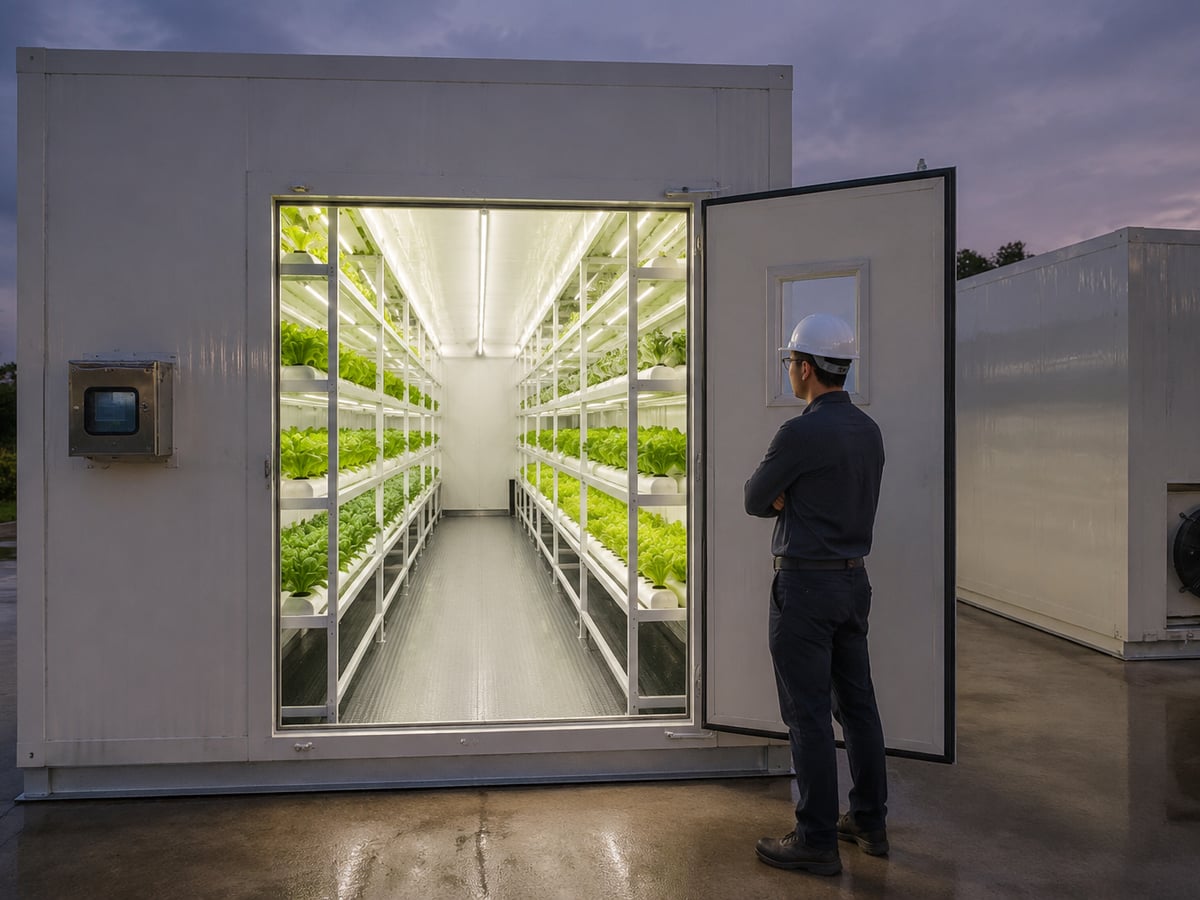
Commercial HVAC Units for Mushroom Farms in Global Markets
Quick Answer: What to Check First

A commercial mushroom cultivation HVAC unit is not simply a room air conditioner. It is part of a grow-room climate system that may need to manage temperature, air circulation, fresh-air exchange, humidity, and coordination with sensors and controls. The exact functions depend on the equipment configuration: some units provide cooling and heating with air handling, while humidification, dehumidification, filtration, fresh-air dampers, and climate controls may be separate or optional.
Before requesting a quotation, define the crop and production stage, room dimensions, insulation, expected outdoor design conditions, target temperature and humidity ranges, fresh-air requirements, and the number of rooms served. Then ask suppliers to identify the included components, state performance under specified conditions, and provide installation dimensions, electrical data, control interfaces, service access requirements, and protection functions.
For commercial buyers, the most useful comparison is not a single nominal capacity figure. It is a documented operating proposal tied to the actual room, crop cycle, ambient climate, and installation plan. Buyers should also confirm what is supplied as standard, what must be sourced separately, and who is responsible for system commissioning and ongoing support.
Define the Unit’s Role in the Grow-Room System

The term “mushroom HVAC unit” can describe different products. It may mean a packaged climate-control unit, an air-handling assembly connected to a refrigeration system, a combination of heating and cooling equipment, or one component within a wider cultivation-room package. Comparing quotations is difficult until the equipment boundary is clear.
Start by mapping the complete room system. A typical arrangement can include insulated panels, a vapor-resistant room envelope, supply and return air paths, refrigeration equipment, heating, humidification, fresh-air intake, exhaust or relief air, sensors, a controller, electrical protection, and drainage. Not every project needs each item in the same form. The correct arrangement depends on the cultivation method, building, local climate, operating schedule, and applicable regulations.
Ask the supplier to mark which items are integrated into the unit and which are external. For example, “humidity control” could refer to a humidity sensor and control output, a humidifier included in the package, or merely the unit’s ability to operate alongside separate humidity equipment. Those are not equivalent offers. Likewise, fresh-air capability may mean a duct connection, a motorized damper, a complete controlled intake assembly, or a design option requiring additional equipment.
| Element | Possible role | Buyer verification |
|---|---|---|
| Cooling section | Removes heat from the room air | Request capacity at stated indoor and outdoor conditions |
| Heating section | Raises room temperature when required | Confirm type, capacity, control stages, and energy source |
| Air-handling fans | Move and distribute conditioned air | Check airflow, external static pressure, and speed control |
| Humidification | Adds moisture to the room air | Ask whether the equipment is included, optional, or separate |
| Fresh-air assembly | Introduces outside air and supports air exchange | Confirm damper, fan, filtration, and control arrangement |
| Controller and sensors | Monitor conditions and coordinate outputs | Request sensor list, interface details, and alarm functions |
| Drainage and condensate | Manages water produced during operation | Review drain locations, traps, and installation requirements |
For an integrated approach, compare the HVAC proposal with the room envelope and automation package rather than treating the unit as a standalone purchase. A [smart mushroom cultivation container](https://smartmushroomcabin.com/smart-mushroom-cultivation-container/) may combine the cultivation space and climate equipment within a modular project, while a retrofit in an existing building requires closer coordination with the site’s ducts, structure, drainage, and electrical supply.
Identify Cooling, Heating, and Air-Handling Functions

Cooling load changes with outdoor temperature, solar exposure, building insulation, lighting, fan motors, workers, equipment, and the crop’s heat and moisture contribution. A unit selected using room floor area alone can be undersized or oversized. Ask for the assumptions behind the capacity calculation, including room volume, panel construction, infiltration, crop loading, setpoints, and the design weather conditions.
Cooling performance should be tied to specified conditions. A nominal rating without indoor and outdoor temperatures, airflow, and operating mode may not represent performance at a farm’s actual location. Buyers in hot, humid regions should request data for the relevant summer design conditions. Projects in colder climates should also establish whether the equipment can operate reliably during the expected low-ambient season and what controls or accessories are required.
Heating may be needed for particular crop stages, seasonal operation, room recovery, or frost protection. Confirm whether heating is electric, heat-pump based, hot-water based, or provided by another system. Ask whether heating and cooling can operate together if a process requires simultaneous temperature and moisture management, and whether the controller prevents conflicting calls. Do not assume that a cooling unit includes a heater simply because the product is described as a climate-control system.
Air handling is as important as rated capacity. The fan must deliver the required airflow through the actual ductwork, filters, coils, and room outlets. Ask for airflow and available external static pressure, fan type, speed-control method, and the recommended arrangement of supply and return openings. Poor distribution can produce temperature and humidity differences between shelves, corners, and door areas even when the controller reports that the setpoint has been reached.
| Function | Useful specification | Why it matters |
|---|---|---|
| Cooling | Total and sensible capacity at stated conditions | Supports comparison against the calculated room load |
| Heating | Output, operating range, and energy input | Shows whether the system suits seasonal and process needs |
| Supply airflow | Air volume at stated external static pressure | Helps confirm compatibility with duct and room design |
| Fan control | Fixed, staged, variable-speed, or signal-based | Indicates how airflow can adapt to operating conditions |
| Coil performance | Coil details and operating conditions | Helps assess heat transfer and condensate management |
| Outdoor operating limits | Minimum and maximum ambient conditions | Clarifies seasonal suitability and required options |
| Electrical input | Voltage, phase, frequency, and current | Supports utility planning and local electrical review |
Air distribution should be reviewed with the cultivation layout. Rack spacing, growing-bag placement, aisle widths, and loading practices influence airflow paths. Ask for recommended supply and return locations and whether the supplier expects ductwork, plenums, or direct discharge. A commissioning plan should include checks at representative locations in the room, rather than relying only on a sensor beside the unit.
Clarify Included Humidity and Fresh-Air Equipment
Mushroom production is sensitive to moisture management, but humidity is not a single function. A system may need to add moisture, remove moisture, control condensation, or coordinate these actions with ventilation and temperature. The required sequence depends on species, strain, production phase, growing medium, room design, and the grower’s process. Buyers should provide target operating ranges for each relevant phase and request a control description showing how the equipment responds.
Humidification options can include spray or mist systems, ultrasonic equipment, steam systems, or other arrangements. Each has different water-quality, maintenance, distribution, and hygiene considerations. Ask what water specification is required, whether filtration or treatment is needed, how nozzles or emitters are accessed, and how the system prevents unwanted wetting of electrical components or room surfaces. Confirm whether humidification hardware is included in the quoted unit or supplied as a separate assembly.
Dehumidification may occur as a consequence of cooling, through dedicated equipment, or by coordinated ventilation and heating strategies. Cooling coils can remove moisture when operated under suitable conditions, but this does not automatically mean the system provides precise, independent dehumidification. Ask the supplier to explain the operating sequence and the conditions under which humidity can be reduced without driving room temperature outside its acceptable range.
Fresh-air control also needs a specific definition. Outside-air volume, filtration, damper position, exhaust arrangement, and pressure balance can affect both climate stability and operating cost. A fresh-air connection alone does not prove that the system can deliver a controlled exchange rate. Ask whether the proposal includes a damper actuator, intake fan, filter, exhaust or relief path, and a sensor or control strategy. Confirm how outdoor heat and moisture loads are considered.
- Request a component-by-component list for humidification, dehumidification, intake, exhaust, and filtration.
- Ask for the operating sequence for temperature, humidity, and fresh-air control.
- Confirm water quality, drainage, cleaning, and inspection requirements.
- Specify whether humidity and temperature sensors are supplied and where they should be installed.
- Check whether the control can limit fresh-air operation under unsuitable outdoor conditions.
A buyer evaluating automation can review the available [mushroom climate controller](https://smartmushroomcabin.com/smart-mushroom-climate-controller/) and ask how it communicates with fans, valves, dampers, heaters, and alarms. Confirm whether the controller is bundled with the HVAC unit or separately supplied, and whether the project requires integration with a farm monitoring platform.
Match Unit Performance to Crop and Ambient Conditions
Equipment selection should begin with the cultivation plan, not a catalogue model. Species and production methods differ, and even the same species may require different room conditions at different stages. Provide the supplier with the crop, cycle stages, intended loading, operating hours, target temperature and humidity ranges, fresh-air expectations, and any limits on air velocity or direct drafts. The supplier should state which assumptions are used and identify information still needed for a responsible selection.
Outdoor conditions are equally important. A site near a humid coast has a different design challenge from an inland facility with large day-to-night temperature swings or a high-altitude location. The buyer should provide the project city or nearest weather station and ask what design conditions are applied. For international projects, this avoids comparing a unit selected for one climate with a system proposed for another.
Insulation quality, door openings, room orientation, roof exposure, air leakage, and adjacent spaces all influence demand. So do the number of rooms, whether they operate simultaneously, and how quickly each room must recover after loading or cleaning. If the supplier has not been given these details, the quotation should be treated as preliminary rather than as a guaranteed design selection.
| Information | Example detail to provide | Selection impact |
|---|---|---|
| Crop and process | Species, strain if known, and production stages | Establishes relevant operating targets |
| Room geometry | Internal length, width, height, and room count | Supports volume and airflow calculations |
| Envelope | Panel thickness, insulation, doors, and roof exposure | Affects heat gain, loss, and infiltration |
| Outdoor climate | Project location and design temperature conditions | Influences capacity and operating limits |
| Crop loading | Growing area, shelf arrangement, and expected load | Helps assess heat, moisture, and distribution needs |
| Utilities | Available voltage, phase, frequency, and water | Checks compatibility with site services |
| Operation | Daily schedule, room turnover, and recovery expectations | Shapes control strategy and duty requirements |
| Site constraints | Access route, plant-room space, drainage, and noise limits | Identifies installation and service risks |
Consider lifecycle fit as well as initial capacity. A unit that frequently cycles, struggles during peak weather, or is difficult to clean can create operational problems even if its headline rating appears adequate. Ask for expected maintenance tasks, consumables, replacement-part availability, and recommended inspection intervals. For energy comparisons, request the assumptions and test conditions behind efficiency claims, and compare systems using the same operating scenario.
Check Installation Dimensions and Service Clearances
Installation planning should happen before purchase approval, particularly for retrofits and modular projects. Request a dimensioned general arrangement drawing showing the unit footprint, height, connection positions, lifting points, access panels, and required clearances. Check whether the unit can pass through site doors, corridors, loading bays, and any internal route to its final position. A technically suitable system may be impractical if it cannot be delivered or serviced in the allocated space.
Review the structural support, vibration isolation, condensate drain route, refrigerant or water connections where applicable, electrical isolation, duct transitions, and outdoor-unit location. Confirm who supplies interconnecting pipework, insulation, control wiring, weather protection, and drain traps. For roof or wall penetrations, establish responsibility for structural coordination and weather sealing.
Service access is not optional. Technicians may need room to inspect filters, fans, coils, electrical panels, valves, sensors, and drains. Ask for the manufacturer’s required access clearances and whether panels can be opened in the proposed location. Consider safe access equipment and the local rules governing electrical isolation, refrigerant work, and elevated maintenance.
| Check | Information to obtain | Common coordination point |
|---|---|---|
| Unit envelope | Overall dimensions and operating weight | Room layout, plinth, or equipment platform |
| Delivery route | Largest shipping section and lifting points | Door, corridor, crane, or forklift access |
| Service clearance | Required access at panels and coil faces | Adjacent walls, racks, and other equipment |
| Duct connections | Sizes, positions, and allowable transitions | Air distribution and ceiling coordination |
| Drainage | Drain size, outlet position, and required fall | Floor drain and condensate disposal |
| Electrical supply | Voltage, phase, frequency, current, and isolator needs | Local utility and electrical contractor |
| Outdoor equipment | Clearances, mounting, weather, and noise guidance | Neighboring buildings and site access |
For containerized or modular systems, verify transport dimensions and lifting arrangements early. International delivery may involve container loading, port handling, customs clearance, and onward road transport. Buyers should confirm the shipping configuration, packaging, documentation, and local unloading requirements before selecting a delivery term. Depending on the route, logistics planning may involve hubs such as Qingdao, Shanghai, Rotterdam, Singapore, or Los Angeles, followed by inland transport to the farm.
Review Control Interfaces and Protection Functions
The control system is the operating link between room conditions and mechanical equipment. At minimum, identify the sensors supplied, their accuracy specifications where available, recommended placement, controller outputs, alarm behavior, and operator interface. Ask whether the system supports independent room monitoring, schedules, stage-based setpoints, remote access, data logging, or connection to a building-management or farm-management platform. Do not assume these functions are included because a product is described as “smart.”
Clarify communication and wiring requirements before installation. Ask which protocols or signal types are available, whether interfaces are standard or optional, and what information can be read or commanded by an external controller. If multiple rooms are involved, confirm whether each room needs a dedicated controller and how shared equipment is coordinated. Document who supplies network hardware, configuration, user access, and cybersecurity updates where remote connectivity is used.
Protection functions can include high- and low-temperature alarms, fan or motor protection, overload protection, phase monitoring, pressure-related protections, freeze protection, condensate overflow detection, and sensor-failure alarms. The exact list varies by design. Request the protection schedule and ask which conditions stop equipment, which trigger an alarm only, and how an operator acknowledges or resets a fault. Local electrical and machinery safety requirements still apply; supplier documentation does not replace review by qualified local professionals.
Commissioning should test the controls as well as the mechanical equipment. A practical handover includes verifying sensor readings, actuator direction, fan operation, heating and cooling calls, alarms, interlocks, fresh-air sequences, drainage, and response to representative setpoints. Request operating and maintenance manuals, electrical drawings, wiring diagrams, spare-parts information, and a record of tests performed before shipment and at site commissioning.
Prepare a Unit-Specific Technical Inquiry
A well-prepared request for quotation reduces guesswork and makes supplier responses easier to compare. Instead of asking only for a “mushroom HVAC price,” send a project brief that describes the room, crop, climate, required functions, utilities, delivery location, and schedule. Ask suppliers to list exclusions and assumptions explicitly. Where the design is not final, invite them to identify the missing information and provide a clearly labelled preliminary option.
- Project: country, city, site type, project stage, and contact details.
- Room: quantity, internal dimensions, insulation, doors, construction, and layout drawings.
- Crop: species, production stages, target conditions, and expected loading.
- Climate: outdoor design conditions or the project location for confirmation.
- Functions: cooling, heating, airflow, humidification, dehumidification, fresh air, exhaust, and filtration requirements.
- Utilities: available electrical supply, water quality, drainage, and any site restrictions.
- Controls: sensors, alarms, data logging, remote monitoring, and third-party integration needs.
- Commercial details: delivery destination, required documentation, installation support, commissioning, warranty, and spare parts.
Ask every bidder to respond in a consistent format. Require equipment make and model, capacity conditions, airflow and static pressure, operating limits, dimensions, weight, electrical data, included accessories, options, exclusions, delivery schedule, warranty terms, and after-sales arrangements. Ask whether the quoted configuration has been tested as a complete assembly or whether certain components will be selected later. For OEM or customized projects, define branding, drawings, approval stages, and responsibility for compliance documentation.
| Quotation item | Response expected | Comparison purpose |
|---|---|---|
| Design basis | Room, crop, and ambient assumptions | Shows whether proposals address the same project |
| Capacity data | Cooling and heating values with stated conditions | Prevents comparison of unrelated ratings |
| Air performance | Airflow, static pressure, and fan control | Checks compatibility with the room distribution |
| Included scope | Equipment, sensors, controller, and accessories | Identifies omissions and separate purchases |
| Installation data | Drawings, dimensions, weight, and connection points | Supports site coordination |
| Compliance documents | Available certificates, manuals, and test records | Assists local review and procurement records |
| Service provision | Warranty, spares, technical assistance, and response route | Supports operational continuity after delivery |
For customization or private-label requirements, discuss engineering scope before purchase. A supplier offering [OEM and ODM services](https://smartmushroomcabin.com/oem-odm-service/) can clarify whether a request affects the enclosure, controls, electrical configuration, documentation, branding, or testing. Avoid assuming that a custom label means the equipment has been redesigned or certified for every destination market.
Our Company: Engineering, Manufacturing, and Support
Shandong Lanhu Air Conditioning Equipment Co., Ltd. is based in Dezhou, Shandong, China, and develops agricultural climate-control equipment, industrial HVAC systems, and modular cultivation solutions. Its product range includes smart mushroom cultivation containers, mushroom climate controllers, smart hydroponic plant containers, and air-source heat pumps. For buyers, the practical value of discussing a project with an equipment manufacturer is the opportunity to review the room, climate, operating targets, and equipment scope together rather than selecting a unit from a capacity label alone.
Technological capabilities: Lanhu draws on more than 12 years of thermodynamic research and development experience and reports holding more than 45 registered patents. Its engineering work can support discussions about equipment configuration, cultivation-room integration, controls, and project-specific requirements. Buyers should provide a written performance brief and confirm the exact scope, available options, and technical documentation applicable to their project and destination.
Manufacturing capabilities: The company operates a manufacturing facility covering more than 30,000 square meters. Its integrated production activities include product design, engineering development, sheet-metal fabrication, CNC bending, insulation-panel production, electrical assembly, system integration, equipment testing, and quality inspection. Lanhu reports functional inspection, electrical verification, performance testing, and operational evaluation before shipment. It also holds ISO 9001, ISO 14001, ISO 45001, and ISO 12100 certifications; purchasers should request the relevant certificate details and confirm applicability to the product and transaction being considered.
Service capabilities: Lanhu offers factory-direct supply, OEM and ODM customization, engineering assistance, international logistics support, spare-parts support, installation guidance, and after-sales service for agricultural contractors, distributors, engineering companies, and commercial farming projects. Before ordering, buyers should agree on the service channel, response expectations, commissioning responsibilities, language of manuals, spare-parts lead times, and the division of work between the supplier and local installer.
To discuss a project, send room drawings, site conditions, target operating ranges, utility information, and a list of required functions through the [contact page](https://smartmushroomcabin.com/contact-us/). Clear project information helps the engineering team distinguish a preliminary budget estimate from a unit-specific proposal.
Frequently Asked Questions
Is a mushroom HVAC unit the same as a standard air conditioner?
Not necessarily. A standard air conditioner may provide cooling but lack the airflow arrangement, heating, humidity equipment, fresh-air control, sensors, or integration needed for a cultivation room. Compare the required functions with the offered bill of materials and technical schedule.
Does every mushroom climate unit include a humidifier?
No. Humidification may be integrated, offered as an option, supplied separately, or controlled through an external device. Ask for the exact equipment list, water requirements, controls, and maintenance instructions.
Can one unit serve multiple grow rooms?
It depends on the design, room schedules, load diversity, duct system, and control arrangement. Shared equipment can introduce coordination and resilience considerations. Ask the engineer to assess each room’s operating needs and explain the consequences of equipment downtime.
How should I compare cooling capacity between suppliers?
Compare capacities only when the rating conditions and assumptions are clear. Request indoor and outdoor conditions, airflow, and whether the value is total or sensible capacity. Then compare the data with a documented room-load calculation.
What should I send for a preliminary quotation?
Provide the project location, room dimensions, insulation details, crop and production stages, target conditions, utility supply, required HVAC functions, and delivery destination. Drawings and photographs of an existing installation can help identify access and connection constraints.
Is fresh-air ventilation always part of the HVAC package?
No. Some units provide only a connection or control output, while other configurations include dampers, fans, filtration, or exhaust components. Confirm the required air exchange and the exact equipment included in the offer.
Which documents should accompany the equipment?
Request product specifications, general arrangement drawings, electrical diagrams, operating and maintenance manuals, test records, applicable conformity documents, and a recommended spare-parts list. Check local import, electrical, refrigerant, and machinery requirements with qualified professionals.
What trends should commercial buyers consider for 2026?
Buyers are increasingly evaluating connected monitoring, improved variable-speed control, better operating data, and integration between cultivation controls and mechanical equipment. Sustainability discussions include energy use, refrigerant selection, insulation quality, water management, repairability, and equipment life. Policy and compliance requirements differ by market and can evolve; verify current local rules for refrigerants, energy performance, electrical safety, product documentation, and imports before placing an order. Treat emerging technologies as project options to evaluate, not as guaranteed features of every unit.
How can I reduce installation and operating risk?
Confirm the design basis, scope boundaries, service clearances, local utility compatibility, and commissioning responsibilities before purchase. Keep written records of selected setpoints, control sequences, test results, maintenance tasks, and spare parts. Engage qualified local contractors for installation and regulatory review.
Share this article

About the Author: Shandong Lanhu Air Conditioning Equipment
Lanhu is a professional climate control equipment manufacturer specializing in smart agricultural systems, commercial HVAC solutions, and customized temperature control technologies. With extensive engineering experience, Lanhu provides reliable solutions for plant factories, controlled environment agriculture, and industrial applications.
Need a Custom Climate Control Solution?
From smart agricultural systems to commercial HVAC solutions, Lanhu provides reliable temperature and humidity control solutions tailored to your project needs.
Contact Us