Mushroom Container Costs in the Global Market: A Guide
Quick Answer: What Determines Mushroom Container Prices?

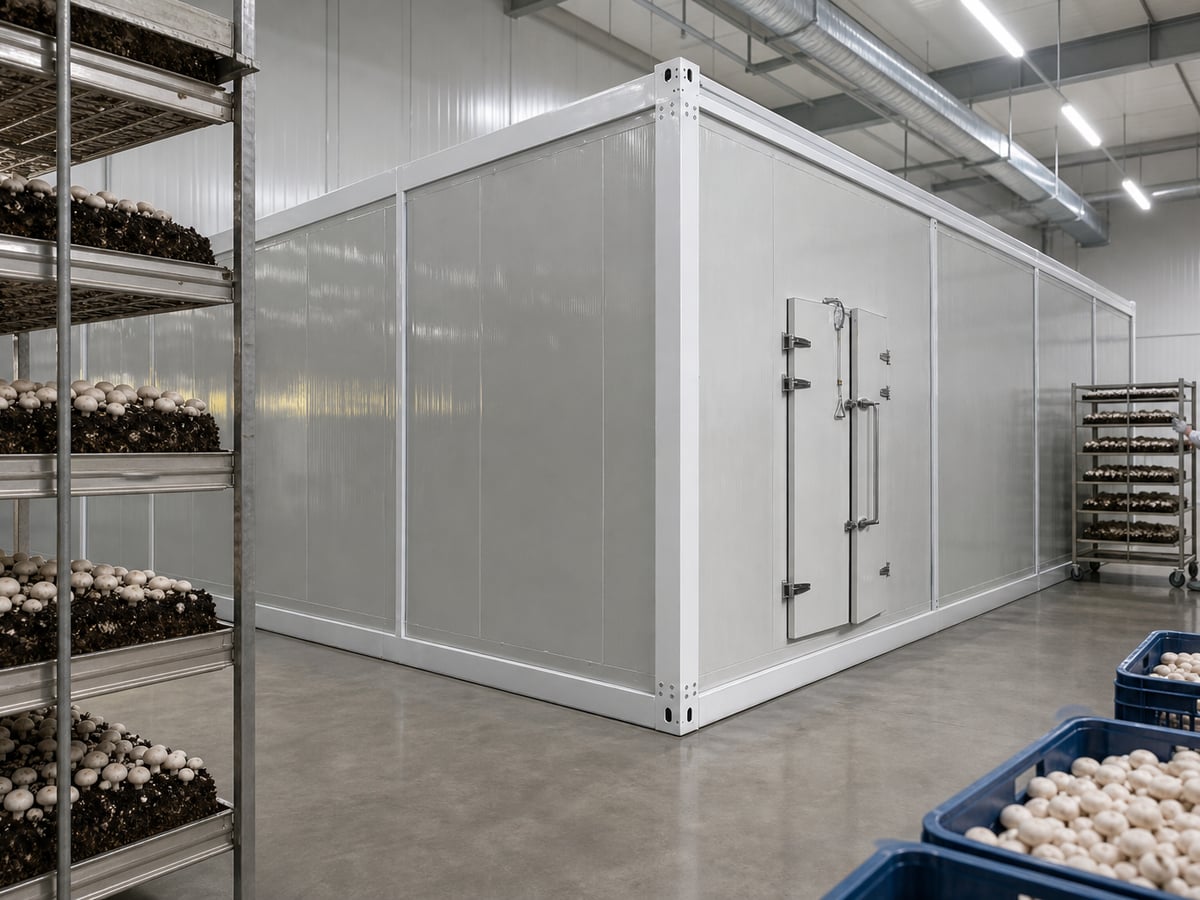
Mushroom container prices in the global market are shaped by far more than the steel box itself. A quotation usually combines the container body, insulation, cultivation racks, refrigeration and heating capacity, humidification, fresh-air management, controls, freight, unloading, commissioning, and after-sales support.
For a commercial buyer, the most useful question is not “What is the cheapest mushroom container?” but “What specification will produce the required growing conditions at the lowest total operating cost?” Two containers with similar external dimensions can have very different prices and performance. One may use basic insulation and manual controls, while another includes food-safe surfaces, corrosion-resistant racks, variable-speed fans, remote monitoring, backup sensors, and climate capacity designed for a hot or cold regional climate.
A practical budget should therefore separate the following cost groups:
- Core enclosure: container frame, doors, floor, wall panels, ceiling, insulation and internal finishes.
- Growing infrastructure: rack height, number of shelves, aisle width, tray compatibility, material grade and load rating.
- Climate system: cooling, heating, ventilation, fresh-air exchange, dehumidification, humidification and air distribution.
- Automation: sensors, controller, touchscreen, alarms, data logging, remote access and integration with farm management systems.
- Project logistics: inland transport, sea freight, customs handling, unloading equipment, foundations, electrical connection and drainage.
- Lifecycle support: commissioning, operator training, spare parts, warranty response and replacement components.
Buyers comparing offers from China, Europe, North America, the Middle East or Southeast Asia should request a line-by-line specification. A low initial price may exclude installation, local electrical work, unloading, software access or climate performance at the stated outdoor temperature. A higher quote may include these items and provide a lower total cost of ownership.
| Cost area | What changes the price | Why it matters | Questions for the supplier |
|---|---|---|---|
| Container shell | New or refurbished body, dimensions, doors and floor type | Determines durability, hygiene and usable internal space | Is the body new, modified or refurbished? |
| Insulation | Panel material, thickness, joints and thermal bridges | Influences energy consumption and condensation control | What U-value and panel thickness are guaranteed? |
| Racks | Number of levels, steel grade, coating and load capacity | Controls production volume and cleaning life | What is the shelf load per square metre? |
| Climate capacity | Ambient design temperature, crop load and air exchange | Determines whether the crop can hold its target conditions | At what outdoor conditions is capacity tested? |
| Controls | Manual, programmable or remotely connected operation | Reduces labour and improves repeatability | Are alarms, data records and remote access included? |
| Logistics | Port, inland distance, crane access and customs terms | Can significantly change delivered project cost | Is the offer EXW, FOB, CIF, DAP or another basis? |
The sections below explain how to evaluate each part of the quote and how to compare suppliers on a like-for-like basis.
Container Body and Insulation Cost Factors

The enclosure is the foundation of the growing environment. It must protect the crop from outdoor temperature swings, dust, insects, moisture and uncontrolled air leakage. The cost is influenced by whether the supplier starts with a new insulated module, a standard shipping container, or a customized panel structure built around a steel frame.
A refurbished shipping container may appear economical, but its floor condition, corrosion history, previous cargo use and dimensional tolerances require inspection. A purpose-built agricultural module can offer cleaner surfaces, more predictable insulation and better integration of doors, drains, cable routes and service panels. For mushroom production, hygiene and condensation resistance often justify a higher-quality enclosure.
Insulation thickness is one of the most important long-term decisions. Thin panels may reduce the initial quotation but increase the workload of the refrigeration system, particularly in locations such as Riyadh, Dubai, Mexico City or southern India. Cold regions including northern Europe, Canada and northeastern China may need attention to heat retention and frost protection instead. Panel joints, door seals, floor edges and penetrations can create thermal bridges even when the nominal panel thickness looks adequate.
Common insulation choices include polyurethane or polyisocyanurate sandwich panels, expanded polystyrene panels and mineral wool systems. Each has different thermal, fire, moisture and structural characteristics. The correct choice depends on local building rules, fire requirements, cleaning chemicals, humidity levels and the expected service life.
| Item | Entry-level specification | Commercial specification | What to verify |
|---|---|---|---|
| Wall panels | Basic insulated sandwich panel | Thicker food-production panel with sealed joints | Thickness, density, U-value and surface finish |
| Ceiling | Standard insulated roof panel | Reinforced panel with moisture-resistant lining | Condensation control and equipment support |
| Floor | Basic steel or coated floor | Washable, non-slip and drainage-compatible floor | Load capacity, slope, corrosion resistance and cleaning method |
| Doors | Single insulated access door | Sealed door with viewing panel and hardware | Door dimensions, gasket quality and emergency release |
| Internal finish | Painted metal surface | Hygienic, washable and corrosion-resistant lining | Coating type and chemical cleaning compatibility |
| Penetrations | Basic cable and pipe openings | Sealed service penetrations with maintenance access | Air leakage, water ingress and future serviceability |
Ask the supplier to state the usable growing area separately from the external container dimensions. Fan housings, evaporators, electrical cabinets, ducts and service clearances can reduce the space available for racks. Also confirm whether the quote includes internal lighting, drainage, washable skirting and insect protection on fresh-air inlets.
Rack Layout and Material Choices

Racks determine how much growing media can be placed in a container and how easily staff can work inside it. The same container may support two, three, four or more growing levels depending on ceiling height, tray dimensions, crop variety and the required aisle. More shelves do not automatically mean better economics if they restrict air movement, harvesting access or cleaning.
Galvanized steel is common for commercial rack frames because it offers a balance between strength and cost. Powder-coated steel can provide a smooth finish, but damaged areas may become vulnerable in a constantly humid environment. Stainless steel generally has a higher initial cost and may be selected for high-humidity production, strict hygiene requirements or projects where long service life is the priority. The best material depends on the crop cycle, sanitation method and local labour practices.
Rack design should be matched to the actual trays or bags used by the farm. Confirm tray width, tray depth, shelf spacing, edge protection and maximum load. A rack that is suitable for lightweight grow bags may not be appropriate for wet substrate blocks. Consider the weight of the crop, substrate, water and handling tools rather than the empty tray weight alone.
Air distribution is another major consideration. Shelves should not block the return-air path or create stagnant zones. A good layout permits an even temperature and humidity profile from the front to the rear of the container. Suppliers should be able to explain the fan direction, supply-air position and return-air arrangement.
| Rack feature | Lower-cost approach | Higher-value approach | Effect on operations |
|---|---|---|---|
| Frame material | Painted or galvanized carbon steel | Heavy galvanized or stainless steel | Changes corrosion resistance and service life |
| Shelf count | Two to three levels | Three to five optimized levels | Changes capacity, access and airflow |
| Shelf surface | Fixed slats or welded mesh | Removable, washable and tray-compatible surface | Affects cleaning speed and replacement cost |
| Load rating | Light-duty growing media | Reinforced for wet substrate and harvest load | Improves safety and prevents deformation |
| Mobility | Fixed racks | Modular or movable rack sections | Supports cleaning and layout changes |
| Air clearance | Minimal spacing based on available room | Designed clearance around supply and return paths | Improves uniformity and reduces disease risk |
When requesting a quotation, send the supplier a drawing of your tray or bag dimensions, target production volume and preferred aisle width. This prevents the supplier from pricing a generic rack arrangement that later needs modification.
Climate Capacity and Ambient Conditions
Climate equipment is often the largest technical variable in mushroom container pricing. The system may include a cooling coil, compressor, condenser, electric or hot-water heating, humidification, fresh-air ventilation, exhaust control and dehumidification. Capacity must be selected for the outdoor design condition, crop heat load, moisture load, insulation performance and the desired air-change rate.
A container located in a hot coastal area such as Lagos, Manila, Miami or Dubai may require more cooling and corrosion protection than an identical unit in London or Harbin. High outdoor humidity increases the latent load because the system must remove more moisture from incoming air. Cold climates may require additional heating capacity, low-temperature compressor protection and freeze prevention in water lines.
Ask for performance data at realistic conditions instead of relying on a nominal horsepower figure. A system advertised as suitable for a certain container size may not maintain the target temperature when the outdoor temperature reaches 40°C, when fresh-air exchange is high, or when the crop releases substantial heat and moisture.
For mushroom production, stable conditions are usually more important than extreme short-term capacity. The climate system should maintain the required temperature, relative humidity, carbon dioxide level and fresh-air exchange without excessive cycling. Sensors should be positioned to measure representative growing conditions rather than only the air near the evaporator.
| Condition | Typical impact | Potential equipment response | Buyer action |
|---|---|---|---|
| High summer temperature | Raises refrigeration load and condensing pressure | Larger condenser, protected compressor and stronger airflow | State the local summer design temperature |
| High outdoor humidity | Increases latent moisture load | Enhanced dehumidification and drainage capacity | Provide local humidity data if available |
| Cold winter conditions | Increases heating demand and freeze risk | Additional heater, insulation and pipe protection | Specify minimum outdoor temperature |
| Dust or sand | Can reduce coil performance and damage fans | Improved filtration and cleanable intake design | Request a maintenance plan for filters and coils |
| Unstable electricity | Can interrupt compressors and controls | Voltage protection, phase monitoring and restart logic | Share voltage, frequency and backup-power details |
| Seawater exposure | Accelerates corrosion of metal components | Protective coatings, suitable fasteners and treated coils | Identify coastal or marine installation conditions |
In a project near Rotterdam, Hamburg or Singapore, the logistics location may be convenient but the humid marine environment should be considered in the equipment finish. In inland areas near Nairobi, São Paulo or Almaty, dust, altitude and electrical conditions may be more influential. A responsible quotation records these assumptions clearly.
Automation and Remote Access Options
Automation ranges from a basic thermostat and manual humidifier switch to a complete controller that manages temperature, humidity, carbon dioxide, fan speed, fresh-air dampers, alarms and production records. The right level depends on labour availability, the number of containers, operator experience and the cost of crop losses.
A basic system can be appropriate for a single pilot container operated by an experienced grower. A commercial farm with several modules usually benefits from programmable recipes, sensor calibration records, alarm history and remote access. Remote monitoring is particularly valuable when the site is outside the city, when night staff are limited, or when a distributor supports multiple farms across different regions.
Confirm whether remote access is included as permanent functionality or depends on a subscription. Ask how the system connects when local internet service is weak. A controller should continue to protect the crop locally if the internet connection fails. Users should also clarify data ownership, password administration, software updates and cybersecurity responsibilities.
Automation can improve consistency, but it does not replace correct sensor placement and preventive maintenance. The controller should display actual readings, set points, alarm thresholds and equipment status in a clear format. Operators need training on what to do when temperature rises, humidity falls, a fan stops or a sensor reports an impossible value.
| Control level | Included functions | Suitable application | Pricing consideration |
|---|---|---|---|
| Manual | Local switches and basic thermostatic control | Small trial or closely supervised operation | Lowest initial cost, highest labour dependence |
| Programmable | Temperature and humidity set points with schedules | Single commercial container | Moderate cost with better repeatability |
| Sensor-based | Multiple sensors, alarms and automatic fresh-air control | Professional production with defined recipes | Requires calibration and operator training |
| Remote-enabled | Mobile or web monitoring, notifications and data logs | Remote farms and multi-container projects | May include communication hardware or subscription fees |
| Networked | Central dashboard for several containers | Growing facilities and distributors | Needs system integration and network planning |
| Integrated | Climate, energy, production and maintenance data | Large commercial or research operation | Higher engineering cost but stronger management insight |
Lanhu’s smart mushroom climate controller can be discussed as part of a broader control strategy, including sensor selection, alarm logic and remote operation requirements.
Freight, Unloading, and Site Works
The factory price is only one component of the delivered investment. Freight can vary according to the shipment port, container dimensions, seasonal demand, destination, Incoterms, insurance and customs requirements. A quotation from a Chinese manufacturer may be based on EXW or FOB terms, while a distributor may quote a delivered price that includes additional handling and margin.
Common export routes from northern China may involve trucking to Qingdao, Tianjin or another suitable port before ocean transport. Buyers in Europe may compare delivery to Rotterdam, Hamburg, Antwerp or Piraeus. Projects in North America may use Long Beach, Vancouver, New York or Houston, while customers in Africa, Latin America and Southeast Asia should review transshipment schedules and inland delivery constraints.
Unloading is frequently overlooked. A fully assembled module may require a crane, heavy forklift, flatbed truck, spreader beam or temporary road closure. The destination must have adequate turning space, ground bearing capacity and overhead clearance. If the site is remote or elevated, the cost of the final kilometre can exceed the difference between two equipment quotations.
Site works may include a concrete pad, steel supports, drainage, water supply, electrical distribution, grounding, internet connection, shade structure and access paths. The supplier should identify which works are excluded. Local contractors may handle foundations and utilities, but their requirements must be coordinated with the container drawings.
| Item | Possible charging basis | Information needed | Common risk |
|---|---|---|---|
| Export packing | Included or charged separately | Packaging method and protection period | Damage during handling or storage |
| Ocean freight | Per container, route or seasonal rate | Port pair, transit time and cargo dimensions | Rate changes and schedule delays |
| Insurance | Percentage of cargo value | Coverage limits and exclusions | Insufficient cover for specialized equipment |
| Customs and taxes | Destination-specific duties and fees | HS classification, origin documents and importer status | Unexpected duty or clearance charges |
| Unloading | Crane, forklift or specialist lifting contractor | Weight, lifting points and site access | Equipment cannot reach the final position |
| Foundation and utilities | Local contractor quotation | Pad drawing, power, water, drainage and network data | Rework caused by incomplete engineering information |
Before placing an order, provide photographs, a site plan, GPS location, road dimensions and utility information. This allows the manufacturer and local contractor to identify practical problems before shipment.
Spare Parts and Commissioning Costs
Commissioning is more than switching on the equipment. It normally includes inspection, electrical checks, sensor verification, controller configuration, airflow review, leak testing, operating trials and operator instruction. The scope may be performed remotely, by a local technician or by a factory engineer travelling to the site.
Remote commissioning can reduce the initial project cost when the local electrical and mechanical teams are capable. On-site commissioning may be more valuable for multi-container farms, unusual climate conditions or projects with strict production deadlines. Travel, accommodation, visas and local transportation should be identified separately if an engineer visit is required.
Spare parts should be planned around the operating environment. Filters, belts, humidifier components, temperature and humidity sensors, relays, contactors, fuses, fan motors and control modules are common maintenance items. A remote farm may need a broader stock than a site located near a well-supported industrial service centre.
The buyer should request part numbers, recommended quantities, warranty terms and expected availability. Critical components should be replaceable without dismantling the entire container. It is also useful to clarify whether equivalent local parts can be used without affecting the warranty.
| Support item | Basic provision | Expanded provision | Why it affects total cost |
|---|---|---|---|
| Factory testing | Visual and functional inspection | Documented electrical and performance testing | Reduces installation surprises |
| Installation guidance | Manual and drawings | Remote supervision or technician support | Improves correct assembly and startup |
| Operator training | Short basic instruction | Recipe setup, alarms, cleaning and maintenance training | Reduces crop and equipment errors |
| Initial spare kit | Fuses, sensors and small consumables | Fans, controllers, valves and critical electrical parts | Limits downtime while parts are shipped |
| Warranty | Standard parts warranty | Defined response times and remote diagnostics | Changes financial exposure after delivery |
| Service contract | Ad hoc support | Scheduled inspections and performance reviews | Can protect uptime in larger farms |
Lanhu’s manufacturing process includes sheet-metal fabrication, CNC bending, insulation-panel production, electrical assembly, system integration, equipment testing and quality inspection. Buyers can request a documented pre-shipment inspection covering functional operation, electrical verification and performance evaluation.
Building a Like-for-Like Quote Comparison
A fair comparison requires a common technical schedule. Start by defining the internal growing volume, number of shelves, target crop, production cycle, temperature range, relative humidity range, carbon dioxide strategy and required fresh-air exchange. Then state the local ambient design conditions and available electrical supply.
Do not compare a factory-direct equipment price with a local turnkey price without adjusting for freight, taxes, installation and support. Likewise, do not compare a container with three rack levels against one with five levels without considering aisle width, tray capacity and climate uniformity.
Use a scoring system that gives weight to performance and lifecycle cost, not only the purchase price. For example, technical compliance might represent 30 percent, total delivered cost 25 percent, energy efficiency 15 percent, service support 15 percent and supplier experience 15 percent. The weighting should reflect the project’s risks and production priorities.
| Comparison category | Required information | Pass or fail question | Weight example |
|---|---|---|---|
| Capacity | Usable volume, rack levels and tray count | Does it meet the planned production volume? | 15% |
| Climate performance | Cooling, heating, humidity and fresh-air capacity | Is performance stated at local ambient conditions? | 20% |
| Hygiene and durability | Panel finish, floor, drainage and rack material | Can the system be cleaned and maintained safely? | 15% |
| Controls | Sensors, alarms, data logging and remote access | Can operators manage the crop consistently? | 10% |
| Delivered cost | Equipment, freight, tax, unloading and site works | Is the total project cost transparent? | 20% |
| Support | Warranty, commissioning, training and spare parts | Is help available after delivery? | 20% |
Request the following documents before comparing final bids:
- Dimensioned general arrangement drawing.
- Electrical load list and power requirements.
- Climate performance data and design assumptions.
- Rack layout with shelf dimensions and load ratings.
- Insulation details and internal surface specifications.
- Control-system functions, alarm list and remote-access terms.
- Foundation, drainage, lifting and utility requirements.
- Incoterms, packing details, warranty and commissioning scope.
Energy use deserves special attention. A lower-priced unit with poor insulation, fixed-speed fans or oversized compressors may cost more to run over five years. Ask suppliers to estimate operating consumption under a stated climate and duty cycle. The estimate should identify whether it includes heating, humidification, ventilation and defrost.
Market Segments, Product Types, and Applications
Smart mushroom containers serve several market segments. New growers may use one unit for proof of concept, restaurants may produce specialty mushrooms close to consumers, and established farms may deploy multiple modules to add capacity without constructing a full building. Research institutions and agricultural colleges can also use modular units for controlled trials.
Product types range from basic cultivation containers to integrated units with climate control, racks, lighting, monitoring and recipe management. Some buyers need only the insulated growing chamber because they already own refrigeration and automation equipment. Others prefer a complete package that can be installed and operated with limited local engineering.
Typical applications include oyster mushroom production, shiitake fruiting, lion’s mane cultivation, incubation trials, climate research, urban farming and demonstration projects. The system should be selected according to the crop stage. Fruiting rooms, incubation rooms and substrate preparation spaces have different temperature, humidity and ventilation requirements.
Commercial customers should evaluate the relationship between usable growing area, cycle time, yield, labour and selling price. A container is not automatically profitable because it is compact. Business planning should include substrate supply, spawn, packaging, cold storage, labour, sanitation, electricity, water, market access and crop-loss risk.
Case Patterns and Local Supplier Considerations
Project requirements differ by region. A farm near Toronto may prioritize heating efficiency and winter protection. A producer in Barcelona or Athens may need strong summer cooling and water-saving humidification. A buyer in Jakarta or Manila may focus on dehumidification, corrosion resistance and reliable drainage. In Nairobi or Accra, stable power and service-part availability may matter as much as nominal equipment capacity.
For ports and trade hubs, buyers should assess both delivery cost and local technical support. A unit delivered to Rotterdam may be easy to move across the Netherlands, Belgium or western Germany, while a shipment to a smaller port may have lower ocean freight but higher inland costs. Customers in the Gulf region may compare Jebel Ali with other regional logistics routes. Latin American buyers should review port congestion, customs documentation and local voltage requirements early.
Local suppliers can provide foundations, electrical installation, crane services, water treatment and maintenance. The equipment manufacturer should coordinate with these contractors through clear drawings and connection points. A local contractor may also be able to stock general electrical parts, but specialized controllers, sensors and refrigeration components may still need to come from the original manufacturer.
Illustrative project patterns can be reviewed through the mushroom container project examples. Buyers should treat each case as a reference point rather than a guarantee, because climate, crop, rack density and operating schedules affect results.
Future Trends for 2026 and Beyond
By 2026, mushroom container projects are likely to place greater emphasis on energy efficiency, data visibility and modular expansion. Variable-speed compressors and fans can reduce energy use during partial-load operation. Better heat recovery may allow rejected refrigeration heat to support water heating or nearby process loads. Improved sensors will help operators identify airflow imbalance, filter blockage and abnormal moisture conditions before they become crop problems.
Artificial intelligence and predictive analytics may increasingly support climate recipes, although reliable basic controls remain essential. Systems may compare historical climate data with yield, contamination and energy records to recommend more efficient operating parameters. Remote service teams can use alarm histories and controller data to diagnose faults before travelling to the site.
Sustainability requirements will also influence purchasing decisions. Buyers may request refrigerants with lower global-warming potential, recyclable panels, efficient motors, water-saving humidification and documented energy performance. Some markets may introduce stricter reporting for refrigerants, electrical consumption, waste handling and building materials. A modular system can reduce construction waste and shorten deployment time, but end-of-life disassembly and material recovery should be considered.
Policy and food-security programmes may encourage local production in cities, islands and regions that depend heavily on imported fresh produce. However, incentives should not replace a sound operating model. Buyers should verify eligibility, local permits, electrical certification, fire requirements, import rules and food-hygiene obligations before committing to a project.
Our Company
Shandong Lanhu Air Conditioning Equipment Co., Ltd. develops agricultural climate-control equipment, industrial HVAC systems and modular cultivation solutions from Dezhou, Shandong, China. Its product range includes smart mushroom cultivation containers, mushroom climate controllers, smart hydroponic plant containers and air-source heat pumps.
Technological capabilities: The company combines thermodynamic research with practical climate engineering for controlled agricultural environments. More than 12 years of research and development experience and over 45 registered patents support work on temperature control, humidity management, air treatment and modular system integration. Solutions can be adapted for different crops, climates, electrical standards and monitoring requirements.
Manufacturing capabilities: Lanhu operates a manufacturing facility of more than 30,000 square metres. Its integrated production process includes product design, engineering development, sheet-metal fabrication, CNC bending, insulation-panel production, electrical assembly, system integration, testing and quality inspection. Each system is checked for function, electrical safety, performance and operational readiness before shipment. The company maintains ISO 9001, ISO 14001, ISO 45001 and ISO 12100 certifications, together with patent and enterprise-credibility credentials.
Service capabilities: The company supplies factory-direct equipment and supports OEM and ODM projects for agricultural contractors, distributors, engineering companies and commercial farms. Services can include engineering assistance, international logistics coordination, installation guidance, spare-parts support, operator training and after-sales communication. Buyers can use the smart mushroom cultivation container information to define an initial project scope, then submit climate, rack and site requirements through the project enquiry page.
FAQ: Mushroom Container Pricing and Purchasing
What is the average price of a mushroom cultivation container?
There is no reliable single global average because specifications differ substantially. A basic enclosure with simple racks and manual controls may be priced very differently from a complete commercial module with high-capacity climate equipment, remote monitoring, commissioning and export delivery. Request a detailed quotation based on usable internal dimensions and local ambient conditions.
Why do two suppliers quote different prices for similar containers?
The offers may differ in insulation thickness, rack levels, steel grade, compressor capacity, sensor quantity, controller functions, electrical components, warranty, freight terms or commissioning scope. The quoted container dimensions may also be similar while the usable growing area and climate performance are not.
Should I buy a new or refurbished shipping container?
A refurbished body can reduce the initial price, but inspect corrosion, floor condition, previous cargo use, door seals and dimensional accuracy. A purpose-built insulated module may provide better hygiene, thermal performance and integration. The right option depends on the crop, expected service life, cleaning requirements and local regulations.
How many racks should a mushroom container have?
The answer depends on tray dimensions, crop weight, ceiling height, air distribution and working access. More levels increase potential capacity but may restrict airflow and harvesting. Ask for a layout drawing showing shelf spacing, aisle width, load rating and clearance around supply and return air paths.
Can a container operate in a hot climate?
Yes, but the refrigeration system must be selected for the local design temperature, humidity and crop load. A unit rated only at moderate outdoor conditions may lose capacity during extreme heat. Provide the supplier with summer temperature, humidity, power quality and installation exposure information.
Is remote monitoring necessary?
It is not essential for every small pilot, but it can be valuable for commercial farms, unattended sites and multi-container operations. Remote access should include alarms, data history and secure user permissions. The local controller must continue operating safely if the internet connection is interrupted.
What freight terms should global buyers compare?
Compare EXW, FOB, CIF, DAP or other terms only after confirming exactly which costs each includes. Check export packing, port handling, marine insurance, import clearance, duties, inland delivery, unloading and local taxes. Delivered cost is more useful than factory price when comparing suppliers.
What site preparation is normally required?
Most projects need a level foundation, drainage, electrical supply, grounding, water access, internet or mobile connectivity, and sufficient room for unloading and maintenance. Some sites also require shade, fencing, access roads or a backup generator. Request foundation and utility drawings before construction begins.
How many spare parts should be ordered?
Keep commonly replaceable items such as filters, sensors, fuses, relays and humidifier components on site. Remote farms may also need fan motors, valves, contactors and controller modules. The ideal kit depends on local service availability, shipping time and the cost of crop loss during downtime.
How can I request an accurate quotation?
Provide the destination country and city, outdoor temperature range, humidity, electrical supply, crop type, container quantity, tray dimensions, desired rack levels, target climate, automation needs, unloading conditions and preferred delivery terms. The more complete the technical brief, the less likely the final price will change.
Share this article

About the Author: Shandong Lanhu Air Conditioning Equipment
Lanhu is a professional climate control equipment manufacturer specializing in smart agricultural systems, commercial HVAC solutions, and customized temperature control technologies. With extensive engineering experience, Lanhu provides reliable solutions for plant factories, controlled environment agriculture, and industrial applications.
Need a Custom Climate Control Solution?
From smart agricultural systems to commercial HVAC solutions, Lanhu provides reliable temperature and humidity control solutions tailored to your project needs.
Contact Us