Global Market Guide to Multi-Container Mushroom Farm Layout
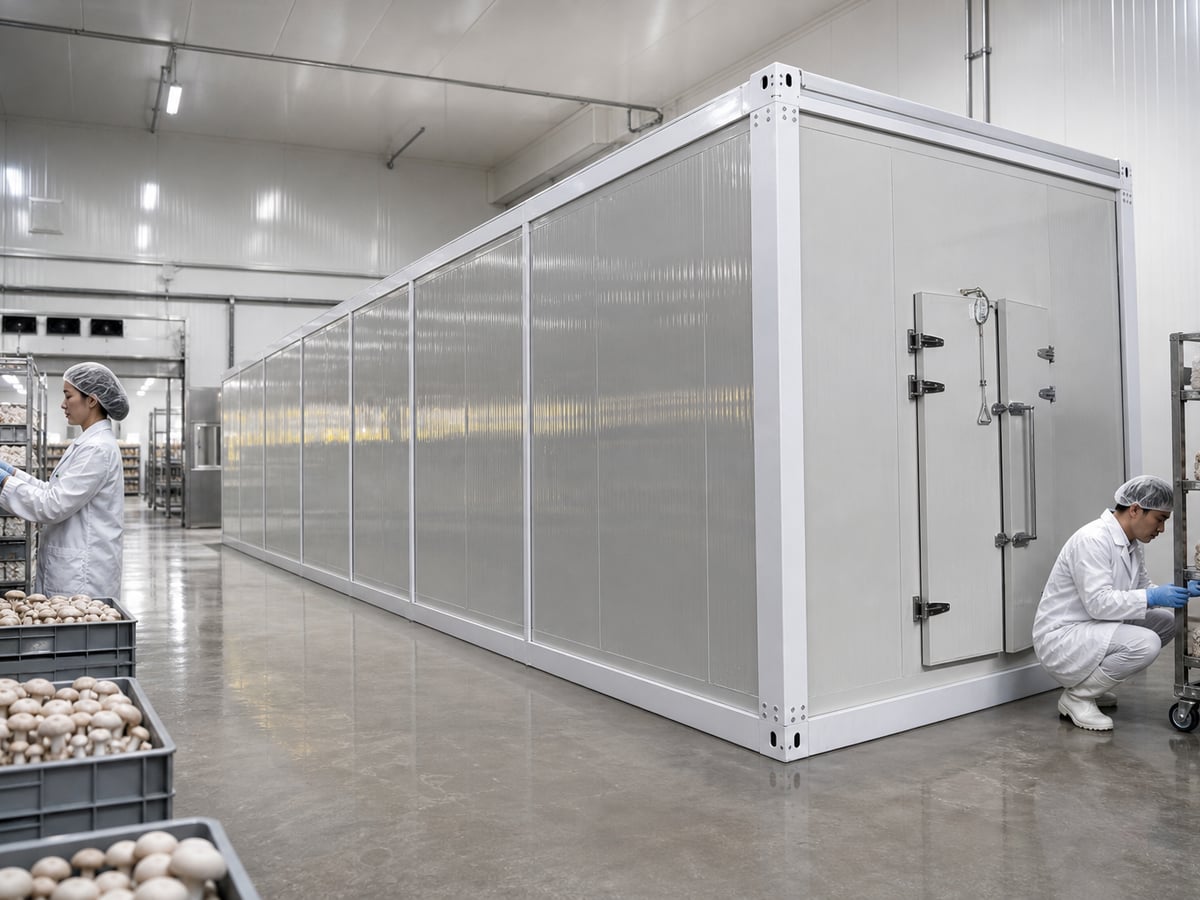
Fast Layout Guidance for Container Mushroom Farms

A successful multi-container mushroom farm depends on more than adding extra growing units. The site must be arranged around production stages, hygiene control, utility access, climate stability, worker movement, harvesting efficiency, and future growth. For projects serving the Global Market, the best layout normally separates inoculation or substrate receiving activities from fruiting, harvesting, waste handling, and loading areas.
The practical rule is simple: place containers in groups according to their production function, establish one-way clean and dirty traffic routes, install shared utility corridors with independent meters, leave sufficient spacing for maintenance and outdoor-air circulation, and operate fruiting rooms with staggered batch schedules. Central monitoring can supervise the complete farm, while each container should retain independent climate control for different mushroom species, crop ages, and local operating conditions.
For commercial farms, a modular layout can reduce expansion risk. Instead of building a single oversized facility before sales demand is confirmed, growers can begin with several smart cultivation containers and reserve space for additional units, central equipment, logistics lanes, and utility capacity. This approach is especially useful near distribution centers, food wholesale markets, ports, and urban agricultural zones in Rotterdam, Dubai, Singapore, Los Angeles, Hamburg, Sydney, and São Paulo.
| Layout Objective | Recommended Practice | Operational Benefit |
|---|---|---|
| Production zoning | Group containers by crop age and production stage. | Reduces cross-contamination and simplifies work planning. |
| Hygiene control | Create separate clean and dirty movement routes. | Improves biosecurity and protects fruiting rooms. |
| Utility reliability | Use shared main lines with container-level metering. | Supports cost control and fault isolation. |
| Service access | Keep clear service lanes around each container. | Allows safe maintenance, delivery, and emergency access. |
| Harvest continuity | Stagger crop batches across fruiting rooms. | Creates steadier weekly output for buyers. |
| Expansion readiness | Reserve land, electrical capacity, and pipe connections. | Reduces disruption when new containers are added. |
This table summarizes the foundation of efficient modular mushroom farm planning. The final dimensions and route design should always reflect local fire codes, food safety requirements, weather conditions, container size, equipment loads, and the species being cultivated.
Organizing Containers by Production Stage

Container grouping should follow the biological flow of mushroom production. A farm growing oyster mushrooms, shiitake, king oyster mushrooms, button mushrooms, lion’s mane, or specialty fungi may use different substrate systems, but the principle remains consistent: young material and mature fruiting crops should not share the same movement pattern without hygiene controls.
A typical container farm may include receiving or storage containers, incubation containers, fruiting containers, harvesting and packing areas, cold storage, wash-down zones, and waste or spent substrate collection points. For smaller farms, some functions can be combined, but fruiting rooms should remain protected from dirty operations whenever possible.
Place the most contamination-sensitive rooms deeper within the clean production zone. Receiving, packaging material storage, maintenance workshops, and spent substrate staging should be closer to the external road or loading entrance. This reduces the number of unnecessary visits by forklifts, drivers, contractors, and waste collection vehicles near fruiting rooms.
| Production Area | Typical Container Location | Key Layout Requirement |
|---|---|---|
| Substrate receiving | Near delivery gate or loading road | Easy truck access and washable hardstanding surface |
| Incubation | Between receiving and fruiting zones | Stable temperature with restricted traffic |
| Fruiting rooms | Inside clean production block | Protected air intake and controlled personnel access |
| Harvest staging | Adjacent to fruiting rooms | Short harvest travel distance and clean crates |
| Packing and cold storage | Near dispatch area but outside fruiting cluster | Fast transfer to refrigerated transport | Spent substrate handling | Downstream from clean areas | Separate drainage, loading route, and waste collection point |
The table illustrates a one-directional production flow. Material should enter from the receiving side, move through incubation and fruiting, continue to harvest and packing, and leave through dispatch. Spent substrate should exit on a route that does not pass clean growing rooms.
For farms supplying supermarkets, restaurants, meal-kit companies, or fresh produce distributors, crop consistency is often more important than maximum peak output. Grouping containers by stage helps managers standardize climate recipes, harvesting labor, sanitation intervals, and expected yields. It also makes it easier to isolate a room if a crop issue occurs.
Smart container systems can be valuable when multiple production stages require separate conditions. A smart mushroom cultivation container can be configured around a defined crop cycle, enabling farms to allocate individual units to incubation, pinning, fruiting, or trial production without rebuilding the entire site.
Clean and Dirty Traffic Route Planning

Clean and dirty traffic routes are among the most important safeguards in container mushroom farming. “Clean” traffic includes trained farm staff, disinfected harvest carts, clean packaging, sanitized tools, and finished-product movement. “Dirty” traffic includes incoming raw materials, used growing bags, waste bins, maintenance equipment, external contractors, and spent substrate.
The site should have a visible route hierarchy. Ideally, visitors and delivery drivers remain outside the clean production zone. Employees enter through a hygiene station with footwear controls, handwashing facilities, protective clothing, and equipment storage. Harvest teams should move from cleaner areas toward less sensitive areas during a shift, rather than returning repeatedly from waste handling to fruiting rooms.
In wet or humid climates, routes require strong drainage and durable surfaces. In tropical locations such as Jakarta, Manila, Ho Chi Minh City, or Kuala Lumpur, covered walkways can protect workers and electrical equipment from heavy rain. In colder regions such as northern Europe, Canada, or inland China, snow clearance, frost-resistant drainage, and sheltered maintenance access must be included in the master plan.
| Traffic Type | Primary Users | Suggested Route Rule |
|---|---|---|
| Clean personnel route | Production and harvest staff | Enter through hygiene station and avoid waste zones. |
| Clean product route | Harvest carts and packed mushrooms | Move directly to packing or cold storage. |
| Raw material route | Suppliers and forklifts | Use receiving side without crossing fruiting access lanes. |
| Maintenance route | Technicians and spare-parts teams | Access exterior equipment panels whenever possible. |
| Waste route | Spent substrate and cleaning crews | Exit downstream through a dedicated collection area. | Visitor route | Buyers, auditors, and contractors | Limit entry and provide controlled observation access. |
This route plan helps farm managers turn hygiene policies into physical operating habits. Colored floor markings, directional signs, dedicated carts, access badges, and container numbering are low-cost measures that can improve compliance significantly.
Where local food regulations require documented sanitation controls, route separation also supports traceability. A manager can identify who entered a room, when sanitation occurred, what crop batch was harvested, and whether external service work affected production. This is particularly useful for farms supplying export-oriented customers through trade hubs such as Antwerp, Jebel Ali, Shanghai, Busan, and Long Beach.
Shared Utility Distribution and Metering
Multi-container farms often benefit from shared utility infrastructure, but each container should remain independently measurable and controllable. Main utility corridors can distribute electricity, water, drainage, communications, and, where applicable, heating or cooling services. Individual sub-meters help managers understand the operating cost of each fruiting room and identify abnormal consumption before it becomes a crop or equipment problem.
Electrical design should account for climate equipment, lighting, humidification, ventilation fans, pumps, controls, refrigeration, packing equipment, and future expansion. Water systems should include filtration where local quality requires it, pressure regulation, isolation valves, backflow protection, and accessible drain points. In regions with unreliable grid power, a backup generator, battery storage, or hybrid solar system may protect crop continuity.
Utility corridors should be designed for serviceability. Avoid burying all cables and pipes without access points. A combination of protected overhead cable trays, underground conduits, labeled manifolds, and accessible service trenches can shorten repair time. The most suitable solution depends on local building rules, frost depth, rainfall intensity, soil conditions, and vehicle movement.
| Utility System | Shared Infrastructure | Container-Level Control |
|---|---|---|
| Electricity | Main distribution board and protected cable route | Sub-meter, breaker, emergency isolation switch |
| Water supply | Central tank, filtration, and supply manifold | Pressure valve, flow meter, individual shutoff | Drainage | Main drainage channel or collection line | Traps, inspection point, container drain connection | Data network | Central router, gateway, and network cabinet | Dedicated controller connection and alarm reporting | Heating or cooling | Shared energy source where appropriate | Independent temperature setpoint and operating schedule | Backup power | Generator or energy storage system | Priority circuits for climate control and monitoring |
This utility framework balances economies of scale with operational accountability. A shared main supply lowers infrastructure duplication, while individual metering reveals whether a particular container is using excessive electricity, water, or cooling energy.
For advanced farms, data from utility meters can be connected to a smart mushroom climate controller. Managers can compare humidity demand, fan runtime, carbon dioxide control, temperature performance, and energy consumption across rooms. This supports evidence-based changes to cultivation recipes and operating schedules.
Service Clearance and Outdoor Air Spacing
Containers should never be positioned so closely that staff cannot access doors, climate equipment, electrical cabinets, roof edges, condensate drains, or air intake and exhaust points. Adequate spacing protects maintenance teams, supports fire access, reduces heat buildup, and improves outdoor-air exchange around equipment.
Recommended clearance depends on container orientation, HVAC design, prevailing wind, local fire requirements, truck turning radius, and whether external condensers, heat pumps, or ductwork are installed. As a general operational concept, allow a narrow pedestrian service lane on low-access sides, a wider maintenance route on equipment sides, and a vehicle-capable lane where forklifts or delivery trucks must pass.
Outdoor air intake location matters. Avoid placing fresh-air intakes directly beside exhaust outlets, waste collection zones, diesel generators, dusty roads, compost piles, or loading bays. If containers are installed in parallel rows, staggered placement or wider gaps may reduce recirculation of warm, humid exhaust air.
| Site Feature | Planning Consideration | Reason for the Space |
|---|---|---|
| Container side clearance | Allow staff walking and panel access. | Supports inspections, cleaning, and repairs. |
| Equipment-side lane | Provide wider access near HVAC units. | Allows safe replacement of components. |
| Fire access route | Maintain code-compliant emergency lane. | Improves safety and regulatory compliance. | Air intake separation | Keep intakes away from exhaust and contaminants. | Protects crop air quality and climate performance. |
| Drainage perimeter | Slope paving away from container foundations. | Prevents standing water and corrosion risk. | Loading turning area | Reserve space for refrigerated vans or trucks. | Prevents congestion near production rooms. |
The spacing plan should be checked before foundations, electrical trenches, and drainage work begin. Changing container positions after utilities are installed can be expensive. A site drawing should show container footprints, doors, service panels, air equipment, drains, road widths, fence lines, emergency exits, and expansion pads.
Batch Scheduling Across Fruiting Rooms
Batch scheduling converts multiple fruiting containers into a predictable supply system. Instead of filling every room on the same date, commercial growers typically stagger loading, pinning, fruiting, harvesting, sanitation, and restart cycles. This smooths labor demand and helps the farm meet regular delivery commitments.
For example, a six-container oyster mushroom farm may place one room into a new fruiting phase every few days or every week, depending on crop cycle length and sales requirements. One room may be in early pinning, two may be in peak harvest, one may be in late flush, one may be under cleaning, and one may be held for a different species or customer order. This reduces the risk of having no harvest one week and too much product the next.
Scheduling should consider customer demand, local transport availability, harvest labor, cold storage capacity, packaging consumption, and wholesale price patterns. Farms near major cities may schedule more frequent harvests for short-distance deliveries. Farms shipping through ports or cross-border logistics channels need more stable cold-chain planning and product shelf-life management.
The chart shows the logic of staggered production rather than a fixed formula. The right schedule depends on mushroom species, substrate source, room capacity, crop performance, and contracted sales volumes. Managers should review actual harvest records and adjust loading intervals as the farm develops.
Batch discipline also simplifies cleaning. A fruiting container can be fully emptied, washed, inspected, dried, and reset without stopping the harvest from all other rooms. This is an important resilience advantage of modular production compared with a single large growing hall.
Central Monitoring with Room-Level Independence
Central monitoring gives farm owners visibility across the site, while independent controls protect the crop requirements of each container. A central dashboard may display temperature, relative humidity, carbon dioxide, fan status, alarms, door activity, water use, power consumption, and historical trends. Each fruiting room, however, should be able to follow its own climate setpoints.
This independence is essential because rooms may contain different mushroom species, different crop ages, or crops responding differently to seasonal weather. A young pinning room may require a different fresh-air and humidity strategy than a late-flush room. If one container has a sensor fault or a door is opened repeatedly during harvest, its control response should not disrupt the entire farm.
Remote access can help managers supervise sites across large regions. This is useful for investors operating farms in multiple countries, distributors supporting customer installations, or agricultural contractors managing remote projects. Alarm escalation should be practical: notify staff only when action is needed, assign priority levels, and keep local manual override capability for trained operators.
Future trends through 2026 include broader use of predictive maintenance, energy optimization algorithms, sensor validation, crop-yield forecasting, and integrated traceability. More farms are also expected to adopt lower-carbon energy systems, heat recovery, variable-speed fans, water reuse where permitted, and renewable electricity procurement. Policy direction in many markets increasingly favors food security, local production, energy efficiency, water stewardship, and documented food safety practices.
Keeping Room for Future Expansion
Expansion planning should begin before the first container is delivered. A farm may start with four fruiting rooms but later require eight, twelve, or more units. If the initial site plan does not reserve utility corridors, drainage capacity, truck turning space, cold storage expansion, staff facilities, and emergency routes, growth can become unnecessarily expensive.
Reserve a clear expansion zone adjacent to the existing production block. Extend main electrical conduits, water mains, data cables, and drainage connection points to the boundary of that zone. Where practical, select a main electrical panel, transformer, water storage system, or heating capacity that can support planned growth or be upgraded in modules.
Expansion also includes business space, not only container pads. More fruiting rooms may require additional packing tables, cold rooms, crate washing, quality control areas, staff lockers, spare-parts storage, and loading capacity. Farms serving retailers may eventually need labeling equipment, traceability systems, and refrigerated dispatch bays.
Before purchasing additional containers, review sales performance, crop yields, labor availability, energy pricing, local permits, and customer concentration. Gradual expansion is often safer than rapid expansion, particularly in markets where fresh mushroom demand is still developing. A documented layout plan can help lenders, partners, and local authorities understand the project’s long-term logic.
Our Company
Shandong Lanhu Air Conditioning Equipment Co., Ltd. supports modular cultivation projects with agricultural climate-control and containerized growing solutions for customers across the Global Market. The company’s technological capability is rooted in more than 12 years of thermodynamic research and development, with over 45 registered patents supporting climate management, system integration, and controlled-environment cultivation applications.
Its manufacturing capability is based in Dezhou, Shandong, China, where the company operates a modern facility exceeding 30,000 square meters. Integrated processes include product engineering, sheet metal fabrication, CNC bending, insulation panel production, electrical assembly, equipment integration, testing, and quality inspection. Systems are evaluated through functional checks, electrical verification, performance testing, and operational assessment before shipment. Quality and management credentials include ISO 9001, ISO 14001, ISO 45001, and ISO 12100.
Lanhu’s service capability includes factory-direct supply, OEM and ODM customization, engineering support, installation guidance, spare-parts assistance, international logistics coordination, and after-sales service. The company works with agricultural contractors, distributors, engineering firms, and commercial farming projects. Buyers seeking customized specifications can explore the company’s OEM and ODM cultivation equipment service for layout, climate, electrical, and branding requirements.
For project evaluation, relevant examples can be reviewed through the company’s container cultivation project cases. These references can help buyers compare different modular approaches for climate conditions, production goals, logistics constraints, and available site area.
Frequently Asked Questions
How many containers should a new commercial mushroom farm start with?
Many new projects begin with two to six cultivation containers, depending on available capital, sales demand, staffing, and substrate supply. Starting with several independently controlled rooms enables batch scheduling and provides operational flexibility without creating excessive complexity.
Should incubation and fruiting containers be separated?
Yes, where budget and site area allow. Incubation and fruiting normally require different climate conditions and have different hygiene risks. Separation improves crop management and allows the fruiting area to remain cleaner and more stable.
What is the best container orientation for outdoor installation?
The best orientation depends on prevailing wind, solar exposure, equipment location, drainage, and access roads. Avoid positioning air intakes toward dusty roads, exhaust outlets, waste zones, or generator emissions. Local engineering review is recommended for each site.
Can several containers share one water and electrical connection?
Yes. A shared main connection can distribute utilities efficiently, but each container should have its own isolation points, protection devices, and sub-metering. This makes maintenance, billing analysis, and fault detection easier.
Why is staggered batch scheduling important?
Staggered scheduling creates more regular harvest volumes, reduces labor peaks, supports weekly customer deliveries, and allows individual rooms to be cleaned and reset without stopping the entire farm.
Can container mushroom farms be expanded later?
Yes. Modular farms are designed for phased growth. Reserve expansion pads, utility capacity, drainage connections, logistics space, and service lanes during the first construction phase so new containers can be added with minimal disruption.
Share this article

About the Author: Shandong Lanhu Air Conditioning Equipment
Lanhu is a professional climate control equipment manufacturer specializing in smart agricultural systems, commercial HVAC solutions, and customized temperature control technologies. With extensive engineering experience, Lanhu provides reliable solutions for plant factories, controlled environment agriculture, and industrial applications.
Need a Custom Climate Control Solution?
From smart agricultural systems to commercial HVAC solutions, Lanhu provides reliable temperature and humidity control solutions tailored to your project needs.
Contact Us