Global Market Mushroom Container Yield Planning Guide
Quick Capacity and Yield Answer

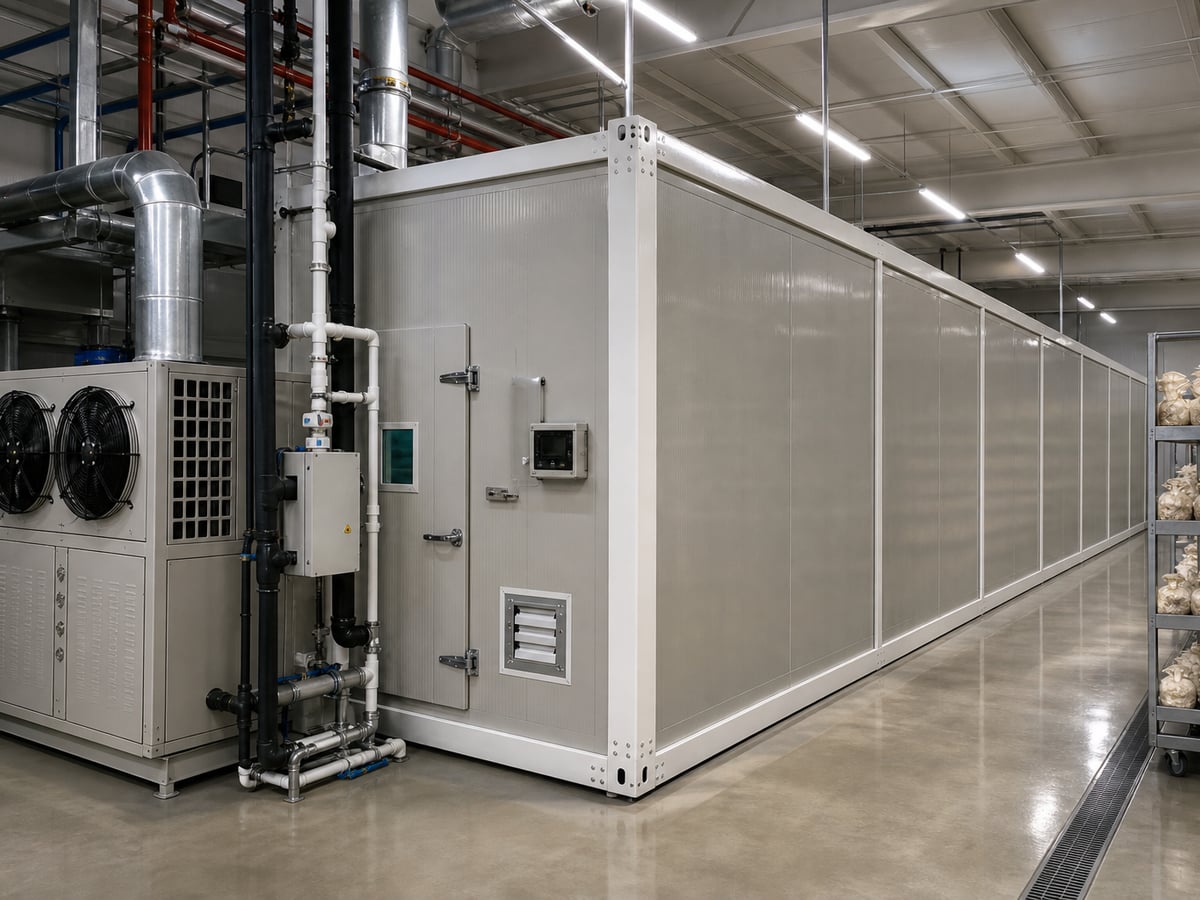
Mushroom container capacity should never be described only as the total number of grow bags that fit inside a container. A reliable production estimate separates physical bag capacity, usable rack positions, active substrate batches, biological efficiency, flush scheduling, crop losses, and cleaning downtime. For Global Market buyers, this distinction is important when comparing suppliers, preparing operating budgets, or calculating how many containers are needed for a commercial mushroom farm.
As a practical starting point, estimate production with the following approach:
Saleable mushroom output = usable bag positions × bags per crop cycle × average saleable yield per bag × annual crop cycles.
For example, a climate-controlled mushroom container may physically hold 1,200 substrate bags, but only 1,000 to 1,080 positions may be commercially usable after allowing for aisles, airflow gaps, humidification distribution, harvest access, and sanitation clearance. If each bag produces 0.65 kg of saleable oyster mushrooms over two or three flushes, the expected harvest may be approximately 650 to 702 kg per production cycle rather than a theoretical maximum based on every shelf space.
Container growers in Rotterdam, Dubai, Singapore, Johannesburg, São Paulo, Los Angeles, and other trade-connected agricultural markets should use conservative planning assumptions during the first three to six crop cycles. Local substrate quality, spawn performance, electricity reliability, labour skills, delivery time, and market grading standards can all affect actual output.
| Planning Item | Theoretical Value | Commercial Planning Value | Why It Matters |
|---|---|---|---|
| Total rack positions | All shelf spaces installed | Includes only accessible positions | Prevents overestimating bag capacity |
| Bag count | Maximum bags placed tightly | Bags placed with airflow gaps | Supports consistent fruiting conditions |
| Yield per bag | Best trial result | Average saleable yield | Reflects real market-grade mushrooms |
| Flush number | Maximum biological flushes | Economically practical flushes | Balances output, labour, and room turnover |
| Crop cycle time | Growing days only | Growing plus cleaning and reset days | Improves annual capacity forecasts |
| Annual output | Peak theoretical production | Validated saleable production | Supports realistic financial planning |
The table above shows why a container’s advertised bag count should be treated as a layout reference rather than a guaranteed harvest forecast. Buyers should ask for the number of usable production positions, the recommended bag size, the crop species, the expected cycle duration, and the yield assumptions behind every quoted capacity figure.
Separate Bag Capacity from Harvest Output

Bag capacity answers one question: how many substrate bags can be loaded into the cultivation room at one time? Harvest output answers a different question: how many kilograms of saleable mushrooms can be produced over a defined period? These figures are related, but they are not interchangeable.
A container may be designed for oyster mushrooms, shiitake, lion’s mane, king oyster, enoki, reishi, or other specialty species. Each crop needs different bag dimensions, incubation practices, pinning conditions, humidity levels, fresh-air exchange rates, carbon dioxide targets, and harvest timing. A rack arrangement suitable for compact oyster mushroom blocks may not be suitable for larger shiitake blocks or high-value lion’s mane bags that require more space around fruiting openings.
For purchasing decisions, request capacity calculations in at least three forms: installed rack positions, recommended loaded bags, and expected saleable kilograms per crop cycle. This allows a buyer to compare equipment suppliers fairly, even when container dimensions or rack configurations differ.
| Mushroom Type | Typical Bag Size Range | Space Requirement | Typical Harvest Pattern | Planning Consideration |
|---|---|---|---|---|
| Oyster mushroom | 1.5–3.0 kg wet substrate | Moderate side clearance | Two to three flushes | Fast turnover and strong airflow demand |
| King oyster | 1.0–2.5 kg wet substrate | More vertical fruiting room | Usually one major harvest | Requires stable temperature control |
| Shiitake | 2.0–3.5 kg wet substrate | Moderate clearance | Multiple flushes | Longer production planning period |
| Lion’s mane | 1.0–2.5 kg wet substrate | Front-facing fruiting space | One to two flushes | Product appearance affects price grade |
| Enoki | Smaller bottles or bags | Dense vertical layout | Single harvest | Requires specialized production protocol |
| Reishi | 1.5–3.0 kg wet substrate | Expanded shape clearance | Longer cycle | Often sold as dried or processed product |
This comparison explains why “1,000 bags” does not automatically mean the same output for every mushroom project. Product type, crop quality standard, and market channel influence both physical loading density and revenue potential.
Measure Usable Rack Positions

Usable rack positions are the shelf locations that can be safely loaded, inspected, irrigated or humidified, harvested, and cleaned without blocking airflow or worker movement. A well-designed mushroom container uses racks efficiently while keeping enough clearance for doors, evaporators, supply-air outlets, return-air paths, sensors, drains, humidifiers, lighting, and maintenance access.
Begin with internal room dimensions rather than external shipping container dimensions. Insulated wall panels, refrigeration equipment, electrical cabinets, air ducts, drainage channels, and access corridors reduce net cultivation space. Measure each shelf level and confirm the practical length, width, height, and loading limit of each rack section.
For a standard container farm, racks close to doors or cooling coils may require reduced loading density. Shelves directly below humidification outlets can also create uneven moisture conditions unless air circulation is correctly engineered. In hot regions such as the Gulf, Southeast Asia, East Africa, and inland Australia, climate equipment clearance is especially important because cooling and dehumidification loads can be higher.
| Rack Position Check | What to Measure | Recommended Decision | Risk If Ignored |
|---|---|---|---|
| Door zone | Opening width and loading route | Keep a clear entry area | Damaged bags and unsafe handling |
| Main aisle | Worker passage and harvest trolley width | Maintain accessible central aisle | Slow harvesting and poor hygiene |
| Air supply zone | Distance from supply outlets | Avoid overcrowding near discharge air | Drying, temperature variation, malformed crops |
| Return-air zone | Air return and sensor clearance | Keep return paths open | High carbon dioxide pockets |
| Drainage area | Floor drain and cleaning access | Leave service clearance | Standing water and contamination risk |
| Upper shelves | Reach height and inspection visibility | Use safe access procedures | Unharvested mushrooms and labour delays |
The purpose of this measurement process is not to reduce capacity unnecessarily. It is to ensure that every loaded bag has a realistic chance of reaching target yield. A slightly lower bag count with stable air distribution often produces more saleable kilograms than an overcrowded room with inconsistent climate conditions.
Allow for Airflow and Harvest Access
Mushrooms are highly responsive to carbon dioxide concentration, humidity, temperature, and air movement. Rack loading must allow conditioned air to reach each crop zone. Inadequate spacing can create wet corners, dry edges, high carbon dioxide pockets, and unequal pinning. These conditions reduce uniformity and make harvest labour more difficult.
Airflow planning is particularly important in modular container farms because the cultivation room has a compact enclosed volume. Fresh air and recirculated air must be balanced according to mushroom species and crop stage. During pinning and fruiting, the room may need different ventilation and humidity settings than during incubation or recovery between flushes.
Harvest access also affects profitability. Workers should be able to inspect bags, remove mature clusters, identify contamination, clean floors, and replace damaged blocks without moving large numbers of healthy bags. When evaluating a container layout, walk through the expected daily work sequence: loading, checking, harvesting, weighing, packing, cleaning, and unloading spent substrate.
For projects requiring automated climate management, a smart mushroom climate controller can help coordinate temperature, humidity, ventilation, refrigeration, and alarm functions. However, automation cannot fully correct a poor rack layout. Equipment selection and airflow design must work together.
Estimate Yield per Substrate Batch
Yield per substrate batch should be calculated from actual substrate weight, moisture content, spawn quality, mushroom species, and harvest standard. Many growers use biological efficiency, which compares fresh mushroom weight with dry substrate weight. For commercial planning, it is also useful to calculate kilograms of saleable mushrooms per loaded bag and per square metre of productive rack area.
Use batch-based records rather than relying only on general industry averages. A batch is a traceable group of substrate bags produced with the same raw materials, formula, moisture target, pasteurization or sterilization method, spawn lot, and loading date. Batch records make it easier to identify whether lower output comes from substrate inconsistency, environmental control, contamination, labour timing, or market grading.
| Yield Input | Example Planning Value | How to Verify | Effect on Final Output |
|---|---|---|---|
| Loaded bags | 1,000 bags | Physical loading count | Defines maximum crop population |
| Average wet substrate weight | 2.5 kg per bag | Batch weighing | Changes available growing material |
| Average fresh yield | 0.75 kg per bag | Harvest scale records | Measures gross production |
| Contamination loss | 3% | Rejected bag records | Reduces productive bag count |
| Quality downgrade | 8% | Packhouse grading data | Reduces premium-grade sales |
| Saleable yield | 0.65–0.68 kg per bag | Invoices and packing records | Supports revenue forecasting |
In the example above, gross output could be 750 kg, but saleable output may be closer to 650–680 kg after contamination, handling damage, overmature mushrooms, trimming losses, and quality grading. Wholesale markets near major ports such as Jebel Ali, Rotterdam, Durban, Santos, and Singapore often require consistent appearance, shelf life, and packaging, so saleable yield is more useful than gross biological yield.
The chart illustrates the production pathway from nominal loaded capacity to packed output. The values are examples only; every farm should replace them with crop records from its own substrate, spawn, climate settings, and sales process.
Include Flushes and Cleaning Downtime
Annual yield estimates must include the full operating cycle, not only fruiting days. A container may be occupied by loading, colonization, fruiting, harvesting, rest periods, spent-bag removal, deep cleaning, disinfection, maintenance, and reloading. Ignoring these steps can overstate annual output by a significant margin.
The number of economically useful flushes varies by species and local operating costs. A third flush may increase biological output but produce smaller mushrooms, lower quality, more labour, and longer room occupancy. In markets with high electricity prices or premium fresh-mushroom demand, faster turnover after one or two strong flushes may be more profitable than pursuing every possible flush.
| Cycle Stage | Typical Duration | Capacity Status | Operational Focus |
|---|---|---|---|
| Container preparation | 1–2 days | No production | Inspection, sanitation, equipment checks |
| Loading substrate bags | 1 day | Partial production | Batch identification and rack placement |
| Colonization or recovery | 7–21 days | Occupied capacity | Temperature stability and contamination checks |
| First flush | 3–7 days | Harvesting capacity | Peak crop quality and labour scheduling |
| Second or later flush | 7–14 days | Declining capacity value | Yield-versus-turnover evaluation |
| Cleaning and reset | 2–5 days | No production | Spent substrate removal and disinfection |
For accurate annual planning, divide 365 days by the complete cycle duration, including downtime. A 35-day crop cycle supports roughly 10.4 cycles per year in theory, but operational interruptions, delivery delays, maintenance, labour shortages, and seasonal market decisions may reduce the practical result. Conservative annual planning often uses 85% to 92% operational availability until the farm has reliable historical data.
Model Saleable Output and Losses
Saleable output is the quantity that meets customer specifications and can be invoiced. It should account for crop loss, contamination, irregular shape, bruising, overmaturity, dehydration, packaging loss, cold-chain loss, and unsold inventory. Farms supplying supermarkets, hotels, restaurants, processors, and exporters may have different grading standards.
A useful model separates losses into biological losses and commercial losses. Biological losses include contaminated bags, poor pinning, disease, pest damage, and low yield. Commercial losses include trim waste, rejected size, insufficient shelf life, transport damage, delayed delivery, and price-driven product diversion to lower-value channels.
For example, a farm serving city wholesale markets may sell mixed-grade mushrooms quickly, while a farm supplying premium retailers may need stricter grading and cold-chain handling. Near high-density urban markets such as London, Toronto, Tokyo, Nairobi, and Mexico City, frequent delivery can reduce storage losses but requires dependable production scheduling.
When purchasing a smart mushroom cultivation container, buyers should ask whether the design includes insulation performance, drainage, washable interior surfaces, air distribution, cooling capacity, humidification options, ventilation control, remote monitoring, and alarm protection. These features influence loss rates as much as nominal rack capacity.
Validate Estimates Against Crop Records
Crop records convert assumptions into management data. Each container should maintain records for batch number, bag count, substrate formula, bag weight, spawn lot, loading date, room settings, contamination rate, harvest date, gross yield, grade distribution, packed weight, rejected weight, cleaning date, and energy use. After several cycles, these records reveal the real operating capacity of the farm.
Validation should compare forecast output with actual saleable output. If the planned yield is 700 kg per cycle but the packed result is 580 kg, investigate the gap rather than simply increasing bag density. Common causes include inaccurate bag counts, uneven airflow, weak substrate hydration, delayed harvesting, unreliable humidity control, insufficient fresh air, poor sanitation, or market rejection.
Good data also supports expansion decisions. A grower considering additional containers can use verified kilograms per rack position and verified cycles per year, instead of depending on supplier marketing claims. This is valuable for agricultural contractors, investors, food distributors, and engineering companies serving Global Market projects.
Future trends through 2026 include remote crop monitoring, predictive climate algorithms, energy-use optimization, digital batch traceability, automated alerts, water-saving humidification, lower-global-warming-potential refrigeration options, and renewable-energy integration. Sustainability policies in many regions are also encouraging efficient insulation, reduced food waste, reusable packaging, spent-substrate recycling, and local food production closer to urban consumption centres.
Container mushroom farms may increasingly be used beside logistics hubs, food distribution zones, resorts, remote communities, research stations, supermarkets, and controlled-environment agriculture parks. The strongest projects will combine climate-control technology with disciplined crop records, skilled operators, realistic yield assumptions, and local sales planning.
Our Company
Shandong Lanhu Air Conditioning Equipment Co., Ltd. supports commercial mushroom cultivation projects with modular climate-controlled solutions designed for practical operation rather than theoretical capacity alone. The company serves agricultural contractors, equipment distributors, engineering companies, and commercial growers in Global Market regions.
Technological Capabilities
Lanhu develops smart mushroom cultivation containers, climate controllers, hydroponic plant containers, and air source heat pump solutions. With more than 12 years of thermodynamic research and development experience and more than 45 registered patents, the team focuses on the relationship between cooling, heating, humidification, ventilation, insulation, monitoring, and crop-stage control. This helps growers plan a cultivation environment that supports usable rack capacity, consistent air distribution, and repeatable harvest conditions.
Manufacturing Capabilities
Based in Dezhou, Shandong, China, Lanhu operates a manufacturing facility of more than 30,000 square metres. Its integrated production process includes product design, engineering development, sheet metal fabrication, CNC bending, insulation panel production, electrical assembly, system integration, equipment testing, and quality inspection. Each system undergoes functional inspection, electrical verification, performance testing, and operational evaluation before shipment. The company’s ISO 9001, ISO 14001, ISO 45001, and ISO 12100 certifications support structured quality and safety management.
Service Capabilities
Lanhu provides factory-direct supply, OEM and ODM customization, engineering assistance, international logistics support, spare parts support, installation guidance, and after-sales service. For customers requiring a customized layout, the OEM and ODM cultivation solution service can support requirements related to container size, rack configuration, climate equipment, power supply, and project branding. Buyers can also review practical deployment examples through the company’s mushroom cultivation project cases.
Frequently Asked Questions
How many mushroom bags can a cultivation container hold?
The answer depends on internal dimensions, insulation thickness, rack design, mushroom species, bag size, aisle width, airflow zones, and harvest access. Ask for usable rack positions rather than only maximum installed shelf capacity.
How do I calculate mushroom yield from bag capacity?
Multiply usable loaded bags by average saleable yield per bag, then multiply by verified crop cycles per year. Include contamination, grading loss, cleaning downtime, and operational availability.
Should I use gross yield or saleable yield for business planning?
Use saleable yield for revenue and investment calculations. Gross yield is useful for crop biology, but it does not account for rejected mushrooms, trim waste, packaging losses, or commercial quality standards.
Does higher rack density always increase production?
No. Excessive density can reduce airflow, increase humidity variation, slow harvesting, and raise contamination risk. A lower-density layout can provide higher saleable output if climate conditions become more uniform.
How many flushes should be included in a yield forecast?
Include only flushes that are commercially worthwhile for the target species and market. Record the yield, labour, quality, and room occupancy of each flush before deciding whether later flushes improve profitability.
What information should I provide when requesting a container quotation?
Provide the mushroom species, target bag size, expected batch volume, substrate method, local climate, electrical supply, desired annual output, installation location, available water source, drainage conditions, and preferred market channel. This allows the supplier to recommend a more accurate rack and climate-control configuration.
Share this article

About the Author: Shandong Lanhu Air Conditioning Equipment
Lanhu is a professional climate control equipment manufacturer specializing in smart agricultural systems, commercial HVAC solutions, and customized temperature control technologies. With extensive engineering experience, Lanhu provides reliable solutions for plant factories, controlled environment agriculture, and industrial applications.
Need a Custom Climate Control Solution?
From smart agricultural systems to commercial HVAC solutions, Lanhu provides reliable temperature and humidity control solutions tailored to your project needs.
Contact Us