Global Market Mushroom Farms: Site Work Before Start
Quick Answer

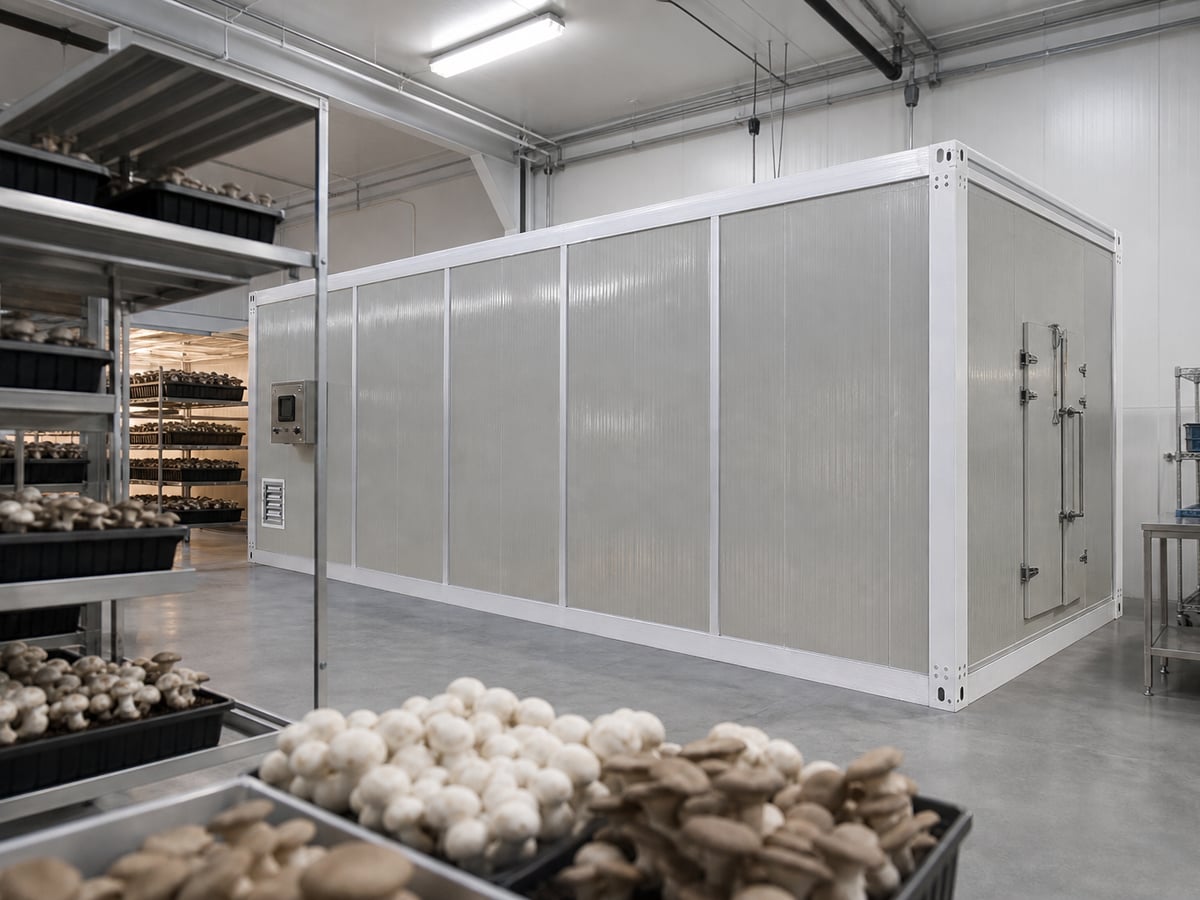
Plug-and-play mushroom farms reduce onsite construction, but they do not eliminate site work. A factory-built mushroom cultivation container can arrive with insulated panels, refrigeration equipment, humidification, air circulation, lighting, sensors, electrical cabinets, and climate controls already assembled. However, the buyer still needs a suitable foundation, unloading access, electrical supply, clean water, wastewater drainage, internet connectivity, safety protection, and trained operators.
For Global Market projects, the practical goal is not simply to buy a container and place it on bare ground. The goal is to prepare a stable operating environment that allows the climate system to perform accurately from the first crop cycle. Whether the unit is delivered to Rotterdam, Dubai, Singapore, Los Angeles, Mombasa, São Paulo, or Melbourne, the site must match local utility standards, climate conditions, shipping restrictions, and food production expectations.
A well-prepared site helps protect mushroom blocks, improve biological efficiency, reduce equipment downtime, and avoid costly delays after arrival. Buyers should confirm site readiness before production, not after the container has been delivered. A modular farm can be fast to deploy, but successful cultivation still depends on correct commissioning, daily operating discipline, water management, and crop-specific climate settings.
| Site Element | Usually Included in Factory Preassembly | Usually Required Onsite | Why It Matters |
|---|---|---|---|
| Growing room enclosure | Insulated container structure and interior finish | Level placement area | Protects insulation integrity and door alignment |
| Climate equipment | Cooling, heating, ventilation, humidification and controls | Correct utility connection | Ensures stable temperature, humidity and fresh air |
| Electrical system | Internal wiring, cabinet, sensors and equipment connections | Incoming power, grounding and protective devices | Reduces safety risks and voltage-related faults |
| Water system | Internal pipes, nozzles and humidification components | Clean water source, filtration and drainage point | Prevents nozzle clogging and standing wastewater |
| Internet connection | Controller communication capability | Stable network or cellular service | Supports remote monitoring and technical support |
| Operations | Factory testing and operating documentation | Operator training and crop loading plan | Supports a consistent first production cycle |
The table above shows the basic division of responsibility. Factory integration shortens installation time, while onsite preparation provides the conditions needed for safe, efficient operation. For buyers comparing a smart mushroom cultivation container with a conventional farm building, the major advantage is predictable equipment integration, not the absence of all civil and utility work.
What Factory Preassembly Can Include

A professional modular mushroom farm manufacturer can preassemble much more than a steel container shell. Depending on the project, factory preassembly may include insulated wall panels, stainless or coated interior surfaces, shelving layouts, fresh-air ducts, exhaust paths, evaporators, condensers, heat pump connections, humidification pipelines, LED lights, electrical cabinets, touchscreen controllers, alarms, sensors, and access doors.
For export projects, factory integration is valuable because it reduces the number of onsite trades required. Local installers do not need to design every cable route, select every sensor, or fabricate every duct connection. Instead, they focus on positioning the unit, connecting external utilities, checking safety devices, and completing commissioning. This is especially useful in locations where skilled refrigeration technicians or agricultural HVAC contractors are limited.
A smart system may also include temperature sensors, humidity probes, CO₂ sensors, differential-pressure monitoring, fan speed control, lighting schedules, fault alarms, remote access functions, and data logging. These features are particularly important for oyster mushrooms, shiitake, lion’s mane, enoki, button mushroom fruiting rooms, medicinal mushrooms, and other species with narrow climate tolerances.
Preassembly should not be confused with one universal specification. Mushroom farms differ according to crop, local climate, expected yield, block size, production frequency, and energy availability. A container installed in tropical Jakarta may require higher dehumidification and corrosion protection than one operating in temperate Hamburg. A project in Riyadh may prioritize solar-ready electrical design and strong cooling capacity, while a farm near Vancouver may require freeze protection and heating redundancy.
| Factory-Built Component | Typical Function | Buyer Verification Before Shipment | Value for International Projects |
|---|---|---|---|
| Insulated enclosure | Maintains controlled indoor conditions | Panel thickness, seals, floor finish and door fit | Reduces onsite construction variability |
| Climate control unit | Regulates cooling, heating, airflow and humidity | Capacity matched to local ambient temperature | Improves climate stability across seasons |
| Humidification system | Maintains crop humidity requirements | Nozzle layout, filtration requirements and drainage path | Supports uniform pinning and fruit body development |
| Electrical cabinet | Controls power distribution and equipment operation | Voltage, frequency, breaker ratings and labeling | Allows smoother local electrician connection |
| Digital controller | Automates setpoints and records operating data | Language, sensor list and remote access method | Supports remote troubleshooting and repeatable recipes |
| Racks and interior layout | Holds substrate blocks or cultivation trays | Load rating, spacing and cleaning access | Optimizes usable growing volume |
The table highlights why a detailed technical confirmation is more useful than a broad claim of “fully equipped.” Buyers should request an equipment list, electrical drawings, operating limits, water requirements, spare-parts list, and shipping dimensions before confirming an order. For specialized climate automation, a smart mushroom climate controller can be configured around crop recipes, sensor feedback, and local power conditions.
Preassembly also supports quality control. Equipment can be wired, pressure-tested, inspected, and functionally evaluated in a controlled factory environment before export packing. This reduces the risk that a project discovers missing parts or incompatible components after delivery to a distant inland location.
Foundation and Unloading Arrangements

A modular mushroom farm needs a stable, level, accessible base. The foundation does not always need to be a full building foundation, but it must safely support the loaded weight of the container, crop racks, substrate blocks, water, people, and equipment. The base should prevent settlement, water pooling, twisting, and door misalignment.
Common solutions include reinforced concrete pads, concrete piers, steel beams on compacted ground, or engineered gravel pads with suitable support points. The final choice depends on local soil conditions, frost depth, drainage, seismic requirements, and container dimensions. In areas with heavy rain, such as parts of Southeast Asia, Central America, and coastal East Africa, drainage around the base is often as important as the base itself.
Unloading planning should begin before shipment. A 20-foot or 40-foot cultivation container may arrive by truck from a port such as Antwerp, Jebel Ali, Durban, Santos, Long Beach, or Singapore. The buyer must confirm that the delivery route has sufficient road width, turning space, bridge clearance, gate width, and ground bearing capacity for trucks and cranes.
| Foundation or Delivery Check | Recommended Preparation | Common Problem Avoided | Responsible Party |
|---|---|---|---|
| Ground level | Check level across all support points | Door binding and uneven condensate drainage | Site owner or civil contractor |
| Load-bearing capacity | Confirm soil and pad capacity for operating weight | Settlement after crop loading | Civil engineer or contractor |
| Rainwater management | Create surface slope away from the container | Flooding, corrosion and slippery access areas | Site owner |
| Crane access | Reserve firm, open lifting space near placement area | Delayed unloading or unsafe lifting | Logistics provider |
| Truck route | Inspect access roads, turns, gates and overhead cables | Container delivery obstruction | Buyer and freight coordinator |
| Service clearance | Leave room around equipment service sides | Restricted maintenance and poor airflow | Buyer and installer |
This checklist is important because container farms are compact but not weightless. Buyers should also reserve space for technicians to open electrical panels, clean condensers, inspect drains, replace filters, and access exterior refrigeration components. Placing the unit tightly between walls or storage buildings may restrict airflow and make maintenance difficult.
For sites in colder countries, foundations should consider frost heave. For coastal regions, corrosion-resistant materials and elevated placement may be advisable. For earthquake-prone locations, local engineers may recommend anchoring details. A site survey before shipping is one of the best investments a commercial buyer can make.
Electrical Supply and Protective Devices
Electrical compatibility is one of the most important site requirements for plug-and-play mushroom farms. The internal electrical system may be completed at the factory, but the farm still needs a correctly sized incoming power supply. Voltage, phase type, frequency, cable size, grounding method, and protective devices must be matched to the equipment specification.
Global Market buyers should not assume that all regions use the same electrical standard. A project in the European Union may commonly use 400V, 50Hz, three-phase power. North American industrial sites may use 208V, 230V, 460V, or 480V configurations at 60Hz. Many farms in the Middle East, Africa, Latin America, and Asia operate under different combinations. The final design must be confirmed before production begins.
Protective devices may include main isolators, miniature circuit breakers, molded-case circuit breakers, overload protection, residual-current protection, surge protection devices, phase-loss protection, emergency-stop switches, and grounding terminals. These devices help protect personnel, compressors, fans, humidifiers, controllers, and lighting systems from faults and unstable power.
Where grid reliability is poor, buyers may need a generator, battery backup, solar hybrid system, automatic transfer switch, or voltage stabilizer. Climate interruptions can quickly affect mushroom quality. A prolonged cooling failure during a hot afternoon can lead to elongated stems, poor caps, bacterial issues, or reduced yields. A loss of ventilation can increase CO₂ and damage crop morphology.
| Electrical Item | What Must Be Confirmed | Operational Impact | Recommended Action |
|---|---|---|---|
| Incoming voltage | Exact voltage range and phase configuration | Prevents motor and controller damage | Match factory design to local supply |
| Frequency | 50Hz or 60Hz compatibility | Affects motor speed and equipment selection | Confirm before manufacturing |
| Main cable | Length, insulation, conductor size and installation route | Reduces voltage drop and overheating | Use a qualified local electrician |
| Grounding | Local grounding system and resistance requirement | Improves electrical safety | Test grounding before energizing |
| Surge protection | Lightning and grid fluctuation risk | Protects controllers and sensors | Install suitable surge devices |
| Backup power | Generator capacity and transfer arrangement | Maintains climate during outages | Prioritize critical loads |
The electrical table should be reviewed with the local electrical contractor before the unit lands at port. Buyers should provide the manufacturer with site power details early, including utility photographs where possible. This prevents late changes, such as replacing contactors, motors, transformers, plugs, or protective devices after shipment.
Water Quality and Drainage Connections
Water is essential for humidification, cleaning, and sometimes cooling support, but water quality is often underestimated. Hard water, sediment, high iron content, chlorine imbalance, microbial contamination, or high mineral concentration can clog misting nozzles, damage pumps, leave deposits on surfaces, and reduce humidification performance.
Before installation, buyers should test the local water source or obtain a basic water report. At minimum, it is useful to understand turbidity, hardness, pH, total dissolved solids, iron, and microbiological quality. A simple sediment filter may be enough for some locations, while other sites may need carbon filtration, softening, ultraviolet treatment, reverse osmosis, or a dedicated water storage tank.
Drainage is equally important. Humidification, condensation, cleaning water, and defrost cycles can produce wastewater. The drainage system should be trapped, correctly sloped, protected against backflow, and routed according to local environmental and sanitation requirements. Water should not collect under the container or flow into public areas.
For mushroom farms operating near food markets, hotels, restaurants, supermarkets, or urban agriculture facilities, clean drainage supports hygiene and customer confidence. In dense urban areas such as London, Tokyo, New York, Dubai, and Shanghai, drainage routes may require coordination with property management or local utility authorities.
Buyers should also consider water storage for areas with intermittent municipal supply. A clean buffer tank with controlled refill can help maintain uninterrupted humidification. However, tanks must be covered, cleaned regularly, and protected from heat and contamination.
Internet Access and Remote Support
Internet access is increasingly valuable for commercial mushroom production. A connected controller can allow operators to view temperature, humidity, CO₂, alarm status, fan operation, and historical trends. Depending on the controller configuration, remote access may support technical diagnostics, parameter review, software assistance, and operational guidance.
Internet should not replace onsite responsibility. It is a support tool, not a substitute for daily farm inspections. Operators still need to check substrate condition, pinning, cap development, surface moisture, contamination signs, air distribution, drainage, and hygiene. However, remote monitoring can help detect problems earlier, especially for projects operated across multiple sites.
Sites may use wired broadband, industrial Wi-Fi, 4G or 5G routers, or satellite internet where terrestrial service is unavailable. Remote farms in Australia, inland Africa, Latin America, Central Asia, or island markets may need cellular or satellite solutions. The preferred connection should be stable, secure, and protected from unauthorized access.
When planning remote support, buyers should confirm time-zone expectations, access permissions, data privacy requirements, and the process for alarm escalation. A clear support agreement improves response speed when a controller alarm appears outside normal working hours.
For multi-unit operations, networked data can also support comparative crop management. Managers can compare room performance, energy use, humidity stability, and harvest timing across locations. This is useful for distributors, agricultural contractors, and commercial growers expanding a standardized modular farming model.
Empty-Room Tests Before Block Loading
Before loading mushroom substrate blocks, run the cultivation room empty. Empty-room testing confirms that the equipment performs as designed and that the site connections are correct. This stage is often called commissioning, dry testing, functional testing, or pre-production verification.
Testing should include cooling response, heating response, humidification output, fresh-air intake, exhaust operation, fan rotation, sensor readings, door seals, lighting, alarms, drainage, electrical protection, and remote communication. The room should be operated through realistic temperature and humidity settings for sufficient time to observe stability.
Do not load blocks immediately after the power is first connected. If a drain leaks, a sensor is incorrectly positioned, a fan direction is wrong, or the water pressure is unsuitable, it is much easier to correct the issue in an empty room. Once blocks are loaded, every repair may affect sanitation, crop timing, and labor planning.
| Empty-Room Test | What to Check | Pass Indicator | Why It Should Be Completed First |
|---|---|---|---|
| Temperature control | Cooling and heating response to setpoint changes | Stable operation within agreed tolerance | Protects crop development from thermal stress |
| Humidity control | Mist output, sensor response and room distribution | Humidity reaches target without excess pooling | Reduces dry blocks and surface water problems |
| Ventilation | Fresh-air and exhaust fan operation | Expected airflow and CO₂ response | Supports correct mushroom morphology |
| Drainage | Condensate and cleaning water flow | No standing water or leakage | Improves hygiene and slip safety |
| Electrical safety | Grounding, breakers, emergency stop and alarms | Protective devices operate correctly | Reduces risk to staff and equipment | Remote connection | Controller access, alarms and data transmission | Stable communication confirmed | Enables timely support after crop loading |
The commissioning table provides a practical minimum. Advanced projects may also verify air velocity at rack level, CO₂ distribution, energy consumption, condensate temperature, and recovery after a door-opening event. These checks are useful when producing premium mushrooms for retail, export, pharmaceutical ingredients, restaurants, or value-added food processing.
Records from empty-room tests should be retained. They establish a baseline for future maintenance and help operators identify whether later crop issues are caused by biology, climate settings, block quality, or equipment performance.
Operator Training Before the First Cycle
A controlled growing room is only as effective as the team operating it. Operator training should be completed before the first substrate blocks arrive or, at minimum, before the first fruiting cycle begins. Training should cover basic climate concepts, controller navigation, setpoint adjustment, daily checks, sanitation, alarm response, water filter maintenance, drainage inspection, and harvest procedures.
Different mushroom species require different cultivation strategies. Oyster mushrooms often need strong fresh-air management during fruiting. Shiitake may require different temperature transitions and humidity discipline. Lion’s mane can be sensitive to CO₂ and airflow balance. A generic climate setting should never be assumed to suit every strain, substrate formulation, or production stage.
Operators should understand the relationship between temperature, relative humidity, fresh air, CO₂ concentration, evaporation, and crop appearance. For example, high CO₂ can lead to long stems and small caps in oyster mushrooms. Excessive direct airflow can dry developing fruit bodies. Poor sanitation can turn a minor contamination issue into a major crop loss.
Training should also include escalation procedures. Staff should know when to reset an alarm, when to inspect a water source, when to call an electrician, and when to contact technical support. A written daily checklist is useful, particularly for farms that operate with rotating teams.
Future-ready farms are increasingly using digital crop records. Operators can log block batch numbers, loading dates, climate recipes, harvest weights, contamination observations, and maintenance actions. Over time, this data can reveal which conditions produce the best yield and quality for a specific local market.
Our Company
Shandong Lanhu Air Conditioning Equipment Co., Ltd. supports Global Market customers with modular cultivation systems designed around agricultural climate control, industrial HVAC knowledge, and practical farm operation. The company works with commercial growers, agricultural contractors, distributors, engineering firms, and project developers seeking repeatable indoor cultivation solutions.
Technological capabilities are built on more than 12 years of thermodynamic research and development experience. Lanhu develops climate management solutions for temperature, humidity, airflow, ventilation, and intelligent control. With more than 45 registered patents, the company applies automation and environmental control principles to mushroom cultivation containers, hydroponic plant containers, air source heat pumps, and related agricultural systems.
Manufacturing capabilities include product design, engineering development, sheet metal fabrication, CNC bending, insulation panel production, electrical assembly, system integration, equipment testing, and quality inspection. The modern manufacturing facility covers more than 30,000 square meters in Dezhou, Shandong, China. Systems are inspected through electrical verification, functional checks, performance testing, and operational evaluation before shipment.
Service capabilities include factory-direct supply, OEM and ODM customization, engineering assistance, international logistics coordination, installation guidance, spare-parts support, and after-sales service. Buyers planning projects near ports such as Rotterdam, Jebel Ali, Savannah, Mombasa, Santos, or Singapore can coordinate shipping and site preparation with clearer technical documentation and delivery planning.
Lanhu holds ISO 9001, ISO 14001, ISO 45001, and ISO 12100 certifications. These systems support structured quality management, environmental awareness, occupational safety processes, and risk-oriented equipment development. For customers requiring customized layouts, branding, climate specifications, or project engineering support, the company provides OEM and ODM cultivation system services.
Practical project experience matters. Buyers can review selected mushroom cultivation project cases to understand how modular systems can be adapted for different climates, production scales, operational models, and customer requirements.
FAQ
Is a plug-and-play mushroom farm ready to grow immediately after delivery?
Not always. The internal equipment may be preassembled, but the foundation, electrical supply, water source, drainage, network connection, safety checks, and commissioning should be completed before blocks are loaded.
What type of foundation is needed for a mushroom cultivation container?
A level, load-bearing concrete pad, engineered gravel base, concrete piers, or steel support system may be suitable. The correct option depends on soil conditions, unit weight, local climate, drainage, and regional building requirements.
Can the farm operate with a generator?
Yes, provided the generator is correctly sized and delivers stable voltage and frequency. Critical climate equipment should be prioritized, and an automatic transfer system may be useful in regions with frequent outages.
Does water need to be filtered?
In many locations, yes. Sediment, mineral deposits, iron, and other contaminants can block humidification nozzles and reduce system performance. The required filtration depends on local water analysis.
How important is internet access?
Internet access is not mandatory for basic onsite operation, but it is strongly recommended for remote monitoring, alarm review, data access, and technical support. Cellular routers can be practical where wired internet is unavailable.
Why test the room before loading mushroom blocks?
Empty-room tests identify electrical, drainage, airflow, sensor, humidification, and cooling problems before they affect crop quality. This reduces production risk during the first cycle.
What trends will affect mushroom farms in 2026?
In 2026, mushroom farms are expected to adopt more sensor-based automation, predictive maintenance, remote diagnostics, energy-efficient heat pump systems, water-saving humidification, and digital crop traceability. Sustainability policies, food-security programs, local food incentives, and carbon-reduction targets are also encouraging more efficient controlled-environment agriculture.
Can modular mushroom farms support sustainable production?
Yes. Modular farms can reduce construction waste, improve climate precision, support local food production near cities, and reduce losses caused by inconsistent growing conditions. Energy efficiency, water reuse where permitted, recyclable packaging, and renewable power integration can further improve sustainability performance.
Share this article

About the Author: Shandong Lanhu Air Conditioning Equipment
Lanhu is a professional climate control equipment manufacturer specializing in smart agricultural systems, commercial HVAC solutions, and customized temperature control technologies. With extensive engineering experience, Lanhu provides reliable solutions for plant factories, controlled environment agriculture, and industrial applications.
Need a Custom Climate Control Solution?
From smart agricultural systems to commercial HVAC solutions, Lanhu provides reliable temperature and humidity control solutions tailored to your project needs.
Contact Us