Global Market Mushroom Facilities: Containers or Greenhouses
Immediate Recommendation

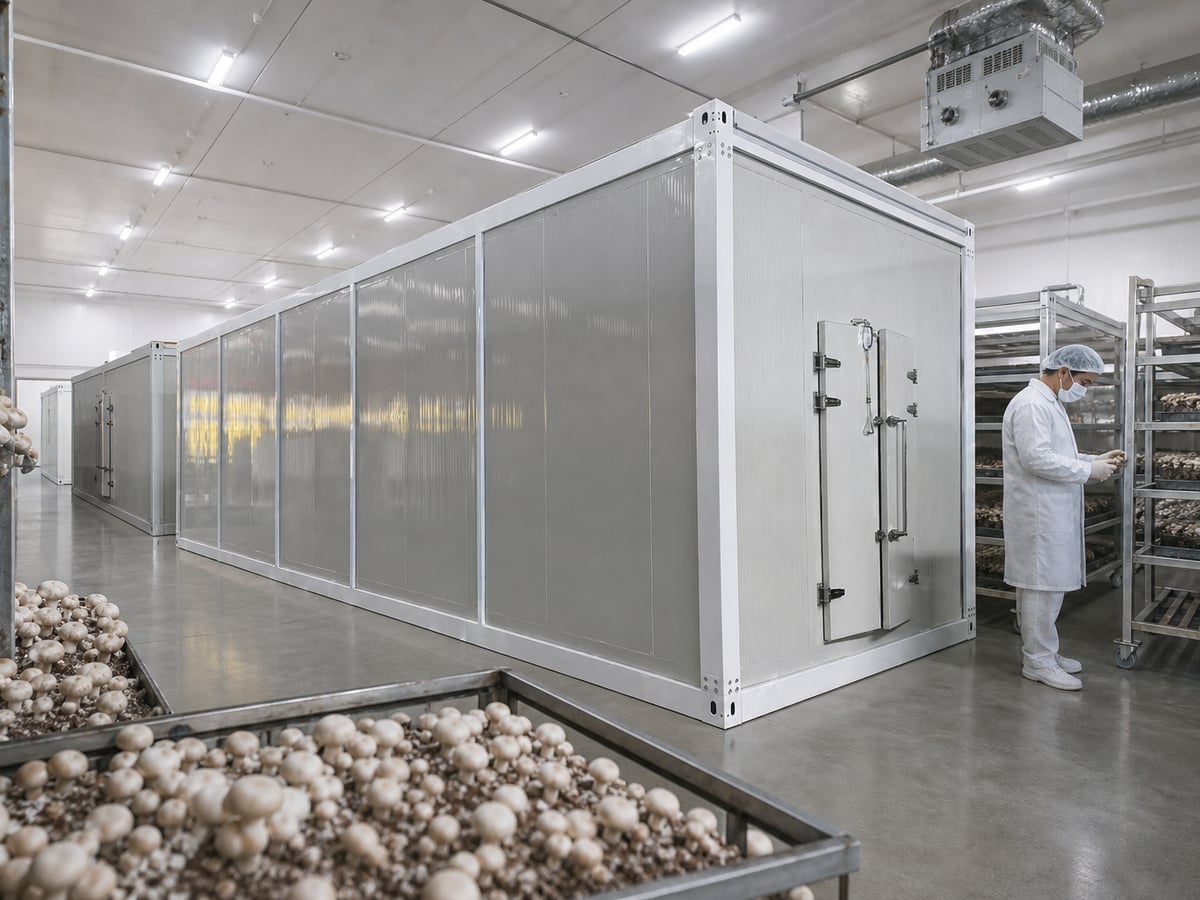
For most commercial mushroom projects in the Global Market, a climate-controlled mushroom container is the safer choice when production consistency, hygiene, year-round harvesting, limited land, and predictable quality are the priorities. A greenhouse can be suitable for lower-cost projects, seasonal production, compost preparation, or regions with mild temperatures and low solar heat gain. However, standard greenhouses are not naturally designed for mushroom cultivation because mushrooms require controlled temperature, humidity, fresh-air exchange, carbon dioxide management, darkness or low light, and strict sanitation.
The practical choice depends on the mushroom species, local climate, utility cost, harvest schedule, labor availability, land price, and the required production scale. Oyster mushrooms, shiitake, lion’s mane, enoki, button mushrooms, and specialty medicinal mushrooms all respond differently to temperature fluctuation, humidity imbalance, direct solar radiation, and airborne contaminants.
For growers operating near major trade and logistics hubs such as Rotterdam, Dubai, Singapore, Los Angeles, Hamburg, Mombasa, São Paulo, Melbourne, or Johannesburg, container farms can simplify site selection because they can be installed near urban markets, food distribution centers, processing facilities, warehouses, and cold-chain infrastructure. Greenhouses generally need larger land parcels and may require more site-specific climate adaptation.
A smart mushroom cultivation container is particularly suitable for new investors who need a controlled start-up environment, rapid commissioning, and repeatable production modules. Greenhouses may remain appropriate where capital budgets are limited, land is inexpensive, and the crop is tolerant of seasonal production risk.
| Decision Factor | Mushroom Container | Mushroom Greenhouse | Preferred Option |
|---|---|---|---|
| Temperature stability | High insulation and active HVAC control | Strongly affected by outdoor weather | Container |
| Humidity management | Closed-loop monitoring and automated humidification | Can be difficult during hot, dry, or windy periods | Container |
| Initial building cost | Higher cost per square meter | Often lower for simple structures | Greenhouse |
| Hygiene control | Sealed surfaces and controlled entry points | More openings and pest-entry risks | Container |
| Land requirement | Compact, modular footprint | Requires larger site area | Container |
| Natural light use | Usually unnecessary for mushrooms | Often excessive without shading | Container |
| Expansion method | Add additional production modules | Extend or build new bays | Depends on site |
The table shows why containers are frequently selected for premium and fresh-market mushrooms. Greenhouses can still work well when the building is heavily insulated, shaded, partitioned, and fitted with reliable cooling, dehumidification, humidification, ventilation, and pest-control systems.
Match the Structure to the Mushroom Crop

The first purchasing question is not “container or greenhouse?” but “what mushroom will be grown, in what production method, for which market?” Mushroom species differ in fruiting temperature, carbon dioxide tolerance, humidity requirements, substrate format, light response, crop cycle, and contamination sensitivity.
Oyster mushrooms are widely grown because they colonize quickly, fruit in clusters, and can be produced on straw, sawdust, or agricultural residues. They are relatively adaptable but still need reliable humidity and fresh-air control during pinning and fruiting. Shiitake generally requires a longer crop cycle and stable humidity, while lion’s mane benefits from careful air exchange and controlled carbon dioxide levels to maintain shape and quality. Enoki and button mushrooms require more specialized low-temperature management and are usually better suited to highly controlled rooms.
In tropical regions such as Southeast Asia, East Africa, Central America, the Gulf region, and northern Australia, outdoor heat can make mushroom greenhouse cooling expensive. In colder markets such as Northern Europe, Canada, northern China, Korea, Japan, and parts of Central Asia, insulation performance becomes critical. A container with insulated panels and properly sized climate equipment can reduce exposure to these external conditions.
| Mushroom Crop | Typical Fruiting Climate Need | Container Suitability | Greenhouse Suitability |
|---|---|---|---|
| Oyster mushroom | Moderate temperature, high humidity, fresh air | Excellent for consistent quality | Suitable in mild climates with controls |
| Shiitake | Stable humidity, moderate cooling, clean air | Excellent for bag or block production | Suitable with insulation and shading |
| Lion’s mane | Precise carbon dioxide and humidity balance | Highly recommended | Possible but technically demanding |
| Enoki | Low temperature and strict process control | Recommended for small-scale premium production | Generally difficult without industrial systems |
| Button mushroom | Controlled compost, casing, cooling, ventilation | Suitable for modular trials | Suitable for large specialized farms |
| Reishi and medicinal fungi | Stable climate and low contamination pressure | Recommended | Suitable only with controlled compartments |
| Morel mushroom trials | Species-specific and often experimental conditions | Useful for research modules | Useful for larger pilot areas |
This comparison does not mean a greenhouse cannot grow premium mushrooms. It means the greenhouse envelope must be engineered around the crop rather than treated as a standard vegetable house. Many successful projects use a hybrid model: a greenhouse for substrate preparation, storage, solar-powered utilities, or packing support, and insulated container rooms for fruiting.
Insulation, Sunlight, and Heat Load

Insulation and solar heat gain are among the largest differences between mushroom containers and greenhouses. A conventional greenhouse is designed to capture sunlight for plants. Mushrooms do not depend on photosynthesis, and most commercial species do not need direct sunlight. Excess solar radiation raises indoor temperature, increases water loss, reduces relative humidity, and creates uneven growing zones.
In hot locations such as Riyadh, Dubai, Nairobi, Bangkok, Mumbai, Lagos, Mexico City, Houston, Perth, and southern Europe, greenhouse roofs can receive intense solar energy. Shade cloth, reflective covers, whitewashing, thermal screens, evaporative cooling, and mechanical refrigeration can reduce heat pressure, but each measure adds complexity. During summer afternoons, a poorly designed mushroom greenhouse may require very high cooling capacity simply to offset solar load.
Insulated mushroom containers use composite wall panels, sealed doors, insulated flooring, and controlled air pathways. This reduces thermal transfer and helps maintain stable crop conditions. However, insulation alone is not enough. The equipment design must consider outdoor temperature, solar exposure, occupancy, substrate heat, lighting load, fan heat, moisture load, fresh-air volume, and harvest activity.
For coastal areas near ports such as Antwerp, Santos, Jebel Ali, Busan, Durban, Long Beach, and Singapore, corrosion resistance should also be assessed. Salt-laden air can affect external steel components, electrical enclosures, condenser coils, fasteners, and ventilation hardware. Buyers should request appropriate coatings, drainage design, and maintenance access.
| Building Element | Container Approach | Greenhouse Approach | Operational Effect |
|---|---|---|---|
| Roof surface | Insulated steel panel roof | Glass, polycarbonate, film, or sandwich panel roof | Greenhouse roof may create major solar heat gain |
| Wall insulation | Continuous insulated panels | Often limited unless upgraded | Containers reduce external temperature swings |
| Thermal bridges | Can be controlled in factory fabrication | Common at frames, vents, and glazing joints | Thermal bridges increase condensation and energy loss |
| Light entry | Minimal and controlled | High unless shaded | Mushrooms usually do not benefit from strong sunlight |
| Condensation control | Managed through insulated surfaces and airflow | Requires careful roof and vent design | Condensation can promote disease and material damage |
| Weather resilience | Strong modular steel structure | Depends on greenhouse engineering grade | Local wind, snow, and storm loads matter |
The table demonstrates that the structural envelope directly affects climate-control cost. In an insulated container, climate equipment mainly manages the crop load and planned ventilation. In a lightly insulated greenhouse, the equipment must continuously fight outdoor heat, sunlight, wind, and nighttime cooling.
Cooling, Fresh Air, and Humidity Management
Mushroom production requires more than “cooling and humidifying.” A profitable farm needs coordinated control of air temperature, relative humidity, carbon dioxide, fresh-air replacement, circulation speed, condensation risk, and substrate evaporation. If humidity is too low, mushroom caps dry, stems become tough, and yield can fall. If humidity is too high without air movement, bacterial blotch, mold growth, wet surfaces, and poor shelf life may occur.
Containers are usually easier to control because the internal air volume is known, insulation is predictable, and inlet and outlet pathways can be designed from the beginning. Sensors can monitor temperature, humidity, carbon dioxide, and operating alarms. A mushroom climate controller can coordinate cooling, heating, humidification, ventilation, circulation fans, and programmed crop stages.
Greenhouses need a more detailed engineering assessment. Natural vents may be useful for some crops but can introduce unfiltered spores, insects, hot air, cold air, and uncontrolled humidity. Mechanical ventilation with filtered air, cooling coils, fogging or ultrasonic humidification, circulation fans, and climate sensors may be required. In humid coastal climates, dehumidification can become as important as humidification.
For example, a mushroom farm in Rotterdam may face cool outdoor temperatures and high ambient humidity during parts of the year. A project in Dubai may face extreme heat and dry conditions. A site in Manila may face high heat, heavy rainfall, and high humidity. The correct HVAC concept cannot be copied from one market to another without local load calculations.
The chart provides a practical relative comparison rather than a universal cost formula. A well-engineered greenhouse can score much higher than a basic greenhouse, while a poorly maintained container can lose its advantages. Equipment sizing, installation quality, maintenance, crop management, and local climate remain decisive.
Sanitation and Pest Prevention Choices
Hygiene is a commercial issue, not only a technical preference. Contamination can reduce yield, delay crop cycles, increase labor, damage buyer confidence, and create inconsistent supply to supermarkets, restaurants, processors, and export customers. Common threats include green mold, bacterial contamination, fungus gnats, mites, flies, rodents, airborne spores, and poor worker hygiene.
Containers offer a naturally enclosed format. Smooth internal panels, sealed joints, washable surfaces, controlled access doors, insect screens, and defined air pathways make sanitation procedures easier to standardize. Farms can separate incubation, fruiting, packing, and waste handling into different modules. This supports biosecurity when multiple mushroom strains or crop ages are produced on the same site.
Greenhouses can also achieve high hygiene standards, but the design should include sealed wall systems, screened vents, washable interior finishes, cleanable drainage, entry rooms, footbaths, staff changing areas, filtered intake air, and pest-monitoring stations. A plastic-film greenhouse with open sides may be inexpensive, but it is generally unsuitable for premium fresh mushroom production in areas with high insect pressure.
| Biosecurity Measure | Container Implementation | Greenhouse Implementation | Why It Matters |
|---|---|---|---|
| Controlled staff entry | Single-door access and optional changing zone | Requires dedicated entry room | Reduces contamination brought by workers |
| Insect exclusion | Sealed walls and screened air intakes | Screening needed at all vents and openings | Limits flies, gnats, and moths |
| Washable surfaces | Insulated metal panels and sealed floor finishes | Must be specified during construction | Supports cleaning between crop cycles |
| Air filtration | Easy to integrate into mechanical intake system | More difficult with natural ventilation | Reduces airborne contamination |
| Crop separation | Separate containers by crop stage or strain | Requires partitions or separate bays | Improves disease management |
| Waste removal | Dedicated route from container doors | Requires planned external service access | Prevents cross-contamination |
The table highlights that hygiene investment should be considered part of total crop economics. A lower-cost structure can become expensive if it causes repeated contamination, irregular harvest quality, or excessive labor for cleaning and pest control.
Production Space and Harvesting Access
Growing area should be measured by usable rack capacity, not only by floor size. A container may have a smaller footprint than a greenhouse, but vertical shelving can create substantial productive growing area. Multi-tier racks allow growers to use the room height efficiently, especially for bag-grown oyster mushrooms, shiitake blocks, lion’s mane, and medicinal fungi.
Harvest access must be designed around people, crop trolleys, picking baskets, cleaning tools, and substrate movement. Narrow aisles may increase nominal capacity but reduce labor efficiency and make it difficult to inspect crops. The best layout balances rack density, airflow, cleaning access, worker safety, and harvest speed.
Containers are commonly configured with shelving on both sides and a central aisle, or with rack systems designed for front and rear access. Larger projects can use several containers for different crop phases. Greenhouses provide more open floor area and may accommodate larger trolley systems, bulk substrate handling, or larger-scale button mushroom beds. Yet greenhouse layouts often require more careful zoning to avoid uneven climate conditions between the center, sidewalls, roof areas, and door zones.
Before purchasing, ask suppliers for a capacity drawing that states container dimensions, internal usable height, rack levels, aisle width, block spacing, expected substrate volume, airflow direction, door location, and harvest access. Do not compare suppliers only by external container size or headline “bag capacity.”
Investment Cost and Operating Assumptions
Capital cost should include more than the structure itself. Buyers should compare the complete installed system: insulated shell, racks, climate control, humidification, ventilation, electrical cabinet, sensors, drainage, lighting, water connection, freight, foundation, local installation, commissioning, spare parts, and training. A low quotation may exclude important equipment that later increases total project cost.
Greenhouses usually offer lower initial cost per ground-area square meter, especially when using film-covered structures. However, the operating cost can be higher in hot climates because of cooling demand, solar heat gain, humidity loss, and uncontrolled ventilation. Containers usually require more capital per square meter but can generate a more stable crop environment and higher usable vertical growing density.
Energy cost assumptions should be based on local tariffs. Electricity prices in Germany, Japan, the United Kingdom, Australia, South Africa, Brazil, the Gulf region, and many island markets can vary significantly. Water availability, diesel backup requirements, labor cost, refrigeration maintenance, and distance to market should also be included in the financial model.
| Cost Category | Mushroom Container | Mushroom Greenhouse | Buyer Evaluation Question |
|---|---|---|---|
| Structure purchase | Moderate to high per footprint area | Low to moderate for basic structures | Does the price include insulation and interior finish? |
| Climate equipment | Integrated and compact | May require larger cooling and shading systems | Is the load calculation based on local weather? |
| Electricity consumption | Often more predictable | Can rise sharply in hot or sunny weather | What is the estimated seasonal energy range? |
| Land preparation | Small foundation or level pad | Larger site preparation area | Is land cost a major local issue? |
| Labor efficiency | Compact workflow and standardized zones | May require longer travel distances | How many workers are needed per harvest cycle? | Expansion investment | Add modules as demand grows | Expand bays or build additional structures | Can the project scale without interrupting production? |
This table explains why investors should calculate cost per kilogram of saleable mushroom rather than only cost per square meter. The right structure is the one that produces acceptable quality, yield, and consistency at a manageable total operating cost.
Select a Structure for Regional Conditions
Local climate should guide the final decision. In hot and dry markets, insulated containers typically reduce solar load and humidity loss. In hot and humid climates, both containers and greenhouses need strong cooling, fresh-air management, drainage, and dehumidification planning. In cold climates, heating energy, insulation quality, snow loads, and condensation control are important. In temperate regions with stable weather, upgraded mushroom greenhouses may provide an economical solution for selected crops.
Buyers should also consider local building rules, import duties, food safety requirements, electrical standards, water regulations, fire compliance, zoning, and port logistics. For example, projects shipping through Rotterdam, Hamburg, Jebel Ali, Singapore, Durban, Mombasa, Santos, or Los Angeles should plan container unloading, customs documentation, crane access, inland transport, and final-site access before confirming the order.
Future trends toward 2026 include increased use of remote climate monitoring, sensor-driven crop recipes, lower-global-warming-potential refrigerants, air source heat pumps, solar-supported electrical systems, water-saving humidification strategies, and agricultural waste recycling. Governments and buyers are also placing greater emphasis on traceability, energy efficiency, food safety, worker safety, and reduced chemical pesticide use.
For sustainable production, mushroom farms can use agricultural by-products such as straw, sawdust, cotton waste, corn cobs, and other locally available lignocellulosic materials when the substrate process is validated. Spent mushroom substrate can potentially be reused as compost, soil conditioner, livestock-feed component where permitted, or biomass resource, subject to local regulations and quality controls.
About Our Manufacturing and Engineering Team
Shandong Lanhu Air Conditioning Equipment Co., Ltd. supports commercial mushroom projects with modular cultivation solutions, agricultural climate-control equipment, industrial HVAC systems, and customized engineering support for the Global Market.
Technology Capabilities
Lanhu applies more than 12 years of thermodynamic research and development experience to mushroom climate management. Its solutions can integrate temperature regulation, humidity control, ventilation, carbon dioxide management, circulation airflow, sensor monitoring, and programmed operating logic. The company has more than 45 registered patents and offers equipment designed for controlled mushroom cultivation, hydroponic plant containers, and air source heat pump applications.
Manufacturing Capabilities
The company operates a manufacturing facility of more than 30,000 square meters in Dezhou, Shandong, China. Internal capabilities include product design, sheet metal fabrication, CNC bending, insulation-panel production, electrical assembly, system integration, testing, and quality inspection. Each system is subject to functional inspection, electrical verification, performance testing, and operational evaluation before shipment. Relevant management and safety certifications include ISO 9001, ISO 14001, ISO 45001, and ISO 12100.
Service Capabilities
Lanhu provides factory-direct supply, OEM and ODM customization, engineering assistance, international logistics coordination, spare-parts support, installation guidance, and after-sales service. Commercial growers, agricultural contractors, distributors, engineering companies, and investors can review mushroom cultivation project cases to understand possible deployment formats. For private labeling, local specification changes, or specialized integration requirements, the company also provides OEM and ODM customization services.
Frequently Asked Questions
Is a mushroom container always better than a greenhouse?
No. Containers are generally better for stable climate control, hygiene, modular expansion, and premium mushroom production. Greenhouses can be more economical where land is inexpensive, weather is mild, production is seasonal, or the project requires large open working areas.
Can oyster mushrooms be grown in a greenhouse?
Yes. Oyster mushrooms can grow in a greenhouse when the structure includes adequate shading, cooling, humidification, ventilation, air circulation, insect exclusion, drainage, and sanitation procedures. In hot climates, cooling cost should be calculated carefully.
What should be included in a mushroom container quotation?
A complete quotation should identify the container size, insulation specification, internal racks, climate-control equipment, humidification, ventilation, controller, sensors, electrical requirements, water connection, drainage, freight terms, installation scope, commissioning support, spare parts, and warranty conditions.
How many containers are needed for a commercial farm?
The number depends on crop cycle, weekly harvest target, substrate volume, rack design, and whether incubation and fruiting are separated. Many commercial farms begin with one or several fruiting containers and add modules after confirming local sales demand.
Can containers operate in very hot or very cold countries?
Yes, but climate equipment must be sized for the local design temperature, humidity, solar exposure, and utility conditions. Buyers should provide the project location, seasonal weather data, voltage, frequency, and expected production capacity for accurate engineering.
What is the most important factor when comparing suppliers?
Compare complete system performance, not only purchase price. Review insulation, climate-control design, usable rack capacity, hygiene features, component brands, testing process, service support, shipping experience, spare parts, and evidence of completed projects.
Share this article

About the Author: Shandong Lanhu Air Conditioning Equipment
Lanhu is a professional climate control equipment manufacturer specializing in smart agricultural systems, commercial HVAC solutions, and customized temperature control technologies. With extensive engineering experience, Lanhu provides reliable solutions for plant factories, controlled environment agriculture, and industrial applications.
Need a Custom Climate Control Solution?
From smart agricultural systems to commercial HVAC solutions, Lanhu provides reliable temperature and humidity control solutions tailored to your project needs.
Contact Us