King Oyster Mushroom Climate Rooms for the Global Market
Quick Answer: How to Plan King Oyster Mushroom Rooms

For the Global Market, a successful king oyster mushroom room should be designed around the production container, crop stage, target morphology, and local climate rather than around refrigeration capacity alone. Bags and bottles require different rack clearances, air distribution patterns, handling routes, and sanitation routines. The room must also support several climate recipes, because colonization, pinning, fruiting, and post-harvest turnover do not use the same temperature, humidity, carbon dioxide, or fresh-air settings.
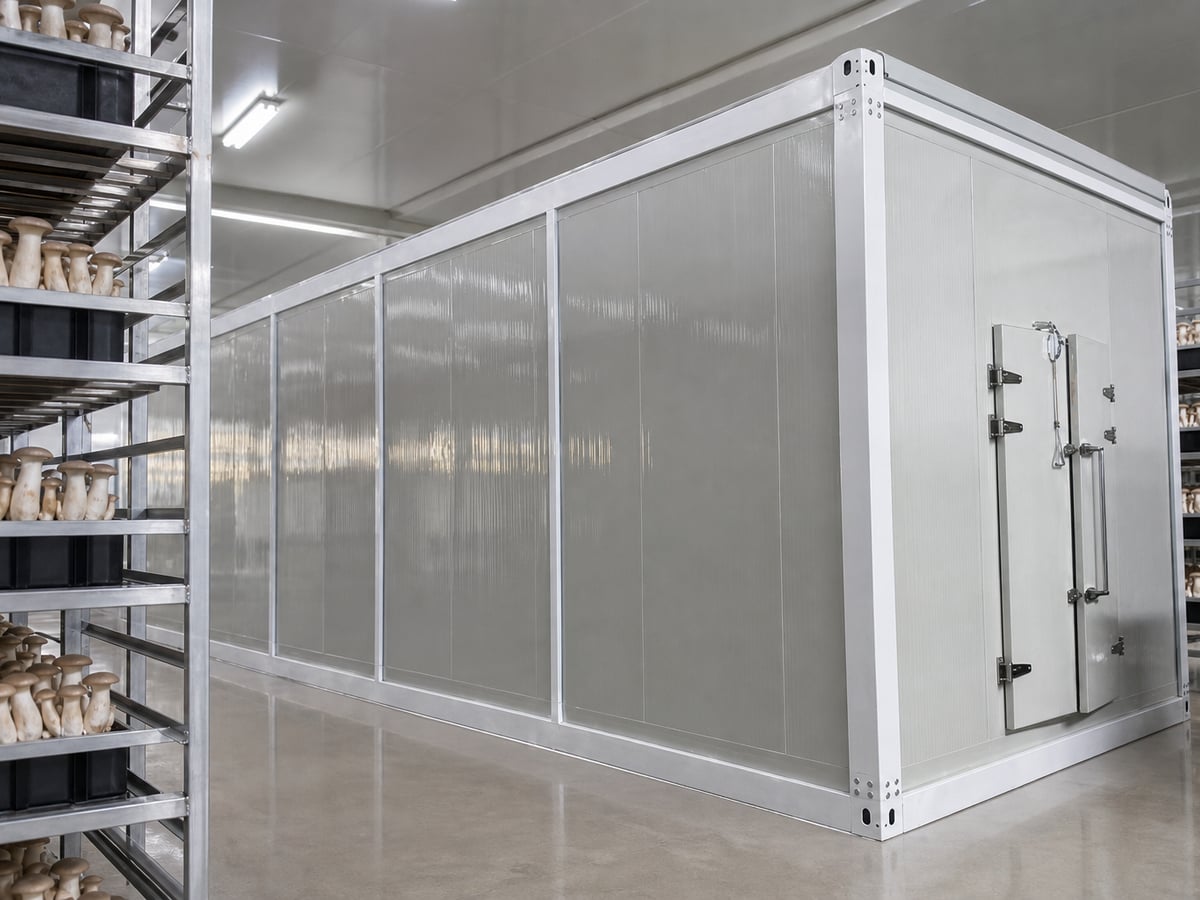
A practical layout normally includes insulated panels, washable floors, separated clean and dirty routes, adjustable racks, controlled fresh-air intake, return-air paths, dehumidification, heating and cooling, and sensors positioned at crop level. King oyster mushrooms often need carefully managed CO2 to develop the desired stem length and cap size. Excessive CO2 can produce long, thin stems, while too much fresh air can reduce humidity and increase energy use. Condensation control is equally important because wet surfaces encourage contamination and shorten equipment life.
For a new project, begin with a pilot room or modular cultivation container. Test the intended substrate recipe, container size, rack density, temperature sequence, airflow volume, and harvest schedule before duplicating the design across a commercial farm. A modular smart mushroom cultivation container can help producers validate a repeatable climate program without committing immediately to a large building.
| Planning factor | Recommended approach | Why it matters |
|---|---|---|
| Production container | Choose bags or bottles before finalizing rack geometry | Container shape determines spacing, loading, and airflow resistance |
| Climate stages | Program separate recipes for colonization, pinning, fruiting, and recovery | One fixed room setting rarely delivers consistent quality |
| CO2 control | Use crop-level sensors and adjustable fresh-air dampers | CO2 strongly influences stem and cap morphology |
| Humidity | Combine humidification with controlled ventilation and dehumidification | High humidity without air movement causes condensation and contamination risk |
| Rack layout | Leave service aisles and clearance around every rack face | Workers need safe access for pinning checks and harvesting |
| Scaling method | Validate recipes in one room before commercial duplication | It reduces the cost of correcting design and control errors |
The right solution depends on local weather, electricity prices, water quality, labor availability, import logistics, and sales requirements. A farm near Rotterdam, Dubai, Nairobi, São Paulo, Toronto, or Melbourne may use the same production concept but require different insulation, cooling, heating, humidity, and corrosion-protection specifications.
Room Design for Bags, Bottles, and Other Production Containers

King oyster mushrooms are commonly cultivated in polypropylene bags, plastic bottles, or other sterilizable containers filled with a formulated substrate. The container choice affects every major engineering decision. Bags can be flexible and economical, but their shape may change during loading and fruiting. Bottles provide consistent geometry and can work well with automated or semi-automated handling, although they require compatible filling, sterilization, inoculation, and rack systems.
Bag rooms often need broader shelves, anti-fall lips, and enough vertical separation to prevent fruit bodies from pressing against the shelf above. Bottle systems usually benefit from fixed guides, trays, or openings that keep containers upright. In both cases, the room should prevent blocked air channels. A tightly packed rack may appear efficient on a floor plan but can create hot, humid, high-CO2 pockets that cause uneven crops.
| Container type | Typical advantages | Design concerns | Suitable operating model | Handling priority | Scaling note |
|---|---|---|---|---|---|
| Filter bags | Flexible format and broad substrate compatibility | Variable shape and possible leaning | Manual or semi-automated production | Stable shelf support | Easy to start, but rack density must be validated |
| Rigid bottles | Uniform dimensions and repeatable placement | Higher equipment and container coordination | Standardized commercial production | Vertical alignment | Efficient when filling and loading are organized |
| Trays | Convenient for grouped handling | More exposed surface area and wash requirements | Specialty or batch systems | Tray sanitation | Works well where labor routes are controlled |
| Blocks with collars | Simple access to fruiting surface | Collar geometry can restrict airflow | Small and medium farms | Even collar spacing | Suitable for modular room testing |
| Reusable containers | Lower disposable-material consumption | Requires reliable cleaning and inspection | Sustainability-focused operations | Hygienic turnaround | Needs documented washing and drying procedures |
| Mixed formats | Can serve multiple customer or recipe needs | Complex airflow and inventory planning | Research, contract, or diversified farms | Separate zoning | Use only after each format has been independently validated |
Room depth and rack height should reflect the equipment used to load and unload containers. A manual farm may need turning space for carts, while a larger operation may need pallet access, lift tables, or conveyor interfaces. Doors should be wide enough for the largest unit that will enter the room, and thresholds should be easy to clean. Avoid placing evaporator coils, humidifiers, or supply-air outlets where workers will regularly collide with them.
For bottles, rack shelves should maintain enough open area around the container neck and fruiting opening. For bags, allow room for the bag surface to expand and for workers to inspect contamination or pin development. When a room is intended for several crops, use adjustable shelves and movable dividers, but do not sacrifice cleanability for flexibility.
Clearance for Pinning, Harvesting, and Crop Handling

Pinning is a sensitive period. Workers need to see the fruiting surface, identify uneven initiation, remove damaged material, and adjust the climate program without disturbing neighboring containers. A design that maximizes the number of bags or bottles but prevents inspection can reduce total saleable yield.
Provide a clear aisle in front of each rack face and reserve space for carts, harvest crates, weighing equipment, and temporary staging. The exact dimension depends on local safety rules and the equipment used, but the principle is consistent: workers should not need to twist containers sideways or step into another rack to harvest. Doors and air curtains should also be positioned to reduce the time the room remains open.
| Work activity | Recommended space feature | Operational benefit | Common mistake | Design response | Verification method |
|---|---|---|---|---|---|
| Pin inspection | Unobstructed view of fruiting openings | Faster identification of uneven development | Closely stacked containers | Increase shelf pitch and front clearance | Conduct a timed inspection with a full rack loaded |
| Harvesting | Continuous aisle beside the rack | Improves worker safety and product quality | Harvest crates blocking access | Add a staging bay outside the crop zone | Simulate peak harvest movement |
| Crop removal | Cart or trolley turning area | Reduces handling damage | Narrow door or sharp corner | Measure the largest loaded cart | Perform a full-load route test |
| Sanitation | Washable wall and floor junctions | Speeds cleaning between batches | Open joints and inaccessible corners | Use sealed, coved, cleanable finishes | Inspect after wet cleaning |
| Maintenance | Access to sensors, coils, fans, and drains | Shortens service interruptions | Equipment installed behind fixed racks | Reserve a technical clearance zone | Complete a mock filter and sensor replacement |
| Waste removal | Separate route from clean substrate entry | Reduces cross-contamination | One shared doorway for all traffic | Schedule routes or create separate access | Map personnel and material movement |
Consider the entire crop journey: substrate arrival, filling, sterilization, inoculation, incubation, room loading, pinning, harvest, spent-substrate removal, cleaning, and room reset. Even a compact farm benefits from a simple flow diagram. When clean and dirty materials cross the same corridor repeatedly, the risk of contamination and labor inefficiency rises.
Temperature Programs Across Growth Stages
King oyster mushrooms typically require different environmental conditions during substrate colonization, pinning, fruiting, and post-harvest room recovery. Exact values depend on strain, substrate formulation, container geometry, and commercial quality targets. The important point is to use staged recipes rather than a single setpoint.
During colonization, the room must remove metabolic heat generated by the growing mycelium. The air temperature may appear acceptable while the substrate core is warmer. Use representative product probes during recipe development, especially when racks are densely loaded. During pinning, gradual changes may be preferable to abrupt shifts. During fruiting, temperature should be stable enough to support uniform morphology, while the air system must also manage CO2 and moisture.
| Growth stage | Primary climate objective | Sensor priority | Air-system focus | Risk if poorly controlled | Management approach |
|---|---|---|---|---|---|
| Post-inoculation | Maintain stable conditions for mycelial establishment | Room temperature and product core temperature | Gentle circulation and heat removal | Slow or uneven colonization | Use conservative loading density until heat generation is known |
| Active colonization | Prevent substrate overheating | Multiple crop-level temperature points | Balanced cooling and return-air mixing | Stalling, contamination, or uneven development | Use trend alarms rather than relying on one sensor |
| Pin initiation | Support even formation at the fruiting surface | Temperature, relative humidity, and CO2 | Controlled fresh-air transition | Delayed or irregular pinning | Change settings gradually and observe several rack levels |
| Fruiting | Develop consistent stem and cap morphology | Crop-level temperature and CO2 | Stable supply air with moisture control | Long stems, small caps, or drying | Link climate adjustments to customer specifications |
| Harvest window | Preserve quality and reduce surface moisture | Humidity, temperature, and condensation points | Moderate air movement and controlled drying | Bruising, wet caps, or shortened shelf life | Coordinate harvest timing with room conditions |
| Room recovery | Dry and sanitize the room efficiently | Surface moisture and drain performance | Ventilation, heating, and dehumidification | Persistent odor, mold, or corrosion | Use a documented cleaning and dry-out cycle |
Climate controllers should allow recipes to be scheduled by time, crop stage, and sensor feedback. A capable mushroom climate controller can integrate temperature, humidity, CO2, fan operation, alarms, and data records. For commercial projects, data logging is valuable because it connects a crop result with the actual climate history rather than with an operator’s memory.
Local climate affects the heating and cooling balance. A room in northern Europe may need substantial heating during winter while also requiring dehumidification after humidification. A farm in the Gulf region may have high cooling demand and significant latent load when fresh air enters. In tropical areas such as Malaysia, Indonesia, or coastal Brazil, corrosion protection, condensate management, and air-treatment hygiene deserve early attention.
CO2 Management for the Desired Mushroom Shape
CO2 is one of the most important variables for king oyster morphology. The target is not simply “as low as possible.” The desired stem length, diameter, cap development, texture, and customer specification determine the appropriate range. Excess CO2 may encourage elongated stems and smaller caps, while excessive ventilation can dry the crop, reduce energy efficiency, and create temperature fluctuations.
CO2 sensors should be positioned where they represent the crop environment, not directly in a strong supply-air jet or beside the exhaust outlet. In a tall rack, one sensor near the ceiling may not reveal conditions near the lower shelves. Multi-point measurement or rotating validation with a calibrated handheld instrument can show whether the room is truly uniform.
Fresh-air fans, exhaust fans, dampers, and recirculation fans should operate as a coordinated system. If an exhaust fan removes air without a controlled replacement path, the room can develop negative pressure, uncontrolled infiltration, and uneven humidity. If the fresh-air fan runs continuously at high volume, the crop may experience unnecessary drying and higher refrigeration demand.
For recipe development, change one major variable at a time. Record CO2 trends, cap-to-stem proportions, stem firmness, harvest weight, and customer feedback. A production manager in Hamburg may prefer a different morphology from a retailer in Riyadh or a food-service buyer in Singapore. Climate control should therefore be connected to the sales specification rather than treated as an isolated engineering target.
Humidity, Condensation, and Hygienic Room Control
High relative humidity is often needed for healthy mushroom development, but air that is close to saturation can condense on panels, pipes, lights, doors, and cooling coils. Condensation is not the same as useful crop humidity. Water on surfaces can support microbial growth, damage insulation, corrode metal, and create slippery floors.
Design the room around dew point as well as relative humidity. Keep cold surfaces insulated, maintain proper vapor barriers, and direct condensate to trapped drains. Avoid placing humidifier outlets directly toward walls or sensors. The humidification system should create a fine, evenly distributed moisture field rather than large droplets that settle on fruit bodies.
Air movement helps prevent stagnant zones, but high velocity directly across the crop can cause surface drying. Use adjustable diffusers, fabric ducts, perforated distribution tubes, or carefully selected supply outlets according to room geometry. Verify conditions at the top, middle, and bottom of loaded racks.
| Humidity challenge | Likely cause | Possible crop effect | Engineering response | Maintenance action | Performance check |
|---|---|---|---|---|---|
| Wet walls or ceiling | Surface temperature below dew point | Contamination and poor room hygiene | Improve insulation and air mixing | Inspect vapor barriers and panel joints | Track surface temperature during peak humidity |
| Dry fruiting surfaces | Excessive fresh air or direct fan velocity | Cracking, reduced weight, or rough texture | Rebalance air volume and diffuser direction | Clean filters and verify fan speed | Compare crop-level humidity across racks |
| Condensation on coils | High latent load or insufficient drain capacity | Water carryover and microbial risk | Size coils, drains, and dehumidification correctly | Flush drains and inspect traps | Test during the most humid operating period |
| Uneven humidity | Dead zones or poor return-air placement | Different quality between shelf levels | Adjust supply and return paths | Check fans and dampers for blockage | Use portable sensors for mapping |
| Persistent wet floor | Improper slope or insufficient drainage | Safety hazard and sanitation difficulty | Correct floor falls and drain locations | Remove solids and clean drain baskets | Perform a wash-down flow test |
| Corrosion | High humidity, salts, or unsuitable materials | Shortened equipment life | Select protected metals and sealed components | Inspect fasteners, coils, and electrical enclosures | Record corrosion at scheduled intervals |
Water quality also matters. Minerals can clog nozzles, create scale on humidifiers, and increase cleaning requirements. Depending on the local supply, filtration, softening, reverse osmosis, or another treatment method may be appropriate. Any treatment should be selected with the humidifier manufacturer and local water analysis.
Uniform Air Delivery Across Every Rack
Uniform air delivery is one of the clearest differences between a room that merely operates and a room that produces consistent commercial crops. Air must reach every rack level without creating a high-speed drying zone near the supply outlet or a stagnant pocket at the opposite wall.
Start with a simple air-distribution map. Mark supply outlets, return grilles, evaporator locations, doors, humidifiers, and rack faces. Then test the room empty and loaded. The loaded condition is more important because bags, bottles, workers, and carts change resistance and airflow patterns.
Supply and return paths should encourage mixing without short-circuiting. If supply air immediately returns to the coil, the sensor may report a satisfactory room temperature while the crop racks remain outside the intended range. In tall rooms, vertical temperature stratification may require additional circulation or a different duct arrangement.
Use smoke tests, anemometers, temperature loggers, and humidity sensors to verify distribution. Commercial farms should repeat this verification after major rack changes. A room that performs well with two racks may perform poorly after a third or fourth rack is installed.
Lanhu’s engineering approach combines climate equipment, control logic, insulation panels, electrical assembly, and system testing rather than treating each component as an unrelated purchase. This integrated method can help projects coordinate the air path, panel construction, sensors, controls, and service access before equipment is shipped.
The chart is an illustrative commissioning format, not a universal performance specification. Actual values should be measured in the completed room using the intended rack load and operating recipe.
Testing Recipes Before Commercial Scaling
Before building multiple rooms, conduct a controlled pilot. A pilot should test more than whether the mushrooms grow. It should determine whether the room can maintain the target conditions at the planned rack density, whether workers can complete tasks efficiently, and whether the product meets the commercial buyer’s requirements.
Record the substrate batch, container dimensions, inoculation date, loading date, climate settings, alarm events, harvest weight, grade distribution, and rejection reasons. If a recipe changes, mark the change clearly. This makes it possible to distinguish a climate problem from a substrate problem or a handling problem.
| Pilot test | What to measure | Acceptance question | Useful record | Scaling decision | Potential correction |
|---|---|---|---|---|---|
| Temperature uniformity | Top, center, and bottom rack temperatures | Does every crop zone remain within the intended band? | Time-stamped sensor trends | Approve or redesign air distribution | Adjust fans, ducts, insulation, or loading density |
| CO2 response | CO2 rise and recovery after ventilation changes | Can the system reach the morphology target predictably? | CO2 trend and crop photographs | Approve recipe logic | Reposition sensors or modify fresh-air capacity |
| Humidity stability | Relative humidity, dew point, and surface moisture | Can humidity be maintained without condensation? | Humidity and condensate logs | Approve humidification strategy | Improve dehumidification or airflow mixing |
| Worker movement | Loading and harvest time per rack | Can the planned labor team work safely? | Timed route observation | Approve aisle and door layout | Widen aisles or add staging space |
| Energy performance | Electricity, heating, cooling, and water consumption | Is the recipe commercially viable in the local climate? | Meter readings by batch | Set an operating cost benchmark | Improve insulation, scheduling, or heat recovery |
| Product quality | Stem, cap, firmness, color, weight, and shelf life | Does the crop satisfy the intended customer? | Harvest grading report | Approve commercial morphology | Adjust substrate or climate recipe |
Testing should cover seasonal conditions where possible. A room commissioned in spring may not behave the same way during a humid summer or a cold winter. Projects in cities such as Istanbul, Vancouver, Johannesburg, Bangkok, and Mexico City should consider seasonal swings and utility availability during the pilot stage.
For large projects, duplicate the same sensor locations and data labels in every room. Standardization makes it easier to compare rooms, identify underperforming equipment, and train operators. It also creates a stronger basis for warranty discussions and preventive maintenance.
Markets, Industries, and Commercial Applications
King oyster cultivation rooms serve a range of businesses. Specialized mushroom farms sell fresh produce to supermarkets, restaurants, wholesalers, meal-kit companies, and food-service distributors. Agricultural contractors may design turnkey farms for investors, while equipment distributors may need private-label or region-specific systems. Research institutions and technical colleges may use compact rooms for variety trials, substrate studies, or operator training.
In the Global Market, buying decisions are shaped by more than equipment price. Import duties, electrical standards, local refrigerants, after-sales response, spare-parts availability, and installation capability can determine the true project cost. Buyers should request a clear scope of supply that identifies the insulated enclosure, refrigeration, heating, humidification, ventilation, sensors, control cabinet, commissioning support, and documentation.
Local suppliers remain important even when the main climate system is imported. Electrical contractors, refrigeration technicians, building contractors, sanitation specialists, and logistics companies can support installation and operation. Ports such as Qingdao, Shanghai, Rotterdam, Jebel Ali, Singapore, Santos, and Los Angeles may be relevant depending on the project route, while inland farms need reliable container transport and customs coordination.
Applications include:
- Fresh king oyster mushroom production for retail and food service.
- Contract cultivation for regional distributors and supermarket brands.
- Urban or peri-urban modular farms with limited building space.
- Demonstration farms for agricultural investors and equipment dealers.
- Research rooms for strain selection and recipe development.
- Expansion rooms added to existing substrate or packing facilities.
- Climate-controlled rooms in regions with hot summers, cold winters, or high humidity.
2026 Trends in Mushroom Climate Technology and Sustainability
By 2026, commercial mushroom projects are increasingly focused on measurable efficiency, digital traceability, and flexible production rather than simple room automation. Sensors are becoming more affordable, but sensor quantity alone does not create a reliable system. The important trend is better interpretation of crop data, including the relationship between climate history, energy use, morphology, and saleable yield.
Artificial intelligence and advanced analytics may help identify abnormal temperature trends, fan failures, blocked filters, humidifier faults, or unusual crop development. These tools should support operators rather than replace practical inspection. A photograph of the crop, combined with climate data and harvest records, can help build a more useful production history.
Heat recovery, variable-speed fans, high-efficiency refrigeration, improved insulation, and demand-based ventilation are also gaining importance. In cold regions, recovered heat from refrigeration or air compressors may reduce heating demand. In warm climates, better latent-load management can reduce the penalty associated with fresh-air exchange.
Policy and market expectations are also changing. Customers increasingly ask about energy consumption, water use, packaging, responsible refrigerants, worker safety, and waste handling. Spent substrate may be directed to composting, soil improvement, animal-feed research, or other local reuse pathways where regulations permit.
| 2026 trend | Technology or policy direction | Farm benefit | Implementation priority | Possible limitation | Recommended first step |
|---|---|---|---|---|---|
| Demand-based ventilation | Fans respond to CO2 and crop-stage requirements | Lower energy use with better morphology control | High for new commercial rooms | Requires accurate sensors and control logic | Map CO2 response during a pilot |
| Digital batch records | Climate, substrate, labor, and harvest data linked together | Improves traceability and recipe comparison | High for multi-room operations | Inconsistent data entry reduces value | Standardize labels and daily records |
| Heat recovery | Recovered heat used for water or room heating | Can reduce total utility consumption | Project-dependent | Needs matching heat demand and equipment design | Measure annual heating and cooling loads |
| Low-impact refrigerants | Regulatory movement toward lower global-warming potential | Supports long-term compliance | High during equipment selection | Local service skills may vary | Confirm refrigerant rules and technician availability |
| Water efficiency | Filtered humidification and cleaning-water management | Lower consumption and reduced scaling | Medium to high | Water treatment adds maintenance | Test source-water quality |
| Modular expansion | Rooms added in repeatable production units | Reduces initial risk and supports staged investment | High for growing farms | Site utilities must allow future capacity | Plan power, drainage, and logistics for expansion |
Sustainability should be evaluated across the full system. A highly efficient cooling unit is less valuable if poor insulation causes constant heat gain. A water-saving humidifier is less useful if room leaks create uncontrolled drying. The best results normally come from coordinated design, commissioning, operator training, and regular maintenance.
Our Company: Integrated Climate Manufacturing and Support
Shandong Lanhu Air Conditioning Equipment Co., Ltd. is a manufacturer based in Dezhou, Shandong, China, serving agricultural, industrial, and modular cultivation projects internationally. Its work focuses on climate-controlled cultivation systems, agricultural air conditioning, modular mushroom rooms, smart hydroponic containers, air source heat pumps, and related control equipment.
Technological capabilities: Lanhu combines thermodynamic research, climate-control programming, refrigeration integration, ventilation design, humidity management, sensor deployment, and system-level testing. With more than 12 years of thermodynamic research and development experience and over 45 registered patents, the company develops equipment for applications where temperature, humidity, CO2, airflow, and energy performance must work together. Control systems can be configured for staged crop recipes, alarm management, data monitoring, and different regional operating requirements.
Manufacturing capabilities: The company operates a manufacturing facility of more than 30,000 square meters. Its integrated production process includes product design, engineering development, sheet-metal fabrication, CNC bending, insulation-panel production, electrical assembly, system integration, equipment testing, and quality inspection. This in-house coordination can reduce communication gaps between enclosure design, air equipment, control cabinets, and final commissioning.
Before shipment, systems undergo functional inspection, electrical verification, performance testing, and operational evaluation. Lanhu maintains ISO 9001, ISO 14001, ISO 45001, and ISO 12100 certifications, together with patent certificates and enterprise credibility credentials. Buyers should still confirm the exact documentation, electrical configuration, refrigerant selection, and local compliance requirements for each project.
Service capabilities: Lanhu provides factory-direct supply, OEM and ODM customization, engineering assistance, international logistics support, spare-parts support, installation guidance, and after-sales service. Its customers include agricultural contractors, equipment distributors, engineering companies, and commercial farming projects. For buyers comparing suppliers, the most useful questions concern response time, remote troubleshooting, commissioning scope, warranty boundaries, replacement-part availability, and whether the supplier can support local installation partners.
Potential customers can review completed project information through the mushroom cultivation project cases page or discuss customized room requirements through the OEM and ODM climate equipment service. A good inquiry should include the target crop, container format, room quantity, local climate, electrical standard, desired production volume, rack arrangement, and expected delivery location.
FAQ: King Oyster Mushroom Climate Rooms
What is the best room type for a new king oyster mushroom farm?
A modular cultivation container or a purpose-built insulated room is often suitable for a new farm because it allows the operator to test recipes, labor procedures, and customer requirements before expanding. The best choice depends on land, utilities, local building rules, desired capacity, and whether the project needs future room duplication.
Are bags or bottles better for king oyster mushrooms?
Neither format is universally better. Bags can offer flexibility and a lower entry barrier, while bottles provide more consistent geometry and may support standardized handling. Select the format that matches the substrate process, labor model, sterilization equipment, rack layout, and sales volume.
How much space should be left between racks?
The required space depends on local safety rules, rack height, cart dimensions, and harvesting practices. The aisle should allow workers to inspect pins, remove containers, place harvest crates, and clean the room without twisting or blocking another rack. Validate the design with a fully loaded cart and a complete harvest simulation.
Why does CO2 affect king oyster mushroom shape?
CO2 influences gas exchange and fruiting morphology. Higher CO2 conditions may encourage longer stems and smaller caps, while increased fresh-air exchange can promote different proportions. The correct setting depends on the strain and buyer specification, so use crop observations and measured data rather than a generic target alone.
How can condensation be reduced?
Control dew point, insulate cold surfaces, maintain correct vapor barriers, provide adequate drainage, and distribute air evenly. Humidification should not spray directly onto walls, sensors, or fruiting surfaces. Dehumidification and a controlled room-recovery cycle are useful after cleaning and between batches.
Do I need separate climate rooms for every growth stage?
Separate rooms can improve scheduling and biosecurity, but they are not always required for a small operation. A well-designed room with programmable recipes may support several stages if loading schedules, sanitation, and airflow capacity are appropriate. Larger farms often separate incubation, pinning, and fruiting to improve throughput and control.
What should be tested before ordering several rooms?
Test temperature uniformity, CO2 response, humidity stability, condensation behavior, airflow at every rack level, worker movement, energy consumption, cleaning time, and final product quality. Use the same container type and rack density planned for commercial operation. A lightly loaded pilot may hide problems that appear after expansion.
Can a supplier customize the system for different countries?
Many international suppliers can customize electrical systems, insulation, controls, refrigerants, door sizes, airflow arrangements, and logistics. Buyers should confirm the exact voltage, frequency, certification documents, language of manuals, local installation responsibilities, spare-parts plan, and after-sales communication method before signing a contract.
Which local partners are important during installation?
Depending on the project, local refrigeration technicians, electricians, building contractors, drainage specialists, logistics providers, and food-production consultants may be needed. A factory supplier can provide engineering guidance, but local professionals are often essential for permits, utility connections, code compliance, and rapid service.
How can I compare quotations fairly?
Compare the complete scope rather than the equipment headline price. Check insulation thickness, panel materials, cooling capacity, heating method, humidification, ventilation, CO2 sensors, control functions, data logging, drains, lighting, rack supply, installation support, testing, packaging, shipping terms, warranty, and spare parts. Ask each supplier to state exclusions clearly.
Is an air source heat pump useful in mushroom production?
An air source heat pump can provide efficient heating and, depending on the system design, contribute to cooling or hot-water production. Its value depends on the local climate, operating temperatures, electricity cost, and whether heating demand occurs at the same time as cooling or dehumidification demand.
How often should climate sensors be checked?
Check sensor readings against a calibrated reference on a planned schedule and whenever crop behavior appears inconsistent with the displayed data. Temperature, humidity, and CO2 sensors should be accessible for cleaning, replacement, and verification. A sensor-management record helps prevent long-term operation based on inaccurate readings.
What information should be included in a supplier inquiry?
Include the target country and city, room dimensions, crop stage, production capacity, bag or bottle details, rack count, desired morphology, seasonal outdoor conditions, utility data, preferred delivery port, installation expectations, and required certifications. Photographs or drawings of the proposed building can help the engineering team identify access and drainage issues early.
Share this article

About the Author: Shandong Lanhu Air Conditioning Equipment
Lanhu is a professional climate control equipment manufacturer specializing in smart agricultural systems, commercial HVAC solutions, and customized temperature control technologies. With extensive engineering experience, Lanhu provides reliable solutions for plant factories, controlled environment agriculture, and industrial applications.
Need a Custom Climate Control Solution?
From smart agricultural systems to commercial HVAC solutions, Lanhu provides reliable temperature and humidity control solutions tailored to your project needs.
Contact Us