Global Market Guide to Mushroom Container Service Life
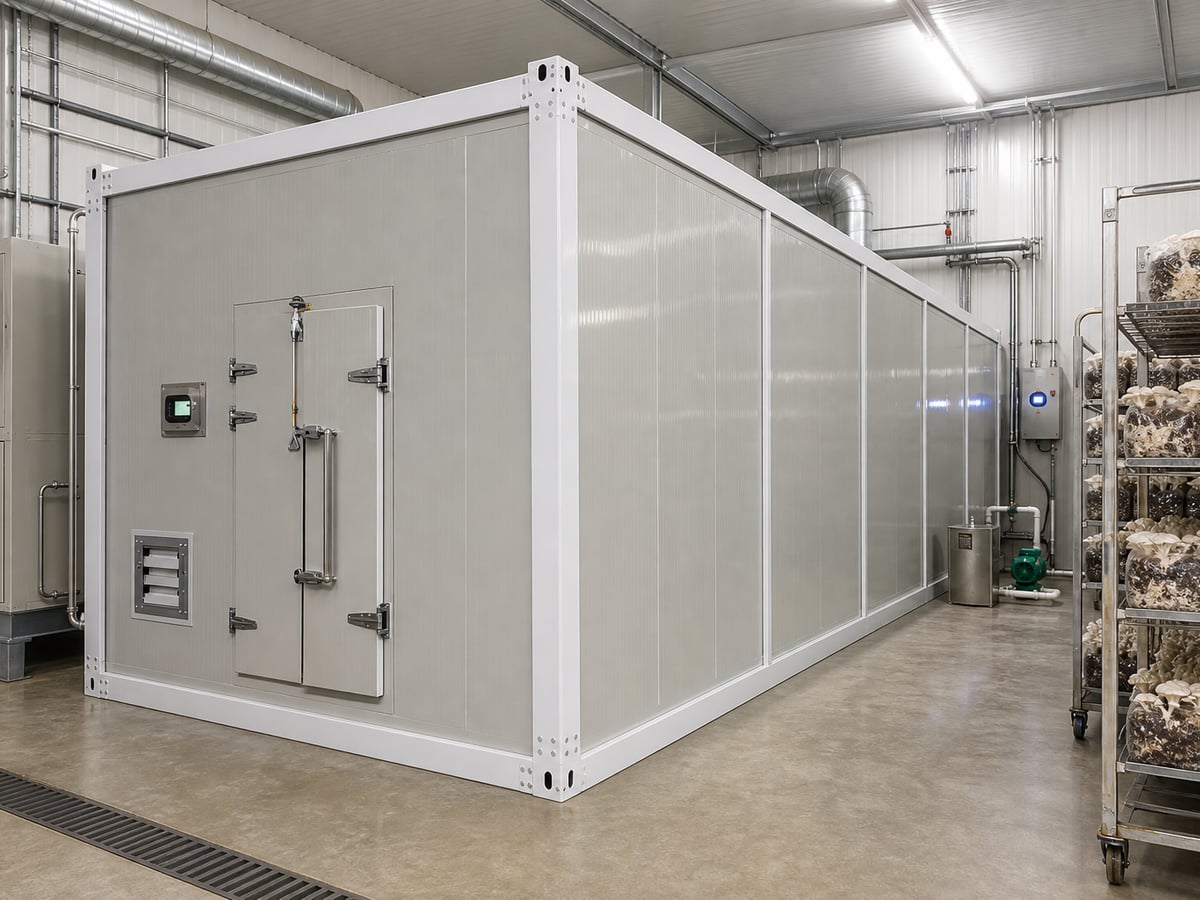
Quick Answer: How Long Does a Mushroom Container Last?

A well-built mushroom cultivation container can remain structurally useful for approximately 15 to 25 years, while its refrigeration, ventilation, humidification, electrical, and control equipment usually requires service or replacement much sooner. In many commercial projects, the insulated shell lasts longer than the original climate-control package.
For planning purposes, expect major equipment renewal after 7 to 12 years, depending on operating hours, ambient temperature, humidity, water quality, maintenance discipline, and access to spare parts. Doors, seals, floor coatings, panel joints, evaporator coils, fans, sensors, humidifiers, and compressors may need attention before the main structure reaches the end of its working life.
The most important distinction is between container shell life and equipment life. A galvanized or coated steel enclosure with sound insulation may continue serving a farm for two decades, but an original compressor or controller may not be economical to repair after a decade. A replacement strategy should therefore be staged rather than based on one total lifespan figure.
| Component | Typical planning life | Main causes of earlier failure | Recommended approach |
|---|---|---|---|
| Insulated wall and ceiling panels | 15–25 years | Water ingress, impact, delamination, corrosion | Inspect joints and protective coatings annually |
| Floor system | 8–18 years | Standing water, trolley impact, chemical attack | Repair cracks promptly and maintain drainage |
| Doors and hardware | 7–15 years | Frequent opening, misalignment, damaged gaskets | Replace seals and adjust hinges before air leakage grows |
| Compressor and refrigeration circuit | 7–15 years | Dirty coils, oil return problems, voltage instability | Use scheduled service and monitor operating pressures |
| Fans and motors | 5–12 years | Dust, moisture, bearing wear, imbalance | Clean, lubricate where applicable, and check vibration |
| Controller, sensors, and electrical parts | 5–12 years | Condensation, obsolete components, power surges | Keep backups and confirm upgrade compatibility |
These ranges are practical estimates, not guarantees. A container operating continuously in a hot coastal region such as Singapore, Lagos, Santos, or Dubai may experience greater corrosion and refrigeration stress than one operating in a dry inland climate. Conversely, a well-maintained unit in Rotterdam, Melbourne, Toronto, or Munich may achieve a longer service interval.
Separating the Life of the Shell from the Life of the Equipment

A mushroom container is a coordinated production room, not simply a shipping box with machines installed inside. Its service life has at least four layers: the structural enclosure, the hygienic interior surfaces, the environmental equipment, and the automation system. Each layer ages differently.
The shell includes the frame, insulated panels, roof, floor, doors, fasteners, protective coatings, and sealing materials. Its performance depends mainly on mechanical integrity and resistance to moisture. If panel cores remain dry and joints stay sealed, the enclosure can often be refurbished rather than discarded.
The equipment package includes refrigeration, heating, air circulation, fresh-air exchange, dehumidification, humidification, pumps, valves, electrical cabinets, and sensors. These components operate under repeated thermal and moisture cycles. Even when the container looks new, the equipment may have accumulated thousands of operating hours.
The control platform has a separate lifecycle. A controller can remain functional while becoming difficult to support because the display, communication protocol, sensor type, or software is obsolete. An upgrade may extend the useful life of the entire container without replacing the shell or refrigeration system.
How to evaluate a used or older unit
- Check whether the floor is level, sealed, non-slip, and free from soft spots.
- Look for rust at panel bottoms, door frames, roof edges, fasteners, drain outlets, and equipment mounts.
- Measure temperature and relative humidity at several points, not only near the controller sensor.
- Review compressor starts, fan noise, alarm history, refrigerant service records, and electrical test reports.
- Confirm that replacement sensors, fan motors, relays, valves, and controller modules are still available.
- Inspect whether the container dimensions and utility connections match the intended site.
For a buyer in the global market, transport history is also relevant. A container moved through the Port of Shanghai, Ningbo-Zhoushan, Hamburg, Jebel Ali, Los Angeles, or Durban may have experienced different humidity, vibration, and handling conditions. Damage from lifting or repositioning can appear months later as a leaking joint or distorted door.
Humidity Exposure and Corrosion Risks

Mushroom cultivation requires controlled humidity, but high humidity is not automatically damaging. The greater risk is uncontrolled condensation: water forming on cold surfaces, inside panel joints, beneath equipment, or around electrical enclosures. Repeated wetting and drying can damage coatings and create hidden corrosion.
Corrosion risk increases when high humidity combines with salts, cleaning chemicals, organic residues, poor drainage, and warm air. Coastal farms near Miami, Mombasa, Jakarta, Manila, or Alexandria may need more frequent inspection than inland operations because airborne salt accelerates corrosion. Chlorides can attack stainless steel and coated steel when surfaces remain wet.
| Exposure zone | Common problem | Early warning sign | Preventive measure | Inspection frequency | Likely consequence if ignored |
|---|---|---|---|---|---|
| Panel base | Water wicking and rust | Brown line near floor | Keep splash water away and reseal base trim | Monthly | Core moisture and panel replacement |
| Ceiling joints | Condensation infiltration | Dark marks or soft sealant | Renew sealant and correct air balance | Quarterly | Insulation loss and microbial growth |
| Door frame | Coating breakdown | Blistering paint or stiff latch | Clean, dry, treat rust, and adjust hardware | Monthly | Air leakage and hygiene problems |
| Drain area | Standing water and chemical attack | Persistent odor or residue | Improve slope and flush drains | Weekly | Floor damage and corrosion |
| Electrical cabinet | Condensation on terminals | Oxidized contacts or nuisance trips | Use suitable enclosure protection and ventilation | Quarterly | Control failure and safety risk |
| Cooling coil | Dirty wet surface | Reduced airflow or ice formation | Clean coil and check defrost operation | Monthly | Compressor overload and poor climate control |
Material selection matters. Insulated sandwich panels with protected steel skins are common because they provide thermal performance and fast installation. However, the coating system, edge protection, joint design, and installation quality are as important as the nominal panel thickness. A panel with excellent insulation can still fail early if water enters through an unsealed cut edge.
Cleaning practices should be compatible with the materials. Strong alkaline or chlorine-based products may be useful for sanitation, but excessive concentration or long contact time can damage coatings, gaskets, aluminum parts, and electrical labels. Follow chemical supplier instructions, rinse where appropriate, and allow surfaces to dry before closing the container.
Air pressure also affects moisture movement. Excessive negative pressure can draw humid outside air through small gaps, while excessive positive pressure can push moist air into panel joints. A qualified technician should balance fresh-air supply, exhaust, circulation, and door opening patterns.
Panel Joints, Doors, and Floor Wear
The most visible signs of container aging often appear around access points and walking surfaces rather than in the middle of a wall panel. Mushroom farms wash floors, move racks, use carts, and open doors repeatedly. These activities create mechanical wear that gradually reduces insulation and hygiene performance.
Panel joints should remain tight, clean, and sealed. Inspect vertical corners, ceiling-to-wall intersections, floor-to-wall transitions, service penetrations, and locations where pipes or cables pass through the enclosure. Sealant that has shrunk, cracked, or detached should be removed and replaced with a product compatible with the panel surface and sanitation program.
Doors deserve special attention because a small gasket gap can cause continuous cold-air loss. The refrigeration system then operates longer, increasing energy use and compressor wear. Check hinge alignment, latch pressure, door closers, viewing windows, threshold condition, and the integrity of magnetic or compression gaskets.
Floor wear depends on construction, loading, drainage, and cleaning. A commercial cultivation floor should resist moisture, impact, biological contamination, and routine detergents. Cracks and open joints allow water to reach insulation or the supporting structure. Repair systems should be selected for food or agricultural environments and applied to a properly prepared, dry surface.
| Inspection item | Acceptable condition | Repair indicator | Typical repair | Operational effect | Priority |
|---|---|---|---|---|---|
| Wall joint sealant | Continuous and flexible | Cracks, gaps, peeling | Remove failed sealant and reseal | Reduces moisture entry | High |
| Door gasket | Even compression around frame | Visible daylight or hard rubber | Replace gasket and adjust latch | Improves temperature stability | High |
| Door hinges | Smooth movement and correct alignment | Sagging or scraping | Lubricate, align, or replace hardware | Protects frame and seal | Medium |
| Floor coating | Continuous, slip-resistant surface | Blisters, chips, exposed substrate | Patch or resurface affected area | Supports hygiene and safety | High |
| Drain cover | Secure and easy to clean | Broken grate or slow drainage | Replace cover and clear trap | Prevents standing water | High |
| Service penetrations | Sealed without movement | Loose cable or pipe opening | Install proper sleeve and seal | Limits air and pest entry | Medium |
When reviewing a supplier quotation, ask whether the floor is designed for the expected rack load and whether the door width allows equipment replacement. A low purchase price can become expensive if the compressor cannot be removed without dismantling panels or if carts damage the floor within the first year.
Compressor and Fan Service Requirements
Refrigeration is normally the largest mechanical factor in a mushroom container’s operating cost and equipment lifespan. Compressors work harder when filters are blocked, coils are dirty, doors leak, air circulation is restricted, or the container is installed in a hot location with insufficient clearance.
At minimum, technicians should inspect refrigerant pressures, suction and discharge temperatures, electrical current, oil condition where applicable, vibration, unusual noise, and compressor start frequency. A system that cycles rapidly may have incorrect controls, inadequate airflow, a refrigerant issue, or a load that exceeds the original design.
Outdoor condenser placement matters in cities with high summer temperatures. In Riyadh, Phoenix, Delhi, or inland Brazil, a condenser exposed to extreme heat may operate at much higher head pressure than one installed in a mild climate. Shade, clean airflow, adequate clearance, and regular coil washing can materially extend service life.
Fans are equally important because air movement controls temperature uniformity, carbon dioxide distribution, drying, and humidity response. Bearings, belts, guards, impellers, motor insulation, and mounting points should be checked. Moisture-resistant motors and correctly rated electrical components are preferable in wet production rooms.
| Service task | Suggested interval | What to check | Why it matters | Responsible person | Record to keep |
|---|---|---|---|---|---|
| Visual equipment inspection | Weekly | Leaks, noise, alarms, frost, loose parts | Finds developing faults early | Operator | Daily or weekly log |
| Air filter inspection | Weekly to monthly | Dust loading and moisture | Protects airflow and fan motors | Operator | Cleaning date |
| Evaporator and condenser cleaning | Monthly or quarterly | Dust, organic residue, bent fins | Improves heat transfer | Technician | Maintenance report |
| Electrical connection test | Every 6–12 months | Terminals, current, insulation, earthing | Reduces overheating and safety risks | Qualified electrician | Test certificate |
| Refrigeration performance check | Every 6–12 months | Pressures, superheat, subcooling, cycling | Protects compressor efficiency | Refrigeration technician | Measured readings |
| Fan and motor overhaul | Every 2–5 years | Bearings, vibration, insulation | Prevents sudden airflow loss | Technician | Service history |
Never release refrigerant or modify a sealed circuit without following local regulations and using licensed personnel where required. Rules differ between countries, particularly for refrigerant recovery, fluorinated gases, pressure testing, and technician certification.
Water Quality and Humidifier Reliability
Humidification reliability is closely linked to water quality. Minerals in untreated water can accumulate on nozzles, evaporative media, pumps, tanks, valves, and sensors. Hard water may create scale that restricts flow and changes humidity response. High mineral content can also produce deposits on surfaces inside the growing room.
Before selecting a humidifier, test the source water for hardness, total dissolved solids, pH, iron, manganese, and biological contamination where relevant. A system using filtered or treated water may require a different maintenance schedule from one using municipal water. Reverse osmosis can reduce mineral loading, but it also produces reject water and may require remineralization for certain applications.
Ultrasonic humidifiers can provide fine mist but may distribute dissolved minerals if water treatment is inadequate. High-pressure fogging systems require clean nozzles and stable pump pressure. Steam systems avoid some mineral carryover but use more energy and require careful attention to electrical load, water treatment, and scale management.
| Water condition | Potential effect | Equipment at risk | Recommended control | Monitoring frequency | Planning implication |
|---|---|---|---|---|---|
| High hardness | Scale formation | Nozzles, heaters, valves | Softening, filtration, or reverse osmosis | Monthly testing | Budget for consumable media |
| High total dissolved solids | Mineral residue and mist carryover | Ultrasonic units and room surfaces | Use treated water and scheduled flushing | Weekly to monthly | May favor another humidification method |
| Iron or manganese | Staining and deposits | Tanks, pipes, nozzles | Pre-filtration and water treatment | Quarterly | Requires filter replacement planning |
| Low pH or aggressive water | Metal corrosion | Pumps, fittings, tanks | Material compatibility review | Monthly | May require corrosion-resistant components |
| Biological contamination | Biofilm and odor | Water tanks and distribution lines | Sanitation and controlled storage | As required by site plan | Include cleaning downtime |
| Unstable supply pressure | Uneven humidification | Fogging pumps and nozzles | Install regulator or buffer tank | Weekly observation | Improves crop consistency |
Drainage is as important as water delivery. Tanks, trays, filters, and low points should be easy to empty and clean. A humidifier that works technically but leaves standing water can increase contamination risk and accelerate corrosion inside the container.
Spare Parts and Control Upgrade Options
Parts availability can determine whether a container remains productive or sits idle. Before buying, request a recommended spare-parts list covering at least two years of normal operation. Critical items commonly include temperature and humidity sensors, fan motors, belts, contactors, relays, fuses, solenoid valves, pump components, door gaskets, filters, drain parts, and controller modules.
For international farms, standardization is valuable. If several units use the same sensors, fan motors, and control architecture, the operator can hold fewer part numbers. It is also useful to confirm voltage, frequency, plug standards, refrigerant type, communication protocols, and local service compatibility.
Control upgrades may include a modern touchscreen, remote monitoring, data logging, alarm forwarding, variable-speed fan control, improved recipe management, or integration with a farm management system. A new controller should not be installed without checking sensor ranges, relay capacity, actuator signals, safety interlocks, and software access.
Remote monitoring is especially useful for containers located at distributed sites. An operator in Nairobi, Vancouver, São Paulo, or Warsaw can receive an alarm for high temperature, low humidity, compressor fault, water shortage, or door-open status. However, remote access should include password management, user permissions, backup procedures, and a local manual override.
For a broader overview of climate automation, review the smart mushroom climate controller solutions. Buyers assessing complete cultivation rooms can also compare features of a modular mushroom cultivation container.
Estimating Replacement Costs Over Time
Replacement budgeting should separate routine maintenance, corrective repairs, planned component renewal, and complete container replacement. The purchase price alone does not reveal the cost of ownership. Freight, installation, local electrical work, refrigerant regulations, water treatment, downtime, and technician travel can significantly affect the total.
| Ownership stage | Likely expenditure | Typical scope | Cost drivers | Business objective | Planning action |
|---|---|---|---|---|---|
| Years 0–2 | Low to moderate | Commissioning, filters, seals, training | Installation quality and operator learning | Stabilize production | Document baseline performance |
| Years 3–5 | Moderate | Fan service, sensor calibration, coating repairs | Operating hours and cleaning routine | Preserve efficiency | Start a replacement reserve |
| Years 6–10 | Moderate to high | Motors, valves, controls, pumps, gaskets | Parts availability and water quality | Avoid unplanned downtime | Plan upgrades before failure |
| Years 8–15 | High | Compressor, controller, humidifier, floor repairs | Climate, service history, technology changes | Extend productive life | Compare repair with renewal |
| Years 12–20 | High or variable | Panel refurbishment, door replacement, equipment renewal | Corrosion, insulation condition, local labor | Maintain hygiene and output | Conduct full life-cycle audit |
| Years 15–25 | Project-level | Major refurbishment or new container | Shell condition and production strategy | Secure long-term capacity | Evaluate total replacement cost |
As a simple budgeting method, establish an annual reserve equal to a percentage of the installed project value. The correct percentage varies by climate, utilization, warranty, and local labor rates, but a reserve should cover both predictable service and occasional major failures. Keep a separate allowance for business interruption because lost production may exceed the component invoice.
When comparing a repair with replacement, calculate:
- Remaining shell life and insulation performance.
- Expected repair cost, technician travel, freight, and installation labor.
- Energy consumption compared with a modern system.
- Availability of compressors, controllers, sensors, and refrigerants.
- Downtime required for the repair or new installation.
- Potential productivity gains from better climate uniformity and automation.
- Future compliance requirements for refrigerants, electrical safety, water discharge, and energy use.
The chart shows why a container should be evaluated as a system with staggered renewal dates. Actual results vary, but replacing a controller or fan does not necessarily mean replacing the entire enclosure.
Market, Product Types, and Buying Advice
The global market includes insulated cultivation containers, converted refrigerated containers, factory-built modular growing rooms, and customized agricultural HVAC enclosures. Product names may be similar while construction quality differs considerably. Buyers should compare the complete operating specification rather than focusing only on external dimensions or rated cooling capacity.
Common product types include:
- Standard cultivation containers: factory-integrated systems for controlled temperature, humidity, ventilation, and lighting or rack integration.
- Multi-zone containers: divided into incubation, fruiting, or storage areas with different climate recipes.
- Converted shipping containers: adapted for cultivation, often requiring careful inspection of insulation, floor condition, vapor barriers, and utility routing.
- Custom modular rooms: assembled from insulated panels for larger farms or sites requiring special dimensions.
- Research and demonstration units: designed for trials, education, urban farms, and small-scale commercial production.
- Hybrid farm modules: combined with hydroponic, cold-storage, packing, or renewable-energy systems.
Ask suppliers for performance data at the climate conditions expected at your site. A unit rated in a cool factory environment may not provide the same output in a hot, humid region. Request noise data, electrical load, water requirements, control screenshots, alarm lists, cleaning instructions, and the limits of the warranty.
Commercial users should also verify loading and unloading arrangements. A project near the Port of Antwerp, Port Klang, Piraeus, or the Port of Vancouver may have different inland transport constraints from a farm near a remote regional hub. Confirm crane access, road width, container dimensions, customs documents, insurance, and local lifting regulations before shipment.
Industries, Applications, and Real-World Use
Mushroom containers serve more than one type of customer. Commercial growers use them for repeatable production, while agricultural contractors deploy them as modular production systems. Distributors may require standardized configurations for multiple countries, and research institutions may prioritize data collection over maximum throughput.
Typical applications include oyster mushroom and specialty mushroom production, spawn or incubation rooms, fruiting trials, urban farming, supermarket supply programs, restaurant-linked farms, agricultural training, emergency food projects, and remote production sites. In regions with limited agricultural land, a controlled container can shorten the distance between production and consumption.
Applications in cold or hot climates require different design attention. In northern Europe, insulation and frost protection may be central concerns. In the Gulf region, compressor capacity, condenser placement, and energy efficiency become more important. In tropical markets, corrosion protection, dehumidification, water management, and electrical reliability deserve additional scrutiny.
Operators should define their production recipe before selecting equipment. Temperature, relative humidity, fresh-air exchange, carbon dioxide targets, lighting, rack spacing, sanitation cycles, and harvest workflow all influence the design. A container optimized for one mushroom variety may not be ideal for another without control adjustments.
Case Studies and Local Supplier Evaluation
Every project should be evaluated against local operating conditions rather than copied from a different market. A container installed near Jakarta may require stronger moisture management than one operating in northern China. A unit shipped to West Africa may need a different spare-parts package because local technical support and freight times differ.
Useful case-study questions include:
- What crop and production cycle were used?
- What were the outdoor temperature and humidity conditions?
- How many operating hours did the compressor and fans accumulate?
- What water treatment was installed?
- What maintenance tasks were performed locally?
- How quickly were warranty and spare-parts requests resolved?
- What were the actual energy, water, and labor requirements?
When evaluating local suppliers, compare technical capability, not only warehouse distance. A local reseller may offer faster visits, while an overseas manufacturer may provide more integrated engineering, customization, or factory support. The best arrangement may combine factory-direct equipment with a trained local refrigeration and electrical contractor.
| Supplier evaluation area | Questions to ask | Evidence to request | Risk reduced | Importance | Review timing |
|---|---|---|---|---|---|
| Manufacturing quality | How are panels, wiring, and equipment tested? | Inspection records and photographs | Hidden defects | Very high | Before contract |
| Climate performance | At what outdoor conditions is capacity rated? | Performance data and test conditions | Under-sizing | Very high | Before design approval |
| Parts support | Which parts are stocked and for how long? | Spare-parts list and lead times | Extended downtime | High | Before purchase and annually |
| Installation support | Who commissions and balances the system? | Method statement and checklist | Startup faults | High | Before delivery |
| Warranty coverage | What is covered and where is service performed? | Written warranty terms | Unexpected expense | High | Before payment |
| Upgrade path | Can controls and sensors be modernized? | Architecture diagram and options | Premature obsolescence | Medium to high | During specification |
For examples of completed projects and equipment applications, visit the mushroom cultivation project case studies. Case information is most useful when it includes operating conditions, not just photographs.
Future Trends for 2026 and Beyond
By 2026, mushroom container design is moving toward greater energy visibility, modular maintenance, remote diagnostics, and lower environmental impact. Buyers increasingly expect equipment to provide usable data rather than simply display temperature and humidity.
Important technology trends include variable-speed compressors and fans, predictive maintenance based on vibration and current data, cloud-connected alarms, digital production recipes, improved sensor calibration, heat recovery, and integration with renewable electricity. Artificial intelligence may assist with detecting abnormal climate patterns, but human review remains important for crop decisions and safety.
Sustainability requirements are also shaping procurement. Farms are evaluating refrigerant global warming potential, insulation recyclability, water consumption, energy intensity per kilogram of product, and the ability to repair rather than discard equipment. Modular components support circularity because doors, controls, fans, and humidifiers can be replaced independently.
Policy changes may affect refrigerant selection, energy labeling, electrical compliance, data security, and waste handling. Requirements differ across the European Union, United States, Canada, Australia, the Gulf states, Southeast Asia, and African markets. Importers should confirm local rules before finalizing equipment, especially when the system crosses borders through major trade hubs.
Future-ready specifications should include accessible service panels, documented wiring, replaceable sensors, remote alarm capability, manual control fallback, efficient motors, corrosion-resistant materials, and a clear end-of-life plan. These features may increase initial cost but reduce downtime and improve long-term value.
Our Company: Engineering, Manufacturing, and Service Support
Shandong Lanhu Air Conditioning Equipment Co., Ltd. develops agricultural climate-control systems from its manufacturing base in Dezhou, Shandong, China. Its work focuses on controlled-environment agriculture, industrial HVAC, smart mushroom cultivation containers, climate controllers, hydroponic plant containers, and air source heat pumps.
Technological capabilities
Lanhu combines thermodynamic research with control-system development to coordinate temperature, humidity, airflow, fresh-air exchange, and alarm functions. Its engineering approach considers the relationship between refrigeration capacity, insulation, fan selection, humidification, sensor placement, and production recipes. This is important because extending container life depends not only on material strength but also on avoiding unnecessary thermal and moisture stress.
The company has more than 12 years of thermodynamic research and development experience and holds multiple registered patents. Its systems can be configured for different crops, climates, utility conditions, and automation preferences. Options may include remote monitoring, customized control logic, data logging, and integration with project-specific equipment.
Manufacturing capabilities
Lanhu operates a modern facility of more than 30,000 square meters with integrated capabilities for product design, engineering development, sheet-metal fabrication, CNC bending, insulated panel production, electrical assembly, system integration, equipment testing, and quality inspection. This integrated workflow helps coordinate enclosure dimensions with refrigeration, electrical routing, door construction, and maintenance access.
Before shipment, systems undergo functional inspection, electrical verification, performance testing, and operational evaluation. The company maintains ISO 9001, ISO 14001, ISO 45001, and ISO 12100 certifications, together with patent and enterprise credibility credentials. Buyers should still confirm the project-specific test scope, documentation, and destination-country compliance requirements.
Service capabilities
Lanhu provides factory-direct supply, OEM and ODM customization, engineering assistance, international logistics coordination, spare-parts support, installation guidance, and after-sales service. This model can help contractors, distributors, engineering companies, and commercial farms plan a complete project rather than sourcing panels, refrigeration, controls, and humidification from unrelated vendors.
For service planning, request a commissioning checklist, recommended maintenance schedule, electrical drawings, control documentation, spare-parts list, warranty process, and escalation contacts. More information about warranty and after-sales support can help buyers compare long-term service arrangements.
FAQ: Mushroom Container Lifespan and Maintenance
Can a mushroom container last 20 years?
Yes, the shell may last 15 to 25 years or longer when panels, joints, floor, doors, and protective coatings remain dry and structurally sound. The refrigeration, fan, humidification, and control systems will normally require several repairs or upgrades during that period.
What usually fails first?
Door gaskets, fan motors, sensors, filters, humidifier nozzles, pumps, electrical relays, and sealant often require attention before the main panels. In demanding climates, condenser coils and compressor components may also experience accelerated wear.
Does high humidity always shorten container life?
No. Controlled humidity is part of the intended operation. Uncontrolled condensation, standing water, poor drainage, contaminated water, chemical residue, and leaking joints are the main concerns. Good airflow, sealing, cleaning, and inspection reduce the risk.
How often should the container be serviced?
Operators should perform visual checks weekly and inspect drains, filters, door seals, and alarms regularly. Professional refrigeration and electrical inspections are commonly scheduled every six to twelve months, with more frequent service in hot, coastal, dusty, or heavily utilized locations.
Is it better to repair or replace an old compressor?
Compare repair cost, remaining compressor life, refrigerant availability, energy consumption, downtime, and the condition of the rest of the system. A compressor replacement may be sensible when the shell, coils, controls, and insulation remain healthy. A complete renewal may be better when several major components are obsolete.
Can a controller be upgraded without replacing the container?
Often, yes. Compatibility must be checked for sensors, relays, variable-speed drives, communication protocols, safety circuits, and actuator signals. A documented upgrade can improve alarms, data logging, remote access, and recipe management while preserving the existing enclosure.
What water should be used in a humidifier?
The correct water depends on the humidifier design and local quality. Filtered or treated water is often preferred where hardness or total dissolved solids are high. Test the source water and follow the equipment manufacturer’s limits for hardness, conductivity, pH, and sanitation.
What should an international buyer request before ordering?
Request performance data, electrical specifications, utility requirements, drawings, materials, warranty terms, commissioning procedures, spare-parts recommendations, packaging information, compliance documents, and support arrangements. Also confirm site access, customs responsibilities, lifting requirements, and local service availability.
How can downtime be reduced?
Keep critical parts on site, train operators to recognize alarms, record baseline operating data, clean coils and filters, test water quality, inspect seals, and schedule planned repairs before peak production. A remote alarm system and a local qualified technician can further reduce response time.
What is the most important factor in long-term value?
Long-term value comes from matching the container design to the climate, crop, workload, water quality, and service resources at the site. A durable shell with accessible equipment, documented controls, available parts, and responsive support generally delivers better value than the lowest initial price.
Share this article

About the Author: Shandong Lanhu Air Conditioning Equipment
Lanhu is a professional climate control equipment manufacturer specializing in smart agricultural systems, commercial HVAC solutions, and customized temperature control technologies. With extensive engineering experience, Lanhu provides reliable solutions for plant factories, controlled environment agriculture, and industrial applications.
Previous Post
Next Post
Need a Custom Climate Control Solution?
From smart agricultural systems to commercial HVAC solutions, Lanhu provides reliable temperature and humidity control solutions tailored to your project needs.
Contact Us