Global Market Guide to Mushroom Container Upkeep 2026
Immediate Maintenance Guidance

A disciplined mushroom container maintenance schedule protects crop yield, food safety, energy efficiency, and equipment life. For operators in the Global Market, the simplest rule is to inspect climate conditions and water systems every day, clean production surfaces between batches, and document every fault before it becomes a production interruption.
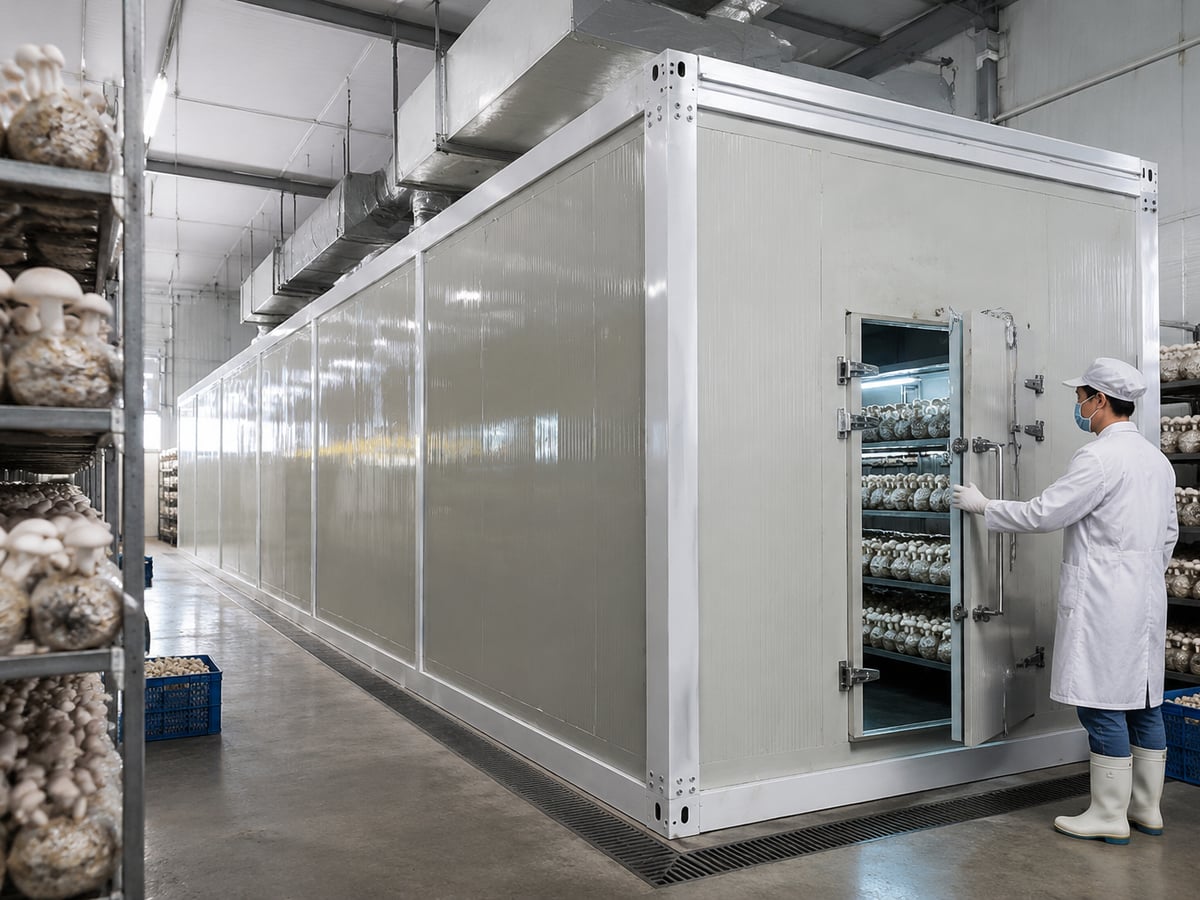
Smart mushroom cultivation containers combine insulation panels, cooling systems, heating equipment, humidification devices, ventilation fans, air inlets, drainage routes, sensors, and automated controllers in a compact growing environment. Because these systems operate under high humidity and frequent temperature changes, small maintenance problems can quickly become serious. A blocked drain can raise humidity beyond the crop target. A dirty filter can reduce fresh-air volume. A scale-covered humidifier nozzle can create uneven moisture distribution. An inaccurate sensor can cause a controller to run cooling or heating equipment unnecessarily.
For farms producing oyster mushrooms, shiitake, enoki, button mushrooms, lion’s mane, king oyster mushrooms, or specialty fungi, maintenance should be based on crop cycle intensity rather than on a single fixed calendar. High-output farms near Rotterdam, Dubai, Singapore, Los Angeles, Hamburg, Melbourne, São Paulo, or Nairobi may operate containers continuously and require more frequent inspections than seasonal projects.
| Maintenance Frequency | Main Tasks | Operational Purpose | Responsible Role |
|---|---|---|---|
| Every shift | Check temperature, humidity, CO₂, alarms, water level, drainage, and fan operation | Prevent rapid climate deviation | Grow room operator |
| Daily | Inspect filters, water quality, humidifier output, door seals, and floor cleanliness | Maintain stable crop conditions | Farm supervisor |
| Weekly | Clean air inlets, inspect fans, flush drainage routes, check electrical terminals | Reduce airflow and moisture risks | Maintenance technician |
| Between batches | Deep clean surfaces, sanitize drainage, inspect coils, replace damaged seals | Lower contamination pressure | Sanitation and technical team |
| Monthly | Verify sensor accuracy, test alarms, inspect belts, pumps, valves, and controllers | Confirm control reliability | Qualified technician |
| Seasonally | Review system performance, refrigerant condition, insulation integrity, spare parts stock | Prepare for weather and production changes | Operations manager |
The table provides a practical starting point. Actual intervals should be adjusted according to local water hardness, dust levels, coastal corrosion exposure, outdoor temperature, crop loading, and operating hours. Containers operating near ports such as Jebel Ali, Antwerp, Busan, Shanghai, Mombasa, or Santos may need more frequent checks because salt air, logistics dust, or rapidly changing ambient conditions can affect air-handling components.
Before purchasing or operating a new system, define maintenance ownership. The best equipment cannot perform consistently if no team member is responsible for daily inspections, sanitation approval, spare-part ordering, and corrective action. A clear checklist is more valuable than relying on memory.
Daily Climate and Water Checks

Daily climate and water checks are the foundation of mushroom container reliability. At the beginning of each shift, compare controller readings with crop targets and inspect whether actual conditions match expected equipment operation. If the system is calling for humidification, operators should confirm that mist or moisture output is present. If CO₂ levels are increasing, check whether fresh-air fans, dampers, or exhaust pathways are operating correctly.
Temperature, relative humidity, CO₂ concentration, and airflow should be reviewed together. For example, low humidity may result from inadequate humidifier output, but it can also be caused by excessive ventilation, a damaged door seal, a cooling coil operating too aggressively, or a blocked water line. Treating the symptom alone may not solve the underlying issue.
Water quality deserves equal attention. Hard water can form mineral scale on nozzles, pumps, solenoid valves, float switches, pipes, and humidification pads. Water containing sediment can clog filters and reduce flow. Water with poor microbial quality can introduce unwanted contamination into the growing environment. Farms should monitor source water, filtration performance, storage tank cleanliness, and visible buildup around humidification components.
| Daily Inspection Point | What to Observe | Warning Sign | Recommended Action |
|---|---|---|---|
| Temperature reading | Compare controller value with independent thermometer | Difference greater than the farm tolerance | Inspect sensor placement and calibration |
| Humidity level | Review humidity trend and physical moisture output | Repeated dry periods or condensation | Check humidifier, airflow, and drainage |
| CO₂ reading | Compare crop stage target with actual concentration | Slow reduction after ventilation starts | Inspect fans, dampers, filters, and inlets |
| Water tank | Check level, clarity, odor, and sediment | Cloudy water, deposits, or unusual smell | Clean tank and improve filtration |
| Drainage outlet | Confirm free flow and dry exterior area | Standing water or backflow | Flush line and remove blockage |
| Door seal | Inspect compression and visible gaps | Condensation around door frame | Clean, adjust, or replace seal |
| Controller alarm screen | Review active and historical alarms | Repeated alarm without corrective record | Investigate cause and log repair |
A practical daily check should take 10 to 20 minutes per container when the system is well maintained. The operator should record readings at a consistent time and note crop stage, outside weather, and unusual equipment behavior. This creates a useful operational history. When a yield problem occurs, records can reveal whether it followed a heatwave, water supply interruption, filter blockage, or sensor failure.
Operators using a smart mushroom climate controller can review trend data remotely, but remote monitoring does not replace physical inspection. Cameras and dashboards may show an alarm, yet they cannot always reveal scale buildup, water leakage, strange fan noise, or damaged insulation edges.
In regions with unstable municipal water pressure, including some industrial zones in Africa, South Asia, Latin America, and the Middle East, consider installing a buffer tank, pressure regulator, sediment filtration, and low-water alarm. These additions reduce the risk of sudden humidification failure during critical fruiting stages.
Cleaning Between Mushroom Batches

Cleaning between mushroom batches is essential for reducing pest pressure, mold spores, bacteria, flies, mites, and residual organic material. The objective is not simply to make the container look clean. The objective is to remove biological load from surfaces, drainage systems, equipment housings, floors, shelving, and hard-to-reach airflow areas before new substrate enters the room.
After harvest, remove all spent substrate, packaging waste, loose debris, and damaged growing materials. Vacuum or sweep dry residues carefully before applying water. Excessively wet cleaning at the beginning can spread organic matter into drains and corners. Once debris is removed, wash surfaces with a suitable detergent, rinse thoroughly, apply an approved sanitizer according to its label instructions, and allow the container to dry before loading the next batch.
Pay special attention to the area behind shelving, under racks, beneath humidification pipes, around fan guards, near door thresholds, and at ceiling corners. These locations often collect dust, mushroom fragments, and moisture. If the farm uses reusable trays or racks, clean and sanitize them outside the main container where possible.
| Cleaning Zone | Common Residue | Preferred Method | Verification Standard |
|---|---|---|---|
| Floor and corners | Substrate fragments, water, organic debris | Dry removal, wash, rinse, sanitize | No standing water or visible residue |
| Wall panels | Condensation marks and spore deposits | Soft brush and non-corrosive cleaner | Clean surface without panel damage |
| Racks and shelves | Crop residue and bag fragments | Wash separately and sanitize | Dry before reuse |
| Drainage channels | Slime, sediment, biofilm | Flush, brush, sanitize, inspect flow | Free drainage and no odor |
| Fan guards | Dust, spores, airborne particles | Vacuum or wipe after power isolation | Open airflow path |
| Door frame and seals | Condensation, dust, residue | Wipe and inspect seal compression | No cracks, gaps, or residue |
| Humidifier enclosure | Scale and moisture deposits | Follow manufacturer cleaning procedure | Consistent output after restart |
Do not use highly corrosive chemicals on stainless steel, coated sheet metal, electrical enclosures, sensors, or insulation panel joints unless the chemical supplier and equipment manufacturer confirm compatibility. Chlorine-based products, acidic descalers, and alkaline detergents can be effective when used correctly, but incorrect concentration or inadequate rinsing may shorten equipment life.
Cleaning procedures should include lockout and power isolation steps. Fans, pumps, controllers, electrical panels, and heating elements must be protected from direct high-pressure washing. Use low-pressure cleaning methods near sensitive equipment. After sanitation, inspect for loose wires, damaged panels, cracked seals, and water trapped around electrical components.
Commercial growers supplying supermarkets, hotels, food distributors, and export markets should retain batch-cleaning records. These records support internal quality management and help demonstrate disciplined operations when working with buyers in markets such as the European Union, Gulf Cooperation Council countries, Japan, Canada, Australia, and the United States.
Filters, Fans, and Air Inlets
Air movement determines how evenly temperature, humidity, and CO₂ are distributed inside a mushroom cultivation container. Dirty filters, weak fans, blocked inlets, and damaged dampers can create microclimates that reduce mushroom quality. Crops near the air outlet may dry too quickly, while crops in stagnant zones may develop excessive moisture or irregular pinning.
Inspect filters visually and replace or clean them before airflow is noticeably restricted. In dusty agricultural zones, construction areas, desert regions, and logistics hubs, filter loading may occur much faster than expected. A container located near a flour mill, grain facility, livestock farm, unpaved road, or port warehouse needs closer attention than a unit in a clean industrial park.
Fans should run smoothly without vibration, scraping noise, excessive heat, or unusual electrical smell. Check fan guards, mounting hardware, motor condition, bearings, and blades. Loose hardware can create vibration that gradually damages brackets, wiring, and duct connections. Fan imbalance may also increase energy consumption.
| Air System Component | Inspection Interval | Typical Problem | Impact on Cultivation |
|---|---|---|---|
| Pre-filter | Weekly or as required | Dust accumulation | Reduced fresh-air volume |
| Fine filter | Monthly or pressure-based | Blocked media | Higher fan load and poor air exchange |
| Circulation fan | Weekly visual check | Noise, vibration, dirty blades | Uneven room climate |
| Fresh-air fan | Weekly operational check | Motor overheating or weak rotation | High CO₂ and weak pin formation |
| Air inlet louver | Weekly cleaning | Dust, insects, obstruction | Restricted outside air entry |
| Damper actuator | Monthly test | Sticking or delayed movement | Incorrect ventilation control |
| Air duct connection | Between batches | Loose joint or condensation leak | Air loss and moisture damage |
When replacing filters, match the correct size, air resistance rating, and material specification. Installing a filter that is too restrictive can overload fan motors and reduce ventilation. Installing a filter with inadequate filtration can allow dust, insects, and contaminants to enter the production environment.
Air inlets should be designed to prevent rain entry, insect access, and wind-driven dust. In coastal locations such as Durban, Valparaíso, Manila, and Istanbul, inspect external louvers for corrosion and salt deposits. In cold climates, inspect inlet areas for frost and condensation. In hot climates, consider whether direct sunlight or hot outdoor air is placing additional load on cooling systems.
For larger projects, use differential pressure readings across filters and trend fan current draw. These measurements provide more accurate replacement timing than visual inspection alone. They also help operations teams identify whether reduced airflow comes from filter loading, fan wear, blocked ducts, or incorrect controller settings.
Humidification Components and Water Scale
Humidification equipment must operate reliably because mushroom crops are highly sensitive to moisture balance. However, humidification components work in one of the most demanding parts of the container environment: constant water exposure, mineral deposits, biofilm risk, and frequent on-off cycles.
Water scale is especially common where groundwater or municipal water contains high levels of calcium and magnesium. Scale can reduce nozzle opening size, weaken mist quality, damage pump seals, block solenoid valves, and interfere with float switches. In severe cases, a humidification system may appear to be operating while delivering insufficient moisture into the room.
Inspect nozzles, pipes, pumps, water filters, tanks, valves, and humidification pads regularly. If white mineral deposits appear, introduce a controlled descaling program using a product compatible with the equipment materials. Follow flushing procedures after descaling so that residue does not enter the crop environment.
| Humidification Component | Scale or Water Risk | Maintenance Action | Recommended Frequency |
|---|---|---|---|
| Water tank | Sediment, algae, biofilm | Drain, clean, sanitize, refill | Weekly to monthly |
| Sediment filter | Restricted flow | Replace cartridge or clean housing | According to pressure drop |
| Humidifier nozzle | Mineral blockage | Remove and descale carefully | Weekly in hard-water areas |
| Pump | Seal wear and reduced pressure | Inspect pressure, sound, leakage | Weekly |
| Solenoid valve | Scale and sticking | Test opening and closing response | Monthly |
| Water line | Biofilm and sediment buildup | Flush and inspect connectors | Between batches |
| Float switch | Deposits causing false readings | Clean and test level response | Monthly |
Water treatment choices depend on local supply conditions. Sediment filtration is useful for visible particles. Carbon filtration may help improve some water characteristics. Softening systems can reduce mineral scale. Reverse osmosis may be suitable for demanding applications, although operators should consider water recovery, cost, and local regulations. In regions facing water scarcity, such as parts of the Middle East, North Africa, Australia, and southern Europe, water efficiency should be included in equipment planning.
Humidification maintenance also has a sustainability benefit. A clean system reaches the required humidity faster, uses less power, and reduces unnecessary water waste. By 2026, more commercial mushroom farms are expected to adopt water-flow monitoring, automatic leak detection, water reuse assessment, and predictive scale alerts as part of resource-efficient cultivation management.
When buying a container, ask whether humidification components are accessible for cleaning without removing major panels or dismantling the entire system. Service access is a practical design feature that affects long-term labor cost.
Coils, Seals, and Drainage Routes
Cooling coils, heating coils, door seals, insulation panel joints, and drainage routes should be inspected between batches and whenever climate control becomes unstable. These components influence both energy efficiency and hygiene. Dirty coils reduce heat transfer. Damaged seals allow unwanted air leakage. Blocked drains create standing water and increase microbial risk.
Coils should be kept free from dust, spore deposits, and accumulated moisture. Use a soft brush, low-pressure air, or approved coil-cleaning method. Bent fins can reduce airflow and should be straightened carefully with suitable tools. Never damage refrigerant lines or electrical connections while cleaning.
Door seals are often overlooked, even though they have a major effect on energy consumption. A loose or cracked seal can pull hot, cold, humid, or dusty outside air into the container. In humid climates, this can increase condensation around the entrance. In cold climates, it can create frost near the door frame. In hot climates, it can increase cooling demand.
Drainage routes should have sufficient slope, clean traps, and protected outlets. If the drain is connected to a shared building system, prevent odors or pests from entering the container through the line. A simple daily visual inspection of drainage flow can prevent expensive repairs later.
For modular systems installed at remote agricultural sites, maintain spare seals, drain fittings, pipe connectors, clamps, and coil-cleaning tools on site. Waiting for small replacement items can cause longer downtime than the repair itself. This is especially important for projects located far from major logistics centers such as Mexico City, Johannesburg, Jakarta, Lima, or Almaty.
Sensor Calibration and Alarm Testing
Automated climate control is only as accurate as its sensors and alarm logic. Temperature, humidity, CO₂, water level, pressure, and door sensors should be checked regularly against reliable reference instruments. Sensor drift can occur because of moisture exposure, dust, aging, electrical interference, physical damage, or incorrect installation location.
Calibration frequency depends on the sensor type, crop sensitivity, local conditions, and farm quality requirements. Temperature sensors may remain stable for long periods, while humidity and CO₂ sensors often require more frequent verification. Do not place reference instruments directly beside a sensor without considering airflow patterns; compare readings in representative crop zones.
Alarm testing should include high-temperature alarms, low-temperature alarms, high-humidity alarms, low-water alarms, fan-failure alarms, power-loss alarms, communication alarms, and door-open warnings. Every alarm should have a defined response: who receives it, how quickly they respond, what action they take, and how they record the event.
Modern farms increasingly use cloud dashboards, mobile alerts, remote access, and automated trend reporting. These tools are valuable for multi-site operations, distributors, and engineering teams, but they must be supported by local backup procedures. A farm should know what happens if internet service fails, a controller loses communication, or a power interruption occurs during a critical crop stage.
By 2026, predictive maintenance is likely to become more common in mushroom production. Controllers may identify unusual fan current, longer cooling cycles, repeated humidifier activation, sensor drift patterns, and declining water pressure before a complete failure occurs. Farms that keep clean historical data will benefit most from these technologies.
Recording Faults and Replacement Parts
Fault records turn maintenance from reactive repair into measurable operational management. Every issue should include the date, container identification number, crop stage, symptoms, alarm code, inspection findings, corrective action, replacement parts used, technician name, and confirmation that the system returned to normal operation.
For example, instead of recording “humidity problem fixed,” write “Container C-03, fruiting day 7: humidity remained 6% below target; found scale blockage in three mist nozzles and sediment filter heavily loaded; replaced filter cartridge, cleaned nozzles, flushed line, verified stable output for two hours.” This level of detail helps identify repeated causes and improves spare-part planning.
Maintain a critical spare-parts list that includes filters, sensor probes, fuses, relays, contactors, fan belts where applicable, water pumps, solenoid valves, humidifier nozzles, drain fittings, door seals, controller communication components, and emergency lighting parts. The exact list should be based on system design and local supply lead times.
Farms working with international equipment suppliers should confirm part numbers, electrical specifications, voltage requirements, shipping weight, and customs documentation before ordering. Global customers may receive components through sea freight routes from Qingdao, Shanghai, Ningbo, or Shenzhen, while urgent small parts may travel by air through Beijing, Dubai, Frankfurt, Singapore, or regional courier hubs.
Lanhu provides technical guidance and spare-parts support for customers operating modular cultivation systems internationally. Buyers can review the company’s warranty and after-sales service information when planning maintenance responsibilities, remote troubleshooting procedures, and long-term parts availability.
A strong service plan should include local electrical support, plumbing capability, refrigeration assistance where required, and a direct communication channel with the equipment manufacturer. Local technicians can handle routine inspections, while factory engineers can support complex controller logic, system configuration, component identification, and performance troubleshooting.
Our Company
Shandong Lanhu Air Conditioning Equipment Co., Ltd. supports commercial mushroom farms, agricultural contractors, equipment distributors, engineering companies, and controlled-environment agriculture projects in the Global Market. The company develops modular cultivation solutions designed for practical climate management, including smart mushroom cultivation containers, climate controllers, hydroponic plant containers, and air source heat pump systems.
Its technological capabilities are based on more than 12 years of thermodynamic research and development experience. Lanhu integrates temperature control, humidity regulation, ventilation management, sensor monitoring, electrical control, and cultivation environment design to help growers maintain more stable production conditions. The company’s patented technical development supports equipment intended for agricultural climate control and modular growing applications.
Its manufacturing capabilities include product design, engineering development, sheet metal fabrication, CNC bending, insulation panel production, electrical assembly, system integration, testing, and quality inspection. The manufacturing facility in Dezhou, Shandong, China covers more than 30,000 square meters. Before shipment, systems undergo functional inspection, electrical verification, performance testing, and operational evaluation to help reduce commissioning risks for overseas projects.
Its service capabilities include factory-direct supply, OEM and ODM customization, engineering assistance, international logistics coordination, installation guidance, spare-parts support, and after-sales service. This approach is useful for projects that require different container sizes, climate ranges, electrical standards, crop layouts, or transport arrangements. Customers can also explore international project examples through the company’s mushroom cultivation case studies.
When selecting a supplier, buyers should evaluate more than equipment price. Compare climate-control design, insulation performance, accessibility for maintenance, electrical documentation, controller functions, spare-part availability, packaging quality, technical response time, and experience with international shipping. A lower initial purchase price may become more expensive if replacement parts are difficult to source or if the system requires frequent manual adjustment.
For distributors and project developers, local supplier networks remain important. A manufacturer can provide core equipment and technical support, while local partners may provide installation labor, electrical connection, civil preparation, water treatment, refrigeration service, and operator training. This combination is often effective for projects in emerging agricultural markets and remote commercial farms.
Frequently Asked Questions
How often should a mushroom container be cleaned?
Operators should remove debris and inspect hygiene conditions daily, while full sanitation should be performed between mushroom batches. High-volume farms, warm climates, and operations with repeated contamination issues may require additional cleaning during the crop cycle.
How frequently should filters be replaced?
Filter replacement depends on dust load, airflow resistance, local environmental conditions, and fan performance. Visually inspect filters weekly and replace them when airflow is restricted, pressure drop increases, or the filter media cannot be cleaned effectively.
What causes humidity to stay below the target level?
Common causes include scale-clogged nozzles, low water pressure, blocked filters, pump failure, excessive fresh-air intake, door leakage, damaged seals, incorrect sensor readings, or cooling equipment operating longer than expected.
Why is drainage maintenance important in mushroom cultivation?
Blocked drainage can cause standing water, unpleasant odor, increased contamination risk, humidity instability, and damage to flooring or insulation joints. Drainage routes should be inspected daily and flushed between batches.
Can smart controllers replace manual inspections?
No. Smart controllers improve monitoring, alarm management, trend analysis, and remote access, but operators still need to physically inspect water systems, filters, fans, seals, drainage, and crop conditions.
What spare parts should be stored on site?
Keep critical parts such as filters, fuses, relays, sensor probes, humidifier nozzles, solenoid valves, drain fittings, seals, connectors, and other components identified by the equipment supplier as high-priority items.
What maintenance trends will affect mushroom farms in 2026?
Key trends include predictive maintenance, remote alarm analytics, water-use monitoring, energy-performance tracking, low-impact cleaning methods, improved insulation, efficient heat pump integration, and stronger documentation for food safety and sustainability programs.
Share this article

About the Author: Shandong Lanhu Air Conditioning Equipment
Lanhu is a professional climate control equipment manufacturer specializing in smart agricultural systems, commercial HVAC solutions, and customized temperature control technologies. With extensive engineering experience, Lanhu provides reliable solutions for plant factories, controlled environment agriculture, and industrial applications.
Need a Custom Climate Control Solution?
From smart agricultural systems to commercial HVAC solutions, Lanhu provides reliable temperature and humidity control solutions tailored to your project needs.
Contact Us