Mushroom CO2 Control Systems for the Global Market
Quick Answer

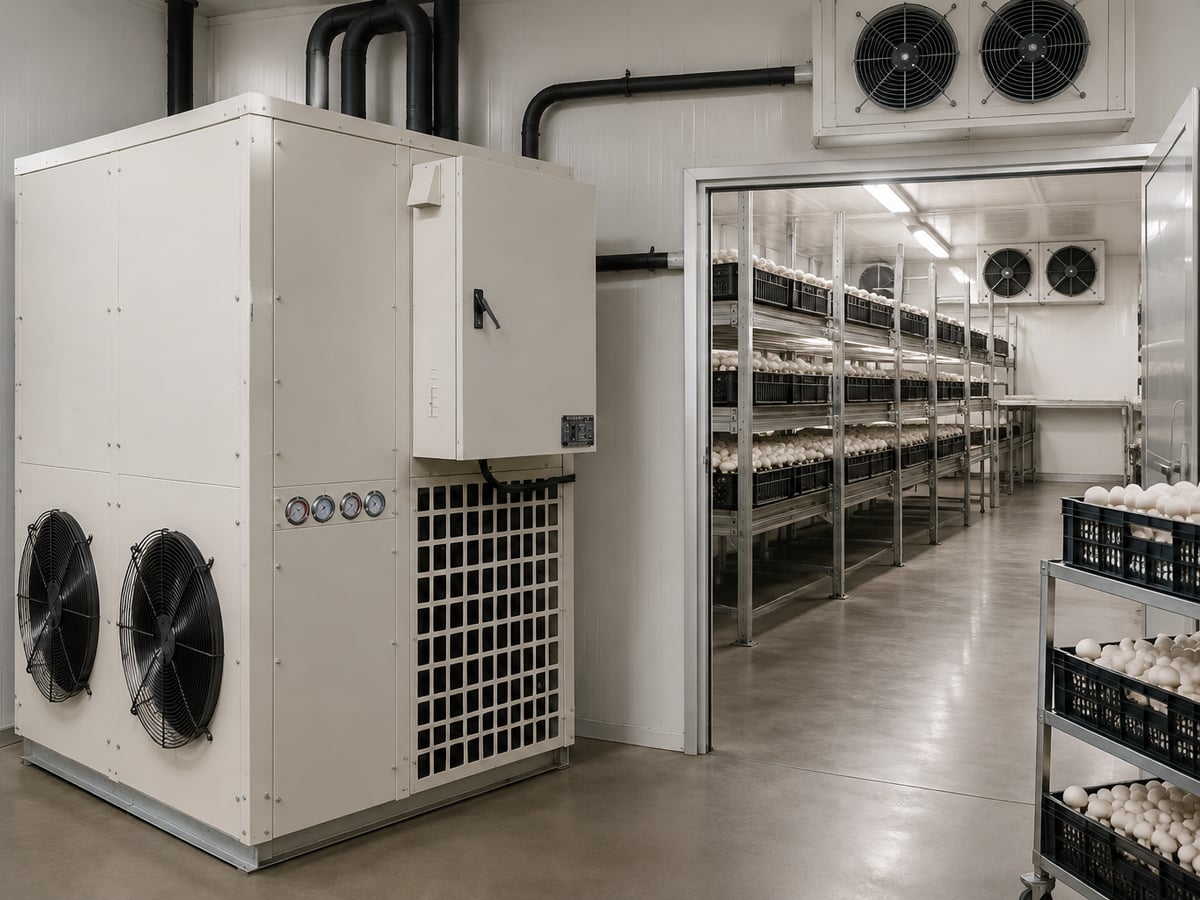
A mushroom CO2 controller measures carbon dioxide concentration in the growing room and uses that information to regulate fresh-air dampers, supply fans, recirculation fans, and exhaust equipment. As mushrooms and substrate respire, they release CO2. When concentration rises above the programmed limit, the controller increases outside-air exchange; when the target is restored, it reduces ventilation to protect humidity, temperature, and energy efficiency.
The most reliable system uses a properly ranged NDIR CO2 sensor, careful sensor placement, variable-speed or staged fans, balanced supply and exhaust airflow, and alarms for high CO2, sensor failure, communication loss, and abnormal ventilation performance. A single sensor can control a small room, but larger rooms with loaded racks should be checked at several locations because CO2 is rarely distributed evenly.
For commercial farms, the best design is not simply “turn the fan on when CO2 is high.” It is a coordinated climate-control strategy that considers crop stage, room temperature, relative humidity, outside weather, air pressure, door openings, rack arrangement, and the operating limits of the ventilation system. This approach is suitable for button mushrooms, oyster mushrooms, shiitake, lion’s mane, and other cultivated species.
How Mushroom Respiration Changes CO2

Respiration is the biological process that converts available nutrients and oxygen into energy. Mushrooms, mycelium, casing materials, and microorganisms all contribute to gas exchange. The result is the production of carbon dioxide and heat, particularly when the crop is actively colonizing, pinning, fruiting, or carrying a high biological load.
CO2 behavior changes during the production cycle. A newly filled room may have relatively moderate gas production, while a heavily colonized substrate or a room with dense fruit bodies can produce a rapid increase. The room may remain within target conditions during the day and rise significantly overnight if ventilation is reduced or the building is tightly sealed.
Different species also have different tolerance levels and airflow requirements. Oyster mushrooms often require strong fresh-air management to prevent excessive stem elongation and poor cap development. Button mushrooms typically need accurate coordination between CO2, temperature, humidity, and air velocity. Shiitake and specialty mushrooms may have different setpoints depending on strain, substrate, and fruiting schedule. The controller should therefore support recipe-based settings instead of one fixed limit for every crop.
| Production condition | Typical CO2 behavior | Control implication | Common risk | Recommended response | Verification method |
|---|---|---|---|---|---|
| Freshly loaded substrate | Gas generation begins gradually | Use gentle baseline ventilation | Over-ventilation dries the room | Maintain minimum airflow and monitor the trend | Compare sensor readings after loading |
| Active colonization | CO2 can rise steadily over time | Use scheduled and demand-based ventilation | High concentration may remain unnoticed | Set a high limit and trend alarm | Review hourly data logs |
| Pinning period | Small changes can affect development | Use stable, responsive control | Rapid air changes disturb humidity | Limit fan ramp speed and protect RH | Inspect pins and room uniformity |
| Heavy fruiting load | CO2 may increase quickly | Increase available air capacity | Fans cannot recover concentration | Check fan duty, filters, and dampers | Measure recovery time after a peak |
| Night operation | Reduced ventilation allows accumulation | Keep a night minimum setting | Morning concentration starts too high | Use nighttime limits and pre-ventilation | Compare day and night trends |
| Door or harvest activity | CO2 may change abruptly | Filter short transients | False alarms trigger unnecessary airflow | Use delay timers and event logging | Check readings against activity records |
The important measurement is not only the current CO2 number but also its rate of change. A slow increase may be handled with a small fan adjustment. A rapid increase suggests a sudden biological load, blocked filter, closed damper, failed exhaust fan, or inaccurate sensor. Advanced controllers can use proportional control, staged control, or PID-style algorithms to respond smoothly rather than repeatedly switching equipment on and off.
Choosing CO2 Sensor Range and Placement

Sensor selection should begin with the expected operating range, not with the lowest purchase price. A sensor intended for a controlled growing room may need a different range from one used in a composting area, loading zone, or high-density production chamber. For most cultivation rooms, an NDIR sensor is preferred because it provides stable measurement without relying on consumable chemical reagents.
A very wide measurement range can reduce resolution at normal cultivation levels, while an excessively narrow range may saturate during an abnormal event. Ask the supplier for measurement accuracy, repeatability, response time, temperature compensation, calibration interval, output type, ingress protection, and recovery behavior after exposure to high CO2. Modbus, 0–10 V, and 4–20 mA interfaces are commonly used in integrated climate systems.
Placement is equally important. Mount the sensing point in the active air zone, away from direct supply-air jets, exhaust openings, humidifier discharge, cooling coil outlets, and doors. CO2 is heavier than air under many room conditions, but air movement, temperature gradients, rack geometry, and fan operation can create local pockets at different heights. A wall sensor installed beside the doorway may not represent the air between loaded racks.
For a small room, one central sensor may be sufficient if airflow is well mixed. For long rooms, high racks, or rooms with multiple air circuits, use a primary control sensor plus portable verification measurements. Larger installations may benefit from multiple fixed sensors with averaging, high-reading selection, or zone-based control.
| Sensor consideration | Preferred practice | Why it matters | Buying question | Maintenance action | Failure symptom |
|---|---|---|---|---|---|
| Measurement technology | Industrial NDIR CO2 sensing | Provides stable gas measurement | Is automatic compensation included? | Follow the calibration schedule | Slow drift or implausible values |
| Measurement range | Match the normal and fault range | Protects resolution and avoids saturation | What happens above the rated range? | Check high-level recovery | Reading remains fixed at the maximum |
| Accuracy | Use documented accuracy at room conditions | Improves control stability | Is accuracy specified across humidity? | Compare with a reference instrument | Frequent unnecessary fan changes |
| Installation height | Place in the representative breathing zone of the crop | Reflects actual crop exposure | Can the probe be remotely mounted? | Inspect brackets and cables | Readings change when the door opens |
| Environmental protection | Use a protected enclosure suitable for humid rooms | Reduces condensation damage | What is the ingress protection rating? | Keep vents clean and dry | Intermittent signal or corrosion |
| Communication | Use a documented analog or digital protocol | Supports reliable integration | How are faults reported to the controller? | Check terminals and address settings | Signal loss or frozen value |
Before final commissioning, map the room. Record CO2 at the supply side, return side, upper rack, lower rack, center aisle, and door side during normal operation. If readings differ significantly, correct the air pattern before changing the setpoint. A more sensitive controller cannot solve a poorly mixed room.
Demand-Based Fresh-Air Control
Demand-based ventilation adjusts fresh-air delivery according to measured CO2 rather than operating at full capacity continuously. This saves energy and helps preserve humidity, especially in cold or dry climates such as northern Europe, Canada, northern China, and inland areas of the United States. It also reduces unnecessary temperature fluctuations caused by excessive outdoor-air intake.
A basic strategy uses three values: a target setpoint, a low or stop threshold, and a high or maximum-ventilation threshold. For example, the system may maintain a crop-specific target, begin increasing fresh air above the target, and reach full programmed ventilation at the high threshold. The exact values must be determined by species, cultivar, crop stage, room design, and agronomic testing rather than copied from a generic chart.
Proportional control is usually smoother than simple on-off control. If CO2 is only slightly above the target, the controller can increase fan speed by a small amount. If the concentration continues to rise, it can open the intake damper further and increase exhaust capacity. Once the value falls, the system should reduce output gradually to prevent oscillation.
Ventilation should also have a minimum position. Even when CO2 is below the target, the room may need baseline fresh air for odor control, oxygen balance, condensation management, or process requirements. A minimum setting prevents stagnant zones and allows the controller to recover more quickly after door openings or high biological activity.
| Control mode | Operating principle | Best application | Advantage | Limitation | Commissioning check |
|---|---|---|---|---|---|
| On-off control | Fan switches at one or two limits | Small, simple rooms | Low installation cost | Creates wider CO2 swings | Confirm delay and hysteresis |
| Staged control | Fans or dampers operate in steps | Medium rooms with fixed equipment | Easy to understand and service | May cause abrupt airflow changes | Test each stage independently |
| Variable-speed control | Fan speed follows demand | Commercial rooms with EC or VFD fans | Efficient and smooth | Requires compatible drives | Verify minimum safe fan speed |
| Proportional control | Output changes according to CO2 deviation | Rooms needing stable conditions | Reduces overshoot | Needs suitable tuning | Observe recovery and settling time |
| Recipe control | Setpoints change with crop stage | Multi-stage production facilities | Matches biological requirements | More setup and operator training | Audit each recipe transition |
| Zone control | Separate areas respond to local sensors | Large halls or modular farms | Improves uniformity | Higher equipment and wiring cost | Check zone interaction and pressure |
Outdoor conditions must be part of the control logic. A cold winter intake may require preheating. Hot, humid air may require cooling or dehumidification before entering the crop room. In dry weather, full fresh-air exchange can reduce relative humidity rapidly. The controller should therefore coordinate CO2 demand with temperature and humidity limits rather than treating gas concentration as an isolated variable.
Coordinating Dampers, Fans, and Exhaust
Fresh-air systems work correctly only when intake and exhaust components operate as a coordinated group. Opening an intake damper without enabling exhaust may pressurize the room and cause air leakage through doors, panels, and service openings. Running an exhaust fan while the intake damper is closed can create excessive negative pressure, draw unfiltered air through gaps, and reduce the actual airflow below the controller’s expectation.
A typical sequence begins with a permissive check. The controller confirms that the system is enabled, the emergency stop is reset, the damper is available, and no critical sensor fault is active. It then opens the intake damper, waits for position feedback or a short proving time, starts the supply or exhaust fan, and verifies airflow or fan status. When demand falls, the system reverses the sequence with a controlled run-on period to remove residual CO2.
Where possible, use feedback rather than assuming that a command equals actual operation. Damper position feedback, fan run status, differential pressure, airflow switches, and motor fault contacts can identify failures quickly. A fan commanded to 70% but running at 20% because of a drive fault should create an alarm and a safe response.
Air filtration adds resistance as it becomes dirty. The controller may need to increase fan speed to maintain airflow, but there is a practical limit. A differential-pressure sensor across the filter helps maintenance teams identify replacement requirements before the room loses ventilation capacity.
| Component | Primary function | Useful feedback | Typical fault | Control response | Maintenance focus |
|---|---|---|---|---|---|
| Fresh-air damper | Regulates outdoor-air entry | Position signal | Stuck or partially closed | Alarm and limit fan demand | Inspect actuator and linkage |
| Exhaust fan | Removes room air and CO2 | Run contact or speed signal | Motor or drive failure | Stop dependent intake sequence | Check bearings, belt, and wiring |
| Supply fan | Distributes conditioned air | Airflow or pressure | Low output or blocked filter | Increase service alert or reduce load | Clean filters and inspect impeller |
| Recirculation fan | Mixes room air and reduces stratification | Run status | Dead zone between racks | Maintain minimum circulation | Check direction and balance |
| Filter section | Protects the crop from contaminants | Differential pressure | Progressive blockage | Generate maintenance alarm | Replace according to pressure limit |
| Variable-speed drive | Matches motor output to demand | Speed and fault code | Overload or communication loss | Use backup stage or safe mode | Review drive settings and cooling |
Balanced air distribution matters as much as equipment capacity. Supply air should reach the crop without creating damaging drafts or drying the casing. Return and exhaust openings should be positioned to remove accumulated CO2 without short-circuiting directly from supply to exhaust. In modular containers, the compact room geometry makes diffuser direction, rack spacing, and fan selection especially important.
Maintaining Humidity During Air Exchange
Fresh-air exchange almost always affects humidity. If outside air is drier than the room air, CO2 reduction may be accompanied by a drop in relative humidity. If outside air is warm and humid, ventilation may add moisture and latent heat. For this reason, a mushroom climate controller should coordinate CO2 ventilation with humidification, cooling, heating, and dehumidification.
A practical sequence is to increase air exchange gradually while monitoring relative humidity and temperature. If humidity falls below the permitted band, the system can reduce the ventilation ramp, activate humidification when appropriate, or use conditioned air instead of untreated outside air. If humidity is too high and condensation risk increases, ventilation may be used together with heating or dehumidification.
Relative humidity readings must be interpreted with temperature. A small temperature change can produce a noticeable RH change even when the absolute moisture content is stable. Sensors should be protected from direct mist and positioned where they represent the crop environment. Condensation on a humidity probe can create a false high reading and cause the controller to stop necessary drying.
Humidity management is also a product-quality issue. Excessive drying may produce cracked caps, thin stems, poor weight gain, or uneven flushes. Excessive moisture can encourage bacterial problems, surface water, and condensation on panels or equipment. The correct response depends on species, strain, substrate, and growth phase.
| Air-exchange condition | Humidity effect | Potential crop impact | Preferred control action | Equipment involved | Operator observation |
|---|---|---|---|---|---|
| Cold, dry outdoor air | RH falls quickly | Dry casing or fruit bodies | Precondition air and limit ramp rate | Heater, humidifier, mixing fan | Check surface moisture |
| Warm, humid outdoor air | Moisture load increases | Condensation and disease risk | Use cooling or dehumidification | Cooling coil, drain, dehumidifier | Inspect corners and panels |
| High CO2 with low RH | Ventilation is necessary but drying | Competing climate demands | Use conditioned fresh air | Air handler and humidifier | Review CO2 and RH trends together |
| High CO2 with high RH | Ventilation can improve both | Potential condensation | Increase exchange cautiously | Exhaust and cooling system | Look for wet surfaces |
| Fogging or mist operation | Local RH may be much higher | False sensor readings | Separate probe from direct spray | Humidifier and circulation fans | Inspect probe housing |
| Door opening during harvest | Short-term fluctuation | Temporary stress only | Use alarm delay and recovery logic | Controller and door switch | Record event timing |
Energy performance should be measured alongside crop results. A system that maintains CO2 but consumes excessive heating or cooling energy may need better heat recovery, improved insulation, tighter doors, or more accurate fan control. In regions with high electricity prices, demand-controlled ventilation and heat recovery can significantly improve operating economics.
Alarm Settings and Sensor Fault Modes
Alarms should help operators act before crop quality or worker safety is affected. A high CO2 alarm should have at least two levels: an early warning and a critical alarm. The exact thresholds depend on the room recipe, local occupational-safety requirements, and the intended use of the space. Operators must never enter a room with a high CO2 alarm without following the site’s ventilation and entry procedure.
Alarm delays prevent nuisance notifications caused by door openings, harvest work, or brief fan transitions. However, delays should not be so long that a genuine ventilation failure is hidden. Use separate delays for high concentration, sensor fault, fan failure, and communication loss. Alarm acknowledgment should not disable the underlying protective action.
A sensor fault mode must be clearly defined. If the CO2 sensor is disconnected, out of range, frozen, or reporting invalid data, the controller should not assume that the room is safe. A suitable fallback may be minimum ventilation plus a timed emergency purge, subject to temperature and humidity limits. The system should also notify the operator and record the fault.
| Alarm type | Trigger example | Immediate action | Operator response | Reset condition | Record to retain |
|---|---|---|---|---|---|
| CO2 warning | Concentration above warning limit | Increase ventilation gradually | Check trend and room access | Value remains below reset limit | Time, value, and duration |
| CO2 critical | Concentration reaches critical limit | Run emergency ventilation | Restrict entry and inspect system | Safe reading after verification | Event and corrective action |
| Sensor disconnected | No signal or invalid value | Enter configured fallback mode | Inspect cable, power, and probe | Valid signal for a defined period | Fault code and repair time |
| Sensor drift | Unreasonable change or mismatch | Flag reading for review | Compare with portable instrument | Calibration or replacement completed | Calibration results |
| Fan failure | Commanded fan without run feedback | Stop unsafe damper sequence | Check motor, drive, and breaker | Run proof restored | Fault code and downtime |
| Communication loss | Controller cannot reach remote device | Use local safe settings | Inspect network and address settings | Stable communications restored | Network event history |
Alarm testing should be part of commissioning and periodic maintenance. Simulate a disconnected sensor, a failed fan contact, a blocked filter warning, and a high-CO2 condition using approved test procedures. Confirm that local indicators, remote notifications, data logging, and fallback ventilation all function as intended.
Checking CO2 Across Loaded Racks
Rack loading changes air resistance and creates shadows in the airflow pattern. Bags, trays, shelves, and fruit bodies can restrict circulation, while warm equipment or lighting can create vertical convection. A controller located near the return duct may show an acceptable value even when CO2 is elevated between racks.
Use a calibrated portable meter to survey the room at different rack heights and positions. Measurements should be taken after the room has reached normal operating conditions, not immediately after opening a door. Record the fan speed, damper position, temperature, humidity, crop stage, and time of each reading. Repeat the survey with a full crop load because an empty-room test cannot show the final pressure and airflow pattern.
Uniformity problems can often be corrected by adjusting diffuser direction, increasing recirculation, changing return-air positions, removing obstructions, balancing duct branches, or modifying rack spacing. Raising the overall fan speed may reduce the average CO2 value but still leave local high readings and increase drying.
| Measurement location | What it can reveal | When to measure | Acceptable interpretation | Corrective option | Follow-up |
|---|---|---|---|---|---|
| Near fresh-air supply | Short-circuiting or excessive dilution | During active ventilation | Not used as the only control point | Redirect diffuser airflow | Compare with central rack readings |
| Between lower racks | Low-level accumulation | At full crop load | Should track the room trend | Add circulation or open a flow path | Repeat after loading changes |
| Between upper racks | Stratification and warm-air effects | During stable operation | Difference remains within the farm limit | Balance vertical airflow | Check seasonal behavior |
| Center aisle | Representative operator zone | Before and during harvest | Supports safe work decisions | Improve air mixing if elevated | Link to entry procedure |
| Return-air opening | Average room exhaust condition | At several fan speeds | Useful for trend control | Verify sensor calibration | Compare with portable meter |
| Door side | Leakage and transient effects | After door closure | Stabilizes within the configured delay | Improve seals or air balance | Review door-event logs |
Data logging supports better decisions. Store CO2, temperature, relative humidity, fan speed, damper position, alarms, and crop recipe in a common timeline. A graph can show whether high CO2 is caused by biological production, insufficient fan capacity, a closed damper, or a humidity-protection limit that intentionally reduced ventilation.
Market, Product Types, and Buying Advice
Global mushroom farms use several types of CO2 control equipment. A standalone wall controller may be suitable for a small growing room with one fan. An integrated climate controller is more appropriate when CO2 must coordinate with temperature, humidity, cooling, heating, humidification, and pressure. Containerized cultivation systems generally require compact control hardware, remote monitoring, and factory-tested wiring because the equipment is installed in a limited space.
When comparing suppliers, buyers should evaluate the complete operating system rather than the sensor alone. Confirm whether the quotation includes probes, control cabinet, fan drives, damper actuators, programming, alarm outputs, data logging, commissioning support, and spare parts. Ask for electrical standards suitable for the installation country and verify whether the supplier can provide manuals and labels in the required language.
For international projects, lead time and logistics are important. Equipment shipped through Qingdao, Shanghai, Shenzhen, Rotterdam, Hamburg, Dubai, or Long Beach may face different freight, customs, and installation requirements. A supplier experienced with export packaging, replacement parts, remote troubleshooting, and local engineering coordination can reduce project risk.
| Product type | Suitable facility | Key features | Buyer priority | Typical integration | Best question to ask |
|---|---|---|---|---|---|
| Standalone CO2 controller | Small single-room farm | Basic sensor and relay outputs | Simple operation | One fan or damper | What happens during sensor failure? |
| Multi-room controller | Commercial production site | Multiple zones and recipes | Scalability | Fans, dampers, HVAC, alarms | How many rooms and sensors are supported? |
| PLC-based control cabinet | Engineering projects | Custom logic and industrial wiring | Integration flexibility | BMS, VFDs, monitoring systems | Can the I/O list be customized? |
| Container climate system | Modular or remote production | Compact, prewired equipment | Fast deployment | Cooling, heating, humidity, CO2 | What factory tests are completed? |
| Remote monitoring package | Distributed farms and contractors | Cloud or network trend access | Service visibility | Mobile alerts and data records | How is data protected and exported? |
| OEM or ODM platform | Distributors and branded systems | Custom enclosure and interface | Product differentiation | Private-label control solutions | What documentation and customization are available? |
Industries using these systems include commercial mushroom farms, agricultural contractors, food-production campuses, research facilities, vocational training centers, hydroponic projects, and modular farms operating in remote regions. Applications range from a single fruiting room to a complete facility with incubation, growing, packing, cold storage, and utility areas.
Demand Control in Different Climates and Applications
In tropical areas such as Southeast Asia, coastal Brazil, and parts of Africa, the main challenge may be removing heat and moisture while maintaining the desired CO2 level. Fresh air may require cooling and dehumidification. In cold locations such as northern China, Scandinavia, Canada, and parts of Russia, the priority may be recovering heat and moisture from exhaust air while preventing condensation and freezing.
Urban farms near London, Paris, Singapore, Tokyo, Seoul, New York, and Dubai may have limited space and high energy costs. Modular cultivation containers can provide a controlled production environment where airflow, cooling capacity, and sensor placement are designed together. Remote farms may place greater importance on alarms, autonomous fallback modes, spare-parts availability, and remote technical support.
A CO2 controller can also support process optimization. By comparing gas concentration with harvest weight, flush timing, electricity use, and humidity events, growers can refine recipes for each species. The purpose is not to chase the lowest CO2 value but to maintain the biological environment that produces consistent quality at an acceptable operating cost.
2026 Trends in Mushroom CO2 Management
By 2026, commercial growers are increasingly combining environmental sensors, variable-speed drives, digital records, and predictive maintenance. Controllers are moving from isolated relay panels toward connected climate platforms that can compare rooms, identify abnormal trends, and recommend maintenance before production is affected.
Sensor fusion is a major technology trend. CO2 data can be analyzed together with temperature, relative humidity, differential pressure, fan speed, damper position, and door status. This helps distinguish genuine respiration changes from sensor drift or airflow faults. Edge control is also becoming more important because the room should continue operating safely if an internet connection is lost.
Sustainability policies and energy prices are encouraging heat recovery, high-efficiency EC fans, variable-speed motors, better insulation, low-leakage doors, and demand-based ventilation. Farms are also looking at refrigerant selection, water consumption, packaging materials, and lifecycle serviceability. A system designed for repair and component replacement can reduce waste compared with a sealed, disposable control package.
Future projects should allow for cybersecurity, role-based access, audit trails, and secure remote updates. Data ownership should be discussed during procurement, especially when farms operate across multiple countries or use an external monitoring platform. Open communication protocols and documented interfaces make it easier to expand the installation later.
Our Company
Shandong Lanhu Air Conditioning Equipment Co., Ltd. develops climate-control equipment for agricultural and industrial applications from its manufacturing base in Dezhou, Shandong, China. The company combines more than 12 years of thermodynamic research and development experience with a production facility of over 30,000 square meters. Its product range includes mushroom climate controllers, smart mushroom cultivation containers, smart hydroponic plant containers, and air-source heat pumps.
Its technological capability covers air treatment, temperature control, humidity management, CO2-based ventilation, electrical integration, and modular cultivation design. Engineering teams can adapt control logic for different species, room volumes, crop recipes, fan configurations, and local electrical requirements. More than 45 registered patents and a focus on practical system integration support the development of equipment for commercial farms and engineering contractors.
Manufacturing is managed through integrated processes including product design, engineering development, sheet-metal fabrication, CNC bending, insulation-panel production, electrical assembly, system integration, equipment testing, and quality inspection. Each system undergoes functional inspection, electrical verification, performance testing, and operational evaluation before shipment. ISO 9001, ISO 14001, ISO 45001, and ISO 12100 certifications support its quality, environmental, occupational-safety, and machinery-safety management practices.
For international customers, Lanhu provides factory-direct supply, OEM and ODM development, engineering assistance, international logistics coordination, spare-parts support, installation guidance, and after-sales service. Agricultural contractors, distributors, system integrators, and commercial farming projects can discuss room dimensions, crop type, target climate conditions, electrical standards, monitoring requirements, and delivery destination before selecting the equipment configuration.
Customers can review the smart mushroom climate controller solution for integrated environmental management or explore the modular mushroom cultivation container for compact production projects. The company’s project cases provide additional context for different installation environments, while the OEM and ODM service supports customized branding, enclosure design, control functions, and project documentation.
FAQ
What does a mushroom CO2 controller do?
It measures carbon dioxide in the growing environment and adjusts ventilation equipment to keep the concentration within a programmed operating range. Depending on the system, it can also coordinate temperature, humidity, cooling, heating, humidification, alarms, and data logging.
Which sensor technology is best for mushroom rooms?
An industrial NDIR CO2 sensor is commonly preferred because it provides stable measurement and can be integrated with digital or analog control systems. The sensor should be selected for the expected range, humidity conditions, response time, accuracy, and communication method.
Where should the CO2 sensor be installed?
Install it in a representative crop-air location away from direct supply jets, exhaust openings, humidifier spray, cooling discharge, and doors. Large rooms should be surveyed at several rack heights and locations before choosing the final control point.
Can CO2 control operate with a humidity controller?
Yes. The best systems coordinate CO2 demand with relative humidity, temperature, cooling, heating, and humidification. This prevents fresh-air exchange from drying the crop or adding excessive moisture without conditioning.
Why does CO2 remain high even when the fan is running?
Possible causes include a closed or blocked damper, dirty filter, undersized fan, incorrect fan rotation, excessive rack resistance, poor air mixing, a failed drive, or an inaccurate sensor. Measure airflow and compare several room locations before increasing the setpoint or fan speed.
How often should mushroom CO2 sensors be calibrated?
The interval depends on the sensor design, operating conditions, manufacturer instructions, and the consequences of inaccurate control. Many farms schedule periodic verification with a reference instrument and recalibrate or replace the sensor when drift exceeds the site’s permitted tolerance.
What should happen if the CO2 sensor fails?
The controller should identify the invalid signal, issue an alarm, log the event, and enter a defined fallback mode. This may include minimum ventilation or a timed purge, subject to safe temperature and humidity limits. Operators should repair or replace the sensor promptly.
Are CO2 setpoints the same for every mushroom species?
No. Suitable conditions vary by species, strain, substrate, crop phase, and product objective. Oyster, button, shiitake, and lion’s mane mushrooms may require different strategies. Setpoints should be developed with cultivation experience and verified through crop results.
Is a single CO2 sensor enough for a commercial room?
It may be adequate for a small, well-mixed room, but commercial rooms with long racks, high loading density, or several airflow zones should be checked with portable measurements. Multiple sensors or zone control may be justified when readings vary significantly.
What information should be provided when requesting a quotation?
Provide room dimensions, rack arrangement, crop species, production stage, target temperature and humidity, expected CO2 range, fresh-air and exhaust requirements, electrical supply, climate location, desired alarms, monitoring requirements, and destination port. This allows the supplier to size the system more accurately.
Share this article

About the Author: Shandong Lanhu Air Conditioning Equipment
Lanhu is a professional climate control equipment manufacturer specializing in smart agricultural systems, commercial HVAC solutions, and customized temperature control technologies. With extensive engineering experience, Lanhu provides reliable solutions for plant factories, controlled environment agriculture, and industrial applications.
Need a Custom Climate Control Solution?
From smart agricultural systems to commercial HVAC solutions, Lanhu provides reliable temperature and humidity control solutions tailored to your project needs.
Contact Us