Mushroom Climate Automation Plan for the Global Market
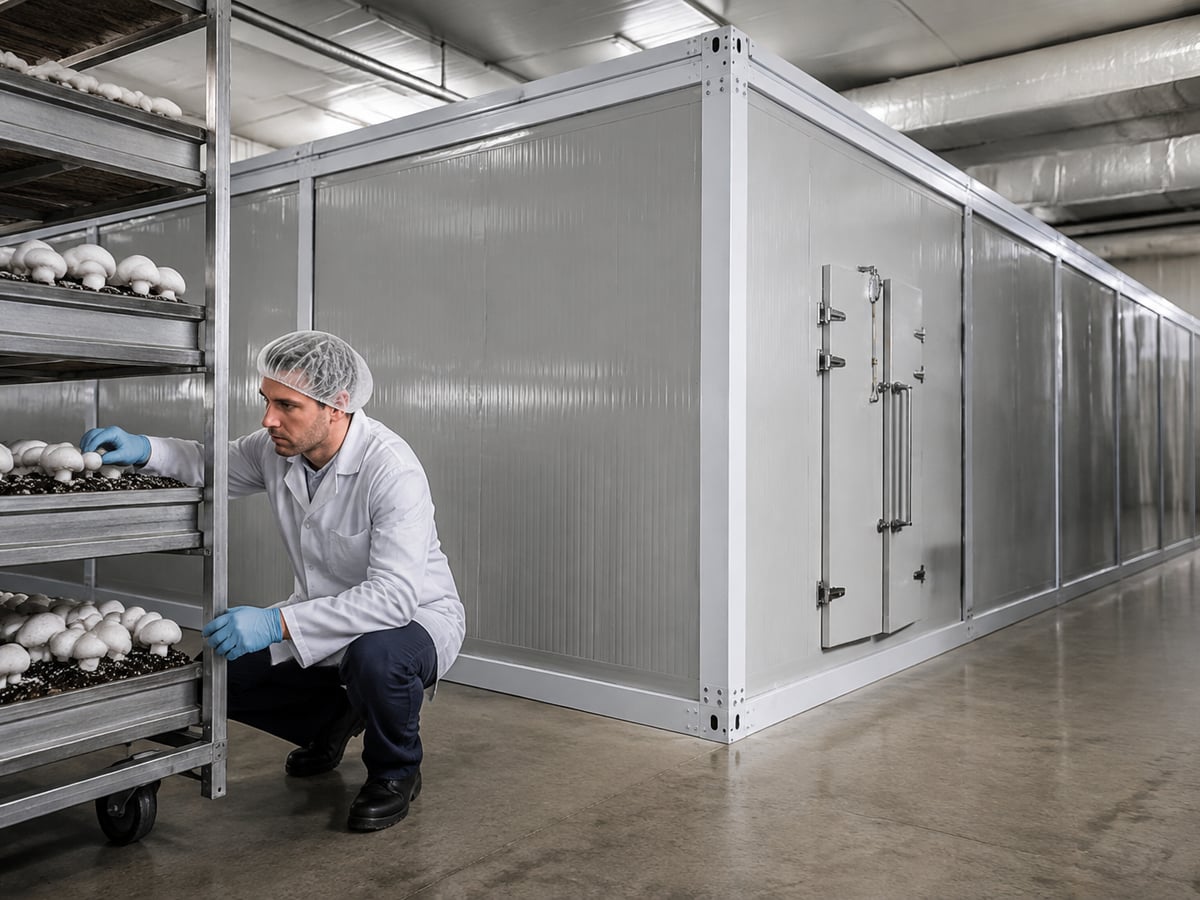
Quick Answer: Build a Reliable Mushroom Climate Control Plan

Mushroom farm automation is most successful when it begins with a clear operating plan rather than a list of equipment. The goal is to convert repeatable climate decisions into safe, measurable control routines while keeping trained staff responsible for crop judgment, maintenance, and abnormal conditions.
A practical plan should begin by recording every climate task performed during a crop cycle. This includes checking temperature, relative humidity, carbon dioxide, fresh-air volume, evaporator operation, heating, cooling, humidification, dehumidification, air pressure, water quality, and sanitation status. Separate routine decisions from decisions that require biological experience. Routine tasks are good candidates for automation; crop observations and final harvest decisions should remain with qualified operators.
Next, define the inputs, outputs, safety limits, and priorities of the control system. Sensors provide inputs, equipment creates outputs, and the controller applies recipes and alarms. A dependable system should protect the crop in this order:
- Personnel safety and electrical protection.
- Equipment protection and prevention of water or refrigerant damage.
- Maintenance of minimum crop survival conditions.
- Achievement of the target growing recipe.
- Energy and labor optimization.
Use separate recipes for spawning, colonization, casing, pinning, fruiting, and post-harvest sanitation. Include transition times instead of changing set points abruptly. Every recipe should state its target range, acceptable deviation, maximum rate of change, equipment priority, alarm delay, and manual override rule.
Finally, prepare a fault plan before commissioning. Staff should know what to do when a temperature sensor fails, a fan stops, the controller loses communication, or a power interruption occurs. User permissions, alarm escalation, trend training, and labor measurement are as important as the controller itself. For commercial projects, a modular system such as a smart mushroom climate controller can provide a practical foundation when it is engineered around the farm’s rooms, crops, utilities, and staffing model.
Map Repetitive Climate Management Tasks

Before selecting automation hardware, create a process map for a typical day, a typical week, and a complete production cycle. Interview growers, maintenance technicians, supervisors, and sanitation workers. Their combined experience often reveals hidden tasks that are not recorded in standard operating procedures, such as manually correcting a humidifier after a cold night or reducing fresh air when pins begin to dry.
Record the task, its frequency, the person responsible, the information used, the decision made, the equipment affected, and the consequence of an error. Tasks with a stable relationship between sensor readings and equipment commands are usually the easiest to automate.
| Task | Typical frequency | Useful input | Automation potential | Human responsibility |
|---|---|---|---|---|
| Check room temperature | Several times daily | Calibrated air sensors and product observations | High | Verify sensor accuracy and crop response |
| Adjust fresh-air damper | Hourly or as needed | Carbon dioxide, temperature, fan status | High | Confirm crop stage and air distribution |
| Correct humidity | Hourly during active fruiting | Relative humidity, dew point, surface condition | High | Inspect condensation and mushroom quality |
| Inspect evaporator coils | Daily | Visual condition, pressure, airflow | Medium | Clean, defrost, and report damage |
| Assess pin development | Daily | Crop observations and images | Low to medium | Approve recipe changes |
| Record water and energy use | Daily or weekly | Flow meters and electrical meters | High | Review abnormal consumption |
| Verify sanitation conditions | At room turnover | Checklist, inspection, test results | Medium | Release room for the next batch |
The mapping exercise should also identify manual repetition outside the grow room. Operators may walk long distances to read gauges, open doors to release heat, reset trips, or check water tanks. These activities affect labor cost and biosecurity. Excessive door opening can disturb pressure balance and introduce contamination, while repeated manual adjustment can create inconsistent results between shifts.
Use a simple classification system:
- Automate: repeated, measurable, and low-risk actions such as fan staging or humidity correction.
- Assist: actions where software recommends a change but a supervisor approves it.
- Keep manual: biological judgments, sanitation release, emergency isolation, and repairs.
Map seasonal conditions as well. A farm near Rotterdam, Vancouver, or Qingdao may face damp outdoor air, while a site in Riyadh, Perth, or inland Mexico may require heavy cooling and water management. The same recipe cannot be applied without considering outdoor temperature, humidity, utility stability, and local building construction.
Define Inputs, Outputs, and Control Priorities

A control plan becomes reliable when every decision has a defined input and every output has a stated purpose. Avoid purchasing a controller that only lists a large number of channels. The important question is whether the system can process the signals needed for the crop and operate the equipment safely.
Common inputs include room temperature, supply-air temperature, return-air temperature, relative humidity, carbon dioxide, outdoor temperature, outdoor humidity, water-tank level, filter differential pressure, fan feedback, compressor status, pump status, door position, power status, and smoke or fire signals. Optional inputs may include substrate temperature, surface moisture, air velocity, differential pressure, energy consumption, and camera-based crop observations.
Outputs may include variable-speed fans, fresh-air dampers, exhaust fans, compressors, electronic expansion valves, heating valves, humidifiers, dehumidification coils, circulation fans, pumps, ultraviolet sanitation equipment, lights, warning beacons, and remote notifications.
| Control area | Input signal | Output device | Priority | Design consideration |
|---|---|---|---|---|
| Temperature | Room and supply-air temperature | Cooling, heating, or valve control | Very high | Use independent high and low limits |
| Humidity | Relative humidity and dew point | Humidifier, coil, or fresh-air control | High | Prevent condensation on panels and coils |
| Carbon dioxide | CO₂ concentration and fan feedback | Fresh-air damper and exhaust fan | High | Install sensors away from direct supply air |
| Air movement | Fan speed, pressure, or airflow | Circulation and supply fans | High | Maintain uniformity across racks |
| Water supply | Tank level and pump status | Make-up valve and irrigation pump | Medium | Use dry-run and overflow protection |
| Equipment status | Run, trip, overload, and communication signals | Standby equipment or shutdown command | Very high | Alarm on failure instead of assuming operation |
| Room security | Door, smoke, and power signals | Interlock, alarm, and emergency stop | Very high | Follow local electrical and fire requirements |
Set control priorities before writing software. For example, cooling should not operate against a heating valve unless a controlled dehumidification sequence specifically requires it. A humidifier should not run when the room is already at a high dew-point risk. A fresh-air damper should not open fully if an evaporator is at risk of freezing or if a fire signal is active.
Use dead bands and minimum run times to avoid short cycling. A room target of 18°C does not mean that cooling must start at 18.0°C and stop immediately at 18.0°C. A practical sequence may start cooling at 18.5°C, stop at 17.8°C, and enforce a compressor minimum off-time. Exact values must be validated for the crop, equipment, and local climate.
Sensor placement deserves the same attention as software. Install multiple temperature and humidity sensors where rooms are large, racks are dense, or airflow is uneven. Place carbon dioxide sensors at representative crop height and away from direct supply jets. Calibrate sensors on a planned schedule, compare them against a reference instrument, and document replacement dates.
Program Recipes for Each Growth Stage
Recipes should describe how the room is expected to behave over time, not only provide one temperature and humidity set point. A useful recipe includes environmental targets, ramp periods, ventilation logic, equipment sequencing, alarm limits, and an approval step before moving to the next stage.
Different species and strains require different conditions. Oyster, shiitake, lion’s mane, and white button mushrooms should never be treated as interchangeable crops. Even within one species, the substrate, casing method, bag or tray design, room size, rack density, and harvest schedule affect the correct program.
| Growth stage | Main objective | Key variables | Automation approach | Operator check |
|---|---|---|---|---|
| Spawning | Support uniform mycelial development | Stable temperature, moderate air movement, limited fresh air | Hold a narrow thermal range and prevent rapid drying | Inspect substrate temperature and contamination |
| Colonization | Maintain steady biological activity | Room temperature, substrate heat, humidity | Use gradual cooling or heating corrections | Confirm colonization uniformity |
| Casing | Protect surface moisture and structure | Humidity, air speed, temperature, irrigation timing | Coordinate humidification with gentle ventilation | Check casing surface and water distribution |
| Pinning | Encourage even pin formation | Fresh air, CO₂, temperature reduction, humidity | Apply staged ventilation and controlled set-point ramps | Approve changes based on pin size and density |
| Fruiting | Produce consistent quality and weight | CO₂, humidity, temperature, airflow | Use feedback control and short-term trend alarms | Inspect caps, stems, moisture, and disease risk |
| Flush transition | Prepare the next harvest cycle | Room recovery, irrigation, humidity, ventilation | Run a defined recovery sequence after harvest | Check remaining clusters and crop debris |
| Sanitation | Reduce biological and operational risk | Temperature, wash water, drying time, ventilation | Lock production recipes and activate cleaning mode | Release the room only after inspection |
Recipes should use stages and transitions. A sudden temperature change may stress the crop, cause condensation, or create a large energy peak. Instead, define a ramp, such as a gradual reduction over several hours, and use a maximum change per hour. The controller should record who approved the transition and when it occurred.
Include recipe version control. A change to the pinning program should create a new version with a date, reason, author, and expected result. Do not allow operators to overwrite production recipes without authorization. If a trial is needed, run it in a designated room or on a controlled batch.
Automation does not replace crop scouting. A trend may show that humidity is within limits while mushroom surfaces remain too wet because of poor airflow. Conversely, an average carbon dioxide reading may appear acceptable while a rack corner experiences stagnant air. Combine data trends with visual inspections, crop images, and harvest records.
For farms seeking a compact, repeatable environment, a smart mushroom cultivation container can be evaluated as a modular production unit. Buyers should confirm internal airflow, insulation, service access, controller compatibility, drainage, and the ability to adapt recipes to the selected species.
Plan Manual Operation During Faults
Every automated room needs a manual operating procedure. A fault plan should be printed near the control panel, stored digitally, and practiced during staff training. The plan must explain which equipment can be operated locally, which actions require isolation, and how long the crop can remain in a degraded condition.
Classify faults by urgency. A critical fault threatens people or creates a serious equipment hazard. An urgent fault may damage the crop within a short period. A warning requires attention but allows the room to continue safely. This classification helps supervisors avoid alarm fatigue.
| Fault | Immediate risk | First action | Temporary operation | Escalation trigger |
|---|---|---|---|---|
| Temperature sensor failure | Uncontrolled heating or cooling | Confirm with a reference thermometer | Use a validated backup sensor or local control | No reliable reading or rapid crop change |
| Humidity sensor failure | Drying or condensation | Inspect crop and compare with a handheld meter | Operate humidification on timed pulses | Surface wetness, drying, or sensor disagreement |
| CO₂ sensor fault | Poor ventilation decisions | Check calibration and room airflow | Use conservative timed ventilation | Crop symptoms or sustained high concentration |
| Supply fan trip | Uneven climate and cooling loss | Check overload, filters, and belt condition | Reduce load and use standby fan | Fan cannot restart or room heats quickly |
| Power interruption | Loss of climate and data logging | Confirm emergency power and safe restart order | Use generator or portable ventilation if approved | Backup power fails or duration exceeds plan |
| Water-pump failure | Drying, irrigation loss, or overheating | Check tank level and pump protection | Use a clean backup pump or manual watering | No safe water supply or crop stress develops |
| Controller communication loss | Unknown equipment state | Inspect local panels and network power | Switch to local safe mode | Remote and local status cannot be verified |
Manual operation should have time limits. For example, a worker may run a circulation fan locally for 20 minutes while a technician investigates, but the room should not remain in an unmonitored manual state overnight. Use a manual-mode timer that generates an alarm when it expires.
Prepare spare sensors, fuses, relays, fan belts, contactors, filters, pump seals, and communication components. Keep wiring diagrams and equipment manuals accessible. If the farm imports equipment through a regional logistics hub such as Hamburg, Dubai, Singapore, Los Angeles, or Qingdao, include realistic spare-part lead times in the contingency plan.
Emergency procedures should also cover refrigeration and electrical safety. Staff must not bypass overload protection, open refrigerant circuits, enter a wet electrical area, or reset repeated trips without identifying the cause. Local regulations and qualified technicians should govern electrical isolation, fire response, pressure systems, and refrigerant service.
Set User Access and Alarm Escalation
Access control protects both the crop and the integrity of production data. Not every user needs permission to change recipes, calibrate sensors, disable alarms, or edit historical records. Use role-based permissions with named accounts rather than a shared password.
- Operator: view live conditions, acknowledge routine alarms, start approved modes, and record observations.
- Supervisor: approve recipe transitions, change permitted set points, and review daily trends.
- Maintenance technician: test equipment, calibrate sensors, inspect electrical status, and manage service modes.
- Administrator: manage users, backups, network settings, and system configuration.
- External service user: receive limited, time-limited access for remote diagnosis with farm approval.
Alarm escalation should be based on consequence, persistence, and time of day. A brief humidity deviation may only require an on-screen message. A failed supply fan during fruiting may require a phone notification within minutes. A smoke signal or dangerous electrical condition should follow the site’s emergency procedure immediately.
Define alarm delays carefully. Instant alarms for every small fluctuation create notification fatigue. Delays should be long enough to ignore normal control movement but short enough to protect the crop. Each alarm should state the condition, room, time, likely causes, current equipment status, and required first action.
Use an alarm review meeting at least weekly during commissioning and monthly after stabilization. Identify repeated alarms, nuisance alerts, alarms that were acknowledged without action, and events that were not detected by the system. A good alarm list becomes shorter and more meaningful over time.
Train Staff to Interpret Climate Trends
Training should focus on interpretation rather than button pressing. Operators need to understand how temperature, humidity, carbon dioxide, airflow, and equipment status interact. A trend chart can reveal a failing fan, clogged filter, leaking valve, poor insulation, or an unsuitable recipe before crop quality visibly declines.
Teach staff to review at least four time scales:
- Live view: identifies immediate deviations and equipment status.
- Short trend: shows whether a correction is working over 15 minutes to several hours.
- Daily trend: reveals night and day effects, door opening, and shift practices.
- Batch trend: compares the complete recipe with crop development and harvest results.
Operators should compare the target line with the actual line, not simply look for a current value inside a green zone. A room may currently be at the correct temperature but have experienced repeated overshoot. A rising cooling runtime with stable room temperature may indicate increased heat load or a dirty coil. A humidity graph that follows a sharp saw-tooth pattern may indicate oversized humidification, poor sensor location, or insufficient mixing.
Use trend interpretation exercises during onboarding. Show staff a normal fruiting graph, a blocked filter graph, a failed humidifier graph, and a sensor drift graph. Ask them to identify the first abnormal sign, the probable cause, and the safest action. Repeat the exercise after seasonal changes and equipment modifications.
Keep a shift log connected to the data. Operators should record harvest volume, room observations, unusual door openings, maintenance activity, irrigation events, and recipe changes. Combining operational notes with trend data makes later troubleshooting much faster.
Measure Labor Changes After Automation
Automation should be judged by reliable production results, reduced repetitive work, safer operation, and improved use of staff time—not only by the number of installed sensors. Establish a baseline before commissioning. Measure labor over at least two or three comparable production cycles when possible.
| Measure | Baseline method | Post-automation method | Interpretation | Review frequency |
|---|---|---|---|---|
| Climate-check hours | Manual rounds per shift | Remaining verification rounds | Shows reduced inspection repetition | Weekly |
| Manual adjustments | Recorded damper, fan, and set-point changes | Controller logs and approved interventions | Shows process stability | Weekly |
| Alarm response time | Estimated or logged time to notice faults | Notification and acknowledgement records | Shows visibility and escalation quality | Per event |
| Maintenance hours | Routine and corrective maintenance records | Service log after installation | Identifies new service needs or savings | Monthly |
| Energy per kilogram | Meter data divided by saleable output | Same calculation by room and batch | Shows efficiency without hiding yield changes | Per batch |
| Saleable yield | Harvest weight and quality records | Comparable crop and room records | Confirms automation supports the crop | Per flush |
| Overtime hours | Payroll or shift records | Payroll or shift records | Shows staffing impact beyond grow-room checks | Monthly |
Do not claim labor savings by simply moving work to maintenance or supervision. Include time spent calibrating sensors, reviewing alarms, cleaning filters, updating recipes, and responding to communication failures. The best result is often not fewer employees but more productive employees who spend less time walking between rooms and more time on crop quality, sanitation, and preventive maintenance.
Measure quality and risk at the same time. Compare contamination, uneven pinning, dry edges, excessive stems, crop loss, rejected product, water use, and unplanned downtime. A small labor reduction that creates a large quality loss is not a successful automation project.
Use a before-and-after dashboard. A basic chart can compare weekly manual climate hours, energy consumption, and saleable yield. Keep units and measurement periods consistent, and note changes in crop variety, outdoor weather, room occupancy, or staffing.
Choose the Right Market Solution and Product Type
The Global Market includes small specialty farms, large industrial facilities, agricultural contractors, container farms, research centers, and food companies adding local mushroom production. Their automation needs are different. A small farm may need a robust room controller with simple local access, while a multi-site operator may require centralized dashboards, user permissions, remote alarm escalation, and data export.
Common product categories include standalone climate controllers, integrated mushroom grow rooms, smart cultivation containers, packaged air-handling systems, humidification units, dehumidification systems, air source heat pumps, remote monitoring gateways, and custom control panels. Select the product category according to production scale and service capability rather than marketing language.
| Farm model | Typical need | Preferred solution | Important buying question | Expansion path |
|---|---|---|---|---|
| Small specialty farm | Simple repeatable climate control | Room controller with local display | Can staff operate it without an engineer? | Add sensors and remote alerts |
| Multi-room commercial farm | Consistent recipes across rooms | Networked controllers and central monitoring | Can recipes be copied with approval? | Add room-level energy metering |
| Container operation | Compact integrated production | Smart mushroom cultivation container | Are service access and drainage adequate? | Deploy standardized container groups |
| Engineering contractor | Flexible project integration | Custom panel and HVAC package | Are communication protocols documented? | Develop repeatable project templates |
| Research facility | Precise trials and data capture | High-resolution monitoring system | Can data be exported with timestamps? | Integrate cameras and laboratory records |
| Food company | Traceability and operational continuity | Redundant controls and documented service | What is the recovery plan for failure? | Connect multiple production sites |
When comparing suppliers, ask for a complete technical schedule. It should identify sensor ranges, accuracy, operating temperature, control outputs, electrical requirements, communication methods, enclosure protection, spare parts, commissioning scope, documentation, warranty, and after-sales response. Request a demonstration using your own production sequence instead of accepting only a general product presentation.
Applications, Industries, and Practical Buying Advice
Automation applies across mushroom production and related controlled-environment industries. Commercial farms use it to standardize rooms and reduce dependence on individual operator habits. Agricultural contractors use it to deliver repeatable projects in different countries. Distributors need products with clear documentation, accessible spare parts, and training support. Research organizations require accurate data and flexible trial recipes.
Before placing an order, define the project’s climate load. Calculate room volume, insulation performance, rack density, substrate heat, lighting load, worker heat, infiltration, outdoor design conditions, and required cooling or heating capacity. A system sized only by room volume may perform poorly when production density is high or local weather is extreme.
Ask the supplier how the system handles:
- High outdoor humidity and dehumidification demand.
- Low outdoor temperatures and coil-frost protection.
- Water hardness, pump protection, and humidifier maintenance.
- Voltage variation, power interruption, and generator operation.
- Different languages, time zones, units, and local electrical standards.
- Remote service while protecting farm cybersecurity.
- Cleaning chemicals, wash-down procedures, and corrosion risk.
For international projects, clarify Incoterms, packaging, port handling, customs documents, installation responsibilities, and spare-part delivery. A supplier serving projects through Shanghai, Qingdao, Ningbo, Rotterdam, Hamburg, Dubai, or Singapore should explain how equipment is protected during transport and how technical support is coordinated after arrival.
Use a staged purchase process:
- Prepare the room and crop specification.
- Request a control architecture and equipment schedule.
- Review energy, water, and maintenance assumptions.
- Confirm factory testing and documentation.
- Commission one room or module first.
- Validate trends and crop response.
- Replicate the approved configuration across additional rooms.
Case Examples and Local Supplier Evaluation
Consider a contractor developing a ten-room farm near Warsaw. Winters create heating demand, summers can bring high humidity, and labor availability may vary by shift. The contractor could use staged ventilation, heat recovery where appropriate, humidity safeguards, frost protection, and centralized alarm escalation. The commissioning plan should compare rooms with the same recipe and verify that sensors reflect actual rack conditions.
A container project near Melbourne may prioritize modular deployment, water efficiency, remote monitoring, and rapid replacement of components. Because container interiors can develop uneven airflow, the buyer should request airflow testing at different rack positions. The control plan should also include outdoor heat rejection, condensate drainage, and a safe shutdown sequence.
A specialty grower near Toronto may need reliable winter heating and backup power. A practical design could use an air source heat pump with auxiliary heat, insulated room construction, temperature alarms, and a generator interface. The grower should measure energy per kilogram because heating demand can substantially affect operating cost.
When evaluating a local supplier or system integrator, review its ability to coordinate mechanical, electrical, software, and service work. A local partner may be valuable for installation, code compliance, and emergency response, while the equipment manufacturer may provide the controller, air-conditioning system, documentation, and remote engineering support. Clarify who owns each responsibility before the contract is signed.
Ask for references from projects with similar crop types and climate conditions. Review not only the installation photographs but also commissioning records, alarm histories, maintenance schedules, and operator feedback. A visually attractive room is not proof of stable climate control.
Future Trends for 2026: Technology, Policy, and Sustainability
By 2026, mushroom climate automation is expected to move toward more connected, energy-aware, and data-driven operation. The most useful developments will support growers without making systems unnecessarily complex.
- Edge control and resilient connectivity: Controllers will increasingly keep essential recipes running locally when cloud services or internet connections fail.
- Predictive maintenance: Fan current, compressor runtime, vibration, filter pressure, and temperature response will help identify faults before a breakdown.
- Adaptive recipes: Systems will adjust ventilation and cooling based on crop stage, outdoor conditions, room load, and recent trend behavior.
- Digital traceability: Batch records will connect climate history, sanitation, irrigation, harvest quality, and staff actions.
- Energy flexibility: Farms may shift heating, cooling, and water treatment loads to lower-cost or lower-carbon periods where local tariffs allow.
- Water recovery: Condensate collection, efficient humidification, filtration, and leak detection will become more important in water-stressed regions.
- Lower-impact refrigerants and equipment: Policy changes and environmental requirements will influence heat-pump and refrigeration selections.
- Cybersecurity and access governance: Multi-factor authentication, software updates, network separation, and audit logs will become standard expectations for connected farms.
Technology should be selected according to measurable value. Artificial intelligence may help identify abnormal trends or compare images, but it should not replace crop expertise or safety interlocks. Sustainability should include the full operating picture: energy intensity, refrigerant management, water consumption, equipment life, repairability, packaging, and the environmental impact of rejected crops.
Farm owners should request an upgrade path. A system installed today should allow additional sensors, energy meters, remote alarms, and new recipe logic without requiring a complete replacement. Open documentation and clear ownership of software settings reduce long-term dependence on one individual.
Our Company: Technology, Manufacturing, and Service Capabilities
Technological capabilities
Shandong Lanhu Air Conditioning Equipment Co., Ltd. develops climate-control and modular cultivation solutions for agricultural and industrial applications. Its work combines thermodynamic research, air-conditioning engineering, electrical control, insulation design, and system integration. With more than 12 years of thermodynamic research and development experience and over 45 registered patents, the company can support projects that require more than a standard off-the-shelf controller.
Its product range includes smart mushroom cultivation containers, mushroom climate controllers, smart hydroponic plant containers, and air source heat pumps. These solutions can be configured around room size, crop stage, local weather, utility conditions, and desired level of remote monitoring. Buyers can discuss control priorities, sensor selection, recipe structure, alarm logic, and equipment compatibility during the engineering stage.
Manufacturing capabilities
Lanhu operates a manufacturing facility of more than 30,000 square meters in Dezhou, Shandong, China. Its integrated production process includes product design, engineering development, sheet metal fabrication, CNC bending, insulation panel production, electrical assembly, system integration, equipment testing, and quality inspection.
This in-house capability helps coordinate mechanical construction and control-system requirements. Before shipment, systems undergo functional inspection, electrical verification, performance testing, and operational evaluation. The company holds ISO 9001, ISO 14001, ISO 45001, and ISO 12100 certifications, together with patent certificates and enterprise credibility credentials. International buyers should still confirm project-specific compliance, local electrical requirements, and installation standards for their destination market.
Service capabilities
Lanhu provides factory-direct supply, OEM and ODM customization, engineering assistance, international logistics support, spare-parts support, installation guidance, and after-sales service. Its OEM and ODM cultivation equipment service can be considered by agricultural contractors, equipment distributors, engineering companies, and commercial farming projects that need a branded or project-specific configuration.
For examples of completed applications and equipment configurations, buyers can review the company’s global cultivation project cases. A responsible procurement process should then confirm room drawings, climate calculations, factory acceptance testing, documentation, operator training, warranty terms, spare parts, and remote support before production begins.
FAQ: Mushroom Farm Automation and Climate Control
What is the first step in automating a mushroom farm?
Document current climate tasks and crop stages before selecting equipment. Record who changes settings, what information they use, how often the task occurs, and what happens if it is missed. This reveals which activities are suitable for automation and which require human judgment.
Which climate variables should be automated first?
Temperature, humidity, carbon dioxide, airflow, and equipment status are usually the first priorities. Add water level, energy metering, differential pressure, substrate temperature, and door status when they support a clear operational decision.
Can one recipe be used for every mushroom species?
No. Species, strains, substrate, casing, room design, rack density, and harvest objectives affect the correct recipe. Use species-specific programs and validate them through crop observations and harvest records.
How many sensors are needed in one room?
The answer depends on room size, airflow, rack arrangement, and climate uniformity. A small room may require one representative set, while a large commercial room needs multiple temperature and humidity points. Sensor placement should be verified through commissioning measurements rather than chosen only by room area.
What happens if the internet connection fails?
Essential control functions should continue locally through the controller. Staff should receive a local alarm, inspect the room, and follow the manual fault plan. Remote dashboards and notifications may be unavailable, so local displays, backup records, and defined inspection intervals remain important.
How can automation reduce labor without reducing crop quality?
Automate repetitive adjustments while retaining human crop scouting and maintenance. Measure climate-check hours, manual interventions, alarm response, energy use, yield, quality, and downtime before and after commissioning. Labor savings are meaningful only when crop performance remains stable or improves.
Should a farm buy a container or automate an existing room?
A container may be suitable when modular deployment, rapid installation, and standardized room conditions are priorities. An existing room may offer lower construction cost or more production space. Compare insulation, airflow, drainage, service access, expansion options, utilities, and local building requirements.
What should be included in a supplier contract?
Include the equipment schedule, control philosophy, drawings, sensor list, capacity calculations, factory testing, commissioning responsibilities, training, warranty, spare parts, software access, alarm support, delivery terms, and acceptance criteria. Clearly state who is responsible for local installation and compliance.
How often should sensors be calibrated?
Set the interval according to sensor type, operating conditions, manufacturer guidance, and the cost of an incorrect reading. Use reference instruments, document results, and investigate sudden drift. High-risk rooms may require more frequent verification than low-risk storage or staging areas.
Is automation suitable for a small mushroom farm?
Yes, if the system is scaled to the farm’s needs. A small operation can begin with reliable local climate control, clear alarms, basic data logging, and a manual backup plan. It can later add remote access, additional rooms, energy meters, or more advanced recipes.
Share this article

About the Author: Shandong Lanhu Air Conditioning Equipment
Lanhu is a professional climate control equipment manufacturer specializing in smart agricultural systems, commercial HVAC solutions, and customized temperature control technologies. With extensive engineering experience, Lanhu provides reliable solutions for plant factories, controlled environment agriculture, and industrial applications.
Need a Custom Climate Control Solution?
From smart agricultural systems to commercial HVAC solutions, Lanhu provides reliable temperature and humidity control solutions tailored to your project needs.
Contact Us