Container Farms for the Global Market: 2026 Buyer Guide
Quick Answer

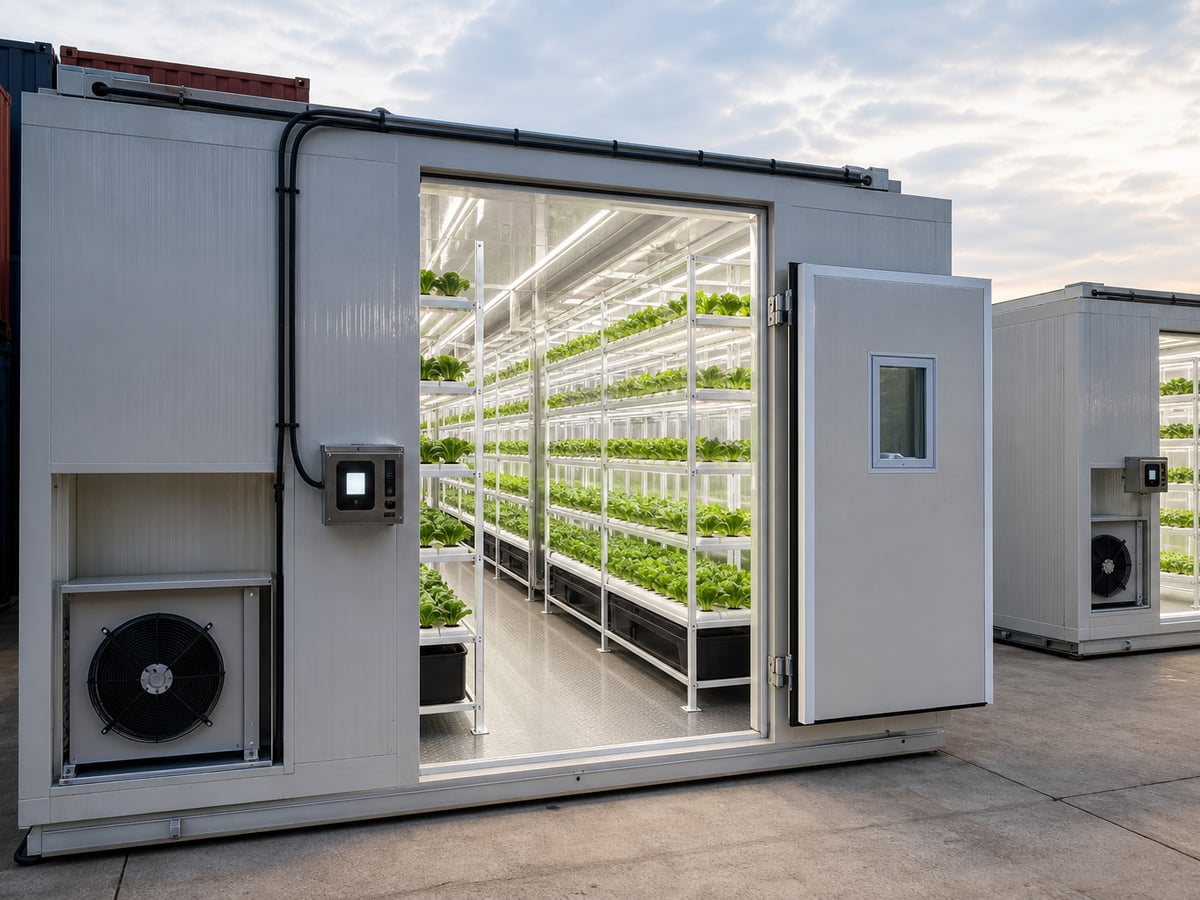
A container farm is a controlled-environment growing system built inside a modified shipping container. It combines insulated panels, vertical racks, LED grow lights, irrigation, nutrient dosing, HVAC, humidity control, sensors, and automation into a compact production unit. For the Global Market, container farming is especially useful where land is limited, weather is unpredictable, fresh produce supply is inconsistent, or year-round production is required.
Commercial container farms are commonly used for leafy greens, herbs, microgreens, seedlings, edible flowers, fodder, specialty vegetables, and selected medicinal or research crops. A properly engineered unit can operate near urban consumption centers, remote resorts, islands, mining camps, logistics hubs, military facilities, supermarkets, universities, food-service businesses, and agricultural demonstration projects.
Buyers should evaluate a container farm as an integrated production system rather than simply a shipping container with shelves. The most important decisions include crop selection, usable grow area, rack density, water quality, electricity supply, climate design, grow-light efficiency, service access, control software, local import requirements, and long-term technical support. The right system should match the farm’s market price, labor capacity, climate conditions, and expected sales channel.
| Buyer Question | Why It Matters | Recommended Starting Point |
|---|---|---|
| Which crops will be sold? | Crop biology determines lighting, humidity, nutrient, and harvest requirements. | Begin with lettuce, basil, kale, arugula, mint, or microgreens. |
| Where will the unit be installed? | Ambient temperature, sun exposure, wind, water, and grid stability affect design. | Confirm site climate and utilities before ordering. |
| What is the sales channel? | Restaurants, retailers, distributors, and direct customers need different pack sizes. | Secure off-take discussions before commissioning. |
| How much labor is available? | Seeding, transplanting, harvesting, cleaning, and packing still require people. | Assign trained operators and clear daily routines. |
| What water quality is available? | Hard water, salinity, iron, and bacteria can disrupt nutrient management. | Test source water and select suitable filtration. |
| What is the electricity cost? | Lighting and HVAC are significant operating costs. | Compare tariff structure, peak demand, and backup power options. |
The table above shows why a commercial container farm must be planned around operating conditions, not only purchase price. A lower initial price can create higher costs later if the system lacks efficient climate control, reliable electrical protection, water treatment, accessible maintenance points, or local technical support.
What Is a Container Farm and Who Uses It?
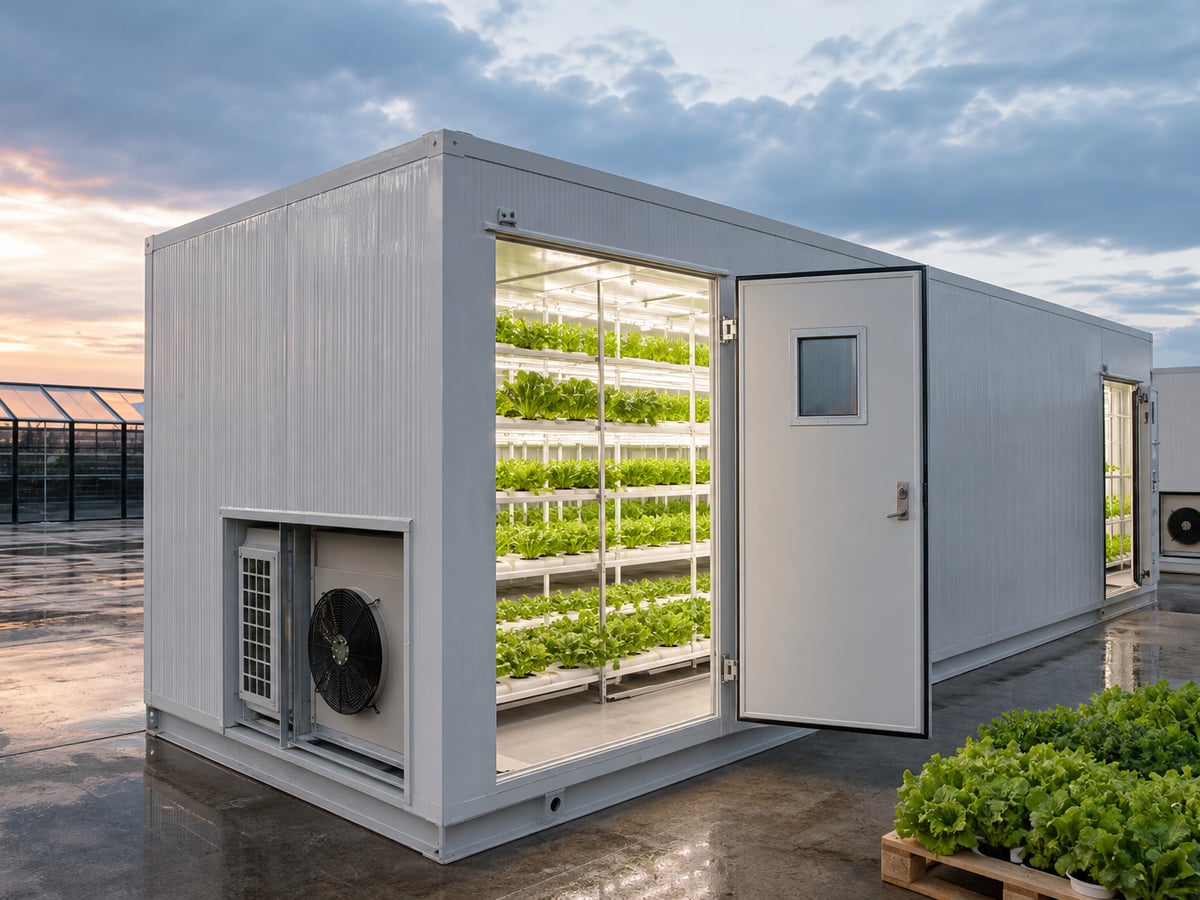
A container farm is a modular indoor farm installed within a 20-foot, 40-foot, or customized insulated container structure. Unlike a conventional greenhouse, it does not rely primarily on sunlight. Plants receive controlled LED lighting and are grown in a managed indoor environment. This enables growers to set photoperiod, temperature, humidity, carbon dioxide levels, irrigation intervals, nutrient concentration, and airflow according to the crop recipe.
In the Global Market, container farms are used by commercial growers seeking premium local produce, agricultural contractors delivering turnkey projects, equipment distributors, food-security programs, hospitality groups, research institutes, city farms, and entrepreneurs developing branded fresh-food businesses. They are also increasingly installed near airports, ports, cold-chain centers, and dense metropolitan regions where land prices or transport costs make traditional cultivation difficult.
For example, a container farm can support local leafy-green supply in Dubai, Singapore, Rotterdam, Los Angeles, London, Sydney, Nairobi, São Paulo, Riyadh, Cape Town, or Vancouver. It can also serve remote locations where long-distance transport leads to high prices, poor freshness, and supply disruptions. Units near major trade routes, including the Port of Rotterdam, Jebel Ali Port, Port of Singapore, Port of Santos, and Port of Durban, can be attractive for distributors and project developers serving regional food markets.
Container agriculture is not a replacement for all field farming. Grain, potatoes, large fruit trees, and low-value commodity crops are usually not economically suitable for this format. The strongest business case is typically high-value, perishable, compact, fast-growing crops that benefit from predictable quality, clean production, and short harvest-to-customer time.
| User Group | Typical Objective | Container Farm Benefit |
|---|---|---|
| Commercial growers | Produce premium greens year-round. | Reliable crop scheduling and protected growing conditions. |
| Restaurants and hotels | Serve fresh herbs and specialty greens. | Very short supply chain and menu differentiation. |
| Supermarkets | Improve freshness and reduce shrinkage. | Consistent local supply close to retail distribution. |
| Remote communities | Reduce dependence on imported produce. | Production in challenging climates or isolated locations. |
| Research institutions | Run repeatable crop trials. | Stable environmental settings and recorded data. |
| Agricultural contractors | Deliver modular food-production projects. | Fast deployment and scalable standardization. |
As shown above, the same container can support different business models. However, the crop plan, processing workflow, technical specifications, and rack arrangement should be tailored to the intended customer. A restaurant-focused farm may prioritize herbs and edible flowers, while a retail supplier may prefer predictable volumes of lettuce and baby-leaf greens.
Container Layout, Growing Method, and Suitable Crops
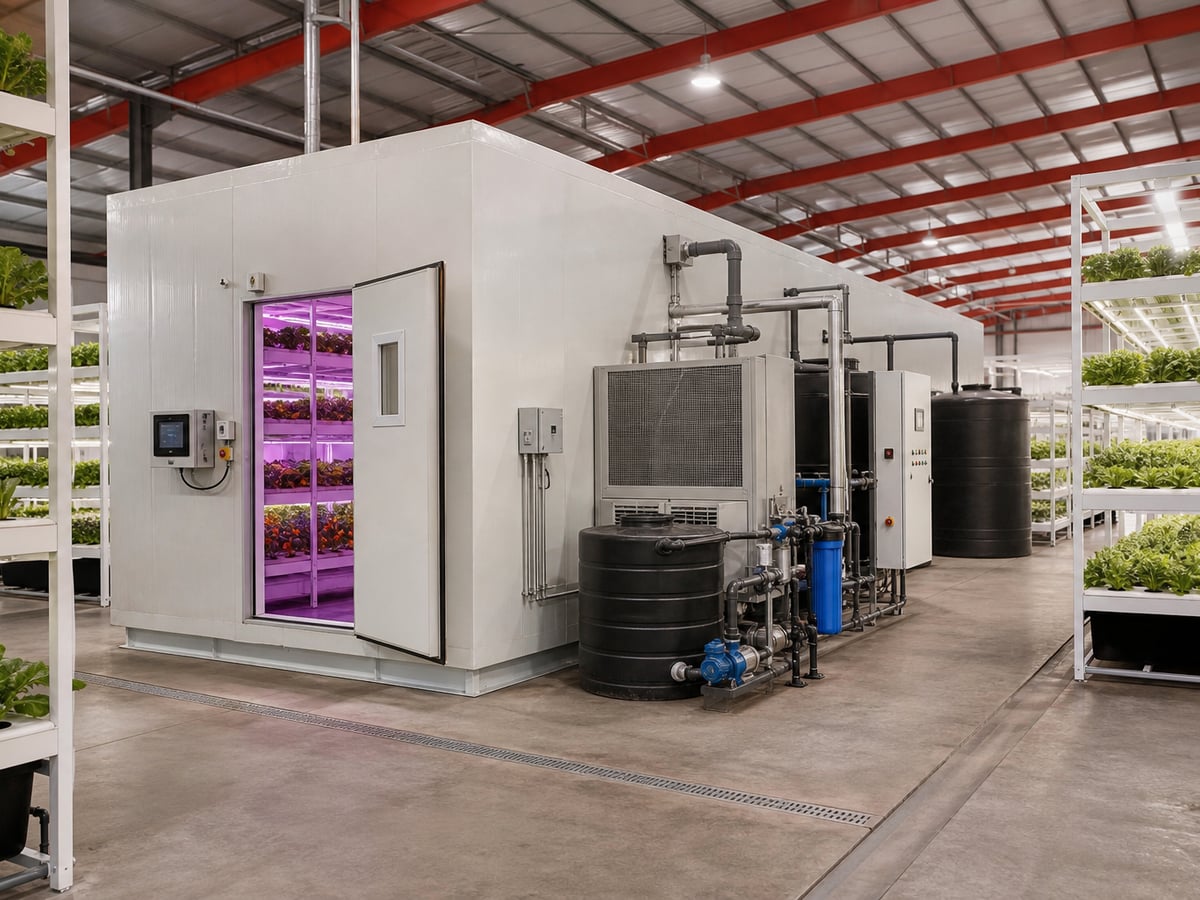
A standard commercial layout usually includes an insulated grow room, entry area, electrical control cabinet, HVAC equipment, nutrient mixing tank, irrigation pumps, drainage system, vertical cultivation racks, LED fixtures, ventilation ducts, and sensor locations. Some projects also include a small processing zone, germination room, seedling area, water-treatment skid, backup generator connection, or external packing room.
Most indoor container farms use vertical hydroponic growing methods. Common choices include nutrient film technique channels, deep-water culture rafts, drip irrigation, ebb-and-flow trays, substrate-based cultivation, and microgreen trays. The best method depends on crop roots, harvest style, desired density, operator experience, sanitation needs, and water recirculation strategy.
Leafy greens such as lettuce, bok choy, kale, spinach, Swiss chard, arugula, mustard greens, and pak choi are widely suitable because they have rapid crop cycles and moderate plant height. Herbs including basil, mint, cilantro, parsley, dill, chives, oregano, thyme, and sage can achieve strong margins where local buyers value freshness. Microgreens are compact, fast-growing, and suitable for premium restaurants, meal-kit companies, and health-food retailers.
For operators who want a ready-developed hydroponic solution, Lanhu provides smart hydroponic plant containers designed around controlled cultivation, vertical rack systems, environmental management, and project-specific customization.
| Crop Category | Typical Growing Method | Approximate Cycle | Commercial Suitability |
|---|---|---|---|
| Butterhead lettuce | Nutrient film technique or deep-water culture | 28–40 days | High-volume retail and food-service crop. |
| Basil | Channels, rafts, or substrate drip systems | 30–45 days | High-value herb for restaurants and supermarkets. |
| Arugula | Channels or shallow tray production | 21–35 days | Fast crop with premium salad demand. |
| Microgreens | Tray-based substrate or mat cultivation | 7–18 days | Strong for local premium and direct sales. |
| Mint | Hydroponic channels or substrate systems | 35–55 days | Suitable for hospitality and beverage markets. |
| Seedlings | Propagation trays with controlled irrigation | 14–35 days | Useful for nurseries and greenhouse operators. |
The crop comparison helps buyers avoid overloading a first project with too many varieties. A new operation should normally begin with a limited number of compatible crops, establish stable climate recipes, build reliable sales, and then add varieties after labor routines and food-safety procedures are proven.
Production Capacity, Rack Density, and Utility Requirements
Production capacity depends on the internal container dimensions, number of rack layers, tray or channel size, crop spacing, crop cycle, germination capacity, harvest rate, and loss rate. Marketing claims should always be checked against the actual usable canopy area rather than the external container footprint. A 40-foot container can hold multiple vertical rack levels, but the crop density must still allow uniform airflow, worker access, sanitation, and light distribution.
For leafy greens, production is often measured in plant sites, kilograms per month, or harvest heads per week. For herbs, cut weight and bunch volume may be more relevant. For microgreens, tray count and weekly harvest weight are normally used. Capacity estimates should include a practical allowance for crop losses, maintenance downtime, seedling space, cleaning cycles, and seasonal ambient-temperature impacts.
Utilities should be confirmed at the site before shipping. The project needs adequate electrical capacity for LEDs, HVAC, pumps, dosing equipment, fans, controllers, and optional water treatment. It also needs a clean water source, drainage or wastewater plan, internet access for remote monitoring where required, stable foundation support, and safe delivery access for a truck and crane.
| Utility or Site Item | Purpose | Buyer Verification |
|---|---|---|
| Electrical supply | Powers lights, HVAC, irrigation, and controls. | Confirm voltage, phase, frequency, breaker size, and grounding. |
| Water connection | Supports nutrient mixing, cleaning, and irrigation. | Provide water test results for treatment selection. |
| Drainage | Handles cleaning water and maintenance discharge. | Confirm local discharge rules and drainage slope. |
| Internet connection | Enables app control, reports, and remote alarms. | Check signal coverage or wired network availability. |
| Foundation pad | Supports the container safely and levelly. | Use engineered concrete, compacted base, or approved supports. |
| Delivery access | Allows transport, crane lifting, and future service. | Measure road width, turning radius, gates, and overhead clearance. |
This utility checklist reduces installation delays. In many international projects, the most common problems are not inside the container; they are inadequate site power, poor water quality, insufficient drainage, difficult transport access, or missing permits. Early coordination with local electricians, plumbers, civil contractors, and import agents is essential.
LED Lighting, Nutrient Dosing, Irrigation, and Water Treatment
LED grow lights are one of the most important operating components because they influence plant growth, quality, electricity consumption, and crop consistency. Commercial systems should provide appropriate photon output, spectrum, dimming capability, heat management, fixture protection, and service access. Light recipes should be selected according to crop type, growth stage, photoperiod, and target morphology rather than relying on a single setting for all plants.
For most leafy greens, stable lighting is more valuable than extremely high intensity. Excessive light can raise leaf temperature, increase electricity use, and create quality defects if climate and nutrition do not keep pace. Herbs may require a different light recipe from lettuce, while microgreens may be managed with lower or shorter-duration lighting depending on the variety and market requirement.
Nutrient dosing systems generally monitor electrical conductivity and pH, then inject fertilizer concentrates and acid or alkali as needed. A well-designed system includes separate stock tanks, accurate dosing pumps, mixing circulation, calibration procedures, level alarms, and easy access for cleaning. Growers should use crop-specific nutrient programs, but they should also validate recipes against local water chemistry and cultivar performance.
Irrigation may be recirculating or partially drained depending on the system and food-safety plan. Recirculation can reduce water use, but it requires filtration, sanitation, regular testing, and disciplined cleaning. Water treatment may include sediment filtration, activated carbon, softening, ultraviolet treatment, reverse osmosis, or other methods selected after source-water testing.
Water efficiency is a major advantage of controlled hydroponic cultivation, but water quality cannot be ignored. High sodium, bicarbonates, iron, chlorine, pathogens, or suspended solids can interfere with nutrient balance and irrigation equipment. The system should include a documented water-management plan from intake through filtration, nutrient mixing, crop delivery, drain handling, and periodic cleaning.
HVAC, Humidity, CO2, Airflow, and Condensation Control
Climate control determines whether a container farm produces stable crops or recurring disease, tip burn, root problems, and uneven growth. The HVAC system must manage heat from LED lights, humidity released by plants, ambient conditions outside the container, and the heat load created when workers enter. In hot and humid locations such as Southeast Asia, the Gulf region, tropical Africa, or coastal Latin America, dehumidification and insulation design are particularly important.
Temperature targets vary by crop, but the system should maintain a stable day-and-night strategy rather than large uncontrolled swings. Relative humidity must be controlled together with temperature because plants respond to vapor pressure deficit, transpiration, and leaf-surface conditions. Excess humidity can increase disease pressure and condensation, while overly dry air can cause stress and excessive water demand.
Carbon dioxide supplementation can increase photosynthetic performance when lighting, nutrition, temperature, and airflow are already properly managed. It should not be treated as a substitute for basic environmental control. CO2 equipment should include safe placement, accurate monitoring, interlocks, ventilation logic, and operating procedures for staff.
Airflow should move evenly across all rack levels without creating damaging drafts. Fans, ducts, return-air paths, and rack spacing should be designed to avoid dead zones. Condensation control is equally important. Moisture accumulating on ceilings, wall joints, lights, ducts, or panel seams can damage equipment and create hygiene risks. Good insulation, vapor barriers, drainage design, and dehumidification capacity help prevent this problem.
For projects needing efficient thermal equipment, Lanhu also offers air source heat pump solutions that can be evaluated as part of an integrated agricultural climate-control strategy. Final equipment selection should always consider local ambient temperatures, electricity tariffs, maintenance conditions, and crop load.
Sensors, App Control, Automation, and Remote Alarms
A modern container farm should record the environmental conditions that influence crop performance. Typical sensors measure air temperature, relative humidity, carbon dioxide, water temperature, pH, electrical conductivity, tank level, flow, leakage, door status, and equipment operation. Data allows operators to identify trends before they become crop losses.
App control and remote monitoring are valuable for operators managing multiple sites or working across long distances. A grower in Rotterdam may want to monitor a unit in the Middle East, while a distributor in Australia may need remote technical support for a farm in the Pacific. Remote access can provide dashboard visibility, recipe adjustment, historical charts, alarm acknowledgment, and maintenance reminders.
Automation should simplify repeatable tasks, not make the farm impossible to operate without specialists. Good controls provide clear manual override options, labeled electrical components, local display access, alarm history, sensor calibration prompts, and secure user permissions. Alarm systems should notify the responsible team for power failure, high temperature, low water level, pump faults, abnormal pH or EC, excessive humidity, and communication loss.
The chart is a practical planning illustration rather than a universal cost model. Lighting and HVAC usually deserve the highest technical attention because they have a direct impact on crop growth, climate stability, and energy use. Maintenance and automation are also critical because downtime in a sealed growing environment can rapidly affect plant quality.
Installation, Training, Maintenance, and Warranty
Container-farm installation begins before the equipment arrives. The site should be prepared with a level base, electrical connection, water point, drainage, safe lifting area, access route, and local approvals where applicable. For international shipments, buyers should coordinate container unloading, customs documentation, electrical standards, connection fittings, and local contractor availability in advance.
After placement, commissioning usually includes electrical verification, water-system flushing, sensor checks, climate testing, irrigation testing, lighting inspection, control configuration, and trial operation. The first crop cycle should be treated as an operational learning period. Operators should record environmental settings, germination rates, nutrient use, crop quality, labor time, and harvest weight so recipes can be improved.
Training should cover seeding, transplanting, crop-spacing rules, nutrient preparation, pH and EC calibration, routine cleaning, pest prevention, harvesting, packaging, food-safety practices, alarm response, and basic troubleshooting. A container farm is a technical asset, but its commercial performance depends on disciplined daily management.
| Maintenance Task | Suggested Frequency | Purpose |
|---|---|---|
| Inspect water levels and pump performance | Daily | Prevents irrigation interruption and root-zone stress. |
| Check pH and EC calibration | Weekly or according to use | Maintains nutrient accuracy and crop consistency. |
| Clean filters and inspect drains | Weekly | Reduces clogging, overflow, and sanitation risks. |
| Inspect HVAC filters and airflow | Monthly | Supports efficient cooling, heating, and dehumidification. |
| Check LED fixtures and electrical connections | Monthly | Identifies failures before uneven crop growth occurs. |
| Deep-clean grow zones and tanks | Between crop cycles or scheduled intervals | Controls biofilm, algae, pathogens, and residue buildup. |
The maintenance schedule above should be adapted to crop intensity, water quality, local dust levels, and operating hours. Before purchase, buyers should ask for warranty scope, excluded consumables, spare-parts availability, response procedures, wiring diagrams, control documentation, recommended service intervals, and remote support terms.
Our Company
Shandong Lanhu Air Conditioning Equipment Co., Ltd. supports commercial cultivation projects with integrated climate-control and modular farming equipment. Its technological capability is built on more than 12 years of thermodynamic research and development experience, supported by more than 45 registered patents. This background is relevant for projects that require reliable temperature, humidity, airflow, and energy-management solutions rather than simple standalone equipment.
From a manufacturing perspective, Lanhu operates a modern production facility of more than 30,000 square meters in Dezhou, Shandong, China. Its capabilities include product design, engineering development, sheet metal fabrication, CNC bending, insulation-panel production, electrical assembly, system integration, equipment testing, and quality inspection. Systems undergo functional inspection, electrical verification, performance testing, and operational evaluation before shipment. The company’s management and safety credentials include ISO 9001, ISO 14001, ISO 45001, and ISO 12100 certifications.
For service capability, Lanhu provides factory-direct supply, OEM and ODM customization, engineering support, international logistics coordination, spare-parts assistance, installation guidance, and after-sales service. This is important for global buyers who need equipment adapted to local voltage, climate conditions, crop plans, transport constraints, or project branding. Agricultural contractors, distributors, engineering companies, and commercial growers can review the company’s OEM and ODM customization services when planning tailored modular cultivation systems.
Lanhu’s product range also includes smart mushroom cultivation containers and mushroom climate controllers, giving the company broader experience in humidity-sensitive agricultural environments. Prospective buyers can explore selected project examples through the container farming case studies section and discuss technical requirements through the project consultation channel.
Looking toward 2026 and beyond, container farming will increasingly be shaped by energy-efficient LEDs, heat recovery, intelligent dehumidification, predictive maintenance, AI-supported crop recipes, renewable-energy integration, water recycling, traceability systems, and more localized food-security policies. Sustainability requirements are likely to become more important as buyers assess energy consumption, packaging reduction, water stewardship, transport emissions, refrigerant choices, and food-resilience benefits. The strongest projects will combine efficient equipment with realistic crop economics and disciplined operational management.
Frequently Asked Questions
How much space does a container farm require?
A 40-foot container requires enough space for the container footprint, access doors, maintenance clearance, crane placement, delivery truck turning, electrical equipment, and water connections. The final site layout should include safe space around HVAC components and any external treatment or storage equipment.
Which crops are best for a first container-farm project?
Leaf lettuce, basil, arugula, kale, mint, and microgreens are common starting crops because they grow quickly and have established markets. The best choice depends on local pricing, customer demand, labor skills, and the selected growing system.
Can a container farm operate in hot or cold climates?
Yes, but the climate-control design must match local conditions. Hot regions require adequate cooling and dehumidification, while cold regions need efficient heating, insulation, and condensation management. Site climate should be provided during equipment selection.
How much electricity does a container farm use?
Electricity use depends on lighting hours, LED power, HVAC load, outside climate, insulation quality, crop density, and automation equipment. Buyers should request a project-specific electrical load estimate and review local utility tariffs before calculating profitability.
Is water recirculated in a hydroponic container farm?
Many systems recirculate nutrient solution to reduce water consumption. However, recirculation requires filtration, sanitation, regular monitoring, and cleaning. The appropriate system depends on crop type, water quality, food-safety requirements, and operator practices.
What should be included in a supplier quotation?
A complete quotation should identify container dimensions, insulation, rack count, growing method, LED specifications, HVAC capacity, control system, nutrient dosing, water treatment, delivery terms, installation support, training, spare parts, warranty, and exclusions. It should also clarify the buyer’s responsibility for site work and utilities.
Share this article

About the Author: Shandong Lanhu Air Conditioning Equipment
Lanhu is a professional climate control equipment manufacturer specializing in smart agricultural systems, commercial HVAC solutions, and customized temperature control technologies. With extensive engineering experience, Lanhu provides reliable solutions for plant factories, controlled environment agriculture, and industrial applications.
Need a Custom Climate Control Solution?
From smart agricultural systems to commercial HVAC solutions, Lanhu provides reliable temperature and humidity control solutions tailored to your project needs.
Contact Us