Global Mushroom Growing Containers: Specs and Buyer Guide
Quick Answer
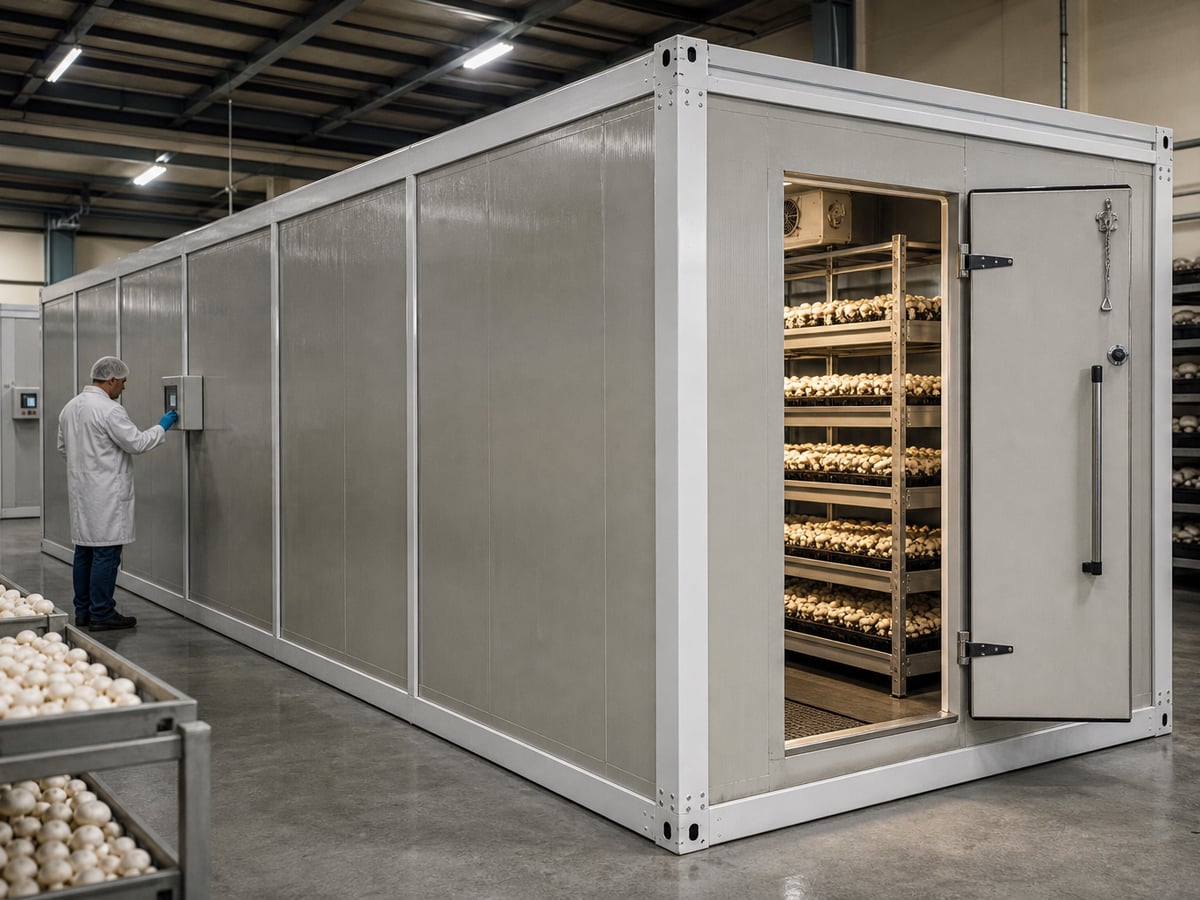
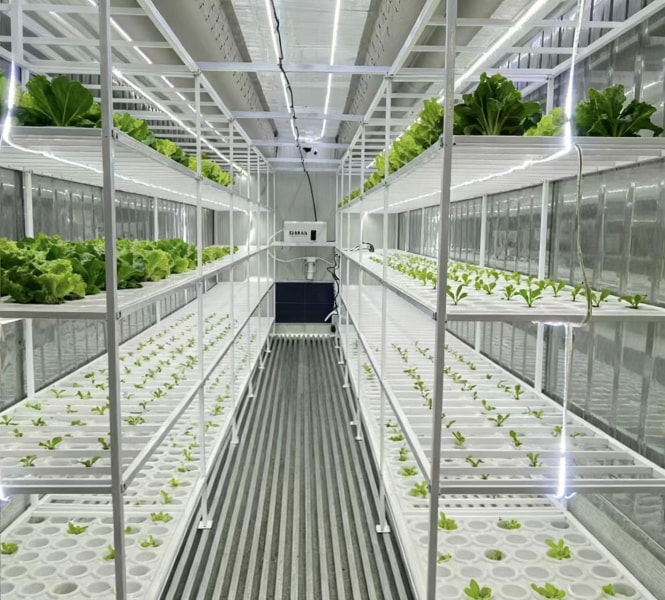
A mushroom growing container is an insulated, climate-controlled modular unit designed to provide stable growing conditions for commercial mushroom production. It combines a container structure, refrigeration or heat-pump equipment, humidification, fresh-air exchange, CO2 control, circulation fans, lighting, shelving, drainage, and a programmable climate controller.
For the Global Market, a commercial mushroom cultivation container is commonly used by farms that need predictable production without constructing a permanent growing building. It is suitable for oyster mushrooms, shiitake, lion’s mane, enoki, button mushrooms, king oyster mushrooms, medicinal mushrooms, and selected specialty fungi, depending on the selected climate range and cultivation method.
Buyers typically choose containerized mushroom farms when they require rapid deployment, controlled production quality, expansion in phases, transportable assets, or production near urban food markets. A modular mushroom growing unit can be installed near agricultural zones, food-distribution centers, hotels, restaurants, laboratories, supermarkets, and rural cooperatives.
For an initial project, buyers should define the mushroom species, substrate block size, target monthly output, local ambient temperature, electricity availability, water quality, required certifications, shipping route, and whether the container will be used for incubation, fruiting, or both. A properly specified unit helps reduce climate instability, contamination exposure, labor variability, and crop-loss risk.
| Buyer Need | Recommended Container Solution | Primary Benefit |
|---|---|---|
| Small pilot farm | 10-foot or 20-foot fruiting container | Lower initial investment and easier training |
| Commercial fresh mushroom sales | 40-foot high-cube fruiting container | Higher rack capacity and scalable output |
| Hot-climate production | Enhanced cooling, insulation, and heat-pump system | More stable temperature control in high ambient heat |
| Cold-region farming | Heating module with insulated panels and freeze protection | Reliable winter operation |
| Multiple mushroom species | Separate climate zones or multiple containers | Reduces compromise between crop recipes |
| Urban farm or food hub | Low-noise container with remote monitoring | Improved operational control near customers |
The table above shows why container selection should start with the production model rather than the container size alone. A 40-foot container may offer more growing space, but its value depends on whether the farm has enough substrate supply, trained labor, market demand, and utility capacity to operate it consistently.
What Is a Mushroom Growing Container and Where Is It Used
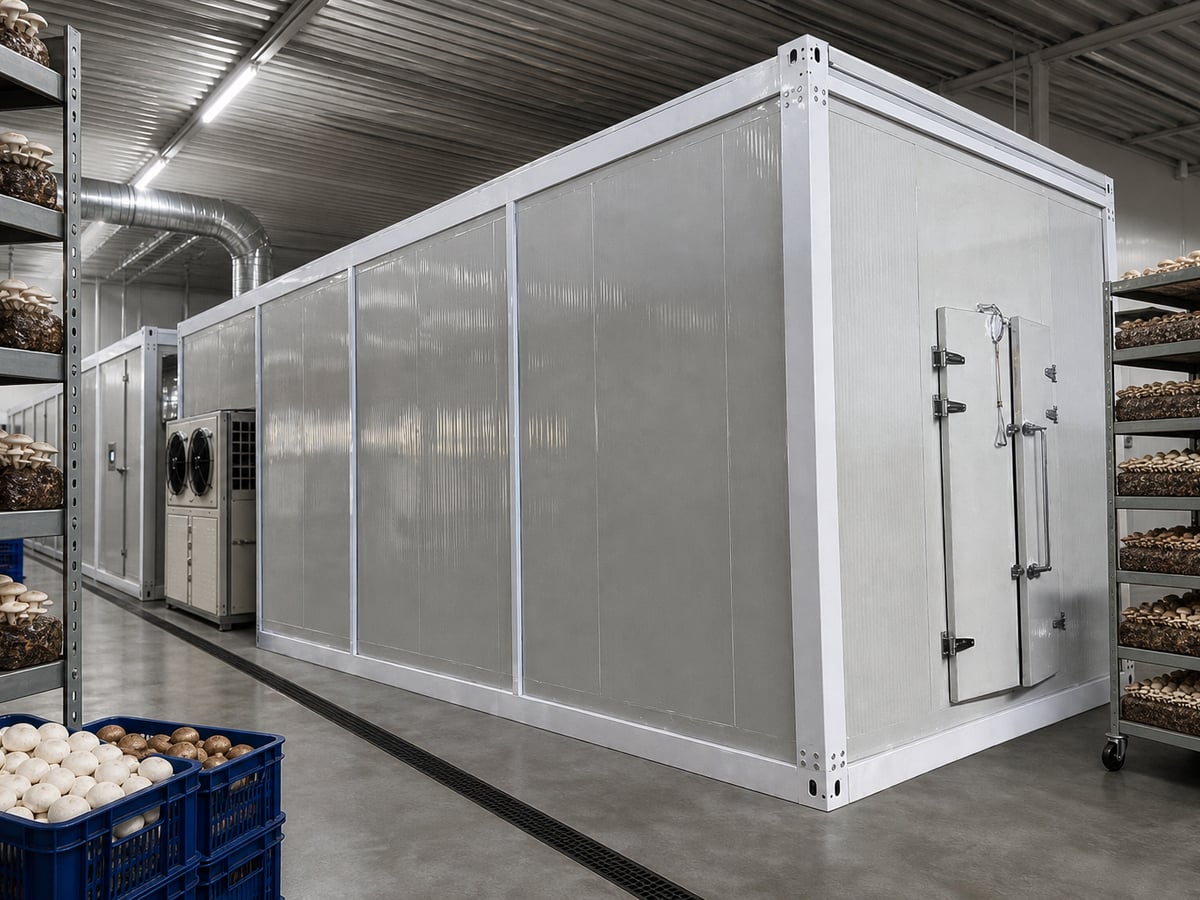
A mushroom growing container is a prefabricated controlled-environment cultivation room built around a shipping-container frame or a purpose-built insulated modular enclosure. It is engineered to maintain the temperature, humidity, CO2 concentration, airflow, and hygiene conditions required during mushroom fruiting or incubation.
Unlike a conventional agricultural shed, a mushroom container uses an enclosed and controlled system. Fresh air is introduced through filtered inlets, internal air is circulated to reduce dead zones, moisture is added through humidification equipment, and temperature is managed by cooling, heating, or heat-pump technology. Sensors continuously report environmental values to the control system.
In the Global Market, mushroom cultivation containers are used across Asia, Europe, the Middle East, Africa, North America, Latin America, Australia, and island markets where construction costs, land limitations, climate variability, or logistics make modular farming attractive. Buyers may deploy units near Rotterdam, Hamburg, Dubai, Singapore, Los Angeles, Melbourne, Lagos, São Paulo, or regional agricultural hubs connected to ports and cold-chain distribution routes.
Common applications include farm expansion, commercial mushroom cultivation, restaurant supply programs, supermarket private-label production, agricultural demonstration projects, vocational training centers, research trials, rural development initiatives, and climate-smart food production projects. Some operators use containers only for fruiting, while others create a modular production line with separate incubation, fruiting, packing, and cold-storage modules.
For projects requiring an integrated solution, buyers can review a smart mushroom cultivation container solution to understand typical layouts, environmental systems, and commercial applications.
| Industry or User | Typical Use | Key Selection Priority |
|---|---|---|
| Commercial mushroom farm | Continuous fruiting production | Capacity, automation, energy efficiency |
| Agricultural contractor | Turnkey projects for farm clients | Engineering support and customization |
| Food distributor | Local fresh mushroom supply | Reliable harvest scheduling |
| Hotel or restaurant group | Premium on-site or local sourcing | Compact footprint and clean appearance |
| University or research center | Variety trials and cultivation studies | Data logging and adjustable recipes |
| Rural cooperative | Shared production and employment project | Simple operation and service accessibility |
These applications demonstrate that the product is not limited to large industrial farms. A container farm can serve as an independent revenue unit, a production expansion module, or a standardized system replicated across multiple locations.
Standard Product Configuration and System Boundaries
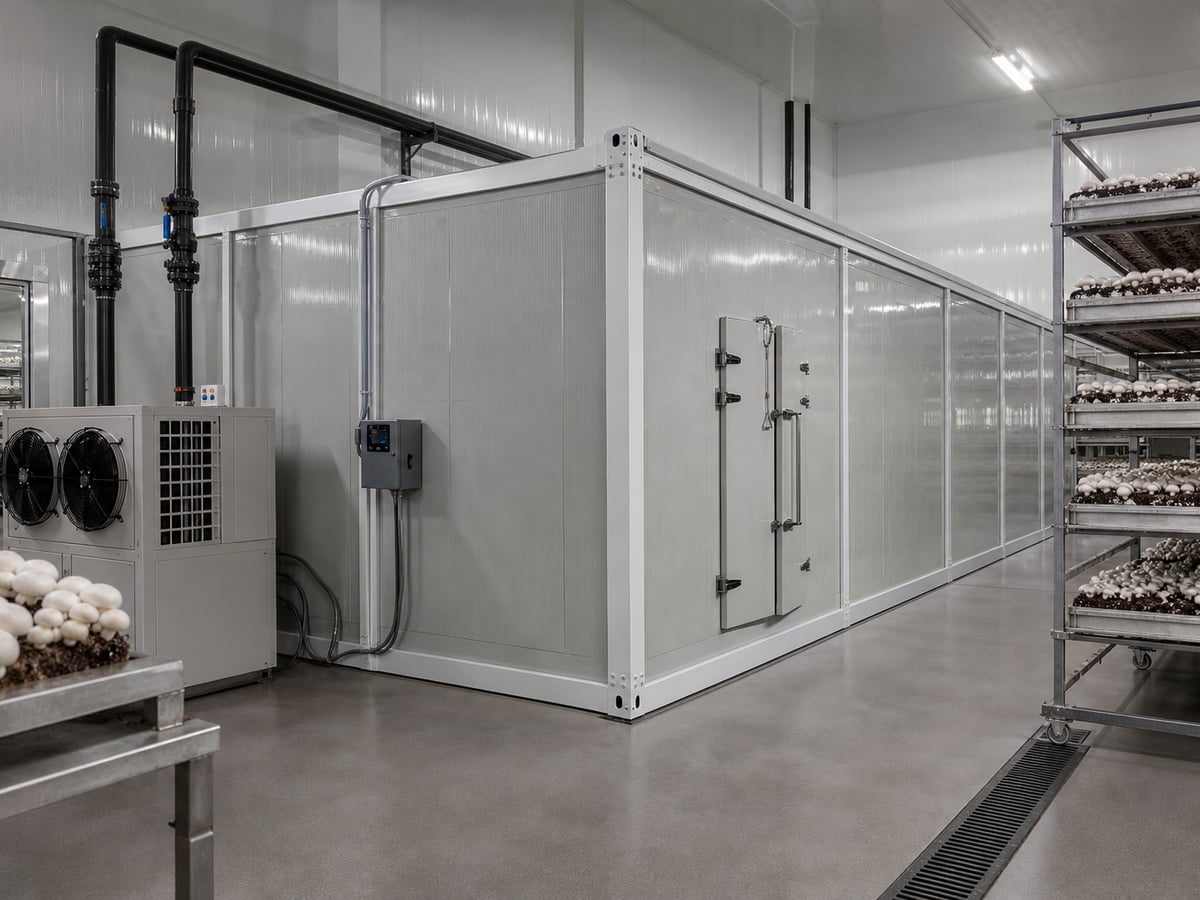
A standard mushroom growing container generally includes the insulated container body, internal growing racks, climate-control equipment, ventilation components, humidification system, electrical cabinet, sensors, drainage arrangement, interior lighting, access door, and digital controller. The exact system boundary should be confirmed before ordering because “container” can mean either the complete cultivation room or only the insulated shell.
A complete commercial system normally controls the fruiting environment inside the container. It does not automatically include substrate production, sterilization, inoculation, spawn supply, cold storage, packing equipment, building foundations, external water tanks, backup generators, or local electrical installation unless these items are specifically listed in the quotation.
Buyers should request a clear responsibility matrix. This prevents misunderstandings about whether the supplier provides electrical cabling beyond the container, exterior drainage, crane unloading, on-site assembly, ventilation duct extensions, remote network access, or local certification support.
| Standard Configuration Item | Typical Function | Scope Confirmation Needed |
|---|---|---|
| Insulated container enclosure | Maintains an isolated cultivation environment | Panel thickness, floor design, door type |
| Cooling and heating system | Controls growing-room temperature | Ambient design temperature and power rating |
| Humidification equipment | Maintains crop humidity requirements | Water quality, filtration, drainage |
| Fresh-air and exhaust system | Removes CO2 and supplies oxygen | Airflow rate, filtration level, duct routing |
| Climate controller | Automates environmental setpoints | Language, recipes, remote-access method |
| Growing racks | Holds substrate blocks, bags, or trays | Tier count, loading method, material grade |
| Electrical cabinet | Protects and distributes power | Voltage, frequency, local electrical standard |
The table clarifies standard system boundaries. A buyer should avoid comparing quotations based only on exterior dimensions because two containers with the same size can differ significantly in insulation quality, refrigeration capacity, control accuracy, rack loading, and automation level.
Capacity, Dimensions, and Utility Requirements
Capacity is commonly measured by the number of substrate blocks, bags, bottles, trays, or kilograms of fresh mushrooms produced per cultivation cycle. The actual harvest depends on mushroom species, substrate formula, biological efficiency, crop management, harvest schedule, block density, and environmental consistency.
A 20-foot container may be appropriate for pilot production or a specialty crop program. A 40-foot high-cube mushroom growing container is more common for commercial fruiting because it provides a longer rack layout, larger air volume, and more efficient use of climate-control equipment. However, higher capacity also requires more disciplined substrate planning and harvest labor.
| Container Type | Typical External Size | Indicative Growing Use | Utility Consideration |
|---|---|---|---|
| 10-foot container | Approximately 3 m long | Trials, training, premium specialty mushrooms | Lower power demand but limited production volume |
| 20-foot standard container | Approximately 6 m long | Small commercial fruiting room | Requires stable power, water, and drainage |
| 40-foot standard container | Approximately 12 m long | Medium-scale commercial mushroom growing | Higher cooling and ventilation load |
| 40-foot high-cube container | Approximately 12 m long with added height | Higher-density racks and improved access | Suitable for larger crop turnover |
| Dual-container installation | Two connected modules | Separate incubation and fruiting stages | Needs coordinated power and drainage planning |
| Multi-container farm | Three or more modules | Scalable regional production site | May require transformer, water storage, and backup power |
Before purchase, provide the local voltage and frequency, such as 380–415V/50Hz or 460V/60Hz, together with available phase configuration. The supplier should match motors, compressors, protection devices, control components, and plugs to the destination market. Water demand depends on humidification technology, local air dryness, ventilation rate, and crop setpoints. Hard water may require filtration or softening to prevent nozzle blockage and mineral buildup.
Site planning should include a level concrete base or engineered supports, access for delivery vehicles, safe drainage, sufficient clearance for maintenance, and a route for lifting equipment. Projects delivered through Qingdao, Shanghai, Ningbo, Shenzhen, Rotterdam, Jebel Ali, Durban, or Santos should also account for inland transportation dimensions, road restrictions, and local crane availability.
Temperature, Humidity, CO2, Airflow, and Control Performance
Mushroom production depends on environmental control, but the correct setpoint varies by species and crop stage. Incubation often requires different temperature and ventilation conditions from fruiting. Oyster mushrooms may require strong fresh-air exchange during fruiting, while shiitake and lion’s mane programs may use different temperature, humidity, lighting, and CO2 strategies.
Temperature control is usually provided by a refrigeration system, heating source, air-source heat pump, or combined HVAC configuration. Humidity is maintained through high-pressure misting, ultrasonic humidification, fogging, or another specified method. CO2 control is achieved by balancing fresh-air intake, exhaust airflow, internal circulation, and sensor-based automation.
| Environmental Parameter | Typical Commercial Control Objective | Why It Matters |
|---|---|---|
| Temperature | Species-specific stable setpoint range | Influences pinning, growth speed, and crop quality |
| Relative humidity | High humidity without excessive surface condensation | Supports fruit body development and reduces drying |
| CO2 concentration | Controlled through ventilation and sensor feedback | Shapes stems, caps, density, and yield quality |
| Fresh-air exchange | Adjusted by crop stage and occupancy load | Removes CO2, heat, and excess moisture |
| Internal airflow | Uniform circulation without direct crop stress | Reduces climate variation between rack levels | Lighting | Timer-controlled low-intensity illumination where needed | Supports species requiring light for fruiting development |
The values in the table are control categories rather than universal recipes. A reliable supplier should configure the system according to the mushroom variety, substrate type, local climate, and desired crop schedule. Excess airflow can dry mushroom surfaces, while insufficient airflow may raise CO2 levels and create uneven growth. Excessive humidity can cause condensation and hygiene problems, while low humidity can reduce product quality.
A dedicated smart mushroom climate controller can simplify recipe management by allowing operators to set temperature, humidity, ventilation, CO2, lighting, and alarm thresholds from one interface. For commercial farms, sensor calibration, alarm logic, fan interlocks, compressor protection, and data history are as important as the displayed setpoint.
For hot and humid destinations such as Southeast Asia, the Gulf region, coastal Africa, and tropical Latin America, buyers should request performance confirmation at the highest expected outdoor temperature and humidity. For cold climates in Northern Europe, Central Asia, Canada, or mountainous regions, heating load, defrost logic, insulation thickness, and freeze protection should be evaluated before finalizing the design.
Core Components, Materials, and Protection Features
The quality of a mushroom container depends on both visible materials and internal engineering. Insulated wall panels, floor construction, door sealing, drainage slope, rack structure, electrical protection, corrosion resistance, and service access all affect long-term farm performance.
Commercial units commonly use polyurethane or similar insulated panels, galvanized or coated steel framing, stainless-steel or corrosion-resistant growing racks, washable interior surfaces, LED lights, sealed electrical enclosures, insulated doors, and drainage channels. Material selection should reflect the humidity level, cleaning chemicals, local climate, and intended years of operation.
Shandong Lanhu Air Conditioning Equipment Co., Ltd. integrates thermodynamic engineering experience into its mushroom climate solutions, including temperature-control design, air-distribution planning, humidity management, and automated environmental control. The company’s technological capability is supported by more than 12 years of research and development experience and more than 45 registered patents related to agricultural climate control and equipment innovation.
Protection features should include overload protection, phase-loss protection where applicable, leakage protection, compressor delay, high-pressure and low-pressure safety functions, fan protection, sensor alarms, emergency stop arrangements, and electrical labeling. For projects in coastal regions or humid tropical markets, corrosion protection and reliable cabinet sealing deserve special attention.
Automation, Remote Monitoring, and Customization Options
Automation reduces routine manual adjustment and improves repeatability between growing cycles. A modern mushroom container can use programmable recipes to automatically operate cooling, heating, humidification, ventilation fans, exhaust fans, lighting, and alarms. Operators can save crop programs for different species and modify setpoints as production experience develops.
Remote monitoring is especially valuable for farms with multiple sites, distributors managing customer units, or operators located away from the farm. Depending on the selected configuration, remote access may provide current environmental values, equipment operating status, alarm notifications, trend charts, historical data, and selected remote-control functions.
Customization options can include container size, insulation thickness, rack configuration, rack material, door position, exterior color, climate zone, electrical standard, controller language, sensor package, HEPA or pre-filter options, water treatment, backup power interface, solar integration readiness, packing-room layout, and branding requirements.
Lanhu’s manufacturing capability includes product design, engineering development, sheet-metal fabrication, CNC bending, insulation-panel production, electrical assembly, system integration, equipment testing, and quality inspection. This integrated process helps OEM and ODM buyers request tailored layouts rather than relying only on standard container designs. Companies seeking private-label systems or project-specific modifications can explore the OEM and ODM customization service.
Future trends through 2026 include lower-energy heat-pump systems, variable-speed fans, improved sensor accuracy, cloud-based crop data analysis, predictive maintenance, water-saving humidification, solar-ready electrical designs, and more traceable food-production records. Sustainability requirements are also influencing buyer decisions, particularly in markets with stricter energy-efficiency policies, carbon reporting, water-use limits, and local food-security programs.
Installation, Commissioning, Maintenance, and Warranty
Installation begins with site preparation. The location should have a level foundation, sufficient access for container delivery, reliable power, clean water, drainage, ventilation clearance, and enough working space around the unit. Operators should avoid placing the container where direct sun, flood risk, dust, vehicle exhaust, or poor drainage creates unnecessary operating challenges.
Commissioning normally includes checking electrical connections, confirming phase rotation where required, testing cooling and heating functions, verifying humidification, inspecting ventilation direction, calibrating sensors where applicable, checking drainage, confirming alarm operation, and running the container under target conditions before loading mushroom substrate.
Routine maintenance should include cleaning filters, inspecting humidification nozzles, checking drain lines, washing interior surfaces, reviewing door seals, checking fan operation, tightening electrical connections, inspecting refrigerant-system performance, and validating sensor readings. Maintenance frequency depends on water quality, dust conditions, operating hours, local climate, and crop sanitation procedures.
Warranty terms should be confirmed in the commercial contract. Buyers should ask which components are covered, how long the coverage lasts, whether labor is included, how spare parts are supplied internationally, and what remote troubleshooting support is available. For overseas projects, a recommended spare-parts kit can reduce downtime when local refrigeration or electrical components are not immediately available.
Lanhu provides service capabilities including factory-direct supply, engineering assistance, international logistics support, installation guidance, spare-parts support, remote technical communication, and after-sales service for agricultural contractors, equipment distributors, engineering companies, and commercial farms. Before shipment, systems undergo functional inspection, electrical verification, performance testing, and operational evaluation. Buyers can review selected deployment examples in the mushroom container project cases.
Commercial Specification and RFQ Checklist
A detailed RFQ allows suppliers to provide an accurate technical proposal instead of a generic price. The more complete the project information, the easier it is to size the climate system, select suitable materials, estimate energy demand, and define shipment and installation responsibilities.
| RFQ Item | Information to Provide | Reason for Inclusion |
|---|---|---|
| Mushroom species | Oyster, shiitake, lion’s mane, button, enoki, or other type | Determines climate recipe and rack arrangement |
| Crop stage | Incubation, fruiting, or combined use | Defines ventilation, lighting, and temperature needs | Container size | 10-foot, 20-foot, 40-foot, high-cube, or custom module | Sets available production space and equipment capacity |
| Local climate | Summer maximum, winter minimum, humidity, altitude | Supports accurate HVAC sizing |
| Electrical supply | Voltage, frequency, phase, and available power | Ensures compatible equipment selection |
| Water conditions | Water source, pressure, hardness, and treatment availability | Protects humidification and sanitation performance |
| Destination and port | Country, city, inland delivery address, preferred port | Helps plan logistics and container transport |
| Required options | Remote monitoring, branding, racks, filters, backup power | Prevents missing items in the commercial offer |
The RFQ checklist above should be used together with target production volume and budget expectations. Buyers should compare offers based on delivered scope, environmental design conditions, insulation quality, automation functions, warranty, and service support—not solely on the lowest equipment price.
For Global Market projects, ask whether the quotation is EXW, FOB, CIF, DAP, or another agreed Incoterm. Confirm the departure port, sea-freight assumptions, customs responsibilities, destination handling, inland delivery, unloading equipment, and local installation requirements. A project shipped from Shandong may use Qingdao Port, while final delivery may require coordination with local logistics teams in Dubai, Mombasa, Antwerp, Houston, Sydney, or other regional trade hubs.
Shandong Lanhu Air Conditioning Equipment Co., Ltd. operates a manufacturing facility of more than 30,000 square meters in Dezhou, Shandong, China. Its quality-management approach includes functional testing and inspection before shipment, supported by ISO 9001, ISO 14001, ISO 45001, ISO 12100, patent documentation, and related enterprise credentials. Buyers needing a project-specific proposal can contact the mushroom container team with their crop, climate, utility, and delivery requirements.
FAQ
What mushrooms can be grown in a mushroom growing container?
Common options include oyster mushrooms, shiitake, lion’s mane, king oyster mushrooms, enoki, button mushrooms, and selected medicinal varieties. The container must be configured for the required temperature, humidity, CO2, airflow, lighting, and crop-management method.
Can one container grow different mushroom species at the same time?
It is possible only when the species have compatible environmental requirements. In most commercial projects, separate containers or independent climate zones provide better consistency because different species often need different temperatures, CO2 levels, and ventilation rates.
How much electricity does a mushroom container use?
Power consumption varies with container size, insulation, outdoor climate, crop recipe, cooling load, ventilation rate, humidification system, and operating hours. Hot climates generally require more cooling energy, while cold climates may require more heating energy. Request an estimated operating-load range based on your local design conditions.
Does the system include substrate preparation equipment?
Normally, a mushroom growing container is designed for incubation or fruiting rather than substrate sterilization and inoculation. Substrate mixers, bagging machines, sterilizers, boilers, clean rooms, and cold rooms should be quoted separately if needed.
Can the container be monitored remotely?
Yes. Optional remote monitoring can provide environmental data, equipment status, alarms, historical records, and selected control functions through a networked platform, depending on the selected controller and local internet connection.
How long does installation take?
If the site foundation, power, water, drainage, and delivery access are ready, the container itself can usually be positioned quickly. Final commissioning time depends on electrical connection, utility completion, climate testing, staff training, and any custom integration work.
What should buyers check before signing a purchase order?
Confirm container dimensions, crop capacity assumptions, local climate design conditions, voltage and frequency, included equipment, excluded works, rack design, control functions, warranty scope, spare parts, shipping terms, commissioning support, and delivery responsibilities.
Is a container farm suitable for sustainable mushroom production?
Yes, when designed and operated efficiently. Insulated structures, efficient heat pumps, programmable climate control, water management, local distribution, and phased expansion can help reduce avoidable energy use, transport distance, and crop waste. Sustainable performance still depends on local power sources, substrate supply, sanitation, and operational management.
Share this article

About the Author: Shandong Lanhu Air Conditioning Equipment
Lanhu is a professional climate control equipment manufacturer specializing in smart agricultural systems, commercial HVAC solutions, and customized temperature control technologies. With extensive engineering experience, Lanhu provides reliable solutions for plant factories, controlled environment agriculture, and industrial applications.
Need a Custom Climate Control Solution?
From smart agricultural systems to commercial HVAC solutions, Lanhu provides reliable temperature and humidity control solutions tailored to your project needs.
Contact Us