Hydroponic Container Farms for the Global Market Guide
Quick Answer

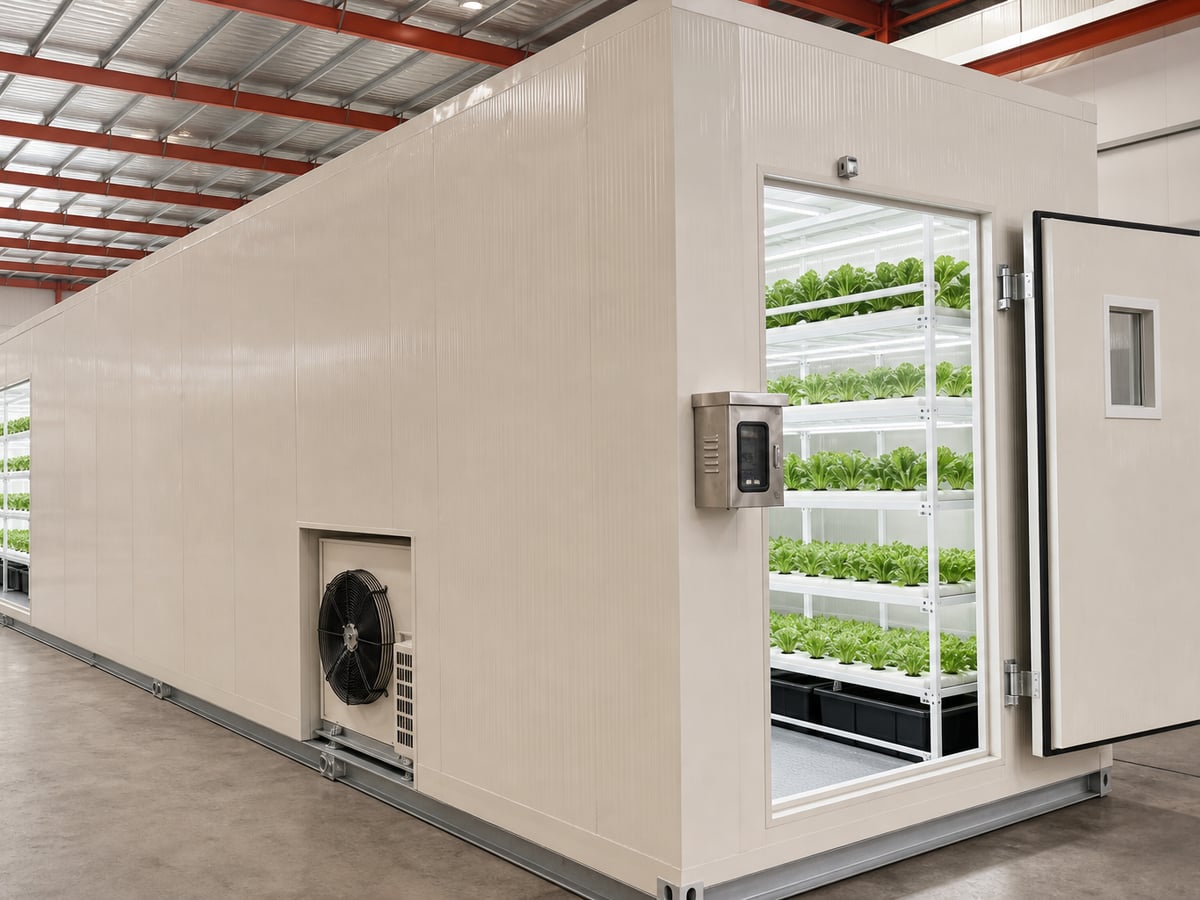
A hydroponic container farm is a climate-controlled growing system built inside a shipping container or modular insulated cabin. It uses water-based nutrient solutions instead of soil, together with LED lighting, ventilation, cooling, dehumidification, irrigation, sensors, and automation. For the Global Market, it offers a compact way to produce leafy greens, herbs, seedlings, and selected specialty crops close to consumers throughout the year.
Commercial container farms are used by urban agriculture companies, restaurant groups, food distributors, schools, hotels, mining camps, island communities, agricultural contractors, research institutions, and fresh-produce entrepreneurs. They can be installed near city markets in Dubai, Singapore, Rotterdam, Los Angeles, Nairobi, Sydney, São Paulo, or Hamburg, reducing transport distance and improving supply continuity.
The right system is not simply the container with the highest number of growing racks. Buyers should compare usable cultivation area, crop cycle, climate capacity, electricity demand, water quality, labor workflow, sanitation design, spare-parts availability, and local service capability. A well-designed hydroponic container farm creates stable conditions for plant growth; an under-sized HVAC or water-treatment system can limit yield even when lighting and racks appear impressive.
| Buyer Objective | Recommended Container Farm Approach | Typical Priority |
|---|---|---|
| Urban retail greens | 40-foot farm with multi-layer NFT or DWC racks | Consistent weekly harvests and attractive crop variety |
| Restaurant or hotel supply | Compact herb-focused container near the kitchen or warehouse | Freshness, flavor, and menu differentiation |
| Remote communities | Insulated container with robust water and power backup planning | Food security and reduced logistics dependence |
| Plant nursery production | Propagation-oriented shelves with adjustable light levels | Uniform transplants and predictable schedules |
| Education and research | Visible grow area with data logging and flexible recipes | Learning, trials, and demonstrable results |
| Commercial farm expansion | Multiple standardized modular containers | Repeatable operating procedures and scalable output |
This comparison shows why the intended business model should define the equipment specification. A restaurant may value a wide herb assortment more than maximum kilograms per square meter, while a distributor may require standardized lettuce volume, food-safety records, and year-round supply contracts.
What Is a Hydroponic Container Farm and Who Uses It?
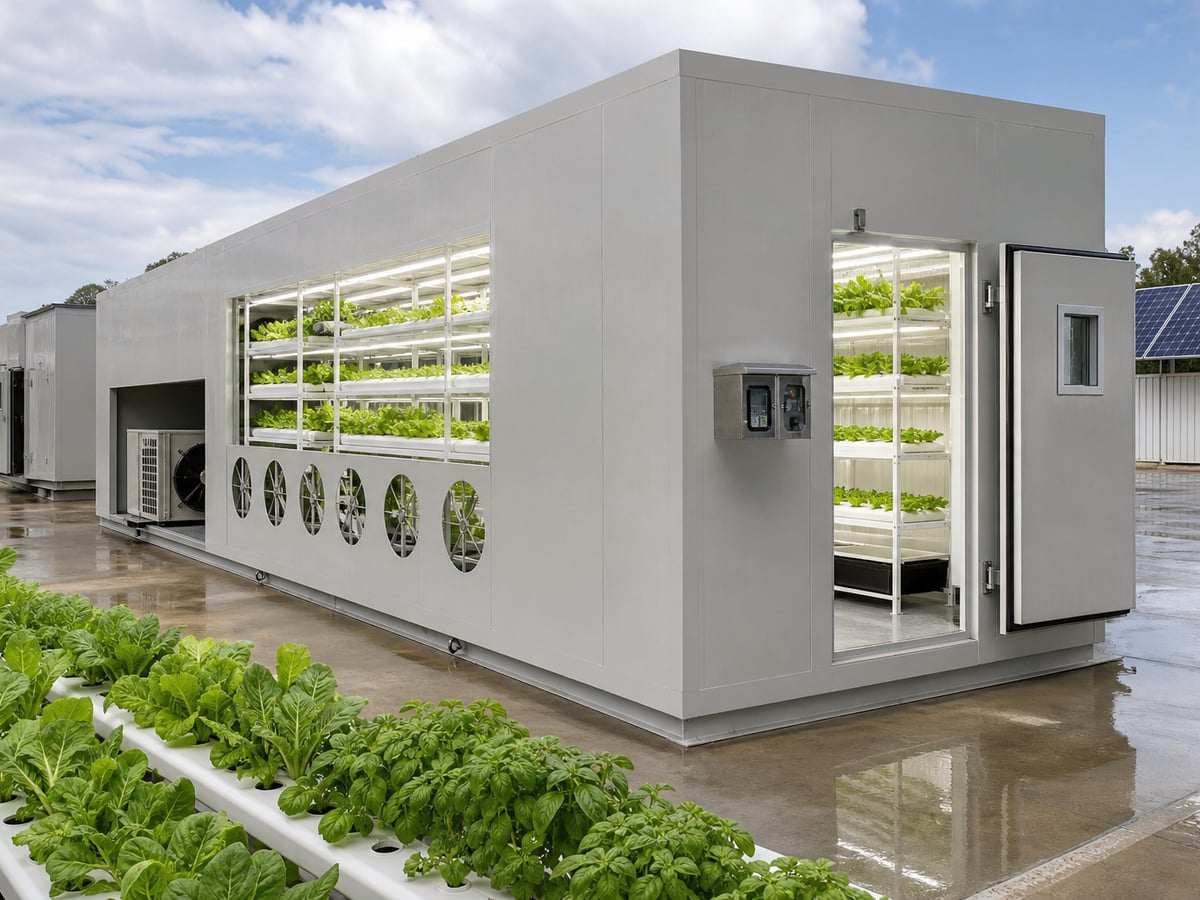
A hydroponic container farm is a self-contained controlled-environment agriculture unit. The structure is generally based on a 20-foot or 40-foot container chassis, or a purpose-built modular cabin with insulated panels. Inside, growers find vertical cultivation racks, crop channels or beds, nutrient reservoirs, pumps, LED fixtures, air handling equipment, water filtration, electrical distribution, and a control cabinet.
The main commercial advantage is environmental control. Outdoor production depends on rainfall, heat, frost, pests, wind, and seasonal daylight. A container farm manages plant-zone temperature, relative humidity, irrigation frequency, nutrient electrical conductivity, pH, air circulation, and photoperiod. This makes production feasible in difficult climates, including hot Gulf regions, cold Northern European locations, humid tropical ports, and land-constrained metropolitan districts.
Users range from first-time growers to professional agricultural operators. In the Global Market, container farms are especially relevant where imported fresh vegetables are expensive, urban land is scarce, or demand for traceable local produce is increasing. Locations near Jebel Ali Port, Port of Rotterdam, Port of Singapore, Durban, Long Beach, and Santos may benefit from modular agriculture because containers and equipment can be transported through established logistics corridors.
Typical products include loose-leaf lettuce, romaine lettuce, butterhead lettuce, basil, mint, coriander, parsley, arugula, kale, bok choy, mustard greens, microgreens, and seedlings. Fruiting crops such as tomatoes, peppers, cucumbers, and strawberries can be grown in some designs, but they usually require taller crop zones, different lighting strategies, stronger trellising, and greater climate capacity. Buyers should not assume that a leafy-green container is automatically suitable for fruiting plants.
Container Layout, Growing Method, and Suitable Crops
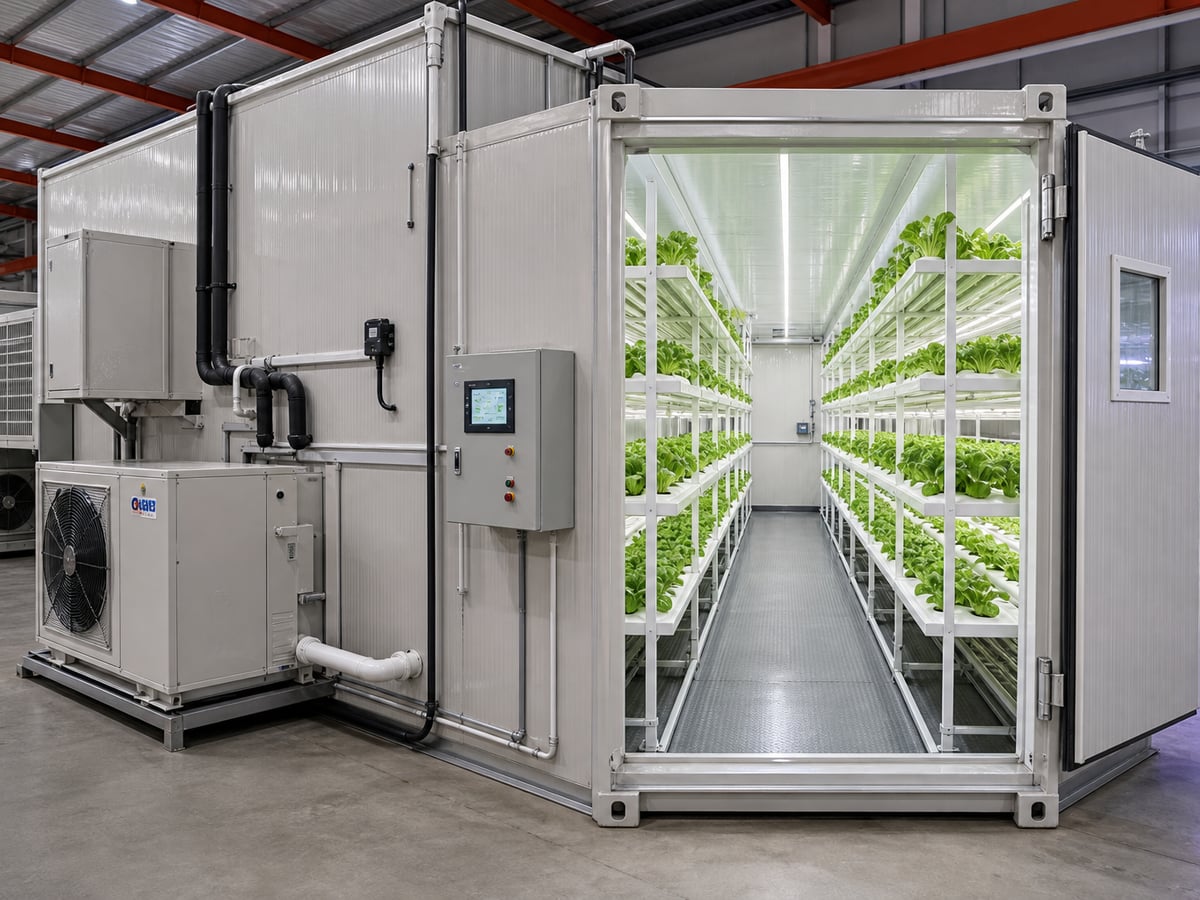
The internal layout determines productivity, cleaning access, worker safety, and maintenance convenience. A practical 40-foot hydroponic container usually includes an entry zone, central aisle, vertical grow racks on one or both sides, a nutrient and filtration room, HVAC components, electrical panels, and drainage provisions. Some layouts add a small germination area, while larger operations may use a separate nursery container for seedlings and a dedicated harvest-and-pack room.
Common growing methods include nutrient film technique (NFT), deep water culture (DWC), ebb-and-flow benches, drip irrigation in coco coir or other substrates, and vertical tower systems. NFT is widely used for leafy greens because roots receive a thin flowing nutrient film and channels can be arranged efficiently. DWC can provide stable root-zone conditions for lettuce but requires careful water-temperature and sanitation management. Drip systems are often better suited to herbs, strawberries, and fruiting crops.
| Growing Method | Best-Suited Crops | Key Benefit | Buyer Consideration |
|---|---|---|---|
| Nutrient Film Technique | Lettuce, arugula, basil, bok choy | Efficient water use and high rack density | Channels must maintain even slope and flow |
| Deep Water Culture | Lettuce, leafy greens, herbs | Stable root access to nutrient solution | Reservoir temperature and dissolved oxygen matter |
| Ebb-and-Flow | Seedlings, herbs, specialty greens | Flexible tray-based production | Regular cleaning prevents algae and root debris buildup |
| Drip Substrate System | Strawberries, tomatoes, peppers, cucumbers | Individual irrigation control | Needs drainage strategy and crop support structure |
| Vertical Tower System | Herbs, leafy greens, ornamental edibles | Strong visual presentation in limited footprint | Uniform light and irrigation can be harder to maintain |
| Propagation Benches | Microgreens, plugs, young plants | Fast turnover and adaptable crop recipes | Requires precise humidity and sanitation management |
The table highlights that crop selection must be linked to system geometry. For example, basil can generate a higher sales value than lettuce but needs pruning, harvest planning, and labor management. Microgreens have short cycles and may improve cash flow, yet frequent seeding, tray washing, and packaging require additional operating discipline.
Before ordering, buyers should request a layout drawing showing clear aisle width, rack dimensions, door swing, floor drain location, reservoir placement, maintenance access, electrical cabinet position, and air-supply direction. This is particularly important for imported projects, where modifications after delivery may increase cost and delay commissioning.
Production Capacity, Rack Density, and Utility Requirements
Production capacity should be expressed as a crop-specific estimate rather than a single marketing number. Yield depends on cultivar, plant spacing, germination rate, crop cycle, harvest style, lighting intensity, climate stability, operator skill, and local ambient conditions. A container with many tiers may have high theoretical plant capacity but lower usable productivity if workers cannot access crops safely or airflow is blocked.
For leafy greens, a 40-foot commercial container can often support hundreds to several thousand planting sites, depending on rack layers and spacing. Weekly output may range widely because baby leaf, full-head lettuce, herbs, and microgreens have very different growth cycles and weight per plant. Buyers should ask suppliers for a production model that identifies plants per level, levels per rack, crop days, expected survival rate, and realistic harvest weight.
| Specification Area | Typical Commercial Planning Range | Why It Matters |
|---|---|---|
| Container format | 20-foot, 40-foot, or modular cabin | Defines transport, cultivation area, and equipment room space |
| Rack layers | 3 to 8 levels, depending on crop and ceiling height | Affects planting density, light distance, and labor access |
| Electrical supply | Three-phase supply is preferred for commercial units | Supports lighting, pumps, HVAC, dehumidification, and controls |
| Water connection | Potable or treated source with adequate pressure | Required for nutrient mixing, cleaning, and reservoir top-up |
| Drainage connection | Floor drain or managed wastewater collection | Essential for washdown, condensate, and maintenance safety |
| Internet connection | Ethernet, Wi-Fi, or cellular gateway | Enables remote monitoring, alarms, and service support |
This utility overview should be reviewed with a local electrician, plumber, and site contractor before shipment. Voltage, frequency, plug standard, water hardness, outdoor temperature, wind exposure, and drainage regulations vary substantially between countries. A farm installed in Riyadh may need stronger cooling and dust protection, while a project in Oslo may require enhanced insulation and heating design.
Electrical capacity is often the most important site requirement. LED lighting, compressors, circulation fans, water pumps, ultraviolet treatment, dehumidifiers, and controllers can create significant peak loads. Buyers should request a load schedule showing connected load, estimated operating load, starting current, recommended breaker size, cable requirements, and backup-power considerations.
LED Lighting, Nutrient Dosing, Irrigation, and Water Treatment
LED lighting replaces sunlight in most indoor hydroponic container farms. Quality fixtures should deliver a crop-appropriate spectrum, stable output, suitable photosynthetic photon flux density, and heat management appropriate for the rack design. Adjustable dimming is useful because seedlings, lettuce, herbs, and mature plants may require different light levels. A lighting recipe should also define photoperiod, dawn-and-dusk transitions if used, and fixture height.
Nutrient dosing systems measure and adjust fertilizer concentration through electrical conductivity and pH control. Commercial systems may use separate stock tanks for concentrated fertilizers, acid or alkali adjustment, and automatic dosing pumps. Manual mixing is possible for smaller operations, but automation improves repeatability when operators follow correct calibration and cleaning procedures.
Irrigation should deliver uniform nutrient solution to every channel, tray, or dripper. Uneven flow can create inconsistent crop size, root stress, and losses. A properly designed system includes circulation pumps, filters, valves, return lines, overflow protection, water-level sensors, and accessible points for flushing. Food-contact materials should be selected carefully, and all plumbing should be easy to inspect and sanitize.
| Water and Irrigation Component | Operational Function | Maintenance Focus |
|---|---|---|
| Sediment filter | Removes particles from incoming water | Replace cartridges according to pressure drop and water quality |
| Carbon filter | Reduces chlorine and selected impurities | Monitor service life to protect roots and beneficial treatment stages |
| Reverse osmosis unit | Produces lower-mineral water where source water is hard or saline | Check membrane performance and reject-water management |
| Ultraviolet treatment | Helps reduce microbial load in recirculating water | Clean sleeve and replace lamp at scheduled intervals |
| EC and pH dosing pumps | Maintain nutrient concentration and acidity targets | Calibrate probes and inspect dosing lines regularly |
| Recirculation pump | Moves nutrient solution through the crop system | Clean filters, check seals, and keep backup parts available |
This equipment list explains why water analysis should be completed before final design. High bicarbonate levels, chlorine, iron, manganese, salinity, and biological contamination can change the recommended treatment arrangement. In coastal regions near major trade hubs, source water may be more saline; in some inland cities, hard water may require reverse osmosis or nutrient recipe adjustment.
Water-saving performance is one of the key benefits of recirculating hydroponics, but water reuse does not eliminate the need for sanitation. Operators should maintain cleaning schedules, check roots and channels, remove plant debris, manage reservoir temperatures, and record dosing activity. Production hygiene is as important as automation.
HVAC, Humidity, CO2, Airflow, and Condensation Control
Climate equipment is the core of a dependable hydroponic container farm. Plants transpire continuously, especially under LED lighting. Without adequate cooling, dehumidification, and airflow, the container can become hot and humid, increasing risks of condensation, tip burn, fungal pressure, uneven growth, and electrical corrosion.
HVAC design should be based on local climate, container insulation, LED heat load, number of plant layers, crop transpiration, door-opening frequency, and the desired temperature and humidity range. In tropical cities such as Jakarta, Manila, and Lagos, latent moisture removal can be as important as cooling. In desert markets such as Abu Dhabi or Doha, high outdoor heat and dust require robust cooling, filtration, and sealed construction. In cold-climate markets, heating and condensation prevention become priorities.
Airflow must reach all plant levels. Fans should move conditioned air through rack aisles without causing excessive leaf movement or drying. Air distribution should avoid stagnant corners, particularly around the lowest and highest shelves. Good designs use supply and return positions that complement rack geometry, not simply the easiest location for installation.
Carbon dioxide supplementation may improve growth when the container is sealed and lighting levels are high. However, CO2 should not be added without proper sensors, ventilation logic, operator safety procedures, and crop-specific targets. In many entry-level systems, stable temperature, humidity, nutrition, sanitation, and airflow should be optimized before adding CO2 enrichment.
| Climate Control Factor | Purpose in a Container Farm | Common Warning Sign |
|---|---|---|
| Temperature control | Maintains crop-specific growth conditions | Slow growth, bolting, or leaf-edge damage |
| Humidity control | Balances transpiration and disease prevention | Condensation, soft leaves, or fungal development |
| Air circulation | Reduces stagnant zones and improves uniformity | Uneven crop size across rack levels |
| Fresh-air exchange | Supports air quality and pressure management | Persistent odors or unstable climate readings |
| CO2 monitoring | Verifies safe and productive concentration levels | Growth inconsistency or unnecessary gas consumption |
| Condensate drainage | Removes moisture from cooling and dehumidification equipment | Water on floors, corrosion, or microbial growth |
The practical lesson is that climate control should be engineered as a complete system. Cooling without dehumidification may still leave excessive humidity. Strong fans without proper supply-air temperature can distribute stress instead of solving it. A buyer should request design conditions for maximum summer temperature, minimum winter temperature, local humidity, and expected internal heat load.
Sensors, App Control, Automation, and Remote Alarms
Modern hydroponic container farms can use a central controller to collect data from temperature, humidity, water level, EC, pH, light, CO2, flow, pressure, and door sensors. The controller can operate lights, pumps, dosing equipment, ventilation fans, HVAC units, valves, alarms, and scheduled crop recipes. Automation reduces repetitive work, but it should be transparent enough for the operator to understand and verify.
A useful app or web dashboard provides live status, historical trends, setpoint adjustment permissions, alarm records, and device status. Remote access is valuable for multi-site operators in the Global Market because technical teams may supervise farms across different time zones. For example, a distributor managing units in Rotterdam, Dubai, and Kuala Lumpur can identify abnormal temperature or low-water alarms before crops are severely affected.
Remote alarms should be configured for high and low temperature, high humidity, water leak detection, reservoir low level, pump failure, power loss, dosing deviation, door-open duration, and communication interruption. Alerts can be sent by app notification, email, text message, or integrated building-management platform depending on the control architecture.
Automation does not replace standard operating procedures. Sensors must be calibrated, backup components must be stocked, and operators must inspect crops daily. A pH probe can drift, a filter can clog, and a pump can fail even in an advanced system. Successful farms combine digital monitoring with visual crop assessment and disciplined record keeping.
Installation, Training, Maintenance, and Warranty
Installation begins with site preparation. The foundation should be level, accessible to delivery vehicles, and designed to support the container weight. The location needs sufficient clearance for doors, maintenance panels, condensers, and forklift or crane handling. Before delivery, the buyer should confirm utility points, electrical protection, water supply, drainage, internet connectivity, security, and local permits.
International projects require careful shipping coordination. Container farms can be dispatched through ports such as Qingdao, Shanghai, Ningbo, Shenzhen, Rotterdam, Antwerp, Jebel Ali, and Long Beach. Buyers should clarify shipment terms, inland transport responsibilities, customs documentation, destination voltage, and whether local certification or inspection is required before ordering.
Training should cover crop seeding, transplanting, nutrient mixing, EC and pH calibration, harvesting, cleaning, HVAC operation, alarm response, basic troubleshooting, food safety, and record management. A supplier should provide manuals, wiring diagrams, maintenance schedules, spare-parts lists, and remote technical guidance where applicable.
Preventive maintenance protects both yield and equipment lifespan. Filters, pumps, fans, sensors, lights, dosing tubes, drain lines, door seals, and electrical connections should be inspected according to a documented schedule. Refrigeration and HVAC equipment should be serviced by qualified local technicians familiar with applicable refrigerants and electrical codes.
Warranty terms should clearly identify covered equipment, warranty duration, excluded consumables, response procedures, remote-support scope, spare-parts availability, and responsibilities for installation quality. A low purchase price can become costly if components are difficult to replace in the destination country.
Our Company
Shandong Lanhu Air Conditioning Equipment Co., Ltd. supports hydroponic container farm projects for customers in the Global Market from its manufacturing base in Dezhou, Shandong, China. The company works with agricultural contractors, equipment distributors, engineering firms, commercial farms, and modular cultivation projects seeking integrated climate and growing solutions.
Technological Capabilities
Lanhu applies more than 12 years of thermodynamic research and development experience to agricultural climate control, industrial HVAC systems, smart hydroponic plant containers, mushroom cultivation containers, mushroom climate controllers, and air source heat pumps. Its engineering focus includes temperature management, humidity control, airflow distribution, insulation performance, control integration, and operational stability for demanding cultivation environments. With more than 45 registered patents, the company develops configurable systems that can be adapted to crop requirements, climate zones, and project layouts. Buyers can also explore Lanhu’s smart hydroponic plant container solutions for modular controlled-environment production.
Manufacturing Capabilities
The company operates a modern facility exceeding 30,000 square meters and integrates product design, engineering development, sheet-metal fabrication, CNC bending, insulation-panel production, electrical assembly, system integration, equipment testing, and quality inspection. This integrated workflow supports greater control over component matching and project consistency. Each system undergoes functional inspection, electrical verification, performance testing, and operational evaluation before shipment. Lanhu holds ISO 9001, ISO 14001, ISO 45001, and ISO 12100 certifications, supporting structured quality, environmental, occupational safety, and machinery safety practices.
Service Capabilities
Lanhu offers factory-direct supply, OEM and ODM customization, engineering assistance, international logistics support, spare-parts planning, installation guidance, and after-sales support. For projects requiring integrated energy solutions, buyers may review the company’s air source heat pump equipment. Customers can also examine practical project references through the case study collection, discuss private-label or project-specific configurations via OEM and ODM services, or request a technical consultation through the contact page.
FAQ
What crops are most profitable in a hydroponic container farm?
Profitability depends on local selling price, labor, energy cost, crop cycle, and market access. Lettuce, basil, mint, coriander, arugula, microgreens, and specialty herbs are common starting crops because they grow quickly and can be sold fresh to restaurants, retailers, and distributors.
Can a container farm operate in very hot or cold regions?
Yes, but the HVAC, insulation, electrical capacity, and condensation-control design must match the local climate. A system for Dubai should not be specified exactly the same way as a unit for Helsinki, Toronto, or Cape Town.
How much water does a hydroponic container farm use?
Recirculating systems generally use substantially less water than conventional field production because unused nutrient solution can be returned to the reservoir. Actual use depends on crop transpiration, cleaning, water quality, drainage practices, and whether reverse osmosis is installed.
Does the farm need three-phase electricity?
Three-phase power is usually preferred for commercial 40-foot container farms because it supports HVAC equipment, LED lighting, pumps, and controls more efficiently. Smaller units may be designed for other power supplies, subject to the equipment load and local electrical standard.
Can the system be monitored remotely?
Yes. With suitable sensors, controller hardware, and internet access, operators can monitor climate, nutrient conditions, alarms, and equipment status remotely. Remote monitoring should support daily management, not replace physical crop inspections.
What should buyers check before choosing a supplier?
Review the supplier’s engineering drawings, HVAC capacity calculations, electrical load schedule, water-treatment plan, control features, manufacturing process, testing procedure, warranty terms, spare-parts support, shipping experience, and evidence of installed projects.
What trends will shape container farming in 2026?
In 2026, buyers are expected to place greater emphasis on energy-efficient LEDs, heat recovery, high-performance insulation, smart climate algorithms, predictive maintenance, water recycling, traceability, local food security, and lower-carbon logistics. Sustainability requirements, urban food policies, and demand for resilient regional supply chains are likely to encourage modular production near major cities and distribution hubs.
Share this article

About the Author: Shandong Lanhu Air Conditioning Equipment
Lanhu is a professional climate control equipment manufacturer specializing in smart agricultural systems, commercial HVAC solutions, and customized temperature control technologies. With extensive engineering experience, Lanhu provides reliable solutions for plant factories, controlled environment agriculture, and industrial applications.
Need a Custom Climate Control Solution?
From smart agricultural systems to commercial HVAC solutions, Lanhu provides reliable temperature and humidity control solutions tailored to your project needs.
Contact Us