Mushroom Cultivation Equipment Guide for Global Markets
Quick Answer

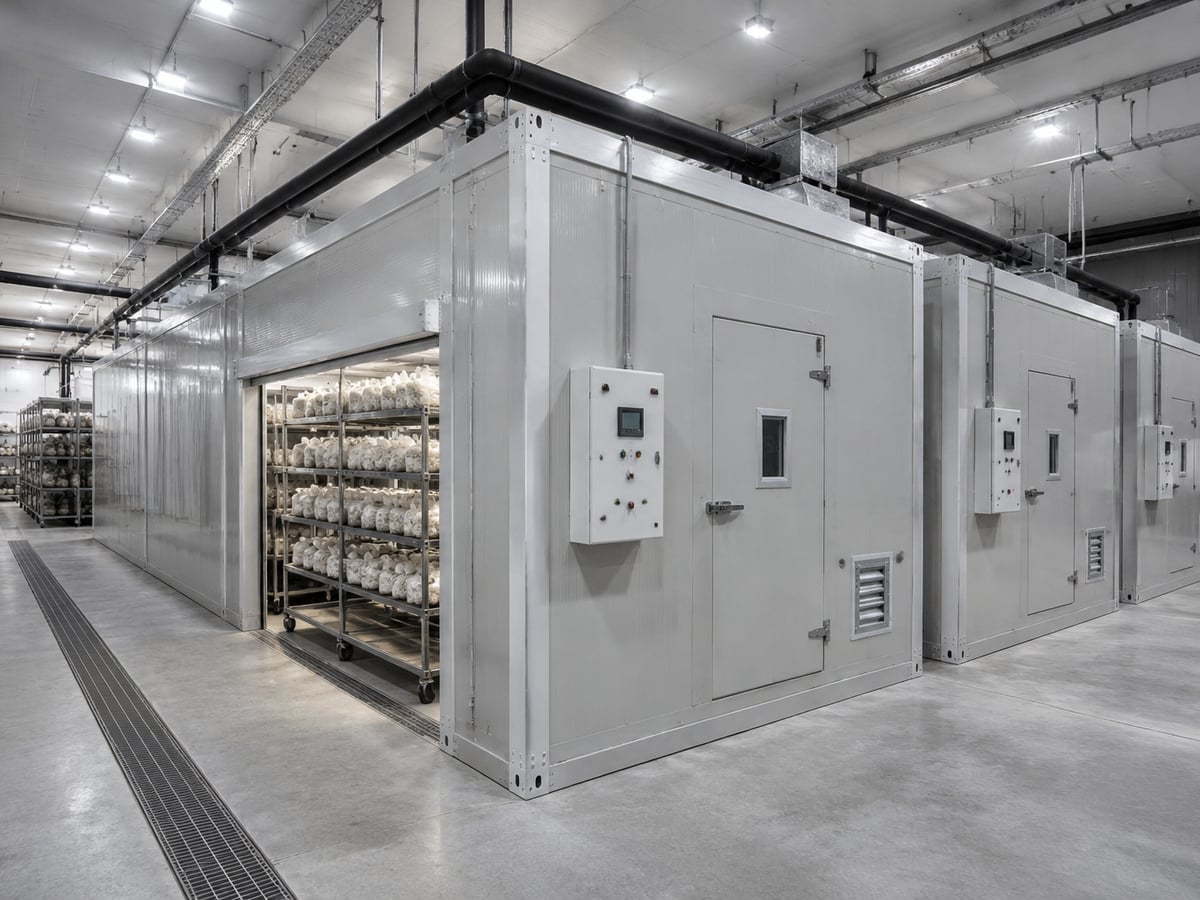
Mushroom cultivation equipment is a controlled-environment system used to create stable growing conditions for edible and medicinal mushrooms. Commercial systems typically combine insulated growing rooms or containers, refrigeration or heat-pump equipment, humidification, fresh-air exchange, CO2 management, circulation fans, sensors, and automated controls. The purpose is to maintain repeatable fruiting conditions while reducing dependence on outdoor weather.
For the Global Market, the right equipment depends on mushroom species, substrate type, production scale, local climate, electricity supply, water quality, labor availability, and export or food-safety requirements. Oyster mushrooms, shiitake, lion’s mane, enoki, button mushrooms, reishi, and other specialty varieties may require different temperature, humidity, airflow, lighting, and CO2 strategies.
A commercial buyer should evaluate more than the purchase price. Important decision factors include usable growing capacity, insulation performance, climate-control accuracy, component brands, corrosion protection, automation level, installation support, spare-parts availability, and lifecycle energy cost. A well-matched system can help growers establish consistent production in hot, cold, humid, coastal, inland, or remote operating environments.
Lanhu supplies integrated solutions including smart mushroom cultivation containers, climate-control equipment, modular room systems, and customized cultivation projects for commercial growers, contractors, distributors, and agricultural engineering companies.
What Is Mushroom Cultivation Equipment and Where Is It Used

Mushroom cultivation equipment refers to the mechanical, electrical, and structural equipment that controls a mushroom-growing environment. It may be installed in a stand-alone insulated container, a prefabricated cultivation room, a converted warehouse, a tunnel structure, or a purpose-built mushroom farm. The system is designed to regulate the indoor microclimate during incubation, pinning, fruiting, harvesting, and crop-change periods.
Modern mushroom farms use controlled cultivation equipment because mushrooms are sensitive to environmental changes. Excessive CO2 can create long stems and small caps in some species. Low humidity can cause drying and cracking. Excessive humidity or poor ventilation may increase condensation and disease pressure. Temperature variation can slow crop development or reduce yield quality. Properly designed equipment addresses these risks through coordinated cooling, heating, humidification, dehumidification, ventilation, and circulation.
Commercial mushroom climate systems are used in urban farms, rural cooperatives, food-processing zones, agricultural parks, research centers, hospitality projects, supermarket supply programs, and container-farming businesses. They are particularly valuable in regions with extreme summer heat, winter cold, seasonal humidity, limited agricultural land, or inconsistent outdoor conditions.
Global buyers commonly deploy these systems near logistics and trade hubs where fresh mushrooms can reach customers quickly. Examples include Rotterdam and Hamburg for European distribution, Dubai and Jebel Ali for Gulf-region food supply, Singapore for high-value urban agriculture, Los Angeles for North American specialty-food markets, and Shanghai, Qingdao, and Shenzhen for Asian processing and export networks. In Africa and Latin America, containerized units can also support decentralized production near cities where cold-chain distance is a challenge.
| Application Area | Typical Equipment Format | Main Production Goal | Common Users |
|---|---|---|---|
| Commercial mushroom farms | Insulated rooms, tunnels, container farms | Year-round production | Growers and farm operators |
| Urban agriculture projects | Modular cultivation containers | Local fresh supply | Urban farms and investors |
| Agricultural cooperatives | Multi-room climate systems | Shared production capacity | Farmer groups and rural enterprises |
| Food-processing facilities | Controlled fruiting rooms | Stable raw-material supply | Processors and packers |
| Research and training centers | Small programmable rooms | Trial cultivation and education | Universities and laboratories |
| Hospitality and retail projects | Display-ready growing containers | Fresh experiential production | Hotels, restaurants, retailers |
The table shows that equipment selection should begin with the production model. A high-output farm needs capacity and operating efficiency, while a restaurant or education project may prioritize compact dimensions, clean appearance, easy operation, and viewing access.
Standard Product Configuration and System Boundaries

A standard mushroom cultivation system normally includes the insulated enclosure, climate-control unit, supply and return air paths, circulation fans, humidification equipment, sensors, electrical cabinet, control interface, lighting where required, drainage provisions, and racks or shelving if included in the order scope. The exact configuration should be confirmed in a technical proposal because system boundaries can differ between suppliers.
For example, a container solution may include the complete container body, internal insulation, refrigeration system, electrical control, fans, humidification, fresh-air dampers, sensors, and cultivation racks. However, civil foundations, external water piping, incoming power cable, on-site drainage, loading equipment, local permits, and substrate preparation facilities may be outside the standard supply scope unless specifically agreed.
Buyers should request a clear equipment list, layout drawing, electrical single-line diagram, utility connection plan, operating manual, and commissioning checklist before placing an order. This avoids confusion between “equipment supply” and “turnkey farm delivery.” A transparent proposal also helps engineering teams compare quotations fairly.
| System Element | Usually Included | Function | Buyer Confirmation Needed |
|---|---|---|---|
| Insulated room or container body | Yes | Creates a sealed cultivation environment | Size, door type, panel thickness |
| Cooling and heating equipment | Yes | Maintains target temperature | Climate design conditions and voltage |
| Humidification system | Yes | Maintains crop humidity range | Water source and filtration requirement |
| Fresh-air and exhaust system | Yes | Controls CO2 and air renewal | Duct route and outdoor installation area |
| Cultivation racks | Optional or included by model | Organizes bags, blocks, or trays | Tier count, load capacity, spacing |
| Foundation and site civil works | Usually excluded | Supports stable installation | Local contractor responsibility |
| External utility connections | Usually excluded | Connects power, water, drainage, network | Distance from site connection point |
The table clarifies a practical rule: a standard configuration should be complete enough for cultivation, but the buyer should define the site interfaces early. This is especially important for overseas deliveries to ports such as Durban, Santos, Manila, Mombasa, Antwerp, or Melbourne, where local installation conditions may differ from factory assumptions.
Capacity, Dimensions, and Utility Requirements
Capacity is not simply the external size of a mushroom-growing container or room. Usable production capacity depends on internal rack layout, number of tiers, aisle width, mushroom species, substrate bag dimensions, crop cycle, and the need for airflow around each growing block. A container with higher rack density may hold more substrate, but excessively dense loading can restrict circulation and create uneven fruiting.
Common modular formats include 20-foot and 40-foot containers, while room-based systems can be designed from small trial rooms to multi-chamber commercial facilities. A 40-foot unit may be appropriate for demonstration production, specialty mushroom supply, or a scalable farm cluster. Larger projects may use several connected units or dedicated insulated rooms with separate incubation and fruiting zones.
| Project Scale | Typical Format | Approximate Use | Power Requirement | Water and Drainage Need |
|---|---|---|---|---|
| Trial or training project | Small insulated room | Species testing and learning | Single-phase or three-phase, project dependent | Basic clean water and floor drain |
| Restaurant or retail farm | 20-foot container | Fresh local specialty mushrooms | Usually compact electrical load | Humidification water and drain |
| Small commercial grower | 40-foot container | Regular market supply | Three-phase commonly preferred | Stable water source and drainage |
| Growing cooperative | Multiple containers | Shared production and staggered harvest | Centralized power planning required | Water distribution and waste handling |
| Regional farm | Prefabricated cultivation rooms | Higher-volume production | Three-phase commercial supply | Designed piping and drainage network | Processing-linked farm | Multi-zone facility | Fresh, dried, or packaged mushroom supply | Dedicated load calculation required | Water treatment and sanitation planning |
Before ordering, buyers should provide local voltage, frequency, phase configuration, ambient temperature range, altitude, water pressure, water hardness, drainage conditions, and site dimensions. Electrical systems can be adapted for common international standards, but the required specification must be finalized before production. Areas with unstable power should consider voltage protection, backup generation, or energy-storage planning to protect crops and refrigeration equipment.
Utility planning also affects operating cost. In tropical climates such as Southeast Asia, the Gulf region, coastal West Africa, and northern Australia, cooling and dehumidification can be major energy loads. In colder climates such as Canada, northern Europe, Central Asia, and high-altitude regions, heating performance and insulation quality become especially important. Selecting the correct panel thickness, refrigeration capacity, and heat-pump configuration is therefore essential.
Temperature, Humidity, CO2, Airflow, and Control Performance
The environmental setpoints for mushroom cultivation must be based on the species and crop stage. There is no single temperature or humidity target suitable for every mushroom. Oyster mushrooms often require different fruiting conditions from shiitake, lion’s mane, king oyster, enoki, or reishi. The system should allow growers to save adjustable recipes rather than rely on one fixed program.
Temperature control must account for the heat produced by substrate blocks, lighting, fans, workers, and outdoor climate. Humidity control must provide sufficient moisture without creating persistent water droplets on caps, walls, or ceilings. CO2 control requires a balanced combination of fresh-air intake, exhaust air, and internal circulation. Airflow should be even, gentle, and distributed across the crop rather than directed aggressively at mushroom bodies.
| Control Parameter | Why It Matters | Potential Issue If Too Low | Potential Issue If Too High |
|---|---|---|---|
| Temperature | Controls crop metabolism and development speed | Slow growth or delayed pinning | Stress, weak fruiting, contamination risk |
| Relative humidity | Supports healthy pin formation and cap quality | Dry caps, cracking, low yield | Condensation, disease pressure, poor appearance |
| CO2 concentration | Influences mushroom shape and fruiting behavior | Excess ventilation energy use | Long stems, small caps, irregular morphology |
| Fresh-air volume | Removes excess CO2 and stale air | Insufficient gas exchange | Temperature and humidity instability |
| Air circulation | Improves uniformity around racks | Dead zones and uneven crops | Surface drying and physical crop damage | Lighting | Supports species requiring light cues | Weak orientation or delayed development | Unnecessary energy use or heat gain |
The table demonstrates why climate control must be coordinated rather than handled by separate devices operating independently. For example, opening fresh-air dampers to reduce CO2 may reduce humidity and alter temperature. A properly programmed controller should recognize these interactions and sequence equipment according to priority settings.
Lanhu’s smart mushroom climate controller can be configured around temperature, humidity, CO2, ventilation, circulation, lighting, and alarm logic. The appropriate control tolerance depends on room size, sensor placement, outdoor conditions, equipment capacity, loading density, and operating strategy. Buyers should ask suppliers to explain sensor quantity, sensor calibration, control logic, alarm thresholds, and the response process for high-temperature or water-supply faults.
Core Components, Materials, and Protection Features
Commercial cultivation equipment operates in a humid environment, so material selection has a direct effect on durability, hygiene, and maintenance requirements. Insulated wall panels should have suitable thermal performance and sealed joints. Rack structures should resist corrosion. Electrical components should be protected from moisture. Drainage surfaces should be easy to clean. Refrigeration and air-handling components should be selected according to the project’s local climate and maintenance resources.
Typical equipment may include polyurethane-insulated panels, color-coated or stainless-steel surfaces depending on requirements, galvanized or stainless-steel rack structures, corrosion-resistant fasteners, sealed doors, LED lighting, axial or centrifugal fans, atomizing humidifiers, refrigeration units, heat-pump modules, electrical enclosures, PLC or controller systems, temperature and humidity sensors, CO2 sensors, and alarm devices.
| Component | Preferred Feature | Benefit to Grower | Maintenance Consideration |
|---|---|---|---|
| Insulated panel | Dense insulation core and sealed joints | Lower heat transfer and stable climate | Inspect seals and panel damage |
| Cultivation rack | Corrosion-resistant metal structure | Safe loading and easier sanitation | Check joints and surface corrosion |
| Humidifier | Fine mist output with accessible cleaning | More even humidity distribution | Clean nozzles and manage water quality |
| Circulation fan | Balanced airflow design | Reduced hot spots and stagnant zones | Clean blades and inspect bearings |
| Electrical cabinet | Moisture-protected enclosure | Improved electrical safety | Keep dry and verify terminals | Door and sealing system | Insulated, durable gasket design | Reduces air leakage and energy loss | Inspect hinges and replace worn seals |
Protection features may include overload protection, phase-loss protection, high- and low-pressure refrigeration protection, water-shortage alarms, high-temperature alarms, sensor fault notifications, emergency stop functions, electrical leakage protection, and remote fault alerts where enabled. The exact protection package should match local electrical codes and project risk conditions.
Automation, Remote Monitoring, and Customization Options
Automation helps growers reduce repetitive manual adjustments and improve consistency between crop cycles. A basic system may use programmable temperature and humidity settings. A more advanced system can include stage-based recipes, CO2 management, timed ventilation, lighting schedules, fan control, alarm history, data logging, remote access, and multi-room management.
Remote monitoring is useful for farms with several containers, distributed sites, or limited on-site staffing. Managers can review current conditions, operating status, alarm records, and historical trends through a compatible monitoring platform. However, remote access should support—not replace—regular crop inspection. A sensor may show correct humidity while the grower still needs to inspect cap condition, disease symptoms, substrate moisture, and airflow distribution.
Customization options can include container dimensions, panel thickness, rack layout, number of shelves, door location, internal finish, electrical standard, refrigeration configuration, heat-pump integration, humidifier type, fresh-air design, sensor package, multilingual interface, external branding, and OEM labeling. Buyers can review OEM and ODM customization services when developing private-label equipment or project-specific cultivation modules.
By 2026, mushroom cultivation equipment is expected to place greater emphasis on energy management, low-GWP refrigerant selection where locally applicable, variable-speed fan control, heat recovery, water-saving humidification, predictive maintenance, sensor verification, cloud-based crop records, and integration with farm-management software. Sustainability policies, energy-efficiency incentives, food-traceability requirements, and corporate carbon-reporting expectations may increasingly influence equipment specifications in the Global Market.
For buyers supplying supermarkets, hotels, processors, or export customers, digital records can support quality management by documenting operating conditions, alarm events, maintenance activity, and crop batches. This information does not replace food-safety procedures, but it can strengthen operational discipline and traceability planning.
Installation, Commissioning, Maintenance, and Warranty
Successful installation starts with site preparation. The foundation must be level and capable of supporting the loaded weight of the container or cultivation room. The site should provide sufficient clearance for doors, maintenance access, ventilation discharge, drainage, and loading operations. Incoming power, water, drainage, and internet access for remote monitoring should be ready before commissioning.
During commissioning, technicians typically verify mechanical installation, electrical connections, refrigeration operation, fan rotation, humidification output, drainage, sensor readings, alarm functions, ventilation sequence, and control settings. The grower should receive operating instructions covering setpoint adjustment, daily inspection, sanitation, harvest-cycle changes, alarm response, and basic troubleshooting.
Routine maintenance is essential in high-humidity environments. Filters, humidifier nozzles, water lines, drains, fan blades, evaporator surfaces, door gaskets, electrical terminals, and sensors should be inspected according to the operating manual. Water hardness and sanitation practice can strongly affect humidification equipment. A preventive-maintenance schedule is usually less costly than emergency repairs during an active crop cycle.
Warranty terms should be confirmed in the commercial contract. Buyers should understand the warranty duration, covered components, exclusions, remote troubleshooting process, spare-parts policy, response time, and responsibility for local labor or travel. International projects benefit from maintaining recommended critical spare parts on site, especially in remote locations or countries with longer import lead times.
For project planning, Lanhu can provide engineering assistance, installation guidance, documentation, spare-parts support, and international logistics coordination. Buyers may also review relevant project examples in the mushroom cultivation case gallery before selecting a configuration.
Our Company
Shandong Lanhu Air Conditioning Equipment Co., Ltd. is a Dezhou, Shandong-based manufacturer serving the Global Market with agricultural climate-control equipment, industrial HVAC solutions, modular mushroom cultivation systems, hydroponic plant containers, climate controllers, and air source heat pumps.
Technological capabilities: Lanhu draws on more than 12 years of thermodynamic research and development experience and holds more than 45 registered patents. Its engineering approach focuses on matching refrigeration, heating, humidification, airflow, insulation, sensing, and control logic to real cultivation conditions. This supports practical equipment selection for different mushroom species, production stages, climates, and operating models.
Manufacturing capabilities: The company operates a modern manufacturing facility of more than 30,000 square meters. Integrated production processes include product design, engineering development, sheet-metal fabrication, CNC bending, insulation panel production, electrical assembly, system integration, equipment testing, and quality inspection. Before shipment, systems undergo functional inspection, electrical verification, performance testing, and operational evaluation. Lanhu holds ISO 9001, ISO 14001, ISO 45001, and ISO 12100 certifications.
Service capabilities: Lanhu provides factory-direct supply, OEM and ODM support, project consultation, international logistics assistance, installation guidance, spare-parts support, and after-sales service. The company works with agricultural contractors, equipment distributors, engineering companies, commercial growers, and investment projects worldwide. For a project quotation or technical discussion, buyers can contact the Lanhu team with their mushroom species, target capacity, site climate, local voltage, and layout requirements.
FAQ
What mushroom species can be grown with controlled cultivation equipment?
Controlled equipment can be designed for oyster mushrooms, shiitake, lion’s mane, king oyster, enoki, reishi, and many other edible or medicinal mushroom varieties. The environmental recipe, rack arrangement, fresh-air demand, and humidity strategy should be adjusted for the selected species and cultivation stage.
Is a container farm better than a traditional mushroom room?
A container farm is compact, modular, transportable, and often faster to deploy. A traditional insulated room may offer more economical capacity for large farms. The best choice depends on output target, available land, construction timeline, local permits, budget, and future expansion plan.
What information is needed for an accurate quotation?
Provide the mushroom species, intended production capacity, cultivation method, country or city, local summer and winter temperatures, voltage and frequency, available water source, drainage condition, installation area, preferred container or room size, and desired automation level.
Can the equipment operate in hot or cold climates?
Yes, but the refrigeration, heating, insulation, and ventilation design must match the local design climate. A system intended for Dubai, Nairobi, Warsaw, Vancouver, or São Paulo should not use identical capacity assumptions. Site climate data should be evaluated before manufacturing.
How often should mushroom cultivation equipment be maintained?
Daily checks should cover temperature, humidity, CO2, water supply, drainage, unusual noise, and alarms. Weekly and monthly maintenance should include cleaning and inspection of humidification components, fans, filters, drains, electrical cabinets, seals, and sensors. The exact schedule depends on operating hours and water quality.
Can I order a customized mushroom growing container under my own brand?
Yes. OEM and ODM options may include customized dimensions, rack layout, electrical standard, control interface, exterior color, branding, and project-specific climate configuration. Early technical communication is recommended because customization may affect design, production time, shipping, and installation requirements.
Share this article

About the Author: Shandong Lanhu Air Conditioning Equipment
Lanhu is a professional climate control equipment manufacturer specializing in smart agricultural systems, commercial HVAC solutions, and customized temperature control technologies. With extensive engineering experience, Lanhu provides reliable solutions for plant factories, controlled environment agriculture, and industrial applications.
Need a Custom Climate Control Solution?
From smart agricultural systems to commercial HVAC solutions, Lanhu provides reliable temperature and humidity control solutions tailored to your project needs.
Contact Us