Global Market Vertical Farm Containers: Operator Guide 2026
Quick Answer

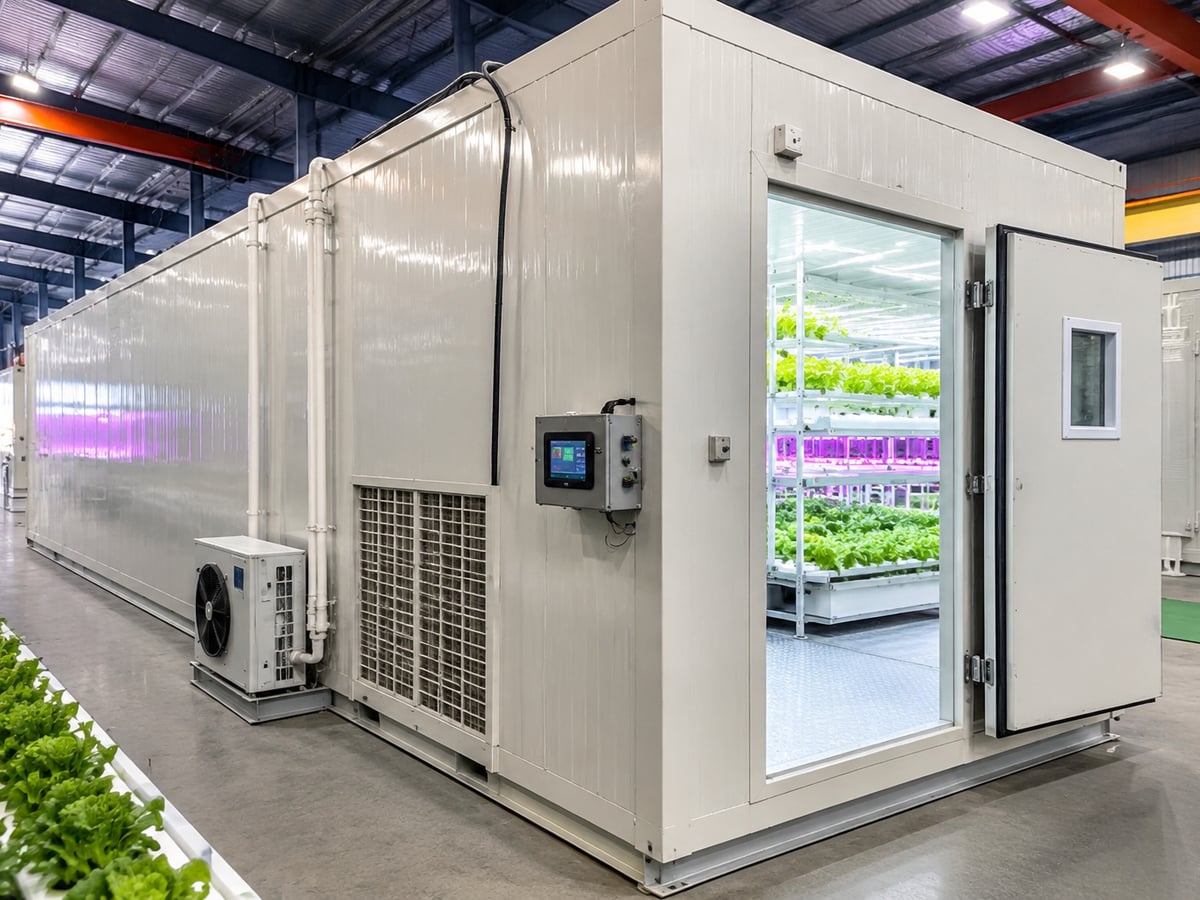
A vertical farming container is a climate-controlled modular growing unit designed to produce leafy greens, herbs, microgreens, seedlings, and selected specialty crops in a compact, controlled environment. For commercial operators in the Global Market, it can provide predictable cultivation conditions, short production cycles, reduced weather exposure, and flexible deployment near customers, cities, ports, resorts, retail centers, or remote worksites.
The commercial value of a containerized vertical farm does not come from placing shelves and LED lights inside a shipping-container-sized enclosure. It comes from integrating insulation, airflow, cooling, dehumidification, irrigation, nutrient dosing, lighting schedules, sanitation, remote monitoring, and backup protection into one reliable operating system. A poorly balanced container can produce uneven crops, high power bills, disease pressure, condensation, and frequent maintenance interruptions. A properly engineered system can support repeatable crop quality and help operators plan deliveries more confidently.
Before purchasing a vertical farming container, define the crop, expected weekly output, local electricity price, water quality, ambient climate, labor model, market channel, and food-safety requirements. Operators in humid tropical regions such as Singapore, Jakarta, Manila, and Dubai face different latent-load and corrosion challenges than growers in Rotterdam, Hamburg, Toronto, or inland Australian locations. The same container layout should not be specified identically for every climate or business model.
For many commercial farms, the best starting point is one pilot module with documented yield, energy, labor, and maintenance records. After two to four successful crop cycles, the operator can decide whether to add more containers, centralize packing, connect multiple modules, or move toward a larger indoor farm. Modular deployment reduces initial uncertainty, but it does not remove the need for agronomy, preventive maintenance, and disciplined operating procedures.
What Commercial Operators Should Know About Vertical Farming Containers

Commercial vertical farming containers are generally built around an insulated steel enclosure, multi-layer growing racks, full-spectrum LED fixtures, hydroponic channels or trays, water treatment equipment, HVAC and dehumidification systems, air circulation fans, sensors, and a programmable control platform. They are typically delivered as self-contained cultivation modules or as semi-integrated units requiring on-site electrical, water, drainage, and communications connections.
The Global Market includes several main buyer groups: urban produce distributors, hospitality groups, food-service suppliers, agricultural contractors, universities, community food programs, remote industrial camps, supermarket chains, seedling suppliers, and specialty herb producers. Each group evaluates container farming differently. A restaurant buyer may prioritize basil aroma and consistent harvest timing. A retailer may prioritize food safety, packaging, shelf life, and year-round supply. An engineering company may prioritize structural documentation, electrical compliance, installation speed, and long-term serviceability.
Container farms are particularly suitable where land is expensive, weather is unreliable, food supply routes are long, or demand is concentrated near dense populations. They can be positioned near logistics hubs such as Rotterdam Port, Jebel Ali Port, Singapore Port, Los Angeles, Hamburg, São Paulo, Melbourne, and Durban. Proximity to consumers can reduce delivery distance, but commercial success still depends on whether the crop value offsets electricity, labor, packaging, depreciation, and distribution costs.
Product types vary significantly. A compact unit may focus on microgreens or seedling propagation. A standard 20-foot or 40-foot container may contain several vertical rack levels for lettuce, kale, arugula, cilantro, mint, basil, or edible flowers. Larger modular cultivation projects may use linked container units for separate germination, production, harvesting, and utility functions. Some operators also use containers as controlled nursery rooms supporting greenhouse production rather than as the final harvest location.
| Container Farm Type | Typical Commercial Purpose | Common Crops | Primary Buying Priority |
|---|---|---|---|
| Seedling container | Reliable transplant production | Lettuce, herbs, vegetable seedlings | Uniform germination and hygiene |
| Leafy-green production unit | Weekly local harvest supply | Lettuce, kale, arugula, pak choi | Stable climate and low operating cost |
| Herb-focused unit | Premium food-service or retail supply | Basil, mint, cilantro, parsley | Flavor, appearance, harvest scheduling |
| Microgreen container | High-value short-cycle production | Radish, pea, sunflower, broccoli | Labor flow and sanitation control |
| Research and demonstration unit | Training, trials, crop development | Multiple trial crops | Flexible controls and data recording |
| Remote-site food unit | Fresh produce near isolated operations | Leafy greens and herbs | Reliability, remote support, spare parts |
This comparison matters because equipment selection should follow the crop and business case. A microgreen operation may need wide trays, washing space, rapid turnover, and labor-efficient handling. A lettuce unit may need deeper production channels, stronger cooling capacity, dependable nutrient recirculation, and tightly managed harvest intervals. A buyer who chooses a generic rack layout without mapping crop workflow may lose usable growing area and create avoidable labor bottlenecks.
Why It Matters to Yield, Quality, and Operating Risk

Yield in a vertical farming container is influenced by far more than the number of plant sites. Plant density, light intensity, photoperiod, nutrient temperature, root-zone oxygen, airflow, vapor pressure conditions, room temperature, relative humidity, cultivar choice, and harvest timing all interact. A container that looks productive on paper may underperform if the top rack receives more light and cooler air than the lower rack, or if humidity rises during the dark period and creates persistent leaf wetness.
Quality is especially important for commercial buyers. Lettuce must be uniform, clean, compact, and free from tip burn. Basil must retain leaf integrity, color, and aroma. Microgreens must be harvested under hygienic conditions with reliable shelf-life performance. When crop quality varies between shelves or harvest days, distributors may downgrade the product, restaurants may reject deliveries, and operators may struggle to maintain pricing.
Operating risk is commonly underestimated. Container farms combine water, electrical equipment, electronics, high-intensity lights, refrigeration components, drains, pumps, and biological production within a confined envelope. A failed condensate drain, sensor drift, clogged filter, failed circulation fan, or unstable electrical supply can affect every crop rack within hours or days. Commercial operators should therefore view climate control and alarm systems as production-critical infrastructure rather than optional accessories.
| Risk Factor | Likely Business Impact | Early Warning Signal | Practical Control |
|---|---|---|---|
| High humidity at night | Mold, leaf wetness, soft crops | Condensation on panels or leaves | Dehumidification and scheduled air movement |
| Uneven light distribution | Non-uniform size and harvest weight | Rack-to-rack growth variation | PPFD mapping and fixture adjustment |
| Nutrient imbalance | Slow growth, chlorosis, tip burn | EC or pH drift | Calibrated dosing and daily checks |
| Cooling failure | Rapid crop stress and lost shelf life | Temperature alarm or compressor cycling | Preventive HVAC maintenance and backup plan |
| Water contamination | Root disease and food-safety exposure | Odor, biofilm, turbidity | Filtration, sanitation, cleaning records |
| Power interruption | Climate instability and irrigation downtime | Voltage fluctuation or alarm event | Generator, UPS, surge protection |
The table shows why a commercial unit should be designed around failure prevention. It is not enough to measure room temperature. Operators should monitor supply-air temperature, return-air temperature, humidity, nutrient solution temperature, pH, electrical conductivity, tank level, pump status, door-open duration, compressor operation, and alarm history. Trend data helps distinguish a one-time event from a repeating design problem.
For high-value markets, quality assurance should also include batch identification, seed source records, nutrient logs, harvest dates, cleaning schedules, pest inspection, packaging conditions, and customer feedback. This level of documentation is useful for growers supplying supermarkets, airlines, hotel groups, premium retailers, and export-oriented distributors.
Key Parameters, Measurements, and Design Assumptions
A vertical farming container should be specified using measurable assumptions rather than broad claims. The most important question is not “How many plants fit inside?” but “How much marketable crop can be harvested consistently under local operating conditions?” The answer depends on cultivar, target plant weight, crop cycle length, planting density, rack count, climate design, and the percentage of product lost to quality defects or downtime.
For leafy greens, operators commonly set crop-specific targets for air temperature, relative humidity, nutrient temperature, pH, EC, light intensity, and daily light integral. However, these values are not universal. A premium basil crop may use a different strategy than butterhead lettuce, while seedlings may require lower light levels and more carefully managed moisture. The supplier should provide a controllable range and explain the logic behind the selected design point.
| Parameter | Commercial Measurement | Typical Operating Consideration | Why It Should Be Recorded |
|---|---|---|---|
| Air temperature | °C or °F by zone | Day/night crop requirement | Supports growth consistency and fault detection |
| Relative humidity | Percentage by zone | Must match temperature and transpiration | Controls condensation and disease risk |
| Light intensity | PPFD at canopy level | Verify every rack level | Prevents uneven biomass production |
| Photoperiod | Hours of light per day | Crop and electricity-tariff dependent | Supports repeatable scheduling |
| Nutrient EC | mS/cm | Adjusted by crop stage and water source | Indicates nutrient concentration stability |
| Nutrient pH | pH value | Requires routine calibration | Protects nutrient availability |
| Water temperature | °C or °F in reservoir | Influences dissolved oxygen and roots | Helps prevent root-zone stress |
Before ordering, ask the supplier to state design assumptions for outdoor temperature, outdoor humidity, solar exposure, electrical frequency, voltage, maximum electrical load, water supply quality, drain location, installation clearance, and expected crop load. For example, a container placed in Riyadh, Doha, or inland Mexico may require a stronger cooling strategy than the same model installed in northern Europe. A humid coastal site such as Bangkok, Mombasa, or Miami may require more attention to dehumidification and corrosion resistance.
Buyers should request rack drawings, airflow paths, equipment placement, access clearance, maintenance access, electrical single-line information, water connection details, drainage layout, and estimated utility consumption. A credible supplier will distinguish between installed power and average operating consumption. Installed power describes the maximum connected load; it does not mean the unit continuously uses that amount of electricity.
Crop capacity should also be described transparently. Useful capacity metrics include plant sites, usable canopy area, seedlings started per cycle, harvest kilograms per week, and projected annual output. These figures should identify crop type and cycle assumptions. A claim based on small seedlings cannot be compared directly with finished-head lettuce production.
Required Equipment, Controls, and Infrastructure
A commercial container vertical farm needs integrated equipment rather than isolated components. The enclosure should use insulated panels suitable for the intended climate, washable interior surfaces, sealed joints, durable flooring, safe drainage, and materials that tolerate repeated cleaning. Food-growing applications benefit from finishes that resist moisture, corrosion, and microbial buildup.
The HVAC system should be sized for sensible heat from LEDs and equipment, latent heat from plant transpiration, outside-air infiltration, and local ambient conditions. In many container farms, moisture management is as important as cooling. If the air-conditioning system lowers temperature but cannot maintain humidity under crop load, condensation and disease risk may increase. Air distribution must reach every shelf, not only the aisle.
Lighting should provide appropriate spectrum, intensity, uniformity, dimming capacity, timer control, and service access. Hydroponic equipment usually includes tanks, filters, pumps, channels or trays, dosing pumps, pH and EC sensors, and water-level protection. The control platform should collect data, allow alarm thresholds, support remote viewing where practical, and retain operating history.
| System Area | Essential Equipment | Commercial Requirement | Maintenance Priority |
|---|---|---|---|
| Structure | Insulated enclosure, sealed doors, drainage floor | Thermal stability and hygienic surfaces | Inspect seals and corrosion monthly |
| Climate control | HVAC, dehumidification, circulation fans | Rack-level temperature and humidity consistency | Clean filters and inspect coils regularly |
| Lighting | LED bars or panels, drivers, timers | Uniform canopy intensity | Check output and replace failed fixtures |
| Irrigation | Tanks, pumps, channels, filters, valves | Stable flow and clean nutrient delivery | Flush lines and inspect pumps |
| Controls | PLC, sensors, alarms, dashboard | Accurate monitoring and traceability | Calibrate sensors and test alarms |
| Power protection | Distribution panel, breakers, UPS, generator option | Safe operation during grid instability | Test backup systems quarterly |
| Water management | Filtration, UV option, drain and condensate lines | Reliable water quality and no standing water | Clean filters and verify drainage |
Infrastructure outside the container is equally important. The site needs a level foundation, vehicle access for delivery, adequate clearance for doors and maintenance panels, electrical supply sized by a qualified electrician, potable or treated water, drainage, lighting, security, internet or mobile signal where remote monitoring is used, and a safe working area for harvest and loading.
For larger projects, operators may separate the cultivation container from packing, cold storage, seed handling, and staff changing areas. This is often more hygienic and more efficient than trying to complete every task inside the growing module. A dedicated wash-and-pack zone also reduces traffic through the production room and limits the introduction of contaminants.
Commercial buyers assessing modular hydroponic systems can review smart hydroponic plant container options to compare cultivation layouts, climate integration, and project configuration needs.
Recommended Workflow and Operating Procedure
A successful container farm operates through repeatable routines. Standard operating procedures should cover seed receiving, seed storage, sowing, germination, transplanting, nutrient preparation, climate verification, scouting, harvesting, cleaning, packaging, maintenance, and incident response. The goal is not excessive paperwork; it is ensuring that crop quality does not depend on one experienced employee remembering every step.
Begin each production day by reviewing alarms, room temperature, humidity, tank level, pH, EC, water temperature, pump status, and any visible condensation. Check crop appearance at multiple rack levels, not only near the door. Inspect roots, leaf color, canopy uniformity, algae presence, clogged emitters, and fan operation. Document deviations before corrective actions are taken.
During sowing and transplanting, use lot identification for seeds and labels for each crop batch. Record the cultivar, sow date, expected harvest date, rack position, nutrient program, and responsible operator. This enables accurate crop forecasting and helps identify the cause if a batch develops uneven growth.
| Operating Stage | Core Task | Frequency | Verification Record |
|---|---|---|---|
| Opening inspection | Review alarms, climate, pumps, drainage | Daily | Daily environment checklist |
| Nutrient management | Measure pH, EC, tank level, solution temperature | Daily or per crop protocol | Nutrient log |
| Crop scouting | Check leaves, roots, pests, disease symptoms | Daily | Crop health report |
| Seeding and transplanting | Label batches and assign rack positions | Per production plan | Batch record |
| Harvesting | Harvest, weigh, inspect, pack, cool | Scheduled harvest days | Harvest and rejection log |
| Cleaning | Sanitize tools, trays, surfaces, drains | Between batches and as scheduled | Sanitation checklist |
| Preventive maintenance | Inspect filters, fans, sensors, pumps, lights | Weekly to monthly | Maintenance report |
Harvest operations should be planned backward from delivery commitments. For example, a hotel in Dubai or a retailer in London may require specific packing formats, morning delivery windows, and consistent shelf-life performance. Harvesting should occur under clean conditions, followed by rapid cooling when the crop requires it. Packing material should protect the crop without trapping excess moisture.
When a problem occurs, the team should first stabilize the environment, then protect the crop, then diagnose root causes. If humidity rises unexpectedly, verify doors, condensate drainage, dehumidification function, fan operation, crop density, and sensor accuracy. If EC drifts, check dosing settings, water source changes, sensor calibration, leaks, and tank refill practices. Corrective actions should be documented so the same issue can be prevented later.
Capacity, Energy, Labor, and Cost Considerations
Commercial capacity should be calculated from saleable output, not maximum theoretical planting positions. A container may have hundreds or thousands of sites, but marketable output depends on germination percentage, crop loss, harvest weight, crop cycle length, and the percentage of each harvest that meets customer specifications. Operators should model conservative, expected, and high-performance scenarios.
Energy is usually one of the largest variable costs. LEDs generate heat, and HVAC equipment must remove that heat while controlling humidity. Electricity pricing differs substantially across the Global Market. A system operating in a region with high daytime tariffs may benefit from lighting schedules that use lower-cost periods, provided crop biology and cooling capacity are considered. In hot climates, nighttime lighting can reduce cooling demand in some seasons, although humidity management must still be maintained.
Labor is another major cost factor. A container farm can reduce field labor and weather-related interruptions, but it still requires sowing, transplanting, scouting, harvesting, cleaning, packaging, inventory management, and maintenance. The most efficient operations design workflows so employees do not repeatedly enter and exit the production room, search for tools, move products long distances, or handle each crop batch unnecessarily.
| Cost Category | Main Cost Drivers | How to Control It | Commercial Decision Impact |
|---|---|---|---|
| Capital equipment | Container build, racks, HVAC, LEDs, controls | Match specification to crop and climate | Determines initial investment and upgrade path |
| Electricity | Lighting hours, cooling load, dehumidification | Efficient equipment and tariff-aware scheduling | Strong effect on production margin |
| Water and nutrients | Water source, filtration, recirculation, crop demand | Monitor usage and maintain dosing accuracy | Affects crop consistency and resource efficiency |
| Labor | Seeding, harvest, packing, cleaning, supervision | Use planned workflows and batch scheduling | Determines scalability of the operation |
| Maintenance | Filters, pumps, sensors, refrigeration components | Preventive maintenance and spare-parts planning | Reduces downtime and crop loss |
| Logistics | Delivery frequency, packaging, cold chain, location | Locate near buyers and consolidate deliveries | Influences freshness and landed cost |
Cost estimates should include site preparation, customs duties where applicable, installation, electrical work, water and drainage connection, local certification, staff training, spare parts, seed inventory, packaging, cold storage, insurance, and working capital. Buyers should avoid comparing only the factory price of the container. A lower purchase price may lead to higher utility consumption, weaker climate control, limited local serviceability, or more frequent equipment replacement.
As a practical buying approach, request a commercial model showing expected output, crop assumptions, installed electrical load, average energy estimate, labor hours per week, consumables, maintenance intervals, and exclusions. Then compare the model with actual local selling prices and delivery costs. For examples of deployed modular cultivation projects, operators can review container farming project cases when evaluating project planning methods.
Common Mistakes, Failure Modes, and Corrective Actions
A common mistake is buying a container before confirming the route to market. Producing fresh lettuce is not enough; the operator must know who will buy it, how often they will buy it, what pack size they require, what quality specification applies, and what price supports the production model. Pilot customers and supply agreements should be developed alongside equipment planning.
Another common mistake is specifying capacity based only on plant sites. A stronger approach is to establish target harvest kilograms per week, acceptable rejection percentage, labor hours, delivery schedule, and energy budget. This makes it easier to select the correct rack configuration, lighting plan, and harvest workflow.
Many failures arise from inadequate humidity control. Operators sometimes install cooling equipment that can lower air temperature but cannot handle crop transpiration at full canopy. The result may be damp surfaces, fungal growth, nutrient uptake problems, and weak shelf life. Corrective action includes checking latent-load capacity, airflow distribution, plant density, room sealing, drainage, and control setpoints.
Sensor neglect is another recurring issue. pH, EC, temperature, and humidity sensors can drift. If calibration is delayed, automated dosing and climate controls may make incorrect decisions. A simple calibration schedule, reference solutions, and cross-check measurements can prevent costly crop inconsistencies.
Power reliability must be considered at the site-selection stage. In regions with unstable grids, a generator, UPS for controls, surge protection, and alarm notifications may be essential. The required backup scope depends on local outage duration, outdoor conditions, crop sensitivity, and the ability of staff to respond. A backup plan should include procedures for extended outages, not merely a generator purchase.
Finally, buyers should avoid designs with poor maintenance access. Filters, pumps, electrical panels, coils, dosing equipment, and drain lines need safe access. If technicians must dismantle racks or interrupt production to reach routine service components, maintenance will be delayed and operating risk will increase.
Our Company
Shandong Lanhu Air Conditioning Equipment Co., Ltd. supports commercial cultivation projects with an engineering focus on controlled environments, agricultural climate systems, modular growing equipment, and integrated air-conditioning solutions. For vertical farming container projects, the company’s technological capability centers on combining temperature control, humidity management, ventilation, water circulation, lighting integration, automation, and crop-room monitoring into practical operating systems.
Its manufacturing capability is based in Dezhou, Shandong, China, where the company operates a modern production facility exceeding 30,000 square meters. Internal capabilities include product engineering, sheet-metal fabrication, CNC bending, insulation-panel production, electrical assembly, system integration, testing, and quality inspection. This integrated approach supports configuration control for modular hydroponic plant containers, smart mushroom cultivation containers, climate controllers, and related equipment. Functional checks, electrical verification, performance testing, and operational evaluation are carried out before shipment.
Lanhu’s service capability is designed for agricultural contractors, distributors, engineering companies, and commercial growing projects across the Global Market. Support can include factory-direct supply, OEM and ODM customization, project engineering assistance, international logistics coordination, spare-parts planning, installation guidance, and after-sales service. Buyers seeking tailored equipment layouts can explore OEM and ODM cultivation equipment services for project-specific requirements.
For facilities requiring coordinated heating, cooling, or energy-saving climate solutions beyond the container itself, suitable air source heat pump systems can be considered during broader site planning. Commercial operators can also contact the Lanhu project team to discuss crop targets, climate conditions, utility constraints, container dimensions, and delivery requirements.
Looking toward 2026 and beyond, container farming projects are increasingly expected to include smarter automation, remote diagnostics, predictive maintenance, energy monitoring, water-use reporting, recyclable or lower-impact materials, and stronger food-safety documentation. Sustainability requirements are also expanding across major markets. Buyers may face more demand for energy transparency, responsible refrigerant selection, efficient lighting, low-water crop strategies, and traceable local production. Operators who build these capabilities into early purchasing decisions are better positioned for future retailer, investor, and regulatory expectations.
FAQ
What crops are most suitable for a vertical farming container?
Leafy greens, herbs, microgreens, seedlings, edible flowers, and selected compact specialty crops are generally the most suitable. These crops have relatively short cycles, high value per square meter, and compatibility with controlled-environment hydroponic systems. Crop selection should be based on customer demand and local selling price, not only on ease of growing.
How much electricity does a commercial container farm use?
Electricity use depends on lighting intensity, lighting hours, local climate, insulation quality, cooling demand, humidity load, crop density, equipment efficiency, and operating schedule. Buyers should request both installed electrical load and an estimated average operating profile for the intended crop and location. The estimate should clearly state its assumptions.
Can a container farm operate in hot or humid climates?
Yes, but the climate-control system must be designed for the local ambient temperature and humidity. Hot, humid regions usually require careful sizing of cooling, dehumidification, condensate drainage, insulation, air sealing, and corrosion protection. A standard temperate-climate design may not perform adequately in tropical or desert environments.
Is a vertical farming container suitable for remote locations?
It can be suitable for mining camps, island communities, resorts, research sites, military-support environments, and remote food-service operations where fresh produce is difficult to source. The project should include power reliability, water treatment, spare parts, remote alarms, staff training, and logistics planning for seeds, nutrients, packaging, and replacement components.
What information should I provide before requesting a quotation?
Provide the target crop, desired weekly output, installation country and city, ambient climate, available voltage and frequency, electricity price, water source, drainage conditions, site dimensions, customer type, preferred container size, expected delivery timeline, and any local certification requirements. Better input information leads to a more accurate specification.
How can operators reduce crop loss in a container farm?
Use documented crop protocols, maintain stable temperature and humidity, calibrate pH and EC sensors, inspect plants daily, clean tanks and channels, verify drainage, maintain airflow across all racks, test alarms, keep critical spare parts, and record incidents. Consistency in daily operation is usually more valuable than frequent changes to setpoints.
What are the main vertical farming trends for 2026?
Key trends include more energy-efficient LED systems, AI-assisted climate optimization, remote monitoring, predictive maintenance, heat-pump integration, water recirculation, improved crop traceability, modular expansion strategies, lower-impact materials, and greater emphasis on local food resilience. Commercial buyers are also placing more attention on operating data rather than relying only on theoretical yield claims.
Share this article

About the Author: Shandong Lanhu Air Conditioning Equipment
Lanhu is a professional climate control equipment manufacturer specializing in smart agricultural systems, commercial HVAC solutions, and customized temperature control technologies. With extensive engineering experience, Lanhu provides reliable solutions for plant factories, controlled environment agriculture, and industrial applications.
Need a Custom Climate Control Solution?
From smart agricultural systems to commercial HVAC solutions, Lanhu provides reliable temperature and humidity control solutions tailored to your project needs.
Contact Us