Smart Mushroom Containers for the Global Market Guide
Quick Answer

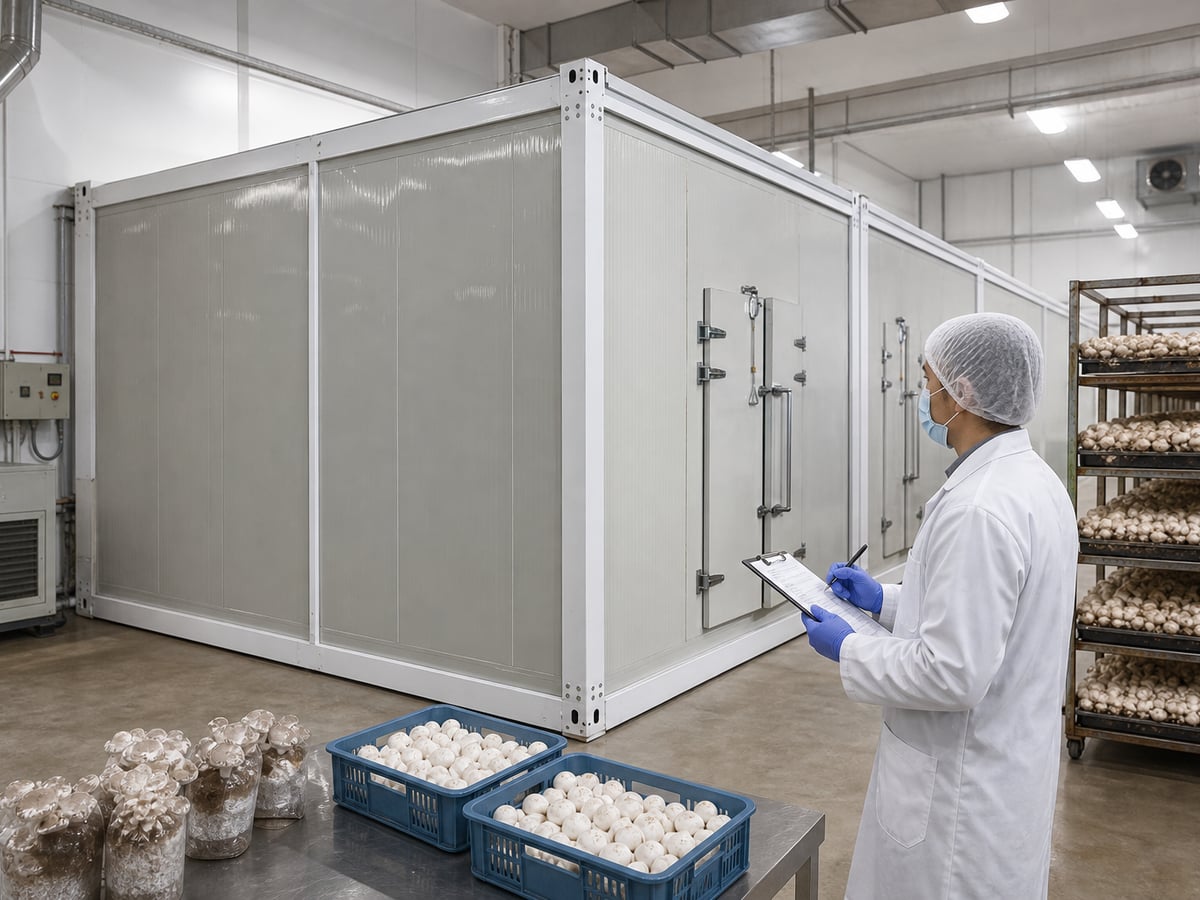
A smart mushroom container is a factory-built, insulated cultivation room installed inside a shipping-container-style structure. It combines refrigeration or heat pump equipment, humidification, fresh-air ventilation, CO2 management, circulation fans, sensors, shelving, lighting, drainage, and a programmable controller in one modular system. Commercial growers use it to create stable fruiting conditions for oyster mushrooms, shiitake, lion’s mane, enoki, king oyster mushrooms, button mushrooms, and other specialty varieties.
For the Global Market, a smart mushroom growing container is especially useful where land is limited, outdoor conditions are unreliable, farms need fast deployment, or a project requires controlled production close to consumers. It can be placed near food distribution centers, hotels, supermarkets, processing plants, agricultural estates, research facilities, and urban farms. Instead of constructing a conventional mushroom house from the ground up, buyers receive an integrated cultivation environment that can be commissioned after site preparation, utility connection, and system testing.
The practical value is consistency. Mushroom production depends on narrow environmental ranges, and the target conditions change by species and growth stage. A well-designed container cultivation unit helps growers maintain temperature, humidity, airflow, fresh-air exchange, and carbon dioxide concentration with less manual adjustment. This supports improved crop uniformity, cleaner production management, reduced seasonal dependence, and easier replication across multiple sites.
Smart mushroom containers are not a substitute for good substrate, hygienic handling, trained staff, and correct crop scheduling. They are controlled-environment tools that make those operating practices more predictable. Buyers should select the container size, cooling capacity, shelving layout, controller functions, and electrical configuration according to crop species, local climate, daily loading plan, and expected production cycle.
What Is a Smart Mushroom Container and Where Is It Used?

A smart mushroom container is a modular controlled-environment farming solution built around an insulated container body or container-like steel structure. The system creates a separated production zone where cultivation parameters can be measured and automatically adjusted. Standard systems are commonly used as fruiting rooms, incubation rooms, spawn-running rooms, experimental cultivation units, or small-scale demonstration farms. Some projects use several containers together, with each module assigned to a different crop stage.
In commercial use, one container may receive colonized substrate blocks every day or every week, while another operates as a dedicated fruiting chamber. This staggered arrangement can help farms plan harvests more evenly. For example, a grower supplying restaurants in Dubai, Singapore, Rotterdam, Los Angeles, São Paulo, or Johannesburg may value the ability to harvest fresh mushrooms close to buyers instead of depending entirely on long-distance chilled transport.
Containerized mushroom farming is used across a wide range of industries and operating models:
- Commercial farms expanding capacity without constructing permanent buildings.
- Urban agriculture projects located near wholesale markets and food-service districts.
- Agricultural contractors delivering turnkey mushroom projects.
- Food distributors seeking local, traceable fresh produce sources.
- Hotels, resorts, culinary schools, and restaurants using premium mushrooms in farm-to-table programs.
- Universities, vocational colleges, and research centers conducting controlled cultivation trials.
- Remote sites where conventional farm construction is difficult or slow.
- Equipment distributors serving regional growers with standardized modular products.
The container format is particularly relevant in areas with high summer temperatures, cold winters, high rainfall, water restrictions, or unpredictable weather. In tropical ports such as Jakarta, Manila, Mombasa, and Ho Chi Minh City, dehumidification, cooling, and airflow design may be a major purchasing priority. In colder regions near Hamburg, Toronto, Warsaw, or Almaty, insulation quality, heating performance, frost protection, and energy recovery may become more important.
For buyers comparing systems, the product should be evaluated as a complete cultivation environment rather than simply an insulated box. The performance of the enclosure, refrigeration system, air distribution, humidification method, sensor quality, drainage design, and controller logic is closely connected. Learn more about complete smart mushroom cultivation container solutions when reviewing available configurations.
Standard Product Configuration and System Boundaries

A standard smart mushroom container normally includes the insulated room structure, internal shelving or hanging arrangement, climate-control equipment, electrical control cabinet, sensors, lighting, fresh-air inlet and exhaust components, drainage features, and access door. The exact arrangement varies according to container length, local voltage, mushroom species, and site climate. A 20-foot unit is often selected for pilot production and limited-space locations, while 40-foot models are commonly considered for commercial output or multi-rack layouts.
It is important to define the system boundary before purchase. A supplier may provide the cultivation container and its internal operating equipment, while the customer remains responsible for site leveling, concrete pads, utility connection, incoming water treatment, external drainage, permits, unloading equipment, and local electrical compliance. Clear responsibility allocation prevents delays during installation and protects the equipment from unsuitable site conditions.
| System Area | Typical Included Items | Purpose | Buyer Confirmation Needed |
|---|---|---|---|
| Container enclosure | Steel frame, insulated panels, interior finish, access door | Creates a clean, insulated cultivation space | Local wind, snow, corrosion, and transport requirements |
| Climate equipment | Heat pump, cooling unit, heater, evaporator, ducts | Maintains crop temperature | Ambient temperature range and power supply |
| Humidity system | High-pressure misting, ultrasonic or other humidification options | Supports required relative humidity | Water quality, filtration, and drainage conditions |
| Ventilation system | Fresh-air inlet, exhaust fan, dampers, filters | Controls CO2 and air freshness | Outdoor dust, insects, odor, and local air quality |
| Control system | PLC or intelligent controller, sensors, touchscreen | Automates setpoints and alarms | Remote access, language, and data requirements |
| Cultivation fixtures | Galvanized racks, stainless steel options, LED lights | Holds blocks or trays and supports operations | Bag size, loading method, and cleaning preference |
| Site-side works | Foundation, utility routing, water source, external drainage | Allows safe operation after delivery | Normally arranged by buyer or local contractor |
The table shows why quotations should be compared line by line. Two products described as “mushroom containers” may have very different insulation thicknesses, cooling capacities, rack materials, electrical protections, sensor quantities, and delivery scopes. A lower initial price can create higher commissioning costs if necessary ventilation, drainage, water filtration, or electrical accessories are excluded.
For projects that require unique door positions, larger machinery compartments, special racks, branding, alternative panel finishes, or multiple connected rooms, OEM and ODM engineering is often more appropriate than a fixed standard model. Buyers can review OEM and ODM customization services when developing a project-specific configuration.
Capacity, Dimensions, and Utility Requirements
Container capacity should be calculated from usable cultivation area, not only external container length. Rack levels, aisle width, bag dimensions, crop spacing, and the need for service access all influence the practical loading volume. Overloading can restrict airflow, increase local humidity variation, make harvesting difficult, and raise contamination risk. Therefore, the ideal number of substrate blocks should be based on the selected mushroom species and operational workflow.
A 20-foot smart mushroom container may suit small commercial trials, restaurant supply, research programs, and decentralized local farming. A 40-foot unit generally provides greater rack length and more stable capacity for wholesale production. Larger projects can combine multiple modules: for example, one incubation container, two fruiting containers, one preparation room, and one cold-storage or packing zone.
| Container Format | Typical External Length | Common Use | Indicative Block Capacity | Recommended Project Stage |
|---|---|---|---|---|
| 10-foot compact module | About 3 meters | Testing, education, culinary demonstration | Approximately 300–700 blocks | Entry-level or research |
| 20-foot standard module | About 6 meters | Small commercial fruiting room | Approximately 800–1,800 blocks | Startup production |
| 40-foot high-cube module | About 12 meters | Commercial fruiting and staggered harvests | Approximately 2,000–4,500 blocks | Growth-stage farm |
| Dual-container farm | Two connected modules | Separate incubation and fruiting | Depends on rack and crop plan | Professional operation |
| Multi-module cluster | Three or more modules | Continuous production and crop separation | Scalable by module | Regional supply project |
| Custom insulated cabin | Designed to site dimensions | Large farm or processing integration | Specified by engineering layout | Industrial-scale expansion |
Capacity figures are indicative because a bag of lion’s mane may require different spacing from a block of oyster mushroom. Mushroom pinning density, harvest access, and whether the farm uses bags, bottles, trays, or shelves also matter. Buyers should provide substrate package dimensions, expected crop cycle, desired weekly harvest volume, and local labor availability before finalizing the internal layout.
Utility planning is equally important. Most systems require stable electrical power, a clean water source, drainage, and a prepared level foundation. Electrical supply may be single-phase or three-phase depending on equipment size and local standards. The controller and motors should be matched to the country’s voltage and frequency requirements. In regions with unstable grids, an appropriately sized generator, voltage stabilizer, surge protection, or backup power solution should be considered.
| Utility | Typical Requirement | Why It Matters | Site Preparation Guidance |
|---|---|---|---|
| Electricity | Single-phase or three-phase supply | Runs climate equipment, fans, pumps, lights, and controls | Confirm voltage, frequency, cable size, and breaker capacity |
| Water | Clean water for humidification and cleaning | Supports humidity generation and sanitation | Install filtration where mineral content is high |
| Drainage | Floor drain and external wastewater route | Removes condensate and wash-down water | Provide slope and avoid water pooling near the container |
| Foundation | Level concrete pad, piers, or engineered base | Supports structure and keeps doors aligned | Design for local soil, rainfall, and wind conditions |
| Internet connection | Wi-Fi, Ethernet, SIM, or local network where required | Enables remote monitoring functions | Check signal stability before relying on cloud access |
| Access route | Truck and crane or forklift access | Allows delivery and positioning | Check turning radius, gate width, and unloading space |
At ports and logistics hubs such as Rotterdam, Jebel Ali, Santos, Durban, Felixstowe, and Long Beach, buyers should coordinate container unloading, customs clearance, inland trucking, and lifting equipment before shipment arrival. Modular farming equipment is easier to transport than conventional building materials, but a successful delivery still depends on detailed local logistics planning.
Temperature, Humidity, CO2, Airflow, and Control Performance
Mushrooms respond quickly to their climate environment. Temperature affects mycelial growth, pinning, fruit body development, and harvest timing. Relative humidity influences surface moisture and mushroom quality. Carbon dioxide levels affect stem length, cap formation, density, and overall morphology. Airflow helps distribute conditioned air, remove excess heat and moisture, and prevent stagnant zones. These factors must be managed together rather than independently.
For oyster mushrooms, a fruiting environment may often require cool-to-moderate temperatures, high humidity, regular fresh-air exchange, and CO2 control. Shiitake and lion’s mane have different environmental preferences and crop-stage requirements. The controller should therefore allow multiple recipes or setpoint programs, including day and night schedules, staged ventilation logic, humidification intervals, and alarm limits.
| Climate Factor | Typical Control Function | Crop Risk If Uncontrolled | Recommended Buyer Question |
|---|---|---|---|
| Temperature | Cooling, heating, defrost, and setpoint scheduling | Slow growth, poor pinning, overheating, crop loss | What ambient conditions can the unit handle? |
| Relative humidity | Humidification and moisture feedback control | Dry caps, cracked fruit bodies, bacterial issues | Which humidification method is supplied? |
| CO2 concentration | Sensor-based ventilation or timed fresh-air exchange | Long stems, small caps, uneven development | Is a CO2 sensor included and where is it installed? |
| Air circulation | Internal fans, ducting, adjustable outlets | Hot spots, wet zones, inconsistent crop quality | How is airflow balanced across all rack levels? |
| Fresh-air filtration | Inlet filters and protected openings | Dust, insects, spores, and outside contamination | What filter grade and replacement method are used? |
| Alarm management | High/low setpoint alarms and equipment fault alerts | Delayed response to climate failure | Can alerts be sent to mobile devices? |
The table highlights a key purchasing principle: climate specifications should be tied to actual operating conditions. A container intended for northern Europe may require a different thermal design from a unit operating in the Gulf, Central America, West Africa, or inland Australia. Buyers should share annual temperature data, peak summer highs, winter lows, humidity levels, elevation, and whether the site is shaded or exposed to direct sun.
Control performance also depends on installation quality. Poorly sealed doors, blocked air outlets, unbalanced racks, neglected filters, untreated water, or excessive door opening can reduce stability. During commissioning, operators should verify sensor readings with calibrated instruments, check airflow direction, test alarms, inspect drainage, and record the initial operating parameters for each mushroom strain.
A dedicated smart mushroom climate controller can centralize these functions and make daily management easier. However, growers should still inspect crop condition visually. Automation can manage equipment, but experienced cultivation decisions remain important when interpreting pinning behavior, substrate condition, disease pressure, and harvest maturity.
Core Components, Materials, and Protection Features
Commercial reliability depends on durable components and materials suitable for humid agricultural environments. The container enclosure should use corrosion-resistant construction, effective insulation, sealed interior surfaces, and a floor capable of regular cleaning. Internal materials must balance hygiene, durability, repairability, and cost. Galvanized racks are common, while stainless steel may be preferred for high-humidity, premium food production, or intensive wash-down applications.
Insulated panels reduce heat gain and heat loss, supporting more stable temperatures and lower energy waste. Proper panel joints, vapor sealing, door gaskets, and thermal-break details are important because humidity can cause condensation where insulation is incomplete. The equipment compartment should provide access for maintenance while protecting fans, electrical parts, and refrigeration components from accidental damage.
Protection features may include circuit breakers, overload protection, phase-loss protection, grounding provisions, waterproof electrical enclosures, emergency stop functions, high-temperature alarms, low-temperature alarms, compressor protection, and automatic defrost management. In coastal markets such as Miami, Busan, Lagos, Valparaíso, and Chennai, buyers should discuss corrosion protection because salt-laden air can shorten the service life of exposed metal components.
Good drainage is another overlooked component. Humidification, condensation, cleaning, and occasional spills generate water inside a mushroom room. Floors should guide water to drains without creating puddles beneath shelves. Drain traps and external waste routing should be designed according to local sanitation rules. Easy-to-clean interior geometry helps operators maintain hygiene between crop cycles.
When comparing suppliers, request information on panel thickness, insulation density, rack loading capacity, refrigerant system design, electrical enclosure rating, sensor brands or specifications, door construction, floor finish, and available spare parts. Product photos alone do not confirm long-term durability.
Automation, Remote Monitoring, and Customization Options
Smart mushroom containers can be configured for manual, semi-automatic, or highly automated operation. In a basic configuration, the operator sets target temperature and humidity values, while the controller starts and stops connected equipment. More advanced systems can use sensor feedback, programmed crop recipes, timed fresh-air exchange, data logging, remote alarms, historical trend displays, and mobile access.
Remote monitoring is valuable for growers managing multiple sites or farms located far from technical staff. A manager in London may monitor a container farm near Birmingham, while an agricultural contractor in Nairobi may supervise units installed in neighboring counties. Data access can help identify unusual temperature rises, extended humidification cycles, CO2 drift, power interruptions, or equipment faults before they become severe crop problems.
Remote functions should not be treated as a replacement for site visits. Internet quality, cybersecurity, local network compatibility, and user access permissions should be addressed during system design. Buyers should also ask whether data can be exported, whether alarms work during network interruptions, and whether local manual control remains available.
| Customization Area | Available Direction | Project Benefit | Typical Buyer |
|---|---|---|---|
| Container size | 10-foot, 20-foot, 40-foot, high-cube, or custom cabin | Matches site area and output target | Startups and expanding farms |
| Climate capacity | Selected for local ambient conditions | Improves performance in hot or cold regions | International projects |
| Rack configuration | Layer quantity, spacing, hanging or shelving layout | Fits bags, bottles, trays, or blocks | Species-specific growers |
| Controller language | Interface and documentation adaptation | Improves local operator usability | Distributors and overseas farms |
| Remote functions | Cloud platform, mobile alarms, data logging | Supports multi-site oversight | Commercial farm managers |
| Exterior treatment | Brand color, logo, corrosion protection, sunshade options | Supports marketing and local climate resilience | Retail and franchise projects |
| Integrated modules | Incubation, fruiting, packing, cold storage connection | Creates a scalable farm workflow | Turnkey agricultural projects |
Customization should begin with production objectives, not appearance. The first questions should be: Which mushroom species will be grown? How many kilograms must be harvested weekly? What substrate format will be used? What are the highest and lowest outdoor temperatures? What utilities are available? Who will operate the system? Once these variables are known, the enclosure, equipment, racks, and control program can be engineered more accurately.
By 2026 and beyond, the sector is expected to place stronger emphasis on energy efficiency, data-driven crop recipes, lower-water humidification methods, refrigerant transition planning, solar integration, and traceability. Many markets are also strengthening food-safety documentation, worker safety, electrical compliance, and environmental reporting expectations. Modular systems that measure energy consumption, record climate conditions, and support preventive maintenance may be increasingly attractive to professional operators and investors.
Installation, Commissioning, Maintenance, and Warranty
Installation begins long before the container reaches the site. The buyer should prepare a level foundation, accessible utility connections, drainage, secure site access, and unloading equipment. The final position should allow adequate clearance around the equipment compartment, doors, and ventilation openings. Avoid placing the unit where floodwater can accumulate, exhaust air can re-enter the fresh-air intake, or direct sun excessively increases cooling load without shading.
During commissioning, technicians or trained site personnel should inspect the enclosure, check electrical connections, confirm grounding, verify water supply and drainage, test the controller, run fans, check cooling and heating operation, inspect humidification output, test alarms, and confirm sensor readings. A no-load test should be followed by a loaded operating trial because racks and substrate blocks change airflow and thermal behavior.
Maintenance is essential for preserving climate control performance. Filters should be checked regularly, humidification nozzles or ultrasonic components cleaned according to water quality, drains inspected, door seals examined, sensors verified, electrical terminals reviewed, and refrigeration equipment serviced by qualified technicians. Operators should keep a maintenance log showing filter replacement, cleaning dates, alarm events, sensor calibration, and repairs.
Warranty terms should be confirmed in writing and reviewed by component category. Buyers should understand what is covered, the warranty duration, exclusions related to improper installation or utility failure, spare-parts availability, remote troubleshooting process, and local service arrangements. For international projects, keeping essential consumables and selected critical spare parts on site can reduce downtime.
Before purchasing, request a clear commercial proposal covering equipment scope, technical drawings, power requirements, delivery terms, packing method, commissioning support, operator training, warranty conditions, and lead time. Buyers can also use published mushroom container project cases to compare layouts and application approaches.
Our Company
Shandong Lanhu Air Conditioning Equipment Co., Ltd. is a manufacturer based in Dezhou, Shandong, China, serving agricultural climate-control, industrial HVAC, and modular cultivation projects for customers in the Global Market. The company focuses on solutions including smart mushroom cultivation containers, mushroom climate controllers, smart hydroponic plant containers, and air source heat pumps.
From a technological perspective, Lanhu applies more than 12 years of thermodynamic research and development experience to climate-control design. Its product development work considers the interaction between cooling, heating, humidity, ventilation, air circulation, and automation for controlled agriculture. With more than 45 registered patents, the company supports tailored engineering for different mushroom species, climate zones, electrical standards, and commercial operating models.
From a manufacturing perspective, Lanhu operates a modern facility of more than 30,000 square meters. Integrated capabilities include product design, engineering development, sheet metal fabrication, CNC bending, insulation panel production, electrical assembly, system integration, equipment testing, and quality inspection. Each system undergoes functional inspection, electrical verification, performance testing, and operational evaluation before shipment. ISO 9001, ISO 14001, ISO 45001, and ISO 12100 certifications support its structured quality, environmental, occupational safety, and machinery safety management approach.
From a service perspective, Lanhu provides factory-direct supply, OEM and ODM support, engineering assistance, international logistics coordination, spare-parts support, installation guidance, and after-sales service. This is relevant for agricultural contractors, regional equipment distributors, engineering companies, and commercial farming projects seeking an experienced manufacturing partner. For a configuration discussion, project drawing request, or shipping inquiry, buyers may contact the Lanhu team directly.
The company’s location in Dezhou supports access to China’s manufacturing and export supply chain, while international logistics planning can support deliveries through major trade routes and destination ports. For projects in Europe, the Middle East, Africa, Asia-Pacific, North America, and Latin America, technical specifications should be adapted to local climate, electrical standards, operating regulations, and site infrastructure.
FAQ
What mushrooms can be grown in a smart mushroom container?
Smart mushroom containers can be configured for many cultivated varieties, including oyster mushrooms, shiitake, lion’s mane, king oyster mushrooms, enoki, and selected specialty species. The final design should reflect the crop’s fruiting temperature, humidity, fresh-air demand, CO2 tolerance, shelf spacing, and harvest method.
Is a 20-foot or 40-foot mushroom container better?
A 20-foot model is often suitable for pilot projects, restaurants, training centers, and small commercial farms. A 40-foot model offers more growing area and may better support regular wholesale production. The best choice depends on harvest targets, site space, available power, labor, and budget.
Can the container operate in very hot or very cold climates?
Yes, but climate equipment, insulation, sun protection, heating capacity, and electrical load must be selected for the local environment. Buyers should provide peak summer temperature, winter minimum temperature, humidity, altitude, and expected exposure to direct sunlight before engineering begins.
Does the system require internet access?
Basic climate control can normally operate locally without continuous internet access. Internet is primarily needed for remote monitoring, cloud data access, and mobile alerts. A stable local control method should remain available even if the network fails.
What maintenance is required?
Routine work includes cleaning filters, checking water quality, inspecting humidification equipment, clearing drains, cleaning interior surfaces, checking door seals, reviewing alarms, and arranging qualified refrigeration and electrical service when required. A maintenance schedule should be established before the first crop cycle.
Can the container be customized for local voltage and branding?
Yes. Smart mushroom container projects can be adapted for local voltage, frequency, plug and protection standards, interface language, exterior color, logo placement, rack layout, climate capacity, and remote-control options. Early technical communication helps avoid later modification costs.
What should I prepare before delivery?
Prepare a level foundation, electrical connection, water supply, drainage, delivery access, unloading equipment, and a protected installation location. Confirm the route from port or warehouse to the farm, especially where roads, gates, or lifting access are limited.
How do I request a quotation for the Global Market?
Provide your country, city, target mushroom species, intended container size, local voltage, outdoor temperature range, expected production capacity, and any customization requirements. This information allows the supplier to recommend a practical system configuration and shipping arrangement.
Share this article

About the Author: Shandong Lanhu Air Conditioning Equipment
Lanhu is a professional climate control equipment manufacturer specializing in smart agricultural systems, commercial HVAC solutions, and customized temperature control technologies. With extensive engineering experience, Lanhu provides reliable solutions for plant factories, controlled environment agriculture, and industrial applications.
Need a Custom Climate Control Solution?
From smart agricultural systems to commercial HVAC solutions, Lanhu provides reliable temperature and humidity control solutions tailored to your project needs.
Contact Us