Global Market Guide to Mushroom Incubation Containers
Quick Answer

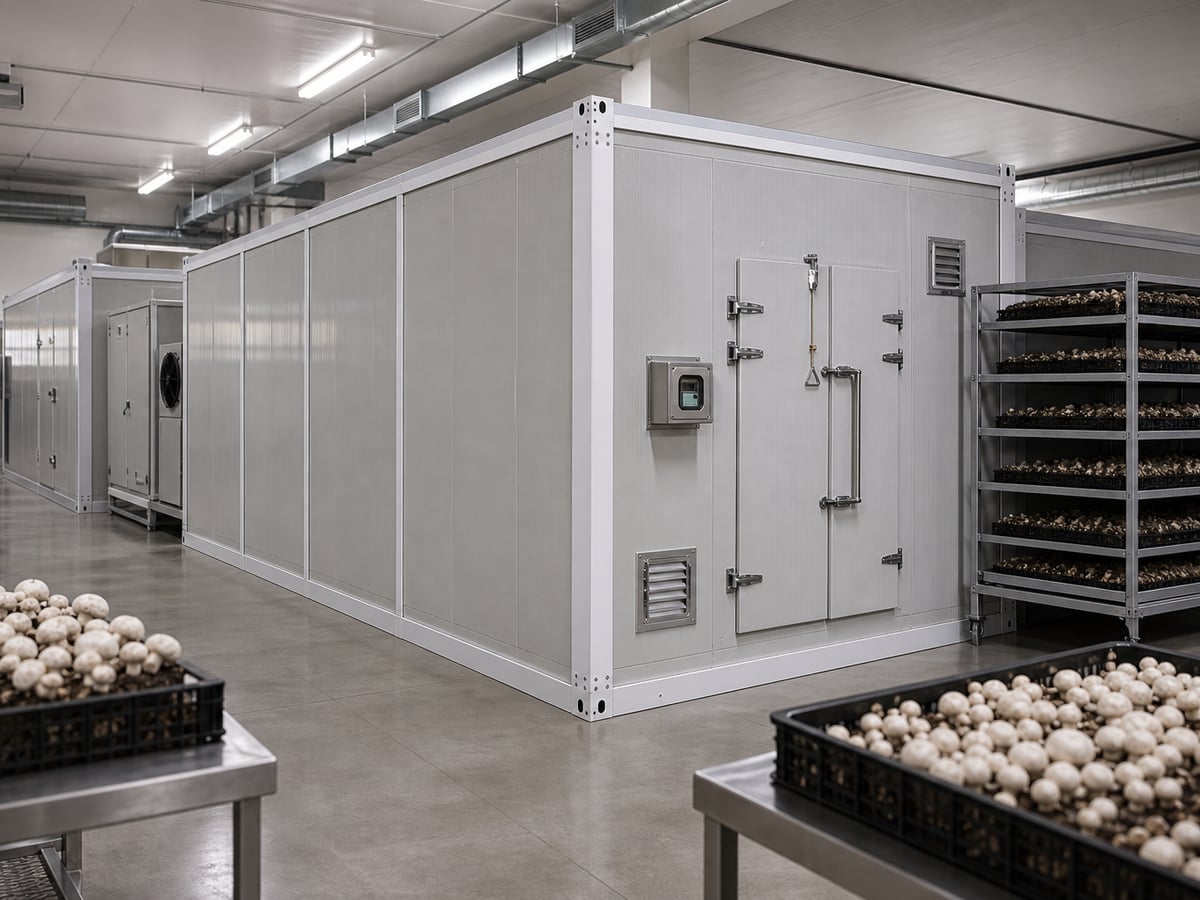
Mushroom incubation containers should be selected as controlled production environments, not simply insulated storage boxes. For commercial growers in the Global Market, the correct design must manage substrate-generated heat, rack spacing, clean loading, air circulation, batch traceability, and contamination response before fruiting begins.
The most important purchasing check is whether the container can maintain stable substrate core temperatures when bags, blocks, bottles, or trays are densely loaded. During colonization, mycelium produces heat. A container that appears adequately cooled when empty can become too warm after full loading, especially in warm trade regions, coastal humid climates, or facilities operating near logistics hubs such as Rotterdam, Dubai, Singapore, Los Angeles, Melbourne, and Durban.
For many oyster, shiitake, lion’s mane, and specialty mushroom operations, incubation targets are commonly different from fruiting targets. Incubation often requires a warmer, darker, cleaner, and less ventilated environment than fruiting. Buyers should therefore evaluate whether a multi-purpose cultivation container can reliably switch between stages or whether a separate incubation container provides better operational consistency.
A practical buying checklist includes the following: verified insulation performance; sufficient cooling and heating capacity under full substrate load; adjustable circulation fans; shelving designed around bag dimensions; temperature and humidity sensors placed at representative levels; alarms for high core temperature; washable internal surfaces; segregated loading procedures; and remote monitoring capability. A smart mushroom cultivation container can combine these controls in a modular format for farms that need predictable expansion without constructing a permanent building first.
| Buying Check | Why It Matters During Incubation | Practical Question for Suppliers |
|---|---|---|
| Cooling capacity | Substrate metabolism can raise the internal temperature after loading. | What cooling output is available at full rack density and high ambient temperature? |
| Insulation structure | Weak insulation causes energy losses and unstable temperatures. | What panel thickness, insulation material, and thermal design are used? |
| Rack configuration | Poor spacing traps heat and limits air movement around bags or blocks. | Can shelf height and aisle width be adjusted for our substrate format? |
| Air circulation | Uneven airflow creates hot spots and inconsistent colonization. | How is air distributed from top to bottom and front to rear? |
| Control system | Incubation requires dependable responses to changing biological loads. | Can the controller manage temperature, humidity, timing, alarms, and remote access? |
| Sanitation design | Incubation rooms can spread contamination when surfaces are difficult to clean. | Are walls, floors, corners, drains, and electrical components washdown-friendly? |
This table shows why container selection should start with biological performance rather than exterior dimensions alone. The most affordable unit may become expensive if it causes slow colonization, heat stress, high rejection rates, or additional labor for cleaning and batch management.
Incubation Needs Versus Fruiting Needs

Incubation and fruiting are distinct cultivation stages. Incubation supports mycelial colonization of a prepared substrate. Fruiting encourages pin formation and mushroom development. Although exact setpoints vary by species, strain, substrate formula, and local production protocol, the environmental logic is consistent: incubation generally prioritizes substrate temperature stability and cleanliness, while fruiting generally requires stronger fresh-air exchange, species-specific humidity, lighting schedules, and often lower temperatures.
For example, oyster mushroom farms may incubate blocks in a comparatively warm and dark area before moving them to a fruiting room with fresh air, humidity, and light. Shiitake producers may require an incubation and maturation sequence that differs substantially from the fruiting climate. Lion’s mane can also benefit from controlled transitions that prevent excessive condensation, uneven growth, or delayed pinning.
A container intended for both stages should have programmable recipes rather than one fixed climate mode. It should also be evaluated for how quickly it can recover after doors open, after a batch is loaded, or after the system changes from incubation conditions to fruiting conditions. For operators managing several species, separate recipes and user access controls are valuable because one incorrect setpoint can affect an entire batch.
| Operating Factor | Typical Incubation Priority | Typical Fruiting Priority |
|---|---|---|
| Temperature | Stable conditions suited to mycelial growth and substrate core control. | Species-specific conditions that support pinning and crop development. |
| Fresh-air exchange | Moderate circulation with limited unnecessary outside-air exposure. | Higher exchange to manage carbon dioxide and support morphology. |
| Light | Usually minimal or absent, depending on species and workflow. | Often scheduled or diffused according to crop requirements. |
| Humidity | Managed to avoid drying and surface condensation during storage. | Closely controlled to support mushroom formation without pooling water. |
| Cleaning risk | Focused on preventing contamination during loading and colonization. | Focused on hygiene, crop handling, and water management. |
| Door activity | Ideally limited after batch loading to preserve stable conditions. | More frequent due to inspection, harvest, and crop maintenance. |
The comparison clarifies why a fruiting room is not automatically a suitable incubation room. A fruiting design with constant high fresh-air exchange may waste energy and introduce unnecessary variability during colonization. Conversely, an incubation-only room may lack the airflow, humidification response, lighting, and drainage needed for productive fruiting.
For emerging farms, a programmable modular system can reduce initial capital requirements. For larger facilities, separating stages often improves biosecurity, labor flow, and crop scheduling. The right decision depends on production volume, crop diversity, building layout, labor availability, energy cost, and the financial impact of a contaminated or overheated batch.
Accounting for Heat from Substrate

Substrate heat is one of the most underestimated factors in mushroom incubation container design. Colonizing mycelium is biologically active. As it grows through substrate, metabolic activity generates heat inside each bag, block, bottle, or tray. In a densely loaded container, this heat accumulates faster than many operators expect, particularly in the center of racks and in the middle of large batches.
Air temperature alone is not enough for decision-making. A wall-mounted sensor may show an acceptable reading while the substrate core in the middle rack is several degrees warmer. This difference can slow colonization, encourage competitor organisms, alter moisture balance, or stress heat-sensitive strains. Buyers should ask suppliers where sensors are installed, whether probes can be inserted into representative substrate units, and whether high-temperature alarms are configurable.
Heat risk rises when substrates are freshly sterilized or pasteurized and loaded before their temperature is fully equalized, when bags are packed tightly, when containers are placed in direct sun, or when refrigeration is sized only for empty-room calculations. Projects in tropical, desert, and subtropical regions require particular attention to ambient design temperatures. Container placement near a hot concrete yard, rooftop, shipping terminal, or sun-exposed warehouse wall can materially affect cooling demand.
| Heat Source or Condition | Potential Result | Recommended Design Response |
|---|---|---|
| Dense substrate loading | Heat accumulates at rack centers and between adjacent bags. | Use rack gaps, calculated loading limits, and balanced airflow paths. |
| Warm incoming substrate | Initial cooling load overwhelms the climate system. | Define loading temperature limits and allow pre-cooling when needed. |
| High external ambient temperature | Compressor runtime increases and recovery becomes slower. | Specify equipment for the project climate, shading, and insulation level. |
| Blocked return-air path | Air does not circulate through the lower or central racks. | Maintain clear aisles and prevent bags from covering vents. |
| Oversized batch | Internal heat exceeds the planned biological load. | Stagger loading dates or reduce the number of units per cycle. | Single-point sensing | Hidden hot spots remain undetected until crop quality declines. | Use multiple air sensors and periodic substrate core checks. |
The table demonstrates that equipment capacity and operating discipline must work together. Even a powerful cooling system cannot compensate for blocked ducts, overloaded shelves, or poor batch sequencing. During commissioning, operators should conduct a loaded thermal test using the real substrate format, realistic bag density, normal door-opening behavior, and the expected local ambient conditions.
For remote farms or container projects shipped through ports such as Jebel Ali, Hamburg, Santos, Mombasa, or Busan, planning should also include local power supply stability. Voltage variation, generator backup, and refrigeration restart behavior should be reviewed before the equipment arrives on site.
Rack Density and Core Temperature
Rack density determines how much production can fit inside a container, but maximum density is not always maximum profitability. Overpacking may increase the number of substrate units per cycle while reducing airflow, raising core temperatures, increasing uneven colonization, and making contamination checks difficult. The optimum layout balances capacity with climate uniformity and labor access.
Aisles should allow personnel to inspect all shelves without crushing bags or brushing against exposed filters, vents, or surfaces. Rack materials should resist corrosion and support repeated cleaning. Adjustable shelves are useful for growers who change between short blocks, tall bags, bottle systems, and experimental products. Shelf design should also prevent water accumulation and avoid inaccessible corners where debris can build up.
Core temperature mapping is an effective commissioning practice. Place probes in representative substrate units at the top, middle, and lower shelf levels; near doors; at the rear; and in the center of the densest rack zone. Compare readings over a full cycle, including the first days after loading when metabolic heat may increase. The goal is not only to obtain one acceptable reading but to identify differences across the container.
The chart illustrates a common operating pattern: room air appears stable while substrate cores become warmer, especially in central racks. It is an example only, not a universal setpoint recommendation. Each farm should validate its own species, substrate formula, bag size, inoculation rate, and loading arrangement.
Operators should document the maximum safe load per rack and per container. This procedure is especially important when production teams attempt to increase output by reducing spacing. A controlled trial with temperature logging is safer than changing the layout during a commercial batch.
Ventilation During Mycelial Growth
Ventilation during mycelial growth should be purposeful rather than excessive. Mycelium needs a stable environment, but the container must still circulate air adequately to avoid stagnant zones, trapped heat, localized condensation, and uneven conditions. The proper balance depends on species, substrate packaging, filter design, room cleanliness, and the amount of biological activity in the batch.
Internal air circulation and outside-air exchange are different functions. Internal circulation moves conditioned air through the room and around racks. Outside-air exchange introduces fresh air and removes gases from the room. During incubation, strong fresh-air exchange may not be necessary at the same level as during fruiting, yet circulation must remain sufficient to distribute cooling or heating throughout the container.
Air outlets should not blow aggressively onto exposed bag filters or delicate substrate surfaces. High-velocity drafts can cause localized drying and may create inconsistent microclimates. At the same time, insufficient air movement can leave the lower shelves warmer and more humid than the upper shelves. A well-designed system uses fan placement, return-air paths, baffles, and programmable schedules to maintain uniformity.
| Ventilation Issue | Visible or Measurable Sign | Corrective Action |
|---|---|---|
| Insufficient circulation | Warm centers, condensation, uneven colonization, stale odors. | Check fan operation, rack gaps, return paths, and airflow balance. |
| Excessive direct airflow | Dry bag surfaces or inconsistent moisture near vents. | Redirect outlets, reduce fan speed, or add diffusion control. |
| Blocked vents | One side of the container performs differently from the other. | Reposition stored materials and enforce a no-blocking zone. |
| Uncontrolled door opening | Rapid temperature and humidity swings after inspections. | Use inspection windows, batch schedules, and clear access procedures. |
| Dirty filters or coils | Reduced airflow, higher energy use, slower climate recovery. | Follow documented preventive maintenance intervals. | Incorrect controller settings | Fans run continuously or remain off when thermal demand rises. | Review control logic and verify sensor calibration. |
This operating guide helps separate equipment failures from workflow failures. A ventilation problem may be caused by an undersized system, but it may also result from a blocked aisle, neglected filter, improperly positioned rack, or unplanned changes in batch density.
For container farms operating in urban industrial zones, external air quality should also be considered. Facilities near busy roads, processing plants, ports, or dust-prone construction areas may need suitable filtration and disciplined door management to reduce contaminant entry.
Clean Loading and Batch Separation
Clean loading begins before substrate reaches the incubation container. The loading path should separate dirty activities, substrate preparation, inoculation, clean transfer, incubation, fruiting, harvesting, and waste handling as much as the site allows. A container can have excellent climate performance but still suffer poor results if workers move contaminated tools, footwear, packaging, or waste through the same route used for fresh inoculated substrate.
Each batch should have a clear identity: species, strain, substrate recipe, inoculation date, supplier or spawn lot, operator, container location, rack position, and expected transfer date. Basic labeling enables growers to identify patterns. If contamination increases on a particular rack or within a particular production week, records help distinguish a climate issue from a substrate, spawn, or handling issue.
Batch separation can be physical, temporal, or procedural. Physical separation uses separate rooms or containers. Temporal separation loads one batch at a time and avoids mixing ages. Procedural separation uses designated tools, entry practices, cleaning routines, and access rules. The best option depends on scale, but even small farms should avoid placing old suspect batches beside newly inoculated substrate whenever possible.
| Loading Control | Purpose | Recommended Practice |
|---|---|---|
| Entry hygiene | Reduces introduction of contaminants from personnel. | Use clean footwear, hand hygiene, protective garments, and clear entry rules. |
| Batch labels | Supports traceability and faster problem investigation. | Label each rack zone and substrate group before loading. |
| First-in, first-out flow | Prevents forgotten batches and unnecessary mixing of ages. | Plan unloading dates before loading begins. |
| Tool segregation | Limits transfer of contamination between areas. | Assign cleaning tools to specific rooms or containers. | Waste isolation | Prevents spent or contaminated material from crossing clean routes. | Remove waste through a separate route whenever possible. |
| Loading records | Links crop outcomes to operational conditions. | Record time, substrate temperature, load count, and personnel involved. |
The table supports a practical rule: sanitation is not one cleaning event. It is a repeatable system that begins with material handling and continues through inspection, unloading, and waste removal. Clean loading is especially valuable for contract growers, farms supplying retail chains, and export-oriented businesses that need consistent production records.
Monitoring Colonization and Contamination
Monitoring should combine automated data with trained visual inspection. Climate controllers can record temperature, humidity, equipment status, alarm history, and operating time. However, human inspection remains necessary to identify abnormal colors, sour odors, wet patches, weak mycelial growth, damaged filters, pest activity, or condensation on bags and shelves.
Inspection frequency should be based on crop risk and labor capacity. Excessive door opening can disturb the climate, but no inspection can allow problems to spread unnoticed. Many commercial operations use scheduled checks, inspection windows where possible, remote camera systems, and targeted core-temperature measurements. The objective is early action rather than frequent disruption.
A smart mushroom climate controller can support disciplined monitoring by centralizing setpoints, historical trends, alarm notifications, and operating schedules. For multi-container farms, remote access can help managers compare performance between batches or sites, including projects located far from the main office.
When contamination is found, isolate the affected materials according to the farm’s sanitation procedure. Do not move suspect bags through clean zones without containment. Record the rack location, batch identity, visual condition, and timing. Review whether the issue is isolated, concentrated by location, connected to a substrate supplier, associated with a specific loading team, or correlated with abnormal climate data.
When Separate Incubation Space Pays Off
A separate incubation space usually pays off when a farm has regular production volume, multiple fruiting rooms, valuable specialty strains, strict delivery schedules, or recurring contamination caused by mixed-stage operations. Separation allows each zone to be optimized for its task. Incubation can remain darker, cleaner, and more stable, while fruiting rooms can focus on fresh-air exchange, crop access, humidity, lighting, and harvesting workflow.
The financial case should consider more than the purchase price of another container. Compare reduced crop losses, better scheduling, lower labor disruption, improved quality consistency, easier sanitation, and the ability to load new batches while harvest teams work elsewhere. For farms supplying hotels, supermarkets, meal-kit companies, or wholesale distributors, predictable output can be more valuable than the additional floor area.
Separate incubation is particularly useful when the farm operates near regional distribution centers. A producer serving markets from Istanbul, Nairobi, São Paulo, Vancouver, Kuala Lumpur, or Frankfurt may need to maintain steady weekly delivery volumes. A protected incubation workflow can reduce the risk that fruiting-room activity, harvesting traffic, and open-door ventilation disrupt colonizing batches.
Modular expansion also offers a practical path. A business may begin with one flexible container, then add a dedicated incubation unit after demand and operating procedures are proven. Growers can review completed project layouts and installation approaches through the mushroom cultivation project cases page before defining their own staged expansion plan.
Our Company
Shandong Lanhu Air Conditioning Equipment Co., Ltd. develops modular climate-control solutions for commercial agriculture, including mushroom cultivation containers, climate controllers, hydroponic growing containers, and air source heat pump systems. The company supports Global Market customers that require factory-built systems for indoor farming, pilot projects, agricultural contracting, distribution, and scalable mushroom production.
Technological capabilities are built around more than 12 years of thermodynamic research and development. Lanhu applies climate-control engineering to temperature management, humidity control, ventilation, electrical integration, automation, and operational monitoring. Its product development supports programmable cultivation environments that can be configured around mushroom species, ambient conditions, production scale, and local utility requirements.
Manufacturing capabilities include an integrated production facility of more than 30,000 square meters in Dezhou, Shandong, China. Core processes include product design, engineering development, sheet metal fabrication, CNC bending, insulation panel production, electrical assembly, system integration, equipment testing, and quality inspection. Systems undergo functional inspection, electrical verification, performance testing, and operational evaluation before shipment. The company maintains ISO 9001, ISO 14001, ISO 45001, and ISO 12100 certifications and holds multiple patented technologies.
Service capabilities cover factory-direct supply, OEM and ODM customization, project engineering assistance, international logistics coordination, spare parts support, installation guidance, and after-sales service. For buyers who need customized layouts, branding, regional electrical specifications, or specialized control logic, Lanhu provides OEM and ODM cultivation equipment services that can be aligned with commercial project requirements.
Whether equipment is routed through Qingdao, Shanghai, Ningbo, Antwerp, Long Beach, or another international logistics gateway, project planning should account for container transport, local offloading, electrical connection, site drainage, ventilation clearance, and commissioning access. Early engineering coordination reduces avoidable delays after delivery.
FAQ
Can one mushroom container be used for both incubation and fruiting?
Yes, a programmable container can be used for both stages, particularly for smaller farms or pilot projects. However, dedicated incubation and fruiting spaces usually provide better biosecurity, workflow control, and environmental stability as production volume increases.
Why is substrate core temperature more important than room air temperature?
Mycelium produces metabolic heat inside the substrate. The core can become significantly warmer than the surrounding air, especially in dense racks. Core monitoring helps identify hidden overheating before it affects colonization quality.
How densely can incubation racks be loaded?
The safe density depends on bag or block dimensions, species, substrate formula, inoculation rate, rack design, airflow pattern, cooling capacity, and local ambient temperature. Farms should validate density through a fully loaded temperature-mapping trial rather than relying on empty-container performance.
Do incubation containers require fresh-air exchange?
They require controlled air circulation and appropriate ventilation, but incubation generally does not need the same fresh-air exchange level as fruiting. Excessive outside-air exchange can increase energy consumption and climate instability.
What records should be kept for each incubation batch?
Keep the species, strain, substrate recipe, spawn lot, inoculation date, loading date, rack position, room settings, substrate temperature checks, inspection results, contamination observations, and transfer or disposal date. These records improve traceability and decision-making.
What 2026 trends should buyers consider?
In 2026, buyers are increasingly prioritizing remote climate monitoring, energy-efficient inverter systems, heat recovery opportunities, predictive maintenance alarms, modular farm expansion, recyclable insulation approaches, water-conscious humidification, and production data traceability. Sustainability expectations are also increasing as agricultural projects seek lower energy use, reduced crop waste, and clearer environmental management practices. Policy trends in many regions are encouraging controlled-environment agriculture, food resilience, efficient refrigeration, worker safety, and documented quality systems. Buyers should select container designs that can be upgraded through software, sensors, and modular equipment rather than becoming obsolete after one production cycle.
Share this article

About the Author: Shandong Lanhu Air Conditioning Equipment
Lanhu is a professional climate control equipment manufacturer specializing in smart agricultural systems, commercial HVAC solutions, and customized temperature control technologies. With extensive engineering experience, Lanhu provides reliable solutions for plant factories, controlled environment agriculture, and industrial applications.
Need a Custom Climate Control Solution?
From smart agricultural systems to commercial HVAC solutions, Lanhu provides reliable temperature and humidity control solutions tailored to your project needs.
Contact Us